
The agreement of Passau — Preparations of Charles V for the recovery of Metz — The defence of the town is entrusted to François de Guise — His preparations — Siege of Metz — Obstinacy of the Emperor — The Imperialists are compelled to raise the siege — Horrible condition of their abandoned camp — Humanity of Guise towards the wounded — Marriage of Diane de France and Orazio Farnese — Thérouenne stormed by the Imperialists and razed to the ground — Death of Orazio Farnese at Hesdin — The French army assembles at Amiens — Skirmish at Doullens — The King and the Constable carry the war into the Netherlands, but nothing is effected — Death of Edward VI of England — Alarm of Henri II at the proposed marriage of Mary Tudor and Philip of Spain — Mary refuses to make a new treaty with France — Henri II encourages the English refugees and refuses the Queen of England's demand for their extradition — Futile campaign of the King and the Constable in Flanders — Battle of Renty — Outcry against the incapacity of Montmorency — The war in Italy — Truce of Vaucelles — Abdication of Charles V
FRANCE had Metz, but it was doubtful if she would long be able to retain it. At the earnest entreaty of his brother, the Emperor, on August 2, 1552, accepted the agreement of Passau, by which he annulled the Interim of Augsburg, promised to convene a Diet for the regulation of religious affairs, and set at liberty the captive princes. Thus freed from his Germanic embarrassments, he was able to turn all his forces against the foreign enemy, and he at once resolved on a great effort for the recovery of the lost bulwark of Lorraine.
Under the pretext of suppressing Albert Alcibiades, who had refused to recognise the agreement of Passau and at the head of 20,000 brigands was roaming the Rhine country, forcing cities to pay him tribute, pillaging churches, and spreading terror and devastation wherever he went, he began assembling a formidable army in the valley of the Upper Danube. From all sides troops arrived, and particularly from Italy, where the War of Parma was now at an end, Julius III having agreed to a truce which would enable Ottavio Farnese to hold Parma for two years; and in the middle of August he began his march for the Rhine.
The French Government, aware that it was impossible for Charles to accept as an accomplished fact their possession of Metz, without compromising his authority in Germany, did not doubt that it was against their recent annexation rather than the robber Hohenzollern that his preparations were directed, and were already actively engaged in making ready for its defence. As Montmorency's position at the head of affairs necessitated his presence in the centre of the kingdom, this defence was entrusted to the Duc de Guise, who was nominated governor of Metz, with practically unlimited powers. Bitter as was the rivalry between the two great nobles, it was not permitted to prejudice the safety of the country, and the Constable, as Minister for War, rendered the duke every possible assistance.01
Even with the loyal co-operation of Montmorency, Guise's task was a sufficiently formidable one. The town of Metz is enclosed on the west, north, and east by the Moselle and the Seille, which form a very strong natural bulwark, but on the south, on which side the place is directly accessible, it was at this time only defended by an old wall without bastions and in a very bad state of repair; while the extensive faubourgs afforded abundant cover for the batteries of a besieging force. To render the town defensible against the great army which was approaching, extensive works must be undertaken, but, even if they were pushed on with all possible expedition, it was very doubtful if they could be completed before the arrival of the enemy. Guise, however, was not the man to be discouraged, and he had the good fortune to have under his orders the Florentine Piero Strozzi, Camillo Marini, and the Sieur de Saint-Rémy, three of the most skilful engineers of the time.
The town suffered cruelly from the necessities of its defence. An immense number of buildings were demolished, to make room for new ramparts or to clear the approaches; the beautiful faubourgs were almost entirely razed to the ground, with all the churches, convents, and colleges they contained, and even the ancient Abbey of Saint-Arnoul, in which were the tombs of Louis le Débonnaire, of his brother Drogo, of his mother Hildegarde, Charlemagne's best loved wife, and of other great personages of the Carolingian epoch, was not spared. It was, indeed, impossible to do so, since it was situated on an eminence which commanded the Porte Champenoise quarter, and would most certainly have been turned to account by the besiegers. The bodies were removed, with great solemnity, to the Dominican Church, escorted by Guise and his principal officers, bareheaded and with tapers in their hands.02
Notwithstanding the loss and suffering inflicted on them by this wholesale destruction, the citizens proved wonderfully tractable, for since the occupation of the town in the previous spring the French had treated them with consideration, and their sympathies were now entirely with their new masters; while Guise's courtesy and tact had won all hearts. So far from showing any ill-feeling, many of the people are said to have assisted in the demolition of their own houses, "regarding it as being for the public good and for their own security."03
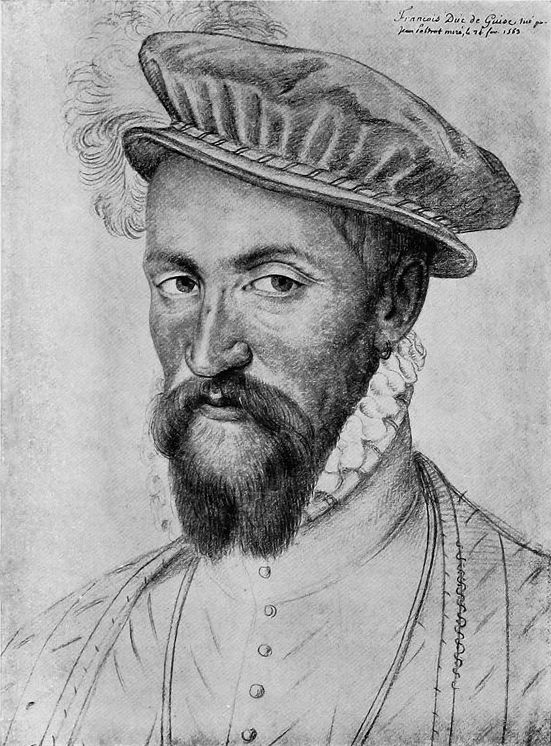
FRANÇOIS DE LORRAINE, DUC DE GUISE
FROM A DRAWING ATTRIBUTED TO C. DUMOUSTIER IN THE BIBLIOTHÈQUE NATIONALE
The duke himself set a splendid example of energy and devotion to duty. Although, in time of peace, it was his habit to take considerably more than the usual amount of sleep, he now contented himself with brief snatches of slumber. At all hours he might be seen hurrying to and fro, encouraging the engineers, who laboured unceasingly, day and night, at the fortifications, supervising the drilling of the recruits, and inspecting the ammunition and stores which were being brought into the town, of which he caused a careful inventory to be made. From the time of his arrival in Metz until the end of the siege, "many as were the eyes which were continually upon him, he was not seen to waste a single hour";04 no matter seemed too small for his attention, and, to show that a commander should be able to give personal proof of hard labour and fatigue, as well as of a vigilant mind, he often wielded pick and shovel himself.
Meanwhile, the great army of the Emperor, swollen continually by the arrival of reinforcements from different quarters of Germany and the Netherlands, was slowly drawing nearer. It had been greatly delayed after crossing the Rhine by the illness of Charles, who was so feeble that he could not walk without support, though his indomitable spirit still drove him on; and it was not until October 19 that it appeared before Metz, while the siege did not really open until the 31st. By that time the fortifications had practically been completed and the place abundantly provisioned for several months, for Guise had sent away and distributed among the neighbouring towns all the non-combatants, with the exception of a few priests and monks, and some two thousand labourers and artisans, whom he kept to repair the ramparts and assist in serving the artillery.
On the other hand, the Imperialists had received an unlooked-for accession. Albert Alcibiades, endangered by the advance of his outraged suzerain, had offered his troops to France; but the price he demanded was so exorbitant, and the French mistrusted him so thoroughly, that his services were declined. Thereupon the Margrave opened negotiations with Alva, and began to prowl round Toul, "like a wolf round the sheepfold." The Constable, informed of this, despatched Aumale with a force of cavalry to watch him. Suddenly, on October 28, Albert threw himself on the Lorraine prince, defeated, and captured him. Then he presented himself with his prisoner in the Imperial camp, made his peace with the Emperor, and joined the besiegers.
At the end of September, Montmorency had assembled a considerable army at Rheims, and early in October he advanced into Lorraine, with the intention of throwing rein forcements into Metz and harassing the Imperialists. But, on reaching Saint-Mihiel, he learned that the Comte de Rœux had invaded Picardy, and, after laying waste the country between the Oise and the Somme, was about to lay siege to Hesdin, which had been taken by the Netherlanders in the last campaign, though it had soon been recovered. He therefore confined himself to strengthening the garrisons of Toul and Verdun, and returned to Rheims, where he was joined by the King; and it was decided that the bulk of the army should be despatched under Vendôme into Picardy. The conduct of the Constable and the King has been criticised by some historians, but it should be pointed out that Guise had assured them that he had sufficient forces at Metz, and that the royal army could be employed in other operations; while it was certainly necessary to deal with the invasion of Picardy.05
By the middle of November, three armies were encamped around Metz. The Spaniards, Italians, and Germans besieged it from the south, the Netherlanders from the north, and the troops of Albert Alcibiades from the south-west. The main attack, however, was directed from the south. Authorities differ widely as to the total strength of the investing force, but the most reliable estimate it at from 70,000 to 80,000 men, with about 140 cannon of various calibre. The garrison numbered about 10,000 men, and included three Bourbons — the Princes de la Roche-sur-Yon and de Condé and the Comte d'Enghien; the two elder sons of the Constable, François and Henri de Montmorency; Nemours, La Rochefoucauld, and a great number of other young nobles, "who had come to take their pleasure at the siege."
Great as was the numerical strength of the Imperial army, its effectiveness was ruined by the dissensions between the various nations which composed it. The Germans and Netherlanders detested the Spaniards, who cordially reciprocated their sentiments; there was little love lost between the Germans and the Italians; and the troops who came from the districts which had suffered at the hands of Albert Alcibiades were indignant at the pardon which the exigencies of war had compelled Charles to extend to the crimes of that princely brigand, and would have infinitely preferred to cut the throats of his Pomeranians and Prussians to those of the French. The Emperor's selection of Alva for the command was most unpopular, and the German and Flemish generals criticised every order he gave, and often ignored him altogether.
Charles arrived in the camp on November 20. He was still so weak from illness that he had been carried from Thionville in a litter, but, on reaching Metz, he mounted a white horse and rode through the lines, commending the officers and men who had distinguished themselves. The presence of the Emperor infused some spirit into his army, and the trenches were pushed so close to the walls that the garrison were able to throw stones into them. By the 28th, a breach three hundred paces wide had been made, but Guise had constructed an inner line of earthworks, bristling with cannon, and awaited the expected assault with confidence.06
It was never delivered, however, for the besiegers had not counted on the second line of defence, and, though the Emperor repeatedly urged that an attempt should be made to storm the place, Alva and the other generals refused to undertake it, pointing out that it would be to lead the troops to certain destruction. They were probably right, but Charles reproached them bitterly with their want of courage, and declared that he "saw very well that he had no real men left, and must take leave of the world and get him to a monastery."07
November had been cold and wet; December was worse. The camp of the Imperialists became a swamp; their huts and tents were inundated, and the condition of the roads and the activity of the garrisons of Toul and Verdun rendered it difficult for their convoys to reach them. The troops suffered terribly, particularly the Spaniards and Italians, unaccustomed to the rigours of the northern winter; dysentery and typhus broke out, and hundreds were carried off, while many more deserted. The besieged, too, gave them no rest, and their continual sorties contributed to the general demoralisation which prevailed.
By Christmas, on which festival only a few shots were exchanged, Charles was compelled to admit the hopelessness of continuing the siege. "I see well," said he, "that Fortune is a jade; she prefers a young king to an old emperor." Next morning, the retreat of the Imperialists began, though it was not until New Year's Day that Charles left his quarters to return to Thionville and thence to Brussels. Albert Alcibiades remained to the last, to cover the retreat of the artillery; but a sortie of the French compelled him to abandon a number of pieces, whose carriages had stuck fast in the ruts of the muddy roads.08
The abandoned camp of the besiegers presented a spectacle calculated to excite the pity of even the most hardened veteran. The number of newly-dug graves which were to be seen on every side made it resemble one vast cemetery; the dead bodies of men and horses lay about in all directions, and there was also a multitude of sick and wounded men, "some prone on the ground, others seated on stones with their legs in the mud, frozen up to the knees. More than three hundred were rescued from this horrible misery; but it was found necessary to amputate the limbs of the majority."09
The generous-hearted Guise treated the unfortunate derelicts of the Imperial army with a humanity very rare at this epoch, and everything possible was done to alleviate their sufferings.10 His conduct, which was the theme of universal praise, was a fitting climax to a success which had established his reputation as one of the greatest soldiers of his time.
The theatre of hostilities in 1552 had extended from the frontiers of Artois and Picardy to the shores of the Two Sicilies. In the north, Vendôme succeeded in driving back the Flemings and in recovering Hesdin; in Piedmont, Brissac obtained some trifling successes over Ferrante Gonzaga; in Tuscany, Siena expelled the Spanish garrison which the Emperor had imposed upon it, and placed itself under the protection of France; and the alliance with the Turks, which had brought so much odium upon François I, having been renewed, through the exertions of Aramon, the French Ambassador to the Porte, the Ottoman fleet attacked and defeated that of Andrea Doria off the Neapolitan coast, and, but for the non-arrival of the galleys of Paulin de la Garde, might have followed up this victory by an attempt upon Naples.
Thus, the net results were wholly on the side of France, and appear to have inspired the French Court with a boundless confidence. It refused to believe it possible that, after the terrible losses Charles V had sustained before Metz, it could have anything more to fear from him; and its astonishment was profound, when, in the middle of the festivities in honour of the marriage of Diane de France and Orazio Farnese, news arrived that a large army of Germans, Spaniards, and Netherlanders had invested Thérouenne, the advance-post of France in Artois. Even then, whether from a fatuous belief that Thérouenne was impregnable or more probably from want of money — so much had been spent in celebrating the defence of Metz and the marriage of the King's daughter that there was none left to pay the troops — no effective steps were taken to succour the place, though François de Montmorency and a number of other young gentlemen received permission "to take their pleasure there."
After a siege of two months, Thérouenne was taken by assault, and the Constable's son with it; the greater part of the garrison was put to the sword, and the town literally razed to the ground. It never rose again, and, says Henri Martin, "is the only example in our history of a French town which has entirely perished."
From Thérouenne, the victorious Imperialists marched upon Hesdin. They were now, it is interesting to note, commanded by Emmanuel Philibert of Savoy, Prince of Piedmont, who in the following August became Duke of Savoy, on the death of his father, the unfortunate Charles III, and was destined to so brilliant a military career. For the third time within a year, Hesdin was taken by assault, and Henri II's new son-in-law, Orazio Farnese, was killed, fighting gallantly in the breach (July 18).
The tears of his daughter, left a widow within a few months of her marriage, seemed to have aroused the King from his apathy, and at the beginning of August a large army was assembled at Amiens, under the orders of the Constable.
The campaign opened auspiciously enough. The Prince of Piedmont was besieging Doullens, which defended the course of the Authie, but on the night of August 12-13 the French passed the river, and, after a sharp engagement between the cavalry of the two armies, in which the Imperialists were completely routed, the prince raised the siege and fell back on Bapaume and Cambrai. The King joined the Constable two days later, bringing with him reinforcements which raised the strength of the army to close upon 50,000 men; and the war was carried into Artois, the Cambrésis, and Hainaut. But absolutely nothing was effected, save the temporary occupation of a few unimportant places; it was a military promenade of the most futile kind.
The blame must rest upon the Constable rather than upon Henri II, who regarded himself as his old friend's pupil in military matters and invariably deferred to his opinion; and even M. Decrue, in general very favourable to his hero, is here in complete agreement with the majority of historians, though he attributes his incapacity to ill health. "His irresolution is pitiable," he says. "Anne de Montmorency exaggerates the faults which he has had all his life. With a magnificent army, he seems to wander, in a futile manner, in search of an easy victory, recoiling before the slightest suspicion of an obstacle." He declined to lay siege to Bapaume or Cambrai, on the ground that they were too strongly fortified; he wasted precious time in holding interminable councils of war; and the climax of fatuity was reached when, on finding the Emperor strongly posted in an entrenched camp at Valenciennes, he demonstrated before the enemy's position, in the hope that the sight of his great numbers would induce Charles to retreat, and then proposed to retreat himself, on the fallacious pretext that the Imperialists refused to give battle. The King consented, and the army fell back across the Somme, and on September 21 was disbanded.
The death of Edward VI of England, on July 6 of that year, dissipated the hopes which France had founded on the treaty of 1551; but the chagrin which this event occasioned was as nothing to the alarm aroused by the news of Mary's determination to give her hand to Philip of Spain. When this project was first announced, Henri II directed Noailles, the French Ambassador in London, to tell the Queen frankly how it was regarded by the French Court, and both the King and the Constable expressed their views still more explicitly to the English Ambassador, Wotton. The Queen, they pointed out, no doubt had every intention of remaining at peace with France, but events might prove too strong for her, and she might find herself drawn into the quarrel between them and the Emperor. If, however, she persisted in the resolution she had taken, they suggested that, as a proof of her good intentions, she should enter into a fresh treaty with France, to provide for unforeseen contingencies. This very reasonable request was refused by Mary, on the ground that the maintenance of the existing treaties with France was guaranteed by a clause added to the marriage articles; and, though it was explained to her that existing treaties did not meet the new conditions, she remained obstinate.11
On the Queen's refusal being communicated to the French Government, they at once determined to employ every possible means to prevent the marriage,12 and relations were established with the disaffected party in England, with a view to effective co-operation. Villegaignon's galleys were in readiness to transport a considerable force across the Channel, and the French only waited to know on what part of the coast they should attempt a landing. But the discovery of their plans drove the English insurgents to a premature rising, which was easily suppressed.
Sir Peter Carew and numbers of discontented English gentlemen took refuge in France, and having been supplied with money, arms, and ships by the Government, roamed about the Channel, plundering Spanish and Flemish vessels. Mary demanded the extradition of "her traitors," to which Henri II bluntly replied that he was not the Queen's hangman; that the so-called traitors were not in arms against their sovereign, but against his own enemy, and that there was nothing in the existing treaties with England to prevent him accepting the services of volunteers from that country. When he had invited her Majesty to enter into a new treaty, she had refused. This answer greatly angered Mary, who, if her Ministers had been of her way of thinking, would have rejoined by a declaration of war.
Powerless to prevent the dreaded marriage, Henri II determined to strike a blow which should force the Emperor to sue for peace before England could be drawn into the struggle. By the creation and sale of new offices13 and other devices, money for the equipment of another large army was procured, and in the middle of June 1554 40,000 infantry and 12,000 cavalry assembled at Crécy-en- Laonnois. The Constable again took the command, with Vendôme and Saint-André as his lieutenants. Brussels was the objective, and the army, advancing down the valley of the Meuse, captured Marienbourg. Here Henri II, who had left the Queen Regent for the third time, joined it, and in honour of his Majesty the town was re-named Henrienbourg.
The French then advanced on Bouvines, and "the King had the pastime of seeing it taken by assault by his soldiers, who conducted themselves so valiantly that they carried it furiously, although the breach was very difficult and they had to mount it in single file."14 The Constable had not renounced the barbarous customs of the wars of Italy, and all who had offered any resistance were mercilessly butchered (July 8). Four days later (July 12), Dinant, the historic rival of Bouvines, surrendered, to escape a similar fate; and the King and the Constable, in very high feather, had already crossed the Sambre, with the intention of marching straight upon Brussels, when they learned that the Emperor and the Duke of Savoy were advancing against them. On this, they decided that, by penetrating so far into the enemy's territory, they had done enough for glory, and moved westwards into Hainaut, taking various small places and mercilessly ravaging the country. The Duke of Savoy, to whom the ailing Emperor had made over the command of the Imperialists, followed them closely; but, though he was inferior in numbers to the French, the latter refused to risk a battle. The pursuit ceased in the Cambrésis, but the French retired into Artois, where they laid siege to Renty. The Emperor, who had once more taken the field in person, advanced to its relief, and the King and the Constable found themselves compelled to fight (August 13). The action, thanks principally to Guise, ended in the retreat of the Imperialists, with the loss of 500 killed, as many prisoners, and several cannon. However, no attempt was made to pursue Charles, and, as he had succeeded in revictualling Renty, Henri II raised the siege and led his army back to Compiègne. The Emperor himself returned to Brussels, but his troops took advantage of the retreat of the French to make a devastating raid into Picardy.
Thus, the results of the campaign of Flanders were well nigh as meagre as those of the preceding year, and once more the chief responsibility must rest upon the Constable, who had not on this occasion the excuse of ill-health. Not only the Guises and their partisans, but disinterested observers strongly condemned his conduct. "The responsibility for these checks," wrote the Venetian Ambassador Capello, "belongs to the Constable, who formerly passed for a pusillanimous man, but is now regarded as a base poltroon (stimato vilissimo), since he was afraid to pursue a beaten and almost flying enemy. He is scoffed at everywhere. At the Court and in places of public resort, sonnets and Latin verses are circulated in which he is called a coward and a man without heart. After so fine an opportunity lost, it is regarded as certain that, so long as the Constable remains at the head of the army, there will never be a great battle; first, because he is timid; secondly, because he is more inclined to peace than to war."
The fact is that the Constable, personally a very brave man, but, as a commander, always prone to push circumspection to its farthest limits, could not bring himself to incur the responsibility of a general engagement, which, if lost, might mean the complete triumph of his enemies the Guises; and there was also probably some truth in the charge which was freely brought against him by the rival faction that he had suspended the pursuit of the Imperialists after Renty from an unwillingness to complete a victory whose credit belonged to Guise rather than to himself.
In Italy, the course of events was even less favourable to the French. In Piedmont, Brissac held his own valiantly against superior numbers, but in Tuscany, Piero Strozzi, who had been entrusted with the defence of Siena, was defeated at Mariano (August 2, 1554), and, after an heroic defence by Montluc, the city was starved into surrender (April 17, 1555). Their only success in the peninsula was a political one, the election to the Papacy, under the title of Paul IV, of the Cardinal Caraffa, a bitter enemy of the Spaniards.15 In the Mediterranean, the Franco-Turkish fleet, after ravaging the Neapolitan coasts, Sardinia, and Elba, landed the condottiere Sampiero Corso in Corsica, where he excited a revolt against Genoese rule and captured Bastia, Bonifacio, and other towns. But quarrels between Paulin de la Garde and Dragut Arraiz, the Turkish admiral, led to the latter's withdrawal; Andrea Doria's fleet brought Spanish and German troops to the assistance of the Genoese; the places lost were recovered, and the Corsicans and their allies driven into the mountains.
Both sides were by this time equally weary of the war. The enormous cost of the huge armies she had raised had exhausted the resources of France. The Emperor, broken in health and disgusted with the failure of his cherished schemes for religious unity and Imperial omnipotence, desired to shift the burden of his vast responsibilities upon younger shoulders and end his days in retirement; and to accomplish the delicate and complicated acts which his abdication would entail, peace was essential. England, whom Charles had vainly endeavoured to drag into the war, offered her good offices, and in May 1555 negotiations were opened at Marcq, near Calais. Nothing came of them; but towards the close of the year the belligerents decided to treat directly with one another, and, though their mutual pretensions rendered the conclusion of a definite peace impossible, a truce of five years was agreed upon and signed, at the Abbey of Vaucelles, on February 15, 1556, during which communications by land and sea were to be re-established and each sovereign was to be left in possession of his conquests. France thus retained the Three Bishoprics and the fortresses she had reduced in Piedmont.
Charles V had not waited for the formal conclusion of the Truce of Vaucelles to divest himself of the crowns whose weight his increasing infirmities made it impossible for him any longer to support. On October 25, 1555, he had abdicated in Philip's favour the sovereignty of the Netherlands, and on January 16, 1556, he had ceded to his son the kingdoms of Aragon, Castile, Sicily and Naples, and the Indies. In order that Ferdinand might select a favourable moment for securing his own election, he retained the Imperial diadem until the following August, and a few weeks later sailed for Spain, to spend the two years of life which remained to him in the cloistral solitude of Yuste.
And let us with Charles turn from war and politics to other matters.
Notes
(1) Decrue, Anne, duc de Montmorency. But one of the biographers of the Guises, M. Forneron, declares that the Constable's jealousy of the duke prevented him from doing more than he was obliged.
(2) Henri Martin, Histoire de France.
(3) Mémoires de Vieilleville.
(4) Bertrand de Salignac, Siège de Metz.
(5) F. Decrue, Anne, duc de Montmorency.
(6) Guise, Mémoires-journaux.
(7) Mr. Edward Armstrong, "The Emperor Charles V."
(8) Guise was particularly exasperated against the Margrave, on account of the way he had treated Aumale. "We must make this drunkard decamp," he exclaimed. "He has treated my brother worse than it he had been a Turk or a Moor, and has made him wear his shirt for thirty-six days!"
(9) Mémoires de Vieilleville.
(10) Guise's example was followed by the citizens of Metz, who raised subscriptions for the relief of those who recovered and for the interment of the dead.
(11) Froude.
(12) It should be pointed out that the French Court was as much concerned about the more distant as about the immediate consequences of this alliance. Charles V proposed to assure to the children of the marriage the Netherlands and the Franche-Comte; and the union of the Netherlands with England would be a most fatal combination for France; while, in the event of the death of the little Don Carlos, Philip's son by his first marriage, Spain, Naples, and Milan would be joined to them.
(13) Wotton wrote to Mary that in the Parlement of Paris alone the King had created thirty new counsellors, "each of whom paid for his office 4,000 crowns of the sun."
(14) Letter of the Constable to Noailles, July 1554, in Decrue.
(15) Julius III had died on March 28, 1555, and his successor, Marcellus II, elected on April 5, had reigned less than a month.