
The Guises turn the duke's brilliant military success to political account by hastening the marriage of their niece to the Dauphin — Madame de Valentinois, alarmed by the increasing power of her former protégés, resolves to redress the balance by an alliance with the captive Constable, and attempts, though without success, to delay the affair — Marriage of the Dauphin and Mary Stuart — Banquet and festivities at the Palais de Justice — Secret treaty signed by Mary Stuart at Fontainebleau — Unbearable arrogance of the Guises — Denunciation of the heresy of Andelot by the Cardinal de Lorraine — Henri II, irritated by the insolence of the Guises, desires peace and the return of the Constable — His letters to Montmorency — Guise takes Thionville — Disastrous defeat of Termes at Gravelines — Henri II and Philip II join their respective armies — A suspension of arms is agreed to, and negotiations for peace are begun at the Abbey of Cercamp — Interview between the King and the Constable at Beauvais — The Spanish plenipotentiaries demand the evacuation of Italy by the French — And, notwithstanding the desperate financial straits of Philip II, their demands are conceded — Treaty of Cateau-Cambrésis — Indignation in France — Results of the treaty considered
GUISE'S brilliant campaign, which in a few days had effaced two centuries of humiliating recollections, made him a national and popular hero. He and his brother, the Cardinal de Lorraine, were not slow to turn the former's military successes to political account, and hurried on the marriage of the Dauphin to the little Queen of Scotland, by which they hoped to render their already immensely strong position altogether impregnable.
They had to encounter some opposition. The Queen pleaded the extreme youth and delicate health of her son, while Diane also wished to delay the marriage. The course of events during the last few months had caused that lady to reconsider her position very seriously. Until the summer of 1557 her policy of supporting the Guises against the Montmorency party had answered admirably, at least so far as she herself was concerned. For the Constable, backed by the Princes of the Blood and the great majority of the nobility, and enjoying the affection and confidence of the King, was still too strong for the Guises; and Diane's assistance was therefore indispensable to the latter. Thus, she had established the equilibrium between the contending factions and dominated the situation.
But Saint-Quentin and Calais had changed all that. The Constable was a prisoner, his party discredited; while the praises of the Guises were in every mouth. Her former protégés now considered themselves strong enough to dispense with her support; they no longer consulted her; they no longer treated her with their customary deference. Diane, indignant at their ingratitude, resolved to show them their mistake, and to restore the equilibrium by an alliance with the captive Constable. However, neither she nor the Queen was able to delay the marriage, for Henri II not only felt himself under great obligations to the Guises, but "he desired to avail himself more surely of the forces of Scotland against the kingdom of England next year";01 and the happy event was fixed for April 24, 1558.
On the 19th, the betrothal took place in the great hall of the new Louvre, and the bridegroom of fourteen and the bride of fifteen plighted their troth and exchanged a ring. A ball followed, which the King opened with the Queen of Scotland.
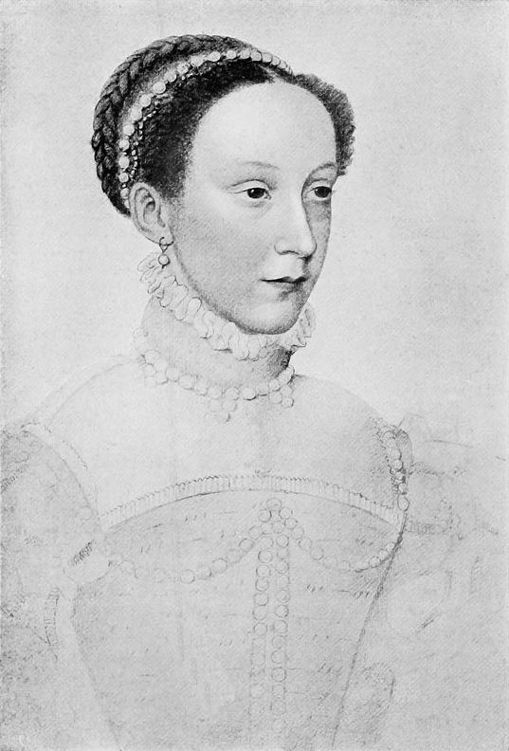
MARY STUART AS DAUPHINE OF FRANCE
FROM THE DRAWING BY FRANÇOIS CLOUET IN THE BIBLIOTHÈQUE SAINTE-GENEVIÈVE
On the following Sunday, the marriage was celebrated at Notre-Dame, with a magnificence which must have entailed very serious inroads on the loan which had been extracted from the Notables in the flush of their enthusiasm over the taking of Calais. A long gallery was erected from the palace of the Bishop of Paris (Eustache du Bellay), where the bridal party had spent the night, to the west door of Notre-Dame, the porch of which was hung with red tapestries adorned with fleurs-de-lis.
Early in the morning, the members of the Parlement of Paris and the municipal authorities assembled at the Palais de Justice and the Hôtel de Ville respectively, and repaired in procession to the cathedral, where they took the places reserved for them on the right and left of the chancel, the scarlet robes of the magistrates and the crimson and yellow of the civic dignitaries making a wonderfully striking effect. About ten o'clock, François de Guise, who replaced the captive Montmorency in his functions of Grand-Master of the King's Household, arrived, accompanied by an imposing suite, to see that everything was in order, and "showed himself a kind prince" towards the populace, by making a number of nobles and gentlemen who had congregated on the scaffolding descend and enter the church, so that the humbler spectators might enjoy an uninterrupted view of the pageant. Following him came a multitude of musicians, with "trumpets, clarions, hautboys, flageolets, viols, violins, citherns, and an infinitude of other instruments, playing so melodiously that it was very delightful to listen to them." Soon the bridal procession was seen approaching. One hundred gentlemen of the King's Household led the way; then the Princes of the Blood, "so richly clothed and adorned that it was marvellous to see them"; the cardinals, archbishops, bishops, and abbots; the Papal Legate, the Cardinal Trivulzio; the Dauphin, escorted by the Ducs d'Orléans and d'Angoulême, his brothers, and Antoine de Bourbon, King of Navarre; the Queen of Scotland, with Henri II holding her right hand and the Duke of Lorraine her left; while Catherine de' Medici, Jeanne d'Albret, Queen of Navarre, the princesses, and all the ladies of the Court followed, "so nobly accoutred that it would be impossible to write of it without too much prolixity."
The bride was clad "in a robe white as the lily, fashioned so sumptuously and richly that it would be impossible to describe it. The train, which was of marvellous length, was borne by two young demoiselles. Around her neck there hung a circlet of untold value, formed of jewels of great price, and on her head she wore a golden crown studded with pearls, diamonds, rubies, sapphires, emeralds, and other gems of priceless value, the most remarkable of all being a carbuncle set in the middle, which was valued at five hundred thousand écus or more."
The Bishop of Paris received the King and the bridal pair in the porch of the cathedral, and delivered "a learned and elegant oration." Then his Majesty drew from his finger a gold ring and handed it to the Cardinal de Bourbon, who was to perform the ceremony; and the bridal party entered the church, while the heralds cried "Largesse!" three times, and threw gold and silver among the crowd. A frenzied struggle ensued, the people scrambling for the money "with such tumult, cries, and clamour that thunder could not have been heard above the din; some fainted, others lost their cloaks, others their hats and divers garments, so that the people cried to the heralds to throw nothing more, by reason of the said tumult."
To the accompaniment of all this uproar, the Cardinal de Bourbon pronounced the words which made François de Valois and Mary Stuart one, and the Bishop of Paris celebrated Mass. During the offertory, the heralds repeated in the nave the largesse which had led to such a commotion at the doors, and the pages and gentlemen of the Court contended for the money as eagerly as the mob. At the conclusion of the service, the bridal pair returned to the episcopal palace, where a grand banquet took place, followed by a ball, "the Most Christian King dancing with the Queen-Dauphine and the King-Dauphin02 with the Queen."
The ball only lasted until a little after four o'clock, when the whole company crossed the Seine to the Palais de Justice, for the festivities which were to conclude the day. The King and the princes rode on war-horses splendidly caparisoned in cloth of gold and silver; the Queen and Mary Stuart were carried in a litter; the princesses were in coaches, and the ladies of the Court on palfreys with trappings of crimson velvet.
In the great hall of the Palais de Justice, "so magnificently decorated that one might have compared it to the Elysian Fields," supper was served to the Court and the members of the Parlement and the civic authorities at tables of white marble, each course being presented to the sound of music. Every one present, the chronicler assures us, was transported with delight, and "the dames and demoiselles leaped in the air for joy."
The supper was followed by a ball, and the ball by "masques, mummeries, ballads, and other games and pastimes." The seven planets presented themselves — Mercury, with golden girdle, spreading wings and caduceus, Mars in armour, and so forth; the young princes and the children of Guise and Aumale entered mounted on hobbyhorses, both riders and mimic steeds being resplendent in cloth of gold, and pilgrims in silver tissue and jewels "sang sweet hymns and psalms in praise of marriage and the married pair." Finally, a fleet of ships with silver sails appeared, sometimes rocking as in harbour, sometimes gliding forward as on the open sea. Each of the princes embarked in one of these vessels and "sailed away" to the table at which the ladies of the Court sat, where he selected a shipmate. The King chose Mary Stuart; the Dauphin, his mother; the Prince de Condé, the Duchesse de Guise; while the Duke of Lorraine carried off Madame Claude, whom he was to marry later.
The evening concluded with other "fantasies, melodies, and recreations," during one of which Ronsard read an épître to the King which he had composed in honour of the marriage. It concluded as follows:
"Sire, tu as, ainsi comme il me semble,
Seul plus d'honneur que tous les Roys ensemble;
De ton vivant tu vois ainsi que toy
Ton fils aisné en sa jeunesse Roy,
Qui pour ta bru t'a donné la plus belle
Royne qui vive, et fust-ce une immortelle,
Et qui peut estre aura dessus le chef
Une couronne encore de rechef
Pour joindre ensemble à la terre Escossoise
L'honneur voisin de la couronne Angloise."03
The festivities were continued at the Louvre for several days, and "were considered the most regal and triumphant that had been witnessed in the kingdom for many years."04
The marriage of the Dauphin and Mary Stuart was an even greater triumph for the Guises than was generally believed, for at Fontainebleau, on April 4 — fifteen days before the signing of the marriage-contract, in which the Queen and her young husband swore to maintain the laws, independence, and liberties of Scotland — they had persuaded her to sign a secret treaty, by which she transferred to the King of France, in the event of her death without children, the kingdom of Scotland and all rights to the Crown of England, until a million gold crowns had been paid him as an indemnity for the sum expended by France in the defence of the country. How far Mary was culpable is a point which has been much disputed; but the probability is that she signed the documents which were laid before her without fully realising their importance.
For the moment, the Guises appeared all-powerful. But their success rendered them unbearably arrogant, and they abused their credit with the King. The duke, as we have mentioned, had discharged Montmorency's functions of Grand-Master at the royal wedding, and his vicarious importance on that occasion had so flattered his vanity that, shortly afterwards, he begged the King to confer this exalted office upon him definitely, as the reward of his military services. The King, dissembling with difficulty his indignation at being asked to despoil his oldest friend — at a moment, too, when the latter was suffering for his devotion to his master's service — declined; whereupon Guise asked for the reversion of the post, which, as he was probably well aware, his Majesty had already accorded to his son-in-law, François de Montmorency. This was also refused.
Another incident, which happened a little later, served to increase the King's irritation against the Guises.
The Constable's nephew Andelot, who had been taken prisoner with his brother Coligny at Saint-Quentin and imprisoned in the citadel of Milan, had recently been ransomed by his relatives and had returned to France. His captivity had afforded him ample leisure for study, with the consequence that he had embraced the Reformed faith. The Cardinal de Lorraine, happening to learn of this from a Spanish source, immediately denounced Andelot's heresy to the King, who sent for the new convert and questioned him on the matter. Andelot courageously admitted the truth of the accusation, whereupon Henri II deprived him of his post of Colonel-General of Infantry, which he gave to Montluc, and caused him to be imprisoned at Meaux. The King was, however, far more angry with the cardinal, who, under the pretext of religious zeal, had compelled him to disgrace a near relative of the Constable.
Soon Henri II, chafing beneath the insolence of the Guises, and yet fearful of offending them, since the political abilities of the cardinal were as necessary to him in the present crisis as were the military talents of the duke, began to long for peace and the return of Montmorency. Madame de Valentinois did everything in her power to stimulate this desire, for the return of the Constable could alone re-establish the equilibrium between the rival factions on which her own importance so largely depended; and, as a proof of her friendly intentions towards Montmorency, she wrote him the most cordial letters and proposed a marriage between her grand-daughter, Gabrielle de la Marck, and his second son Damville. At her instigation, the Duc de Nevers, a friend of the Montmorencies, placed himself at the head of the Constable's party, which found a supporter in the Queen, whom the Guises had also contrived to offend. As for the King, he wrote letter after letter to the captive, urging him to fix his ransom and pave the way for peace. "I shall die happy," he writes, in the hyperbolical style of the time, "if I can see a good peace and the man whom I love and esteem more than any other in the world. And, since this is so, do not fear to fix your ransom at any price, however high." And again: "Do what you can to procure us peace. . . . The greatest pleasure that I can have is to have a good peace and to see you at liberty."05 The King's orders coincided too closely with the Constable's own interests for him to neglect them, and from the month of July several unofficial pour-parlers took place between him and his fellow-prisoner Saint-André, on the one side, and the Prince of Orange, Egmont, Granvelle, and Ruy Gomez, on the other.
Meanwhile hostilities had been resumed. François de Guise, with a force composed of the garrisons of the Three Bishoprics and some troops levied in Germany, operated on the Moselle and took Thionville, which the enemy had reckoned impregnable (June 22); while another corps under Paul de Termes, who had been appointed governor of Calais, crossed the Aa below Gravelines, took Mardyck and Dunkerque, and ruthlessly wasted all the Flemish coast up to Nieuport. It had been arranged that Guise should join Termes after Thionville had fallen, but a mutiny among his landsknechts delayed the duke; and Termes, not receiving any news from him, was retreating, laden with booty, when he learned that a force much superior to his own, which had been hastily raised by Comte d'Egmont, the governor of Flanders, lay at Gravelines, barring his way.
Termes had no alternative but to force a passage along the sands, between the town of Gravelines and the sea, and at low water on July 13 he made the attempt.
The French fought splendidly, and, notwithstanding their inferiority in numbers, and the fact that the cannon of the town played unceasingly on their left flank, would probably have succeeded in cutting their way through. But, at the crisis of the battle, ten English ships, which had been cruising in the neighbourhood of Calais, hove in sight, attracted by the sound of firing, and, standing close in shore, discharged their broad-sides into Termes's right flank. Caught thus between two fires, the French gave way, and a furious charge by Egmont, at the head of his cavalry, changed the retreat into a rout. Termes himself and most of his officers were taken prisoners, while the soldiers were ruthlessly massacred by the Flemings, furious at the devastation of their country. Altogether, some five thousand men — nearly one-half of the army — are said to have fallen.
If the fleet to which the squadron which had intervened so successfully at Gravelines belonged, and which numbered some two hundred and forty vessels, large and small, had been at hand to take advantage of this victory, Calais would have been recovered more easily than it had been lost. But it was loitering at Spithead, and effected absolutely nothing beyond an ineffective descent upon the Breton coast.
On learning of the disaster which had befallen Termes, Guise hurriedly repassed the frontier and collected all the French forces at La Fère. The Duke of Savoy, with the Spanish Grand Army, which had now assembled, established himself on the Authie; the two kings joined their respective camps, and a great battle seemed imminent. But both Henri II and Philip II wanted peace, not war. The conquests of the former had been counterbalanced by the victories of the latter; the Pope, the author of their quarrel, had withdrawn from the fray; they were anxious to have their hands free to deal with the religious question in France and the Netherlands; Henri II ardently desired the return of the Constable to free him from the despotism of the Guises, while Philip was in desperate financial straits.
And so a suspension of arms was agreed to, and was followed, in the middle of October, by a congress at the Abbey of Cercamp, in the Cambrésis, under the mediation of Christina of Denmark, Duchess-dowager of Lorraine, the two distinguished prisoners, released on parole, being among the French plenipotentiaries. Just before the congress met, the Constable received permission to visit his master at Beauvais. The King received him as though he had won and not lost the battle of Saint-Quentin, never loosed his hand during the whole of their public interview, and ordered a bed to be prepared for him in the wardrobe adjoining his own chamber.
After this short meeting, the King more than ever deplored the absence of his old friend, and wrote him the most touching letters, in one of which he declared that "his heart was so sad that he could not tell him anything, except to assure him that he was the person in the world whom he loved the most"; while in another he informed him that "he had brought him all the ease and the contentment that he had ever had, and that he had no hope of recovering it until he saw him definitely at liberty." It was certainly a politic move on the part of Montmorency's captors to authorise the interview at Beauvais.
Although neither France nor Spain could boast any very decisive advantage over the other, the Spanish plenipotentiaries, aware of the private interests involved on the French side, insisted on the evacuation of Savoy and Piedmont, which were to be given back to Emmanuel Philibert, the restoration of all other conquests made by France in Italy, and the renunciation of Henri II's claims to the Milanese and Naples. And to these demands they continued to adhere, even after the death of Mary (November 16, 1558), and Elizabeth's refusal of Philip II's hand, had deprived Spain of all hope of English assistance in the event of the negotiations being broken off.
Nevertheless, the Spaniards had not the remotest intention of provoking a renewal of hostilities, for their resources were so exhausted that to continue the war was absolutely out of the question; and even while his plenipotentiaries were arrogantly pressing their demands, and threatening a recourse to arms unless they were conceded, Philip II was writing to Granvelle as follows:
"I have already expended one million two hundred thousand ducats that I have drawn from Spain. . . . I shall have need of another million from here next March. Spain can do nothing further for me. It appears to me that I must come to an arrangement of some kind, or I am lost. . . . On no account are the negotiations to be broken off."06
However, thanks to the feverish impatience of Henri II for the release of the Constable and Madame de Valentinois's jealousy of the Guises, the Spaniards obtained nearly all they demanded; and on April 3, 1559, at Cateau-Cambrésis, whither the negotiations had been transferred at the beginning of February, France "surrendered by a single stroke of the pen all the Italian conquests of thirty years,"07 with the exception of the little marquisate of Saluzzo. To be more precise, Henri II restored to the Duke of Savoy, Bresse, Bugey, Valromey, Savoy, and Piedmont, annexed by François I in 1536, retaining, however, garrisons in Turin, Chieri, Pinerolo, Chivasso, and Villanuova dAsti, until his pretensions as heir of his grandmother, Louise of Savoy, had been adjudicated upon by arbitrators, such adjudication to be made within three years. Valenza, in Lombardy, was restored to Spain; Montferrato, with Casale, to the Duke of Mantua; Montalcino to Cosimo de' Medici; and Corsica to Genoa. In all, close upon two hundred towns and fortresses were surrendered. The two monarchs agreed to restore reciprocally their conquests in the Netherlands and Picardy.
The question of the restitution of the Three Bishoprics was reserved, which meant that, though France's right to them was not formally acknowledged, she was to be left in peaceable possession. As a pledge of future amity, Philip II was to marry Henri II's eldest daughter, Madame Élisabeth, and the Duke of Savoy that rather mature bas-bleu Madame Marguerite. The former princess was to receive a dowry of 400,000 écus; the latter one of 300,000. Finally, the Duke of Lorraine, who had married Madame Claude in January 1559, was to receive Stenay, and France to evacuate the duchy. The thorny question of Calais, which had been much simplified by the demise of Mary and her successor's refusal of Philip II's hand, was settled by a separate peace between England and France, signed on the preceding day. Calais and the adjoining fortresses were to be left in the hands of France, to be restored in eight years. If they were not restored, France was to pay the sum of 500,000 écus. If England committed any aggression against either France or Scotland, she forfeited all right to restitution or recompense. Peace between England and Scotland was made on the same day.
When the terms of the Treaty of Cateau-Cambrésis were made known in France, there was a violent outcry against it, which grew louder as the return of the French garrisons from Piedmont, Savoy, Luxembourg, and Flanders enabled people to realise the magnitude of the surrender. François de Guise told the King that he had lost more in a single day than twenty years of continuous reverses could have wrested from him, and his opinion was shared by the whole army, even by those who, like Brissac and Vieilleville, disliked him heartily. The treaty was named the "Prisoners' Peace," and the enemies of Montmorency accused him of having sacrificed the interests of the King and of France to his desire of recovering his liberty; while some even went so far as to assert that the Duke of Savoy, to whom he had surrendered at Saint-Quentin, had accepted a nominal ransom, in consideration of the concessions which his captive had procured for him.
The Constable did not altogether deserve these reproaches. In consenting to the demands of the Spaniards he was merely the too complaisant agent of the King, whose dread of the increasing power of the Guises was continually stimulated by Diane de Poitiers, until he had become perhaps more impatient for the release of Montmorency than was the prisoner himself.08
"My friend," he writes to him, "I assure you that M. de Guyse does not desire peace, warning me that I have more means for carrying on the war than I ever had, and that I should not lose so much if I make war as I should if you come to an arrangement. . . . Do what you can to procure us peace; and do not show this letter to any one save the Maréchal de Saint-André, and burn it afterwards. The person whom I name in my letter [Guise] has said to some one here that, so long as the war lasts, not one of you will ever come out of prison. As for this, think of it as a matter which concerns you."09
The Constable did think of it, and he must share with the King and Diane the responsibility for the treaty; but these two, and not Montmorency, were its principal authors.
As for the ransom, the Duke of Savoy did certainly reduce it from 300,000 écus, the price which he had at first demanded, to 200,000 écus; but even that was an enormous sum. Therefore, the Constable can scarcely be accused of having sold Savoy and Piedmont.
But was Cateau-Cambrésis really the "base and damaging peace"10 which contemporary writers declare it with one voice to have been? Almost all modern historians seem to be of their opinion; Sismondi, Michelet, Henri Martin — to cite only a few names — are as emphatic in their condemnation as De Thou, Tavannes, Brantôme, and Montluc. But there are one or two notable exceptions. That very high authority on the sixteenth century, M. Alphonse de Ruble, has consecrated to the defence of this much-abused treaty an erudite monograph, in which he declares it to have been "the greatest benefit which Henri II left to his people." And here is the substance of his argument:
Henri II retained almost all the useful conquests of his reign: Calais, which had served as the rallying port for all the English invasions during two centuries, Metz, Toul, and Verdun, advanced posts of the Empire, which had threatened Champagne. "The recovery of Calais, the conquest of Metz, Toul, and Verdun, the consecration of the autonomy of Lorraine and Alsace, assured our natural limits. The ensemble of these successes gave to the realm of the Valois a cohesive force which no other country has been able to attain, even in our time. France had proof of this during the Wars of Religion, when, though rent within and betrayed without by pitiless factions, her integrity was never seriously threatened by any foreign Power." As for the renunciation of her Italian ambitions, she lost nothing thereby, but was a distinct gainer, for Italy, since the time of Charles VIII, had been a veritable quicksand, swallowing up French lives and treasure.11
There is a great deal of force in what M. de Ruble says, and there can be no doubt that Henri II has been hardly dealt with both by his contemporaries and historians in this matter. But the writer has overlooked the radical defect of the treaty; it did not, as he asserts, assure the natural frontiers of France. Let us listen to M. Lemonnier:
"As to the treaty in itself, it offered the advantage of giving us Metz, Toul, Verdun, and Calais, undoubtedly valuable acquisitions, and of restoring to us certain places lost in the north-east during the course of the war. In forcing us formally to renounce Italy, it rather served our true interests; but the great fault, almost irremediable, of the contract, was in the abandonment, if not of Piedmont, at least of Savoy, Bresse, and Bugey. The conquests made in the north hardly compensated for this loss, which retarded for more than a century the annexation of the Franche-Comté."12
Further, M. de Ruble does not appear to us sufficiently to appreciate the moral effect of the treaty of which he has constituted himself the apologist. France made great concessions to Philip II, and the compensation which she received was not at the expense of Spain, but of England and the Emperor. In the eyes of Europe, she lost from that moment her claims to rank as the equal of Spain; and Philip II, although deprived of the Empire by his uncle, and of England by the death of Mary Tudor, was regarded as the arbiter of European affairs.
Notes
(1) Soranzo, in Armand Baschet.
(2) The title "King of Scotland" was allowed to the Dauphin under the marriage-contract.
(3) "Discours du grand et magnifique triumphe fait au mariage de très noble . . . François de Valois avec Marie d'Estreuart, royne d'Ecosse," in Archives curieuses; Ruble, la Première Jeunesse de Marie Stuart.
(4) Soranzo, in Armand Baschet.
(5) F. Decrue, Anne, duc de Montmorency.
(6) Letter of February 12, 1559, Papiers d'État de Granvelle, vol. v.
(7) Pasquier, Lettres inédites.
(8) Guiffrey, Lettres inédites de Dianne de Poytiers.
(9) Lavisse, Histoire de France.
(10) De Thou.
(11) Le Traité de Cateau-Cambrésis (Paris, 1889).
(12) Lavisse, Histoire de France.