
This year we could not wait until July to return to Bel-Air. Our Cretan holiday of the previous year had been fun, with sunlight so bright in skies so vividly blue, that even before breaking our fast on thick yoghurt and honey, we had reached for sunglasses. The hillsides were an embroidery of flowers and the Cretans the most beautiful people with thick, lustrous hair which sprang from their foreheads as though they were perpetually emerging from the sea. But inevitably we, the tourists, were on the whole an unlovely lot, and I began to tire of enforced idleness and all those meek, red-kneed husbands with shopping bags, patiently trailing their bargain-seeking wives through endless curtains of cotton dresses, scarves and tablecloths.
We flew to Toulouse in May and the train to Agen was crammed with excited migrant workers coming to pick the strawberries. After an exceptionally mild and wet winter the grass round the house, full of scabious, poppies and clover, was up to my shoulders. In the south-facing lawn Raymond had kindly cut a rectangle but he had left a wide, untouched border for fear of inadvertently mowing down my invisible lavender bushes, my escallonia and japonica, my irises, and, most precious of all, a loquat which I had grown from a stone and had planted out the previous summer. The straight red stems of the passion flower had reached the roof. It seemed rather late to prune it so I just hoped that some of the flowers would tumble over and hang down. There were clumps of wild marguerites everywhere and in the dusk they gleamed like unattached, milky stars; but the biggest surprise was the roses.
We had never been at Bel-Air in late May. At Easter they had just begun to bud and by the time we came back in late July they were dry, tattered bushes which gave no hint of the beauty of the flowering. Now we saw what Grandma had always told us. ‘They were Anaïs’s favourite flowers,’ she said. On the north-facing wall, the whole length of the chai, a brilliant cerise rose thrust its long, pointed buds up through the stems of the elderberry and orange blossom. A sweet-scented, double pale pink climber was held neatly in place on the west corner by the tall, sticky stems of common cleaver which, as children, we had called ‘sweethearts’ as we stuck them on each others’ backs. Yet more, small red roses bloomed under the window of the new atelier and on the south-facing wall, what I had always thought was the remains of a dog-rose turned out to be a thick-petalled, creamy white, scented climber. And to think they had all been blooming for the last twelve years and we had never seen them.
And there were more birds. Hour after hour, hidden high in the ash tree, a warbler repeated his liquid, questioning trill. I kept the binoculars round my neck but I never saw him. In the wooden letter box which hangs next to the front door were seven eggs and the parents, a pair of great tits, fretted whenever we sat on the porch. Once the eggs were hatched we were obliged to move chairs and table from the flight path between the nest and the ash tree. Each time we came out of the door the thin, high piping would be instantly silenced by a fierce click from the parent but, once we were out of the way, juicy caterpillars were posted through the slit intended for the mail. We made a sign for the postman, ‘Chez oiseaux. Posez les lettres sur la table SVP.’
Outside the Syndicat d’initiative in Monflanquin there were more roses. They framed the election posters from which smiled M. Chirac and M. Mitterand and steely-eyed M. Le Pen. Everyone was pleased about the release of the French hostages whose faces and number of days in captivity had been shown after the TV news every night since their capture. We felt sad that the British hostages were not so remembered. It was assumed that M. Mitterand would win the presidency but there was an air of real excitement.
Sunday was the day of the election and we were invited down to the farm to watch the results which, we were surprised to learn, would be declared that evening. Raymond, who obviously had complete faith in the system, explained that it was possible to estimate the results. Thinking of our own all night vigils and last minute demands for recounts I could not understand it.
When we arrived just before eight that evening the table was laid but they had clearly not yet eaten. On the stove was a pot of soup which Claudette, intent on the screen, made no attempt to heat or serve. Raymond turned to greet us. ‘Asseyez-vous, asseyez-vous,’ he said hastily, pulling out more chairs. Grandma, hands folded in her lap, her head on one side like a little patient bird, sat leaning towards the screen with its fast-talking commentator. Grandpa, putting down the cat he was stroking, got up to turn up the volume.
Moments later a thinly smiling M. Chirac elegantly and sonorously conceded defeat, making it seem, in the manner of politicians everywhere, that it was almost a triumph. Grandpa laughed. ‘What did I tell you?’ he crowed.
Not from a presidential desk but jostled by an ecstatic crowd, some jumping up to be seen on camera, calm paternal M. Mitterand spoke to the nation. After that it was a free-for-all. In the next hour of chauvinism, mere party politics irrelevant, it was la gloire de la France, past, present and future that was extolled. We imagined the eighty-five per cent of the population that had voted listening as les Bertrand listened with shining eyes. Grandpa did something that I had never seen him do before. Without a word he got up from his chair, lit the gas under the soup, stirred the pot and then served himself, watching the television all the while.
‘Well I always thought that food was the most important thing in France,’ said Mike. ‘Now I know it’s politics.’
Raymond laughed, ‘Bien sûr, mais ce n’est pas tous les jours.’
At last the transmission ended. Claudette came out of her trance and in her usual brisk fashion she prepared a meal. As on most Sunday evenings, except for special occasions, it consisted chiefly of leftovers from lunch. My contribution, a chocolate cake, tempted Véronique, my one-time rosy-cheeked little professeur de dictée, now quite a beauty, who came in briefly for yet another change of clothes. Raymond opened a bottle of his sweet golden wine, fabrication maison from Anaïs’s grapes, to drink with the cake and talked about his plans to sow le grand champ with sunflowers. ‘And what about the newly cleared ground just below the wood?’
‘Sunflowers too,’ he said, ‘but they’ll have to be planted later as the soil is heavier and still too wet.’ Clearly sunflowers were profitable as well as spectacular. ‘You’ll be surrounded by sunflowers,’ he said, ‘that will please you.’
As we said goodnight and came out to the car a nightingale was singing. We freewheeled down the drive and sat leaning out and listening to the miraculous sound, reluctant to start the engine and shatter the night with mechanical noise.
A few days later, hired by the farmers’ Coopérative, another new machine and its driver arrived. With its gleaming red containers it sowed eight rows at a time, blowing each seed through a revolving perforated disc which ensured its falling to earth at exactly spaced intervals. As the young man drove down the field, Raymond, hands on hips, very much the successful patron, watched contentedly, the first eight rows of sunflowers already in his mind’s eye. But when the machine turned and the long straight lines began to waver his face changed. He threw his hands in the air, ‘Oh, comme il est maladroit!’ he cried, clearly wishing he was doing the job himself. He turned his back on the field and came in for an aperitif. ‘Now we need rain,’ he said, ‘then in eight days they will have germinated.’ The next thing, as though to order, I heard the first heavy drops pattering onto my terrace as I fell asleep. The seeds sown by high technology germinated as predicted, but on the tenth day I was amused to see Raymond, a basket on his arm like some biblical sower, trudging the perimeter of le grand champ scattering slug-killer.
We bought twenty square metres of small, square brick tiles to cover the floor of the new atelier and the west facing porch, and Le Barbu being otherwise occupied, Mike became M. René’s new assistant. Their only problem was the low beam which formed the outer edge of the porch roof. With the floor level raised it was now almost lethal, and in spite of constant cries of attention everyone cracked their head.
‘We’ll have a go at raising it in the summer,’ said M. René as he grouted the tiles with liquid cement, forcing it into the cracks with a large squeegee. Then it was all hands to cleaning them, first with sawdust, then on our knees with rags soaked in fuel oil. Rough fired and marked with the odd cinder, the tiles are simple and attractive and we were pleased with the result of our working holiday.
Before our return that summer I went to Granada in June to work on a television film and I spent my one free day walking round the magnificent gardens of the Alhambra in a disbelieving trance. Later on our journey down to Bel-Air in July we called at Giverny and once again I was stunned by another ravishing garden, the one which Claude Monet designed. Yet for me neither of these compared with the experience of climbing our winding track overhung with sunflowers. I think that no one could walk the length of such a field without a lifting of the spirits. The vigour of the tough stems draped with large broadly-veined leaves, the bee-studded centres brown at the outside edge where they begin to ripen, shading inwards to palest green, the exuberant luxury of the overlapping petals with the late afternoon sun behind them, the hot ripe scent of marigolds – all must be enjoyed the more intensely for in a few weeks they will be dry dark mockery of their former perfection. There is a primitive joy about a flower whose head is as large as one’s own. Les tournesols? They do not turn. They lift their faces to the morning sun and stay there and are glorious. And we were doubly lucky for as those in le grand champ began to fade, those planted later on the other side of the house opened. It was a golden summer.
A week after we arrived Grandpa celebrated his eightieth birthday. Twenty-nine adults and seven children sat trying to decipher the menu. Véronique, after specially naming each dish – foie gras entier de canard became délices de Barbarie, intelligible presumably to those familiar with this species of duck, the salmon was seigneur de la rivière – had then written the titles backwards. The guests puzzled over the long list of dishes. One held it up to a mirror. ‘It’s in English,’ shouted another.
‘It’s not,’ we cried. The wife of le garagiste shrugged and smiled.
‘I shan’t bother,’ she said, ‘I know it will all be delicious. I shall just sit here and eat it.’ So did we all, course after course after course, and wine after wine, a 1960 Burgundy, tawny and wonderful and a Château Margaux ‘78 with le rôti. Eighty years called for such a celebration.
Le garagiste, now retired, has taken to travelling and regaled us with tales of tropical fish seen from glass-bottomed boats in Guadeloupe. His brother, a retired peripatetic inséminateur, now stays put and studies bees. He will talk about his hives and his honey with mounting enthusiasm for as long as you will listen. A dragonfly lighted briefly on the table and he was off, describing its lifecycle as though it were one of the wonders of the world, which it is.
Inevitably they talked of wine, and the problems of those growers who were introducing hybrids to improve the quality. But what, in fact was happening to that quality? They threw their hands in the air. ‘Bordeaux? A disgrace!’ said someone. They looked at each other.
‘Of course,’ said the bee-keeper, local pride reasserting itself, ‘un bon Bordeaux is always superior to un Bourgogne.’ They nodded. ‘Mais un bon, j’ai dit,’ he roared, finger poised, ‘with nine out of ten Bourgognes on est sûr, la même avec le Cognac, mais le Bordeaux – attention!’ No one moved, shocked by such perfidy, but there was worse. ‘Armagnac aussi,’ he shouted. They shook their heads in despair. ‘Maintenant,’ he finished solemnly, ‘il faut toujours savoir le terroir et le cru.’
The champagne was poured as they nodded agreement. The bee-keeper, clearly the family orator, took a much altered script from his pocket, put on a pair of glasses which looked far too small on his broad, mobile face and began his peroration to Grandpa with the somewhat inaccurate statement, ‘We have known you now for eighty years – we marvel at your youth.’ Grandpa laughed and looked at his plate.
All summer visitors came and went as the sunflowers ripened, the seed-heads swelling and darkening, plums began to scent the air and the maize dried and crackled in the heat; family and friends, actors and architects, poets, painters, psychologists and priests and, en passant, friends of friends, curious about this place that they had heard of called Bel-Air. Claudette delighted in sampling each new dish that we prepared for her. She was fascinated by steak and kidney pie and a Portugese recipe for potted sardines in whole lemons and also my cousin David’s avocados mixed with sharp apple, watercress and toasted nuts. Raymond demanded more mince pies. Their interest in food is insatiable. On their return from a visit to friends their account of the day will inevitably begin with ‘On a très bien mangé,’ and will continue with many a ‘et puis, et puis.’ I am sure that they would never think of eating, as Mike and I do when we are busy, a tin of tuna emptied onto a bowl of green salad, a squeeze of lemon and a sliced onion. We eat, enjoy and go back to work. This is not le système d’ici!
The sunflowers burned almost black and were harvested leaving a field of stalks which Raymond chopped all day in a swirl of dust. The following day, while he began the plum harvest, we decided to begin working on the west terrace with M. René. The more we looked at the state of the timbers of the porch roof the more sensible it seemed to replace them when we raised the dangerous beam. Clearly when le charpentier had originally done the whole roof twelve years previously he had either run out of enthusiasm or money by the time he had reached that end of the building. Now that the old prune oven was to be used as a studio it was essential to make it watertight and dustproof. We looked up at the smoke-blackened triangle of crumbling rough-cast at the very top of the wall. That too would look so much better if we cleaned it off. Now we realised that we should have done all this work before tiling the floor.
We bought £80 worth of new roof timbers, chevrons et voliges, rafters and laths. We laid a plastic sheet over our brick-tiled floor and then covered it with the new wood. The demolition began. I soon realised just how heavy Roman terracotta roof tiles are, as I helped to remove and stack them. The old worm-eaten roof timbers made another stack of firewood and then we jacked up the heavy beam until the tallest of us could pass beneath it. As we began to tap away the dirty rough-cast the handsome stones beneath emerged. As we worked down the wall we uncovered the hand-cut stones of an early archway. We repointed the stones with a cream cement and then M. René and Le Barbu rebuilt the roof.
They started before eight-thirty in the morning, worked until midday when M. René drank an aperitif, and then disappeared. They began again at two and worked until eight. When I brought them lemon tea and biscuits at five they accused me of teaching them bad habits, but they drank the tea. There was a slight problem next day when they replaced the tiles. For some obscure reason they each began at opposite ends. This did not matter with the underneath, stop tiles, for they lock into place, but the curved canal tiles can be overlapped as little or as much as one wishes. It was Mike who realised that there would be a problem when they met, or rather did not meet, in the middle. I went for a walk while he pointed this out as tactfully as possible and we helped them begin again. ‘Impeccable!’ said M. René happily when it was finished. And it was.
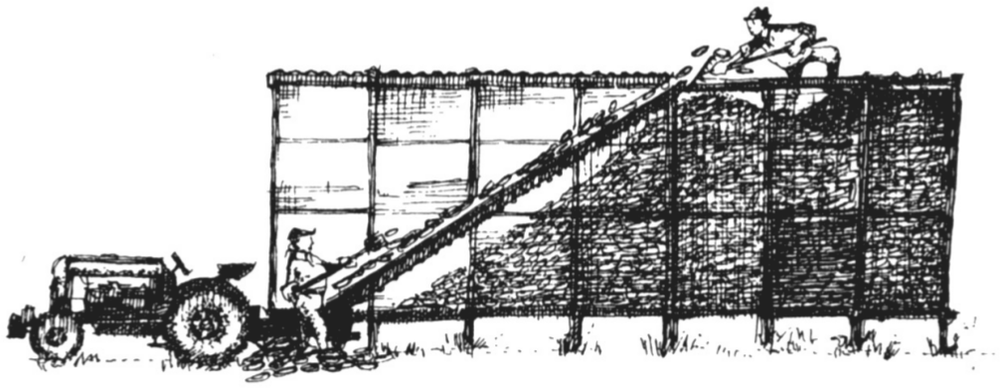
My sister and her husband arrived for a week with enough clothes for a month, not sure what weather to expect at the very end of September. The plum machine shook the last tree, folded its wings and hibernated. The last few plums which fell to earth stayed there as Raymond busied himself with greasing the montecharge, the elevator, and dragging it out of the barn. He cleared the ground around the base of le crib, the tall, narrow cage in which the corn cobs are stored, the grain being stripped later. The harvester and driver arrived the following morning, and the elevator was positioned so that the cobs would drop into the end of the crib. I went down to the edge of the field of maize to watch the first cut.
High in his cabin the driver grinned and waved. The wide machine, scarlet against the blue sky, had four glistening steel rockets on the front. The driver lowered his sights and charged. Four rows of stalks ten feet tall went down like feathers and the cobs were stripped. When the machine was full the back rose up to disgorge the golden shower into a waiting trailer which in its turn carried the load and tipped it into the base of the elevator. The cobs flowed upwards to tumble at the top into the cage. Raymond was everywhere, the first section almost full he ran up the ladder to rake the piled cobs flat and lower the first roof section to protect them, then down again to attend to the machine which had stopped. Something was jammed. He threw the motor into reverse and restarted it. ‘Could someone pick up those?’ he pleaded, pointing to the cobs which had missed the crib. Someone could. It made a change from lifting roof tiles.
The first section full, the elevator was repositioned and all the loose grain underneath had to be shovelled into a sack. Someone else, my brother-in-law, volunteered. ‘What a pity you don’t have any chicken,’ shouted Raymond as he hauled the elevator into place and switched it on to propel another yellow stream upward. Tractors and trailers trundled to and fro. Everything was motion until without warning the elevator stopped again. Now it seemed it would only work in reverse. What to do? My sister and I, not in the least bit interested in machines that don’t work, sat chatting, while the men, including the combine driver, held conference. Various remedies were suggested but in the end they reversed all the wiring and once again the corn cobs clattered to the top where Raymond leapt about with his rake.
With only one more trailer full to unload, the field a massacre of broken and twisted stalks and empty paper sheaths, the elevator once again hiccupped and was silent. Raymond cursed. It was almost dark. The only possible solution was to couple it to the drive of the tractor, itself twenty years old. As the final load inched its way up we heaved a sigh of relief. The last strip of sunset faded and we shivered in a sudden breeze which had a touch of autumn.
Supper for fifteen was ready at the long table, soup, saucisson, croque monsieur, roast guinea fowl, pommes dauphine and floating island, and we drank our ‘81 which we had matured in the famous oak barrel for four years. Inevitably Raymond told tales of the corn harvests d’autrefois and the communal stripping of the sheaths from the cobs. ‘We would all gather in the barn,’ he said, ‘a great crowd of us. We always ate sardines and bread and what les jeunes enjoyed was finding the mouldy cobs, there were always a few, and we would daub our faces with them.’ He sighed.
Even as the farmers in this region of la polyculture group together to buy sophisticated machinery, as they enlarge and modernise their coopératives for processing their grapes and plums, as they change crops to take advantage of financial inducements, soya beans, strawberries and sunflowers replacing wheat and tobacco, their pride in the new is tempered by a real nostalgia. At local midsummer fêtes the old and not so old delight in demonstrations of ancient machinery. Dressed in their best clothes they reminisce, seeming to enjoy being covered in chaff and dust as sweating volunteers hurl forks full of wheat into a snorting clanking steam-driven threshing machine. The very old laugh. To them even this is modern. They can remember machines pulled by oxen, a child following behind with an old saucepan to catch the excrement lest it spoil the wheat, and the great meals that were served afterwards for twenty or thirty harvesters, and always the best wines from la cave. ‘Ah les beaux jours d’autrefois,’ they sigh as they go home in their Volvos and Renaults and telephone the entrepreneur to see when the combine harvester might arrive.
Only la vendange still has something of the olden days about it, as we had discovered. The last grapes were to be picked on Monday and we would leave on the following day. All day Sunday while we closed the other bedrooms, covering the beds with plastic sheets and putting the linen and pillows in lavender scented chests, Claudette was cooking. She and Grandma even made two tourtières. It was not only the last day of la vendange but the last harvest meal of the year. ‘And we shall be able to relax,’ said Raymond, ‘the grapes are for vin de Pays, les Cabernets Sauvignon et les Merlots. We don’t have very many and we shall be finished by midday. That will please Mme Barrou,’ he laughed.
Next morning as we were waiting to start we were introduced to a farmer whose land adjoins our own. I recognised him but I had never seen his wife, a sad creature with gnarled hands and cruelly veined legs. She was very shy and her French was difficult to understand. Eventually she told me that she was, like her husband, originally from Italy. He had been brought by his parents as a baby but she, without a word of French, had come when she was eighteen to be married. ‘I was so lonely,’ she said.
‘Do you remember Anaïs at Bel-Air?’ I asked.
‘Of course,’ she smiled, ‘she would wave to me but I could not speak to her. I could not make friends.’
Mme Barrou roared into the courtyard on her Solex as the bee-keeper, le garagiste and their wives arrived in an ex-Post Office van. Carrying our baskets we walked down to the vineyard and began. ‘I am getting past this,’ said the bee-keeper, puffing slightly. ‘I only come to pick these because they were planted on les hautes tiges, not so much bending!’
‘I love la vendange,’ said his wife, ‘you know that once it is in everything is done, and it’s not too hot to work.’ The air was soft and warm, the pickers as mature as the grapes and we worked at a leisurely pace. The bell for midday sounded from the church and Mme Barrou decided to go home to change her working dress before lunch. Walking back to the house I found it hard to believe that in two days I would be back in London. We had been here for three months, our longest stay ever.
There were wonderful smells in the dining room. Everyone smiled in anticipation. As he passed me an aperitif Raymond whispered, ‘you will sing, Ruth, won’t you? It’s the last day. I’m warning you beforehand so you can think about it.’ He smiled half-apologetic, half-mischievous. It ruined my appetite but not for long. I knew the acoustics were good. If I were singing on some after-dinner engagement in London I would be outside waiting while everyone else ate, worrying about the state of the piano, the band and the microphone. Here there were none of these.
Unaccompanied I sang the songs which over the years I have learned that they love, ‘J’attendrai’, ‘Le Temps des Cerises’ and ‘Le Blé d’Or’. I was sitting opposite my Italian neighbour and when for her I sang ‘Santa Lucia’ her eyes filled with tears. Claudette, passing behind me with the coffee pot hissed, ‘Chantez “Granada”, Ruth.’ Heaven help me! We had listened to ‘Granada’ sung with an expert flamboyance by José Carreras on television a few nights before. But how could I refuse? I would never have an audience like this in London. These are not well-to-do sophisticates out for an evening’s diversion. I look at their faces, their hands. Our backs ache and we have worked together, and they are kind people. I sing and am grateful for such an audience.
That night, as though they know we are leaving, there is a mouse in the bathroom and a tree-frog on the bedroom shutter. What will we enjoy in London? Our other home. Other friends and neighbours, a piano, the theatre, concerts and everything else that London offers. Carpets, central heating, good television and work, if there is any, will ease us through the first cold months of the new year.
As the days warm and lengthen we shall begin to think about returning to Bel-Air. We know that whatever happens in the coming year it will be there, tucked into the hillside, its head down against the westerlies, waiting to restore us all. The cats and owls will chase the mice in the attics which we leave open for the clean sweet air to blow through. Les Bertrand will telephone, ‘il fait beau, le coucou est arrivé, vous venez?’ And we shall begin making plans.
A la prochaine fois!