
I speak Spanish. Not like you, you fucking gringo. I grew up speaking Spanish. And I deserve absolutely no credit whatsoever. My mother immigrated to this country after marrying my father. She was thirty-one and spoke about twenty words in English. I speak Spanish because my mom spoke to us in Spanish, and she did so because twenty words of English can only take you so far.
She didn’t always know the word for a lot of things. She called the ceiling fan a “monster” because it made noise and that’s the only word she knew for a noise-maker. My mother is not of diminished capacities, but after reading that last sentence I’d have second guesses too. Today she speaks fluent English, albeit with a heavy accent. I’d like to take a moment to tell you that my mother uses the word “retarded” a lot. Quite a bit, and so do a lot of native Spanish speakers. They haven’t received the North American memo that certain terms are offensive to some, and I really love that about them.
My South American cousins often greet me with a “Hello, faggot,” which, to be clear, I keep telling them is not okay. The reason they don’t understand is because the Spanish equivalent, “maricon,” is still widely used in their social circles. They just don’t seem to grasp why my eyes bug out of my head since, you know, we’re in public. I think it’s important to note that none of these people are bigots. They’re kind, loving, thoughtful people who have just never subscribed to the notion that “you can’t say that.” I wish I were as hardcore as they are, but I’m too immersed in American culture to go as far as they do. If you have a foreign parent or relative you’re probably nodding right now. You know how hard people outside of America flex their “I really don’t give a fuck” mentality. These days it’s especially refreshing and so goddamn funny.
From the time I was nine, I would spend my summers in Peru. Not simply vacationing, I would live with family and often go to school there. Our summers are their winters, so when you go down in June, you’re not on vacation at all. They’re in the middle of their school year. School was an all-boys Catholic school in Lima, Peru. If you don’t know what I look like, well, I don’t look like I belong. I have very fair skin and blue eyes. It sort of screams gringo, and the kids knew right away that a mark was on campus. It took some balls to go to Peru as an adolescent and look these kids in the eye in order to earn their respect. They all assumed that I was an uppity Yankee they could intimidate. In all my years of going to different schools in different cities, I always stood up to bullies. Not always on day one, but eventually I was going to get their respect.
In a city like Lima and a country like Peru, it’s quite the experience to look and feel like an outsider everywhere. Normally you might feel like an outsider when traveling, but you’re usually only in one place for a short period of time. If you’re a white American in Tokyo, chances are you’re only there for a week or two. (Of course, we all understand that some people are there for much longer, like the rest of their lives. That’s not who I’m talking about here.) Most of us experience that feeling of being “other” for a fleeting moment. This was not the case for me in Peru. I was there for months at a time.
I had somebody yell in my face “Go home, Yankee!” I had a gun pointed at me. That one was kind of my fault. It wasn’t a robbery. It was an armed bodyguard and I knew him. I knew where he was posted. My uncle was highly prominent and had massive political influence at the time. It was not unusual for people in his position to have round-the-clock security. I had gone on a walk after school with my cousin, whose father was the one protected by this guard. We went down to a corner convenience store, like a bodega, and bought ourselves ice cream treats. On our walk back I noted to myself that the armed bodyguard I regularly spoke with was posted up behind a partition that blocked our view of him and his of us. Without telling my cousin, I came up with a plan in my mind that I was sure was going to result in hilarity. I would approach the partition and then jump suddenly to the other side where the bodyguard was, and he would scream, and then we would all laugh at how frightened he was. Sounds funny, right?
Here’s how it actually went down. I walked up to the partition, and without telling my cousin I suddenly jumped to the other side where the bodyguard was seated. As I jumped I also let out a scream—the kind of yelling you do on Halloween, you know, monster sounds, like a ceiling fan.
“Rarrrrrrrr!”
I landed from the jump with my arms up in the air and a crazy look on my face. Ice cream was dripping down one hand and of course my screaming continued. Without any hesitation the bodyguard pointed a shotgun at my chest from less than five feet away. Now my monster sounds changed in pitch. They became more of a falsetto screech. I ran!
After I regained my ability to speak, he and my cousin both let me know in no uncertain terms that it was a miracle that I wasn’t dead. It’s true. They were right. And let that be a lesson to all of you: Don’t try to prank armed bodyguards.
I experienced a lot in my time going to Peru. You’re forced to grow up fast in an underdeveloped country. They don’t have the same resources, luxuries, or laws that we have here in the United States. There are times when that can be frightening, but as a young teen it can also be quite exciting. You don’t think you’re going to spend a lot of time in a strip club when you’re fourteen, but when you’re in Lima, Peru, no one asks for your ID. Driving drunk, throwing eggs at innocent bystanders, terrorism—I experienced all of it before my sophomore year in high school. And no, I’m not joking about terrorism. I spent the entire summer of 1993 in Peru. That also happened to be the most active stretch for the infamous Marxist terrorist group the Shining Path. They spent that summer wreaking havoc and setting off bombs. I am talking real bombs here. One night it was 2,000 pounds of dynamite packed into the trunk of a taxi and driven into a building. That was their signature attack during that time, and I was there for it. The force of that particular explosion was so profound that it blasted out a window in the home we were staying in more than two miles from the epicenter. After an episode like that, I thought my parents would want their young, teenage son to come home and be out of harm’s way. Nope. They weren’t even a little bit worried. The morning after that bomb went off I called them, terrified, certain the call would lead to heightened emotions, and a plan would come together to extract me back to the United States. I had just experienced a terrorist attack and I was still very much a kid. This stood out as a stark reminder that other parts of the world were dangerous in a way that seemed implausible at the time in the United States. I imagined my parents would become characters from Mission: Impossible or the Jason Bourne series, stopping at nothing to retrieve their asset. That is not what happened.
My dad reacted as if I had told him there was a storm the night before.
“Oh. How far away? Two miles. Wow. What else is going on?”
Oh, not much. Just the terrorist attack I just finished telling you about. They didn’t even consider the idea that I should go back to safety. As much as I like giving them shit about it, I’m actually glad I didn’t. Because I fucking love Peru. On top of the culture, family, and love, there’s also the food.
A lot of people don’t know it, but Peru has long been one of the top gastronomical destinations of the world. People travel there just to eat. Many go as far as to say that it is the best culinary destination in the world. I am heavily biased, but I completely agree, since it’s the food I’ve been eating my entire life. It’s the home of ceviche, a dish that has been modified and altered in countless delicious ways. But if you want the real thing you have to go to Peru. Lomo saltado, aji de gallina, picarones—the list goes on and on. Every bite a more sensual experience than the last. It’s like the food is dancing in your mouth, and not wedding reception dancing. That’s sloppy and gross. I mean professional dancing. Like flamenco dancers at the top of their game. It’s beautiful, inspiring; your eyes close and you can feel it. You’re alive.
Many people are surprised to learn that Peru isn’t a homogeneous culture. Huge immigrant populations from China, Japan, Spain, and more fill the country and give the food its unique style and flavor.
Nobu Matsuhisa, the famed chef and restaurateur who owns and operates countless restaurants branded with his name, made Peru his home for a while. Nobu is widely credited with pioneering Asian–Latin fusion after he left Japan at twenty-four and opened a restaurant in Lima, Peru, combining the foods of both cultures. The result is what I would describe as “Proof of God’s existence.” It’s amazing. Don’t believe me? Try it for yourself, and if you don’t enjoy it, just know that you are wrong and dumb and people don’t like you.
As a kid I couldn’t just indulge in their delicious cuisine; I had to learn how to live there. I wasn’t just passing through; I was trying to be accepted. I saw it as my birthright to call myself Peruvian. I just needed the people there to feel the same way. The kids at school didn’t look at me like I was welcomed, but that was nothing new for me. I’d been a “new kid” at a dozen schools.
In Peru the stakes were much higher than any time I had gone to a new school in the US. One of my first days in class at La Immaculada a teacher noticed as he taught class that I had no paper, no pen, no books in front of me. It’s true that you should probably have those things with you when you’re in school, but I had just arrived and no one had given me any of these things. I was twelve. What am I supposed to do, head out to Rite Aid in Lima and stock up on supplies?
When the teacher spotted me, he stopped his class and yelled quite loudly, “Alumno! Párate!” which translates to “Student! Stand up!” The direct, abrupt, fierce way in which he yelled this absolutely scared the shit out of me. I felt like I was being tried for crimes against the state. He asked me my name, and I replied in Spanish. Then he asked why I had no supplies. As I hesitated to explain, the other students chimed in, “Porque es gringo!”
His intensity dropped a notch, but the students began to call out that they had questions for me, and much to my surprise he asked me to stand in the front of the class, facing all the students. I obliged and once again felt like I was on trial, fighting for my life. The kids just barked out questions, and the fun, it seemed, would be in tricking me. They assumed I spoke very little or at least insufficient Spanish. One student asked if I brought my dolls to play with, and I answered back that I didn’t, but I’d be happy to play with him if he wore a skirt the next day.
The room erupted. This was a game. It was a game of language and wits, and it was going to either earn me respect or bury me. And the distinguished, stern teacher was all about it.
The students kept yelling out questions, and I kept firing back. Finally, a student called out that he had a question, and the teacher told him to ask. The kid yelled out, “How many times a day do you masturbate?” I was certain that the teacher was going to annihilate this kid. Instead he looked at me and lifted his head as if to say, “What’s your answer?”
“Si pienso en tu madre, llego hasta siete. A mí me dicen ‘mano muerto.’” I spat it out so fast it was like the universe answered for me. It wasn’t even me.
“If I think about your mother, I can do it seven times. They call me dead hand.”
That is a Hall of Fame level answer for a twelve-year-old speaking his second language. Seriously. I crushed that room so hard that the teacher came over and hugged me. I had won over the kids in the class. It was like a movie. You know those movies where there’s some weird kid and people are mocking him, but he joins the soccer team and scores eleven goals in a game and then people are like, “Wow, he’s really good. We should stop being such a dick to him.” It was like that, but instead of soccer I had words. That isn’t to say that everyone was now a big fan of mine. There were still plenty of kids there who wanted to kick the shit out of me, and a couple even tried. But I had friends now, and that meant if you wanted to kick my ass, you were going to have to kick their asses too.
Use what you have. That’s the real lesson. If you have looks, exploit those to your advantage. If you’re big and strong, intimidate people and maybe physically assault them if you need to. Me? I’m going to talk shit if you press me. Sometimes I’ll come up short, sometimes I’ll go too far. But sometimes, like in the classroom that day, I’ll fuckin’ nail it.
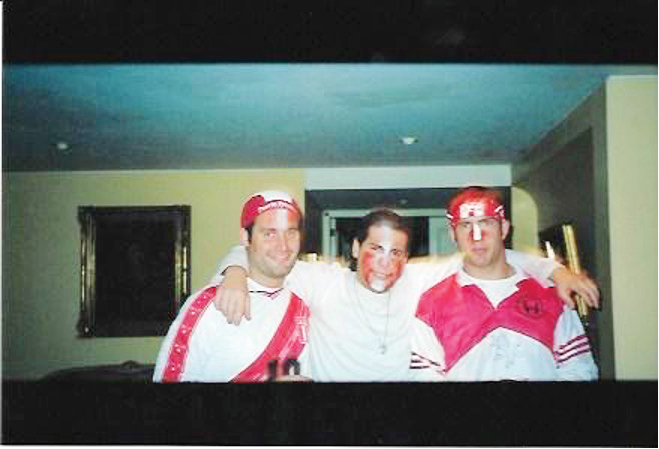
Me, my cousin Rodrigo, and my friend Casey fully committing to supporting Peru’s national soccer team.