
CHAPTER 13
Bill and I kept in touch after I left Microsoft, but it took me a while to get past the bitterness of my last months there. When Bill offered to invest in my new company, Asymetrix, I decided against it. I wanted to see where I could take it on my own, without his help.
Over time, though, the hard feelings faded. In 1990, when Microsoft rolled out Windows 3.0, Bill was generous enough to share the stage with me and ToolBook, an Asymetrix product. After a five-year hiatus, I rejoined the Microsoft board. And when Bill got married in 1995, he included me in his wedding party. After he became a family man, we found a pattern not uncommon among old friends. We saw each other a handful of times a year, took in a movie or went to lunch. We’d fall into old rhythms, that high-bandwidth exchange of ideas—a reminder of our once-powerful bond.
By the late 1990s, Microsoft was the largest and most profitable software company in history, growing at the same rate as the personal computer industry—very rapid growth, indeed. Armageddon seemed unlikely, yet Bill still saw the glass as seven-eighths empty. While Microsoft stock options had created thousands of millionaires, including some long-tenured secretaries, it also led to a gradual exodus as people retired early or went off to try their own start-ups.
Bill had done well too, of course; twenty years after we’d founded the company, he was the richest person in the world. But he felt beset by shareholder and Wall Street expectations for ever-increasing profitability and growth. As the company’s chairman and CEO, Bill was never one to hype future earnings. He’d make modest predictions to set the stage for the company to shine when it exceeded projections. But as Microsoft’s stock price rose by a multiple of nearly a hundred in the 1990s, he found those victories harder to pull off.
To be fair, he had a tough, tough job. In the high-tech field, there’s tremendous pressure even when you’re doing well; you have to run incredibly hard just to hold your competitive position. As Bill told Tom Brokaw on an NBC special in 1995, technology was “a very scary business. If you fall behind technically, no matter how much your past success has been, it’s no guarantee that you’ll keep doing well in the future.” Within months of that appearance, in an internal memo that spread swiftly over the Internet, Bill pointed to Netscape Navigator as the main obstacle to Microsoft’s ascendance on the Internet “tidal wave,” which he now considered the key to the company’s future. And because Navigator didn’t require a richly endowed operating system, it was also a threat to Windows and Office, Microsoft’s core businesses.
Leaders tend to stick with the style that made them successful. In Bill’s case, the tried-and-true formula was hyperaggression and supercompetitiveness. When your company becomes the industry leader, though, the game changes, and you need to ease off to avoid too much resentment from the rest of the ecosystem. But Bill couldn’t back down; that wasn’t in his DNA. He sent the same public message, over and over again: We take on all comers, and we clobber them. Just days before the Brokaw special, when the New York Times Magazine portrayed Microsoft on its cover as an eight-hundred-pound gorilla, it signaled something ominous. Bill’s hard-nosed approach, on top of Microsoft’s run of success, had provoked a backlash from competitors and their allies in the federal government.
The antitrust campaign against Microsoft came to a head in 1997, when the Justice Department demanded a stiff fine against the company for alleged violations. A parallel case was advancing in the European Union. Still on the company’s board, I advised Bill to temper his stance: “Look, Microsoft is going to win anyway from the momentum of the market and the position we’re in. You don’t need to be so aggressive.” I questioned Bill’s assertion that Internet Explorer had to be embedded within Windows for the operating system to work right, a key point of dispute in the federal lawsuit. There was no technical necessity for the bundling, since Windows could be tied to any competent browser and work just as well. (The company has since acknowledged as much in a settlement with the EU that allows users to choose any browser they wish.)
But Bill insisted, as a matter of legal principle, that a company had the right to add features to a product even when that product monopolized the market. What he failed to grasp, despite warnings from many, was that the government’s case wouldn’t hinge on its legal merits. The attack on Microsoft was at bottom political. A target had been painted on the company’s back.
United States v. Microsoft was filed on May 18, 1998. “Microsoft is unlawfully taking advantage of its Windows monopoly … to undermine consumer choice,” said Attorney General Janet Reno. “The Department of Justice will not tolerate that kind of conduct.” That November, in footage that will live forever on YouTube, portions of Bill’s three-day deposition were replayed in U.S. District Court. The Justice Department’s hired legal gun, David Boies, had pushed all of Bill’s buttons, and Bill took it from there. Rather than simply respond to Boies’s questions, he belittled them: “What do you mean by Internet software?” Not only is that question ridiculous, but I’m going to explain just how ridiculous it is—and how clueless you are about the software business.
Bill was sarcastic, combative, defensive, and contemptuous. I knew those traits well, but they were less than helpful on the stand. He might as well have told the Department of Justice (and by extension the judge) that the antitrust case was the stupidest thing he had ever heard. Anti-Microsoft sentiment became widespread and intense, and it cut Bill to the core. He’d been the darling of the business press, the crafty entrepreneur and technology genius. Now the media portrayed him as a bully who’d bent the rules and probably broken them. After he called me late one weekend afternoon, I met him in the living room of the lakeside estate I’d helped him choose years before. Bill looked drawn, as though he hadn’t slept for days. Redlining from stress, he showed a side of himself that many would have found surprising. He’d been trying to move the company forward all these years, he said, but the strain of expectations had grown too much for him.
“I’ve been trying to pump air in the balloon,” he said, “and now the balloon’s popping. I can’t keep it going anymore.”
NOT EVERYONE SAW Microsoft in a bad light. I was dining alone one night at Il Mulino, the Italian place in New York’s West Village, when I noticed a middle-aged man in a double-breasted jacket at a corner table in the back. He had slicked-back hair and a statuesque lady at his side, and he was sitting with his back to the wall, where he could eye the entrance. Toward closing time he sauntered over and said, “Are you Mr. Allen?” He had a thick New Jersey accent, something out of The Sopranos. After I confirmed my identity, he said, “Your company’s involved in that antitrust trial.”
“Yes,” I said. I wasn’t quite sure where this was going.
“Your Mr. Ball-mer said some very critical things about the attorney general.”
“Yes,” I said. In the events leading up to the antitrust suit, Steve had gotten front-page press by declaring, “To heck with Janet Reno!” Now I was getting a little nervous.
And the man said, “I would like to be able to say the same things, but I’m not in a position to say them. Tell your Mr. Ball-mer when you see him that there’s someone who appreciates what he’s saying.”
Relieved, I said, “I’ll tell him!”
On April 3, 2000, Judge Thomas Penfield Jackson ruled that Microsoft had violated the Sherman Antitrust Act. Two months later, the other shoe dropped: Jackson ordered the company broken into two, one for operating systems and the second for other software.
I thought the judge had overreached. The remedy seemed draconian, way out of proportion to the violations found by the court. “The judge is out of bounds—he just hates us,” Bill said. “This will never stand up on appeal.” He was probably right, but what if he wasn’t? How much synergy would Microsoft lose if Windows were split off from Microsoft’s applications? Would our software be marginalized? Which company would Bill go with, and what would happen to the other?
A few months later, shortly after I ended my second stint on the Microsoft board, a federal appeals court reversed the breakup order. The final settlement imposed relatively mild penalties. But the case’s impact on Microsoft was profound because it siphoned so much time and energy, especially from Bill. In a company where tech decisions were still ultracentralized, the repercussions of a distracted CEO had to be damaging. We can only speculate as to how much it affected Microsoft’s course in those critical years, and over the difficult decade that followed.
EVEN THOUGH HE’D seemed frayed of late, I was stunned when Bill announced that he was stepping aside to become “chief software architect” in January 2000, with Steve Ballmer succeeding him as CEO. Steve had been best man at Bill’s wedding, yet they had a tacit rivalry that went back to Harvard, where they’d vied to see who’d get the better grades. While Steve had long served as Bill’s top lieutenant, you got the sense through the nineties that he wasn’t necessarily being groomed for Microsoft’s top spot. I’d say that Bill viewed him as a very smart executive with less affinity for technology than for the business side—that Steve just wasn’t a “product guy.” It took a while for Bill to come around to what seemed obvious to the rest of the board. Whatever his strengths and weaknesses, Steve was the only viable successor.
Bill made it clear that he’d still be Microsoft’s technical leader. He looked over the new CEO’s shoulder at every turn and openly chafed at his own waning influence. Steve called me several times to complain that Bill had challenged him during meetings: “What am I supposed to do?”
“You’ve got to take him aside,” I’d say. “You have to tell him that he can’t contradict you in front of your people anymore. You’re the CEO now.” You had to be direct with Bill. It didn’t work any other way.
In 2006, Bill announced that he’d be leaving his managerial role with Microsoft two years later to focus on his health and education work at the Bill & Melinda Gates Foundation. I tried to tell him that things would be different after he left: “Once you’re no longer a decision maker, people don’t look at you the same way.” I remembered what I’d gone through when I tried to keep my hand in after leaving the company. It took me about a year to come to the realization that my advice no longer counted for much.
For Bill, the ground had already begun shifting. At product review meetings, his scathing critiques became a perverse badge of honor. One game was to count how many times Bill confronted a given manager; whoever got tagged for the most “stupidest things” won the contest. “I give my feedback,” he grumbled to me, “and it doesn’t go anywhere.” By the time he finally left the company’s day-to-day operations in 2008, it seemed almost anticlimactic.
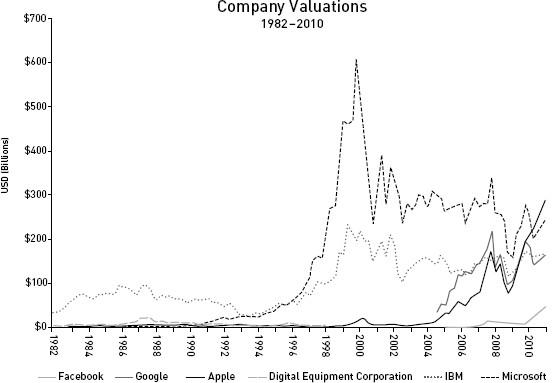
IN JULY 2010, Microsoft announced record fourth-quarter revenue of more than $16 billion. Quarterly earnings totaled $4.5 billion—a third again as much as Apple, more than twice as much as Google. Yet the company’s stock price remained flat, as it has for years. With a price-to-earnings ratio of around 12, it traded at a lower valuation than General Mills or Procter & Gamble. No matter how much money Microsoft mints, Wall Street has declined to price in any future growth beyond the Windows 7 upgrade cycle. Earlier in the year, the company saw its market cap exceeded by Apple’s, a development that even recently would have seemed far-fetched.
Microsoft arguably touches more lives on a daily basis than any other corporation on earth. More than a billion copies of Windows are in use around the world. But the company is haunted by a decade and more of missed opportunities in Internet search and smartphones, social networking and digital media sales. Apple, once a niche player in personal computers, is at present the dominant purveyor of the Cool Devices of the future. Google has blown past Microsoft in search and in Internet-based computing, or “the cloud.” Facebook is king in social networking, where Microsoft’s lone modest success is Xbox LIVE.
Together, these high-tech hellhounds dominate the platforms that people associate with the future. In a breathtaking fall from grace, Microsoft is perceived as yesterday’s news. A recent year-long study by the Pew Research Center found that 15 percent of tech articles were mainly about Apple, 11 percent about Google, and only 3 percent about Microsoft. How did a company once at the forefront of technology and change fall so far behind? It’s a thorny question, with roots that go back decades, but I believe it boils down to three broad factors: scale, culture, and leadership.
The obvious answer is that Microsoft got huge and failed to deal with the consequences. When I left the company, it had fewer than five hundred employees. By 1990, there were more than five thousand; by 2000, nearly forty thousand; today, more than ninety thousand. At that scale, cultural changes creep in unless you guard zealously against them. To avoid mediocrity, you need to be rigorous about weeding out underperformers. Microsoft hasn’t proven to be good at that. One executive recently told me, “I wish I could shoot every fourth one.”
Most of all, an industry leader can never get complacent. It wasn’t so long ago that Microsoft stood by the slogan that Bill and I followed at the start: “We set the standards.” But there is no one in Redmond, speaking privately and candidly, who would make that claim today.
During 2009 and 2010, I had lunch with more than a dozen people who had recently left the company. They all said the same thing: too many semicompetent managers, too much in-house politics among the fiefdoms and silos of principal product lines. Windows Vista was the dead canary in the coal mine. Released years late in 2007, it became a punch line for pundits and a fat target for a mocking Apple ad campaign. How could Microsoft allow this to happen to its signature commodity?
Like any debacle of this magnitude, Vista was the result of multiple blunders, beginning with its overly ambitious scope. It didn’t help that the Windows code base had grown more complex to test and upgrade even as the company lost much of its seasoned leadership. Still, a big part of the problem boiled down to basic oversight. Top management failed to pay enough attention to Vista’s development and then allowed it to be shipped when the software was still deeply flawed.
Microsoft bounced back by finding a drill sergeant par excellence, Steven Sinofsky, to manage the development of Vista’s successor, Windows 7. But the company’s broader cultural issues may be harder to fix. When we began, our mission was narrowly defined as the microprocessor language company. Bill and I were programmers who developed software for other programmers and sold licenses to computer hardware manufacturers. Our DOS deal with IBM marked a departure from that safe home base. Once you start shipping operating systems, and then GUIs and word processors, your products go directly to end users. Microsoft has never stopped hustling in the three decades since to compete in that arena, and continues to make inroads today. But it could be argued that it was never the company’s forte to design products that made the consumer’s heart beat faster.
That history is currently reflected at Microsoft in the tension between selling to the end user and selling to what’s known as “the enterprise,” the server-based corporate market. Enterprise software is a cash cow that accounts for a quarter of the company’s total revenues and has helped lead it to record profits. (The business division generates another 32 percent of revenues, primarily from corporate sales of Office.) As a result, Microsoft inevitably tilts its energies toward the big clients’ IT managers and away from consumers. The company still has strong competitive juices, from its CEO on down. But when you’re “the No. 1 wholesale seller of plumbing supplies,” as the New York Times recently put it, innovation stops being organic. You may want to innovate, but it can be like trying to fight gravity.
Today’s Microsoft has fingers in dozens of pies, from small-business accounting software to Webcams. But too many efforts can distract from the unwavering focus you need for your core products and strategic initiatives. In the early years, we overlooked databases. Had the IBM opportunity not fallen into our lap, Microsoft might have been a footnote in operating systems; had Charles Simonyi not shown up at our door, we could easily have missed out on word processors, because no one in-house knew how to write one. In these markets and a number of others, Microsoft thrived as a fast follower, the company’s MO from MS-DOS through Windows to Word and Excel.
Steve Ballmer forcefully framed the company’s strategy in the midnineties: “[The competition] can be taken. But the only way we’re going to take them is to study them, know what they know, do what they do, watch them, watch them, watch them. Look for every angle, stay on their shoulders, clone them, take every one of their good ideas and make it one of our good ideas.” For a company with a leading market share and a bottomless war chest, it was the ideal approach: minimal risk for maximum return.
Then the world changed (again). As content migrated to the Web, the pace of innovation accelerated. Fast following became more difficult than in the era of disk-based software. Today, for the most part, the best opportunities now lie where your competitors have yet to establish themselves, not where they’re already entrenched. Microsoft is struggling to adapt to that new reality. Over time, its Enterprise-leaning culture has calcified; the fast follower became a slower one. Zune came out five years after the original iPod, an established category leader with a potent consumer lock-in called iTunes, and has captured only a sliver of the market. Bing, Microsoft’s first credible challenge to Google Search, wasn’t launched until 2009. Fourteen months later, the domestic search engine market share for MSN/Windows Live/Bing Search stood at a combined 14 percent, a distant second to Google’s 65 percent. It’s going to be an uphill battle from here on.
Years before Google became the goliath it is today, I repeatedly asked Bill how Microsoft was going to catch up in search, or whether the company might consider buying Google instead. Bill was unimpressed by his then much smaller rival. “In six months, we’ll catch them,” he kept saying. Complacency has taken its toll, most tellingly in the newest competitive arenas of smartphones and tablets, like the iPad. Platforms made Microsoft. The microprocessors of the midseventies were the nucleus of our early success with BASIC. The PC software platform—created by DOS and cemented by Windows and the PC’s symbiotic ties with external software developers—led our young company to dominance. History shows that you ignore emerging platforms at your peril, because one of them might make you irrelevant.
Consider: First there were huge machines called mainframes, and they ruled the world, like the dinosaurs. Then came smaller creatures called minicomputers, offering cheaper access and leading to whole new classes of useful applications. They were followed by the PCs, which elbowed their way into the business world by giving individual users their own computers, with many minicomputers (and companies like DEC and Wang) becoming extinct. The new PC platform sparked killer apps like Word Perfect and Lotus 1-2-3, which owned their respective markets up until they failed to adapt to the next big advance in access, the graphic user interface. When Microsoft’s Windows and superior GUI-powered applications evolved, it was game over.
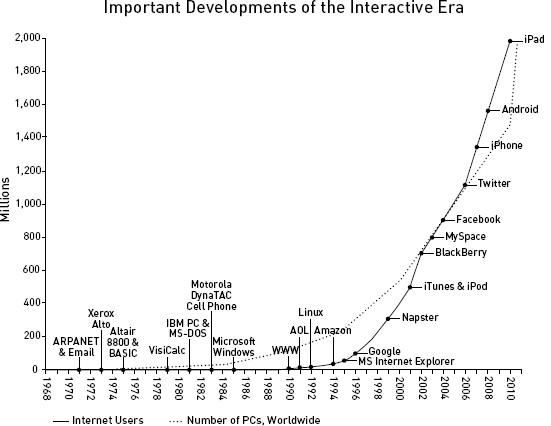
Now we’re moving to a new age, and the same pattern keeps recurring. A company jumps out to a big lead and then is late diving into the latest innovation. Before you know it, an adversary has staked its claim and is crowned as the market and technology leader. User inertia makes the new incumbent tough to dislodge, and the one-time alpha dog finds itself trailing.
The new evolutionary species looming in the PC’s rear-view mirror are mobile devices, epitomized by the smartphone, a computing platform in your pocket. In technology, the future is promised to no one. Microsoft cannot afford to be an also-ran in the mobile platforms, which are rapidly becoming the principal delivery point for low-to-medium-intensity computing and Web content consumption.
Many younger people already spend half their computing time and more on their smartphones and slates. As the phones’ displays improve and their network bandwidth expands, mobiles’ momentum will only accelerate. Microsoft wasn’t blind to this trend. It released its first mobile operating system back in 2000, but the company’s early, stylus-driven devices fell flat in the marketplace. Then the iPhone broke through with a seductive touch screen and friendly interface, and Microsoft wound up missing an entire cycle in consumer technology.
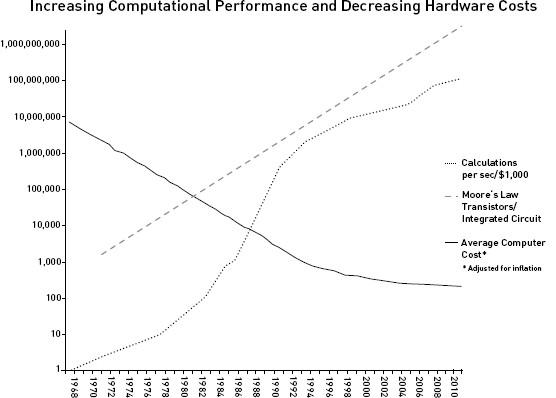
Just as the PC carried the day after we persuaded IBM to adopt 16-bit technology, the mobile-platform leaders have thrived by capitalizing on Moore’s law. Today’s robust iPhones and Droids are the products of high-speed communications, low-cost manufacturing, and superfast microprocessors. Apple and Google have beaten Microsoft to the mobile punch because they’ve been more alert in developing new and innovative platforms. They’ve done a better job of following the chips.
As of mid-2010, Microsoft had slipped to fourth in high-end smartphones behind RIM (BlackBerry), Apple, and a hard-charging Google. While advance word on Windows Phone 7 has been positive, the competition is formidable. BlackBerry looks vulnerable, but Apple is the ultimate auteur company with the most fervent cult following in the business. The world of Jobs offers limited options (there’s only one basic flavor of iPhone), but everything plugs and plays together and is guaranteed to work. That’s a formula that can trump consumers’ natural resistance to walled gardens and their predilection for choice. It can even get them to pay a premium price, at least as long as the products remain compelling.
Then there’s the nimble, cloud-oriented Google, which takes a different approach: start with limited functionality, copy the leader, bring in apps from everywhere, iterate like mad. In essence, it has mastered Microsoft’s old strategy of fast following for the mobile, Web-based era. (As Google elbows and claws for preeminence in the carnivorous tech sector, its new-age motto, “Don’t be evil,” seems less credible by the day.) The Android mobile operating system is Bill’s old bête noire, the open-source version of Unix called Linux. Google essentially gives it away free to manufacturers for the same reason that Microsoft once sold MS-DOS on the cheap: to dominate a market, in this case in smartphone search.
Akin to cameras or TVs, Android follows a product development cycle that runs six months or less or thereabouts, a pace that plays to people’s love of the new. By contrast, a major Windows release—slowed by corporate customer demands, backward compatibility, and countless third-party device drivers—has historically required two years or longer. (The last two, Vista and Windows 7, took five and three years, respectively.) The more streamlined Windows Phone operating system could cycle much faster than that, but only if it overcomes the company’s cultural drag. Can Microsoft quicken its pace to compete in the new mobile platforms? I don’t think it has a choice.
TOUCH-BASED SMARTPHONES and tablets have obvious limitations, notably for multiuser gamers or typists like me who prefer physical keyboards. A tablet isn’t as capable or convenient as a laptop for creating content. But the iPad is unsurpassed for ease of consumption in watching Web videos or reading magazines with a swipe of a finger. Because there are many more consumers than creators in our culture, the Swiss Army–knife strengths of the iPad—and the coming horde of iPad clones—may outweigh its limitations. It appears that tablets are poised to render physical books, magazines, and newspapers obsolete within the next twenty years. As an inveterate book lover, I find the prospect sad but inevitable.
Against this swirl of change, we need to keep in mind that PCs have averaged double-digit growth over the last decade—and as long as there are PCs, there will be a Microsoft. They aren’t about to be supplanted by smartphones for intensive office applications like sales reports or spreadsheets. Everywhere else, however, people are shifting from desktops and laptops to more portable mobile devices. As technologies evolve, consumers (especially younger consumers) get pulled along with them. I often hear people saying, “I don’t like it personally, but my kids are perfectly happy typing on their iPhone.”
New products resonate at first with early adopters, who want the next hot item. But once those products are acknowledged to be more useful than what came before, their consumer net quickly widens, until your grandmother is signing up for her iPhone data plan. Brand loyalties are forgotten as a new platform shoves aside the old. Although the PC still has its place, it is no longer the prime driver of innovation.
Here’s what the death knell for the personal computer will sound like: Mainly I use my phone/pad, but I still use my PC to write long e-mails and documents. Most people aren’t there yet, but that’s where we’re headed.
If Microsoft fails to catch up in mobile, in other words, it’s in for a long, slow slide.
Like the IBM 360, the innovative system of its time, Microsoft Windows has enjoyed an extraordinary run at the top—twenty years and counting, an eon in technology. And like Big Blue in 1980, Microsoft now faces a major threat. For a long time, IBM seemed smug and unassailable, counting money from its corporate client base, and then the behemoth stirred and said, “We’ve got to have a PC.” I was there. I saw how IBM went from nowhere in personal computers to number one in a matter of months, with a fortuitous assist from two young men and their team in Seattle. Still, it’s not easy to come from behind once you’ve ceded momentum; it’s so much more challenging to be Avis than Hertz. You need to do more than try harder. You need to be better, or at least markedly different in the way you meet people’s needs.
If a Microsoft renaissance has grounds for hope, and I believe it does, it’s that markets in technology are inherently dynamic—and that my old company has woken up to the challenge. The smart-phone market will stay fragmented for the foreseeable future, and it’s still relatively cheap and easy for people to switch to something that catches their eye. Five years ago, before anyone had heard of the iPhone, Apple analysts dripped with pessimism about that company’s future. Given Microsoft’s deep cash reserves and its willingness to use them, it could be in a much stronger position five years from now.
But to take on Apple and Android, whose phones won’t stop getting better, Microsoft needs a strategy to win: a quicker development cycle, a qualitatively better mobile operating system, and a secret sauce or two to set Windows smartphones apart. Above all, the company needs somehow to return to its cutting-edge roots. In the early days, from the time we squeezed Altair BASIC into four thousand bytes, no core product was released unless Bill and I believed it could be best-of-breed. To win the mobile wars, the company needs first and foremost to produce phones and slates that consumers will love from the moment they use them.
I left Microsoft a quarter century before Bill did, and we’ve both had our signal triumphs since then. But in certain respects, neither of us has been quite as good alone as we were together. I missed Bill’s laser focus on competition in the marketplace, his ability to execute my ideas and keep me from getting too far ahead of what was doable. And I’d like to think that Bill missed my ability to divine where technology was headed and my knack for meeting its trajectory with something big and original.
In my post-Microsoft years, I discovered how challenging it was to operate without a pragmatic partner and business maven. Even so, I have no regrets about taking my own road. It has led me to rich experiences in a great range of pursuits—to the life I’d always dreamed of, even back in the early days, when I was happily chained to my terminal and striving to perfect the next line of code.