
CHAPTER 12
THE PLAN HAD BEEN APPROVED; THE ACTS DRAFTED; Mountbatten returned to Delhi, chastened but still hopeful. ‘We are just starting our fateful week with the temperature already over 112 and the whole scene very explosive but we hope for the best’, wrote Edwina on 2 June.1 ‘I find myself all alone,’ said Gandhi. ‘Even the Sardar [Patel] and Jawaharlal think my reading of the situation is wrong and peace is sure to return if partition is agreed upon … the future of independence gained at this price is going to be dark.’2
That morning, the future leaders of India and Pakistan were summoned to the Viceroy’s study for a two-hour briefing on the new plan. Sitting around the table with him were Nehru, Vallabhbhai Patel and J.B. Kripalani for Congress, Jinnah, Liaquat and Abdur Rab Nishtar for the League, and Baldev Singh for the Sikhs. ‘I got the feeling that the less the leaders talked, the less the chance of friction and perhaps the ultimate breakdown of the meeting,’ noted Mountbatten, and consequently filibustered for as long as possible. His ploy was to declare upfront that he was not asking for the leaders’ agreement to the plan – for he knew that it met no one’s demands. If they accepted that the plan was a solution in the interests of the country, that would be enough. He asked the leaders to let him have their responses by midnight. Jinnah told Mountbatten he would return at eleven o’clock after consulting his committee and, sending the others off to read their copies of the plan, Mountbatten held him back ‘to impress on him that there could not be any question of a “No” from the League.’ After he left the room, Alan Campbell-Johnson picked up a scrap of paper that the Quaid-e-Azam had left behind him, covered in scribbles from the meeting. The words ‘Governor General’ were written in inverted commas and underlined in the middle of the page; around it was a collection of symbols. ‘I am no psychologist,’ admitted Campbell-Johnson, ‘but I think I can detect the symbols of power and glory here.’ In contemplating his success, Jinnah had drawn a collection of phallic shapes, all pointing proudly upwards.3
One troublesome icon having been dealt with, another showed up. Gandhi had spent the previous week railing against the new plan, and trying to revert to the Cabinet Mission plan of 1946 – which he had been instrumental in refusing. The Congress Working Committee was thoroughly annoyed with him, and Mountbatten too had had his fill of the Mahatma. ‘He may be a saint but he seems also to be a disciple of Trotsky’, the Viceroy wrote to London. ‘Judge then of my astonished delight on finding him enter the room with his finger to his lips to indicate that it was his day of silence!’ Mountbatten spent forty-five minutes explaining why the Cabinet Mission plan could not be enforced if any party was opposed to it, with Gandhi scribbling replies on the backs of old envelopes.4
At midnight, Jinnah returned to the Viceroy’s House, ready to hurl another spanner into Mountbatten’s fragile works. As the constitutional leader of the Muslim League, he said, it was not in his power to accept the plan tomorrow. However, he would do his best to ensure the council of the League would accept it, and would bring it up at their next meeting – in a week’s time.
This was exactly the sort of manoeuvre guaranteed to make Congress back out, and Mountbatten knew it. He told Jinnah that he had only secured Congress acceptance on the basis that the Muslim League would accept simultaneously, but Jinnah would not budge. ‘If that is your attitude,’ Mountbatten told him, ‘then the leaders of the Congress Party and the Sikhs will refuse final acceptance at the meeting in the morning; chaos will follow, and you will lose your Pakistan, probably for good.’
Jinnah shrugged. ‘What must be, must be.’
‘Mr Jinnah!’ exclaimed Mountbatten. ‘I do not intend to let you wreck all the work that has gone into this settlement. Since you will not accept for the Moslem League, I will speak for them myself.’ He told Jinnah that, in the meeting, he would announce that he was satisfied with Jinnah’s assurances, a hair-splitting legalistic move that would hopefully fool Congress into thinking Jinnah had accepted: ‘and if your Council fails to ratify the agreement, you can place the blame on me.’ When he mentioned Jinnah’s assurances, he would look at Jinnah – and Jinnah should nod his head in agreement.
Mountbatten looked at Jinnah then. Silently, the Quaid-e-Azam nodded his head.5
The next morning, the leaders of all parties arrived back at the Viceroy’s House, tired and acquiescent. Mountbatten was prepared to listen to their many reservations in private, but decided that none should be allowed to speak at the meeting in case they upset each other. And so, for the first time in history, no party raised an objection against a plan for independence. Immediately after they had not objected, Mountbatten theatrically raised and then thumped on to the table a plan for the transfer of power. In the first paragraph, this revealed the unexpected fact that power was to be transferred by 15 August 1947 – ten months in advance of the June 1948 deadline, and just ten weeks from the 3 June meeting itself.6 The room’s silence changed its quality from one of studied etiquette to one of shock. The Viceroy dismissed the bewildered leaders into the searing brightness of a Delhi day, and could reflect on his personal moment of glory. Both parties had been forced to compromise – Congress accepting partition, Jinnah more or less accepting what would probably be a moth-eaten Pakistan – but he, Mountbatten, had finally been able to set a date.7
Mountbatten left the leaders as little thinking time as possible between their acceptance of the plan and their distinctly un-triumphant addresses to the nation on All-India Radio that afternoon. ‘It is with no joy in my heart that I commend these proposals, though I have no doubt in my mind that this is the right course,’ said Nehru, sadly. Jinnah, too, noted that ‘We cannot say or feel that we are satisfied,’ and finished on the slogan ‘Pakistan zindabad’ (‘Long live Pakistan’), apparently misheard by some listeners as a exultant crow of ‘Pakistan’s in the bag!’8 Mountbatten declared again that he would have preferred to preserve the unity of India. ‘But there can be no question of coercing any large areas in which one community has a majority, to live against their will under a Government in which another community has a majority. And the only alternative to coercion is partition.’9
In London, the terms of the plan were announced in the House of Commons at half past three that afternoon. Leo Amery had promised Mountbatten he would write a letter to The Times ‘to steady Conservative opinion here, in case Winston proved fractious’, but even Winston was in a placatory mood.10 ‘I am sure that Dickie has done marvellously,’ noted Harold Nicolson, who was present. ‘But it is curious that we should regard as a hero the man who liquidates the Empire which other heroes such as Clive, Warren Hastings and Napier won for us. Very odd indeed.’11 So it may have seemed, but Mountbatten was serving his country with as much loyalty, courage and determination as had those other heroes. Mountbatten turned a stagnating mess into perhaps the most successful retreat from empire in history – from the point of view of the imperialist nation, at least. If his conduct has provoked censure as well as acclaim, then perhaps that is the price any hero must pay; Clive, Hastings and Napier have.
The following day, 4 June, Mountbatten gave a bravura performance of the charisma that had allowed him to pull off this feat. At the press conference he had called to announce the plan, he was warm, witty and spectacular, disclosing the startling closeness of independence in answer to a question like a stage magician pulling a rabbit from a hat. Mountbatten had chosen 15 August ‘out of the blue’, he admitted – it was the second anniversary of VJ Day, but nothing more significant than that.12
Just before the Mountbattens had left England in March, Edwina had answered a relative’s concerns briskly. ‘Don’t worry,’ she had said. ‘This is going to be a marvellous experience – and Dickie says we’ll be back as soon as we can – and that means not long.’13 By the end of May, Mountbatten had browbeaten the government into making it even less long than it might have been. Attlee had given Mountbatten an exit-date of 1 June 1948. This was a tight schedule in any case, bearing in mind the complexity of Indian politics and the possible repercussions of the process. And yet, undaunted by the task before him, the last Viceroy took the bizarre and unilateral decision to speed independence up.
‘When I got out to India I realized … that, although we in London had visualized the programme of transfer for June, 1948, to be moving at lightning speed, in India it was regarded as being much too slow,’ Mountbatten would tell a meeting of the East India Association in London the following year. ‘Everybody there was agreed on this point: the leaders, leading British officials, my staff advisers.’14 This was manifestly untrue. After seeing the plan at Simla, even Nehru had told him he was going too fast.15 Another Congress politician told him that the timetable would only have been workable if the British had announced a five-year date for their departure two or three years previously.16 For the Muslim League, Liaquat stated that he did not believe under any circumstances, united or divided, India could stand on its own legs by June 1948.17 Several of the princes had begged the British to stay. As for the British officials and Mountbatten’s staff advisers, the archives show them to have been explicitly opposed to haste.18 V.P. Menon had advised Mountbatten that ‘The psychological effect of power having been transferred earlier than 1948 will be an invaluable factor in the long-term view of Indo-British relationship.’19 But Menon made it clear that this would hold true only if there was a complete transfer of power to the whole of India of dominion status, followed by ‘not less than four or five years’ during which the parts of the country would draw up their constitutions. He envisaged a joint defence policy and a joint Governor General of India and Pakistan in this eventuality, which is very different from what actually happened. In fact, the only person who seemed to agree unreservedly with Mountbatten that power had to be handed over so far ahead of time was his public relations adviser, Alan Campbell-Johnson.
‘A terrific sense of urgency had been pressed upon him by everybody to whom he had spoken’, Campbell-Johnson wrote.20 But the records do not show anyone else pressing Mountbatten to hurry up: not the British government, not his advisers, not the Sikhs, not the Muslim League, not Gandhi, and not even the majority of Congress. Nehru and Patel may have hinted that they were keen to get on with governing, but neither expressed any demand that Mountbatten set a date in August that same year. The rush was Mountbatten’s, and his alone.
A few months before the Mountbattens went to India, their marriage was in one of its healthier phases. Photographs of the time show them smiling, affectionate and relaxed, and their letters reveal a matching picture. A few weeks afterwards, they reached a nadir, and by the beginning of June were constantly fighting. It is hard to believe that this turbulence did not have an effect on Mountbatten professionally – especially as he had to work closely with Nehru and Gandhi, two men whose company his wife plainly preferred to his own. Edwina had not wanted to be in India in the first place, and in the first few weeks put pressure on her husband to ensure that they would be on their way back to Britain as soon as possible.21 Dickie had always striven to impress her with his achievements at work. Perhaps, if he could carry out the transfer of power swiftly and efficiently enough, he might still save his marriage.22
Within days of the announcement that there would be two successor administrations in India, talk had turned to which of them would be Britain’s favourite.23 The smart money was on Pakistan. Muslim organizations in general, and particularly the League, had spent many years cultivating links with Britain. Pakistan was likely to be the weaker of the two states, and would be seeking out foreign alliances more hungrily than would India. Moreover, its western part was geographically advantageous. West Pakistan would border Persia, Afghanistan and China, three nations of strategic interest to Britain and the United States. It was close enough to Russia to be even more interesting on that count.
Gandhi raised the question of favouritism with Mountbatten in early June, requesting that the British announce there would be no differentiation between the two dominions. The Viceroy took the matter up with the India Office in London, but received a cagey reply. ‘We all felt strongly that we should be extremely guarded in dealing with this request of Gandhi’s’, wrote Lord Listowel; ‘we feel that we should be very careful not to say that we shall not in any circumstances have closer relations with Pakistan than with India.’24
‘I have done my job,’ said Jinnah on 9 June, with some justification.25 He went on to address the last meeting of the Muslim League in the Imperial Hotel that day. The Imperial was Delhi’s grandest hotel, a short distance south of Connaught Circus on the avenue of Queensway. A perfectly spaced colonnade of royal palms screened its smooth, green lawns and pristine art deco frontage from the noise, smells and wandering livestock outside. That Monday, as usual, the better-heeled of Delhi’s visitors were taking tea on the terrace. The gentle murmur of conversation, and the clink of china and silver, were the only sounds emanating from a serene company of dignitaries, American journalists and grand European ladies. Upstairs, in the ballroom, Jinnah took to the stage in front of 425 delegates to present them with Mountbatten’s plan.
Suddenly, a mob of fifty Khaksars – the fundamentalist sect that had been massing in Delhi for a month – burst through the palm colonnade on to the lawn, waving sharpened spades and shouting, ‘Get Jinnah!’ The hotel guests scattered; cups of Darjeeling tea smashed on the marble tiles, and chairs and tables overturned as the Khaksars stormed through the lounge and up the staircases. There they were met by Muslim League national guards, and a battle ensued. Jinnah would have been entitled to panic: the only serious assassination attempt ever made against him had been by a Khaksar who had broken into his house and stabbed him, four years previously. Instead he remained perfectly calm, and continued with his meeting while clashes, screams and thuds echoed up the stairs. He was addressed in the Persian style as ‘Shahenshah-e-Pakistan’ – Emperor of Pakistan. ‘I am a soldier of Pakistan, not its Emperor,’ he swiftly replied. The Mountbatten plan was accepted by 300 votes to 10. Soon the police arrived to subdue the combatants with tear gas, and Jinnah escaped without a scratch. The Imperial was not so fortunate. That evening, red-eyed guests still blinking away the tear gas sat down for dinner at its Shahnaz restaurant on broken furniture. A party from the Viceroy’s House arrived, and was taken to the Mughal Suite on the first floor. Edwina Mountbatten was one of those who picked their way through the wreckage to enjoy a banquet of homard à l’armoricaine and selle d’agneau farci de la paté, with a chilled glass of Chablis Premier Cru 1936.26
On 18 June, the Mountbattens flew to the beautiful lakeside city of Srinagar, for a visit to the largest of India’s princely states, Kashmir. Nehru had already warned Mountbatten that the Muslim-majority Kashmir might prove to be a problem. Mountbatten knew the Hindu Maharaja, Sir Hari Singh, having first met him in Calcutta at Christmas dinner in 1921, for which Sir Hari had been specially selected as one of the British government’s best behaved princely allies. Their acquaintance had been sufficiently cordial that Dickie and Edwina had holidayed with him at Srinagar as late as 1946.27
It was known that the Maharaja wanted Kashmir independent, a scheme unpalatable to Nehru, Gandhi and the British. The Mountbattens’ visit to Kashmir was not a raging success. At the opening banquet, Dickie accidentally set off a bell that had been installed under the table, which alerted the band to play ‘God Save the King’. The band dutifully struck up, at which guests dropped their chicken curry and scrambled to their feet. Mountbatten and the Maharaja’s son cracked up with laughter; but the Maharaja himself was thunderous with rage. The following day, the Maharaja dispatched the Viceroy on a long, lonely fishing trip.28 When he was allowed to return, Mountbatten found Sir Hari reluctant to be in his company. The two only spoke during drives together. On one of these, Mountbatten assured the Maharaja that he would be allowed a free choice of which dominion to join after 15 August, emphasizing the importance of ascertaining the will of the Kashmiri people, but making it clear that any moves to independence would be foolish and dangerous.29
Mountbatten had asked Nehru to brief him on Kashmir just before he left for Srinagar, and received an essay in return arguing that, despite its overwhelming Muslim population of 92 per cent in Kashmir proper (excluding Jammu) and 77 per cent overall, ‘The normal and obvious course appears to be for Kashmir to join the Constituent Assembly of India.’ Furthermore, ‘It is absurd to think that Pakistan would create trouble if this happens.’30 Nehru himself was a Kashmiri by descent, and his detachment would repeatedly fail him when dealing with his ancestral state. Nonetheless, there was another reason for his desperation to secure Kashmir. If the North-West Frontier Province went to Pakistan, India would lose the Hindu Kush mountains – its natural defence against attack from the north. Mountbatten was insisting that a plebiscite be held in the NWFP, to the despair of Nehru and Gandhi. If both the NWFP and Kashmir went to Pakistan, there would be nothing but farmland between India and the Soviets, the Afghans, the Pakistanis, and the Chinese.31 The danger from the north was real and immediate, especially after 2 July, when Afghanistan revived its old claim to territory on the North-West Frontier, comprising most of the land between the Indus and the border. Fears abounded that the Afghans were being encouraged by the Russians, though some in India wondered whether their action was more to do with pan-Islamic ambitions. Nehru received a package of papers from an anonymous correspondent. ‘After Jinnah’s Pakistan has liquidated all Hindus inside its boundaries the big JEHAD of the twentieth Century will begin,’ it said. The correspondent went on to allege that Muslims in India had been directed to act as fifth columns among the Hindus, and ‘In the name of religion Mohammedan women are being ordered to entice Hindu men.’32 Nonsense though this was, the number of similar protests indicates that communal feeling was becoming ever more perilous.
One month later, the North-West Frontier plebiscite would register a decisive vote to join Pakistan, with 289,244 for Pakistan against only 2874 for India. Mountbatten declared himself most satisfied with having ‘insisted on the referendum in spite of the strongest possible opposition’ from Congress.33 Neither he, nor his staff, nor anyone in London, seems to have realized that the die had been cast for conflict in Kashmir.
The Mountbattens returned from Kashmir on 23 June. That day, the Punjab voted in favour of its own partition; Bengal had already done so. Sir Cyril Radcliffe, a London barrister, was flown in to take up the onerous and vulnerable job of drawing the lines of partition. He had been nominated by the British government with the approval of Jinnah.34 The Muslim League’s victory over the principle of basing statehood on identity inspired all sorts of new demands. The 3.5 million Pathans in the north-west were raising a call for a separate state of Pathanistan, and the ‘Frontier Gandhi’, Abdul Ghaffar Khan, added his voice to that call on 2 July.35 The original Gandhi also supported Pathanistan, though Jinnah condemned it as ‘disastrous’.36 The following day, Tamil separatists in the south cabled Attlee from Madras to note that they also wanted a separate Dravidanadu for Muslims and Dravidian people.37 Shortly afterwards, it was reported that the Naga tribes in Assam were keen to establish a Nagastan; their leaders turned up in Delhi, threatening to fight ‘to the last drop of their blood’ to win independence.38 The Sikhs were split over whether or not to accept partition, and some among them still hoped for a separate Khalistan. A Sikh protest day against the partition of the Punjab was declared. Many went to their gurdwaras wearing black armbands, and rumblings began to be heard from agitators. ‘With clear vision, determination, and vigour that is characteristic of our virile race, we shall extricate ourselves out of this whirlpool of annihilation that is facing us’, read one pamphlet. ‘Our phoenix-like rise shall signal the fall of our enemies.’39
This rapidly expanding chaos made the British keener still to escape from India. In late June, riots in Lahore and Amritsar had left hundreds of houses burnt down. People running from their blazing homes were shot in the street for breaking the curfew order. Nehru was horrified, and asked Mountbatten to declare martial law. ‘If you will forgive a personal touch, I should like to tell you that my mother came from Lahore and part of my childhood was spent there’, he wrote to Mountbatten. ‘The fate of Lahore, therefore, affects me perhaps more intimately than it might many other people who are not connected with that city.’40 It affected Jinnah, too. ‘I don’t care whether you shoot Muslims or not,’ he told Mountbatten, ‘it has got to be stopped.’41 The Sikh minister Baldev Singh advised him to ‘shoot everyone on sight’. But the British government had made it clear that they would send no more troops or resources. Britain’s debit balance for imports and exports was running at over £50 million. The Chancellor, Hugh Dalton, had just announced that imports of tobacco, newsprint, petrol and some foods were to be scaled back drastically. There was nothing to spare for India. All Mountbatten could propose was the setting up of a multi-faith security committee, which would sit in Delhi and resolve that things would be better if everyone stopped killing each other.
On 4 July 1947 – the 171st anniversary of another independence day in another of Britain’s colonies – the Indian Independence Bill was introduced into the House of Commons. Not only in India had its passage been perilous. Three days earlier, Churchill had written to Attlee in tones of profound outrage, demanding that the name of the bill be changed to ‘The India Bill, 1947’ or ‘The India Self-Government Bill’. India was becoming a dominion, he argued, not an independent state: if the word ‘independence’ remained, he would not be able to vote for it.42 Had the bill’s name been changed at this stage, Congress could not have accepted it. On the other hand, the prospect of forcing the bill through parliament without Conservative Party support raised the unthinkable possibility of it being defeated. Either eventuality would keep Britain in India and sabotage all the progress that had been made.
Under the circumstances, Attlee did the best thing he could possibly have done. He did not reply to Churchill’s letter until the morning of 4 July itself, and then pointed out that it was too late to change anything. Churchill, who was recuperating after a hernia operation and had less of a fight in him than usual, gruffly accepted this, noting that his protest would remain on record.43
A founding principle of Mountbatten’s plan was the reappointment of himself as joint Governor General of both new dominions for a short period after 15 August. Nehru had acquiesced; Jinnah had hedged, and recommended separate Governors General with a Supreme Arbitrator – in which post he was happy to have Mountbatten – to oversee such matters as the division of financial assets and arms stocks.44 Foolishly, Mountbatten had assumed that Jinnah would eventually come round to the idea of a single Governor General. As might have been guessed from his doodle on 2 June, Jinnah wanted to become Governor General himself.45
During the last week of June, Jinnah announced that he would be unable to accept any position apart from Governor General of Pakistan in six weeks’ time. ‘What I thought would happen funnily enough’, wrote Edwina to Patricia, ‘and which neither Daddy nor any of his staff EVER contemplated has occurred’.46 Mountbatten tried to convince Jinnah that he would have more power as Prime Minister of Pakistan – an argument which a lawyer as assiduous as Jinnah would immediately have seen to be false. ‘In my position it is I who will give the advice and others who will act on it,’ replied the Quaid-e-Azam, who had clearly read the terms of the Indian Independence Bill very closely. ‘Do you realise what this will cost you?’ asked Mountbatten. ‘It may cost me several crores [tens of millions] of rupees in assets,’ Jinnah replied. ‘It may well cost you the whole of your assets and the future of Pakistan,’ snarled Mountbatten, and stormed out of the room.47
Attlee told the cabinet that Jinnah’s demand ‘was no more than an indication of his own egotism’.48 Vain though Jinnah may have been, it would be unfair to attribute his action solely to a lust for fancy titles. He had turned down a British knighthood and sternly rebuked those who attempted to dub him Emperor of Pakistan.
A more convincing reason for Jinnah’s refusal of Mountbatten’s candidacy was personal. Delhi was no place to keep a secret, and the gossips soon ensured that Jinnah found out about Mountbatten showing Nehru the then-secret plan at Simla on 10 May. He also found out that Nehru had been allowed to rewrite it.49 It was obvious that the Viceroy liked Nehru, and even close friends of Mountbatten would later admit that his corresponding dislike of Jinnah had become obvious by this point.50 Mountbatten had repeatedly proclaimed his preference for a united India, creating fears in the Muslim League that a joint Governor Generalship might favour the reabsorption of Pakistan, in line with Congress hopes.51
But there was more to it than that. Yahya Bakhtiar, a Baluchistani politician who was a close associate of Jinnah’s, argued that a joint Governor Generalship under Mountbatten would have meant Pakistan ‘getting destroyed at inception’. By July, Jinnah had very strong reasons to suspect that Mountbatten was wrapped around Nehru’s finger. ‘Nehru in those days was having a roaring love affair with Lady Mountbatten,’ added Bakhtiar, ‘said to be with the tacit approval of Mountbatten.’52
There is an intriguing tale told by S.S. Pirzada, later Foreign Minister of Pakistan, that Jinnah had been handed a small collection of letters that had been written by Edwina and Jawahar. ‘Dickie will be out tonight – come after 10.00 o’clock,’ said one of Edwina’s.
Another revealed that: ‘You forgot your handkerchief and before Dickie could spot it I covered it up.’ A third said: ‘I have fond memories of Simla – riding and your touch.’
Pirzada claimed that Jinnah discussed what to do about these letters with Fatima and his colleagues. In the end, Jinnah concluded that ‘Caesar’s wife should be above suspicion’, and had the letters returned.53 If this incident really did occur in late June 1947, it provides a credible reason for Jinnah’s sudden switch from agreeing that Mountbatten could be a Supreme Arbitrator to refusing him any role whatsoever in Pakistan. Perhaps Edwina and Jawahar were just good friends at this point and the rumours of a roaring love affair jumped the gun; such details may be something that only the two of them will ever know. But exactly how roaring the love affair may have been by this point is of little consequence. They were known to be close, and they were known to have political influence with each other. The Pakistani government could not be expected to tolerate a situation in which its Governor General’s wife was to any substantial degree intimate with the Prime Minister of India. Jinnah could not have accepted Mountbatten’s candidacy.54
On the evening of 2 July, Jinnah came to see Mountbatten, and told him flatly that the Muslim League would not negotiate further. Mountbatten sat with the Quaid-e-Azam for over four hours attempting to persuade, cajole and even bully him into changing his mind. The Viceroy dangled the carrot of British favour, and raised the stick of economic disadvantage: but Jinnah was completely immovable.55
As soon as Jinnah’s position was known, the India Office drew up a top-secret memorandum. There was a specific danger in the provisional constitution: the powers granted to the Governor General of each dominion were ‘exceedingly wide’, allowing him a free hand in controlling most institutions of state, including the judiciary; not requiring him to act on the advice of his constituent assembly; and prescribing no limit to his tenure of office. ‘This position is innocuous and convenient if the Governor-General is a disinterested and transitory Englishman such as Lord Mountbatten,’ noted the India Office, whose staff perhaps did not know him awfully well. ‘Quite different considerations plainly arise if the holder of the office is an ambitious Indian.’ The memorandum predicted serious disturbances after the transfer of power, and recommended that full plans for the evacuation of all British troops and civilians be made without hesitation.56
Mountbatten was personally hurt by Jinnah’s decision, and his sense of crisis was so acute that he flew Lord Ismay back to London to present the situation to the cabinet. Ismay reported that Mountbatten feared that, ‘If he accepted the Congress invitation after being largely responsible for partition, he might be subsequently criticised for siding with Congress and for failing in impartiality during his period of office as Viceroy.’ This was an accurate prediction. But both Attlee and Lord Listowel felt strongly that Dickie should be persuaded to stay on. Listowel argued that Mountbatten could influence India to stay in the Commonwealth and to negotiate defence arrangements that would be beneficial to Britain. Moreover, he admitted, ‘The partition of assets between the two Dominions would in any event work out unfavourably for Pakistan; Lord Mountbatten would be in a better position than anyone else to exercise a moderating influence on Congress policy in this matter.’57 Though the cabinet conceded that Mountbatten’s personal reputation might suffer, it resolved to ask him to carry on as Indian Governor General – in the interests, principally, of his own country.
Ismay next went to discuss the matter with Churchill, who was happy to accept Jinnah’s candidacy for Governor General of Pakistan. He was also concerned that India retain a strong British influence in the form of Mountbatten. He emphasized that Mountbatten would be particularly useful in three key roles: ‘He can strive to mitigate quarrels between Hindu and Moslem, safeguard the position of the Princes, when that is involved, and preserve such ties of sentiment as are possible between the Government of Hindustan and that of the other Dominions (or Commonwealths) of the Crown.’58 All of these roles would have been just as relevant in Pakistan as in India, but Churchill already had good reason to be confident of Pakistan’s obedience: he trusted Jinnah to run it in a way that would serve British interests. Meanwhile Jinnah, who saw as clearly as anyone else the advantage of having one overseeing body to regulate the partition awards, arms and resources distribution and so on, lobbied Churchill and Attlee to set up a council from among the British government to act as such. The intention was clear. He still wanted a Supreme Arbitrator, but not Mountbatten. His suggestion was ignored.59
On 9 July, under pressure from the cabinet, the opposition, and the King, Mountbatten agreed, with great reluctance, to stay on.60 ‘Everyone seems to think the decision has been a right one’, wrote Edwina to Lady Reading, ‘although I myself am still worried at its implications, not personal of course, but as to whether it was really the right decision for the people of this country.’61 The achievement of separate Governors General was, however, a great victory for Jinnah, and no one could be in any doubt at his satisfaction. He held press conferences in fanless rooms, amid hordes of sweating journalists, at which he wore an immaculate white silk suit and smoked cigars while informing them cheerfully about his modern, democratic and inclusive vision for Pakistan.62
For all Jinnah’s publicity, it was Mountbatten’s name that shone out from the headlines. That day, the world’s media had been able at last to confirm what they had keenly suspected for months, if not years. Lieutenant Philip Mountbatten, RN, was engaged to marry Princess Elizabeth of Great Britain, the woman who would be Queen. The Mountbatten connection was not lost on the press: the Times of India printed a warm editorial noting the Viceroy’s contributions to Philip’s upbringing. Dickie himself was elated: ‘I am sure she couldn’t have picked a better man’, he wrote to Attlee.63 Edwina wrote to Lady Reading that Philip was ‘extremely cultured, well-read, of a progressive mind … In fact he will I think be a breath of fresh air into the Royal circle’.64
Thoughts of thrones and crowns and ermine were soon to consume them all. Mountbatten had persuaded India’s political leaders to accept his plan. For his next trick, he would have to persuade each of the 565 princely rulers to join one of the two new dominions. The clock was ticking. Less than a month remained before the British would finally leave India.
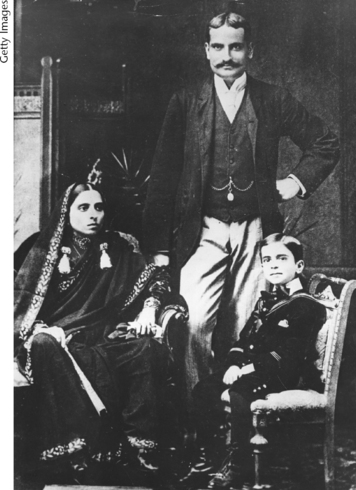
Nehru family portrait, circa 1899. Left to right: Swarup Rani, Motilal, Jawaharlal.

‘A beam of light that pierced the darkness’: Mohandas Gandhi and his wife Kasturba.
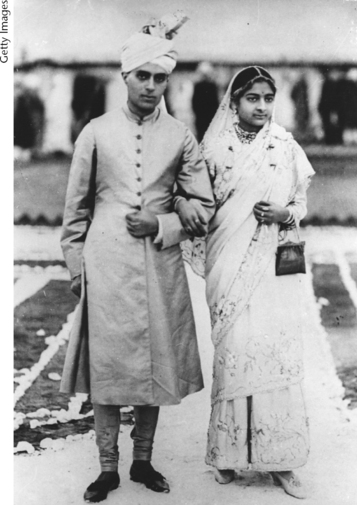
A reluctant Jawahar marries Kamala Kaul, 1916.

‘I think we are going to be great friends’: David (front), the future King Edward VIII, on his imperial tour with Dickie Mountbatten.
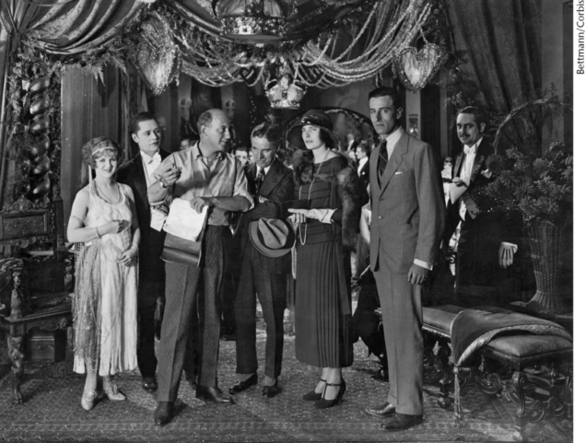
Hollywood honeymoon: Dickie and Edwina Mountbatten (2nd and 3rd right) on set with Charlie Chaplin (centre) and Cecil B. DeMille (3rd left).
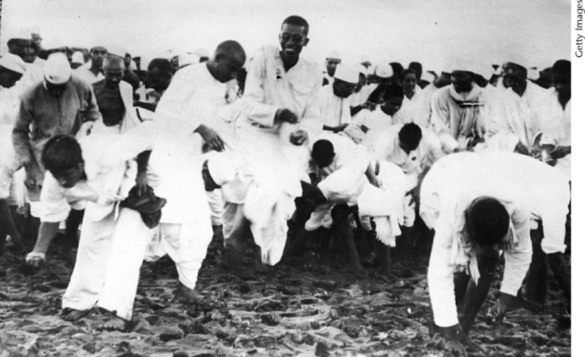
Gandhi (left background, bare-chested) arrives with his Salt Marchers at Dandi, 6 April 1931, to collect salt in defiance of British law.
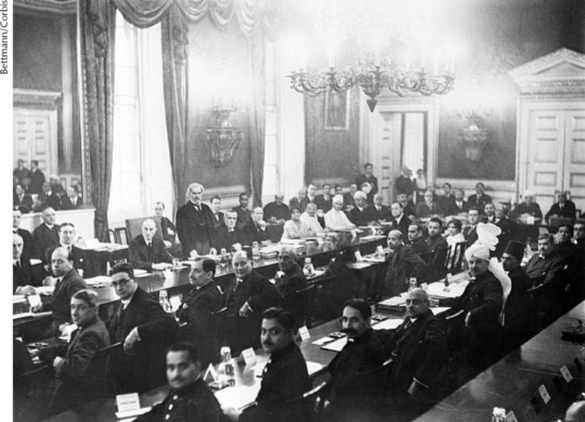
Ramsay MacDonald, standing, presides over the 2nd Round Table Conference, London, 1931. This attempt to move towards Indian self-rule failed, owing in part to the massive number of delegates. Gandhi is sitting centre, fourth right from MacDonald.
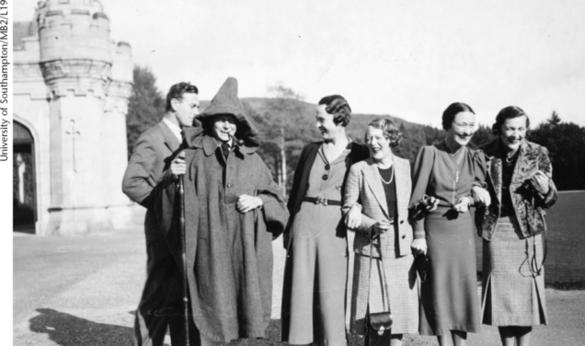
Balmoral, summer 1936: King Edward VIII (in cloak) is joined by friends, including (left) Dickie Mountbatten, and (right) Wallis Simpson and Edwina Mountbatten. A few months later, the King would abdicate to marry Mrs Simpson.
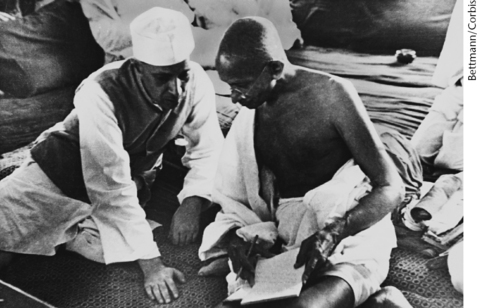
Grand strategy conferences
Jawaharlal Nehru and Mohandas Gandhi agreeing the ‘Quit India’ plan in defiance of the British raj, 1942.
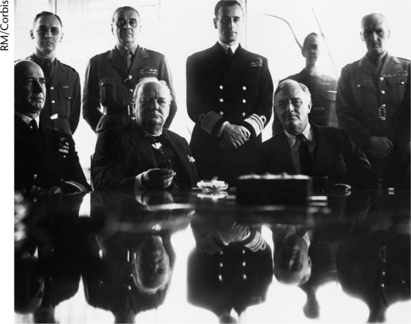
World War II Allies, 1943. Seated centre left, Winston Churchill; centre right, Franklin D. Roosevelt; standing, centre, Dickie Mountbatten. Sir Hastings Ismay is to the left of Mountbatten. Seated to the left of Churchill is Admiral Ernest King, who Mountbatten accidentally shot in the leg.

Captured in a rare moment of mutual good humour: Jawaharlal Nehru and Mohammad Ali Jinnah, 1946.
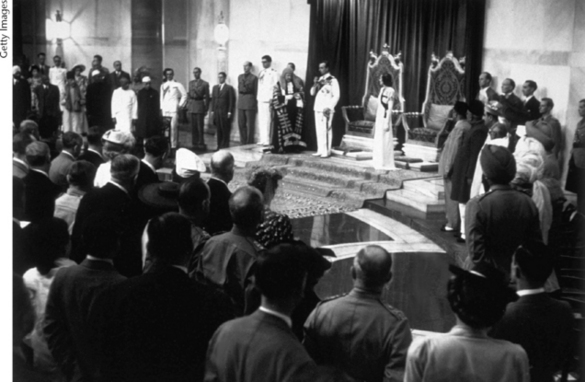
24 March 1947: Dickie Mountbatten is sworn in as Viceroy of India. Edwina is to the right of Dickie. Standing to the left of the picture can be seen Jawaharlal Nehru, in black sherwani and white cap; to the left of Nehru is Vallabhbhai Patel, in white khadi. Liaquat Ali Khan is standing to the right of Edwina, in a light suit and a black cap.

28 March 1947: At the Viceroy’s first garden party, Edwina sits on a sofa with Nan Pandit and Pamela Mountbatten. Jawahar sits at Edwina’s feet.

Front page news, 31 March 1947: Gandhi, at his first meeting with the Mountbattens, leans on Edwina for support.
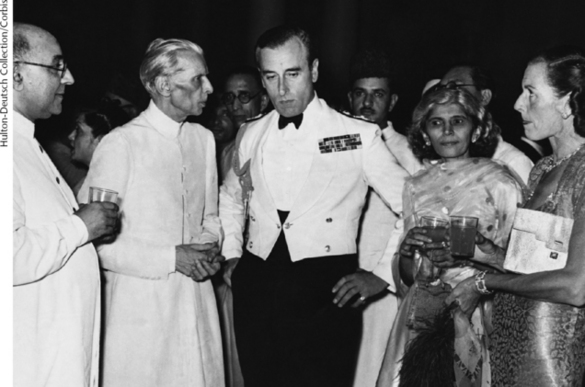
It was no secret that the Mountbattens got on less well with the Muslim League leaders. Left to right: Liaquat Ali Khan, Jinnah, Dickie, Fatima Jinnah, Edwina.
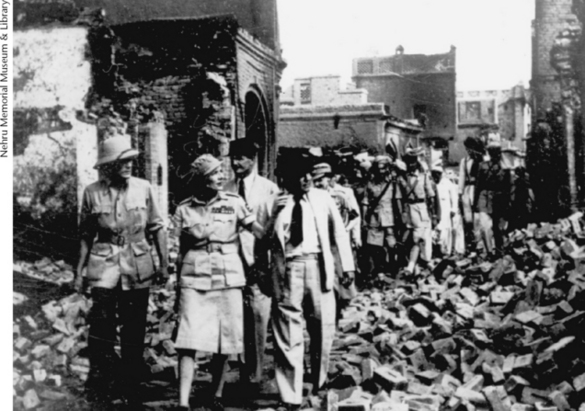
‘Like the Blitz at its worst’: Edwina inspecting riot damage in the Punjab, April 1947.
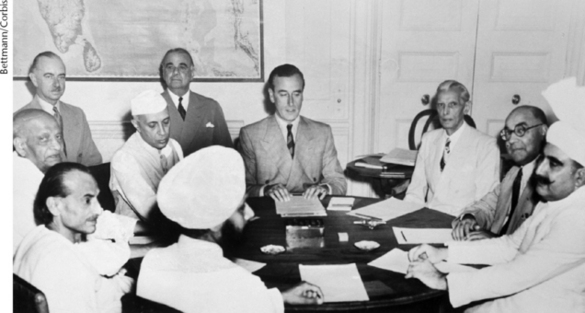
3 June 1947: for the first time in history, no party raises an objection to the plan for independence. Clockwise around the table from centre: Dickie, Jinnah, Liaquat, Abdur Rab Nishtar, Baldev Singh, K. R. Kripalani, Vallabhbhai Patel, Jawahar.
Independence days
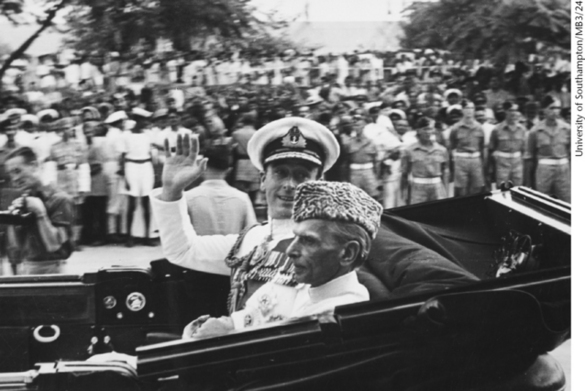
Pakistan’s Independence Day, 14 August 1947. ‘I won’t pretend I wasn’t scared’: driving through Karachi, Dickie and Jinnah maintain brave faces despite an assassination threat.

India’s Independence Day, 15 August 1947: a rainbow appears in the sky as the new flag is raised. Dickie salutes; to the right, Edwina and Jawahar in conversation.
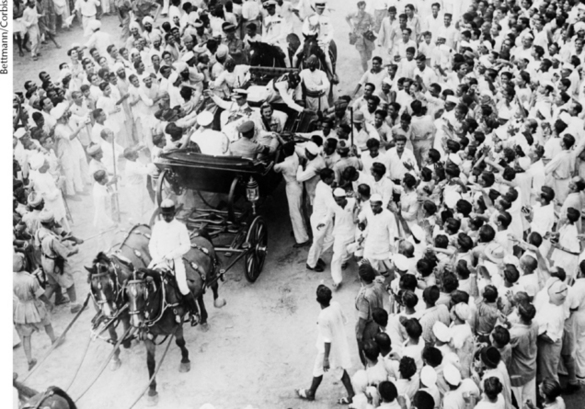
15 August 1947, Delhi: crowds greet the Mountbattens.

Calcutta, August 1947: Gandhi (with grand-niece Manu) plugs his ears against the screams of rioters.
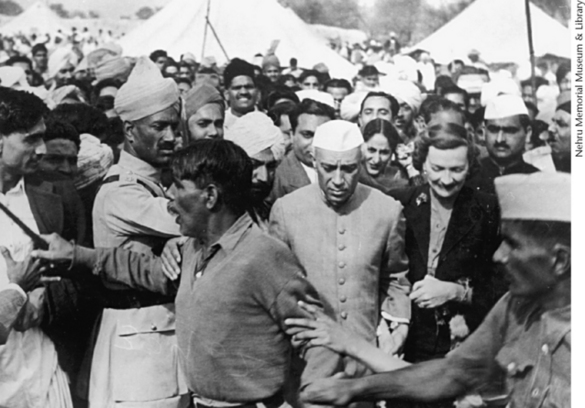
‘A great and unique love’: brought together by their work with the victims of India’s partition, Jawahar and Edwina can be seen holding hands during a visit to a refugee camp in this rare photograph.
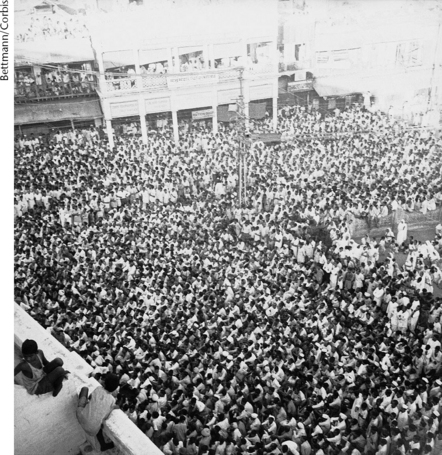
October 1947: crowds gather in riot-torn Delhi to hear Gandhi and Nehru call for peace.
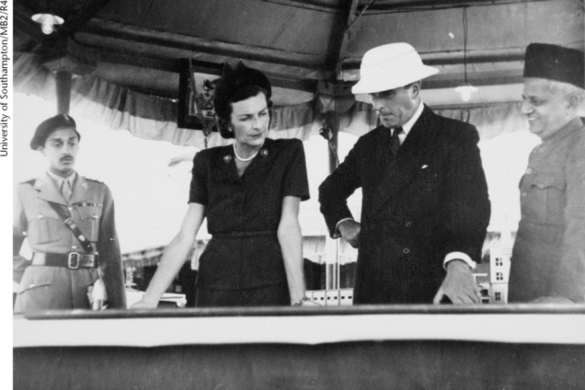
‘We have so long been the “Aunt Sally” of politics in India that our reappearance in that role is hardly surprising’: the Mountbattens in Gwalior during the Kashmir crisis, December 1947.
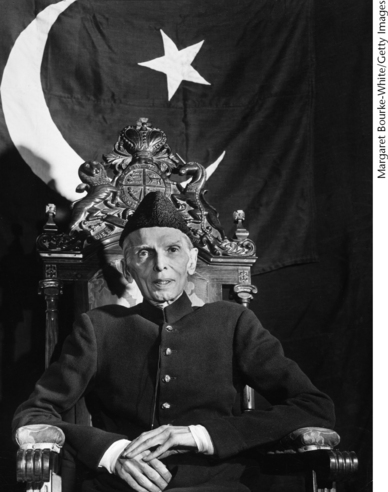
‘His sister slipped up before each photograph and tried gently to uncurl his desperately clenched hands’: the dying Jinnah photographed by Margaret Bourke-White, 1948.
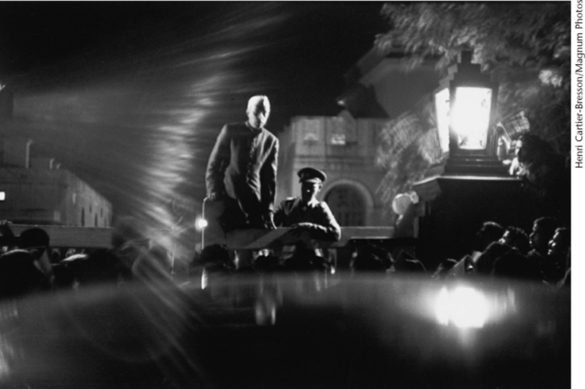
‘A thousand years later that light will still be seen in this country’: Jawahar climbs the gatepost of Birla House to tell the crowds of Gandhi’s murder, 30 January 1948.
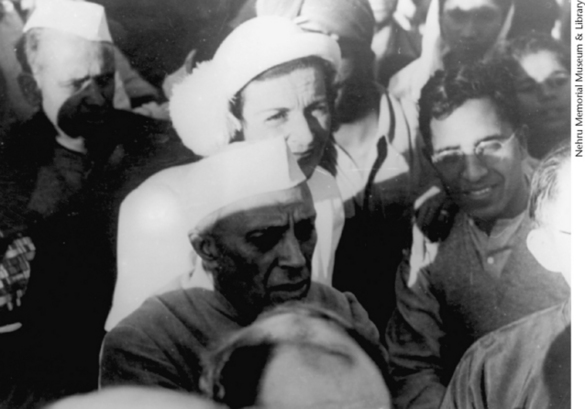
‘Only the eyes revealed stark anguish’: Jawahar (centre) at Gandhi’s funeral, 31 January 1948. Edwina sits behind him.

Mashobra, May 1948: Dickie and Pamela Mountbatten in their car, just outside the Governor-General’s Retreat. Edwina and Jawahar are in the back.
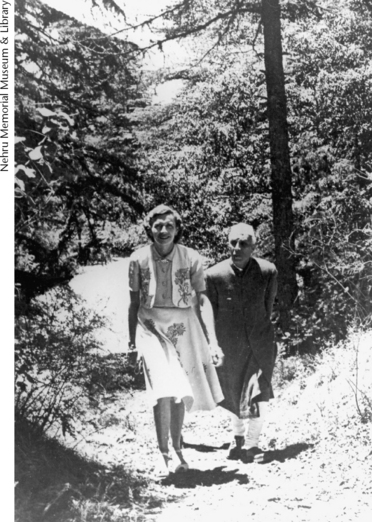
‘They really dote on each other in the nicest way’: Edwina and Jawahar walking together in the forests around Mashobra.
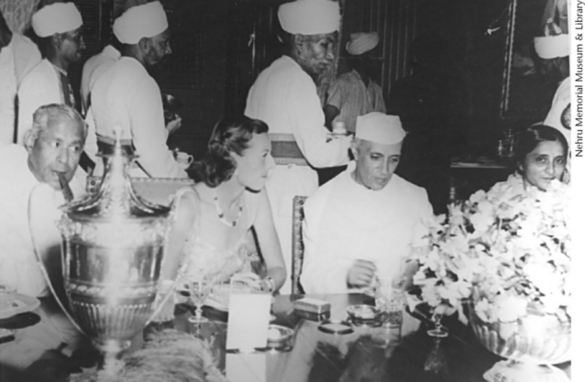
‘Hundreds of thousands will be sorrowful at the news that you have gone’: Edwina and a downcast Jawahar at the Mountbattens’ farewell dinner.
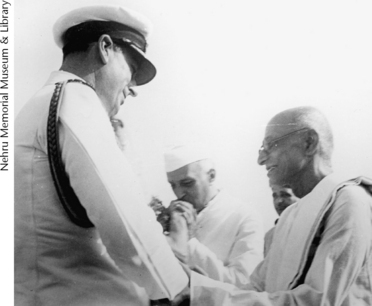
More goodbyes: Dickie bids farewell to Rajagopalachari while, in the background, Jawahar kisses Edwina’s hand.
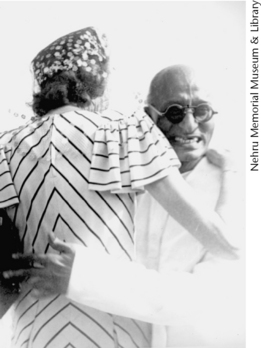
‘It was not a bang but with a kiss you left us’: Edwina hugs India’s new Governor-General, Chakravarty Rajagopalachari, as the Mountbattens leave for London, 21 June 1948.
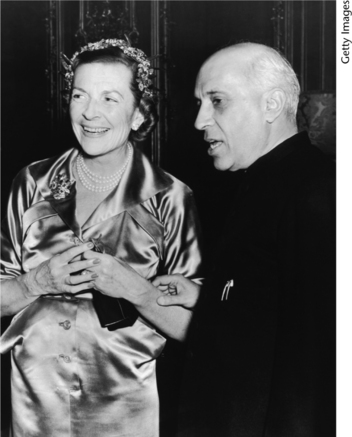
Keeping in touch: Edwina and Jawahar in London, 1955.

‘He had sat between Mrs Kennedy and her sister and with the light of love in his eyes’: Indian state visit to Washington, 1961. Left to right: Jacqueline Kennedy, Jawahar, Indira Gandhi, John F. Kennedy.

‘Theirs had been a harmony of difference, cemented by their mutual admiration for the Mahatma, on the one hand, and the very human Edwina, on the other’: Dickie is the first British visitor to Jawahar’s lying in state, 1964. With Dickie is Jawahar’s sister, Nan Pandit.