

A NEW IVAN was on the throne. He was the master in his own house, free to choose his own friends and advisers, no longer the suppliant of a self-appointed Regent. His first act after the murder of Andrey Shuisky was to recall Fyodor Vorontsov from his exile in Kostroma. While the Shuiskys fell, the Vorontsovs rose to power and prominence, and soon there were many members of the Vorontsov family in high positions. The process was perhaps inevitable, but it was also dangerous. In time, they too would fall.
The “angelic prince” who had been adored by the Muscovites at the time of the invasion by the Tatar Khan had given place to a prince who was proud and imperious, and knew how to give orders and expected them to be instantly obeyed. There had been streaks of cruelty in him long before he ordered the execution of Andrey Shuisky. It was observed that he sometimes vented his anger against the world by hurling dogs to the ground from the terrace of the Kremlin Palace. Prince Andrey Kurbsky, who knew him well but is not an altogether unbiased witness, hints at even more savage cruelties. By the time he was fourteen Ivan was amusing himself by riding with his young companions at breakneck speed through the squares and marketplaces of Moscow, robbing the merchants and flailing everyone within reach with his whip. Moscow was his private possession; he was a law unto himself, and no one dared to prevent him from riding roughshod over the Muscovites. There were always flatterers at court who would remark after one of theseescapades that he was merely demonstrating his manly qualities.
In September 1545, when Ivan had just turned fifteen and was about to embark on his annual pilgrimage to the Troitsa-Sergeyevsky Monastery, he was incensed because a certain Afanasy Buturlin, a young courtier from a well-known noble family, had not behaved with the absolute deference he demanded from his courtiers. Buturlin had said “some rude words,” and therefore must be punished. The punishment must fit the crime. Ivan decided that the offending courtier should have his tongue cut out in full view of the people of Moscow. A stage was erected outside the prison, and Buturlin suffered his punishment. Later, Ivan appears to have regretted this action, invited Buturlin to his court, and even appointed him to the Boyar Council.
Satisfied that he had inflicted an appropriate punishment on an offending courtier, Ivan accompanied his brother to the Troitsa-Sergeyevsky Monastery, where he was especially solicitous of the welfare of the monks, giving them sumptuous gifts of money and grain. Then he went off to his hunting lodge at Alexandrova Sloboda, where he spent several weeks before returning to Moscow. The fruit of his meditations in the hunting lodge was a stream of harsh orders, which were directed chiefly at the Vorontsovs, who were now in disfavor. Fyodor Vorontsov’s crime was that he was continually preventing Ivan from granting privileges and favors unless he had first examined and approved them. Ivan would explode with anger when his warnings were disobeyed. Dmitry Belsky, who worked long and patiently as president of the Boyar Council, was also in disfavor. Some members of the Shuisky faction like Prince Dmitry Paletsky, who had saved the life of the Metropolitan Ioasaf, were also summarily dismissed and in grave danger. Some weeks later, on the intercession of the Metropolitan Makary, they were pardoned. Ivan was demonstrating to his own satisfaction that he was quite capable of dismissing his favorites.
Trouble was brewing with the Tatars, but exactly what form the trouble would take was unclear. Intrigues among the khans and the pretenders in the Khanate of Kazan were continually being fanned by the Russians. In January 1546, while in Vladimir during a tour of inspection of the provinces, Ivan learned that there had been an uprising in Kazan. Khan Safa Guirey, and his friends and advisers from the Crimea, had fled the city and the pro-Russian faction wanted Shigaley to become Khan of Kazan under Russian protection. The unexpected news delighted Ivan, who was well aware of the difficulty of working with the Tatars and therefore acted cautiously. Not until June did an official embassy accompany Khan Shigaley to Kazan, where he was enthroned and where in the presence of Dmitry Belsky he swore an oath of loyalty to the Grand Prince. The Khanate of Kazan was once again a vassal state.
The Khan of the Crimea threw himself into a frenzy of activity. At all costs it was necessary to destroy Muscovite influence in Kazan, which had formerly been ruled by his nephew Safa Guirey. There had been a palace revolution brought about by Russian intrigues and Russian money. He, too, could create a palace revolution and in addition he could wage another war against Muscovy. Spies from the Crimea reported that Khan Saip Guirey intended to lead an army against Moscow by way of Kolomna on the Oka River. Accordingly the Russians transformed Kolomna, a town of about 4,000 inhabitants, into an armed camp. In May 1546 Ivan established his temporary capital in this southern town at the junction of the Moskva and Oka rivers. He was in good spirits. A vast army was gathered around him, there were processions and parades, and good hunting in the nearby forests. The radiant young Grand Prince was enjoying a prolonged summer holiday.
According to the Piskarevsky Chronicle he especially liked to amuse himself with people of his own age. He plowed the fields, sowed buckwheat, dressed himself up in strange costumes, walked on stilts, and enjoyed a game called “playing at boyars,” which apparently had nothing to do with boyars but was a kind of rowdy charade with young men carousing on the eve of an imaginary wedding. Boating, hunting, holding military reviews, acting in charades, and playing games filled his days. The Khan of the Crimea had called off the invasion, or at least there was no sign of his army. Kazan, having become a Russian vassal state, immediately threw off the Russian yoke. Khan Shigaley reigned for a few days and then fled for his life to the safety of Russian territory.
In Moscow power was now being wielded by the Glinskys—the Princes Yury and Mikhail Glinsky who were Ivan’s uncles, and his grandmother, Princess Anna Glinskaya. The Muscovites detested them, for they were cruel and grasping. Ivan adored them, because they permitted him to do whatever he pleased and removed from his shoulders the burden of making decisions.
The long summer made longer by the interminable waiting for the Khan’s army was half over when Ivan demonstrated once more that he was capable of ferocious brutality. He was hunting near Kolomna when about fifty musketeers from Novgorod approached him with a petition. He was in no mood to receive petitions, ordered his nobles to send them away, and was exasperated when the Novgorodians instead of departing peacefully began to pelt the nobles with clumps of mud and to knock off their hats. Ivan, who was at a safe distance, called upon the nobles riding in the rear of his party to join forces with the rest. The Novgorodians were armed with long staves and muskets; the nobles were armed with swords and bows and arrows. There was a skirmish, five or six people were killed on each side, and Ivan was terrified. He gave orders to abandon the hunt and to return to his wood-and-stone palace in Kolomna. The musketeers were still standing in his way, and he was therefore compelled to take a roundabout route.
The Novgorodians had disobeyed his orders and affronted his dignity. It was necessary to give them exemplary punishment. It was also necessary to discover who was behind the conspiracy, for he was firmly convinced that they were conspirators. His private secretary, Vasily Gniliev-Zakharov, was given full powers to investigate the actions of the Novgorodians. It seems never to have occurred to Ivan that they might have had legitimate cause for complaint.
Vasily Gniliev-Zakharov was one of those men who thrive on investigations. He assured Ivan that the conspiracy had been organized by the boyars Ivan Kubensky and Fyodor and Vasily Vorontsov, all of whom held commands in the army at Kolomna. Kubensky was second in command of all the armed forces and Fyodor and Vasily Vorontsov held commands in the field. Implicated in the conspiracy were Vasily Vorontsov’s brother Ivan and a certain Ivan Cheliadnin, the Master of the Horse, who belonged to a famous boyar family. Ivan Vorontsov was put to the torture and sentenced to exile. Ivan Cheliadnin, who knew the Grand Prince well, realized that his life depended upon agreeing to all the charges levelled against him. His clothes were stripped off him and he wasforced to plead naked. Ivan sentenced him to exile in Beloozero, and all his vast possessions—for he was one of the richest men in Russia—were forfeited to the Grand Prince.
The main brunt of punishment fell on Ivan Kubensky and Fyodor and Vasily Vorontsov. They were powerful and important dignitaries, and Fyodor Vorontsov had once been Ivan’s closest friend and confidant. It was known that Fyodor Vorontsov profoundly distrusted the Glinskys, and it is possible that the Glinskys assisted Vasily Gniliev-Zakharov in manufacturing evidence against him. On July 21, 1546, with their hands tied behind their backs, all three were brought before Ivan, who sat on a portable throne outside his tent. In a rage Ivan ordered their immediate execution. A contemporary miniature in the Tsarstvennaya Kniga (The Book of the Kingdom) shows how they were forced to lie on the ground while their heads were chopped off by an executioner with a long-handled ax. About this scene, as drawn by a monkish illustrator, there hovers an air of quiet inevitability with the victims casually accepting their fate; and their heads rest lightly on the earth.
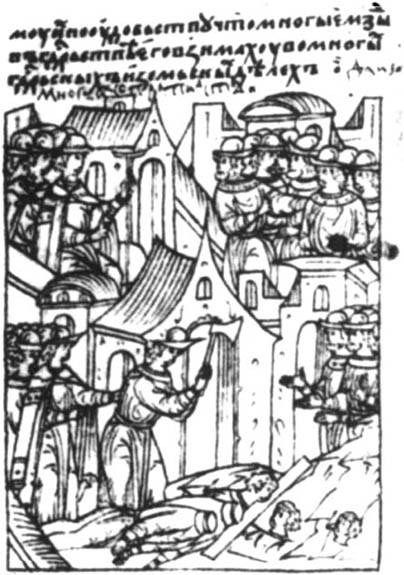
The execution of Prince Ivan Kubensky and the Vorontsov brothers. (From the Nikon Chronicle with Miniatures)
The Glinskys were now completely in power, with Mikhail Glinsky occupying the office of Master of the Horse, a title which concealed immense powers and privileges. Prince Kurbsky wrote that Mikhail Glinsky was “the root of all evil,” but this was to underestimate Ivan’s own involvement in the affairs of the nation. The Tsarstvennaya Kniga says: “The Glinskys were close to the Grand Prince and in his favor, and they permitted their followers to rob and oppress the people, doing nothing to stop them.” Some contemporary historians believe the note was added in Ivan’s own hand.
Three weeks after the executions in Kolomna Ivan returned to Moscow, and in September, in great state, he made his annual ceremonial visit to the Troitsa-Sergeyevsky Monastery to pray at the tomb of St. Sergius. A few days later he set out on a ceremonial tour of the great monasteries and churches, as though to prepare himself spiritually for his forthcoming coronation. He went on to Mozhaisk, Volokolamsk, Rzhev, Tver, and Novgorod, which he reached early in the morning of Sunday, November 14, 1546, to be met by Archbishop Feodosy and a huge concourse of people, the clergy carrying crosses and icons. He stayed in the palatial house of a prominent citizen, Kazarin Dubrovsky, who was later, for the crime of bringing up the artillery too late during a battle in Livonia, hacked to pieces at Ivan’s orders. But for the moment everything in Novgorod was arranged to please the young Grand Prince, and as he continued his journey to Pskov and then to the great Pechersky fortress-monastery, which stood on the Livonian border and was heavily guarded by a detachment of musketeers, he seemed to be enjoying a triumphal progress. His brother Yury and his first cousin Vladimir of Staritsa accompanied him in these journeys and shared in the adoration showered on him.
These ceremonial visits were always costly, and inevitably the ordinary people had to pay for them. The Pskov Chronicle hints at some disquieting aspects of Ivan’s character. “While Prince Yury caused not the slightest harm to his patrimony,” wrote the chronicler, “the Grand Prince raced about all the time on post horses, causing much expense and hardship.”
From Pskov Ivan returned to Novgorod, and then made the long and exhausting journey to Tikhvin, far in the north, where in the Cathedral of the Dormition he worshipped a wonder-working icon of the Virgin. This long pilgrimage had many purposes, and not the least of them was to acquire spiritual merit through the contemplation of as many icons as possible. He reached Moscow on December 12, 1546. During the following month preparations were made for the coronation, which was expected to be the most splendid and the most sumptuous in Russian history.
In Russia, where Church and State were closely intertwined, subtle changes were continually taking place in order to redefine their relationship. The nature of spiritual and earthly power were changing. New concepts, new legends, new arguments were constantly being brought forth to buttress the claims of Church and State. Some legends were invented out of the whole cloth, while others arose by a process of spontaneous generation to fulfill the human need for certainties or to fill up gaps in history. A certain Spiridon Savva, appointed Metropolitan of Kiev by the Patriarch of Constantinople in 1471, was removed from office by the Grand Prince Kazimir of Lithuania and expelled from the country. He came to Russia and went to live in the Ferapontov Monastery in Beloozero and devoted his time to writing imaginative history. In 1510, when he was already an old man, he sent a long epistle to the Grand Prince Vasily III in which he recorded the august descent of the Grand Princes of Moscow. Ultimately the Grand Prince’s authority derived from Noah, Sesostris, “the first King of Egypt,” Augustus Caesar, and the Byzantine Emperors. Spiridon Savva wrote that at his coronation Augustus Caesar had worn the kingly robe of Sesostris and “the crown of King Porus of India, which Alexander of Macedon brought from India.” Augustus Caesar commanded the whole earth and sent his brother Prus to rule over the regions bordering on the Baltic. In the course of time Rurik, the direct descendant of Prus, became the first ruler of Russia and the ancestor of all the Grand Princes of Moscow. But this was only one of the streams of authority that reached out to the Grand Princes. In 1114 Prince Vladimir Monomakh of Kiev was crowned by an envoy of the Byzantine Emperor with all the insignia of the imperial dignity; it was as though the Byzantine Emperor himself had been present. The evidence of the coronation lay in the jewelled “crown of Monomakh.” Thus from imperial Rome and imperial Byzantium the Grand Princes of Moscow derived their imperial authority.
Even before Spiridon Savva wrote his epistle to Vasily III the theory that Moscow was “the Third Rome” was widely current. The monk Filofey of Pskov had spoken about “the Third Rome” about 1500, and it is likely that other monks had used these words before him. Indeed, with the capture of Constantinople by the Turks in 1453, there were many Russians who felt that the leadership and defense of Orthodox Christianity had fallen by default on Moscow and its Grand Prince.
Gradually these ideas had begun to penetrate the minds of the Russian people, who saw in Ivan IV more than a Grand Prince. In their eyes he possessed almost the dimensions of a divinely appointed world emperor.
The Russian Church was well satisfied with this new concept and the Metropolitan Makary went to great lengths to create a coronation ceremony which would reflect the new importance of the new ruler of Muscovy. Previous coronations were studied. Unhappily there was some doubt about the validity of the documentary material. It was known that Vasily III had never been crowned. There existed however a lengthy account of the coronation of Grand Prince Dmitry, the eldest grandson of Ivan III. The Grand Prince had been deposed, but his coronation ceremony was closely followed by the Metropolitan Makary when Ivan was crowned.
Such ceremonies were always immensely long and intricate. There were prayers, acclamations, blessings, recitals from Holy Scripture. The coronation platform, covered with purple cloth, was erected in the middle of the Cathedral with steps leading down to the Royal Gate. The Icon of the Virgin of Vladimir, said to have been painted by St. Luke, was prominently displayed. On a table near the Royal Gate rested the regalia, which consisted of a jewelled cross, a scepter, a jewelled stole known as barmy, and the crown of Monomakh. The thrones of Ivan and the Metropolitan on the coronation platform were covered with cloth of gold. Ivan, the nobility, and all the boyars wore gold vestments which flashed and gleamed in the light of a myriad candles. It was as though the Cathedral had suddenly become transformed into a golden radiance.
On that day, January 16, 1547, the Grand Prince of all Russia received for the first time the title of Tsar. This title had been used tentatively and discreetly in the past. Henceforth the ruler of Russia would be known as Tsar and Grand Prince, and the title was in no way tentative. This was what he called himself and how he expected to be addressed.
At the coronation ceremony Ivan delivered a speech in which he claimed the title of Tsar and Grand Prince. He said:
Father, Most Holy Metropolitan by the will of God, our ancestors, the Grand Princes, have from the earliest times to the present day handed down the Grand Principality to their eldest sons. Thus my father, Grand Prince Vasily Ivanovich of all Russia during his lifetime endowed me with the Grand Principality of Vladimir and of Moscow and of Novgorod and of all Russia, and commanded that I should ascend the grand princely throne and be anointed and crowned with the Tsar’s crown, according to our ancient customs. And my father, the Grand Prince, wrote about this in his testament.
Therefore, our father, thou shouldst bless my ascension to the throne and pronounce me Grand Prince and Tsar crowned by God. Thou shouldst crown me now with the Tsar’s crown according to the ancient ceremonies of the Tsars and according to God’s will and the blessing of my father, Grand Prince Vasily Ivanovich.
Here the formula is still not completely crystallized, but we are able to see it emerging through veils of mythology and tradition. What in the past had been called the grand princely crown has become the Tsar’s crown, and what is now the Tsar’s throne is described as the grand princely throne. Ivan’s father is not the Tsar but the Grand Prince, and Tsardom belongs to Ivan alone.
These were not small matters for they involved immense changes of attitude and new definitions of the powers possessed by Ivan. In the eyes of Makary, who wrote Ivan’s speech, a new dispensation of time had come into existence. Ivan was given absolute authority over everything that belonged to Caesar, but the Metropolitan warned him that he must seek to inherit the Kingdom of Heaven “by the performance of virtuous deeds” and he commanded the new Tsar to be obedient to the Church.
The very word “Tsar” invoked a new absolutism, but Makary went to some pains to insist that the rights of an absolute monarchy were outweighed by its duties. He must dispense justice without fear or favor, preserve the people from their enemies, and walk humbly in the sight of God. He was urged to succor the poor and respect all priests, and to ensure that no high offices were bought with bribes. He must be compassionate and accessible to all, so that at the time of the Second Coming he will be able to say: “Here I am, O Lord, and here are the people of Thy great Russian Tsardom, whom Thou hast entrusted to me.” “Then,” said Makary, “thou shalt hear the sweet voice of the Tsar of Heaven saying: ‘Good and faithful servant, O Russian Tsar Ivan, thou hast been faithful to me over a few things, I will make thee ruler over many things: enter then into the joy of thy Lord.’ ”
Makary’s sermons and invocations were all designed to exalt the Caesar who wore a heavy jewelled cross on his chest, the jewelled barmy over his shoulders, and a jewelled crown. In addition he wore a gold chain which was said to have been a gift from the Emperor of Byzantium. Finally he was anointed with holy oil on his ears, chest, shoulders, palms, and the back of his hands, and when he left the Cathedral to show himself to the people his brother Yury three times showered him with gold and silver coins.
It was a long and exhausting ceremony; many hymns were sung; many bishops, archimandrites, and abbots took part; many precise movements were made; and Ivan acquitted himself well. But the Ivan who entered the Cathedral that morning and the Ivan who left it later in the day were like two different people. The new autocrat of all Russia henceforth believed firmly that he had been crowned by God, and that the destiny of every Russian lay within the anointed palms of his hands.
Headstrong, nervous, wildly erratic and excitable, Ivan had all the makings of a bad Tsar. Only one thing could save him—a good wife. To Makary he had expressed a desire to marry immediately after his return from Novgorod and Tikhvin, saying that he intended to marry a Russian woman and not a foreign princess. Makary was overjoyed, and it appears that he already had a bride in view. She was Anastasia Zakharina, the daughter of a boyar, Roman Zakharin, who had died a few years earlier, and the niece of Mikhail Zakharin who had been one of the prominent members of the court of Grand Prince Vasily III. In those days surnames changed with alarming rapidity, and the Zakharins were known at various times as the Koshkins, the Yurievs, and the Romanovs.According to tradition the family descended from a Prince Kobyla who had entered Russia from the region now known as East Prussia during the thirteenth century, but the name first appears in historical records in 1347 when Andrey Kobyla was a trusted boyar attached to the court of Grand Prince Simeon of Moscow. Anastasia was beautiful, sweet-tempered, and deeply religious. She was also distantly related to Ivan through the marriage of a granddaughter of Fyodor Koshkin to the Grand Prince Vasily II. There were no possible impediments to the marriage, which was celebrated with great pomp on February 3, 1547, less than three weeks after the coronation.
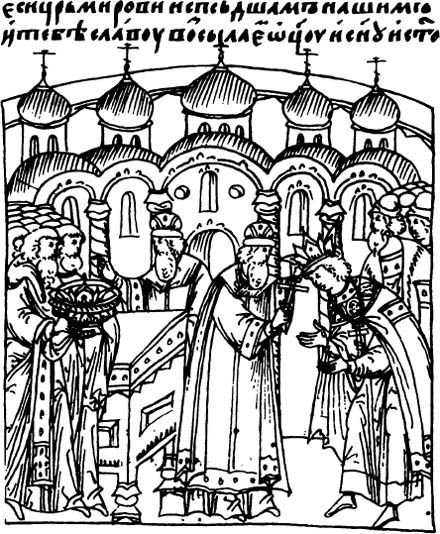
The Coronation of Ivan. (From the Nikon Chronicle with Miniatures)
At the wedding ceremony in the Cathedral Ivan and Anastasia stood side by side on a carpet of red damask bordered with sables. Makary gave them a glass beaker filled with wine, and after they had sipped the wine, Ivan tossed the beaker on the ground and ground it under his heels. After the ceremony they breakfasted together, and Ivan spent the rest of the morning on horseback visiting the neighboring monasteries. The festivities continued in the bedroom, where the bride and groom were surrounded with the symbols of ancient fertility cults and symbols representing long life, wealth, and contentment. They followed the same rituals practiced at the wedding of Vasily and Elena. At night Anastasia’s younger brother, Nikita Zakharin, slept beside the bed, while Mikhail Glinsky, the Master of the Horse and the second most powerful man in Russia, rode on a stallion with a raised sword in his hand below the bedroom windows. Over the bed hung an icon of the Nativity, an icon of the Virgin, and a crucifix. The arrows shot into the corners of the room signified that all enemies would be kept at bay.
On the following morning Ivan and Anastasia went to their respective bathhouses. Nikita Zakharin accompanied Ivan, and they poured hot and cold water over each other. Then the bride and groom returned to the bedroom and were served bowls of kasha.
The festivities lasted for several days, the church bells pealed, and the Muscovites rejoiced. A miniature in the Tsarstvennaya Kniga shows Ivan and Anastasia wearing their crowns while being blessed by the Metropolitan and in another scene we see them sitting at table among their courtiers who lift their goblets and wish them long life. Two weeks after the wedding Ivan and Anastasia set out on foot in pilgrimage to the Troitsa-Sergeyevsky Monastery where, accompanied by the members of the court, they spent the first week of Lent attending services and every day praying at the tomb of St. Sergius. Expensive gifts were showered on the monks, who showered them with blessings. It was generally believed that Ivan under the guidance of Makary and with Anastasia beside him would settle down to a life of quiet and purposeful activity.
Yet there was very little to justify this belief. He refused to permit marriage to restrain his natural impulses and rarely listened to Makary. The coronation ceremony had intoxicated him with his own glory. He was Grand Prince, Tsar, Autocrat, successor to Sesostris and Augustus Caesar, and nothing could be denied to him. The Glinskys ruled insolently and corruptly, apparently unaware that they were detested both for their actions and their Lithuanian origins, appointing corrupt governors at their pleasure and deliberately indulging Ivan’s whims so that he would have less time to deal with government affairs. At the coronation ceremony Makary urged Ivan to cherish the people, but he was indifferent to them and hated them when they got in his way.
The people of Pskov, suffering under a corrupt governor, Prince Turantay-Pronsky, who had been appointed by Mikhail Glinsky, sent a deputation of seventy citizens to Moscow to plead for the removal of the governor. They caught up with the Tsar at the village of Ostrovka near Moscow. It was March, with the snow on the ground, and the deputation of elders solemnly presented the Tsar with the petition, expecting that at the very least he would listen to their arguments and treat them respectfully. Instead he cursed and abused them, poured hot wine over their heads, set their beards on fire, and then commanded them to strip and lie naked in the snow. He was contemplating more indignities when suddenly messengers galloped into the village with news that the great bell that summoned people to church in Moscow had fallen. Ivan ordered his horse to be saddled and galloped off to see something more exciting than seventy elders lying in the snow.
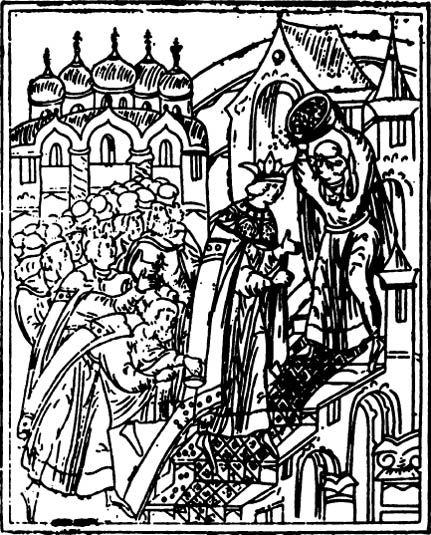
After the coronation gold and silver coins were showered on Ivan by his brother Yury. (From the Nikon Chronicle with Miniatures)
Moscow was dry tinder, always in danger of going up in flames. Every year there were conflagrations; whole streets went up in flames and the fires burned themselves out. Long ago a system of fire watchers had come into existence but had not proved to be especially efficient. In the spring of 1547 there were two large fires. Many houses and shops were destroyed and a powder tower inside the Kremlin blew up, the bricks scattering like projectiles in all directions. Both of these fires had suspicious origins, arsonists were suspected, and many people were arrested and put to the torture until they confessed, and they were then beheaded or impaled or thrown into a bonfire. But no one knew in fact whether arsonists were responsible. It was the year of Ivan’s coronation and marriage, a year of evil omens. Moscow was full of strange rumors that ghouls called serdechniki were wandering abroad and removing people’s hearts. There was an air of expectancy: something dreadful was about to happen but no one knew for certain from what direction it would come.
On June 21, 1547, at ten o’clock in the morning, a fire began in the Church of the Exaltation of the Cross on crowded Arbat Street and within an hour the entire area beyond the Neglinnaya River had gone up in flames. A strong wind was blowing, the fire took the form of sheets of flame moving at will across the city, and when the wind changed direction, the flames stormed across the Kremlin walls. The Tsar’s palace caught fire. His stables, his armory, his treasury went up in flames. Within the treasury he kept his regalia, vast stores of gold plate, and the jeweled cross containing a fragment of the True Cross. The golden-domed Cathedral of the Annunciation, which stood next to the treasury, caught fire, and all its treasures, including the great icon of the Deisis by Andrey Rublev, perished. The roof of the Uspensky Cathedral caught fire, but although the interior was filled with smoke, its treasures survived and the icon of the Virgin of Vladimir was untouched. Makary was in the cathedral when the roof burst into flames. He escaped and succeeded in making his way to the Tainitskaya Tower on the Kremlin wall, where others had taken refuge. At midnight, when flames were still lapping the city, he was lowered down by a rope to the river bank below, but the rope broke and he had a bad fall. Half dead, he was carried to the Novinsky Monastery.
Long-famous buildings inside the Kremlin vanished. The Chudov Monastery was destroyed, and eighteen monks and eight servants perished. The Voznesensky Monastery, where the wives of the Grand Princes were buried, also burst into flames; the charred bodies of ten monks were found in the ashes. The wooden galleries along the top of the Kremlin wall vanished; the powder kegs blew up; and nothing was left of the stone building that housed Ivan’s extensive wardrobe. The gilded roof of the Golden Palace melted in the heat of the flames.
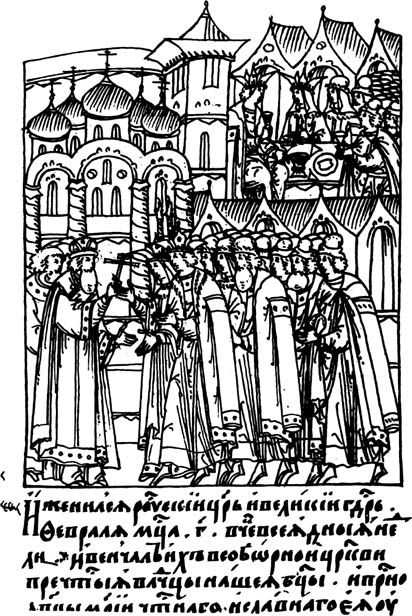
The wedding of Ivan and Anastasia in the foreground and the wedding feast at top right. (From the Nikon Chronicle with Miniatures)
In Kitay Gorod only two churches, ten shops, and a few private dwellings, including some of the palatial houses on the Varvarka, survived. The fire spread beyond the walls east and north of Kitay Gorod; the houses and the vegetable gardens and all the vegetables were reduced to cinders. The roaring of the flames drowned the cries of the helpless. Moscow was transformed into a great crackling bonfire under a black cloud of smoke which was torn into ribbons by the strong winds. Flames fed on flames; stone buildings crumbled or exploded; wooden houses became puffs of smoke; people with smoke-blackened faces wandered desolately through fields of ashes. In the eyes of the Muscovites the city was being punished for its sins, and it was especially remembered that God had not spared the churches or the relics of saints. The Nikon Chronicle says:
The fire came to an end at the third hour of the night. God punished us for our sins because they had multiplied and He did not save the relics of the saints and a vast number of our churches. In a single hour seventeen hundred men and women, not counting small children, perished in the houses and gardens. For God, in his just judgment, brings us to repentance through fire and famine and plague and war.
For Ivan, too, as he watched the flames from his palace on Sparrow Hills, the fire of Moscow seemed to be a visitation of God. He was visibly shaken when, on the second day after the fire, he attended a meeting of the Boyar Council at the Novinsky Monastery. The meeting was convened at the monastery so that Makary could attend, and it was here that Ivan first learned from the lips of his own confessor, the archpriest Fyodor Barmin, that the people of Moscow thought they knew how the fire had come about. The mysterious serdechniki had been removing people’s hearts, soaking them in water and then sprinkling the city with this water which had acquired the magical power of setting fire to everything it touched. This, they said, was how the fire of Moscow had been brought about. The archpriest’s words were supported by the boyars Fyodor Shuisky and Ivan Cheliadnin, who had been pardoned and had now returned to court. This was a matter worth investigating and Ivan gave orders for the establishment of a commission to examine the problem of the serdechniki.
The people of Moscow were naturally credulous, a prey to rumors, but they were also hardheaded and resolutely conspiratorial. They may have deliberately spread the rumor in order to incriminate the Glinskys and their followers who oppressed the people and metaphorically tore out their hearts. On Sunday, June 26, five days after the great fire, the commission of boyars met outside the Uspensky Cathedral in the presence of a large gathering of Muscovites who were in an angry mood. Many people had lost all their possessions; they had lost their families; they hated the Glinskys and feared the Tsar. They could not blame the Tsar directly but they could blame Princess Anna Glinskaya, the Tsar’s grandmother, and all her descendants. They told the boyars: “Princess Anna Glinskaya and her children and her servants have practiced magic, and she herself has taken out the hearts of people, soaked them in water, and she has gone driving through Moscow, sprinkling the water, and thus Moscow was burned down.”
At this time Prince Mikhail Glinsky and his aged mother, the Princess Anna Glinskaya, were living on their estates at Rzhev, and out of reach. But Prince Yury Glinsky, Mikhail’s brother, had recently arrived in Moscow and was actually present on the square outside the cathedral. He, too, was being accused of practicing magic against the people. He was recognized, and fled for safety into the cathedral, hoping to receive sanctuary. But the crowd surged after him, killed him, dragged his body through the main gates of the cathedral and carried it triumphantly to the place of execution on the Red Square, where it was exposed for everyone to see. In this way they wanted to show that Prince Yury Glinsky had been justly executed for his crimes.
Having disposed of Prince Yury, the crowd turned against the members of his household, his servants and retainers, hounding them to death and pillaging whatever property of the Glinskys had survived the fire. The chief enemy was still Princess Anna Glinskaya, and the crowd was now demanding her death, shouting that she was the magician who had set fire to Moscow by transforming herself into a magpie and dropping the magical water that caused the fire. This was perhaps easier to believe than that she had driven through the city in a carriage, tossing water out of the window.
Soon the rumor spread that Princess Anna and Prince Mikhail were hiding in Ivan’s palace on Sparrow Hills and simultaneously there came the rumor that the Glinskys were in secret communication with the Tatars who had pitched their tents on the southern frontier and were preparing to invade Russia, or so it was believed. At all costs the witch and her brood must be executed. With the double purpose of destroying the Glinskys and defending Moscow from the invaders, the crowd rushed to Sparrow Hills, having armed themselves with whatever weapons they could lay their hands on. Ivan saw the mob approaching Sparrow Hills and was terrified. He had good reason to be terrified. The mob demanded that Princess Anna Glinskaya and Prince Mikhail Glinsky should be handed over to them, and it was obvious that they proposed to deal with Ivan’s grandmother and uncle exactly as they had dealt with Prince Yury Glinsky. Ivan succeeded in convincing the mob that he was not hiding the Glinskys and they finally left him in peace. Infuriated that he should have been placed in such great danger, he ordered an investigation, and the arrest and execution of the ringleaders. Most of them had fled. Prince Mikhail Glinsky and his mother had also fled. They abandoned the family estate at Rzhev and took refuge in a monastery.
In later years Ivan complained in a famous letter to Prince Kurbsky that the boyars deliberately spread rumors that the Glinskys started the fire. They also spread rumors that Ivan knew all about it. In the letter Ivan defended himself at considerable length and with great heat. “Who would be so mad or ferocious,” he asked, “as to destroy his own property out of rage against his own subjects?” He had lost his palaces, his treasury, much of his inherited wealth. Dogs and traitors were at work, for how otherwise could one explain the murder of his uncle in the Chapel of St. Demetrius of Salonica in the Uspensky Cathedral? Ivan proclaimed his total innocence; he had nothing whatsoever to do with the fire, and it was beyond belief that his grandmother could have sprinkled magic fire-breathing waters on the city from a great height. He raged against the boyars “who assembled without our knowledge like a pack of dogs” on the square outside the cathedral and then murdered Prince Yury Glinsky, and he found it hard to understand why the Glinskys were so fiercely hated. He was determined to find an explanation for these terrible events.
Sylvester, a priest who had recently arrived from Novgorod and was attached to the Cathedral of the Annunciation near the Kremlin Palace, provided the explanation. He was a man who possessed innate authority; Ivan was taking spiritual guidance from him. According to Sylvester the fire was a punishment sent by God; the murder of his uncle was also a punishment; henceforth he must walk in the paths of righteousness in the fear of the Lord. Sylvester’s hold on Ivan was all the greater because he was not afraid to speak of prophecies, apparitions, and miracles; he was a practical man of the world, but he was also a mystic; and he convinced Ivan that he knew the answers to many mysteries. Prince Andrey Kurbsky later suggested that Sylvester was compelled to practice deception. He wrote: “In this way perhaps did that blessed man deceive Ivan for a good purpose, healing and purifying his soul from leprous sores and restoring his depraved mind, thus leading him along the path of truth.” Sylvester was like a surgeon who cuts away gangrened limbs to save the patient from death.
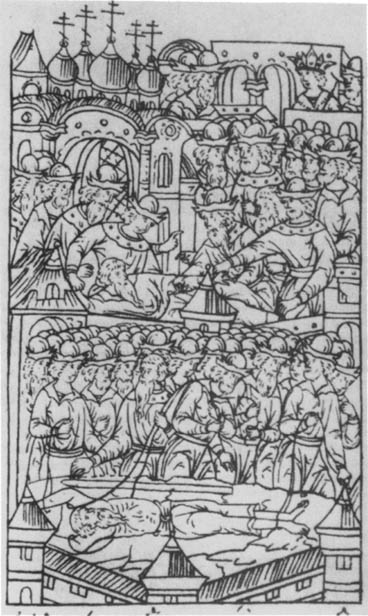
The killing of Prince Yury Glinsky, June 26, 1547. Ivan appears at top right. At center Prince Glinsky is being dragged out of the Cathedral and at bottom he is dead.
Henceforth for a few years we shall see Ivan standing in fear and trepidation before God, the stern figure of Sylvester beside him. He is trying to do good and setting aside his childish ways, trying to act responsibly and behaving with cautious dignity toward the boyars. The good Tsar Ivan, almost beyond hoping for, had finally emerged.
Nevertheless, as we shall see, Sylvester’s strong medicine was too strong. Without being aware of it, the clever priest planted in Ivan the seeds of a rebellion which was perhaps even more dangerous than the original rebellion. In due course Ivan would turn away from Sylvester and abandon the strict code of morality enforced upon him by a man much older and wiser than himself. He would throw morality to the winds and destroy everything in his path.