
CHAPTER FIVE
While the hand of fate made Jack and me political opponents, I always cherish the fact that we were personal friends from the time we came to the Congress together in 1947.
—Richard M. Nixon, from a letter written to
Jacqueline Kennedy, November 22, 1963
Jack Kennedy knew well before going to the House of Representatives that he didn’t intend to stay there. He was headed for statewide office, either the governorship or the U.S. Senate. Even if he opted for the governorship first, it was only to be a stepping-stone. His goal was the Senate, since what he really wanted was to join the big national debates, especially those on foreign policy. That was where he intended to make his mark.
There were no near-term options for reaching his goal. If he ran against Senator Leverett Saltonstall in two years—in ’48—he would look impetuous. Besides, he’d formed an affection for the older man. But if he waited to run against the other senator from the Commonwealth of Massachusetts, the august Henry Cabot Lodge, Jr., in 1952, it might be a suicide mission.
Lodge had sacrificed his first seat in the Senate to go off and fight in the war. Now, in ’46, he’d won the second Massachusetts seat, with a smashing victory over Senator David I. Walsh, a four-term Democrat. So Jack would have to wait. Whatever and whenever he decided on for his next step he needed to prove himself with the job he’d won.
From the start, when he walked into his office on Capitol Hill, Jack Kennedy made it clear he was his own man. Arriving with a high profile, built first on his best-selling, prewar book and then on his news-making exploits in the South Pacific, he had no intention of compromising his hero’s image by becoming just another Massachusetts Democrat. Out there in the Solomon Islands, he’d engineered the saving of ten men’s lives; he was not about to sign on to someone else’s crew. And that included the number two Democrat in the House, John McCormack, who, because he was the senior congressman from Massachusetts, expected a certain deference from his fellow Bay Staters.
He would not be getting it from young Kennedy. On the morning the about-to-be congressman was to take his oath, Billy Sutton met him at the Statler Hilton on Sixteenth Street, a few blocks north of the White House. Jack had just flown in from Palm Beach.
“You should be in a hurry,” Sutton warned his boss, who showed up tanned and carrying his black cashmere overcoat. “You have a caucus meeting.” In other words, McCormack was waiting for him up on Capitol Hill. “Well, I’d like a couple of eggs,” Kennedy said, continuing to ignore the suggestion to get a move on. “How long would you say Mr. McCormack has been here? Don’t you think Mr. McCormack wouldn’t mind waiting another ten minutes?”
The Mucker wasn’t about to let a new headmaster intimidate him. At that, he went into the hotel’s drugstore lunch counter to join his new top aide, Ted Reardon, for breakfast.
Kennedy’s little-concealed disdain for the John McCormacks of the world was not a trait he was ready to hide. He’d made it his business to win his seat free of the entangling alliances that tied up other new lawmakers before they could even get started. Establishing his independence was his purpose from the very first day. Since he didn’t plan to spend the rest of his career as one of 435 members of the House of Representatives, he wasn’t going to get hitched to McCormack, for the simple reason that he intended to pass him by.
Years later, when he was headed to the Senate, Jack Kennedy would advise his successor in Congress, Tip O’Neill, to “marry John McCormack.” Such different behavior from his own, he said, was the better path for a man who by then had been Speaker of the Massachusetts legislature and who, he correctly assumed, would one day want to join the House leadership ladder.
The world Jack Kennedy found in Washington that winter of 1947 was a jamboree of Republican triumphalism. On both sides of the Capitol, committees were cooking up public hearings on the two hot-stove issues Republicans had championed in the previous election: the evils of Big Labor and the threat of Communism at home and abroad. Republicans had won both houses, the first time since before the Great Depression, with a simple slogan that was more a question than an answer, more a taunt than a promise: “Had Enough?”
Its meaning was clear. It summed up two decades of Democratic rule that had comprised an era of government activism or overreach, depending on the voter’s degree of resentment. And during the ’46 campaign it meant everything voters didn’t like after V-J day, from rationing to the recent rash of labor strikes.
The new Republican majority came with a mission. Harry Truman could sit there in the White House and veto its bills, but he couldn’t stop the new Eightieth Congress from investigating him, and that meant the whole twenty-year Democratic era. They were, in the words of one Republican congressman, going to “open every session with a prayer and end it with a probe.” Almost forty investigative panels were setting up schedules to dig up corruption any way they could find it, with the entire Roosevelt-Truman record as their quarry.
Congress was looking for bad guys, especially those who were seen as soft on the Communist threat. Someone had to pay for the giveaway at Yalta, and FDR, who’d agreed to it, wasn’t around to take the punishment.
Jack Kennedy had brought Billy Sutton to Washington as his press secretary and jack-of-all-trades—housemate included. Being from the Boston neighborhoods, he took a street-corner guy’s view of things. So much was happening so fast that the spectacle on Capitol Hill seemed to him like a “Stop ’n’ Shop, a supermarket of hearings.”
The very day he arrived on Capitol Hill, Jack Kennedy met the fellow member of the House freshman class of 1946 whose destiny would wind up twinned with his own. Richard Nixon had just beaten a much-admired New Dealer and five-term Democratic incumbent in the battle for California’s 12th District. It had been an upset victory tinged by telephoned whispers that Nixon’s opponent was a “Communist.”
Kennedy, however, was impressed by the drama of the triumph itself. “So you’re the guy who beat Jerry Voorhis,” Kennedy exclaimed on meeting Nixon at a National Press Club reception for freshman congressmen who’d fought in the war. “That’s like beating John McCormack up in Massachusetts!”
At Harvard, Jack had gravitated to Torby Macdonald, hotshot of the freshman football team. Now it was the star of the House class of 1946—this thirty-four-year-old Californian, like himself a navy man, who’d just pulled off the biggest political upset of the season.
“How’s it feel?” Jack asked him. Here was the son of one of the richest men in the world showing Dick Nixon, the poor boy, true admiration. “I guess I’m elated,” the Californian answered, plainly taken by the attention. In fact, Nixon’s loyal presidential aide H. R. Haldeman told me decades later and just days before his own death that he’d always found Nixon’s feelings toward Jack Kennedy “strange and inexplicable.” It had been so from the start.
The two ex–naval officers from the South Pacific theater—Nixon had been a supply officer there—were both assigned to the Committee on Education and Labor. Now both were being thrown into the most intense battle of the season: the effort by the reenergized Republicans to rein in the power of organized labor. In those early months of 1947, it would offer Jack Kennedy his first chance for distinction.
Rather than join his fellow Democrats in simply opposing the measure, he decided to put forth his own “dissenting opinion.” He had called Mark Dalton, the friend who’d managed his campaign, and asked him to join him in Washington. “John wanted to knowwhat we—Billy Sutton was in the room—thought of the Hartley proposal and what he should do about it. We sat there and developed a position,” recalled Dalton, who wound up manning the typewriter.
To Dalton, it was a billboard screaming the new congressman’s ambitions. “People have always said to me, was John Kennedy running for the presidency from the start? Was he thinking of the future?” For Dalton, there was never any doubt—and certainly not from that moment forward.
But there was more still to learn about his boss, and it had to do with the way he kept his eye on the future competition. The morning Kennedy was scheduled to present his dissenting position to the Rules Committee, a congressman Dalton didn’t recognize was offering the official Republican support of what would be the Taft-Hartley Act. “Listen to this fellow,” Kennedy whispered as Dalton entered the cramped hearing room. “He’s going places.”
When the Republican member finished speaking and took the seat next to them, Kennedy introduced him. “I’d like you to meet Richard Nixon of California.” In the coming years Jack would be telling his family that Nixon was “brilliant,” the smartest of all his colleagues.
Kennedy, of course, was also trying to establish himself. “There were very few Democrats who would speak as strongly as he did to labor,” Dalton recalled. “The reaction was ‘Kennedy is courageous,’ just what Kennedy wanted it to be.”
Thus, when he rose on the House floor to give what would be his maiden speech in Congress, he was taking on the power of organized labor as well as big business. “I told him that day that he reminded me so much of Jimmy Stewart in Mr. Smith Goes to Washington,” Billy Sutton remembered.
Still, not everyone in the chamber was so thrilled. “You can imagine the reaction of the congressmen who had been there for years and had worked on this problem,” said Dalton, “to be told that the new congressman from Massachusetts was filing a separate report.”
A few days later, Kennedy and Dick Nixon got their first chance to match talents in an arena beyond Capitol Hill. A local group had asked a freshman member from western Pennsylvania, Frank Buchanan, to pick the two standouts in his class, one from each party, and invite them home for a debate. The topic would be the new labor reform bill, to be known as Taft-Hartley. The audience would be a mixture of business and labor people.
The pair was greeted at the train station early that evening and taken to the Penn McKeesport hotel. There in the ballroom, they put on vastly dissimilar performances. Nixon was the aggressor, punching away like a hungry middleweight. Playing to the Republicans in the mixed crowd, he pummeled Big Labor. Brutally, he listed all the troubles that had been dominating the postwar headlines: the automobile strike, the steel strike, the coal strike, the railroad strike. He had picked his side in the fight and was quite willing to taunt his enemies on the other.
The younger speaker, the one with the quaint New England accent and the slight limp, offered a more nuanced performance. Watching Nixon antagonize the labor people in the McKeesport crowd, Jack worked to soften the hostility of the business folks. There was much to say for the labor reforms the Republicans were pushing, he allowed, particularly its banning of “wildcat” strikes. His concern was that the legislation might go too far and lead to more trouble between management and labor, not less.
It was Jack’s charm they witnessed that night. Nixon came into the room like a club fighter, eager to win the rivalry point by point. A champion debater at Whittier College, he focused on his rival, challenging whatever he said. Kennedy, his focus on the audience, ignored his rival on the stage and concentrated on winning over the room. Knowing he had labor on his side—Nixon made sure of that—he wanted to end the evening with the business people convinced that he shared their concern for an end to the country’s labor troubles.
What surprised those who greeted them and saw them off that night was the way these two partisans got along with each other personally. Before catching the Capitol Limited back to Washington, they grabbed hamburgers at the local Star Diner and talked over the new baseball season. Boarding at midnight, the two junior pols drew straws for the lower berth. Nixon won. Then, as the train rolled on toward Washington, they spent the early-morning hours discussing their true mutual interest, foreign policy, especially the rising standoff with the Soviets in Europe, which Bernard Baruch had just christened the “cold war.”
Kennedy was drawn to those who shared his big-picture view of the world, and Nixon was one who did. Their responses to the threat posed by Communism’s spread were similar, too. For both of them, it was a central issue of their generation.
In the morning-after press, it was Kennedy who scored highest. The next morning’s editions of the McKeesport Daily News ran a front-page photo of the smiling, handsome Kennedy, one that could easily have been of a popular local college grad. The shot of Nixon, on the other hand, caught him with his eyes darting sideways with a hunted look, his defiant chin displaying a beard well beyond the five o’clock mark. Even in black and white, the charisma gap was stark.
That March, President Truman called on Congress to stop the Red advance across Europe by approving U.S. military aid to help governments in Greece and Turkey resist Communist-backed insurgencies. Speaking to a joint session, he called this move crucial to American security. To those on the political left, the new “Truman Doctrine” was an unwelcome reversal from the pro-Russian policies of FDR. But for many of the young officers back from the war, the president was speaking the language they wanted to hear.
The day after Truman had addressed Congress, Russ Nixon—no relation to Richard—of the United Electrical, Radio, and Machine Workers of America, a union known for its sizable Communist contingent, told the Education and Labor Committee that labor unions had as much right to be led by Communists as by Democrats or Republicans. That was a far from popular view in the halls of Washington.
When his own turn arrived to quiz the witness, Congressman Jack Kennedy said he’d been “impressed by the dexterity” the witness had shown in fielding the earlier questions. Nixon, a Ph.D. in economics, had been Kennedy’s Harvard instructor before joining the labor movement. Now the student to whom he’d given a B-minus his freshman year got to ask the questions.
Was Soviet Communism, he asked his former instructor, “a threat to the economic and political system of the United States?” No, Russ Nixon replied, the real threat to the country was its failure to meet the “basic economic problems of the people in a democratic way” as well as its failure to expand Americans’ civil rights and in that way meet “the problems of the Negro people.”
Kennedy then asked his instructor to defend what he said was the Communist Party’s willingness to “resort to all sorts of artifices, evasion, subterfuges, only so as to get into the trade unions and remain in them and to carry on Communist work in them, at all costs.”
|
Russ Nixon: |
I didn’t teach you that at Harvard, did I? |
|
Kennedy: |
No, you did not. I am reading from Lenin, in which is described the procedure which should be adopted to get into trade unions and how they conduct themselves once they are in. |
His clever questioning of the left-leaning witness won Kennedy positive notice from the press gallery. “A freshman House member with the coral dust of Pacific Islands still clinging to his heels,” UPI’s George Reedy said in a radio broadcast, “stole the show from his older colleagues yesterday.”
In May, Jack outdid that performance. He won a perjury citation against a Communist labor leader, Harold Christoffel, for his role in a wartime strike against a huge defense plant in Milwaukee.
He asked the witness why the union newspaper had strongly opposed war aid to Britain prior to the Nazi invasion of Russia, only to back it strongly thereafter. Why did it condemn “Roosevelt’s War Program” when Hitler was in league with Stalin, then call for “All Aid to Britain, Soviet Union” in a banner headline once the Hitler-Stalin alliance was broken?
Kennedy had harder evidence that the labor leaders were under Communist Party discipline from Moscow. A former party member had testified that the 1941 Milwaukee strike was part of a “snowballing” of such work stoppage aimed at crippling the U.S. defense buildup. The labor leaders had been lying and Kennedy had caught them.
“Would you call Russia a democracy?” Kennedy asked one. “I would not know. I do not think so,” he replied. “I think I would like to inform you on what I believe to be the main difference between socialism in England and socialism in Russia,” Kennedy said. “They have freedom of opposition which they do not have in Russia.” When his witness said he didn’t know if that was true or not, Jack went at him.
“Well, I do not think you are equipped to tell whether a member of your union is a Communist if you do not know any of the answers to any of the things that I have asked you.”
Deeply impressed by his young colleague’s work, the Republican chairman of the committee compared it to the opening shots at Lexington and Concord.
On June 5—two years to the day after the Allies had met in Berlin, affirming the total defeat of Germany—Secretary of State George C. Marshall was Harvard’s commencement speaker. He used the occasion to unveil a massive, complex plan for the economic reconstruction of war-torn Europe, funded by U.S. dollars. Though the Marshall Plan doesn’t seem controversial today in the aftermath of its great success—Time called it “surely one of the most momentous commencement day speeches ever made”—it had its detractors.
One of them was Joseph Kennedy, Sr., who regarded the European Recovery Plan—the Marshall Plan’s official name—as a terrible idea. A shrewder plan, he calculated, would be to let the Communists grab Europe, creating economic chaos that would lead to greater opportunities for businessmen like him down the road. His son disagreed. He believed that serious efforts to halt the Soviet advance in Europe were the only way to avoid repeating the mistake made at the Munich Conference of 1938, when Hitler was allowed free rein.
Had the Third Reich been confronted at a decisive moment, it was now believed, Germany might have retreated and never come to stage a deadly attack on Poland as it did the following year. The outcome of Munich, along with the thinking behind it, meant the Allies were thrown on the defensive. The World War II generation, having lived through the prewar appeasement and its consequences, had returned from the theaters of war in the South Pacific, Europe, and Africa determined to prevent a sequel to the tragedy that had interrupted and harrowed their lives—and erased so many more. This time, the dictator bent on encroachment and annexation must be stopped in his tracks.
To young men like Kennedy and Nixon, the Yalta Conference of February 1945, which had divided up postwar Europe, carried whiffs of another Munich. It represented a buckling under to a new enemy, but one even more subversive in its methods and more pervasive in its ambitions than the one who’d died in his Berlin bunker.
This firm resolve to defend Europe from Stalin was hardly a policy Jack’s father, the ruthless builder of wealth, could embrace. Joe Kennedy had gone back to the isolationism he’d preached throughout the 1930s; his son, meanwhile, was moving in his own direction. “So many people said that the ambassador was pulling the strings for Jack, and he certainly was not,” said Mary Davis, the congressman’s secretary at the time. “Jack was his own man.”
In fact, Jack Kennedy was starting to make it known, both privately and publicly, that he and his father disagreed on important issues.
“We were all at a cocktail party in the garden of Drew and Luvie Pearson,” the senior Kennedy’s friend Kay Halle recalled. “Suddenly, Joe said, ‘Kay, I wish you would tell Jack that he’s going to vote the wrong way.’ I can’t even remember what bill it was, but Joe said, ‘I think Jack is making a terrible mistake.’
“And then I remember Jack turning to his father and saying, ‘Now, look here, Dad, you have your political views and I have mine. I’m going to vote exactly the way I feel I must vote on this. I’ve great respect for you, but when it comes to voting, I’m voting my way.’ Then Joe looked at me with that big Irish smile, and said, ‘Well, Kay, that’s why I settled a million dollars on each of them, so they could spit in my eye if they wished.’ “
Jack’s tough stand against the Soviets abroad and Communism at home made sense to his constituents up in Boston. Growing up, I saw this myself: Catholics as a group had it in our gut that Roosevelt had sold out the country’s interests at Yalta. To us, the growing threat from Moscow increasingly resembled Hitler’s prewar aggression. Supporters back home could see that Jack Kennedy, down in Washington, knew just how they felt, agreed with them, and was saying exactly what they were feeling.
Kennedy also knew he, the privileged son, was being watched back home for how he was handling the job. If he gave the cold shoulder to a single constituent, if a letter went unanswered, the word would get around. He’d be seen as having gotten too big for his britches. “He was very particular about people in his district and answering the mail,” Billy Sutton recalled. “He didn’t want anything to stay on your desk. If some poor soul or constituent needed help and he gave the assignment to you, you were liable to be riding home in the car and he’d say, ‘Well, what about John White? What did you do for him?’ And if you said, ‘Well, I was going to do that tomorrow,’ he’d almost tell you, you know, to get out of the car and go back to the office. He wanted you to do your job, and if you didn’t, then you were in trouble.”
Mary Davis understood the stakes. Her young boss wasn’t down in Washington only to be a dutiful congressman. He wanted those constituents of his to help elect him senator. That meant at least doing no harm. “I would say that was always in the back of Jack’s mind, and in the minds of the people who had supported him first for representative in the House. They always felt that this was a start and that he would go onward and upward.”
There quickly came a time in that first year that Kennedy had to decide between going along and getting along: at issue was the man whose seat he had taken in Congress. Reelected mayor in 1945, James Michael Curley had been convicted of mail fraud; he now sat, plotting, in Danbury federal prison. Curley’s daughter was passing around a petition to the Massachusetts members of Congress asking for his release on health grounds. It was feared, the petition argued, that he would die if not released. A hundred thousand Massachusetts voters had signed a citizens’ petition.
Kennedy friend Joe Healey was Jack’s tutor at Harvard and continued to be a trusted advisor and occasional speechwriter. “I got a call from Washington. It was Congressman Kennedy, and he said he wanted to talk with me about a petition that had been brought to his office. The person who had brought the petition to his office was Mary Curley, the daughter of the former governor.”
Healey was cautious in his advice. If Curley’s illness was truly fatal, he said, the old pol should be given some last time with his family. If he wasn’t as sick as he advertised, he shouldn’t be treated any differently than anyone else convicted of his crimes. Kennedy agreed this was exactly the way to look at it. In fact, army physicians had examined him and found his health as good as any man of his age reasonably could expect to have. Kennedy said he could not, knowing that, in good conscience sign the document.
Hearing this, Healey pointed out it was going to be “a very politically unpopular thing to do.” Kennedy’s refusal to sign the Curley petition was of course infuriating to the local politicians back home. It turned out he was the only Massachusetts Democratic congressman to do so. “I guess I’m going to be a one-term congressman,” he told one back-home advisor.
Mark Dalton, who worked for Kennedy unpaid and picked up his own expenses, was disgusted with the Curley ploy. “My strong reaction was that he was a young man starting his political career, just on the threshold of it, and I thought that the older people who were putting the pressure on him to sign this petition had a terrible nerve.”
Jack had gone against his party and the state machine regarding something he knew in his bones was wrong. It was also an issue of pride; he didn’t want to be a hack. Add in the matter of style: refusing to sign showed class. But standing against the pardon was both a political and moral risk that Kennedy would sweat for weeks to come. Joe Healey never forgot the episode.
Curley, he recalled, “lived for some ten years after this event, but as a congressman, I heard Jack Kennedy say that, if anything had happened to Mr. Curley during his stay in prison, it would have been the end of his political career.” For his part, Jack would cite the Curley dilemma as a case study of how political fortunes turn on the unpredictable.
Years later, to put it in perspective, Tip O’Neill, once a Curley protégé, refused to defend him on moral grounds. In the midst of one of our long backroom conversations about the old days, he had put it bluntly and succinctly, how “Curly was crooked” even by the standard of those days. “Personally crooked?” I asked.
“Personally,” he said with the firmest possible pronunciation.
But Jack Kennedy’s independence on matters such as the Curley petition was unsettling to political observers. He had begun to build a reputation for standing alone, a two-edged sword. Edmund Muskie, who served as governor and later senator from Maine, recalled how Kennedy’s behavior scared the clubhouse types. “I don’t know whether the more foresighted of them saw in young Jack Kennedy a major political force or not, but they certainly recognized his political attractions and his political potential; and they were disturbed by his apparent determination to be independent of the ‘regular’ party organization.”
Mark Dalton remembered another moment when Kennedy stood out. “I’m going to debate Norman Thomas at the Harvard Law School,” said Jack one day, surprising Dalton, who had arrived at his friend’s Boston apartment to find the congressman hard at work. So now his young friend was going to take on the quadrennial candidate of the Socialist Party. “There was Kennedy sitting on the sofa. There were two or three books open there and six or seven books on the floor opened. Each one had been written by Norman Thomas. The next day I got reports from several people, and everyone was agreed that John Kennedy had won the debate with Thomas.”
Again, the old dichotomy. His colleagues saw the popular bachelor who lived the good life in Georgetown, the rich kid with such a great sense of humor. Few noticed the other Jack, the occasional Cold Warrior, the autodidact who crammed for off-campus debates, who quietly but steadily was preparing himself for something greater than labor law.
Like others, his secretary Mary Davis would come to learn that Jack Kennedy was not the fop he played so charmingly. For all the fun she saw him having, she could catch that spark of brilliance. “He didn’t make that many speeches, and we didn’t issue that many position papers when he was here in the House, but when he wanted to write a speech, he did it. I would say ninety-nine percent of that was done by JFK himself.
“I can remember the first time he ever called me in—I even forget what the speech was going to be on, but it was going to be a major speech, one of his first major speeches. And I thought, ‘Oh, oh, this young, green congressman. What’s he going to do?’ No preparation. He called me in and he says, ‘I think we’d better get to work on the speech.’ And I said, ‘Okay, fine.’ And I thought he was going to stumble around, and he’ll ’er, ah, um.’
“I was never so startled in my life. He sat back in his chair, and it just flowed right out. He had such a grasp of what he was saying, and was able to put it in such beautiful language. I thought, ‘Wow. This guy has a brain.’ I mean, you didn’t get that impression when you first met him because he looked so young and casual and informal. But he knew what it was all about. He knew about everything.”
Richard Nixon had a similar epiphany. Ted Reardon recalled the time that Jack became deeply focused on an issue before the Education and Labor Committee, so much so that he went himself to the National Archives to look something up. “At the hearing, the thing I remember is when Jack started to talk, Dicky Boy sort of looked at him . . . with a look between awe and respect and fear.”
Jack’s greatest secret remained his bad health, the extent of which, until then, was unknown even to him. When Kennedy arrived in Washington that January, his problems had followed. “He was not feeling well,” Mary Davis noticed. “I mean, he still had his jaundice, he still had his back problems.”
“Emaciated!” is how his fellow congressman George Smathers of Florida remembers his frail classmate. The Florida Democrat, who had been assigned to the same hallway as Kennedy, vividly recalls that “every time there was a roll call, he’d have to come over on his crutches.” Wanting to help, Smathers often would stop by Jack’s office to give him a hand as his new friend made the painful journey across Independence Avenue to the Capitol to vote.
The various maladies from which he visibly suffered were being blamed on his war traumas, but that explanation, while infinitely useful spinwise, was only part of the story. For Jack the truth lay deeper, and he was about to discover it.
During the summer recess of 1947, a group of congressmen, Dick Nixon included, headed to Europe to study the impact of the Marshall Plan, which was now being implemented. For a bon voyage gesture—one that was, apparently, ignored—Kennedy had sent his married California colleague the names of a few women he might look up while in Paris. For himself, Kennedy also set off across the Atlantic, first to Ireland with his sister Kick, then to the Continent along with a Republican colleague to look into the Communist influence on European labor unions.
Arriving in London after falling ill on the first leg of his journey, he was rushed to the hospital, where he was diagnosed with Addison’s disease, a serious disorder of the adrenal glands. Prior to Jack’s release, the attending physician offered this grim prognosis to Jack’s English traveling companion. “That American friend of yours, he hasn’t got a year to live.” Just as the Queen Mary docked in New York, a priest came aboard to administer to him the last rites.
He had lost his older brother in 1944. The husband of his beloved Kick had died the following year. Yet, on the return voyage home from England and near death, he showed himself as politically curious as ever. Much of his time was spent quizzing a fellow passenger on the new British health service created by the Labour Party.
Jack continued to keep tight the compartments of his life. Like the ship’s captain he still was, he knew he couldn’t sink if he kept each of them strongly secure from the other. In Georgetown, he basked in a princely life, attended by a housekeeper, Margaret Ambrose, and a valet, George Thomas, who delivered a home-cooked hot lunch to his Capitol office each day.
Meanwhile, Billy Sutton was with him 24/7, since Jack still couldn’t stand to be alone. On those nights he didn’t have a date for the movies, his “firecracker” provided entertainment and company. Mary Davis explained the dynamic between the two men this way: “He was someone he could completely relax with, who would be available, and who would be on call, who could do a thousand and one things for Jack, just being there, knowing that he had a friend close by.”
Referring to the townhouse they shared on Thirty-first Street NW as akin to a “Hollywood Hotel,” Billy cherished the memories of all the gorgeous women coming and going. “Thinking about girls is what kept Jack alive,” he said.
Playing the field, rejecting any definite romantic attachments, gave him the freedom he craved. Refusing to give fealty to the Democratic leadership or to the liberal old guard gave him the independence he treasured. Being able to enter each world without the baggage from the other gave him the breezy, debonair life he wanted. Anywhere he went he could simply be Jack Kennedy, the guy he wanted to be, the one he’d made himself.
“He did have a lot of close associations,” Mary Davis recalled. But not “a lot of close personal friendships.” Charlie Bartlett recalls the detached way his friend regarded political colleagues, no matter their status. “He used to enjoy kidding about the personalities on the scene, and there used to be a lot of jokes about different personalities from Sam Rayburn down, and even some sort of gossiping about the foibles of some of the senior statesmen in Congress.” He liked to watch what they were up to, enjoyed charting their purposes and behavior—but at a distance.
George Smathers was the rare social friend Jack made in the House of Representatives. A marine in World War II, and son of a federal judge in Florida, he’d gotten to know Jack’s father at the Hialeah Park Race Track in Miami. Smathers, not to put too fine a point on it, was a hack, knew it, and enjoyed it—and this gave him, for Jack, a special aura of honesty. Confiding that he voted whatever way would keep him in office, this made him, in a world of hypocrites, special indeed.
Kennedy told Charlie Bartlett he liked Smathers “because he doesn’t give a damn.” If he judged Dick Nixon to be the “smartest” guy on the Hill in those days, his pal George was the most fun to hang out with.
Smathers knew his role: he was Falstaff. Jack was still playing Hal, a prince whose fears, in those days, were not—or not yet—of coming kingship but of mortality. Smathers remembers his pal being “deeply preoccupied by death,” talking endlessly on a Florida fishing trip about the best ways to die. He remembered Kennedy deciding it had to be drowning, “but only if you lost consciousness.”
“Quick”—that was the key. “The point is, you’ve got to live each day like it’s your last day on earth,” he recalled Jack telling him. “That’s what I’m doing.” Ted Reardon recalled a similar conversation on the way home from Capitol Hill one late afternoon in Jack’s convertible. “It was a bright, shining day. We had the top down. Out of the blue he said, ‘What do you think is the best way of dying?’ “ A new friend, the newspaper columnist and Georgetown mandarin Joseph Alsop, recalled Jack’s bluntness when it came to his short-range outlook. “Unless I’m very mistaken, he said that as a matter of fact, he had a kind of slow-acting—very slow-acting—leukemia and that he did not expect to live more than ten years or so, but there was no use thinking about it and he was going to do the best he could and enjoy himself as much as he could in the time that was given him.”
Alsop could clearly see there was cause for worry. “He used to turn green at intervals,” he recalled. “He was about the color of pea soup.”
As he had all his life, Jack found refuge from his health worries in the power of words and ideas. Reading remained his salvation, and not just of the newspapers that are the daily fare of most politicians. Billy Sutton recalls him staying up late at night with Arthur Schlesinger’s Age of Jackson. Mark Dalton, perhaps the most thoughtful of the people around him back then, recalled a visit to Hyannis Port one weekend when Kennedy called him and another friend up to his bedroom.
He wanted to read them a passage by Churchill, possibly one from his magnificent study of the Duke of Marlborough, a heroic ancestor. “Did you ever read anything like that in all your life?” Kennedy demanded, thrilled again by his hero’s work.
Dalton, obviously very fond of his friend in those days, believed he saw a side of Jack that rarely showed itself to others. “As I look back, the things that I liked most about John Kennedy were the small flashes of sentiment.” He recalled a particular incident. “One morning I was at mass with him in the early congressional days down at the Cape, at St. Francis there. We were alone. We were about to leave the church, and John said, ‘Will you wait a minute? I want to go in and light a candle for Joe.’ And I was stunned at it. But it showed the deep attachment that he had for his brother Joe, and it also showed his religious nature. You know, there was a strong bond.
“Another day I can remember riding along with him in the car. He was driving. It was over by the Charles River here in Boston and he was humming a tune to himself, but he was way off. And I said to him, ‘What are you thinking about?’ And he said, ‘I was thinking of Joe.’ “
He would soon lose someone closer still. His sister Kathleen, widowed when her husband, Billy Hartington, was killed in 1945, now was being courted by another English aristocrat, Peter Fitzwilliam. In February 1948, Kick took the bold step of telling her mother about this new relationship. It was with yet another Protestant, this one married. Her mother threatened to disown her. But nothing could dissuade Kathleen. She had found true, passionate love and would not let go.
Now came tragedy. She and Fitzwilliam had left Paris on a chartered flight to Cannes. They had persisted in flying despite the bad weather, and then, in heavy rain, their plane crashed into the side of a mountain. Jack was listening to music on his Victrola when the first, preliminary call came.
When the next call confirmed the tragedy, he sat quietly listening to a recording of the Broadway musical Finian’s Rainbow. He would never make it to the funeral of the person he loved most. Setting out for the flight to Europe, he got only as far as New York. For whatever reason, he couldn’t go on.
“He was in terrible pain,” Lem Billings recalled of Jack. “He couldn’t get through the days without thinking of her at the most inappropriate times. He’d be sitting at a congressional hearing and he’d find his mind drifting back uncontrollably to all the things he and Kathleen had done together and all the friends they had in common.”
Chuck Spalding could see the specter the deaths of his friend’s brother and sister had left in their wake. “He always heard the footsteps. Death was there. It had taken Joe and Kick and it was waiting for him.”
Now he started to take risks. In September 1948 Kennedy decided to make a target of the powerful American Legion, declaring that this mainstream, middle-American organization of veterans hadn’t had “a constructive thought since 1918.” It was one of those marks of independence—his risk-taking again—that helped make him a hero to the young.
One of those who thrilled to Jack’s taking on the Legion was Kenneth O’Donnell. A Harvard roommate of Bobby Kennedy and captain of the football team, he’d served in the Army Air Corps. When Jack “took on the American Legion,” said O’Donnell, “that was big to the average veteran.” Veterans, O’Donnell believed, were looking for “a fresh face in politics.”
Jack Kennedy fully intended to be that face. Dave Powers had put a Massachusetts map on the wall of Kennedy’s Boston apartment, with colored pins indicating towns Jack had visited. “When we’ve got the map completely covered with pins,” Jack told his aide, “that’s when I’ll announce that I’m going to run for statewide office.”
By his second year in Congress, Jack Kennedy had committed to a cause: the Cold War. He’d already triggered a mild stir with his tough grilling of the left-leaning Russ Nixon and his indictment of Harold Christoffel. In 1948, when East Germany cut off West Berlin, Kennedy went there and saw for himself the heroic survival of its people, as well as the pro-American loyalty the situation was instilling.
As General Lucius Clay, commander of the American zone, put it, “the Russians, by their actions, have given us the political soul of Germany on a platter.” The spirit of the West Berliners stayed with Jack for years to come.
Back home, the pursuit of the Communist threat continued to stir emotions. Dick Nixon had just led the successful exposure of Alger Hiss, America’s top diplomat at the U.N. Conference in San Francisco. For denying that he had ever been a Communist, the well-connected Hiss now stood indicted for perjury. Jack, who saw Hiss as a “traitor,” shared Nixon’s indignation at the way Hiss had managed to install himself in critical government positions through the patronage of New Deal figures.
In September 1949 President Truman announced that the Soviets had exploded their first atom bomb, making it clear to the world that the United States no longer held a monopoly on the weapon that had ended World War II. Next came the declaration from China’s Communist rebel leader Mao Tse-tung that he had taken control of the entire Chinese mainland. America’s WWII ally Chiang Kai-shek was trapped on the island of Formosa.
Kennedy was quick with his rebuke. “The responsibility for the failure of our foreign policy in the Far East rests squarely with the White House and the Department of State. So concerned were our diplomats with the imperfection of the democratic system of China after twenty years of war and the tales of corruption in high places that they lost sight of our tremendous stake in non-Communist China.” He accused the Truman administration of “vacillation, uncertainty, and confusion.”
To Kennedy, America’s leaders were repeating the old prewar mistake of failing to confront aggression. Kennedy believed FDR had been as derelict in failing to stop Soviet ambitions in Asia as he had been in Europe. In a Salem, Massachusetts, speech, he described how “a sick Roosevelt with the advice of General Marshall and other chiefs of staff, gave the Kurile Islands as well as control of various strategic Chinese ports, such as Port Arthur and Darien, to the Soviet Union. This is the tragic story of China, whose freedom we once fought to preserve. What our young men have saved, the diplomats and our President have frittered away.”
In January 1950 came another Cold War milestone. Alger Hiss, the accused Soviet spy, was convicted on two counts of lying under oath and sent to federal prison. That same month, desperate for material to use at a Lincoln Day talk to Republican women in Wheeling, West Virginia, Wisconsin’s Senator Joseph McCarthy jumped on the anti-Communist bandwagon. Cribbing from a speech Nixon had just given on the Hiss conviction, McCarthy said there were 205 Communists in the State Department. His specificity hooded the recklessness of the accusation.
That June brought a real Communist menace. North Korea attacked American-backed South Korea. President Truman sent troops as part of a United Nations force. The next month came stunning news at home: Julius Rosenberg was arrested for stealing atomic secrets for the Soviets. Suddenly the country was under assault abroad and at home.
Kennedy strongly allied himself with the anti-Communist activism. While facing no political contest himself in 1950, he played a small role in helping Nixon win a Senate seat: he walked to Nixon’s office and left a thousand-dollar check from his father. When he got the word, Nixon was overwhelmed that his Democratic colleague had crossed the political aisle like that. “Isn’t this something!” he exclaimed to an aide.
Jack wanted what Nixon now had. Since they had come to the House together, he, Nixon, and George Smathers had enjoyed running banter on which of them would graduate first to the Senate. Smathers had gotten the jump early that year, beating a fellow Democrat in a Florida campaign notorious for its Red-baiting. Nixon now used similar tactics to beat the liberal New Dealer Helen Gahagan Douglas. Kennedy had to catch up.
“This rivalry developed and they were all shooting for the future,” said Mark Dalton. Billy Sutton saw it in personal terms: “I think the thing that sent him to the Senate was George Smathers and Richard Nixon.” He was clear about not intending to stay in the House. Jack told his new aide Larry O’Brien, whom he recruited to begin organizing Massachusetts for him politically, “I’m up or out.” And he was ready to play rough. “I’m going to run!” he told Smathers. “I’m going to use the same kind of stuff.”
18 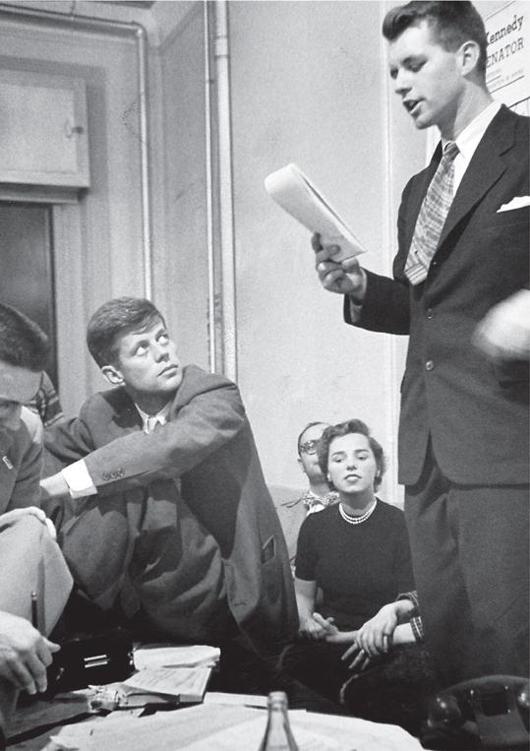
Jack, Ethel, and Bobby, November 1952