
CHAPTER SEVEN
She could be amusing in a direct, caustic way; and she understood the art of getting on with men completely . . . never asked an awkward question.
—David Cecil, writing about
Lady Melbourne in Young Melbourne
In Washington, Tip O’Neill was moving into his new office in the House of Representatives. By coincidence, his predecessor was packing up right across the hall. As he stepped into Jack Kennedy’s outer office, Tip could hear him engaged in a heated backroom argument with his secretary, Mary Davis.
“Mary, now don’t be silly. You’re coming to the Senate with me.”
“No, Senator, I’m not. I’m going to be working for Congressman Lester Holtzman of New York.”
“Now, Mary, you know you’re coming with me.”
“I am not, Senator, and that’s all there is to it.”
O’Neill could hear the dispute going back and forth. Finally, he heard Mary say, “And the reason I’m not going with you is that Congressman Holtzman has offered me six thousand dollars.”
“Tip, can you believe this?” Jack said when he walked out and saw O’Neill.
“I’m paying her four thousand dollars, and I’ve just offered her forty-eight hundred. That’s a twenty percent raise. But this guy wants to give her six grand the first day he’s here. There’s not a broad in the world worth six thousand a year.”
Mary Davis had similar memories of the standoff. When Kennedy won the Senate race, she accepted the mission of building a clerical staff. To this end, she recruited a team of secretaries to assist her with managing the mail and other constituent work.
“They were all experienced, knew exactly how to do things, what to do, where to go, and they really could have been an invaluable asset to the functioning of his Senate office. But he called me one day from Palm Beach and said that he’d been discussing the situation with his father, who wanted to know: ‘Did you find out exactly who they are, what they are, what the salaries are going to be?’ “
Joe Kennedy, still watching the purse strings, wasn’t above keeping his eye even on the funds the Senate provides its members for hiring staff. “I told him,” Davis said, “what I thought the salaries should be, in line with the money we were being allocated. I thought he was going to go through the ceiling!”
She was surprised because she’d set the pay levels for the skilled staff members she’d picked based on the standard allocations from the Senate. But while this might seem routine practice, and wholly acceptable, her focus on the reality of the office’s likely day-to-day needs was, in fact, shortsighted. Her eye to office management and not political strategy, she was failing to consider the larger picture. It simply wouldn’t have occurred to her that the Kennedys, father and son both, intended to start right away building a wider constituency, one that would extend far beyond the Commonwealth of Massachusetts.
The money, therefore, had to stretch further.
For this reason, Jack rejected both the top-drawer hires and the top-of-the-line pay scale. According to Davis: “He said, ‘Well, I don’t think we’re going to be able to work that out.’ And I said, ‘Well, why not?’ He said, ‘Well, number one, I have to have a Polish girl on the staff, I have to have an Italian on the staff, I have to have an Irish girl on the staff, I have to have, you know, these different ethnic groups.’ And I said, ‘That’s ridiculous! You know, a staff member is a staff member.’ He said, ‘No, you don’t understand. I’ve got to have these ethnic groups.’ “
Rejecting the pay levels she’d determined appropriate for the newcomers, Kennedy figured sixty dollars a week about right as an upper limit. He believed Mary herself was asking for too high a weekly check.
Hearing this, she was having none of it. “Sixty dollars a week! You’ve got to be joking. Nobody I’ve lined up would be willing to accept a job at that salary. I have to have competent, capable staff who can back me up. If I don’t, I won’t have a life to call my own.”
She remembered only too clearly what came next: “His famous reply to me was, ‘Mary, you can get candy dippers in Charlestown for fifty dollars a week.’ And I said, ‘Yes, and you’d have candy dippers on your senatorial staff who wouldn’t know beans. If that’s what you want, I’m not taking charge of it.’
“He didn’t believe me. And that’s when I said, ‘Uh-unh. Not me.’ “
So Tip O’Neill’s memory was on the button. She’d continued to stand up to Kennedy despite numerous attempts on his part to win her over. He’d simply pushed her past the breaking point, and his cajoling was to no avail. After six years of working for him, Davis knew the man too well. The issue, for her, anyway, wasn’t the money in and of itself. It was a question of whether Jack Kennedy, born to great wealth, was going to give her, Mary Davis, what she knew the U.S. Senate had decided was owed to anyone taking the supervisor job Jack was offering her.
In the end, he didn’t budge.
What can be seen here is how the financier Joseph Kennedy exerted enduring control over anything in his son’s life having to do with money. Well able to maintain his independence on the matters that counted most with him—policy, politics, his personal associations—Jack was faced with the fact that his father still could tell him what to do if there were dollar signs involved.
There was another rule in play here: when you worked for the Kennedys, you quickly learned that a staffer is a staffer. You needed to understand the limits of the relationship, and also the borders. Mark Dalton had learned that the hard way. As he would tell me, all those years of dedicated volunteering for Jack were forgotten the day he went on the Kennedy family payroll. Before him, the beloved Billy Sutton—the onetime press secretary, entertainer, and live-in buddy—had suffered the same fate. It seemed that he’d asked his salary to be upped from sixty-five dollars a week, a request Jack didn’t take well.
Larry O’Brien, shrewder politically than the others, understood the problem and avoided it. “If you work for a politician, he tells you what to do, but if you maintain your independence, you can now and then tell him what to do.” Seeing the lay of the land, he decided to return to Springfield after helping Jack win the Senate race.
O’Brien had the situation nailed. He’d worked hard to achieve a balance of mutual respect in his relationship with Jack, and he intended not to let it get out of balance. Even as his loyalty grew, so did his awareness of the senator-elect’s nature. The man so steadfast in his friendships, carrying along pals from prep school, college, the navy, and his social world, looked upon staff as employees. He had his needs; they had their tasks. Each was obliged to understand his place as well as his task, to honor the bounds of his role and its tenure. The Kennedys believed that anyone could be replaced. So it was, even with a onetime boon companion like Billy Sutton.
Cut loose from the role he’d so cherished and filled so well, Billy still, years later, loved revisiting spots where once he’d hung out with Jack: the diner downstairs from 122 Bowdoin, Jack’s apartment, the federal buildings where Jack’s offices had been, and political hangouts such as the Parker House hotel. He was like a toy soldier waiting for its young owner to come back.
There’s a measure of defense to Kennedy’s cutthroat approach to personnel. In Washington, a city packed with people who kiss up and kick down, Jack never kissed up. Although it may not perfectly justify the harshness of his discarding people like Dalton and Davis and Sutton, each of whom had been powerfully loyal to him for a decent number of years, it does put it in the context of the place and its morality. Isn’t the definition of a just man one who treats all the same? Jack Kennedy was equally his own man in both directions, caring no more for the feelings of those of higher authority than he was of those who served—or ceased to serve—at his pleasure.
His cheapness, though imposed by his father, came at some cost. George Smathers caught sight of the chaos left in Mary Davis’s wake: “I’d go down to his office and it would always seem as in so much pandemonium, such a disarray . . . Everyone in his back office was very friendly, but it didn’t seem to me as though there was any organization to it, and I used to tell him so.” Jack couldn’t believe he was hearing this from a colleague whose own operation was hardly a model of professionalism.
Smathers, to his credit, actually saw past the seeming daily disorder to what lay behind. “His mind was on bigger things. I never did feel that he was a well-organized man either in his personal life or in just the mundane matters of running an office. If the work got done, that was all that really concerned him.”
His victory over Henry Cabot Lodge had placed him on a career pedestal sufficient for most men. Yet in Jack’s own mind he was merely at the foot of the mountain he now contemplated climbing. To reach the top he would need to further share his vision and also himself, to let a lot more people know who Jack Kennedy was. Even more important, he’d have to successfully signal the country he was ready to lead it.
It was simply a matter of random placement, but Jack Kennedy’s new Capitol Hill office was directly across the hall from that of the new vice president. Richard Nixon was in Room 362, Kennedy in 361. Already, both their futures, at least on the surface, seemed mapped out.
The inhabitant of 362, many figured already, was tagged to be his party’s nominee for president once the incoming Ike finished his two terms. Opposite him, the senator assigned to 361 was marked to spend—and end—his political career as a New England Democratic moderate, a rich man’s son with a celebrated war record who’d shown himself to be a tough Cold Warrior. Being a Roman Catholic, the limitations to Senator Kennedy’s political future were clear to any observer. Hadn’t the country been electing Protestants to the White House since the first peal of the Liberty Bell?
Even before Kennedy moved into Room 361, he was interviewing people to sit at its desks. One of the hopefuls was a twenty-four-year-old lawyer from Nebraska. Ted Sorensen had grown up a world apart from the Ivy League, from Cape Cod, from the Stork Club, and from the U.S. Navy. He came from Scandinavian and Jewish parents, had been a conscientious objector and a dedicated supporter of Adlai Stevenson. What grabbed Jack about him, perhaps, was a reference he presented that praised his “ability to write in clear and understandable language” and, more important, called him “a sincere liberal, but not the kind that always carries a chip on his shoulder.” Jack liked him already.
The result was a five-minute meeting in the hallway outside the office of the Massachusetts senator. Of the encounter, Sorensen would write, “In that brief exchange, I was struck by this unpretentious, even ordinary man with his extraordinary background, a wealthy family, a Harvard education, and a heroic war record. He did not try to impress me with his importance; he just seemed like a good guy.”
Sorensen was surprised even to have been summoned for an interview. He’d sent in his application despite hearing that Jack hired only staffers his father himself might choose. Meaning Irish Catholics, and with few exceptions to this rule. Yet it took only five minutes for Kennedy to make the decision to hire the young stranger. It was another example, one of the most important in its consequence, of Jack not being his father’s son.
Ted Reardon, tapped to run the Kennedy senate office just as he had the House operation, understood what was happening. Jack was starting to reach beyond his old regulars and past the Massachusetts Irish. He was upgrading his team. He wasn’t picking new pals; he had different criteria now. “Jack had the ability to have guys around him whom, personally, he didn’t give a damn about as a buddy . . . but he was able to get what he needed from them.”
Ted Sorensen was the ideal Kennedy staffer. Not only would he go on to help draft some of Kennedy’s most glorious words, ones that stirred the world and resonated down through the decades, but he knew his role. In time it became hard for either man to say who had written what. Ted offered many of the lyrics, but it was always Jack’s music. If they were never social intimates, theirs was a collaboration of the heart. Indispensable as he was, Ted Sorensen would write extraordinary prose under the spell of Jack Kennedy.
However, there were issues Sorensen wanted to resolve before coming on board. Although anti-Communist, he was also anti-McCarthy, and so requested a second interview with the senator-elect. It was then he voiced to him his concerns that “he was soft on Senator Joe McCarthy and his witch-hunting tactics. JFK must have thought I was a bit odd, as well as headstrong and presumptuous, a new job applicant asking questions about his political positions. But he did not resent it, calmly explaining that McCarthy was a friend of his father and family, as well as enormously popular among the Irish Catholics of Massachusetts.”
Kennedy went on to tell Sorensen he didn’t “agree with McCarthy’s tactics or find merit in all his accusations.” Hearing it all, Sorensen accepted. Now, for the first time, Jack had someone at hand whom neither his father—nor his late brother—would have hired. For Jack Kennedy, Ted Sorensen would be his “intellectual blood bank,” providing him the Churchill-like phrase-making we now associate with him. “I never had anyone who could write for me until Ted came along,” Kennedy would later tell Tip O’Neill. There was cruelty in the comment, and it bothered O’Neill. Before Sorensen arrived, Jack had gotten speechwriting help from his former Harvard tutor, Joe Healey, who was also a good friend of O’Neill’s.
As for Sorensen, he understood the boundaries. “I never wanted to be JFK’s drinking buddy; I wanted to be his trusted advisor.” It was enough for him—or, at least, he protested as much to the end—to be “totally involved in the substantive side of his life, and totally uninvolved in the social and personal side.”
Clearly, Jack had found a devoted ally, someone who could see through to the idealist in the politician. Sorensen knew whom he was serving. “He was much the same man in private as he was in public. It was no act—the secret of his magic appeal was that he had no magic at all. Few could realize, then or now, that beneath the glitter of his life and office, beneath the cool exterior of the ambitious politician, was a good and decent man with a conscience that told him what was right and a heart that cared about the well-being of those around him.”
Yet it didn’t take Sorensen long to realize he and Jack came from very different worlds. “During my first year in JFK’s Senate office, when dropping me off after work to catch my bus home, he confessed that he had never ridden one in his life.”
They spent an enormous amount of time together, working, thinking, and planning. Not long before his death, Sorensen wrote this: “I do not remember everything about him, because I never knew everything about him. No one did. Different parts of his life, work, and thoughts were seen by many people—but no one saw it all.”
In the beginning she was Jackie Bouvier. The year was 1951. To hear the name now conjures up that early time and a young, fresh beauty untouched by fame and position.
But what was it about this young woman? Looks, certainly. Jackie was stunning, with large eyes so far apart it took two eyes to see them. Her beauty was original. She was elegant, self-contained, aristocratic. To Jack she was the only woman he “could” have married, he once confided to Red Fay.
Charlie Bartlett had been one of Jack’s best friends ever since they met and began hanging out together in Palm Beach in 1945. Now living in Washington, where he was working for the Chattanooga Times, he remained a careful observer of his pal. “The thing to remember, and that really made him special in my book, was a mind that went right to the problem. I mean, he must have inherited it from his old man. When you discussed anything with Jack, politics mainly, he’d go right to the bottom. He had a wonderful way of separating all the crap from the key issue. . . . It made him great fun to discuss things with.
“He always had a pretty clear picture of the motives of the people he was with, and he was good on that. I don’t know how to say it, but Jack wasn’t, sort of, in love with humanity. He was cool. His attention moved quickly. That mind would start going, and he did get bored awfully easily. This was part of his being spoiled, and I found it sometimes annoying. I mean, if you wanted to get into a long story, why, you were apt to not have Jack with you at the end of it.”
When the moment came for settling on a partner, Jacqueline Bouvier managed to grab his attention and hold it. She possessed both the personality and the pedigree. She also lacked what Jack himself lacked: a childhood cushioned by a warm upbringing. She, too, had been raised by a cold, willful mother and had a father—the handsome but philandering, alcoholic stockbroker known as “Black Jack” Bouvier—who did exactly as he pleased. Whether she told him about her childhood, or he intuited it once they’d met, it could have made her intriguing. Jack was most of all driven by curiosity.
Asked once to describe Jackie in a word, he chose fey. Her otherworldly qualities made her unlike all the other women he’d known and dated. She was detached, elusive, like him.
Jackie, who’d spent her first two years of college at Vassar, followed by a junior year in France, was finishing her college degree at George Washington University. She felt about France the way Jack did about Great Britain. Like Jack, she’d sought escape and refuge in books when she was young, especially as she sought shelter from her parents’ stormy marriage. Her father, John Vernou Bouvier III, was as unreliable as he was attractive, and her parents’ 1928 marriage lasted just a dozen years. Jacqueline Lee—Lee was her mother’s maiden name—was the firstborn child, in 1929; her sister, Caroline Lee, known as Lee, came four years later. Jack Bouvier was sixteen years older than Jackie’s mother, Janet. Jack Kennedy, twelve years Jackie’s senior, noticed that their age difference seemed to appeal to her.
Jackie’s part-time job at the Washington Times-Herald as an “Inquiring Camera Girl” resembled the one Inga Arvad once had held, while requiring far less writing. All Jackie had to come up with were brief captions for the snapshots she took of whoever was being featured that day.
The encounter that set off the romance between Jack Kennedy and Jacqueline Bouvier occurred one evening at Charlie Bartlett’s house. “I leaned across the asparagus and asked for a date,” Jack would recall in a much-quoted line. A Georgetown dinner party was a perfect setting for what began—at least, in the eyes of others—as a fairy-tale union, and became an almost mythical one.
Even at the outset, though, the courtship was uneven; nothing out of the ordinary there. Jack would ask her out for a date, then disappear. Yet he always returned. Following his election to the Senate, he proposed in ’53, and she accepted. The chemistry between them, however you try to analyze it, was undeniable, and they knew it.
While he was wooing her, Jack presented Jackie with copies of his two favorite books, John Buchan’s autobiography, Pilgrim’s Way, and Lord David Cecil’s Young Melbourne. These men each expressed, in their different ways, ideals of honor, sacrifice, and political nobility that continued to inspire him. When she learned his favorite poem was Alan Seeger’s “I Have a Rendezvous with Death,” she memorized it. In the years to come, he would often have her recite it for him.
“Jack appreciated her. He really brightened when she appeared,” Chuck Spalding recalled. “You could see it in his eyes. He’d follow her around the room watching to see what she’d do next. Jackie interested him, which wasn’t true of many women.”
Jackie’s temperament, though, was very far from the rambunctiousness of the large and competitive Kennedy brood. “Jackie was certainly very bored by politics and very bored by the very aggressive camaraderie of the Kennedy family, which was absolutely foreign to her nature,” Alistair Forbes said. “Fortunately, I think, she also spotted that it was really foreign to Jack’s nature.” She saw him as being more sensitive and “much less extroverted than they all were.”
Jackie offered the handsome and popular young senator a social status he didn’t quite have on his own. For all their recently amassed wealth, his family was still nouveau riche and thus lacked entrée to certain clubs, certain circles. Jack knew it, didn’t like it, but made the best of it. His friends, mostly, were like him—the sons of the successful—but others, met at Choate and Harvard and in Palm Beach, were from old money or old bloodlines. Charlie Bartlett, himself an old-line Yalie, could see the effect the Bouvier name had on his friend.
Bartlett, however, liked to speculate, in later years, on what Jack’s life would have been like had he chosen another sort of wife. “There was this beautiful girl up in Boston. Her name was K. K. Hannon. Her father was a policeman. She was gorgeous. If Jack had married her, she could have dealt with him, I think. She was Irish and tough and damned good-looking. But, no, he had to marry up.”
Jackie, whose father’s infidelities had helped destroy his marriage, recognized she was marrying a husband of similar habits. “Well, she knew what she was getting into when she married him,” Bartlett said. “She was in love with Jack, and he had this terrible habit of going out with these other girls.” As Bartlett figured it, his friend’s intended bride simply made a vow that she’d “take it all on, and she did.”
Jack’s concern was more on the politics of his decision. “I gave everything a good deal of thought,” he announced in a letter to Red Fay out in San Francisco. “So I am getting married this fall. This means the end of a promising political career, as it has been based up to now almost completely on the old sex appeal. Let me know the general reaction to this in the Bay area.”
In fact, with an eye to the likely fallout from the coming change in his marital status, he managed to keep secret his engagement until after the Saturday Evening Post had run a long-planned feature headlined “Jack Kennedy: The Senate’s Gay Young Bachelor.” Later, without telling his fiancée, he invited a Life photographer along on a sailing trip that she’d supposed would be time alone for them.
To reap the political benefit of their boss’s engagement, O’Donnell, together with O’Brien, began to plan a large event for all the “Kennedy Secretaries” from the previous year. To get the reluctant Jack to agree, they told him, “They haven’t seen you since the election and they all want to give you a gift and so forth,” O’Donnell recalled his pitch to the bridegroom. It was a classic, canny Kennedy event, a party to honor the engaged couple for which the guests paid admission and were more invested in their hero for having done so. “For the time and the place, it wasn’t cheap. But the faithful were willing to shell out ten dollars for a chance to see the senator they’d helped elect and to meet his beautiful fiancée. They felt included, even ‘related.’ “
O’Donnell described the celebration he staged: “They paid for their meal, paid for their drinks, and they gave the senator and Jackie a gift. One of the few organizations in the history of mankind that were paying him instead of him paying them, but we knew he wouldn’t pay for it, so we had to, or he wouldn’t come—since he didn’t want to, anyway. Though, once they were there, he had a great time.”
The wedding party convened the weekend of September 12, 1953, in Newport, Rhode Island, where Jackie’s remarried mother, now Mrs. Hugh Auchincloss, lived at Hammersmith Farm. The groomsmen included Lem from Choate, Torby from Harvard, and Red Fay from the navy, plus Chuck Spalding, Charlie Bartlett, and George Smathers. The ceremony was held at St. Mary’s, a nineteenth-century church in the Gothic style. Society pages around the country pronounced it the “wedding of the year.”
When Fay showed up, the ever-competitive Jack asked him as soon as the two men were alone what he thought of Jackie. “I said, ‘God, she’s a fantastic-looking woman.’ And then I added, ‘If you ever get a little hard of hearing, you’re going to have a little trouble picking up all the transmission.’ “ Jack laughed, loving his navy pal’s reaction to the classic Jackie whisper.
Jack was about to embark on a new life, yet there remained evidence that he himself, the onetime Mucker ringleader, had changed little over all those years. Fay noticed the way he enjoyed the bit of culture clash that occurred between a few of his cronies and the Newporters. “Almost across the street from Hammersmith Farm were the green fairways of the Newport Country Club,” he said, “where I’d often played during the war. The gentry of Newport had opened up their club for men in uniform, but with the end of the war the doors had shut tight again.”
Somehow, Fay and Kennedy’s aide John Galvin—“looking more Irish than Paddy’s Pig”—got themselves onto the course to play a round. At this point Fay hadn’t realized that the relaxed wartime regulations were no longer in force. The club had returned to its firm rule that all nonmembers must be accompanied by a club member. “I hope you two enjoyed your game of golf,” Jack teased them, “because as a result of it there was almost a total breakdown of relations between the mother of the bride and her dashing prospective son-in-law. I’m afraid that they feel that their worst fears are being realized. The invasion by the Irish Catholic hordes into one of the last strongholds of America’s socially elite is being led by two chunky red-haired friends of the groom.”
Still, the temporary vibe of spontaneous, unpredictable fun was welcomed by at least a few Newporters. Fay recalls a comment made by the lifeguard at a nearby beach where the Kennedy guests were swimming and playing touch football. “I want to tell you,” the young man said, “this is the first time this place has had any life in it since I’ve been here.”
The wedding weekend was not proceeding without discord. Jack had asked Red to be the master of ceremonies at the bachelor dinner. Eventually, this favoritism seemed to cause resentment among his fellow ushers, especially as the evening wore on and more alcohol was imbibed. “Torby Macdonald stood up at the other end of the table, took his water glass, and hurled it the length of the table; and it hit me on the chest. Then it fell to the table and shattered. Since I’d had a few drinks, the natural response was to start down the table after him. Luckily for me—because I’m sure Torby would have taken me apart—Jim Reed and the president, then senator, grabbed me and the thing was averted.”
Also in attendance at the wedding and the dinner were Ken O’Donnell and Larry O’Brien. As the former describes it, “There were only a few political people invited, and we stayed together and talked politics. I met some of the gentlemen for the first time, like Spalding. I’d known Lem through Bobby. I met Smathers for the first time. And Charlie Bartlett. But we didn’t talk to them much. The Boston political guys sat with the other Boston political guys and drank with the Boston political guys, and we mostly talked politics and what the future might be for the senator.”
Lem Billings, Jack’s oldest friend, felt the need to have a personal heart-to-heart with the bride. “She was terribly young, and I thought it would be best if she were prepared for any problems. So I told her that night that I thought she ought to realize Jack was thirty-six years old, had been around an awful lot, had known many, many girls—it sounds like an awfully disloyal friend saying these things—and that she was going to have to be very understanding at the beginning. I said he had never really settled down with one girl before, and that a man of thirty-six is very difficult to live with. She was quite understanding about it and seemed to accept everything I said.”
Rather amazingly, Lem then reported this exchange to Jack. “Of course, later I told him everything I’d said to her—and he was pleased because he felt it would make her better understand him.”
Chuck Spalding had his own telling memory of the weekend. To him, it was as if his friend were actually two people at his own wedding—one being the groom, and the other a grand observer of the entire event, watching it as if from afar, the way an outsider might see it. To Spalding, this other Jack was totally detached from what was happening, this lifetime pairing of him with another.
On the wedding weekend, one thing is sure, which is that the newlywed Jack Kennedy was clearly thinking beyond the imaginings of the ordinary groom. Sailing in the waters off Hammersmith Farm, he gazed at his wife’s family’s cove on Narragansett Bay and said to Bartlett, “This would be a helluva place to sail in the presidential yacht.”
By the time the honeymooning couple arrived in San Francisco—they’d gone first to Acapulco and then on to San Ysidro Ranch in the hills above Santa Barbara—the reality of the union between the thirty-six-year-old Jack Kennedy and twenty-four-year-old Jackie Bouvier was asserting itself. Here’s Red Fay’s account of hosting the two near the end of their wedding journey: “When Jack and Jacqueline came to the West Coast on their honeymoon, the pressures of public life too often intruded on the kind of honeymoon any young bride anticipates. For example, on their last day on the West Coast, Jack and I went to a pro football game. I’m sure this didn’t seem a particularly unusual arrangement for Jack.”
Jack Kennedy continually craved such fresh company. He liked the rush of excitement that came with it. Perhaps that enjoyment was rooted in those times in his youth when he’d been confined to bed. Bored easily by sameness, he preferred to keep moving, wanted the movie to stay exciting, liked people to be forever fascinating—and he wanted never to be alone, or too long with the same person.
The trouble was, as at least one friend saw it, those around him let him get away with it. In Charlie Bartlett’s words, “they spoiled him. . . . They spoiled the hell out of Jack. . . . I wish they hadn’t, actually.” People came to understand that, attractive as he was, Jack could be coldly self-indulgent. Yet his company was magnetic and his joy in life was irresistible.
Jack and Jackie were, both of them, like characters out of Fitzgerald, two people with old-world aspirations, but like most Americans, self-inventing. Lem Billings, I think, had it right when he said: “He saw her as a kindred spirit . . . he understood the two of them were alike. They had both taken circumstances that weren’t the best in the world when they were younger and . . . learned to make themselves up as they went along. Even the names, Jack and Jackie: two halves of a single whole. They were both actors, and I think they appreciated each other’s performances. It was unbelievable to watch them work a party. Both of them had the ability to make you feel that there was no place on earth you’d rather be than sitting there in intimate conversation with them.”
20 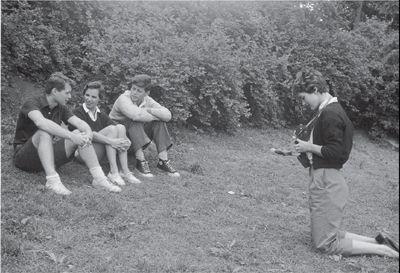
Dumbarton Oaks
21 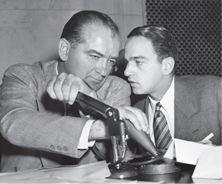
McCarthy & Cohn
22 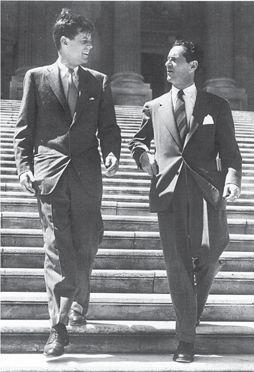
Ted Reardon