

The room where Mary Queen of Scots gave birth to the future James I of England in 1566. During his only return visit to his homeland in 1617, James ordered that the room be preserved and much of what is now seen is decoration dating from his reign. (Dave and Margie Hill)

At the age of 7, James’s features bore a close resemblance to those of his father, as this portrait by Arnold van Bronckhorst clearly shows. In particular, the young king’s wide-set eyes leave little doubt of his parentage, while his passion for hunting (which lasted throughout his life) is also emphasised by the bird of prey upon his left hand.
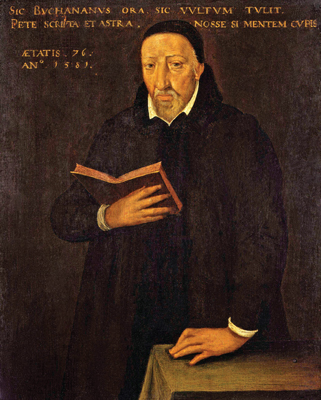
Portrayed here by Arnold van Bronckhorst shortly before his death at the age of 76, the tutor to the future James I enjoyed an outstanding reputation, both as a humanist scholar and historian of his native Scotland. Buchanan’s rigorous methods would leave lasting imprints upon his most famous pupil’s intellect and personality.

The last of the four regents of Scotland during the minority of King James VI, the Earl of Morton was arguably more successful than any of his predecessors, since he concluded the civil war that had been dragging on with the supporters of the exiled Mary, Queen of Scots. Yet his authoritarian rule earned him many enemies and an untimely end when he was beheaded by means of the ‘Maiden’, a primitive guillotine, which he himself is said to have introduced to Scotland.
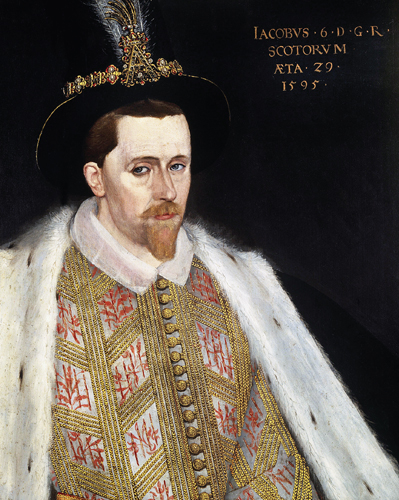
In 1584 Adrian Vanson succeeded Arnold van Bronckhorst as official painter to the Scottish Court. Aside from overseeing every aspect of royal painting, including banners used for the coronation of Anne as Queen of Scotland in 1590, Vanson and his studio would have been responsible for the production of the king’s official likeness, such as the present portrait, either for prominent supporters, or for foreign courts.
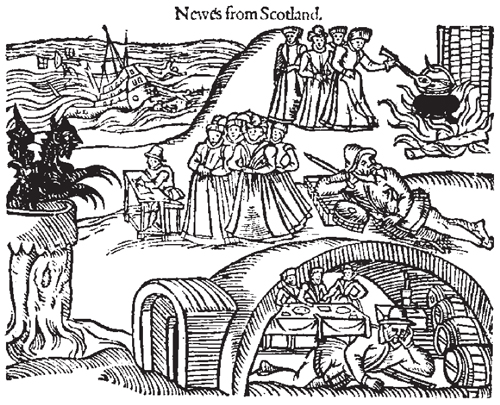
The king’s ongoing interest in witchcraft assumed a new intensity in the early 1590s after evidence had appeared to connect Francis Stewart, 5th Earl of Bothwell, with a diabolical attempt upon his life. Here the North Berwick witches, who had allegedly been enlisted by Stewart, meet the Devil in their local kirkyard.

This portrait from 1612 by Marcus Gheeraerts the Younger depicts James I’s wife in mourning for her eldest son Henry Frederick, Prince of Wales, who had died from typhoid fever earlier that year.

Potentially the most able of the Stuart line, Prince Henry would not live to succeed to the throne. ‘His body was so faire and strong,’ declared his chaplain after the young prince’s death at the age of 18, ‘that a soule might have been pleased to live an age in it.’
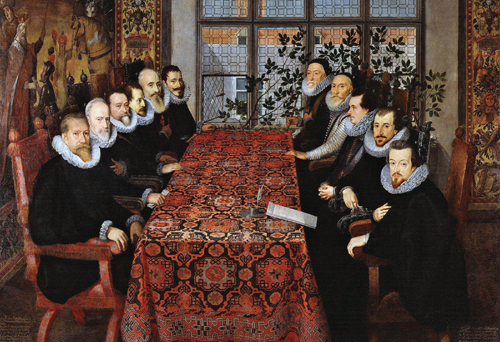
Between 20 May and 16 July 1604, eighteen conference sessions were held at Somerset House, leading to the Treaty of London, which was signed on 16 August and concluded almost twenty years of warfare between England and Spain. On the left are the members of the Hispano-Flemish delegation, on the right, the English commissioners, which, reading from the far end, included the Earl of Dorset, the Earl of Nottingham, Lord Mountjoy, the Earl of Northampton and Robert Cecil.

On 31 January 1606 Robert Keyes, Ambrose Rookwood, Thomas Wintour and Guy Fawkes were taken to the Old Palace Yard in Westminster to be hanged, drawn and quartered. Rookwood and Wintour were the first to ascend to the gallows. Grim-faced, Keyes went ‘stoutly’ up the ladder, but with the halter around his neck he threw himself off, presumably hoping for a quick death. The halter broke, however, and he was taken to the block to suffer the remainder of his sentence.

Robert Carr was a Scottish noble who met James in 1607 and very quickly rose to a position of considerable authority at court. As the premier royal favourite, Carr received a steady flow of gifts in the form of cash, land and titles, until petulance, jealousy and a scandalous marriage to Frances Howard eventually soured his relationship with the king.
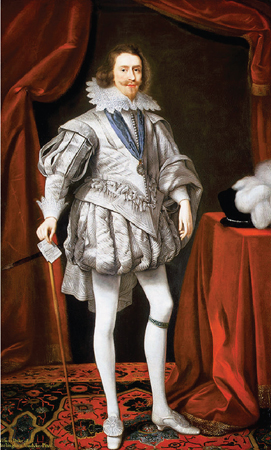
King James’s personal relationships are much debated, with George Villiers the last in a succession of handsome young favourites who were lavished with affection and patronage. In 1617, John Oglander wrote that he ‘never yet saw any fond husband make so much or so great dalliance over his beautiful spouse as I have seen King James over his favourites, especially the Duke of Buckingham’. Edward Peyton, meanwhile, would note how ‘the king sold his affections to Sir George Villiers, whom he would tumble and kiss as a mistress’.

By his mid-50s, James had become increasingly sickly and careworn. A ‘cradle king’ from the age of 1, he had at various times encountered danger and disrespect, and now in his twilight years he was left to endure progressive physical decline and disillusionment.