
Kennedy was allowed little time to savour his first major success on the international stage. Shortly after the curtain had fallen on the Cuban Missile Crisis another issue – one which had been simmering on the home front for some time – came close to boiling point.
Kennedy had long been a supporter of the African–American struggle against racial inequality, which was particularly prevalent in the segregated South. Indeed, in the run-up to the presidential election, Kennedy had lost votes in the Southern States by coming out in support of Martin Luther King, who had been arrested at a protest in an Atlanta restaurant. Luckily, any votes lost were offset by a groundswell of support from the black community, 70 per cent of whom voted for Kennedy.
Nonetheless, the experience had left Kennedy wary of introducing any significant Civil Rights legislation during his first term in office, fearful that a backlash from the South would scupper his chances of being elected for a second term. He justified his prevarication by privately resolving to introduce reforms once a second term was secured.
But the African–American community were in no mood to wait. Civil Rights protests were becoming ever more commonplace, with many descending into violence when met with opposition from the white community. Then, in June 1963, Governor George Wallace of Alabama prevented two black students from enrolling at the State University, in contravention of a court-ordered desegregation of the institution. Kennedy, furious at Wallace’s actions, was finally compelled to act.
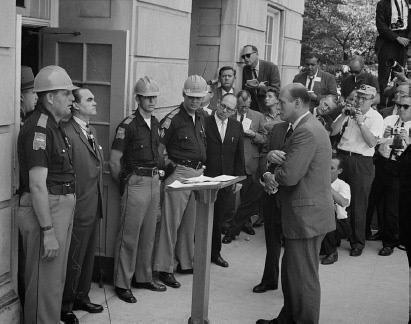
‘Standing in the Schoolhouse Door’, Governor George Wallace (left), 11 June 1963
On 11 June, Kennedy issued a presidential proclamation compelling the Alabama Governor to stand aside and allow the registration of the two students, James Alexander Hood and Vivian Malone. He also mobilized the Alabama National Guard, which was deployed to the university’s campus to restore order and prevent any further violence. Finally, the President took over the primetime 8pm slot on national television to deliver an awe-inspiring address to the American public, announcing the introduction of comprehensive Civil Rights legislation, which would eventually be passed into law in 1964:
One hundred years of delay have passed since President Lincoln freed the slaves, yet their heirs, their grandsons, are not fully free, and this Nation […] will not be fully free until all its citizens are free. […] We face, therefore, a moral crisis as a country and a people.
While the majority of American people rejoiced upon hearing these words, Kennedy was worried that he had lost the support of the Southern States. As he said, ‘I can kiss the South goodbye.’