
THREE
The relief of Orléans changed Joan from God’s herald into God’s warrior. Joan’s strident claims, her eccentric election to dress as a man, her irruption into court life could have been mere topics for gossip if she had not led men to fight and win. Against the cautious policy of diplomacy advocated by La Trémoïlle she urged decisive action – and she had succeeded in getting men to follow her. She later said she had an army of 10,000–12,000, which the chronicler Enguerrand de Monstrelet estimates at 4,000–5,000, which was still a large force for the time; and she also had an abundance of provisions (supplies often determined the result of a siege). Charles paid for them, his mother-in-law produced them and Alençon organised them.
Before being greeted at Blois by the royal commander, the Bastard of Orléans, Joan turned her army into an unusual spectacle. At its head marched a brigade of priests, who were to sing hymns to Our Lady twice a day and to hear the soldiers’ confessions. As they began the march to Orléans, they held aloft their new banner, on which was painted an image of Christ crucified, while they intoned the ‘Veni Creator spiritus’ (‘Come Holy Spirit, Creator, come’). Joan could be practical, and so after two nights most of the priests returned to Blois. She had brought with her some of the most influential military men in France, the Marshal of Boussac, the Admiral of France, the Duke of Alençon and Gilles de Rais, the notorious bluebeard of popular legend, and the gruff La Hire. And yet, after the priests had gone, she still meant to impress on her army that her task was God-given and royally sanctioned; as proof, she had a standard, said to have been made of white canvas fringed with silk on a field of fleur-de-lis, on which was painted a Christ in Majesty flanked by two angels and inscribed at the side with the words ‘Jhesus Maria’. She was clad in armour the Dauphin had ordered for her. She carried a sword that she had sent for from the monastery of Ste-Catherine-de-Fierbois. Much to the monks’ surprise this had been retrieved from under an altar – a weapon located by a miracle indicated a holy cause. On the First Crusade, for example, when the crusaders wilted in Antioch, the lance that had pierced the side of Christ had been divined in a vision; and after its discovery the crusaders’ fortunes had changed dramatically. Joan’s sword, decorated with five crosses, may have belonged to a crusader; the weapon gave her campaigning the quality of a holy war; she carried the weapon until she was beaten for the first time at St-Denis, outside Paris. What the banner, the armour and the sword indicated for all to see was that she was no common soldier, but a knight.
Chivalry was the code of behaviour that had come to be seen as appropriate to the upper classes. Its prestige was bolstered by a military assumption, that the chevalier, the mounted knight, was the most effective arm in any army. Around 1100, when crusaders had just scaled the walls of Jerusalem, it was a reasonable assumption, for nothing had equalled the effectiveness of the charge of Christians clad in their chain mail. By about 1400, ways of winning wars had been transformed. At Nicopolis in 1396 mobile Turkish mounted archers routed the Latin cavalry under John of Burgundy. At Agincourt in 1415 longbow men sheltering behind stakes and English men-at-arms on foot slaughtered the French cavalry trapped in the mud. By then armour was so weighty that any knight needed a squire to help him mount, and if he fell over, he needed a squire to help him get up. Simultaneously a new weapon had been devised, the cannon that could blast a knight off his horse. And yet, socially, there was never a time when there was more cachet in being a knight. If a man joined a military order, he sported its stars and ribbons; in quarterings on his coat of arms and shield he displayed his ancient lineage; if he were captured, etiquette demanded that he should be ransomed at any cost; while in flamboyant pinnacled castles ladies and gentlemen, arrayed in the fantastic, graceful costumes, listened to improbable tales of chivalry about Arthur, Charlemagne and Alexander – and so a future King of England was named Arthur, Kings of France Charles, Kings of Scotland Alexander. Joan took for granted this aristocratic view of contemporary warfare. And for some months reality corresponded to dreams, as a maid in armour led men to victory.
Joan did not forget the practicalities of a siege. Even with the help of some 1,500 Burgundians, the English had lacked the men and the artillery to force Orléans to surrender, so they now hoped to persuade the citizens to give up the struggle by undermining their morale. They had surrounded as much of the city as they could, putting up earthworks or boulevards manned by small numbers of troops, four to the west, one to the north, one on an island in the river to the west and one (the boulevard de St-Loup), that was meant to block the road into the Orléans from the east. Most of the east and north of the city was not blockaded, so the English relied on the effect of capturing Les Tourelles, a stone castle that lay at the southern end of the southern bridge spanning the Loire. As the French blew up two of the arches of the bridge, Les Tourelles became just a good vantage point from which to conduct the siege, but when to the south of it the English constructed the new boulevard des Augustins, in which the new commander, the Earl of Suffolk, placed a strong defensive force, it became obvious that he and his captains were thinking that the best form of offence was defence. Unless they were dislodged, the city would fall.
Before his death, Salisbury had turned his guns on and destroyed twelve water mills that were vital to provide the besieged with bread, but the citizens quickly built eleven new horse-driven mills. Suffolk was more cautious: he intended to wait. There was no sign that the acting head of the Orleanists, the Bastard of Orléans, was enthusiastic to continue the fight. His attacks on English positions in December and January had been in vain. When he tried to surprise the army under Sir John Falstolf that was bringing the besiegers supplies, including a quantity of fish for Lenten meals, he had been mauled; and the so-called battle of the Herrings, on 12 February, could have been his last attempt to save his brother’s city. That day Joan had her final interview with Robert de Baudricourt before setting out for Chinon. For the next two months the Bastard held on, and in late April he went to Blois to meet her. What may have impressed him most was that she was bringing provisions as well as men.
The problem was how to gain access to the city. Initially the French avoided confrontation by marching far to the south of the river, but eventually they knew that they would have to try to cross it. To the west of the city, on the Blois side, the English had erected the majority of their boulevards and held the towns of Beaugency and Meung. To the east, however, they held just one town, Jargeau, and had put up just one boulevard, that of St-Loup. Luckily too, for the French, they had not blocked a ford east of Orléans, near Chécy, and accordingly Joan decided to cross there. But if she could quickly get men on to the north bank, she could bring neither provisions into the city – unless the boats carrying them were helped by a favourable wind – nor her men, unless they could get past the boulevard de St-Loup. That she achieved both easily was said to be the result of two miracles: once she had made up her mind, the wind changed direction; and the English made no attempt to stop her. How provisions sent from Blois, to the west, had to cross at Chécy, to the east, is not clear, but perhaps boats were needed just to move them from one bank to the other. One chronicle, the Journal du siège d’Orléans, an account of the siege written probably thirty to forty years later, gives a reason for English inaction: the citizens themselves made a sortie to distract the defenders of the boulevard.1 And yet, even if the citizens’ cooperation had helped Joan to enter the city, there was still rejoicing, says the Journal, at the ‘divine virtue that was said to be in this simple maid’. The Bastard, however, remembered she had rebuked him for making a cautious entry rather than precipitately rushing at the English.
I am bringing you better help than ever came from any soldier or any city, as it is the help of the King of Heaven. It comes not from me but from God Himself, who, on the petition of St Louis and St Charlemagne, has had pity on the town of Orléans, and has refused to suffer the enemy to have both the body of the lord of Orléans (still in prison in England) and his city.2
The Bastard was unmoved, so Joan next tried to convince the English that they must leave. She went to the boulevard de Belle Croix on the bridge and talked to soldiers in Les Tourelles, but Glasdale, their leader, replied only with insults. She next demanded the return of her herald, perhaps the man who had delivered her letter to the English, and threatened she would kill all the English prisoners in Orléans. This time they did what she requested, but added that if they captured her they would torture and burn her. If she had a plan, it was to be provocative to those who opposed her. At the same time, as she showed while the Bastard was away seeking more men, she was adept at winning friends and influencing the people she needed, in this case the townsfolk. On 4 May she got her way when the French attacked and took the isolated boulevard de St-Loup. She may have wept over the English who died without having been to confession, but she also was thrilled that she was proved right. Attacking worked. On the following day she wrote another, but more terse letter to the English, and took another, deserted boulevard; and yet she was clear in her mind that picking off such weak points one after another might make decisive victory harder to achieve. Her preference was for taking risks, a preference that was realised when the boulevard des Augustins, which lay at the south end of the bridge, was taken. Those in Les Tourelles were now caught between the citizenry of Orléans on the north bank and the relieving troops on the south bank. Though wounded, Joan was not to be deflected from her course, and, after the bloodiest fighting since Agincourt, the castle fell, Glasdale fell into the river and was drowned and Joan was left to weep for the foes who had died for not listening to her words. Although the English were undefeated to the north of Orléans, without Les Tourelles they had little chance of investing Orléans. They realised that to continue the siege was pointless, and on 8 May they withdrew.
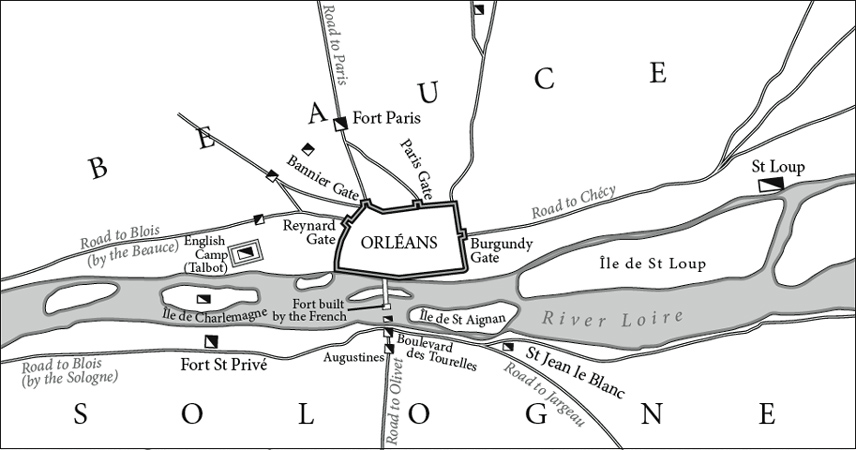
3. Orléans and its environs.
According to the Journal du siège d’Orléans, ‘everyone was filled with great joy and praised the Lord for the great victory He had given them’.3 The clergy and people alike sang the Te Deum and Joan had time to have her wounds treated. She then joined the soldiers who were preparing to fight any English who continued to resist, and watched her foes slink away. The mud boulevards had not been a strong defence; the English would put their trust henceforward in the stone fortresses that they still held on either side of Orléans. To her Orleanist followers, however, it was clear that God was with the Maid. After her death she would be called ‘the Maid of Orléans’, and until her collateral heirs died out her family would be Orléannais and 8 May, the day on which the English marched away, became a day of celebration in the city, with a re-enactment of events in her honour. In London, Charles, Duke of Orléans, rejoiced that his city had not fallen. He must have been grateful to his half-brother but showed his gratitude to Joan by sending her a beautiful robe.
There was a pause for a month, perhaps so that new recruits could be found to replace those killed during the siege. Two strategies were debated at Charles’s court. One idea, supported by the lords of the blood royal and the captains (said the Bastard) was to move on Normandy, and then on Paris. The other idea, Joan’s idea, was to clear the route to Reims so that Charles could be crowned. Joan won the debate by pleading to her lord on her knees. Charles put his cousin Alençon in charge of the army as lieutenant-general and told him to ‘do entirely according to her counsel’. That meant there would be direct assaults on other Loire strongholds.
The first objective was Jargeau to the east, a town strongly defended with five towers, three fortified gates and a fortified bridge over the river, full of gunpowder weapons and protected by some 700 troops under the command of the Earl of Suffolk. The French leaders hesitated until Joan shamed them, saying that if she was not sure God was on their side she would rather have stayed at home to herd her sheep. This led to an attack that was countered by an unexpected sortie. When the French faltered, Joan picked up her standard and encouraged them to fight back. Her resolution paid off and the counter-attack was beaten off. Joan sent a peremptory letter telling the enemy to give up: ‘Surrender this place to Heaven’s King and to gentle King Charles, and you can go. If not you will be massacred.’4 Suffolk tried to negotiate with La Hire rather than with Alençon or Joan. In any case, his offer was rejected and yet he did not leave. While Alençon wished to continue bombarding, Joan urged an immediate assault on the walls. On Sunday 12 June the French put ladders in the ditch and Joan went forward with her standard. After some three or four hours, just as the French were at the point of clambering into the town, Joan was struck on the head with a stone that broke on her helmet. Quickly on her feet again, she cried out: ‘Our Lord has condemned the English. At this hour they are ours. Have courage.’5 Her words seem to have prevented any last-minute attempt at a negotiated surrender. One of Suffolk’s brothers was killed, another was captured and for social reasons – a nobleman could not surrender to a commoner – the noble lord felt compelled to knight a squire from Auvergne before allowing himself to be taken alive. Other Englishmen were less distinguished and less fortunate. Many were killed and many prisoners executed on their way to Orléans.
Back in Orléans, Joan went to Mass and told Alençon that she wished to leave for Meung next day. As had happened so often before, she had to accept an unwelcome delay, in this case for three days, while Jargeau was garrisoned, the army prepared and the gunpowder weapons shipped downstream. This time she would go west.
On 15 June the French marched on Meung, halted to take the bridge and then set out to besiege Beaugency. By then the repute of Joan had attracted many volunteers, including the Lord of Laval, the Lord of Lohéac and his brother, the Lord of Chauvigny de Berry, the Lord of La Tour d’Auvergne and the vidame of Chartres, and, most important of all, Arthur de Richemont, brother of the Duke of Brittany and Constable of France, who had recently been banished from court. Being threatened by an English force under the redoubtable Sir John Falstolf, Joan needed Richemont’s men. Seeing the large numbers ranged against him, however, Falstolf left Beaugency and did not offer battle. He withdrew on 17 June, by which time the French had been steadily bombarding the town for two days, and the commanders of the garrison decided to leave if they could get favourable terms. They were offered free passage if they did not fight for ten days; they accepted, and in the meantime Falstolf, without the use of artillery, made a botched attack on the bridge at Meung. The failure of this effort and English awareness that their enemy was superior in forces and morale persuaded the leaders in Meung that this stronghold too was indefensible. The English army under Falstolf and Talbot withdrew northwards in good order, yet dispirited and feeling weak.
Falstolf prepared for one last stand before he abandoned the Loire valley. Adopting the defensive tactics that had worked so well in the past, he concealed his vanguard, provisions and artillery in a wood on the way to Patay, a village on the road from Orléans to Chartres. Talbot meanwhile hid 500 mounted archers between two strong hedges, where he believed the French must pass. Unluckily for him a stag rushed through this position, so disclosing the intended ambush to the pursuing French cavalry. The archers fled into the woods, where they collided with the other troops whom Falstolf had not had time to deploy. On the heralds’ count 2,200 English, now in disarray, were slaughtered. Talbot could not escape and Falstolf fled with as many men as he could save. Joan’s role in the victory is unknown, for no chronicler mentions her, but at the rehabilitation trial, her page, Louis de Coutes, tells how she held a dying Englishman’s head in her hands while hearing his confession. Thanks to this action, the Loire was once again a French river. Joan prepared to go to Reims.
Joan, who had seen off the English, now had to contend with the Burgundians too, for Reims, her destination, was under Burgundian control. The route there was not as difficult to follow as might appear, for neither the English nor their French allies had the men to garrison all the intervening villages and towns. Many in territory held by the Burgundians were sympathetic to the Anglo-French monarchy of Henry VI only because they preferred being on the winning side; and as this was no longer the case, feelings of loyalty to Henry evaporated. After Patay, the people of Janville closed their gates to the fleeing English and opened them to the pursuing French; and this pattern of behaviour became common as Joan and the Dauphin’s large army made their way first east and then north into the heart of Champagne. Besides, Joan had promised to save Orléans and had done so. As she had said that Charles would be crowned in Reims, people assumed that that too would happen.
In mid-June Charles moved to Gien, east of Orléans, from where it was relatively easy to set off for Champagne. At court, however, La Trémoïlle was all for temporising. The way ahead was not safe; it would be wiser to wait till relations with Philip of Burgundy had improved; the king should go to Bourges. On 25 June Joan sent a letter to the citizens of Tournai in which, after outlining the recent triumphs of French arms, she invited the citizens to the anointing of the king at Reims, ‘where we shall soon be’. This must have been one of several such letters. Clearly she had every intention of setting out in the near future. But as so often, she was frustrated that others, in this case Charles, did not share her sense of urgency. For two days she camped with the soldiers outside the city, which showed Charles how devoted his troops were to her. He could not afford to pay them; they knew they could get him safely to Reims; he gave way.
On 30 June Charles’s troops came to Auxerre, which for ten years had been pro-Burgundian and had even been ruled by Burgundians. The sight of a huge French army, numbering perhaps 10,000, encouraged the town council to make terms. After three days of negotiation, Charles magnanimously pardoned anyone who had sided with his enemies. No one was killed, the gates were opened and the army was reprovisioned. The army next passed through a succession of villages until it came to Troyes. A town long famous as a market town on important trade routes, to Charles Troyes was infamous as the place where nine years earlier his father had denied his right to the French throne, with the added humiliating condition that his sister Catherine, who was to marry Henry V of England, would be wife and mother to future kings of France – in fact she never became queen but was mother to Henry VI and II. With this past in mind, the people of Troyes had reason to reflect. To direct their thoughts to the future, on 4 July Joan wrote yet another letter instructing the citizens to recognise the true King of France, her master, ‘who will soon be at the city of Reims and at Paris . . . And with the aid of the King Jesus he will be in all good cities in his holy kingdom.’6 To this Charles added a practical incentive to make them submit: if they did so, he would grant them an amnesty.
At first the drawbridges were raised, the gates shut and soldiers from the garrison made a show of a sortie, with one beneficial effect: it made the defenders realise they were far outnumbered by the force beyond the walls. Once again days passed while heralds and envoys went from town to camp and from camp to town. The citizens sent their own holy person, Friar Richard, a Franciscan with a line in prophesying the end of the world, to see Joan. When he had made the sign of the cross and sprinkled her with holy water, she told him to approach: ‘I will not fly away.’ On 8 July Charles called a council of war, from which Joan was excluded, to debate whether to bypass the town, as Archbishop Regnault of Chartres urged, or to attack it. Joan was called in to give her views, and she proposed an attack. The very sight of her preparations was enough for the people of Troyes. Once she began the attack, the rules of war meant that the besieged would have no legitimate defence against whatever fate Charles might allow. The prospect of the terrible consequences that could follow from their defiance made Troyes submit. A triumphal entry and the free gift of supplies was enough to buy Charles off. In return he freely pardoned the people of Troyes their offences. The march to Reims was turning into a procession.
The people of Reims were now the only possible obstacle left to the coronation. Charles was anxious because he was aware that if they resisted he had inadequate artillery and siege machines. Joan reassured him that they would come to meet him; and once more she proved to be right. She was almost in her home country. A neighbour, a farmer called Gérardin d’Épinal, came with four friends to see her. He would recall that previously she had told him that she had a secret she would not disclose because he was a ‘Burgundian’ and that now she was afraid of nothing except treason. On Saturday 16 July the royal party reached Reims. On the following day Charles was crowned.
The lengthy coronation service in Reims Cathedral was the happiest time in Joan’s short life. The ceremony enacted publicly Charles’s calling to be the sacred monarch of a holy kingdom; it was for his role in life that she had fought; it was his vocation that gave her life its meaning.
Reims was the royal, national cathedral of France. On its façade is a sculptural group consisting of Clovis, King of the Franks, his Christian wife Clotilda and St Rémi. The pagan chief is being baptised while the saint receives the ampulla from a dove; in the ampulla is the holy oil that will be used to anoint all Frankish and French kings; and the dove stands for the Holy Spirit. There are variations on the royalist theme. The priest-king Melchisedek gives communion in bread and wine to the patriarch Abraham, clad in the armour of a thirteenth-century knight. King Solomon, standing for Christ the King, stands beside the Queen of Sheba, representing the Church. Inside the nave are representations of twenty kings, beside the bishops who consecrated them. Only Karolus (Charlemagne) is named, as he is the most important of all since Clovis. In other French Gothic churches are other examples of devout kingship: at Chartres the story of Charlemagne; at St-Denis the story of Godfrey de Bouillon, the Frankish leader chosen after the First Crusade to rule in Jerusalem; in the Ste-Chapelle in Paris the story of St Louis. Nowhere else, however, is there so much emphasis on the Most Christian King as there is at Reims. On the western front by the great rose window King David is anointed by the prophet Samuel, King Solomon by the prophet Nathan. David shows kingly courage by slaying Goliath, Solomon kingly justice by returning the disputed child to its true mother and kingly piety by building the Temple. Above all these scenes God gives his fatherly blessing to the kings.
Nobody knows if Joan studied these figures, but they were biblical stories familiar to the illiterate poor, from which class she sprang. Nobody knows what exactly she witnessed; for 1429 there is no equivalent to the Coronation Book of Charles V that contains the liturgy by which Charles’s grandfather had been consecrated King of France. We do know, however, that from nine o’clock in the morning until two o’clock in the afternoon the drama moved steadily towards its climax, when Charles was anointed on the head, hands and chest with the holy oil from the ampulla of St Rémi by the saint’s living embodiment, the Archbishop of Reims; and then he was crowned. In October 1422 Charles had been acknowledged as king at Mehun-sur-Yèvre by a forlorn group of followers. From the moment his father died, according to his lawyers, he had the legal authority of a king, yet he was still known as the Dauphin. What made him the Most Christian King were the sacred mysteries of 17 June, le beau mystère as it was described. His anointing made him, unlike all his lay subjects, a priest-king after the order of Melchisedek, who had the right to take communion in both kinds; and it prepared him to become, by a separate rite, a thaumaturge who could ‘touch’ for the tubercular condition called scrofula, the so-called king’s evil. His anointing also gave him, unlike many other kings, some authority within the Church.
Certain traditional parts of the ceremony could not be followed at Charles’s coronation. At one stage, the twelve peers of France, six ecclesiastical and six lay, should have been summoned to stand before the high altar. Three of the clerics were present – the Archbishop of Reims, the bishops of Laon and of Châlons – but three were absent, among whom Pierre Cauchon, Bishop of Beauvais, was deeply involved in Burgundian politics. Among the laity, the Duke of Burgundy, conspicuous by his absence, alone was a peer in his own right; the other five peerages had reverted to the Crown. Of the twelve peers, then, nine had to be substituted. Another official who should have been present was the leading military officer in France, the Constable, but Richemont, who had fought alongside Joan in the Loire valley, had since been disgraced, so his ceremonial sword was carried by the brother-in-law of Joan’s critic, Georges de La Trémoïlle. Other than the king, however, the person most prominent in the cathedral was Joan. She stood beside him, holding her banner, next to him the focus of attention. At the end of the ceremony she knelt down, and clasping him by the knees wept tears of joy. ‘Gentle King,’ she exclaimed, ‘now is God’s pleasure fulfilled. He desired that the siege of Orléans be lifted, and that you should be brought into this city of Reims to receive your holy consecration, so showing that you are the true king, the man to whom the kingdom of France should belong.’
It is not clear if Joan was present at the banquet mounted to celebrate the coronation. If she was not, the reason must have been because she had not yet been ennobled. Among the people of Reims, however, she was revered; and as Charles rode round the city, his crown on his head, she rode at his side. The crowds pressed towards her to touch her. She was thrilled that the great aim of her mission had been accomplished. She remained sure that she was called to do more; but what precisely and how precisely she would do it, she was uncertain.
Joan’s days in Reims were the high point of her public career, for the coronation ceremony gave meaning to everything she had done for her king. A modern visitor to the cathedral may be awe-struck by its beauty and in looking to explain such feelings will probably point to the daring of the masons’ work. Gothic engineering was a new skill, which facilitated the building of churches much taller than Roman and Romanesque arches could sustain. The pointed arches at the royal abbey of St-Denis led to a proliferation of glass where before there had been massive walls; the use of flying buttresses at Chartres produced higher, lighter walls and yet more glass; at Reims and then more ambitiously at Amiens, the pitch of the nave was still steeper. Finally, the Ste-Chapelle in Paris was made into an exquisite glass house and at Beauvais the pillars strained so high till the nave came crashing down.
We cannot tell whether Joan had an aesthete’s eye. What we can believe is that for her Reims was the home on earth of St Rémi, a saint she had known as a child in Domremy. Reims Cathedral was the holy place where kings of France were consecrated by God for the sacred task of ruling France. What mattered to Joan was her assurance of God’s presence and action there. During the final year of her life she would find that such convictions were to be harshly tested by events.