Prologue
A cold winter rain fell on the mountains near the sea. Only a trickle at first, the water gathered into a tiny stream that quickly fell down a steep and rocky valley past empty shepherd huts, bursting at last onto the narrow coastal plain. For thousands of years, travelers moving from the broad and fertile countryside beneath the snow-covered Alps of northern Italy to the warm southern lands along the Adriatic coast had crossed this small river. In summer, when the rains were scarce, the river shrank to little more than a lazy creek. But in winter, its waters grew swift and deep.
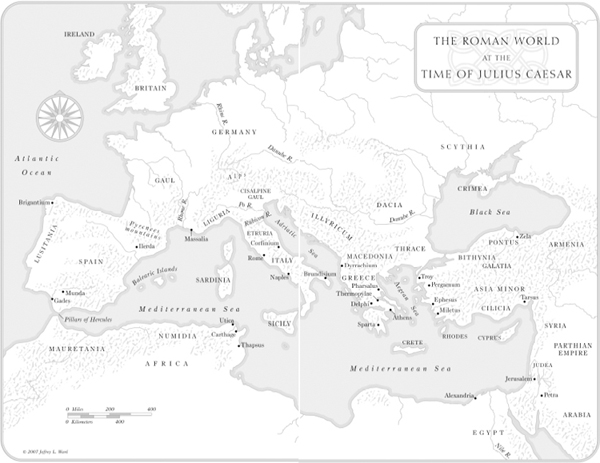
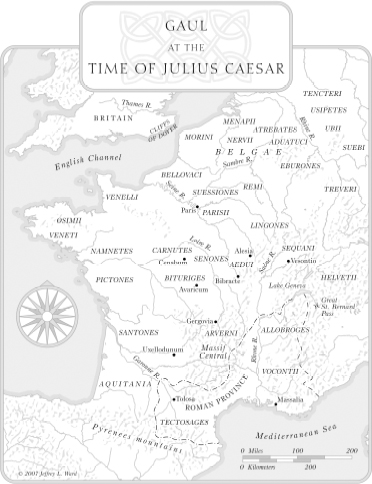
On this blustery January day in the year 49 B.C., Gaius Julius Caesar sat on the banks of the Rubicon River and gazed south toward Rome. Caesar had spent the last eight years in a relentless and often brutal campaign to bring Gaul—roughly modern France—into the Roman world. This huge new province served not only to subdue the troublesome Celts and keep the fierce Germans on their own side of the Rhine, but the war booty Caesar gained made him a very wealthy man. Enormous financial resources, popular military victories, impeccable ancestry, and one of the finest minds the ancient world had yet produced were enough to terrify Caesar’s political enemies. These self-proclaimed defenders of the Roman Republic had for decades used their considerable power to fight that which Rome needed most and which they most feared—reform. The conservative party, or optimates, led by the indomitable Cato were determined to rule the vast Roman lands stretching from Spain to Syria for the benefit of a few families according to ancient tradition, as if Rome were still a small village on the Tiber surrounded by seven hills. The power, vision, and ruthless ambition of Caesar were the biggest threats they had ever faced—and so they were determined to destroy him at any cost.
To be fair, Caesar had tried his best to prevent civil war. When his enemies proposed that he be stripped of his command in Gaul so that he could be prosecuted in Rome, Caesar had calmly outmaneuvered them. When the weak leadership of his ally, the aging general Pompey, and the quarrelsome senators allowed the city of Rome to slip into chaos and mobs to burn down the buildings of the Forum, Caesar held his hand while the Senate made Pompey a virtual dictator. When Cato and his allies demanded Caesar turn over two of his veteran legions to fight the Parthians, he complied, even though the soldiers were kept in Italy to serve Pompey. Caesar had even offered to dismiss his army at the same time as Pompey to avoid trouble, but the Senate instead rejected all his overtures of peace, assaulted his representatives, and passed an emergency decree against him, demanding that he surrender himself into the hands of his scheming enemies.
And thus as the new year began, Caesar had approached the Rubicon River, the boundary dividing his allotted province of Italian Gaul from Italy proper. He had left behind most of his vast army, bringing with him only one legion. But for a general with any troops under arms to cross the river would be treason and a clear declaration of war against Rome.
Caesar spent the day in a nearby town watching gladiators train and dining with friends. As the sun set, Caesar finished dinner and asked his guests to await his return. With just a few trusted companions, Caesar climbed into a rented cart and drove away from the Rubicon at first, only to switch direction soon and head toward the river. At the banks of the rushing stream he stopped and withdrew by himself a little distance to reflect on the magnitude of what he proposed to do. He had been troubled recently by dreams of what lay ahead for his beloved Rome if he proceeded. He seemed to his nearby friends to be deeply distressed, wavering back and forth, fiercely debating with himself about his next step. Caesar returned to his comrades still unsure and asked for their thoughts. They all agreed there would be great suffering ahead for Rome if he crossed the Rubicon, but the consequences of inaction would be his own downfall.
At last, Caesar arose with an expression of calm assurance on his face. He walked to the edge of the water and lifting his voice for all to hear, he shouted, “Let the dice fly high,” and stepped swiftly into the icy stream.