
II
Caesar achieved great popularity at Rome through his skill as a speaker, while the common people loved him because of his friendliness in dealing with them. He was most endearing for someone so young.
—PLUTARCH
Just as Caesar was arriving in Italy, a gladiator on the other side of the peninsula was starting a war. Spartacus was a native of Thrace who grew up among nomadic pastoralists, who herded their flocks freely among the mountains of the northern Balkans. He was captured and put on the auction block, where his physique and strength caught the eye of an Italian entrepreneur named Lentulus Batiatus, who trained gladiators near Naples. Like most gladiators during Roman times, Spartacus was a slave. Potential new gladiators found themselves in schools scattered throughout Italy, though the countryside near Mount Vesuvius was a favorite location. Given the danger posed by large groups of slaves trained in combat, these schools were heavily guarded.
If a gladiator showed promise, he would fight in local contests for public entertainment. Some gladiators wore light armor and used only a trident and net, while others carried shields, swords, or scimitars. Since gladiators were very expensive to purchase and maintain, death in the arena was rare. A wounded man lying in the dust of a stadium raised a finger to ask for mercy. The crowd usually pressed the thumb and index finger together to show their appreciation for a good show, but—contrary to Hollywood movies—angry spectators encouraged a death blow by raising their thumbs upward, not down. Contests were well-advertised to draw large crowds, as in an inscription from the first century A.D.:
THE BAND OF GLADIATORS OWNED BY THE AEDILE AULUS
SUETTIUS CERTUS WILL FIGHT AT POMPEII ON MAY 31st.
THERE WILL ALSO BE A WILD BEAST FIGHT.
AWNING SHADES WILL BE PROVIDED.
But the roar of the crowd was not enough for Spartacus. In 73 B.C., along with about seventy other gladiators, he staged an escape from their training school using kitchen knives. Outside the gates they fortuitously came upon some wagons bringing weapons to the compound. They armed themselves and fled to a nearby mountain, electing three leaders, including Spartacus and his friend Crixus.
Slaves from the countryside of southern Italy flocked to Spartacus, so that soon he had an army of thousands. The Senate sent two successive armies with a few thousand soldiers to conduct what they believed would be a quick campaign against a disorganized rabble, but Spartacus and his men moved with discipline and stealth, defeating the Romans and almost capturing one commander in his bathtub. With the forces sent against them defeated, Spartacus now had the run of the Italian countryside. He was clever enough to know that although the Romans might lose battles at first, they always won the war in the end. His plan therefore was to lead his army north over the Alps so that they might return to their respective homelands of Gaul, Germany, and Thrace; but his men preferred to plunder Italy.
The Senate needed a new, decisive commander to lead the war against Spartacus, so it chose Marcus Crassus, the former ally of Sulla and one of the richest men in Rome. Many Roman noblemen joined Crassus in his campaign, including Cato the Younger—a man who would one day be Caesar’s most implacable foe. Crassus brought a harsh discipline to the army by reviving an ancient punishment for men who had dropped their weapons and fled in battle. From the cowardly, he chose five hundred and divided them into fifty groups of ten each. One from each group of ten was chosen by lot to die—they were quite literally decimated, i.e. one out of ten (decem) was executed while the rest of the army watched.
Spartacus thought his men might stand a better chance if they crossed to Sicily, where there had been major slave rebellions in recent years. With potential new recruits from the Sicilian slaves, he believed they might hold out indefinitely. Retreating to the toe of Italy, he bargained with pirates to provide his army passage to Sicily, but the pirates took his money and sailed away, leaving his troops stranded on the shore. Crassus took advantage of this situation by building a wall almost forty miles long across the whole toe of Italy to trap Spartacus, nevertheless, he and most of his army were able to fight their way out. Crassus was now afraid Spartacus would march on Rome, but the former slaves split into quarreling groups, making it easier for the Romans to crush them. After several defeats, Spartacus killed his own horse to prevent any escape and led his army in a final battle against the Romans south of Naples. By the end of the day, Spartacus lay dead on the battlefield, with a few thousand of his men surviving to flee north. These were intercepted by Pompey, who killed them all and claimed credit for putting down the whole rebellion, leaving Crassus furious at Pompey for grabbing the glory for himself. Six thousand soldiers of Spartacus who had been captured earlier were finally crucified along the whole Appian Way stretching from Capua to Rome—roughly one tortured man hanging on a cross every hundred feet for over a hundred miles.
Although we don’t know for certain, Caesar probably fought in the campaign against Spartacus since he had been elected by the people of Rome as a military tribune on his return to Italy. Having this office, he was now at the formal beginning of his political career.
The Roman government was a res publica (“state of the people”) or in modern terms, a republic, with elected officials governing on behalf of all citizens. In theory, the city magistrates ruled by consent of all the people, and even the most humble farm boy could rise to the heights of Roman power. In practice, Rome was ruled by a small elite of noble families who shamelessly manipulated the political system and jealously guarded the executive offices for themselves.
Rome had several different assemblies where citizens could gather and voice their opinion on candidates for office or proposed legislation. But in order to participate in these assemblies, a man—women, of course, could not vote—had to be physically present in Rome. This was fine when Rome was a small town with all its citizens living nearby, but as the Republic grew, citizens from distant colonies or provinces were effectively excluded from voting. In addition, magistrates completely controlled what matters could be considered by an assembly during any given meeting.
The Centuriate Assembly was military in origin and so met on the Field of Mars just outside the city walls. This was necessary because military affairs had to be conducted outside the pomerium (sacred boundary of the city). The Centuriate Assembly was responsible for the election of chief magistrates, but the voting power was heavily weighted in favor of the wealthiest citizens. This assembly also held the power to declare war and to hear capital cases on appeal, but was not involved in legislation. The Tribal Assembly, however, could pass laws and was more egalitarian. Romans were divided into thirty-five tribes from both the urban and rural areas with each tribe having an equal vote. But as there were only four urban tribes, citizens from rural areas could dominate legislation if they could afford to be away from their farms. In practical terms, poor farmers from distant regions attended the Tribal Assembly only on rare occasions. This assembly elected the lower magistrates of the Republic and could hear noncapital cases on appeal. Finally, the Plebeian Assembly was composed solely of plebeians and, after 287 B.C., was empowered to pass legislation binding on the whole state.
But the most powerful of the political bodies in the Roman Republic was the Senate. This elite group began as a council of patrician advisors to kings, but by the time of the early Republic had become an independent gathering of the most powerful men in Rome. Three hundred wealthy patricians and plebeians formed the Senate, which prepared legislation for consideration by the people, managed foreign affairs, and issued decrees. Although these decrees had no legally binding force on the state, they were, by tradition, honored. Senior magistrates of the Republic became members of the Senate for life, unless they fell into poverty or were removed for unseemly behavior.
There were a number of magistrates within the Roman state who exercised power over different areas of the army and civil government. Many ambitious men like Julius Caesar hoped, planned, and schemed to rise through the ranks from army service to the highest executive power of the Republic. For those with this goal there was a fixed course of advancement to follow, known as the cursus honorum or Path of Honors.
THE PATH OF HONORS
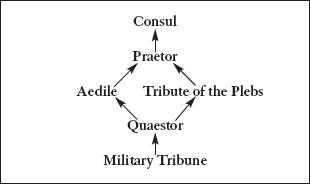
Around his seventeenth birthday, a young man would enter the army and serve for ten years in increasingly important military roles. Toward the end of his military service, a worthy soldier could be elected one of several military tribunes serving a legion. This was the first rung on the Path of Honors which Caesar now held.
In his late twenties, a man with political aspirations would seek election as one of the quaestors that served the Republic at home and abroad. Quaestors handled the mundane tasks of government work such as managing the treasury and organizing the food supply of Rome. Like all the magistrates, a quaestor was unpaid. This had the deliberate effect of limiting entry into the government service to those who had independent means of income. Magistrates served for only one year, with the result that no one ever had time to become an expert in any particular job. High Roman officials were essentially amateurs heavily dependent on the advice and consent of their superiors, especially the power brokers of the Senate.
After service as a quaestor, a rising star might be elected as an aedile for a year to oversee public buildings, temples, water supply, or police functions, among other tasks, including the public games. The state allotted some money for these games, but particularly ambitious aediles would often add to this fund from their own resources to curry public favor in their hoped-for rise up the Path of Honors. Those lacking in sufficient funds could always borrow from money lenders who saw promise in a future leader. But an aedile who spent unwisely or failed to advance after falling into debt could be financially ruined or hounded by creditors for years to come.
An ambitious plebeian could also campaign for election by the Plebeian Assembly as one of ten tribunes. In this office a tribune, whose person was sacrosanct, was charged with protecting the rights of all plebeians. In one of the most powerful actions of Roman government, a tribune could overrule any magistrate or assembly by uttering a single word—veto (“I forbid”). With this statement, laws, Senate decrees, and elections were invalidated. The potential for abuse of this tribunal power was enormous, though tradition and pressure from colleagues minimized the temptation, at least until the late second century B.C.
The penultimate step on the Path of Honors was service as a praetor. In this office, a magistrate might perform military service, serve the state abroad, or exercise judicial functions. A praetor also possessed imperium, the power of command. With this power he was vested with supreme administrative authority, including the right to impose the death penalty. Those magistrates with imperium were escorted everywhere by guards known as lictors, who bore a bundle of rods bound around an ax. These fasces were a praetor’s visible symbol of the right to use force (hence our term fascism).
At the pinnacle of the Path of Honors were the two elected consuls, who also held imperium. The Centuriate Assembly annually chose these men to bear the highest civil and military responsibility for the Republic. The chief task of the consuls was to lead the Roman armies, but they could also carry out judicial proceedings and propose legislation to the assemblies. If a consul was abroad fighting at the end of his term, the Senate could, if it wished, extend his authority as a military leader by granting him proconsular power. Throughout most of the Republic the two consuls worked together amicably, but there was always the potential for a pair of consuls at loggerheads to grind state business to a halt.
Most men who had served as consuls settled back in their chairs at the Senate house and lived out their days as respected elder statesmen. Ex-consuls often served as governors in the conquered provinces, but there were also two other offices that a few distinguished former consuls might attain. The first was the position of censor, two of which were chosen every five years to serve a term of eighteen months. A censor was charged with conducting a census of all citizens and purging the Senate of unfit members.
The final magistrate of the Roman Republic, the dictator, served only in the most dire circumstances. When the state faced the gravest of dangers, the Senate could recommend a dictator to serve for up to six months. The dictator held supreme civil and military power, was not subject to any appeal, and could not be held accountable for his actions after his term of service. The dictator appointed a master of the horse to assist him, but all magistrates remained in office subject to his command. The legendary paradigm of a Roman dictator was the patrician Cincinnatus, who according to tradition was summoned from his fields to serve as dictator during a desperate war in 458 B.C. He reluctantly agreed, led the army to victory, then lay down his dictatorship after sixteen days to return to his plough.
We don’t know exactly what Caesar did during his time as a military tribune, but we may reasonably guess that he served under Crassus against Spartacus and gained valuable experience in fighting a clever enemy. The supposition that he worked for Crassus is especially tempting since Caesar was soon to become a key supporter of Rome’s richest politician.
The period after the defeat of Spartacus in 71 B.C. saw a contest for power between Crassus and Pompey—a rivalry of giants that came perilously close to a full-scale civil war. Pompey had returned from his campaigns in Spain angry at the Senate for its lack of support. He found it convenient not to dismiss his army once back in Italy, citing the continued threat from the slave revolt. He made camp with his battle-hardened forces not far from Rome, then asked the Senate if it wouldn’t terribly mind allowing him to run for consul the next year, even though at thirty-five he had never held any offices on the Path of Honors. Pompey also made it clear he would overturn many of the privileges the Senate had enjoyed since Sulla’s reign. With Pompey’s army breathing down their necks, the senators in desperation turned to Crassus, who also still had his veteran forces on Italian soil. It was an ideal situation for Crassus. If he defeated Pompey, which was quite possible, he could enter Rome as a hero and the optimates of the Senate would hail him as savior of the Republic. But Crassus was a clever businessman who weighed the risk and took a most unexpected path—he joined Pompey. The Senate was left without a defender and watched helplessly as Pompey and Crassus were elected consuls together in 70 B.C..
The two new Roman magistrates acted with surprising cooperation and jointly dismissed both their armies. Their first task was to strip the Senate of its exclusive power to serve on juries deciding corruption cases. The senators were now forced to share their votes on such cases with wealthy businessmen of the second class known as equites (knights). This did little to make the Roman court system more just to abused provincials, but it did earn the consuls political capital from rich Romans outside the Senate. Even more important to the common people of Rome was the successful measure introduced by Pompey and Crassus to restore power to the tribunes of the plebs that had been stripped from them a decade earlier by Sulla. The tribunes could once again, for noble or ignoble reasons, impose their veto on any action by the Roman government. Finally, Pompey and Crassus maneuvered two censors to expel over sixty “unworthy” members of the Senate who just happened to be their political adversaries.
Caesar was active at the same time as a great supporter of Pompey and Crassus. This was to be expected as Caesar had positioned himself clearly in the populist rather than optimate camp. He stood firmly behind the consuls in their move to restore power to the plebeian tribunes. Caesar also spoke out in favor of a bill to grant amnesty to all who had previously supported the failed revolution of Lepidus in 78 B.C. This was a matter of political expediency as well as family honor since the exiles included his brother-in-law Lucius Cinna, but it also points to a characteristic that would later distinguish Caesar from his contemporaries—the quality of mercy that the Romans called clementia, so evident in future years during his dealings with bitter rivals.
In 69 B.C., Caesar took the second step on the Path of Honors when he was elected as a quaestor. In this role Caesar might have been assigned a tedious job in Rome overseeing the water supply or managing the importation of grain to feed the city, but instead he maneuvered a more advantageous foreign assignment with the propraetor of Further Spain. The election as quaestor also at last gave Caesar a voting membership in the Senate. However, before he could leave for Spain he was struck with grief by the death of the family matriarch, Julia, his beloved aunt and widow of Marius. It was customary to honor an elderly and respected woman like Julia with a suitable funeral oration; since her husband and son were both dead, the duty fell to Caesar. But as Marius was still vilified by the ruling aristocracy, a discreet funeral would have been the prudent course for a rising young senator. Instead, Caesar did something totally unexpected and extremely daring. On the morning of the funeral, Caesar proceeded to the speaker’s platform in the Forum accompanied by a procession bearing the images of Marius himself. These were kept in the atrium of a Roman home and customarily borne in funeral marches to celebrate the glorious relatives and ancestors of the deceased. Sulla’s laws had strictly forbidden such public displays of Marius’s image as was befitting a persona non grata. Some in the crowd were outraged at Caesar’s actions, but he had shrewdly calculated the effect of the images some fifteen years after the death of Marius. Although the late general and seven-time consul was still considered a murderous tyrant and destroyer of senatorial values by the optimates, the common people held a warm place in their hearts for the man who had saved Rome from the northern barbarians. Old veterans Marius had raised out of the gutters of Rome to serve proudly in the legions wept and cheered as his images passed by. It was as if the departed Marius himself had risen from the dead and was marching once again through the Forum. If there had ever been any doubt as to Caesar’s populist allegiance, it was now dispelled in one bold stroke.
Caesar climbed to the top of the rostra and faced the huge crowd gathered below him. In a rousing oration for his aunt Julia bursting with family pride, he reminded senators and commoners alike just who he was:
The family of my aunt Julia is descended from kings on her mother’s side and, through her father, from the gods themselves. For the Marcii Reges, her mother’s family, are heirs of Ancus Marcius, fourth king of Rome, while the Julians, of which our clan is a member, descend from the goddess Venus herself. My family therefore holds the sanctity of kings who rule among men and of gods who rule over kings.
Far from being put off by this audacious speech, the people of Rome loved Caesar for it. Here was a man who had grown up among them in the slums of the Subura, who was a nephew of their hero Marius, announcing to all the world that he, a descendant of kings and the gods themselves, was on their side. It was obvious to everyone that Caesar was a man of tremendous gifts who could rise high in the government if he could overcome the entrenched optimates. If he could, the common people of Rome knew that they would have a powerful advocate.
Tragedy struck Caesar again soon after his aunt Julia was laid to rest. His young wife Cornelia now suddenly died. He had been married to Cornelia since he was chosen to be the teenage flamen dialis by her father and Marius. He had loved her so much he risked his life by defying Sulla so that they might remain together. And from Cornelia was born his only child, his daughter, Julia, who was now about seven years old. Caesar was devastated, but he knew his career depended on leaving Rome to serve as quaestor in Spain. He probably put young Julia in the charge of his own mother, Aurelia, who had already been an important presence in her granddaughter’s life and would raise her in his absence as a proper young woman of Rome. But there was one last honor he could perform for Cornelia before he lit the funeral pyre and laid her ashes in the family tomb. Although it was unheard of to do such a thing, Caesar once again mounted the rostra in the Forum to deliver a eulogy. This time there were no images or elaborate ceremony, just a brokenhearted man in mourning who spoke of his childhood bride and his love for her. Eulogies for men and older women were common, but no one had ever delivered a public funeral speech for a young woman. Caesar’s words do not survive, but their effect on those gathered in the Forum that morning was profound. Perhaps they were like the moving epitaph later written by a Roman man in Egypt for his departed wife:
I COMPETED WITH YOU, MY DEAR, IN DEVOTION, VIRTUE,
FRUGALITY, AND LOVE—BUT I ALWAYS LOST.
I WISH EVERYONE THE SAME FATE.
Those who heard his speech for his aunt Julia had been struck by his confidence and pride, but the softer words spoken for his wife revealed a man of gentleness and depth of feeling.
Caesar set off at last for the Roman province of Further Spain on the Atlantic coast to serve as quaestor under the governor Antistius Vetus. In this unsettled land bound by the sea on the west and mountains on the east, Caesar was charged with the difficult task of traveling among the native communities to rule on cases and settle disputes. When Caesar arrived in a town, litigants would come to him seeking justice on tax payments, property disputes, and a thousand other problems. Though the job was tedious, it gave Caesar the opportunity to make himself known among the provincials as a man who dealt with them fairly in their disputes with Rome. Even on the edge of the civilized world, it was useful for a Roman politician to establish friendly relations with the natives. The time and effort he invested in Spain would serve him well in the future.
One day when Caesar was hearing cases in the ancient Phoenician city of Gades (modern Cádiz) on the southwestern Spanish coast, he crossed to the nearby island of Cotinussa to visit the temple of Hercules. There Caesar looked out across the vast Atlantic stretching forever to the west. To the Romans, as to the Greeks, Carthaginians, and Phoenicians before them, this was truly the end of the earth. But Caesar—like all educated people in the classical world—knew that the earth was a sphere and that if he could sail far enough west he would come eventually to the fabled land of the Seres or Chinese. As Caesar entered the temple of Hercules, he saw a statue of Alexander the Great, who had died more than two centuries earlier while still in his early thirties. Caesar was now about the same age and lamented that he himself had done nothing noteworthy at an age when Alexander had already conquered all the lands from Greece to India. He left the temple in despair and was troubled even more deeply the following evening when he dreamed that he, like Oedipus, had engaged in sex with his own mother. Not normally a superstitious man, Caesar sought out a local soothsayer who interpreted his disturbing dream in a most favorable light. His mother, said the seer, was in fact the earth itself, so that his dream foretold he would one day rule the world—as Alexander the Great had.
It may have been this restless ambition that led Caesar to leave Spain before his term as quaestor was over and travel back to Rome by way of northern Italy. Here among the rich lands of the Po River valley settled by Celts four hundred years earlier were a number of Roman colonies. All the towns and lands south of the Po had been granted Roman citizenship twenty years earlier, but except for two colonies north of the river, most of the hardworking inhabitants of Cisalpine Gaul (i.e., Gaul “this side of the Alps”) north of the Po were not considered fully Roman. It was a situation rife with resentment and potential for armed insurrection, as during the Italian War of the previous generation. Caesar knew this, of course, and decided to further his career as a populist by backing the disgruntled Italians north of the Po. Caesar traveled throughout the area making friends and lending a sympathetic ear to the unhappy townsmen and farmers. In Verona, he probably met the poet Gaius Valerius Catullus who was then a teenager. If Caesar traveled to nearby Mantua, as is likely, he could have met a family riding into town from their nearby farm with a toddler named Publius Vergilius Maro, who would one day be known as Virgil, the greatest of Roman poets. In spite of all the contacts he made, it is unlikely that Caesar truly wanted to foment a violent uprising. Such a revolt would only bring the legions down on the settlers and would not serve his own long-term goals, but he did succeed in establishing himself as a patron of the Celts and Romans of northernmost Italy. This move would again pay enormous dividends in the following decade when he recruited thousands of soldiers from this region for his war in Gaul and his subsequent revolution.
Caesar returned to Rome in 67 B.C. and marked the year by throwing himself wholeheartedly into the social and political life of the capital. It was unusual for a man of Caesar’s status to remain single, so he took as a new wife a young woman named Pompeia. She was a remarkable choice for Caesar given that she was a granddaughter of none other than Sulla and a woman whose family on both sides were intimately tied to the optimate cause. It may be that Caesar was hedging his bets by marrying into a family of the political opposition, though he remained a dedicated populist. It could also be that Caesar simply loved Pompeia and that he saw a wonderful irony in marrying the granddaughter of the man who had tried to kill him and whose legacy he was working so hard to destroy.
In the same year Caesar also volunteered for the position of curator of the Appian Way. This most famous and important of Roman roads ran over two hundred miles south from Rome to Capua near Naples, then east across Italy to the port town of Brundisium on the Adriatic. It was a crucial connection between Rome and the rich lands of Campania, but also the main route to the lands of the East. Whenever an army departed for or arrived from Greece, Asia, or Egypt, it almost always went through Brundisium. Like all Roman roads, the Appian Way (Via Appia) was a marvel of both engineering and propaganda. Construction began on the roads by digging deeply into the soil to lay a foundation of rock, covering this in turn with gravel for drainage, and finally paving with virtually indestructible flagstones over which commerce rolled and armies marched. Unlike the earlier muddy tracks around much of the Mediterranean, Roman roads were meant to endure and rarely yielded to the vagaries of topography. Unless prevented by impassable mountains or impregnable swamps, the Romans built their roads straight as an arrow across the landscape. They were in fact a sermon in stone to the world—Romans do not yield. Two thousand years later, the Appian Way and other Roman roads still survive throughout the former Roman Empire, from Scotland to Syria. Caesar’s tenure as curator of this most important Roman road gave him valuable experience in engineering and construction, but it also afforded him the opportunity to work closely with, and develop ties to, many important communities throughout southern Italy. He in fact spent vast amounts of his own borrowed money to ensure that transportation needs of the towns on the road were well served.
Supervising the Appian Way during this year did not keep Caesar from participating in politics at Rome. The numerous failures of the Romans to control the pirate menace in the Mediterranean had finally led to widespread food shortages, rampant kidnapping, and a stifling of trade at sea. The people of Rome were incensed that the Senate had been unable to eliminate piracy, so one of the tribunes of the plebs put forward a bill that would grant an extraordinary commission to a single man to destroy the pirates once and for all. The powers in this proposal were stunning—complete dominion of the entire Mediterranean Sea and inland up to fifty miles along all coasts. In addition, the man chosen would be allowed to select fifteen men from the Senate to help him carry out his plan, requisition two hundred of the best ships available, and draw unlimited funds from the treasury. Although the bill did not mention anyone by name, it was clear to everyone that Pompey was behind the whole affair and expected to be chosen as leader of the war against the pirates. The people of Rome were thrilled at the proposal, but the Senate was understandably horrified. To grant an individual the kind of sweeping power proposed in the bill was to make him a virtual king of Rome’s vast domain. It would be a short step for an ambitious man to move from ruler of the seas and coasts to ruler of the entire realm. Even staunch populists in the Senate balked at the idea of Pompey being handed such power. The sole exception was Caesar. Alone among the senators, Caesar rose to speak for the proposal. Perhaps the fact that he had been kidnapped by pirates moved him to speak out, but it was primarily a political calculation. Caesar knew that the bill would fail and that as a minor member of the Senate his voice would carry little weight, but by standing up alone for the bill, he was assured that Pompey and the Roman people would remember him favorably in the future.
The rest of the senators spoke out strongly against the bill, warning Pompey that if he wanted to act like Romulus he would end up sharing the same violent fate as Rome’s founder. The Senate soundly rejected the commission, but the bill was then taken directly to the people in assembly. One of the tribunes then issued a veto against the proposal, but withdrew it after the people shouted against the opposition so loudly that, according to legend, a raven flying over the Forum was knocked out of the sky. Pompey gained his commission with even more than he had asked for—he received five hundred ships, twenty-four senators as assistants, and over one hundred thousand soldiers. Pompey was a poor political leader but was in his element in war. He divided the Mediterranean into thirteen districts and swept the sea from end to end. In forty days, he had methodically cleared the Mediterranean of piracy. Pompey returned to a Rome now overflowing with trade goods and was welcomed by the people as a true hero. The Senate, which had for decades been unable to act decisively and eliminate the pirates, was of course furious.
Pompey’s success against the pirates prompted him to seek even greater glory. In 66 B.C., a tribune of the plebs, undoubtedly acting under orders, introduced a bill giving Pompey an almost unlimited command to settle affairs in the eastern Mediterranean. Rome had long paid scant attention to the problems posed by threatening or unstable regimes in Asia Minor and Syria, aside from ensuring that the Senate and knights could squeeze the maximum profit from the region. But now with Mithridates once again stirring up trouble in Asia Minor and the states of the Near East engaged in endless bickering, Romans were finally ready to force a permanent peace in the eastern lands.
The optimates of the Senate were firmly opposed to this grand new commission for Pompey, but they were overwhelmed by the will of the people, especially the knights who knew that stability in the East was good for business. Caesar once again spoke out in favor of the bill, as did Cicero. Pompey easily won the day and took over the command of the former consul Lucullus, who had been largely successful against Mithridates, but was unable to bring affairs in Asia Minor to a satisfactory conclusion. Pompey’s ambition, however, went far beyond merely cleaning up the mess Lucullus had left behind. Pompey led his troops against Mithridates and surrounded the wily old king near the Armenian border, destroying his entire army. Mithridates escaped with a few men and fled to the Crimea where he was reportedly gathering a huge force to march on Italy, but his grandiose plans were cut short when his son Pharnaces led a rebellion against him. Trapped in a fortress overlooking the Black Sea, the last great enemy of Rome in Asia took his own life.
Pompey, meanwhile, had crossed into Armenia and the Caucasus, conquering mountain tribes and perhaps hoping to open new trade routes to the Far East. He then turned south to the remnants of the Seleucid empire in Syria and to the Nabataean Arabs, a rich kingdom with their capital at rose-red Petra controlling the lucrative spice routes to Yemen and southern Arabia. But before Pompey reached Petra, he was distracted by the feuding Maccabees of Judea and turned aside to Jerusalem. Rome had long supported Judean independence as a counterweight to Syrian power in the region, but a quarrel between two brothers, Hyrcanus and Aristobulus, had plunged the Jewish state into civil war. Both brothers appealed to Pompey, who decided in favor of the weaker and more easily controlled Hyrcanus. Aristobulus reluctantly yielded, but Jewish partisans who resented Rome meddling in their affairs took over the Temple Mount and for three months resisted the legions sent against them. Pompey finally stormed the sacred mountain on the Jewish Sabbath and slaughtered the defiant priests at their altars. The Roman general entered the temple and strode boldly into the forbidden Holy of Holies at its center, though he left the treasures of the Jews untouched.
Over the course of three years, Pompey had conquered new lands and rearranged the whole political geography of the Near East—without the tedious and often futile process of seeking Senate approval. The king of Armenia, Tigranes, was left in charge of his kingdom as a buffer against the mighty Parthian empire of Mesopotamia. The old Seleucid state was broken up and Syria established as a Roman province. The Jewish kingdom was left nominally independent, but reduced to little more than the area around Jerusalem plus Galilee and a few nearby territories. With a minimum cost to the treasury, Pompey had brought peace to the eastern Mediterranean for the first time in centuries and gained huge riches for Rome as well as himself. The lesson was not lost on Caesar. Freed from interference by the Senate, a capable general could accomplish magnificent deeds that would assure his status at Rome and place in history, in addition to making him fabulously wealthy.
Caesar was not idle while Pompey was in the East. As a patrician, he could never serve as a tribune of the plebs, so he took the alternate step on the Path of Honors when he was elected as an aedile for the year 65 B.C. The aediles served as curators of Rome for a year, handling everything from street repairs and temple maintenance to urban crime, but the position was attractive to aspiring politicians because aediles also managed the public festivals. Two aediles organized a weeklong celebration in honor of the great mother goddess Cybele in April and fifteen days of festivities for Jupiter in September. In addition to state money, an aedile hoping to impress the common people and gain electoral advantages in the future was expected to spend lavishly from his own pocket. In this Caesar outdid anyone before him, though all on borrowed money. He decorated the whole Forum as well as the nearby Capitoline Hill, hosting public banquets, wild beast contests, and stage productions for all of Rome. One of Caesar’s colleagues as aedile was Marcus Calpurnius Bibulus, a sworn optimate who would be a thorn in Caesar’s side for years to come. Bibulus later complained that everything he accomplished as an aedile was overshadowed by Caesar, who claimed credit for the deeds of both of them.
Caesar further eclipsed Bibulus when, in addition to the two required festivals, he sponsored gladiatorial games of unprecedented splendor in honor of his late father. No fewer than 320 pairs of top-rank gladiators were shipped in by Caesar, causing not a few Romans to worry about an uprising by some latter-day Spartacus. But as always, Caesar was in firm control of events.
He had, however, developed a taste for the finer things in life so long denied him in the poverty-stricken Subura. Caesar became an avid collector of fine art with exquisite and extravagant taste in jewelry, sculpture, and paintings. His sense of perfection coupled with his extravagance led him to build an expensive country house at Lake Nemi in the Roman countryside only to tear it down when it failed to meet his exacting standards. The debts that Caesar was incurring both as an aedile and in his private life were staggering.
Caesar’s masterstroke of publicity during his year as an aedile was accomplished in a single night. Four years earlier during his aunt Julia’s funeral, he had paraded the family images of Marius through the streets, much to the chagrin of the optimates in the Senate. Now he had more elaborate displays of Marius constructed and collected the dazzling trophies of Marius’s victories over the Germans that had been banned by Sulla. With his followers, Caesar secretly carried all these forbidden objects to the Capitoline Hill under the cover of darkness and set them up outside the half-finished temple of Jupiter. When the sun rose the next morning, all of Rome could see the trophies of Marius glittering above the Forum. Word spread throughout the city and crowds gathered on the Capitoline to marvel at both the brilliant display and the audacity of Caesar. The optimates were aghast and cried out that Caesar was putting himself above the law by setting up forbidden objects in public. But the common people who loved Marius now wept and cheered for his nephew, filling Rome with their shouts and applause. The Senate held an emergency meeting, which Caesar attended, and the upstart aedile was denounced by Lutatius Catulus, the optimate leader: “This Caesar is no longer trying to undermine the Republic secretly, but is now attacking the state openly with machines of war.”
Caesar rose to answer and calmly explained to the Senate that his intentions were not threatening to the state at all. Though his speech to them is now lost, it must have been a masterwork of oratory since the hostile Senate, even the optimates, were convinced of his noble intentions. Caesar’s supporters in the Forum were thrilled at these events and urged him never to give in to the opposition in the Senate. Even though he was a mere aedile only thirty-five years old, the populists now began to see in him someone who could become the most important man in Rome.
Some ancient sources, however, suggest that the optimates may have been right to fear Caesar. The biographer Suetonius mentions a plot against the state while Caesar was serving as an aedile that promised a bloody end to the Senate’s rule. Suetonius records that Publius Autronius and Publius Sulla, the two consuls who had been elected for 65 B.C., were disqualified from service before taking office because of corruption charges. In their place, Lucius Torquatus and Caesar’s cousin Lucius Cotta were chosen to serve as consuls. The original consuls determined to have their revenge by murdering Torquatus and Cotta at their inauguration, then handing power to the millionaire Marcus Crassus as dictator. Crassus would supposedly then reorganize the government and return power to Autronius and Publius Sulla. The chief assistant of the dictator Crassus was to be none other than Caesar. Suetonius says the plot fell through when Crassus lost his nerve at the last minute and Caesar failed to let his toga fall off his shoulder, the pre-arranged signal for the slaughter to begin.
But there are several good reasons for thinking that Caesar was not involved in this conspiracy, if it happened at all. First, the sources that Suetonius gives for his information on the plot include the plodding anti-Caesarian historian Tanusius Geminus as well as Caesar’s persistent rival and fellow aedile Marcus Bibulus. Second, Cicero, who rarely missed a chance to condemn Caesar in his later years, never claimed that he was involved. Third, Caesar was capable of bold action, but he is unlikely to have been involved in a poorly planned insurrection that included murdering his own cousin. Caesar would one day defy the Senate and lead Rome into civil war, but everything we know about his nature argues against bloody revolts and conspiracy theories. Caesar had for years been carefully, step by step, building his credentials as a proven military leader and sensible populist politician. Even though his enemies would naturally look back at his career in later years and accuse him of revolutionary plans from the cradle, Caesar was not the kind of man who would unnecessarily risk his career by supporting a violent coup d’état.
A much more believable plan for increasing the power of both Crassus and Caesar at this time centered on the ancient kingdom of Egypt. Crassus had been nursing a grudge against Pompey since the younger man had stolen the glory of his victory over Spartacus. Even though the two had made peace and worked well together as consuls in 70 B.C., Crassus had watched impotently as Pompey was lauded by the Roman people for sweeping the Mediterranean of pirates, defeating Mithridates, and conquering the Near East. Crassus realized that in spite of his own vast riches, he needed a spectacular prize to offer Rome if he were ever to equal Pompey in the eyes of the Senate and common people. Crassus saw a golden opportunity in Egypt, the one kingdom of the eastern Mediterranean that Pompey had left untouched. Rome had long meddled in Egyptian affairs, but the land of the Nile still remained independent—and immensely wealthy.
Egypt in the first century B.C. was a far cry from the mighty civilization it had been in earlier ages. The glorious early dynasties of the third millennium B.C. had built the pyramids and Sphinx, while the second millennium saw an Egyptian empire stretching from the Euphrates to Nubia under kings such as Rameses II. In following centuries, however, internal decline and foreign rule weakened Egypt until it was seized by Alexander the Great in the fourth century B.C. After his death, Alexander’s general Ptolemy took over the Nile valley and established a family dynasty of Greek rulers of Egypt—each bearing the name Ptolemy—ruling from the cosmopolitan city of Alexandria on Egypt’s Mediterranean coast. In 80 B.C., Ptolemy XI died, leaving his kingdom to Rome, though the Senate could never agree on whether or how Egypt should be annexed. The Egyptians had maintained their shaky independence since then, though the Alexandrians despised their new king Ptolemy XII (nicknamed Auletes, “flute player”) for being too friendly to Rome.
Crassus now proposed that Rome at last make Egypt a proper Roman province. It was a reasonable proposal given that Rome had a legal claim to the kingdom through the will of Ptolemy XI, and that annexation would mean a considerable influx of gold into the treasury. Crassus wanted to send Caesar to Egypt to handle the details of the takeover, a plan that Caesar wholeheartedly supported. Such a commission could give Caesar enormous popular standing in Rome as well as erasing all his debts. But the Senate quite reasonably concluded that, as much as they disliked Pompey, allowing Crassus control over Egypt would make him far too powerful. The optimates also opposed any move that would increase Caesar’s growing influence in Rome. The bill was soundly defeated when presented to the people because of maneuvering by the optimates and by the well-spoken opposition of Cicero, who was carefully defending the interests of his patron Pompey.
The year 64 B.C. dawned with Pompey still in the eastern Mediterranean, Crassus in Rome counting his money, and Caesar quietly planning his next move up the Roman political ladder. But the one man in Rome most ready to seize the day was Marcus Porcius Cato, five years Caesar’s junior, who had just been elected as a quaestor. Caesar’s quaestorship in 69 B.C. had been spent in Spain, but Cato’s assignment was to manage the treasury in Rome. Previous quaestors had served in this capacity in a loose supervisory role. They were content to let the professional clerks manage the day-to-day paperwork and dull duties of revenue and expenditures, occasionally popping in for a cursory inspection or friendly chat with the treasury supervisor. Cato, however, was not a typical quaestor. A remarkable man of discipline and duty, as well as a sincere student of Stoic philosophy, Cato had spent the weeks since his election carefully studying the minute details of treasury management.
When Cato arrived at the treasury at the start of his term, the clerks and bureaucrats expected just another young Roman politician who had little real interest in the position and who would leave them alone to carry out their dull jobs while skimming state funds as before. But Cato entered the doors of the treasury on the Capitoline Hill like a mighty storm. He immediately put a stop to corruption and mercilessly lectured the clerks on their improper procedures and sloppy bookkeeping. For the lax civil servants of the treasury, Cato’s quaestorship was a nightmare. They appealed to the other quaestors to curb their relentless colleague, but no one could stand up to the righteous fury of Cato. The new quaestor soon spread his crusade beyond the treasury walls when he discovered that many of the Roman nobility owed money to the state that they had somehow forgotten to pay. Cato brought them up on charges without regard for their political standing. He even dug up the records on those who had received blood money during the proscriptions of Sulla almost twenty years earlier and charged these men, on somewhat dubious legal grounds, with murder. The courts designated to handle such cases overflowed with defendants, so special judges were appointed from among ex-aediles, including Caesar, to hear testimony. No respectable member of the Senate admired Sulla’s murderous old henchmen living out their comfortable retirement on blood money, but none before Cato had dared to charge them. Throughout the long and painful year of the trials, the ghosts of the past were exorcised. Caesar, who had little reason to love Cato, could only approve of the quaestor’s decisive actions.