
CHAPTER SEVEN

‘And now ravished at Worcester by numerous overpowering force, on that black and white day September the third, 1651.’
A True Narrative … of His Majesty’s Miraculous Escape
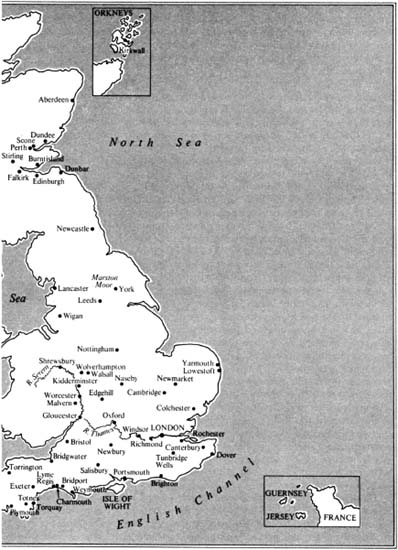
On 4 October 1650 King Charles rode carelessly out of Perth, ‘as if going on hawking’ – and only came to rest forty-two miles later. This attempt to escape his Covenanter captors, as they had virtually become, was known as the Start. It finished almost as soon as it began. The King pushed north to Dundee, paused at Cortachy and rested overnight somewhere near. But no Highland Royalist force emerged to join him. Two officers from his abandoned hosts at Perth soon caught up with him, finding the King to be ‘in a nasty room on an old bolster above a mat of sedge and rushes over-wearied and very fearful’.1
Charles was taken to Huntly Castle, and by 6 October he was back at Perth, listening to yet another sermon. The Scottish leaders issued a cold instruction on the subject to their emissaries: ‘You shall say how much we are grieved and amazed with His Majesty’s sudden and unexpected behaviour….’2
But the Start had a significance beyond a spontaneous gesture of defiance. It demonstrated in terms which the Kirk could not miss that Charles had reached the limits of his endurance where their demands were involved. Humanly, he was no longer capable of compromise. There had already been sufficient interference with his intimate entourage: Long and another of his attendants had taken themselves off to Dundee, where they were already in touch with the northern Royalists.
Charles’ doctor, Alexander Fraizer, also played some part, by putting his master in touch with the ‘Malignants’, as the Episcopalian Royalists were described. Fraizer had the advantage of having known the King in both Jersey and France; other advantages he possessed he would deploy skilfully after the Restoration, for he could deliver a Court lady’s child and cure its father of an amatory disease with equal deftness. In these rugged days, however, it was of more consequence that Fraizer had ‘an unquiet and over-active spirit’; he was a natural intriguer rather than a successful one.
When Sir James Balfour came to Charles on 3 October with news of a whole lot of new purges which would be proposed, to include his own household, the King felt he had had enough, dug his heels into his horse and set off on his gallop to Angus and beyond. That, at any rate, is the most plausible explanation both of the Start and of the King’s speedy arrest. It has been suggested that Buckingham first inspired and then betrayed the expedition; alternatively that he tried to stop it: but all this is to complicate the issue unnecessarily.3 The King’s apprehension was in fact made inevitable by the unplanned nature of the outing.
Charles’ disgust with the Covenanters had been growing apace since Dunbar. On the very day of the battle he had written to Nicholas that it was difficult to conceive of the ‘villainy’ in Scotland – ‘Indeed it has done me a great deal of good,’ continued Charles, ‘for nothing could have confirmed me more to the Church of England than being here, seeing their hypocrisy.’4 Politically and strategically, it was madness on the part of the Covenanters to suppose they could defeat Cromwell without the help of all the pro-monarchical forces in Scotland: these obviously included the northern Royalists, whom they had so unhelpfully termed the Malignants, while putting their celebrated champion Montrose to death.
It was with a view to creating some kind of national unity, even at this late hour, that the project of the King’s coronation was raised once more. In an age when the coronation of the sovereign has a ritual rather than a political significance, it is easy to forget the importance which the ceremony could still bear in the time of Charles II. This was twofold – foreign as well as domestic. The proposed crowning of Charles in Scotland had always been seen as a propaganda exercise to impress the European powers. It had been hoped to crown Charles at Edinburgh on 15 August ‘if Cromwell does not prevent it….’ There were happy rumours in Jersey that the solemnity had actually taken place.5 For a few months at least Cromwell had adequately prevented it.
Now, as the autumn wore on, more colloquies on the subject took place. The Commonwealth gazette, Mercurius Britannicus, might refer to Charles as ‘his little kingship’, an English spy might mark Charles’ correspondence ‘from Proud Tarquin’, and Cromwell refer to him in conversation as ‘the young gentleman’: none of these titles, sardonic and otherwise, replaced the esteem still given to a crowned head.
Domestically, there was a deliberate attempt to focus nationalist sentiment on Charles’ person by referring to the ancient Kings of Scotland – Fergus and so forth, a line of over a hundred sovereigns – to which Charles was regarded as the natural successor. Fergus had probably not figured greatly in Charles’ fantasies hitherto, but at Christmas Sir James Balfour gave him ‘a great charter’, inscribed with the royal genealogical descent, to assist such reveries.6
Enormous trouble was taken over the details of the coronation, which was appointed to take place on 1 January 1651 at the Cathedral at Scone. Still, the restraining hand of Presbyterianism was not lacking from the order of the day, or, as the author of an early life of Charles succinctly put it, ‘A fresh farce was now necessary and his Majesty had a principal part to play in it.’7 A committee was formed to draw up the procedure. The King was allowed to wear a prince’s robe of considerable richness, and his train-bearers were taken from among the sons of the nobility – the right-minded members of it. He also sat under a canopy of crimson velvet. But the traditional ceremony of anointing – a crucial part of any previous coronation – was omitted as being sheer superstition.
For at the heart of the ceremony was a contradiction like a canker, and that marred it somewhat, in spite of all the determination to create enough magnificence to illumine a nation. Charles sat on the throne of Scone, as his forefathers had done. But it was noticeable that he received the crown from Argyll and the sceptre from the Earl of Crawford, both Covenanters. Shortly afterwards John Middleton, a leading ‘Malignant’ soldier who wished to return to the Covenanting fold, did penance in sack-cloth – a strange epilogue to a coronation.
Above all, Charles had to endure another of Robert Douglas’ protracted sermons, the delivery of which, as Moderator of the General Assembly, Douglas took to be his due on this occasion. This particular effort was not only lugubrious but at times positively menacing. There were a number of solemn warnings about collapsing monarchies. These could fall for two principal reasons. First, ‘The sins of former kings have made this a tottering crown’; Douglas added that the chief reason for the misfortunes of both Charles Iand James VI and I was contained in their attitude to Presbyterianism. Secondly, a crown could simply totter through general troubles and commotions. Thus, ‘A King when he getteth his Crown on his head, should think at the best, it is but a fading crown.’8 It must have come as a pleasant surprise when Douglas announced at last the real theme of the coronation – to cleave the Scottish people to their young King.
At least the royal Household Book for Coronation Day shows some taste for magnificence: a vastly increased amount of meat and partridges was ordered, a total of ten calves’ heads, and twenty-two salmon.9 A quantity of damask napkins had been ordered well ahead, in December, fifty-four of which, for the King’s table alone, were embroidered with ‘CR’ in anticipation of the ceremony.10
And to a certain extent the gambit worked. King Charles made a series of progresses in that part of eastern and northern Scotland not controlled by the Commonwealth troops. At Pittenweem, for example, a coal seaport on the East Fife peninsula, the burgh laid down an elaborate order for his reception, including the ringing of bells from the moment of his arrival onwards, the wearing of their best apparel by the baillies and their council, and the employment of one of ‘my lord’s best carpets’ to cover the festive table. On this they proposed to keep in readiness ‘of fine flour some great buns and other wheat bread of the best order’, as well as eight or ten gallons of good strong ale. When the King finally left, cannons were fired.11
Elsewhere too he received a fine, even tumultuous reception. His regal peregrinations included visits to all the Fife coastal towns, on to St Andrews and Struthers House, thence back to Perth, north to Aberdeen via Dundee, as well as a tour of the garrisons of Stirling, Inchgarvie and Burntisland. He found time too for the now celebrated national pastime of golf (which had been enjoyed, incidentally, by both Mary Queen of Scots and James VI) and a jousting pastime named ‘running at the glove’.
In general, Charles bent every effort to make this new deal towards national unity work. At Aberdeen in February he persuaded the ministers to assist General Middleton in recruitment (now that Middleton had used that sackcloth to purge himself of his previous association with Montrose). That was one coup. Another took place in March, when he persuaded the Scottish Parliament to approve the raising of troops generally in the Highlands. The Engagers were in principle allowed back.
And Charles’ own reputation was growing in the world outside. In March his former tutor Newcastle, then in Antwerp, referred to him in glowing terms: ‘A braver King certainly we have not had since the conquest … his most excellent parts being bred in the school of calamity.’ The character he was beginning to acquire was of one ‘admirably active and intelligent in all his great affairs’ – with only one proviso. He did not care enough for his own safety, being ‘too forward to hazard his person in any attempt against the rebels’.12 Even that was not a disastrous quality in a young prince, who had to conjure unity out of nowhere, virtually unaided, except by the magnetism of his own person.
And Charles showed that his natural talent for diplomacy had not deserted him in these more public displays, in his handling of the delicate matter of Argyll’s daughter, Lady Anne Campbell.13 Argyll’s ambitions in this respect have already been mentioned: when he arrived at Breda the previous year, with a present of six Flanders mares for the King’s coach, one wit suggested that he also intended to unload on the King a seventh mare in the shape of his daughter. In Scotland, undeniably a bachelor, Charles could have found himself in an awkward situation.
It was not a question of the young lady’s own attractions (Ann, Lady Halkett, a Scot herself, spoke up for her valiantly and said that she was as well behaved as anyone at the English court). What was at issue was the demonstrable folly of saddling England with a Scottish Queen, one not even of royal birth, the daughter of Argyll to boot. No possible advantage of Argyll’s patronage could possibly outweigh the solecism of such a match, in terms of Charles’ future in England. And that was after all where the whole Scottish venture was aimed. At the same time it would not do to offend Argyll either – and the power of his position at that time is best illustrated by the fact that Buckingham too dangled after the young lady’s hand. Buckingham’s courtships were always practical, never romantic – witness his ultimate marriage to the great northern heiress and daughter of the Parliamentary general Sir Thomas Fairfax.
For once it was Henrietta Maria who behaved with common sense and judgement, when Charles consulted her on the subject. There was nothing ‘new and extraordinary’ in the notion that such a well-born young lady as the daughter of Argyll should wed a King, tactfully wrote back this descendant of the great Henri Quatre. But was it wise to exclude the English altogether from consultation over the question of his marriage? In general, the ‘imprudence or rather the madness’ of Charles’ taking of the Covenant had galvanized the widowed Queen. She warned courtiers who were not Catholics away from her side, saying that she was doing so in order to counterbalance her son’s behaviour. Reasonably enough, she did not wish to forfeit all the Catholic support in Europe. The Argyll marriage project lapsed for lack of encouragement.14
Back in Scotland, the real problem of the time was not the character of the monarch, who was indeed proving himself right royally, nor at this moment even the character of the opposition. Cromwell, a man of over fifty, in precarious health, had taken the winter in Edinburgh badly: he was struck down again in the spring so severely that he saluted the (English) doctor who cured him with the words, ‘He has plucked me out of the grave!’ The problem was that, for all these progresses, for all this parade of unity, marked by the Scots Parliament appointing the King as commander in March, the people themselves simply did not join up in sufficient numbers to constitute a proper resurgent military force.
For at least a generation the Scottish national fabric had been torn and torn again by religious division. Such rents were not so easily mended. For thirteen years, more or less, the country had been at war, its terrain frequently fought over. The deep human instinct to live at peace, if peace was at all possible, was a much stronger impulse than the shallow new growth of national loyalty implanted by their young King.
Unfortunately there was no way of discovering this unpalatable truth except by trial and failure. In the early summer of 1651 King Charles still rode high. Argyll’s influence diminished, his own authority increased. Charles’ twenty-first birthday, 29 May 1651, was declared in the Scottish Parliament the day of ‘the King’s Majestic Majority’; that evening Fife at least was lit up with congratulatory bonfires, and the ordnance was heard blasting off from Burntisland and other Royalist garrisons. The English heard that Charles was ‘very absolute’ in following ‘his own private counsels’. On 24 June the Weekly Intelligence (a Commonwealth gazette) reported that he was ‘higher than his people as much in stature as authority’. And Charles’ enormous physical energy was coming into its own. He thought nothing of riding, two or three times a week, between Stirling and Perth in order to display himself alternately at the head of his forces, and in Parliament. He rode up and down the lines of the army, wearing ‘a soldier’s dress’ of buff, set off by a red sash and his precious George. As to his own commitment, he told them genially that he had only one life to lose.15
The question was rapidly arising: where and in what direction was this life, and indeed this army, to be deployed? The obvious decision was to march on England. Given that, the possibilities were twofold. Charles could either plan for England immediately or he could wend his way north, and join up firmly with the Highlanders and Royalists there. Having united all available Scottish forces, he could consider further southward action. Both these courses begged the question of the Cromwellian army still in Scotland, centred on Edinburgh and straddled about the south-east and south-west of the country. The Scots, as everyone realized at heart, were in no position to take on the English again after the defeat at Dunbar. Indeed, both courses open to the King presupposed the swelling of their forces by a large number of additional troops – without which they could scarcely hope to suffer anything but a new and even more humiliating version of the Dunbar catastrophe.
It is important to realize that any plan for a direct southward move was based on the illusion of English Royalist help, because this goes far to explain the ultimate failure of the disastrous Worcester expedition. The notion of English Royalist help was an illusion for the grim reason that by 1651 the English Royalist movement was in itself a myth.16 Yet of this the King’s intelligence, such as it was, was quite unaware. Communications had been cut for too long. It was impossible for the King’s advisers, or indeed Charles himself, to appreciate the totality of the hold which a vigilant government now held over England itself. In many ways the country had become like a modern police state, with passes and permissions needed for any form of movement.
The activists fled, their estates confiscated. The feeble (and those disgusted by the King’s taking of the Covenant) compounded. The only Royalists with any sort of liberty were those who had decided to sit out the times until better ones prevailed. These were scarcely the types to risk life and limb to join an invading Scottish army, as it would once again appear to be.
Of Royalist underground conspiracy, about the only movement with any vitality in it was the so-called Western Association; this had been formed, under the cover of a race-meeting in April 1650, by Colonel Francis Wyndham of Somerset and Sir John Paulet of Hampshire. The sphere of its activities was remote from the vital north-western territories through which a Scottish army must pass to recruit English troops. The northwest was the traditional area of Royalist support, where many of the great magnates, such as the powerful Earl of Derby, had favoured the King. Yet the Northern Association, the alleged sister movement to that of the West Country, has been shown to be non-existent except on paper. An unsuccessful and easily quelled rising in Norfolk in December 1650 further depressed the Royalist spirits.
Back in Scotland however, Dean King reported that the King’s power was absolute: ‘all factions composed, the ambitious defeated, the army cheerful, accomplished, numerous’.17 In June too, most hopeful sign of all, the pernicious Act of Classes was repealed. From the Scottish angle all the prognostications were cheerful. As far as can be made out, it was always the intention of the King to put this mood of optimism to good use and march on England. Strategically, it made as much sense as marching north; besides, there was always the uncertainty as to how long any alliance of former Malignants and present Covenanters would last. Then there was Charles’ undoubted dislike of the Scots, not diminished by the fact that he had successfully united them under his personal banner. To put it mildly, he had no personal inducement to linger in a country which had treated him so ill.
Nevertheless, the Scots themselves were much less certain of the right course to take. At this point, an unexpected upsurge of the Commonwealth fortunes in Scotland transformed the situation. Hitherto the monarchical party had rested, militarily speaking, on the secure base of the Fife peninsula; apparently impregnable to Commonwealth assault, it enabled them to scurry about the north-east with more or less impunity. But on 24 June, at Inverkeithing just north of Edinburgh (close by the site of the modern Forth Bridge), the brilliant young Parliamentary commander John Lambert presented Cromwell with just the victory he needed. It is possible that David Leslie can also be blamed for not sending in enough troops in support. In any case, the bloodshed at Inverkeithing was even more lethal than that at Dunbar: the proportion of Scots killed in relation to the total force was greater.
The Fife débâcle removed from the Scots their other option of a northward encirclement. In a clever manœuvre Cromwell, now restored to health, reached Perth and cut off the Scots’ supplies. Militarily speaking, Charles had probably been right from the first in desiring the southern expedition. Now he was certainly right in desiring to speed up the operation if it was to take place at all.
Still the Scots havered. Their army lurked uncertainly west of Fife, near Stirling, leaving the initiative to Cromwell. The Scots did not finally take the decision to plunge south, regardless, for several vital weeks. The actual march began as late as 31 July. The Duke of Hamilton (formerly Earl of Lanark, who had succeeded his brother, executed by Parliament) agreed that marching on England was probably the best course. Or at any rate he called it ‘the least ill’. But he added, ‘It appears very desperate to me.’ Now the fatal divisions, the doom of Scottish society for so many years, began to appear in their ranks once again. Argyll, for example, retreated morosely from the scene and refused to join the army. At this the Engager Hamilton was full of glee: ‘All the rogues have left us.’18 But by the time Charles reached England he would need all the rogues he could get.
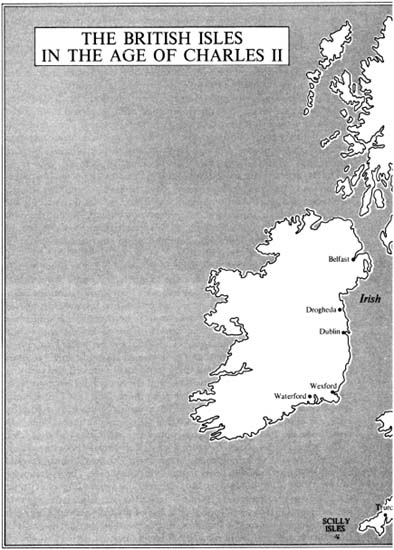
It was thus a listless and troubled force which crossed the border into England on 5 August.fn1 Such energy as it had was unfortunately diverted into such idiotic channels as the dispute initiated, with typically bad timing, by Buckingham. The perky young Duke suddenly took it upon himself to object to command of the army being given to a Scot, although the King had the veteran Leslie at his side, as well as Middleton. When Charles tactfully referred to Buckingham’s youth as a reason for denying him (Buckingham was actually two years older than Charles), the Duke sulked in the most childish and public manner, refusing to speak to Charles, refusing to come to the Council, and – supreme buffoon’s touch – refusing to change his linen in protest.
These debilitations contrasted with the energy with which the Commonwealth acted to meet the Scottish menace. Once again, as in 1648, much care was taken to present the invaders as alien and predatory. Mercurius Britannicus was coached to make a display of anti-Scottish feeling; an issue of early August chose to recall to its readers every single Scottish invasion of England which had taken place since that of King Malcolm in 1071. The word ‘un-English’ was used to describe those who might be so unwary as to join the ‘King of Scots’; stoning was suggested as a suitable fate for them.19
This so-called King of Scots was in fact proclaimed King of England at Penrith, a northern market town, and later at Rokeby, where a flourish of trumpets attended the ceremony. But it was significant that the important border town of Carlisle had refused to surrender to his call. And as their native country receded, all too many of the Scots decided to recede from the army back to it. Practically no-one in England joined the royal standard to replace them.
Government measures in England, including the cancellation of all public meetings, dealt efficiently with the emergency. Meanwhile, Cromwell, Lambert and Harrison, three of the toughest Parliamentary generals, were busy harrying the Scottish army in the rear: ‘That mongrel Scotch Army’, as Thomas Lord Bruce (a Royalist) disdainfully called it in his memoirs.20 But it was not actually mongrel enough. The Catholics of Lancashire existed but they did not rise. The King was after all at the head of a band of Presbyterians.
Nothing seemed to go right. When the Earl of Derby, the great magnate of Lancashire, landed from the Isle of Man to bring his followers to the King’s aid, he was instantly defeated at Wigan. Only the Earl himself, and a handful of his men, escaped to join the King further south. The presence of Commonwealth spies in the Royalist organization exacerbated its problems: Isaac Berkenhead, a supposed Royalist agent, betrayed the correspondence between the King and Lord Derby. Another spy, Thomas Coke, revealed so much of the Royalist network in England that about two thousand people were taken into custody, including potential leaders such as the Duke of Richmond and Lord Beauchamp.21
The King’s fortunes got no better as he moved south. If anything, the patriotic revulsion of the English against the Scots increased. The Parliamentary commander of the town of Shrewsbury refused to surrender to ‘the King’, and addressed his refusal pointedly to the ‘Commander-in-Chief of the Scottish Army’. There are many instances in contemporary records and memoirs of once loyal monarchists who simply stayed away from the doomed and by now straggling royal train as it wound its way through that English countryside. At Chirk Castle Sir Thomas Middleton not only declined to rouse North Wales on behalf of the King, but even refused to receive his letter.
The Duke of Hamilton had written, ‘I confess I cannot tell you whether our hopes or fears are greatest, but we have one stout argument – despair; for we must either stoutly fight or die.’ It was in this mood that King Charles, at the head of no more than sixteen thousand men, most of whom were by now utterly exhausted, arrived on August 22 at the city of Worcester.
Twelve days passed before the Commonwealth Army attacked. This period was spent by the King in desperate activity, trying to salvage something like victory from a hopeless situation.
Proud of its loyalty to the royal house, Worcester had been the first city to declare for Charles I in the Civil War. Graced by an incomparable cathedral, which loomed over the woody bank of the River Severn, it presented a fair sight, this city set in a flat green countryside of fertility, nearing the Marches of England and Wales. Here the King lodged in a small mediaeval housefn2 and gave his mind to the reanimation of his dispirited men. It had been twenty-three days since they departed from Scotland. Their problems were not purely of the mind: they were exhausted by this seemingly endless yet unsuccessful progress through England, and their belongings were in tatters; most of them lacked shoes and stockings altogether.
The city did have one advantage to set against all this; it occupied a naturally defensive position, situated on one river, the Severn, as it flowed down to Bristol, and defended by another, the Teme, which flowed into the Severn at a strategic point slightly south-east of the town. Beyond the river palisade were the heights blocking off Worcester from Evesham and, to the west, the Malvern Hills. This combination of river and hill might be turned to profit at the eleventh hour.
The day after his arrival the King held an assembly in the broad water-meadows below the cathedral. But the manifesto he issued showed that his prolonged march had still given him no opportunity to feel the pulse of English opinion; he was quite out of touch. For instance, he offered to settle religion according to the Covenant; he thought the difficulties of this were covered by promising arrears of pay to anyone who would desert the Commonwealth. The Act of Oblivion he offered to anyone except the actual regicides must also have seemed curiously unreal to those gathered in the water-meadows; they would have formed the perfectly correct conclusion that it was the King and the Scots who were going to need an Act of Oblivion before they were much older. At least Charles stressed the fact that the Scots would be returning to their own country once the matter at hand was concluded: government propaganda had underlined the fear that the Scots would be granted good English land.
But when the King tried to order a levy of all persons between sixteen and sixty, he was preaching to the wind. Soon Cromwell himself would be ranged against him with thirty thousand seasoned men. The government had even successfully ordered out the English militia against England’s titular King. Any stray soldiers were far more inclined to join up with the winning side of the Commonwealth than with that of the beleaguered King.
Cromwell, supported by Lambert, Harrison and Fleetwood, had arrived from the north. But, with his usual strategic flair, he decided to cut off Worcester from the south and south-east in order to obviate the risk of the King reaching London. The royal party inside Worcester were like settlers within a defensive circle of their upturned wagons; they soon found themselves ringed by the Indians. In the absence of any possibility of rescue – no military here galloping up in the nick of time – the King hoped to break out of the ring. He was certainly very much in control of the campaign. Indeed, in this final throw (the first and last military command in the field he would ever hold), he showed both courage and ability. It was at Charles’ orders that the four vital bridges guarding access to the town were blown up; it was not his fault that the order was inadequately carried out, so that one bridge, at Upton, survived in sufficiently good condition to be patched up and used by Lambert.
Otherwise, the King concentrated the bulk of his soldiers within the walled city, where he trusted to the narrow streets to provide a natural form of defensive fortification. But he did position three Scottish regiments under Thomas Dalyell, Sir William Keith and Major General Pitscottie to guard the vital confluence of the Severn and the Teme in the fields below the city to the west. Cromwell was in position from 29 August onwards, with the Cromwellian guns battering away at the town from the east; a bold night foray by Middleton failed to silence these guns.
The final Indian charge could not be long delayed; indeed, there are grounds for believing that Cromwell actually delayed the assault to coincide with his ‘most auspicious day’ – 3 September, the first anniversary of his victory at Dunbar.22 When the first noise of firing was heard, the King climbed up the fine fourteenth-century square tower of Worcester Cathedral. This watchpost surveyed (and still surveys) an imposing panorama of water and wood, as the two rivers were spread out beneath his gaze.
It was an historic position. In this cathedral had been buried another unfortunate English monarch, John, and an unlucky prince, Arthur, he whose premature death after marriage to Catharine of Aragon had brought about the marital conflicts of Henry VIII. Just as in its own past Worcester had seen many battles, with Saxons, Danes and Normans jostling in its legends, so the cathedral too had its scars. The beautiful stained glass which had survived the Reformation had not survived the depredations of the Parliamentary troops after the Siege of Worcester in 1646, when cathedral and city were pillaged. The arrival of King Charles II incidentally provided a welcome doctrinal interruption in the Puritan services which had taken place there ever since.
The King was armed with a spy-glass and dressed in his now familiar uniform of a buff coat, and boots, with a red sash and the George round his neck. Below him he could see into the College Green, surrounded by mediaeval houses, and packed with horses, carts and men. Beyond that could be glimpsed others of his troops, and their colourful standards: in his own mind, at least, they were prepared to defend the city or die in the attempt. Beyond that again lay the marshes outside the city.
The Castle Hill, to the immediate south-west of Worcester, had a fort on it. Close and to the south-east lay the so-called Fort Royal (now a tasteful municipal park), whose top put an observer on a level with the cathedral itself. Perry Wood and Nunney Wood were situated beyond the Fort Royal. Bunns Hill lay roughly between the two high points, with Cromwell stationed below it. There the King could see the bridge of boats being towed up the Severn by Fleetwood, with the men milling around over it. Further away still, his own Scots, under Sir William Keith, guarded the Powick Bridge; they were determined to hold it valiantly.
It was the sight of the boats which inspired the King to his next move. Cromwell with most of his cavalry had crossed the Severn in support of Fleetwood. Determined as he was not to sit down under the certainty of defeat, the King concluded that this departure must have considerably weakened the main Commonwealth force to the south-east. He therefore ordered his own men to charge immediately out of the Sidbury Gate and attack them. And he himself promptly joined in the fray.
At first this brave essay was successful. The Royalists, covered by their own artillery, attacked up hill, and for three hours conducted themselves with an unparalleled energy and venom. Their King was there with them, on foot, fighting at their side, cheering them on. Once their meagre ammunition was exhausted, they still went on at push of pike, butting with their muskets where they were too closely engaged to use pikes. It was here that the gallant Duke of Hamilton fell, mortally wounded.fn3 Some of the enemy’s artillery was captured, and for a brief moment their troops fell back.
It has been proposed that, if the Scottish infantry south-west of the city had been supported at this juncture, victory might have been grasped. When Leslie was created Baron Newark after the Restoration, there was someone with a long enough memory to observe that he should have been hanged instead.23 It is possible that Leslie failed to order support out of a general malaise, product of the dejection which had overcome him since his defeat at Dunbar. His subsequent behaviour at Worcester demonstrates that he was in no mood to believe victory possible and thus seize an unexpected initiative. Nevertheless, one cannot genuinely believe that the King had a chance at this stage, Leslie or no Leslie. The Parliamentary forces were superior in every respect – and numerically by this point nearly tripled those of the King.
As it was, Cromwell, when he took in what was happening outside the Sidbury Gate, immediately recrossed the Severn. The Commonwealth counter-attack was all too potent. It was with the greatest difficulty that the King, amongst others, got back to the Sidbury Gate at all: Charles had to crawl through the wheels of an upturned wagon. The oxen which had been pulling it lay dead in his path.
The loss of Fort Royal was disastrous. Now the Scots’ own guns could be turned upon them with impunity; and Fleetwood was fast approaching the city from the west. Chaos outside the various gates of Worcester grew apace. And inside the city too doubts were mounting as to how long the city itself could be held. The Scots, let it never be forgotten, were far from home. At some point Leslie’s nerve certainly collapsed: he was glimpsed in the mêlée ‘as one amazed or seeking to fly he knew not whither’.24
One man however who kept his head and his courage to the last was the King. There were many tributes to Charles’ valour on that dreadful ‘black and white day’, as a contemporary narrative called it, when the King’s men were ‘ravished at Worcester by numerous overpowering force’.fn4 A nameless Royalist officer, subsequently imprisoned at Chester, described him charging again and yet again: ‘Certainly a braver Prince never lived, having in the day of the fight hazarded his person much more than any officer of his army, riding from regiment to regiment.’ Charles was able to call every officer by name, and if God Himself had not preserved him, so the account ended, ‘he must in all human reason needs have perished that day’.26
Once having beaten his way back into the city via the Sidbury Gate, the King stripped off his armour. To his disgust, he saw that some of the soldiers in the city streets were already throwing down their arms. Calling for a fresh horse, he rode amongst them, urging, pleading and commanding them to stand and fight.
‘I had rather you would shoot me!’ he cried. ‘Rather than let me live to see the consequences of this day.’
It was too late. The cavalry were finished. ‘Neither threats nor entreaty’ would persuade them to make a fresh charge. Charles could not even get them to shut the gates of the city.27
Even so, it was not until several hours later, hours spent in vicious hand-to-hand fighting in blood-soaked streets whose gutters ran red with slaughter, that the King himself even contemplated escape. Afterwards, Cromwell, a man who did not exaggerate, described the Battle of Worcester to Parliament as ‘as stiff a contest as ever I have seen’. Much of the vigour of the last resistance came at the initiative of the King himself.
All the evidence, both of his courage and of his carelessness of his own safety, indicates that the King was prepared to perish in the attempt. He told the Scottish soldiers cheerfully in high summer that he had only one life to lose. Now that the day was turning so heavily against him, and the last throw was failing, he might even have welcomed death. Both his brothers were safe in Europe. The succession would not end with him.
It was towards dusk, when over two thousand of his own men – compared to two hundred odd of the enemy – had been killed, that Charles at last consented to listen to the advice of those who wanted him to withdraw. The exact details of his escape from the town are obscure, partly because the King himself omitted them from the account of his flight which he gave to Pepys – no doubt they merged into the general confused horror of the day. We know that Charles left by St Martin’s Gate, to the north of the city. Possibly he paid a last visit to his lodging before he went, leaving by the back door and narrowly missing the Parliamentary commander who was searching for him at the front. Such at any rate is the legend.
But if he had been prepared to lay down his life earlier in the struggle, Charles was now quite clear where the duty of a sovereign lay. He must escape. A dead king might be a martyr, a captive king would be a pawn.
Nine thousand of the Scots had already been taken. The rest of the roaming, hopeless men were easily harvested.
Worcester itself, like the surviving Royalists, had to wait for the Restoration for its reward, a Latin motto: Civitas in Bello in Pace Fidelis – A City Faithful in War and Peace. The petitions of those who had helped Charles on the day would also be numerous and poignant. (Although another point of view was put by an account at the Guildhall: ‘Paid for pitch and resin to perfume the hall after the Scots – 2s’.)28
The Royalist cause was in ruins.
It remained only to scoop up the person of the fugitive King.
1 Somehow King Charles II managed to pass on his own dislike of Scotland to generation after generation. He ordered the refurbishment of Holyrood Palace but never went to inspect the results. No reigning monarch visited Scotland again until 1822 – a gap of nearly two hundred years. Since the reign of Queen Victoria, of course, the royal family of Great Britain have more than atoned for this neglect.
2 Still to be inspected today, but now converted into a restaurant.
3 This expatriate Scot was buried under the high altar of the cathedral, where he lies to this day.
4 We may discount the usual sneer from Bishop Burnet, who was not of course an eye-witness of the battle and wrote many years afterwards. Extreme courage is the verdict of all those present – with the exception of Buckingham.25 But then Buckingham was still gravely displeased at being denied command.