
CHAPTER 22
“If you are not being criticized, you may not be doing much.”
—Rumsfeld’s Rules
My first day at the Pentagon included the ceremony that traditionally accompanies the arrival of a secretary of defense: a military parade and a nineteen-gun salute. It also included something I hadn’t expected, a sign of the times. As I was getting settled in my office—the same one I’d occupied twenty-five years earlier—a young man walked in. “Mr. Secretary,” he said authoritatively, “I’m here to give you your drug test.”
He presented me with a plastic cup. As I went to the bathroom to follow through with the request, he added one more instruction. “Sir, please leave the door open.” I laughed, but complied. As the young man departed, he said, “I can’t wait to tell my girlfriend that I just did the drug test on a secretary of defense.”
Back in 1975, one of my first acts in the Pentagon had been to turn the lights on—literally. I wanted to brighten up the halls with displays that conveyed the historical importance of the Department and the special privilege it was to be working in the Pentagon. In the quarter-century since I had departed, some had attached more to the meaning of privilege than I ever intended. Lunches for senior officials had become high-end affairs. The Pentagon even had a pastry chef, who displayed his colorful creations in glass cases in the hall just down from my office.
Another sign of how things had changed in the building were the Marine sentries posted at the door outside my office and the security detail that was assigned to follow me everywhere I went inside the Pentagon. These things made me uncomfortable. If the Pentagon was secure enough for the rest of the twenty-five thousand employees in the building to walk around without personal armed guards or sentries at their doors, I concluded it was secure enough for me. And if it wasn’t secure enough, then we had even bigger problems than I thought.
Within days, I had removed as many of the vestiges of pageantry as I could with a few snowflakes. These short memos became my method of communicating directly with the individuals I worked with closely.1 Some would say they developed into an unrelenting snowstorm. They were raw thoughts that I dictated into my still trusty Dictaphone. Some were trivial housekeeping, some were humorous, and, I admit, some missed the mark. Nonetheless, they reminded Department officials of what I believed needed to be done. I hoped they would encourage people to reach out to me in return. After I had sent a few snowflakes, the sentries at my door were soon gone. But I was never certain about the pastry chef.
Shortly after I arrived, I met with the Joint Chiefs of Staff to discuss my approach and what I hoped we could expect from each other. “I look forward to meeting with you frequently,” I said. I added that I hoped our meetings would not simply be gripe sessions on anyone’s part. It was often the case that military leaders got caught up in rivalries among the services. I wanted an open atmosphere in which we put the interests of the Department and the country first.
“I am not one to believe that everything that was done previously was wrong,” I told the chiefs. “Indeed, I am assuming it is right.” I had respect for them and their contributions, and I intended to build on the work they had done. “As I said in my confirmation hearing, there is a lot I don’t know. I need to get briefed up, and I intend to do so.”2 I told the senior civilian appointees in the Department that they should seek out the chiefs’ advice early and often and “find ways to ask them for their collective judgment.”3Early on I established a new entity called the Senior Level Review Group (SLRG) that brought together the military chiefs and civilian leadership in the decision-making process.4 We met regularly to discuss important policy issues facing the Department.
My first task was to consider candidates for the post of deputy secretary of defense. I knew the job could be more difficult with a second-in-command who was not on the same page. President Bush had requested through Cheney that I consider two candidates for deputy: Richard Armitage and Paul Wolfowitz. They were part of the group called “the Vulcans” that had advised Bush on defense policy issues during his campaign. I don’t recall ever having met Armitage before, but from the start of our meeting he was brusque. It quickly became clear that since he wasn’t going to be secretary of defense, as he had hoped, he preferred to be number two at the State Department, working alongside his friend, Colin Powell. I was happy to accommodate him.
Though the President was considering Wolfowitz for the ambassadorship to the United Nations, he seemed far more interested in serving as deputy secretary of defense. I knew Wolfowitz would be an unusual pick. He did not have the industry background or deep management experience traditional for successful deputy secretaries of defense.* I worried that a man with such an inquisitive, fine mind and strong policy interests might not take well to many of the crucial but often mundane managerial duties—making the hundreds of nonpolicy related decisions—that would come with the deputy post. Still I had had some success over the years in making unorthodox hiring choices. From my prior experiences with Wolfowitz, I knew that he would provide thoughtful insights. I expected to be able to take more time in the day-to-day management of the Department, though if we became engaged in a major conflict, that would have to change.
Wolfowitz was not confirmed by the Senate until March, two months after the presidential inauguration, a critical period in which we suffered from not having even a single Bush appointee confirmed and on the job with me in the Department.† The slow pace of Wolfowitz’s confirmation turned out to be a model of swiftness compared to the other four dozen presidential appointees for the Pentagon. It took months and months—almost a full year—to have many of the President’s nominees confirmed by the Senate. “The process is outrageous,” I lamented to the Joint Chiefs.5 We suffered from the absences of secretaries of the Army, Navy, Air Force, the undersecretary of defense for policy, and the assistant and deputy assistant secretaries. These were people needed to carry out the work of the Department. The problem was not only the delay in the Senate. It also took months for the President’s nominees to receive the security clearances they needed to undertake their work. The White House personnel office was painfully slow in vetting candidates. The cumulative effect was that on average we operated with 25.5 percent of the key senior civilian positions vacant over the entire six years of my tenure, causing serious harm to the Department’s activities.*
Despite the dysfunctional clearance and confirmation process, I had to get going quickly on an assessment of the Department and, more broadly, America’s circumstance in the world. I sought out someone whose advice I had valued during my first Pentagon tour: Andy Marshall was still working in the department, though his work was less in vogue during the prior Bush and Clinton administrations, in part because of his cautions on China and Russia. After a few weeks on the job, I asked him to join me for lunch—not privately in my office, but in the lunchroom where senior officials often grabbed a sandwich or a bowl of soup. In the status-conscious Pentagon, I wanted to send a message that I valued Marshall’s thinking. Over lunch, Marshall warned that the Pentagon bureaucracy was as resistant to change as ever.
It was clear that there would be challenges, especially with some of the leaders in the Army. Some of its senior officers were aware that I had overruled the Army on the M-1 tank decision in the mid-1970s. Over time, the Army and other quarters of the Washington defense establishment had raised pointed concerns about what was characterized as my defense transformation agenda. Early on, a story line developed, possibly because of my work on the Space Commission and Ballistic Missile Threat Commission, that I entered the Pentagon with a pet theory about relying more on technology and less on traditional ground forces. This line became the framework for myriad news reports and books about various aspects of my tenure this time as secretary of defense. That myopic focus on technology as a way for some to try to describe my approach to the job was understandable. It was also, to paraphrase H. L. Mencken, simple, neat, and wrong.
In fact, the transformation agenda that I supposedly brought with me to the Pentagon in January 2001 was not of my making. In my first meeting with the chiefs, I made a point of asking for their thoughts on what they believed “transforming” could mean for the Department.7 I had not written on the issue of defense transformation, nor did I consider myself in the circle of national security experts who had promoted the idea throughout the 1990s. I was, however, generally open to proposals for reforming and adjusting old institutions and making them more responsive to contemporary circumstances. This, after all, was what I had done during my earlier service in government, and in business.
The President had given me explicit guidance to make the Defense Department “lethal, light and mobile.”8 On the campaign trail, Bush had promised to direct his secretary of defense to begin “an immediate, comprehensive review of our military—the structure of its forces, the state of its strategy, the priorities of its procurement.” He was reasonably specific about what he wanted the end result to be:
Our forces in the next century must be agile, lethal, readily deployable, and require a minimum of logistical support. We must be able to project our power over long distances, in days or weeks rather than months. Our military must be able to identify targets by a variety of means—from a Marine patrol to a satellite. Then be able to destroy those targets almost instantly, with an array of weapons, from a submarine-launched cruise missile, to mobile long-range artillery. On land, our heavy forces must be lighter. Our light forces must be more lethal. All must be easier to deploy. And these forces must be organized in smaller, more agile formations, rather than cumbersome divisions.9
I knew that accomplishing even one of Bush’s stated goals could preoccupy the Department and its leadership for years. Working toward all of them simultaneously in the Pentagon—an institution that moved with all the speed and dexterity of a half-million-ton oil tanker—would be formidable. People naturally prefer to cling to established ways of doing things. Change is hard. Large organizations especially favor practices they have already mastered, even if those practices, fashioned decades before, are outdated. But the problems we faced, by almost all accounts, were serious. There was an acquisition system with excessive costs and redundancies. Too little attention had been paid to military housing and other infrastructure, as declining defense budgets shifted priorities to preserving costly and, in some cases, out-of-date weapons programs. Yet the resistance to change remained. In my first months in office, more often than not I heard from senior officials: “Don’t change anything. Everything is fine.”10
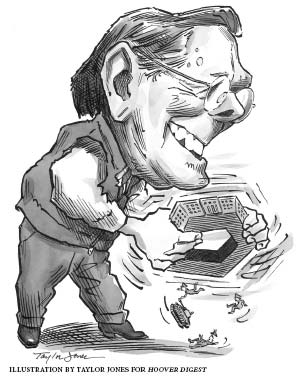
A searing reality was that there were people in the world who were working hard to think of novel ways to harm us. The key to transforming the Department, as I saw it, was through encouraging its civilian and military leaders to be more forward-looking, and to think freely, not conventionally. In my view, transformation hinged more on leadership and organization than it did on technology. Precision-guided weapons and microchips were important, but so was a culture that promoted human innovation and creativity. In the information age it was critical that we be able to transmit information rapidly to the people who needed it. More often than not what prevents that is not a computer or a piece of equipment, but outdated organization charts and layers of bureaucracy.
We couldn’t afford to be constrained by the way the Department was organized, trained, and equipped today because our ever adapting adversaries were seeking to exploit our weaknesses tomorrow. I often noted that the United States then faced no peers with respect to conventional forces—armies, navies, and air forces—and, as a result, future threats would likely lie elsewhere. Even so, I accepted that we couldn’t change overnight. I wanted to stress the gradual and continuing nature of the process. Transformation began before I arrived at the Pentagon, and I knew it would need to continue after I left. It was a continuum, not a discrete event.11 “Transforming,” as I saw it, was a better term than “transformation.” The latter sounded as if an organization might go from being “untransformed” to “transformed” with a distinct end point, which was not the case.
I also understood that the President’s objectives would face stiff resistance from the iron triangle of Congress, defense contractors, and the permanent DoD bureaucracy. What I had encountered in the 1970s was as strong as ever. As before, I anticipated resistance to any significant changes from some military officers—current as well as retired—who saw themselves as protectors of their service’s traditions. Senior members of Congress would also fight changes for a variety of reasons: some to protect pork for their constituents; some to preserve the jurisdiction of their committees and subcommittees; some to lend a hand to friends within the Department; and some because they had honest disagreements with the President’s agenda and about the best way forward.
A shift in Washington had taken place since I left the Pentagon in 1977. The relationship between the executive and legislative branches had evolved from proper congressional oversight to what was becoming legislative micromanagement. The Defense Department was receiving between four and eight hundred letters every month from members of Congress, in addition to countless phone calls. All of these inquiries initiated a flurry of bureaucratic activity to resolve them.
In a memo I drafted soon after my return to the Department, I wrote about the challenge posed by the increasingly intrusive role of the Congress. The Defense Department was “tangled in its anchor chain,” I wrote. The memo continued:
The maze of constraints on the Department forces it to operate in a manner that is so slow, so ponderous and so inefficient that whatever it ultimately does produce is late, wasteful of taxpayer dollars, and has the unintended result of leading to still more letters of complaint and calls of criticism from Congress, more critical hearings and more condemnation in GAO [General Accounting Office] reports, to be followed by a still greater number of amendments, restrictions and requirements to try to correct the seeming mismanagement…. Over time, the regulations and requirements that have been laid on are so onerous that…they are smothering incentive, innovation and risk taking.12
I was astonished, for example, to discover that the legislation authorizing the Department of Defense’s budget had exploded from a bill totaling 16 pages in 1977 when I left the Pentagon to a whopping 534 pages in 2001.13 I knew that Washington lobbyists had invested many years, sizable political contributions, and a great many golf games and private dinners to build intimate relationships with key members of the House and Senate, as well as with select DoD officials. “It is hard to imagine how a collection of such talented, intelligent, honorable, dedicated, patriotic people, who care about the security of the U.S. and the men and women of the armed forces, could have combined to produce such a mess,” I dictated in a note to myself that May. “And yet, they conclude that nothing should be done to clean up the mess.”14 Well, I was going to at least give it a try.
As ambitious as the President’s transformation agenda was, at its core was a humble recognition of the limits of our intelligence capabilities. I wanted everyone in the Department to be aware that, no matter how much information we collected and no matter how much we planned, surprise was inevitable. No large, complex plan ever gets executed as written. A belief that assumptions will play out as planned is a dangerous form of intellectual arrogance. It can lead to confusion and paralysis when those assumptions turn out to be wrong, as they often will. I believed the dangers that flow from error and surprise could be reduced if built into the plans was the expectation that not only will some anticipated problems be handled imperfectly, but that we will inevitably face problems that had not been anticipated. Indeed, I saw preparing for the inevitability of surprise as a key element in the development of defense strategy. We had to consider our vulnerabilities with imagination and ask ourselves the question Frederick the Great once posed to his generals: “What design would I be forming if I were the enemy?”15
A second critical task was to adapt operations as needed and shift resources quickly. That required us to have forces that were agile and could move rapidly. For these lighter forces to be as capable as more traditional heavy forces, far greater precision was required. And to take advantage of the improved precision of our weapons, our forces needed more accurate targeting intelligence.
We also had a responsibility to capitalize on advances in science and engineering. During many years of involvement with national security issues I had seen impressive technological breakthroughs used to vastly improve our military capabilities. When my father served in World War II, for example, it could take dozens of harrowing combat aircraft sorties to ensure that our forces could knock out a single military target. By 2001, however, technological advances had made it possible for a single aircraft to destroy multiple targets with precision on a single sortie.
Because new military systems would only be as good as the human beings who volunteered to operate them, we also needed to make better use of our most valuable asset: the men and women, military and civilian, who make up the Department. This led to one of my high-profile battles as secretary of defense.
For Defense Department civilian employees—some seven hundred thousand strong—the existing personnel system was a tangle of contradictory rules and regulations and, as a result, was counterproductive. The system did not move people into the positions for which they were best suited, nor did it reward good performance. As I knew well, the ability to hire and reward the most talented and move underperformers into other lines of work was essential to success in the private sector. Yet due to congressional restrictions and the influence of government labor unions, it was nearly impossible for senior DoD officials to recruit, promote, transfer, or replace civilian workers efficiently. As a result, instead of trying to fire underperforming workers and hiring new ones, managers were turning to uniformed military personnel and outside contractors, because they could be brought in rapidly to do a job and then be moved out when the job was done. Billions of tax dollars were supporting antiquated personnel systems that were undermining the important work of the Department of Defense.
We made it a high priority early on to address this by proposing a modern personnel system befitting one of the largest, most technologically advanced workforces in the world. I worked with a team at the Pentagon, led by a tenacious undersecretary for personnel and readiness in Dr. David Chu, and a determined secretary of the Navy in Gordon England, to develop and launch the National Security Personnel System. The new system permitted considerably more mobility among the Pentagon civilian workforce and instituted pay for performance. Bush offered his full support for the plan, yet it barely survived several union-led attempts to roll it back.* The Department and many of its civilian employees benefited from the changes Chu and England proposed, but it was met with vigorous opposition, especially from the employees’ unions.
Those within the Department who felt the new system would not work in their favor tried to stir up fear and uncertainty among the workforce. Nobody likes to have their job performance reviewed or questioned—indeed, the Pentagon had become arranged in such a way that an effective review system was all but impossible. My determination to untangle the system and make it easier for supervisors to oversee their employees left me vulnerable to the charge that I was trying to punish civilians in the Department. These accusations fed the developing misperception that I cared more about weapons systems than I did about people.
My focus on personnel was not limited to civilian manpower alone. I felt it important to review military personnel operations as well. Over the prior decade, the military services—Army, Air Force, Navy, and Marines—had been the dominant voices in deciding who would move up to become senior generals and admirals. I was given not too subtle hints from senior uniformed officers that the secretary of defense was expected to steer clear of the senior promotion process. My task, as it was suggested to me, was to give pro forma approval to the candidates presented by the services and to duly forward their recommendations to the President. The President’s approval was expected to be a similar formality.
The results, predictably, tended to reflect each individual service’s interests, which were not always the same as Department-wide interests. The passage of the Goldwater-Nichols Department of Defense Reorganization Act of 1986 imposed requirements for a more joint perspective as a key element for promotion. I sensed that service parochialism remained in the list of officers submitted from the services. I recognized that officers with stars on their shoulders had generally earned them for good reasons. But I felt that special attention was essential in selecting the three-and four-star generals and admirals. They would become the key leaders of the military services and the combatant commands for the twenty-first century.
One crucial aspect to transforming the Department, in my mind, was aggressively carrying out the intent of the Goldwater-Nichols legislation by reducing the redundancies, divisions, incompatibilities, and rivalries among the services—a process referred to as achieving “jointness.” Goldwater-Nichols had set the stage for developing joint capabilities that would both reduce costs and allow the services to leverage and capitalize on each other’s strengths. I wanted to encourage as much joint planning and as many joint operations among the Army, Navy, Air Force, and Marine Corps as possible. I was convinced that jointness could not be mandated from the top. It had to be inculcated in layers well below the secretary of defense. This required multiple leadership centers and individuals some layers down who shared that conviction and recognized the need for innovation and flexibility within their own services. They needed to be able to work in Washington with other departments and agencies that were out of their well-established comfort zones. And above all, they had to be candid and forthright, willing to disagree in private with me and with the President if their military advice differed from a course being considered.16 I felt that the only way to ensure that I was recommending those kinds of candidates to the President was to be personally involved in the selection process.
I called on my senior military assistant from my first tour as secretary, Staser Holcomb, a retired vice admiral living on the West Coast. Staser came to Washington and worked with the service chiefs to put together dossiers on their candidates for the key service and joint positions so we could conduct a more than perfunctory review. Knowing that I needed senior input to help with these decisions, I established a four-person committee that included the Department’s top two civilian officials and top two military officers: the chairman and vice chairman of the Joint Chiefs, the deputy secretary of defense, and me.
We discussed the tasks that would need to be performed for a specific post and the qualities and experiences that would best qualify an individual. Then we considered the recommendations of the services, secretaries, and chiefs, as well as other candidates. This was not a simple exercise. What may make for an outstanding fighter pilot, for example, is not necessarily the same set of skills needed for success as a combatant commander or service chief. After considering the various candidates, each of the four members of our committee made a point of becoming acquainted with the services’ top candidates, well before we needed to make our recommendation to the President. I did not want the prospects who happened to work in the Pentagon to have an undue advantage just because we were more likely to know them. So as I and the others traveled around the country and the world, we made a point of meeting with the top prospects for the senior posts that would soon be vacant.
In my view it was certainly proper that I be involved in senior promotions. Indeed, it was the secretary of defense who had to make the recommendations to the President, and it is the President who makes the nominations to the U.S. Senate. I saw it as an important responsibility. I had had a good relationship with many of the military leaders I worked closely with as secretary under President Ford. I was the one who came to the defense of then chairman of the Joint Chiefs, George Brown, when many were calling for him to be fired. But because my new system represented a major change in how the Department currently operated, it caused considerable contention. Despite the pushback, however, it resulted in an exemplary bench of officers.
I remembered during my first year at Searle that I had ruffled some feathers as I raised questions about the old way of doing business. That was also the case at the Pentagon. It was clear that there were some in the Department who felt I was brusque or asked more questions than made them comfortable. In a large bureaucratic institution, Newton’s laws of physics apply: A body at rest tends to remain at rest, and a body in motion tends to remain in motion. I was determined that the Department of Defense accelerate forward.
Then, at President Bush’s specific direction, I launched an unprecedented, comprehensive review of America’s global defense posture. This was one of the most fascinating, well conceived, and fruitful projects we implemented at the Pentagon. But it too rankled several groups—some in the military, some in foreign governments, and some in the State Department—stirring up a veritable trifecta of harrumphing, protest, and consternation. Admiral Jim Ellis told me what his Naval Academy physics professor had taught him: “If you want traction, you must first have friction.” We were generating more than our share of heat.
The way our forces were stationed overseas was so outdated, it was as if they had been frozen in time for the decades since Berlin and Tokyo fell in 1945, the armistice halted the Korean War in 1953, and the Cold War ended in 1991. Of the quarter million troops deployed abroad in 2001, more than one hundred thousand were in Europe, the vast majority stationed in Germany to fend off an invasion by a Soviet Union that no longer existed. An additional one hundred thousand were in East Asia and the western Pacific, vestiges of the occupation of Japan in World War II and the Korean War. Those deployments were obviously not taking into account the twenty-first-century reality that Germany was now one of the wealthier nations in Europe and that Japan and South Korea were among the most capable and self-sufficient in Asia.
Yet the status quo persisted in the Department; senior DoD officials were not questioning those deployments. Some combatant commanders seemed to feel they owned the forces and assets under their commands, and were loath to part with them. I started to pepper officials with what seemed to me obvious questions. Was it still wise to have large numbers of our forces in a defensive posture in western Germany to deter a tank invasion from the Soviet Union? Did we still need so many thousands of troops stationed in South Korea when the Korean people were increasingly irritated by the American troop presence, and given that Korea could well afford to do considerably more to defend its own territory? Was the enormous investment the American taxpayers were making in our military really meeting the challenges and realities of the twenty-first century or of the last century?
I also found it unwise to have large numbers of our troops stationed in countries where we needed to get approval from the host government and even in some cases from their parliaments before the president of the United States could move our forces where needed to defend the American people. It was unfair to the American taxpayer to be paying for one set of forces to defend Europe and another to defend East Asia, but then not to be able to use them elsewhere as might be required to defend our country and our interests.
I asked the policy office at the Pentagon to look at the globe afresh and to consider what our posture would be if we reconfigured it ideally, on the basis of what we might need in the future rather than for the past.17 The task involved a number of complex questions. Moving troops and their families away from bases Americans had been using for decades meant disrupting a way of life that had been created around some of these large bases—complete with American schools, shopping villages, hospitals, and restaurants. And though some of our deployments seemed outdated, the presence of our forces in Germany had been providing Europeans with a sense of comfort and security. Our presence in South Korea and Japan was a sign of American resolve to defend northeast Asia—an important sector of the globe that lived in the shadow of a burgeoning China and a reckless North Korean dictator.
I believed our troops had to do more than serve as symbols or security blankets for wealthy allied countries. We needed capable, if independent-minded, allies willing to invest in their own defenses. In large part because America was taking on much of the job for them, European defense expenditures were disturbingly low and declining as a percentage of their GDPs. In prosperous South Korea, the government had taken the unfortunate step of shrinking their own army on the assumption that we would maintain our presence and be prepared to bring in additional divisions if North Korea provoked a war.
Keeping in mind our new national security strategy, with its emphasis on the unanticipated, I knew we could no longer assume that we could predict where we might have to conduct military operations. Whether it would be for humanitarian work—earthquake or tsunami relief, for example—or combat operations, our forces needed the flexibility to move rapidly and without requiring the approval of a host country. Further, I wanted our military to be not only where they were needed but also where they were wanted, appreciated, and where we could move them rapidly to deal with whatever contingencies might arise. I questioned the desirability of tying our forces to massive, permanent bases, especially when it created opposition among local populations. Tensions between our military and Okinawan politicians, for example, had been growing for some time.18 In the country that governed Islam’s holiest shrines, Saudi Arabia, the presence of our troops spawned resentments against both the American and Saudi governments. Osama bin Laden propagandized on this point to recruit terrorists and raise money.19
No previous U.S. administration had attempted such a major global defense posture review; we aimed to rationalize our facilities, activities, relationships, legal arrangements, and surge capabilities worldwide to fit a strategy intended to look into the future, not reflect the past.*Our work, not surprisingly, stimulated interest and concern. President Bush’s political opponents who wanted to come across as more hawkish on defense issues made ridiculous accusations that we were “[pulling] back our forces.”20 This ignored the fact that our posture review increased our capability to project forces rapidly anywhere in the world. The more suspicious wondered why we were in such a rush to get this done. My view was, why wait? We had wasted billions of dollars, and we had been sitting in place across the globe for close to sixty years.
Senior State Department officials initially raised no objections to our review. Secretary of State Powell received periodic updates and seemed content with our analysis. But whatever Powell thought about the defense posture review, others in his department anonymously voiced reservations in the press that echoed the concerns and questions of some of our allies that opposed changing the status quo. From Bosnia to Kosovo to the Sinai peninsula, it seemed that the U.S. military was engaging in new peacekeeping efforts every few years. Those efforts were stretching DoD resources. We either had to increase our capabilities or find ways to pare down our peacekeeping efforts sooner.21
When I pushed to reduce the numbers of American military forces supposedly monitoring a two-decade-old truce between Israel and Egypt in the Sinai peninsula, “[s]ome State Department officials [began] to argue that a withdrawal would underscore what is already seen by some in the region as an American retreat from the Middle East.”22 When I learned, for example, that the Pentagon had been spending $225 million every year to maintain our forces in Iceland, I sent a memo to Powell recommending we make a change.23 I pointed out that our aircraft originally had been stationed in Iceland to track Soviet subs in the North Atlantic. Now that there was no Soviet Union, they were spending their time helping Icelandic fishermen in distress. More than $2 billion had been spent since the end of the Cold War in 1989 to keep our aircraft in Iceland. I believed the $4 billion we would be spending over the next twenty years could be better invested elsewhere. Even so, it took me three years of pressing and prodding—and the resulting loss of another $700 to $800 million to taxpayers—before I could get our military presence in Iceland renegotiated. This was accomplished over the continued opposition of the State Department.24 Iceland was a wake-up call for me. If it was that hard to change our posture there, changes elsewhere in the world would be even more difficult.