
CHAPTER 28
General Franks planned to insert special operations teams into Afghanistan on the evenings of October 6 and 7 using a nontraditional, celestial ally. The moon would rise several hours after sunset, allowing our forces a small window when their helicopters could traverse the vast Afghan mountain ranges in darkness and be less vulnerable to Taliban antiaircraft emplacements.
Knowing military action was coming, I set out in the first week of October to meet with leaders in some of the countries in the region. In Saudi Arabia, Oman, Egypt, Uzbekistan, and Turkey I consulted with government officials on our plans, sought their advice, and learned what support they might be willing to provide. I assured our potential partners of two things: The United States would appreciate whatever public or private support they might offer, and we were going to respond aggressively with force against the terrorist threat on a vastly different scale and level of intensity than in the past. This was a welcome message to most leaders of the region, who did not relish the prospects of emboldened radicals in their backyards.
I generally made a point of refraining from asking for specific types of assistance in meetings with foreign leaders. Nor did I spend a lot of time “transmitting”—giving lengthy presentations on the President’s goals and views and trying to push them to see things our way. I listened instead, which was valuable either because the foreign leaders had useful thoughts to convey or simply because those leaders were grateful to be heard out by the American secretary of defense. It is hard to overstate the practical importance of mutually respectful discussions of this kind. I have always found that these exchanges are especially important with smaller nations, and particularly with those that have not had long close relations with the United States.
When foreign leaders offered assistance, as they often did, I expressed our appreciation. I made a practice, however, of not publicly discussing the specifics of our understandings unless they did so themselves. Some nations preferred to support the United States quietly, so as not to inflame their enemies, stir up domestic political opposition, or become a terrorist target. This practice, of course, allowed administration critics to claim we were acting unilaterally, often without knowing the extent of the assistance and cooperation we actually received.
The aides who made official foreign trips with me—I visited seventy-five countries, many of them several times, and traveled 750,000 miles during my second tour as secretary of defense—generally described them as forced marches. We could not afford to waste time. If I could squeeze in stops to two countries on a given day, I did. Three was even better. The combination of constant motion, jet lag, early morning wake-up calls, and difficult, high-stakes work was invigorating. But it could be tough for the staff. On one flight I received a memo from a few long-suffering stalwarts who had dubbed themselves “Rummy’s Tube Dwellers.” They joked that they had “taken control of the plane, and diverted to the Virgin Islands,” unless I agreed to some “non-negotiable demands” such as “frequent flyer miles…less diet coke, more martinis…For every day spent in a ‘stan’ [the countries of Central Asia] we get 4 comp days.”1
On October 4, we arrived in Oman, a country on the eastern tip of the Arabian Peninsula. Sultan Qaboos received us in a large, open tent in the middle of the oppressively hot and humid Omani desert where he regularly camped to meet with his subjects. The tents were brightly colored. Carpets of deep reds and blues covered the sand inside. Those of us in our American contingent, in dark suits and black SUVs, did not cut the image of modern-day Lawrences of Arabia. Every article of clothing we wore was quickly drenched through from the heat. Qaboos, however, seemed unfazed by the temperature as he held forth.
With his immaculately trimmed, strikingly white beard and Bedouin features—skin hardened by sand and sun—Qaboos was much as I had remembered from when I met him in 1983 as President Reagan’s Middle East envoy. The Sultan was sympathetic toward the West, having been educated at Sandhurst, the British military academy, and having served in the British army. In his three decades as sultan, Qaboos had opposed Islamist fundamentalism. He skillfully developed Oman—a nation that in 1970 had few diplomatic relations with foreign states, a meager education system, less than ten miles of paved roads, and a draconian legal code—into a modern Middle Eastern country.
Qaboos became emotional when he discussed 9/11. Then he said something that I found striking. He speculated that the attacks might serve an important purpose by awakening America and the world to the dangers of Islamist extremism and the lethality of weapons of mass destruction. He urged a sustained campaign against the terrorists, cautioning that it would take a long time to do it right. Qaboos lamented that the Arab news media promoted the terrorists’ point of view. And he said we should suggest to other Muslim friends that their leading clerics speak out against terrorist atrocities to change the moral climate that influences young people. He told me he considered some of the Arab countries “hypocrites” who turned to America when they were in trouble but did little when America needed them.2 In that assessment he found a sympathetic ear.
Sultan Qaboos also offered important assistance to the Afghan campaign. He said Oman would allow us to base our C-130 aircraft at Masira Island in the Arabian Sea.
“We trust you. We’re allies,” he said simply. “I have nothing else to add.”3
From Oman, we headed to Egypt, where I met with President Mubarak. After a career as an air force officer, Mubarak had risen to power in 1981, following the assassination by Islamist extremists of his predecessor, Anwar Sadat. Mubarak, then the vice president, had declared a state of emergency and assumed near dictatorial powers. Usually pragmatic in foreign policy, Mubarak followed Sadat’s strategy of cooperation with the United States on issues such as Iraq, counterterrorism, and peace talks with Israel. For decades Egypt had received billions of dollars in American aid annually.
I had first met Mubarak in June 1975 when, as White House chief of staff, I accompanied President Ford to his meetings with President Sadat in Salzburg, Austria. I had worked with Mubarak later when I served as President Reagan’s Middle East envoy, in 1983. Little had changed about the man since our first meeting. On a personal level, I found him animated, even ebullient. Sensing that war in Afghanistan was imminent, he wanted to impart some advice. He shared President Bush’s concern that simply firing cruise missiles at caves in Afghanistan would not be effective. He urged us to use financial assistance to “buy allies on the ground.” He reflexively mentioned the Israeli-Palestinian issue as a root cause of terrorism but did not dwell on it. This was the standard line in the Middle East—everything was Israel’s fault, although in truth Arab nations had done little to help the Palestinians.4
My next stop was Uzbekistan, the most populous of the Central Asian republics and perhaps the most crucial of my trip. It was an example of a country that was generally ignored by American officials. Central Asia, which includes several former Soviet republics, is a blank slate to many in the West, in contrast to Eastern Europe, which Americans had reached out to after the collapse of the Soviet Union. This was due, in part, to personal familiarity. A major reason Americans were eager to forge close ties with Poland, the Czech Republic, and other Eastern European countries after the Cold War was that many Americans in cities like Chicago, Detroit, and Pittsburgh had relatives there or next-door neighbors of East European descent. It worried me that the countries of Central Asia were not getting similar attention, aid, and encouragement as they tried to move toward freer political and economic systems. Yet because of their location—squeezed between two large nuclear powers, Russia and China, and straddling the legendary East-West corridor through Asia—they were countries of great strategic importance with a potential that remains to this day largely unfulfilled. Well before 9/11, in fact, I made it a personal goal to develop new relationships in Central Asia.* Now suddenly their support was of enormous importance. We needed overflight rights, and fueling and operating stations in countries like Uzbekistan, Tajikistan, Turkmenistan, and Kyrgyzstan. Indeed, U.S. military operations could not begin or be sustained in Afghanistan until we made the necessary arrangements with its neighbors.
The Uzbek president, Islam Karimov, had come to power as a commissar in the waning days of the Soviet Union. He was now attempting a balancing act. He wanted to support America’s efforts in Afghanistan but not at the expense of riling his neighbor, Russia. Karimov started our meeting in Soviet style with a thirty-minute statement.5 I recalled Russian President Putin opening in a similar manner when I first met with him, so it did not surprise me; for many who came of political age in the Communist system, this was their normal approach with foreign leaders. Possibly they saw it as a way to assert authority at the outset of a meeting. In any event, after his formal opening remarks, Karimov became quite cordial.6

Usually I did not ask countries for anything specific, but in Uzbekistan’s case it was clear what we needed. Karimov agreed to allow our special operators to launch from the decaying Uzbek air base at Karshi Khanabad, known as K-2, conveniently located only 120 miles from the Afghan border. Two decades earlier K-2 had been used by Soviet bombers during their invasion and occupation of Afghanistan. Now the Uzbek base would be used once again, but this time for the liberation of the same troubled people to their south.
Echoing the Egyptian president, Karimov said, “You can buy any warlord and neutralize him. You don’t need to persuade him to join the Northern Alliance, just neutralize him.” As his translator spoke, I reflected on the differences in English between buying and renting, the latter being more likely for the transactions he was describing. He stressed the importance of putting an Afghan face on the conflict: “In Afghanistan, only Afghans should fight.” And he underscored the importance of coupling military force with humanitarian aid to try to win over the population. He was wise in his advice, and helpful. He knew the territory. I soon learned from Karimov that earlier Russian offers of assistance to us had limits: He confided to me that Russian officials were pressuring him to seek and receive Moscow’s assent before agreeing to provide any help to the United States.
In fact, the Russians already knew the purpose of my visit. Karimov was not pleased that news of my trip had been leaked to the Russians in advance, nor was President Bush, and nor was I. Only a small universe of people knew about my plans to visit Uzbekistan, and apparently an even smaller number were preoccupied with keeping the Russians happy by sharing information with them. “I do not know precisely who is talking to the Russians in real time,” I said in a memo to Powell and Rice, “but you folks should know how unhelpful it is.”7
At a press conference following our meeting, President Karimov was in good spirits. But though he seemed pleased with his evolving relationship with the United States, he spoke carefully. “I would like to emphasize that there has been no talk of quid pro quos so far,” he said. Having little interest in subtlety, he added, “I would like the Russian journalists, in particular, to take this into account.”8
As I departed Uzbekistan, I was asked by a member of our traveling press corps whether the Taliban might stay in power if we were to target al-Qaida in Afghanistan. Even as late as October, despite the public statements by President Bush that should have ended the administration’s internal debate, there were American officials who were still telling journalists that it was in our interest to reach an accommodation with the Taliban.
“Tony Blair said today the Taliban needs to either surrender bin Laden or surrender power,” a reporter told me. “Did he frame that correctly?”
“Well, I guess there are those who think it might be nice if they did both,” I answered.9
On my last stop, in Ankara, Turkey, its leaders offered assistance with military facilities. They were strong backers of our plan to arm and supply the Northern Alliance. The Turks knew the Taliban threatened the interests of Muslims worldwide. For many years I had considered Turkey a key country for the United States—a West-leaning Muslim democracy and NATO member that could function as a link between East and West. I had always been concerned by the American tendency to favor Greece over Turkey, at least in part because of our large politically active Greek-American population and their representation in Congress. “The U.S. needs to publicly show more support for Turkey,” I noted in December 2001, “if we are going to have their help when we need it.”10
Before I returned to Washington, a videotape from Osama bin Laden was aired on the Arab news channel Al-Jazeera, the Arabic TV station that would regularly provide a platform for terrorist propaganda over the coming years. In this tape, his first since 9/11, bin Laden prophesied that the United States would fail to oust al-Qaida from Afghanistan and renewed his call for jihad against the West.
We did not help our cause against al-Qaida’s propaganda machine when CENTCOM announced that Infinite Justice would be the name for combat operations in Afghanistan. The phrase provoked immediate criticism from Muslims who asserted that infinite justice is reserved for God alone. In light of that early error, I joked with the President that Operation Unilateral Hegemony would have been about as well received. Bush was sympathetic. He had created a similar flap when he referred to the war on terror as a crusade. Christendom’s Crusades, of course, hardly symbolized the kind of cooperation with Muslim partners that we knew we needed.
Such missteps focused attention on the pitfalls of waging war against a global network of Muslim extremists whose history, culture, and practices were unfamiliar to most Westerners, myself included. There was an enormous amount about Muslim communities we had to learn if we were to reduce the influence of the extremist ideology that was motivating the terrorists. Soon thereafter, at one of my regular morning meetings in late September, General Dick Myers told us CENTCOM’s replacement for the name of the Afghanistan campaign: Operation Enduring Freedom.
As the sun was setting in Afghanistan on October 7, 2001, giving way to a moonless sky, morning broke in Washington, D.C. That Sunday I stood with General Myers in the Pentagon’s National Military Command Center awaiting the start of America’s operations in Afghanistan. Through Myers, I had sent Franks the execute order signed by the President for Operation Enduring Freedom.
In the command center, the same place where we had worked in the smoke after the Pentagon came under attack, the senior civilian and military leadership gathered to ensure everything was on track. Myers and I sat at the head of a V-shaped, dark wooden table with senior team members arrayed to our left and right. On television monitors in front of us, Franks appeared from CENTCOM headquarters in Tampa; on other screens were several of his senior officers who were deployed across the Middle East. The video feed was grainy, but we could hear Franks and his officers clearly. Franks informed us that bombs and missiles would begin to strike their targets at 12:30 p.m. Eastern Time, or 9:00 p.m. in Kabul.11 Oddly, Afghanistan’s local time zone differed by thirty minutes from the on-the-hour time zones used by most of the rest of the world. This peculiarity seemed apt for a nation run by men who wanted to turn the clock back to the seventh century.
Each senior officer leading a major component proceeded to report on the readiness of his forces. Each had previously assured the President that he had what was needed to begin and complete the mission. All indicators were green—ready to go.
After the teleconference ended, I called Franks. “General,” I said, “the President asked me to extend to you his respect and best wishes, and that we’re going to finish what began on September 11.”
“God bless America,” Franks replied.
That first Sunday of October was less than a month after 9/11. The Pentagon remained scarred, and rubble from the World Trade Center still smoldered. But America was now on the offense. The young Americans who would be risking their lives to defend our country were very much on my mind. Each was a volunteer. In the years that followed I had the privilege of meeting with large numbers of them. Many had signed up for military duty after 9/11 knowing they would likely be sent abroad to fight for their country. I thought about America’s last extended military campaign in Vietnam. Large number of casualties had increased the pressure on American military and political leaders to bring the war to an early and unsuccessful end. There was, of course, the possibility that the fighting in Afghanistan could produce a similar heartbreaking outcome. Our strategy of putting American forces on the ground—and not conducting the campaign entirely by means of high-altitude bombing, as in the 1999 Kosovo campaign—increased the likelihood of U.S. casualties.12 We had planned as best we could and prayed for the safety and success of our troops.
An hour after President Bush addressed the nation to announce the start of Operation Enduring Freedom, General Myers and I went to the Pentagon press room to brief on the start of military operations. We outlined the President’s goals, which while challenging, were limited: to make absolutely clear to the Taliban and to the world that harboring terrorists carried a price; to acquire intelligence for future operations against al-Qaida and against the Taliban; to develop relationships with the key groups in Afghanistan that opposed the Taliban and al-Qaida; to make it increasingly difficult for the terrorists to use Afghanistan as a base of operations; to alter the military balance over time by denying the Taliban the offensive systems that hamper the progress of opposition forces; and to provide humanitarian relief to Afghan people suffering under the Taliban.13
In the early hours of the Afghan war, I watched video links from aircraft dropping munitions. Among the first targets were the al-Qaida training camps at Tarnak Farms and Duranta. B-52s dropped two-thousand-pound bombs on the tunneled caves of Tora Bora near the Pakistani border. All known Taliban tanks were targeted. Fuel depots, training camps, radars, run-ways, and the few dubious aircraft in the Taliban air force were hit. Over the course of five nights, every fixed enemy target that American intelligence had identified in Afghanistan was attacked.
Bombs weren’t the only things we were dropping on Afghanistan, however. The country had long been suffering from drought and in a number of areas food was in short supply. In the first forty-eight hours alone, American aircraft dropped some 210,000 individual food rations.14
After the first wave of air sorties was complete, unmanned Predator aircraft outfitted with high-resolution cameras remained, loitering silently and unobserved above Afghanistan and feeding back images of additional targets. Early on the evening of October 7, Franks called me with urgent information. A Predator drone flown remotely was following a convoy believed to be carrying the leader of the Taliban, Mullah Omar. Franks told me the convoy fit the profile of that used by the Taliban’s leadership. It had stopped at what appeared to be a mosque.
In the weeks leading up to the war, Franks briefed me on various targeting categories and the risks of unintended, or, as it is also called, collateral damage to mosques, schools, hospitals, and urban areas. Franks had developed a detailed template for assessing the risk of collateral damage. Each of his target files included a photo and several metrics that gauged the likelihood of injuring civilians at various times of the day, his level of confidence in the intelligence sources, and the various angles at which munitions could be directed at the target. The experts at CENTCOM calibrated the type of weapon, the size, fuse, trajectory, and time of the attack to the circumstances of each target, with the goal of limiting collateral damage. Without question, more effort was devoted to avoiding collateral damage in Afghanistan than in any previous conflict in America’s history.
Before making a targeting decision, CENTCOM consulted their legion of lawyers for advice. The concern for civilian casualties was understandable for humanitarian as well as strategic reasons. Every time a civilian was accidentally killed or injured, the loss of innocent life was lamented—and our cause suffered. The United States was held to a much higher standard than the enemy, who did not seek legal counsel before they struck purposefully at civilians.
Still, I wanted commanders making go or no-go decisions on targeting with the advice of lawyers—not the other way around. The legal impulse by nature was to be restrictive and risk averse, which was not always compatible with waging an effective war against vicious fanatics. I had seen how the rules of engagement issued by President Reagan during the Lebanon crisis of the 1980s had been diminished at each layer of command until the result bore little resemblance to what the President had intended. Though I wanted commanders like Franks to benefit from legal advice, he needed to make the calls himself.
I had told the combatant commanders even before 9/11 that I expected them to lean forward. I said that I would be too, and that they could be certain I would back them up on tough calls, even if they did not work out. I was concerned that America’s risk aversion in prior years had emboldened terrorists and rogue regimes worldwide.
Immediately after Franks called to inform us of the plan to attack the convoy, I placed a secure call to Bush to inform him of the sketchy facts as we knew them: a likely high-value target, possibly Mullah Omar, was in a building that looked like a mosque. The President gave the green light. I told Franks he was authorized to hit the target. I did not say I had received Bush’s authorization, however. If something went awry, I thought it would be better if those down the chain of command believed that only I was responsible for what turned out to be a poor decision.
In the end, the operation was, as Franks put it, “no joy”—meaning that it was unsuccessful. And I got no joy from learning why it failed. To avoid damaging the building, those who controlled the armed Predator decided to fire a Hellfire missile at a vehicle outside the suspected mosque instead of into the compound itself. The vehicle explosion sent men pouring out of the building, scattering for the hills. Presented with a chance to hit a target that might have been the top Taliban leader, we had failed.
In the days after that operation, Franks and I discussed how to accelerate the speed at which he could decide on whether to attack a high-value target. Figures like Osama bin Laden, Mullah Omar, or al-Qaida’s number two, Ayman al-Zawahiri, could disappear from our intelligence picture as quickly as they appeared, often keeping themselves in the vicinity of civilians both to deter an attack and to increase the likelihood of civilian casualties if we were to strike.
“The payoff for getting a key leader is high,” I said. “Look for a new process—anything to speed it up.” We couldn’t let precious seconds pass as dozens of people offered their views on whether to hit the target or not.
Franks understood. “I will make the hard calls on collateral damage and not use the need to call you as a reason to slow it up,” he said. “I’ll take the hit on that.”
“I’ll be right there with you when you make the call,” I assured him.
“We’re going to catch these bastards sooner or later,” Franks added. “It’s just going to take time.”15
As Air Force bombers and Navy strike aircraft destroyed Afghanistan’s limited air defenses, the Taliban offered little effective resistance. We worried that the enemy might have obtained U.S.-built Stinger antiaircraft missiles that had been used to shoot down Soviet helicopters fifteen years earlier. As it turned out, the Taliban had little antiaircraft weaponry. Not a single American aircraft was lost to enemy fire in those early days. Only the hazards of weather, dust, and geography posed a serious threat to our pilots and crews.
Despite the heavy bombing, Taliban forces were holding their lines against the Northern Alliance, which, two weeks into the campaign, still had not achieved a single significant battlefield success. They were not moving forward aggressively to liberate Afghanistan’s northern cities.
Meanwhile, allies of the Taliban from the tribal regions of Pakistan poured into Afghanistan, reinforcing the enemy lines. The international news media broadcast images of white pickups with men in black turbans roaming the streets of major cities, sending the message that the Taliban was still in control. Bombs dropped from aircraft could inflict damage to be sure, but they could not liberate a people.
Still, there were some bright spots. In those first days of combat in Afghanistan, the Predator and other unmanned aerial vehicles (UAV) conclusively proved their value to our military and intelligence personnel.* The information UAVs sent to our commanders about troop locations, at no risk to American lives, was invaluable. But as with all technology, it had to be used for its proper purpose. At some point in the months after 9/11, I was asked whether I wanted to have the video links from Predator drones and other live video images piped directly to my office in the Pentagon. Feeds were being sent to the White House Situation Room and to the operations centers of the military services. Recalling how LBJ picked out bombing targets from the White House, I was uncomfortable with people all over Washington congregating around the screens and second-guessing the decisions of commanders in the field—second-guessing that I suspected would eventually find its way into the press. Those making the life-and-death decisions on whether to destroy a target did not need a raft of onlookers outside the chain of command constantly looking over their shoulders. Nor did I want people treating the feeds as an object of curiosity. War was not a spectator sport or a video game. I declined to have the feeds piped into my office and asked that they be turned off in any offices that had no compelling reason to receive them.
By mid-October, with the air war well underway, some of the many nongovernmental organizations (NGOs) in Afghanistan were complaining about U.S. military actions. Some were quoted in press reports saying that the American bombing campaign was limiting their ability to provide food for needy people and putting their workers at risk. Most of the food aid from the NGOs was coming through Pakistan to southern Afghanistan, where the Taliban was in control. The NGOs, often supported by the American taxpayer through programs run by the U.S. Agency for International Development and the State Department, wanted the United States to help them distribute food in towns and villages that were held by the Taliban. When the Department of Defense declined to help feed the enemy, some NGOs accused us of using food as a weapon.
I had no interest in using food as a weapon, and it was an oft-repeated admonition from President Bush that we should not do so. But it didn’t make sense to me that American military personnel should risk their lives so food could be delivered to Taliban strongholds, especially when there were urgent needs for food in areas controlled by our Afghan allies. Some humanitarian organizations further argued that U.S. food aid paid for by U.S. taxpayers should not be identified as coming from the United States. Their contention was that America had a bad reputation and Afghans would react negatively if they knew the source of the food. Again, I disagreed. One purpose of the aid was to build goodwill among ordinary Afghans, so they would support our coalition’s effort to liberate their country from the Taliban and al-Qaida. We even took pains to communicate to the Afghans that the food was fit for consumption according to Muslim religious law. I did not believe hungry people would refuse to eat food because it was known to come from the United States. And the humanitarian organizations provided no evidence that that was the case.
Some NGOs tried to ingratiate themselves with Taliban authorities by criticizing the actions of the U.S. military and our coalition partners in the press. But rarely, if ever, did I hear an organization complain publicly about the brutality of the Taliban or al-Qaida. At one point the Taliban raided the offices of a major international humanitarian organization, taking medical supplies and stripping the office bare. The organization did not say a word about it, presumably for fear of retaliation.16 The same organization freely publicized its complaints about the United States.
Throughout the twelve days of the bombing campaign, members of the Northern Alliance questioned whether we were being effective. Targeting the Taliban and al-Qaida required information and tactics that only our special operations forces could provide for precision air strikes. Without the coordination of our laser targeting against the key Taliban and al-Qaida emplacements, Afghan commanders were reluctant to go on the offensive.
Meanwhile, at the Pentagon, we waited anxiously for CIA and special operations teams to link up with Northern Alliance commanders and the Pashtun opposition leaders in the east and south. At K-2 in Uzbekistan, the Army Special Forces A-Teams under the command of Colonel John Mulholland also waited for the signal to move. The special operators were champing at the bit, ready for their assignment as “the tip of the spear.” But the signal to deploy into Afghanistan was not forthcoming.
The press was impatient as well. Once combat operations began, I received variations on the same question from Pentagon reporters: When would American ground forces be deployed? I counseled patience. Wars have their own tempo, I said. “Patience” was a proper theme, and I invoked it sincerely, even though I knew I often lacked that quality myself.17
By mid-October, communications by satellite phone had been established with several Northern Alliance commanders, but only one CIA team had managed to connect with them on the ground. Code-named Jawbreaker, the team had linked up with General Fahim Khan, Massoud’s successor and the de facto leader of the Northern Alliance. The delays in teaming up with the other Northern Alliance commanders were excruciating for me.
“My goodness, Tommy,” I repeatedly said to Franks. “The Department of Defense is many times bigger than the CIA, and yet we are sitting here like little birds in a nest, waiting for someone to drop food in our mouths.” It seemed we couldn’t do anything until the Agency gave us a morsel of intelligence or established the first links on the ground.
In truth, the frustration extended well beyond Tommy Franks. In the month after 9/11, I had been continually disappointed that the military had been unable to provide the President with military options to strike and disrupt the terrorist networks that were planning still more attacks. In one memo to Chairman Myers and Vice Chairman of the Joint Chiefs, Marine General Peter Pace, I wrote that “for a month, DoD has produced next to no actionable suggestions as to how we can assist in applying the urgently needed pressure other than cruise missiles and bombs.” My October 10, 2001, memo continued:
I am seeing nothing that is thoughtful, creative or actionable. How can that be?…The Department of Justice and its counterparts in other nations have arrested hundreds of suspects. The Department of the Treasury and its counterparts in other nations have frozen hundreds of bank accounts totaling hundreds of millions of dollars. The Department of State has organized many dozens of nations in support. But DoD has come up with a goose egg….
You must figure out a way for us to get this job done. You must find out what in the world the problem is and why DoD is such a persistent and unacceptably dry well…. We are not doing our jobs. We owe it to the country to get this accomplished—and fast. Your job is to get me military options. It is the [President’s and my] job to balance risks and benefits. We cannot do our job unless you do your job. If we delay longer, more Americans could be killed. Let’s get it done.18
Myers and Pace pushed all of the combatant commanders to come up with more options. In Afghanistan, Franks explained that there were factors outside anyone’s control contributing to the delays. Blinding dust storms and white-out conditions in the high mountain passes had forced several teams to turn back. The CIA and CENTCOM were trying to use several older Soviet helicopters, similar to those the Taliban had in its possession, to fool the Taliban. But the old Soviet choppers were unreliable and not well suited for the weather conditions.
After one particularly long day in the first week of October, Franks called. The distress over the delays, expressed by everyone he was talking to in the chain of command from the President on down, was wearing on him. Franks questioned whether I still had confidence in him and asked if I thought the President should select a different commander. I admitted that the waiting was difficult but assured him flat out that he and his operation had our full confidence.
I had to keep reminding myself that we were still only a few days into this campaign. Meanwhile, critics of the administration were plunging into despair. Some in the press, reflecting the concerns they were hearing, resurrected the word “quagmire,” an echo of the bitter domestic opposition to the Vietnam War. On September 18, seven days after 9/11 and one month before the first special operations teams would even enter Afghanistan, the Associated Press reported, “Now it may be the United States’ turn to try a foray into the Afghan quagmire.”19 A later editorial in the Dallas Morning News read, “[A]nother generation of American servicemen may be sucked into a quagmire in a foreign land.”20 “Are we quagmiring ourselves again?” the columnist Maureen Dowd asked two days later.21 R. W. Apple, a well-respected foreign correspondent, opined on the front page of the New York Times, “Like an unwelcome specter from an unhappy past, the ominous word ‘quagmire’ has begun to haunt conversations among government officials and students of foreign policy, both here and abroad. Could Afghanistan become another Vietnam?”22
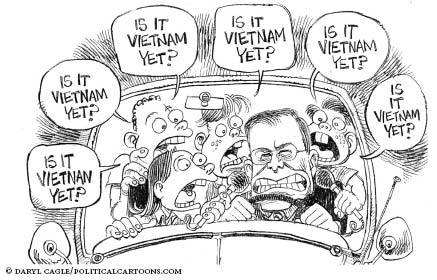
At one press briefing after another, General Myers and I were asked why the military operations were not progressing faster. I believed it was my job to urge CENTCOM to move forward as quickly as possible, and I did so in private. But much of the public discussion, especially the growing quagmire chorus, lacked restraint and historical perspective.
I usually enjoyed my exchanges with the Pentagon press corps. There were several dozen reporters who were regularly assigned to the Pentagon beat. They had small offices not far from the room where we gave media briefings. Most were knowledgeable, hardworking, and reasonably objective, though often skeptical. Many had been in the Pentagon when American Airlines Flight 77 crashed into the building. I was sympathetic to them. Some periodically said that they had to cope with guidance from their editors, who knew that playing up a potential disaster is what sold. As the saying goes, “If it bleeds, it leads.”
I often injected humor into our exchanges with journalists. It’s a relief to find occasion to lighten the mood when discussing serious matters. At one point, our press conferences were parodied on the television show Saturday Night Live. I remembered the show for its spoofs of President Ford in the 1970s that did him real political damage. Still, I had to admit that the skits of my press conferences—with comedian Darrell Hammond playing my bespectacled self—were amusing.
Over the years I had seen many times what happens in politics when a public figure receives a good deal of media attention. Journalists rely heavily on standard narratives that both conform to and shape the conventional wisdom about government officials. If one starts with “good press,” one often gets more and more favorable coverage; early bad stories often spawn additional negative reporting. But journalists also relish dramatic reversals. One memorable observation in this regard was made by World War II general Joseph Stilwell, who warned, “The higher a monkey climbs, the more you see of his behind.”
Still, a free nation could not survive without a free press and an open, transparent government. It was what we were fighting for against our enemies.23 I felt an obligation to explain to the American people in press conferences what the Defense Department sought to achieve in Afghanistan and what was happening on the ground there.