
CHAPTER 33
Only a few hours before the forty-eight-hour deadline for Saddam to leave Iraq for a life in exile expired, George Tenet called me from CIA headquarters in Langley. He said he had an urgent matter to discuss and would be coming to the Pentagon immediately.
The CIA had developed a network of informants across Iraq who reported tips on Saddam’s activities. In my office, Tenet informed General Myers and me that two of the Agency’s sources had information that Saddam Hussein and possibly his sons, Uday and Qusay, were en route to a family compound called Dora Farms, south of Baghdad. We knew there was a possibility that the informants could be compromised, or in error. Saddam constantly tested the loyalty of those around him. If the dictator had penetrated the CIA’s network of informants, he could be using the sources to encourage us to strike a false target, possibly one where American bombs might kill innocents. The campaign might therefore begin amid charges of American war crimes against Iraqi civilians.
If Bush authorized a strike, it might have to take place before the public deadline set for Saddam to resign expired. Though we had no indication that Saddam might comply, Bush would be accused of going back on his word. Tenet and I agreed that the issue needed to be brought to the President, so we drove across the bridge over the Potomac to the White House.
By mid-afternoon Bush had hastily assembled the NSC in his small dining room just off the Oval Office. Tenet repeated what he had told me. “How solid are your sources on this?” Bush asked. Tenet expressed his high level of confidence.
We discussed the possible outcomes if a strike were ordered, the risk of action as well as the risk of inaction. Suppose it turned out that Saddam was meeting at the compound to comply with the President’s ultimatum to resign and leave Iraq? What if it turned out to be a civilian target? What if our aircraft accidentally killed innocent Iraqis and Saddam got away?
As we contemplated these risks, Tenet left the room to speak by secure phone to Agency officials who were in touch with their source on the ground in Iraq. He came back with another promising report: Saddam had just arrived at the site in a taxi. The Iraqi dictator was known to use cars painted like taxis to move around the country inconspicuously. The Agency’s contacts also reported that Saddam’s whereabouts had been verified by a sophisticated electronic tracking system used by his bodyguards. Tenet believed the intel was as solid as it could be.
The President went around the room asking each of us if we favored a strike. Cheney, Powell, Myers, Tenet, and Rice all said yes, as did I. I felt Saddam had made his choice. He was not going to stand down. Removing him and his sons with an early air strike would eliminate the top of the Iraqi military command structure with a single blow. That might lead to a large-scale surrender of Iraqi military forces, saving many American and Iraqi lives. Any chance to avert a broader war had to be seriously considered. The President agreed. But keeping his word, he ordered that the attack commence after his forty-eight-hour deadline expired.
In the early morning hours of March 20—only ninety minutes after the deadline—two U.S. Air Force F-117 stealth fighters flew undetected into Iraqi airspace and released four one-ton bunker-busting bombs onto the Dora Farms complex. The war in Iraq had begun.
As we awaited confirmation that the attack had hit the target, early reports were promising. An eyewitness reported that Saddam Hussein had been brought out of the rubble on a respirator. Then the story started to change. Despite the multiple sources, at least one eyewitness, and the sophisticated tracking devices, Saddam was not, as it turned out, at Dora Farms. Neither were his sons. This first salvo in the war with Iraq foreshadowed the various intelligence failures that would later come to light.
Forty-five minutes after U.S. aircraft had dropped the first bombs targeting Saddam, President Bush appeared on television from the White House to inform the country that the war in Iraq had begun. Saddam responded with a broadcast to the Iraqi people, claiming that Americans would soon lose “patience” with the war effort.1 He ended his message with language characteristic of Islamists: “Long live jihad and long live Palestine.”2 It was a notably unsubtle message—one that made clear the allies he sought.
General Franks had realized that it was not possible to achieve strategic surprise against Saddam’s forces given the purposefully ill-disguised fact that our military had been building up in the region over several months. Nonetheless, Franks thought he might still gain an advantage through tactical surprise. In the 1991 Gulf War, and in our recent operations in Afghanistan, coalition forces conducted a long air campaign before the ground invasion. This was undoubtedly what Saddam and his generals expected to happen again, which would give the Iraqis time to lobby leaders in the Muslim world and Saddam’s supporters at the United Nations to come to his aid before our tanks started rumbling across the desert. Instead, Franks decided to order the air and ground offensives to start simultaneously.
Franks was concerned that a delayed ground invasion might expose American forces staging in Kuwait and elsewhere in the Gulf to the risk of chemical or biological attack. Intelligence and military officials warned that once Saddam judged that our forces were on the march and approaching Baghdad to remove his regime, he would have nothing left to lose and would likely use WMD against the coalition forces. Based on the intelligence, Franks ordered American soldiers and Marines advancing into Iraq to be outfitted with the bulky and uncomfortable chemical and biological protective suits.
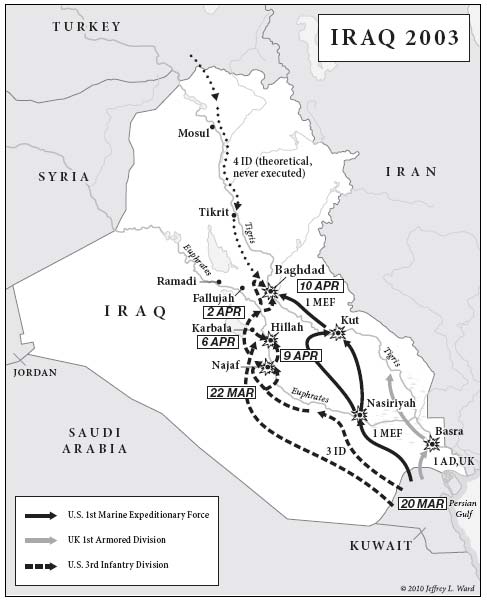
The initial coalition push toward Baghdad from the south had two thrusts. The first was spearheaded by the Army’s 3rd Infantry Division, and the second by the 1st Marine Expeditionary Force (I MEF) and Task Force Tarawa. At the same time, a contingent of Marines took their objectives in the southern Rumaila oilfields to prevent Saddam from sabotaging the Iraqi people’s most valuable natural resource, as he did during the first Gulf War. While British forces successfully took the southern city of Basra, American forces moved rapidly toward Baghdad, engaging the enemy along the way only as necessary.
There was less fighting in the south than had been expected. Many of Saddam’s conscript forces, fearing the fate they would meet against coalition armor and airpower, deserted their positions, removed their uniforms, and fled to their homes.
During the first nights of the campaign, some American special operations commandos dropped into northern Iraq while others stalked the western deserts. As in Afghanistan, they used night vision and handheld laser devices to identify Saddam’s forces, which American aircraft proceeded to attack with pinpoint accuracy.
Coalition forces met their first sustained challenge when they advanced on the city of Nasiriyah, a key strategic target because it commanded crossings over the Euphrates River. Given the city’s importance, American forces expected resistance from the Iraqi army. Instead, the enemy took the form of hundreds of Fedayeen irregular forces that had arrived in trucks, buses, and taxis. Eleven U.S. troops were killed in the fighting. A nineteen-year-old private named Jessica Lynch was captured by the enemy and extravagant reports about her resistance to capture flooded the media.* In hindsight, the real story out of Nasiriyah was the role of the Fedayeen Saddam and the magnitude of the threat they posed. Our intelligence community had not anticipated the kind of enemy that coalition forces eventually faced in Iraq—or the kind of irregular operations by Saddam’s paramilitary forces that foreshadowed the insurgency. Not until our forces were on the ground did we learn the extent to which the Fedayeen Saddam had stockpiled weapons and ammunition in nearly every city, town, and village in the country to help quell any uprising against Saddam. The Fedayeen were trained in counterinsurgency and capable of promptly and ruthlessly suppressing revolts against him.
The Fedayeen soon emerged as the core of an irregular enemy that attracted hundreds, and eventually thousands, of foreign fighters from across the Muslim world looking to fight the West. American forces routinely found a variety of foreign passports on the bodies of enemies they captured or killed in battle. Most of the passports documented that their bearers had crossed into Iraq from Syria. These non-Iraqi jihadists tended to be poorly armed with Kalashnikov rifles and rocket-propelled grenades, but they had the ability to blend in well with the Iraqi civilian population, and they fought with the fervor of fanatics.
As it turned out, weeks before the war began, Saddam’s ministry of defense had made efforts to integrate Arab jihadists into Iraqi training camps.3 Captured documents describe legions of Muslim fighters from Syria, Libya, Bulgaria, Turkey, Tunisia, Egypt, United Arab Emirates, and the Palestinian territories.4 One, dated March 27, 2003, describes an Iraqi intelligence official’s conversation with the leader of Hamas in Gaza in which “[h]e requested us [the Iraqi government] to open the checkpoints at the border to let the volunteer fighters participate in the war.”5 The report continued, “Hamas is willing to carry out demonstrations and suicide attacks to support Iraq.” Captured log records also documented the steady stream of foreign fighters into Iraq during this period.6Saddam ordered that Arab Fedayeen volunteers receive the same salaries and benefits as Iraq’s Special Forces.7
It soon became clear that the gaps in our intelligence about the Fedayeen Saddam were signs of a broader problem. For years there had been an overreliance on reconnaissance from aircraft and satellites rather than on-the-ground human intelligence. The problem was not endemic only to the CIA. Intelligence agencies within the Defense Department, such as the Defense Intelligence Agency, also failed to assess correctly the threat posed by the Fedayeen. While the attraction of foreign jihadists to the conflict in Iraq was possible given their hatred of America, the fact is that our intelligence agencies failed to warn of the possibility, and, as a result, our forces were not well prepared for it.
We would discover more gaps in U.S. intelligence. We would find that the reality on the ground ran counter to the prewar intelligence reporting that had informed CENTCOM’s planning. It turned out that Iraqi infrastructure was not in serviceable condition; most of it was ramshackle and disintegrating. It turned out that the Iraqi army did not remain in whole units capable of being used for reconstruction after liberation; it dissolved itself. It turned out that the Iraqi police was not a trustworthy, professional force capable of securing the country after the invasion; they would have to be recruited and trained from scratch.
This intelligence failure on the existence and capabilities of the Fedayeen and foreign jihadists to wage an asymmetric war against our troops posed daunting consequences for the coalition effort. American forces that were prepared to fight more conventional forces had to adapt to an enemy that hid among civilians and fought by means of ambushes, car bombs, and improvised explosive devices (IEDs). The Fedayeen and foreign jihadists fighting our troops in March and April 2003 would form the core of an insurgency that would engulf Iraq later in the year.
The coalition force’s advance toward Baghdad coincided with a shamal, a massive sandstorm that turned the skies over Iraq orange. In some places, the sand mixed with rain and became an unpleasant mud. Though the shamal slowed the U.S. drive northward, it did not stop it. Nor did it turn into the advantage for the Iraqi army that many thought it might.8 Iraqi forces around Baghdad believed the clouds of sand would give them cover. But our Joint Surveillance and Target Attack Radar System (JSTARS) aircraft in the sky above were able to penetrate the dust clouds with infrared cameras that could see the Iraqi forces below as they repositioned their armor. The Iraqis were stunned as American bombs, with demoralizing precision, broke through the clouds of dust and sand to destroy the Iraqi tanks.
One week after the invasion began, General James Conway, commanding general of the I MEF, and General William Wallace of the Army’s V Corps ordered a seventy-two-hour pause to resupply their troops. I understood the reason for the pause, given the logistical challenges involved with the movement of tens of thousands of troops, thousands of pieces of armor, trucks, and humvees, and supplies. The pause, however, led to news reports that U.S. forces were “bogged down,” this time in an Iraqi quagmire.9
Despite concerns about the accuracy of some of the press coverage, we decided to give news reporters unprecedented access to real-time information as the war was underway. During the planning phase, the Pentagon’s assistant secretary for public affairs, Torie Clarke, approached me with the creative concept of embedding reporters with American forces from the outset of the war. Clarke was aggressively engaged in making the Pentagon responsive to a continuously evolving media environment.
Myers and I weighed the pros and cons of Clarke’s proposal and came to the conclusion that embedding reporters was worth the risk. We believed it would give them a firsthand understanding of the courage and the professionalism of the men and women in our armed forces. Some seven hundred reporters and photographers were embedded with American forces when the war in Iraq began.10 The process created new burdens for our forces, since they had to provide the journalists with food, shelter, transport, and, importantly, be responsible for their safety. No single element of the invasion force had the whole picture. But we concluded they could do a better job presenting the reality of the conflict than they would pool reporting from coalition headquarters.
The program posed risks for the journalists. From 2003 to 2009, seven embedded reporters were killed in Iraq, and several others were wounded.11 The embedded reporters’ bravery was a proud chapter in American journalism. Despite the dangers, many journalists acknowledged the success of the embedding experiment. Some of the best reporting from the war and the postwar period came from these reporters. The New York Times’ John Burns and Dexter Filkins had some of the most compelling coverage from the field with stories that hewed closely to the facts. To my surprise and disappointment, the program eventually became controversial within the press corps. One reporter told me that continuing to embed with U.S. troops meant being ostracized by other reporters who contended that a close linkage with the military could compromise their objectivity.
There was a flip side to the media coverage in Iraq that I also found telling. A month after Saddam’s regime was toppled, the chief news executive at CNN, Eason Jordan, wrote an op-ed in the New York Times titled “The News We Kept to Ourselves.” He belatedly described some of the horrific crimes committed by Saddam Hussein’s regime against Iraqis suspected of being too cooperative with reporters, including an instance in which the secret police beat a woman every day for two months and forced her father to watch. Jordan revealed that the Iraqis smashed her skull and tore her body apart limb by limb. CNN knew about these acts of barbarism for over a decade but had reported not a word of it out of fear the Iraqi government might eject them from their Baghdad news bureau.
“I felt awful having these stories bottled up inside me,” Jordan confessed. “Now that Saddam Hussein’s regime is gone, I suspect we will hear many, many more gut-wrenching tales from Iraqis about the decades of torment. At last, these stories can be told freely,” he added.12
During major combat operations in Iraq, the Pentagon adopted what the military calls a “battle rhythm.” For many in the Department, long days grew even longer. Saturdays and Sundays became like any other day of the week. For me, a typical day began at 6:45 a.m. when Powell, Rice, and I talked over the phone. We needed to keep each other apprised of what had occurred overnight (daytime in Iraq and Afghanistan) and what we expected might happen over the coming twenty-four hours. Powell would give diplomatic updates and Rice would pass on any questions or concerns the President might have. That call would typically be followed by a thirty-minute secure videoconference at 7:25 a.m. with General Franks and his senior commanders, as well as the senior civilian and military leaders at the Pentagon, including the Chairman and the Joint Chiefs. Using slides and statistics, Franks would report on the progress of his operations. I would call the President if there was anything I needed to report immediately. And it was not unusual for Bush to call me with a question about a report or a news story he had seen or if he was concerned about some aspect of the campaign. The day would be interspersed with NSC and principal committee meetings at the White House and more operational updates, as well as meetings with members of Congress and our coalition partners.
As the advance on Baghdad resumed after the sandstorm and subsequent pause for resupply, the 82nd and 101st Airborne Divisions entered the war. Two brigades of the 101st Screaming Eagles, under the command of Major General David Petraeus, were airlifted outside of the holy city of Najaf, the site of the revered Imam Ali Mosque. Block by block, the 101st cleared the city of enemy fighters, and then advanced toward Hillah, where the Hammurabi Division of the Iraqi Republican Guard blocked the way to Baghdad. Hillah was one of the relatively few places where conventional Iraqi forces directly engaged our forces. Petraeus’ troops reduced the Hammurabi Division to wreckage. The last obstacle before Baghdad having been cleared, nothing stood between our forces and the southern outskirts of Iraq’s capital city.
Media analysis suggested that the battle for Baghdad might be like the brutal siege of Stalingrad during World War II.13 There were reports that Saddam Hussein had seen the movie Black Hawk Down, about the ill-fated U.S. involvement in Somalia.14 The lesson he and other enemies had taken away was that American forces could be defeated in urban conflict because our tolerance for casualties was judged to be low. Some in the White House also feared that Saddam could turn Baghdad into an urban nightmare for American and coalition troops by using the city neighborhoods as death traps. This was by far the most urgent concern of Rice and White House Chief of Staff Andy Card, who, before the war began, had asked for numerous briefings on the subject. Franks grew impatient with the number of times he was asked to brief on Fortress Baghdad at the White House.
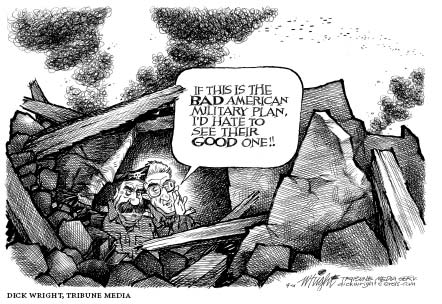
After pushing through the Karbala Gap on the outskirts of Baghdad and securing the river crossings into the capital, U.S. forces were poised to take the city. Some of the fiercest fighting took place around Baghdad International Airport.* Intelligence was reporting that Fedayeen, regular army and Republican Guard units had massed in central Baghdad. U.S. troops launched what became known as thunder runs into the heart of the city to test the strength of the resistance.
As columns of U.S. tanks and armored vehicles sped through Baghdad, the world was introduced to an unconventional celebrity. He was a figure who not only provided comic relief in a time of war, but also offered a disturbing insight into the delusional world that was the Saddam Hussein regime. The Iraqi minister of information, Muhammed Saeed al-Sahhaf, popularly known as Baghdad Bob, had a special talent for either ignoring unwelcome facts or lying about them shamelessly.
After U.S. forces seized the Baghdad airport, he claimed: “We butchered the forces present at the airport. We have retaken the airport! There are no Americans there!” But as Baghdad Bob was making his wild pronouncements on television, just around the corner American forces seized Saddam’s parade ground downtown. Confronted with this evidence, he was impressively undaunted. “There you can see,” Baghdad Bob said. “There is nothing going on.”15
Despite Baghdad Bob’s protestations to the contrary, the U.S. military’s thunder runs into Baghdad damaged the Iraqi forces’ morale and killed large numbers of Iraqi and foreign fighters. U.S. forces encountered not the Special Republican Guard divisions they expected but instead legions of jihadists on the streets of Baghdad. Saddam knew his Republican Guard tank divisions were no match for the American military, but the fanatics armed with small weapons and craving martyrdom proved to be formidable foes.
On April 9, 2003, the Marines reached Firdos Square in the heart of Baghdad. “The midget Bush and that Rumsfeld deserve only to be beaten with shoes by freedom-loving people everywhere,” Baghdad Bob declared, as American troops fixed a rope around the neck of the larger than life statue of Saddam that dominated the square, much as his likeness populated the rest of the capital city and the entire country.16
Our forces were understandably exhilarated by the prospects of the liberation of Baghdad they had made possible. As the statue of Saddam was pulled down by Iraqis and Marines, one Marine draped an American flag over the statue’s head. I remember General Myers expressing concern and calling someone at CENTCOM to fix the problem. Whether Myers’ message got through or not, the American flag was removed. As the statue came down, a crowd of Iraqis began to beat Saddam’s likeness with their shoes—an Arab expression of disrespect. Critics of the war would belittle those who claimed the Iraqis would greet the Americans as liberators—and to be sure not all Iraqis did—but in Firdos Square that day, the sentiment was clearly one of liberation.
Saddam’s regime collapsed twenty-one days after the war began. The invasion was accomplished with skill, precision, and speed—and a minimum of casualties—by Franks, his team at CENTCOM, and the men and women volunteers in uniform. It was a heady moment. Less than two years after 9/11, the U.S. military had changed the regimes in Afghanistan and Iraq, two of the world’s leading sponsors of terrorism.