
CHAPTER 37
Beginning in September 2003, after Bremer’s article was published, I assembled a review group on Iraq policy, headed by Doug Feith and Lieutenant General Walter “Skip” Sharp, the director of plans on the Joint Staff. I hoped to bring resolution to the unresolved debate about our strategy for when to hand over authority to Iraqis. With input from Generals Myers, Pace, and Abizaid, we reformulated the five principal U.S. strategic goals for an Iraqi government: renouncing terrorism, abandoning WMD and long-range missile programs, seeking peace with its neighbors, remaining a unified country, and developing the Iraqi economy.1
Our plan called for the prompt assembly of a group of Iraqis to select an interim prime minister, help draft a constitution, and pave the way for elections. We also called for a date certain for the transfer of full sovereign authority: no later than the middle of 2004. I wanted to give Iraqis concrete assurance that the occupation of their country was going to end—and soon.2
I asked Bremer and Abizaid to fly to Washington to discuss it with us at the Pentagon. My hope was to sit down with Bremer and have him offer ideas and input, with the ultimate goal of getting him to buy in to our plan. I had a sense that our effort might prove successful.
Prominent Iraqis had protested Bremer’s views as set forth in his op-ed. They were not pleased with his assertion that Iraqis would be taking on substantive roles later rather than sooner. Their significant outcry seemed to have put Bremer in a more cooperative mood. In fact, I thought he might be ready to accept a dignified way for him to drop his plan altogether.
I cleared much of my calendar for the two days Bremer and Abizaid would be in Washington. Over the course of our hours-long meetings, we showed them our strategic review and solicited their thoughts.3 As I had hoped, Bremer was receptive. By the close of our discussions, he had reversed his position that the Coalition Provisional Authority could not be dismantled until after elections were held.
On October 29, 2003, with Bremer’s acquiescence, I presented the agreed-upon proposal to the President and the members of the National Security Council. As he heard our timetable, Powell again expressed reservations, calling the turnover plan “exceptionally ambitious.”4The President liked it, however, which was not surprising since it was in line with what I thought he had preferred to do all along. Bush soon set June 30, 2004, as the deadline for turning over sovereign power to the Iraqis. The occupation now had a foreseeable end.
As this was going on in October 2003, there was a curious development. A number of news outlets began to report that there had been a shake-up in the administration’s Iraq policy—but it was not the one that actually had just occurred. “President Bush is giving his national security adviser, Condoleezza Rice, the authority to manage postwar Iraq and the rebuilding of Afghanistan,” USA Today reported.5 In what the New York Times called “a major reorganization” of the postwar effort, it quoted a senior administration official as saying that “[t]his puts accountability right into the White House.”6
The news stories surrounding Rice’s announcement reported that she had established something called the “Iraqi Stabilization Group,” with undetermined responsibilities. CNN reported that it “will be responsible for handling the day-to-day administration of Iraq.”7 One newspaper ran a cartoon of Rice pulling down a statue of me in front of the Pentagon, as Saddam’s statue had been pulled down in Firdos Square.
I thought it would have been terrific if Rice and her staff had the interest and skill to manage all U.S. efforts in Iraq and improve the situation. But they did not. In fact, the lack of resolution on issues relating to the administration’s Iraq strategy at the NSC level had been a major contributing factor to the problems in the first place. Years later I learned that Bremer had been having a daily phone call with Rice at 6:00 a.m., Washington time. She had had ample opportunity to offer Bremer and the CPA management advice. After the press began speculating about the new powers of Rice’s group—and the supposed coup against the Pentagon—Rice tried to clarify the situation. Publicly she said she had consulted on the establishment of the group with various officials, including me. That was not the case. I was informed of the new group’s existence as a fait accompli, but not consulted about whether it was desirable, necessary, or appropriate.
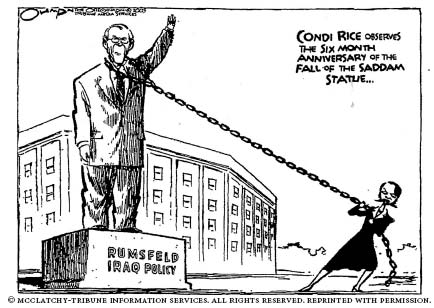
I sent the cartoon to Rice with a note saying she should keep it for her scrapbook.8
The news stories about Rice’s new management plan also repeated the widely believed canard that the State Department had been cut out of postwar planning.9 The stories bore the unmistakable fingerprints of Powell’s top aides.
I had been eager for the State Department to accept more responsibility in Iraq and would have been the last person to shut them out. When we asked the State Department to send experts to Iraq, they failed to meet their quotas.10 When we asked for support for reconstruction teams in Afghanistan and Iraq, they struggled to fill them. When the State Department was in charge of training the Iraqi police, it did not get the job done. Powell was in National Security Council meetings and principals meetings on Iraq and shared in every major decision. It was a mystery as to what these State Department officials felt they were not involved in. I was skeptical that either the National Security Council or the State Department truly wanted to be accountable for the administration’s Iraq policy, and I was all too aware that Rice and the NSC were not able to manage it.
On October 6, 2003, I sent a memo to the President with copies to Cheney and Andy Card. “In Monday’s paper,” I wrote, “Condi, in effect, announced that the President is concerned about the post-war Iraq stabilization efforts and that, as a result, he has asked Condi Rice and the National Security Council to assume responsibility for post-war Iraq.”11 I recommended that Bremer’s reporting relationship be formally moved from Defense to the NSC or to State:
At this point there is a certain logic to [the] transfer. We all understand and agreed that at some point the stabilization responsibilities would move out of DoD.
Next, increasingly, Jerry Bremer has been reporting directly to Colin, Condi and you, as well as to DoD, so the effect of the change should not be major.
Third, the responsibilities that Jerry is currently wrestling with are increasingly non-DoD type activities—they are increasingly political and economic.
Finally, Condi, in effect has ... announced that that is the case. To not make the transfer now will cause confusion as to where the responsibility resides.12
I further noted that I had told Bremer months earlier that I would prefer to have him report to the President, Rice, or Powell. “[H]e is fully aware of my willingness to have this reporting relationship adjusted now that the circumstances there have matured,” I wrote.13 No one took up my offer. In fact, Rice shortly thereafter reversed herself, apparently at the President’s insistence, and informed the press that, contrary to her previous announcement, nothing about the administration’s Iraq policy had changed.
One week later, after a principals meeting on October 14, 2003, Rice asked to see me privately. She apologized for the flap over Iraq and said that she was doing everything to correct it.
I interjected, “You’re failing. You could have said something in the NSC meeting in front of the President and the principals.”
“Don, you’ve made mistakes in your long career,” she replied.
“Yes, but I’ve tried to clean them up.”14
Over the first four years of the administration, I had repeated discussions with Rice and Card suggesting a series of reforms to the NSC process. Mindful of my own admonitions that complaints without tangible recommendations for solutions were generally unhelpful, I had sent a number of memos to Rice and Card proposing that they institute changes to improve the President’s most important national security body. But there had been little or no improvement.15 It was not pleasant to see these problems up close, knowing how they undermined our nation’s policies.
On December 6, 2003, I went to Iraq to assess the situation on the ground and made another attempt to clarify Bremer’s chain of authority. Meeting him at the Baghdad airport, we moved into the lounge, where I took him aside. “Jerry,” I began, “it is clear to me now that you are reporting to the President and to Condi.” My view was that he should report to Powell at the State Department, not to Rice at the NSC, and that State should take on the responsibility for the civilian aspects of reconstruction in Iraq.
“I will keep my hand in on security,” I said, “and I will try to be as helpful to you as I can, but I don’t want four hands on the steering wheel.”
I also said I didn’t think the NSC was doing its job well, and that Rice’s taking on an operational role in Iraq was a grievous mistake. When the NSC staff engaged in operations abroad in the Reagan administration, I noted, they wound up overseeing a trade of arms for hostages in Iran and brought the Iran-Contra scandal down on the President’s head.
Bremer told me that he shared my concerns about the NSC, and that he didn’t disagree with or object to anything I said. I wished him well. At that meeting, as far as I was concerned, any lingering pretense that I oversaw his activities came to an end.16
By the time I arrived in Baghdad that December, military officials told me they were beginning to believe they might finally have Saddam—officially dubbed High Value Target Number One—in their sights. But reports of Saddam sightings were as frequent as they were unreliable. Even as a deposed dictator, he remained skillfully elusive. He had a number of hideouts and body doubles. He reportedly slept in a different place every night.
I put a high priority on Saddam’s capture and considered it a critical step in giving Iraqis confidence that the old tyranny was gone and would never come back. Even after Saddam’s overthrow, many Iraqis feared that the war was not over—and that the Baathists might be heard from again. They had lived in terror of the midnight knock on the door from regime agents for so long that they had difficulty moving past the worry that conceivably one day Saddam Hussein might return to power. Saddam had worked for decades to build his cult of personality. Suddenly turning himself into an amateur genealogist, he even declared he was a direct descendant of the prophet Muhammed. His picture was in all public buildings, on billboards, in homes, and in restaurants, reinforcing the idea in Iraqis’ minds that he was everywhere and everything. Saddam had survived several wars, an earlier U.S. invasion, coups, and uprisings. Iraqis asked themselves, with justification, whether he might pull off such a feat again.
Even the death that July of Saddam’s vicious sons, Uday and Qusay, had not been enough to overcome the fear that a Hussein regime could return in some form. Active participants in the regime’s crimes, Saddam’s sons long had been his heirs apparent and were rumored to be even more sadistic than their father. If Saddam died, Iraq under their leadership was likely to be even more oppressive and hostile to Western interests than it had been under Saddam. After the invasion, Uday and Qusay had gone into hiding. When coalition authorities tracked them to a building in Mosul, they became engaged in a fierce firefight, seemingly determined not to be taken alive. Their wish was granted.17
After his sons were killed, there was an intelligence report that Saddam Hussein was paying $60 million for his agents to target the President’s two daughters and my two daughters for reprisal attacks. That threat report was brought up at an NSC meeting in October 2003. I acknowledged it, but went on with our discussion.
“You need to take this seriously,” Bush said. He had received word that pictures of his daughters had been found in Uday Hussein’s palace.
Tenet broke in, reinforcing the President’s concern. “You took out Saddam’s sons. They might well go after your daughters.” Needless to say, I was concerned about my family, but there was little I could do about it other than encourage them to take precautions.
On December 6, 2003, I visited Kirkuk in northern Iraq, where I met with Major General Ray Odierno. At a hulking six foot five inches, Odierno looked like a superhero in a movie. As commander of the Fourth Infantry Division in the Sunni areas to the north and west of Baghdad, he was leading the hunt for Saddam Hussein. I asked a number of questions about how close we were getting to him and what intelligence methods Odierno was using—human intelligence, signals intelligence—and how many suspects he was rounding up. Odierno made no promises but indicated that the trail was getting warmer.
Exactly one week later, in the late afternoon of Saturday, December 13, I had just left the Pentagon and arrived at General Myers’ house for a brief stop at a holiday party he was hosting when I was summoned for an urgent call from CENTCOM. The many reporters present were curious when I had to quickly end my conversation and go upstairs to Myers’ private office. Abizaid told me over the secure line that our military had finally captured Saddam Hussein. Through an operation code-named Red Dawn, U.S. military personnel had rounded up a host of people judged likely to be hiding Saddam, or at least knowledgeable of his whereabouts, including former bodyguards, palace officials, and tribal leaders. One of these informants directed our forces to a farmhouse near Tikrit, Saddam’s ancestral home. There they found a trap-door concealed by dirt and rubble. As one soldier prepared to lob a grenade into the hole, another noticed that there was a man inside.
As he was hauled up into the light, the man looked disoriented. He was carrying a pistol but made no effort to use it.
“My name is Saddam Hussein,” he announced. “I am the President of Iraq and I want to negotiate.” The Butcher of Baghdad was pulled from the small, dirty “spider hole” at 8:30 p.m. Baghdad time.18
I immediately telephoned the President, who was at Camp David. In light of a number of prior false alarms, I didn’t want to say anything too definitive.
“Mr. President,” I began as soon as he picked up my phone call, “first reports are not always accurate, but—”
“This sounds like it’s going to be good news,” Bush interrupted.
I told him I had been advised by Abizaid that our troops believed they had captured Saddam Hussein. Bush too expressed caution. He asked why we thought it was him. My answer was that U.S. military officials had identified a bullet hole in his left leg and distinctive tattoos on his body; I added, however, that I wasn’t necessarily persuaded by that. Saddam’s body doubles could easily have been given similar identifying marks. I told him I was more impressed that our troops had found a sizable amount of money with him. I did not think it likely that a body double would be carrying some $750,000 in U.S. currency.
I assumed that our military would announce Saddam’s capture. Sanchez and Odierno were the ones who had been hunting him and had successfully tracked and captured him. Their dogged work had led to a major achievement. I thought it also would have been logical for them to have some senior Iraqi official participate in the announcement, to give it added credence. Instead, Bremer strode to the microphones at his Green Zone headquarters in Baghdad the following morning. “We got him,” he announced. Bremer was beaming. I was not.
Shortly after his capture, Iraqi officials displayed Saddam on television. The Iraqi people needed to see him for themselves, so they could be convinced that their resilient and elusive former leader was really in hand. As I saw this bedraggled figure, my mind flashed back to my meeting with him, the grand potentate. Twenty years later, Saddam Hussein was under arrest. The capture led to jubilation throughout much of Baghdad. There was a noticeable uptick in Iraqis’ interest in cooperating with coalition authorities, and, it seemed, an increasing optimism.

It was tempting for me to meet with Saddam in jail, as Bremer and members of the Iraqi leadership had done. However, I was actually more interested in seeing Tariq Aziz, who had been captured months before. I knew that nice guys didn’t last long in criminal regimes, but he lacked the obvious hard edges that many of his fellow Baathist bigwigs displayed. He had a manner that could obscure the underlying evil of the regime he represented—a paradox I had always found interesting whenever I sat across from him and engaged in the friendly conversations we had. I would have been interested in hearing Tariq Aziz’s version of events—how things had gone so wrong for him since our visits together in Iraq and in Washington in the 1980s. I wanted to know why Saddam had refused to comply with seventeen UN resolutions, and why they didn’t leave the country when President Bush had given them a chance in the days before the war. I wanted to understand the tortured logic behind the regime’s serial deception on its WMD programs and why their warped bluff had invited the very thing they hoped to deter. Ultimately, I decided there was no way to talk with my old acquaintance without creating a spectacle.
It was a mistake not to make the separation between the Department of Defense and Bremer official and publicly visible. Had I successfully done so, the Department might have been spared some of the criticism for another of the CPA’s decisions, relating to a violent event in the city of Fallujah.
Known as the “City of Mosques,” Fallujah by the spring of 2004 had become a haven for militants operating against the coalition. Baathists, al-Qaida terrorists, marginalized Sunnis, and criminals looking to make easy money planting roadside bombs had turned the city into a nest of killers. Car bomb factories and terrorist safe houses were scattered throughout the area. Many of the city’s two hundred mosques had become nodes of the disparate resistance movements.
On March 31, 2004, Iraqi insurgents ambushed four Blackwater contractors. They were pulled from their convoy and dragged through the city streets. Their murdered bodies were hanged over a Euphrates River bridge. Photographs and videos of the carnage promptly flashed around the world.
These crimes were monstrous—everyone understood that. But what many also did not seem to realize was that this act had a sinister and calculated purpose. The insurgents knew that they couldn’t hold off an American assault with arms alone. Instead, they had a sophisticated propaganda effort designed to intimidate and make Americans question whether their effort was worth the cost. The shocking images of bloodied and charred American corpses dangling from a bridge was a public relations victory for them. Increasingly, people questioned why Iraq seemed to be chaotic, violent, and out of control after its liberation.
All of us on the National Security Council recognized that we could not allow an Iraqi city to become a sanctuary for murderers and terrorists. My impulse was not only to find the enemies who had committed the atrocity, but also to send a message across the country that anyone who engaged in acts of terror would face the might of the U.S. military.
With the situation appearing to worsen that spring, General Myers and I approved Abizaid’s request to extend the tours of twenty thousand of our forces. Abizaid had earlier hoped that we might be able to gradually begin reducing troop levels. But that now seemed less likely.
On April 6, 2004, the Marines began an offensive to secure Fallujah, the largest combat mission in the eleven months since the end of major combat operations. Through no fault of the Marines, Operation Vigilant Resolve proved to be neither vigilant nor resolute. After three days of intense fighting, the Marines commanded a quarter of the city. But the gains came amid controversy, as the enemy’s savage tactics, combined with their successful propaganda effort, had their desired effect.
Insurgents took over public buildings, notably mosques and hospitals, and used them as bases from which to attack the advancing Marines. When an American air strike destroyed a mosque, it led to a public outcry fueled by false news stories on Al-Jazeera that trumpeted civilian casualties and carnage.* It was asymmetric war in its purest form. The insurgents of course were violating the laws of war: using civilians as human shields; firing on Marines from houses in Iraqi neighborhoods, daring the Marines to fire back; and storing their weapon caches in mosques, schools, and hospitals. The enemy sought to convince the world that America’s use of force was indiscriminate, disproportionate, and reckless.
Sunni members of the Iraqi Governing Council, who were anxious to assume control of their government as the June deadline for Iraq sovereignty approached, expressed outrage at the U.S. attack on Fallujah and pressed Bremer for a cease-fire.
On April 9, Bremer, Abizaid, and Sanchez participated in an NSC meeting via secure video from Baghdad. I joined the President, Powell, and Rice in the Situation Room. “We have a real threat with the top Sunni members of the Iraqi Governing Council,” Bremer told the President. He said they were threatening resignation and the dissolution of the council. “I’ve agreed to a twenty-four-hour cessation of operations,” Bremer said, adding, “This is not a cease-fire.”
It sounded exactly like a cease-fire—even a capitulation—to me. The Iraqi Governing Council wanted time to negotiate, but I doubted any real concessions would be extracted from an army of fanatics who had vowed to attack the new Iraqi government. I wanted to continue the operation.
“What do we do when the Iraqi Council asks for an extension?” I asked.19
“I recommend we don’t grant it,” Abizaid answered quickly.
“I tend to agree,” Bremer interjected, “but we can’t rule it out, and we shouldn’t answer hypothetically.” His reluctance indicated to me an extension of the twenty-four-hour so-called cessation of hostilities was all but certain.
I knew Bush’s instinct was to take the enemy out, but he also had to consider the diplomatic aspects. “How long do the Marines need to conclude their operations in Fallujah?” he asked.
“Three to four days,” Abizaid replied.
“Well, tell ’em we’ll quit in four days,” Bush said.
As the Iraqi Governing Council engaged in discussions, our Marines, still taking fire from the enemy, held their positions but halted their advance. As the twenty-four-hour cessation of hostilities expired, just as I had anticipated, Bremer was reluctant to continue the offensive. He said he feared uprisings in Iraq and a “collapse of the entire political process” if the Marines continued.20 It was not an unreasonable concern, but for me an even greater worry was the insurgent attacks that were continuing against our troops. I felt our military was being tested, and we needed to push back against the challenge.
Bush seemed to share that view. At the NSC meeting the next day, on April 10, the President worried that there would be consequences if people thought, as he put it, that “we’ve been whipped.”21 But the President did not issue an order for the Marines to continue.
The President decided that extending or canceling the cease-fire was an operational decision—one that belonged to the senior officials on the ground. Directly countermanding the recommendations of the two most senior commanders responsible, Abizaid and Sanchez, in addition to Bremer, was not in the cards. The Commander in Chief made the call to let them proceed as they saw fit.
There was logic in deferring to Bremer and Abizaid in that they had made some real progress elsewhere in Iraq. The military’s efforts and arrests of senior members of the regime gave the Iraqi people an opportunity to close the book on their recent past and bring the criminals to account. By October 2003 the country’s electricity generation was higher than prewar levels, though in the years that followed it would ebb and flow with the pace of attacks.* With help from Undersecretary of the Treasury John Taylor, they rapidly created and distributed new Iraqi currency and curbed inflation. Real Iraqi GDP growth during the CPA period was 46.5 percent.22 The stock market opened, as did schools and hospitals across the country. In March 2004, Bremer and CPA officials drafted an interim constitution known as the Transitional Administrative Law that protected human rights, asserted the freedom of religion, and established the basic structure of a representative Iraqi government.23 It left a lasting imprint on Iraqi society. These were important signs of progress that received relatively little recognition.
The first battle of Fallujah, in April 2004, however, was not among the triumphs of that period. The cease-fire the momentum the Marines had gained. The Iraqi Governing Council again said they would resign if our forces pressed on. Eventually our coalition allies began to urge us to call off the attack. They were seeing the same images as many across the Arab world: wounded Iraqis, damaged mosques, and interviews with Fallujans describing supposed crimes by Marines targeting schools and hospitals. The widely disseminated propaganda increased the sense that the situation was one misstep away from a total, nationwide revolt against coalition forces. The Iraqi Governing Council tried to persuade the insurgents to lay down their arms and abandon the city. Bush was unhappy with the situation as was I. It was doubtful that a cease-fire would be productive.24 I knew that sooner or later, we would have to return to the enemy’s stronghold.
Given a growing insurgency and the existence of sanctuaries like Fallujah where insurgents received support from the local population, it was clear that we needed to find a way to involve the Sunnis in the new Iraq. Only a small percentage of them were directly engaged in the insurgency or linked to groups like al-Qaida, but many others sympathized with the resistance and the sense that their country was being occupied by forces hostile to them. It was easy to appreciate why many Sunnis—who were once accorded all of the privileges in Iraqi society—might see the future without Saddam and his largesse as bleak. Around the time of the Fallujah standoff, General Abizaid and I were discussing a Sunni outreach strategy. He thought there could be a way to peel off the disaffected Sunnis from the Islamist extremists and hard-core Baathists. There were intelligence reports about former Iraqi generals and other senior Baathists who had fled Iraq but had connections with insurgents who were ready to negotiate.* A large payment of cash by us could buy a change of allegiance, they informed us. We needed to determine if their offers were in good faith. Abizaid persuaded me of the merits of a determined outreach effort.25
In April 2004, I suggested to Bremer that he put together a strategy designed to “change the mindset of disenfranchisement and hopelessness” among the Sunnis.26 Senior military officers and I had been concerned for over a year that the Sunni tribes were being neglected, but we had found a less than receptive ear in the CPA.27 The Sunni outreach I outlined included easing up on de-Baathification efforts by moving Ahmad Chalabi out of the process.* I urged Bremer to focus on “labor-intensive projects in Sunni areas” and those near moderate Sunni mosques. I also asked him to build ties to Iraq’s Sunni tribes through regular visits with their leaders. We could contract with members, as Saddam did, to provide essential services, such as protecting the electrical grid from sabotage. The tribes and their leaders—in Shia and Kurdish communities as well as Sunni areas—were the backbone of Iraqi society. Not engaging them was unwise. Tribal leaders, I suggested, also could help us recruit for the security forces and put pressure on members of their tribes who helped the insurgency.
But Bremer was not inclined to work through the tribes. Despite his agreement to turn over sovereignty by June, it remained difficult to get him to accept the idea that Iraq belonged to the Iraqis, and that the Iraqis were entitled to their own culture and institutions.
In the spring of 2004, we faced the danger of a two-front insurgency. Sunni insurgents were gaining ground and establishing sanctuaries in Iraq’s west, in places like Fallujah. Meanwhile, Shia militias, under Muqtada al-Sadr, were threatening rebellion in the south. The son of a revered ayatollah who was murdered by Saddam’s lieutenants, Sadr demonstrated little of his father’s intellectual prowess. As a failing seminary student, he had earned the nickname “Mullah Atari” in recognition of his fondness for video games. Yet he developed a following and became a powerful and violent leader of opposition to the American occupation. His angry sermons drew flocks of young men from Shia slums, enabling him to establish a militia that gained influence through a combination of social services and mob terror. Sadr intimidated other Iraqis by being able to put thousands of thugs and young males on the street. These mobs, called the Mahdi Army (though it was in no sense an army), were a potent force for disruption, demonstrations, and terror.
That April, long-simmering tensions with Sadr came to a head in Najaf, Iraq’s holiest Shia city. Taking advantage of the Fallujah flare-up, Shia gangs heeded Sadr’s call, televised on Al-Jazeera, to attack coalition forces throughout southern Iraq.28 Sadr had established his own Islamic courts and prisons in Najaf—the heart of the Shiite clerical establishment—where eyewitness accounts reported torture in the style of Saddam’s regime.29
There were several discussions in the National Security Council about whether, and if so when, our forces should take Sadr into custody. As early as August 2003 I had recommended that Abizaid and Bremer begin to think through “what we are going to do if red lines are crossed.”30 When Sadr began calling the coalition “the enemy,” I felt he had crossed the line.31 If he wanted to define us as his enemy, my view was that we should treat him as one. He had evidently ordered the murder of one of Iraq’s most respected moderate Shia leaders, Abdul Majid al-Khoei. I felt it was important to establish the principle that no one—not even a cleric with the loyalty of tens of thousands of Shia—should be above the law. In January 2004, I recommended that the CPA arrest Sadr to demonstrate “that the rule of law applies to Shi’a as well as Sunni.”32
But there was another legitimate consideration that preoccupied us. Arresting Sadr risked making him even more popular, and could further inflame tensions with the Shia majority, possibly triggering an outright civil war. When Sadr was holed up in the holy city of Najaf, for example, several senior clerics who opposed him nonetheless argued strongly against storming the city to arrest him. They feared it would aggravate sectarian tensions and damage holy sites.33 Still, my view was to arrest the demagogue.
Since this was a decision that could have a significant impact on the relationship between the coalition and our Iraqi allies, the President concluded that Bremer had to decide the best course to take. As coalition forces surrounded Najaf, Bremer and Sanchez decided to let the Iraqis take action on their own to deal with Sadr and his so-called Mahdi Army.34 I understood the reluctance to storm the city. But the idea that the Iraqi clerics or politicians would take on Sadr seemed unrealistic.
To my amazement, Bremer has since claimed that he wanted to go after Sadr but “[W]e got word that Rumsfeld had given instructions not to execute the plan to arrest Muqtada until ‘further notice.’”* That was not the case. It is possible that others on the NSC with whom Bremer regularly communicated might have opposed arresting Sadr, but I did not. In fact, I was so taken aback by Bremer’s suggestion that I later asked Pentagon officials to examine the issue and find out if anyone else at the Defense Department might have led Bremer to think we had wanted him to refrain from acting. The conclusion was that no one had done any such thing.36 Again, through no fault of their own, our military appeared ineffective, not only against the terrorists in Fallujah but also against the vocal cleric looking to cause trouble.
There was another cleric who was in many ways Sadr’s polar opposite—sage and learned, modest, moderate, and, above all, restrained. Grand Ayatollah Ali al-Sistani kept his distance from Americans, declining to meet with U.S. officials—military or civilian. At critical points he calmed passions among the millions of Shia who revered him. He encouraged them to accept the separation between religion and the state in a constitutional democracy, rejecting Iran’s form of clerical rule. In the face of consistent provocations by al-Qaida and Sunni insurgent groups against Shia people, shrines, and mosques, and the rebellions urged by Sadr, Sistani counseled calm and patience. Without him, I have no doubt that Iraq would be very different today—and not for the better. His leadership, along with many others who truly wanted a better life for their people, offered hope as we moved toward finally giving them the sovereignty they desired.
Though a latecomer to relinquishing power to the Iraqis, Bremer worked to organize the transition once the decision was made. He planned a timetable with the Iraqi Governing Council that set out dates for writing an interim constitution and setting up a transitional national assembly. With the CPA’s assistance, they drafted their interim constitution in March 2004. Though based in part on principles from our Constitution, it was by no means an American document, but appropriately an Iraqi document. It protected the rights of minority Sunnis, Kurds, and Christians and gave the long beleaguered majority Shia a full role in their government. Bremer and the Coalition Provisional Authority deserve credit for helping Iraqis craft the most representative constitution in the history of the Arab world.
In May 2004, following the recommendations that the Defense Department’s policy shop and the Joint Staffhad developed, Iraqis on the governing council met to select an interim prime minister. Ayad Allawi, a medical doctor by training, became the first Iraqi leader to assume power since Saddam Hussein. He was a symbol of opposition to Saddam. In years past Allawi, along with some of Saddam’s generals, had attempted to overthrow the Iraqi regime. He fled to London, where Saddam’s hit-men broke into his residence and attacked him with an ax as he slept, wounding him in the head and chest. Miraculously, he survived and remained resolute in his opposition to the regime. Though a secular Shia, Allawi had launched the Iraqi National Accord in 1990—a group comprising many Sunni, Baathist military officers who had become disaffected with the Saddam Hussein regime. The Iraqi Governing Council selected him unanimously as prime minister.
The approach of the June 30 handover date proved an irresistible draw for terrorists and insurgents. They staged several bloody suicide bombings, which seemed designed to intimidate the Iraqis and cast doubt on whether they would be able to lead. The enemy understood well that attacks against a sovereign government would not be nearly as popular or as widely supported as attacks against coalition “occupiers.”
After several of these bombings, doubts resurfaced within and outside of the U.S. government about whether the Iraqis truly were ready to govern themselves. Reporters frequently asked Bremer and others if the date for the transfer was still on track. Bremer defended the plan steadily.37 I did as well. I had no doubt that the turnover was the right thing to do.
As June 30 approached, intelligence reports warned that enemy fighters were planning an ugly reception for the new government, in the form of massive attacks across the country. Bremer wisely decided to outmaneuver them by moving the date of the handover forward by two days.
At the time, I was in Istanbul with President Bush at a historic NATO summit meeting. The alliance was going to admit seven new members, all formerly part of the Warsaw Pact. Three were former republics of the Soviet Union. The alliance had fifteen members when I served as U.S. ambassador there in the early 1970s. It would now have twenty-six. The meeting in Istanbul, in fact, would be the largest gathering of NATO heads of state ever assembled. I felt a great sense of satisfaction seeing the leaders of those once communist nations free to chart their own courses and voluntarily, indeed eagerly, join the NATO alliance. It was a vindication of the tough, nerveracking, long-sustained, costly, and high-minded half-century struggle by the allied countries, with bipartisan U.S. leadership, to contain and eventually defeat Soviet communism.

As I surveyed the large, circular table and the representatives of our alliance partners, I thought about Iraq. I wondered if decades from now Americans might look back on the liberation of those long repressed Iraqis with the same kind of satisfaction that we felt about our liberation of Europe from Nazism and Soviet communism.
I was sitting with the U.S. delegation when an aide passed a cable from Iraq to Condi Rice. In a ceremony with little fanfare—certainly less than when he had arrived in Iraq a year earlier—Bremer presented Prime Minister Allawi with a letter from President Bush affirming the dissolution of the Coalition Provisional Authority.38 Rice penned a note on the cable and passed it to me.
“Mr. President, Iraq is sovereign,” the note read, marking the historic day of June 28, 2004. “Letter was passed from Bremer at 10:26AM, Iraq time.” I handed the note to the President. He had been concentrating on the NATO discussion but looked down long enough to read it. He then took out his pen and wrote “Let Freedom Reign!” before turning to the British Prime Minister, Tony Blair, seated to his right, and whispering the good news. The two leaders smiled at one another and shook hands.
The U.S. and coalition occupation was over. Not a moment too soon, I said to myself. For me the question was whether it was too late. We were still trying to regain the trust of the Iraqi people—a task that had been made more difficult not only by a long and heavy-handed occupation but by the crimes of a few military guards at a prison called Abu Ghraib.