
Many wish to learn how to draw, and enjoy drawing, but do not have a true aptitude for it. This is shown by their lack of perseverance, like boys who draw everything in a hurry, never finishing or shadowing…
Paris MS G, fol. 25r
While serving as a junior worker or dogsbody in the studio, and perhaps as a model, Leonardo was also a pupil or discepolo, receiving specific instruction from Maestro Andrea. A contract drawn up in 1467 gives us an idea of what the apprentice expected to be taught. In it the Paduan painter Francesco Squarcione undertakes to teach his pupil ‘the principle of a plane, with lines drawn according to my method’, and how to ‘put figures on the said plane’ and ‘place objects there, as namely a chair or a bench or a house’, and how to represent a man’s head in foreshortening in isometric rendering’, and the ‘system of a naked body’.34 Thus broadly the pupil would learn the techniques of perspective and of figure-drawing. Squarcione also promises to ‘keep him with paper in his hand’ and to ‘provide him with models’. These ‘models’ would be Squarcione’s own drawings, as well as real objects and people. The pupil spent much time copying from the master’s ‘model book’.
Paper was expensive, and pupils also practised with a coated wood panel and a metalpoint stylus. In his famous handbook, the Libro dell’arte, Cennino Cennini recommends ‘a little boxwood panel, nine inches square’. This should be smoothed down ‘with cuttle such as goldsmiths use’, and then coated with bone-ash moistened with saliva: for the bone-ash use chicken bones, he advises, ‘just as you find them under the dining-table’.35 Leonardo’s earliest drawings on paper show him habitually using a leadpoint or silverpoint stylus before filling the lines in with pen and ink.
Draughtsmanship – disegno – was the foundation of this artistic education. This is stressed by Vasari, who specifies that Ser Piero arranged for Leonardo to ‘study drawing’ with Verrocchio, and it was stressed by Leonardo himself when he became a maestrowith pupils of his own. According to Paolo Giovio, ‘Leonardo would not permit youngsters under the age of twenty to touch brushes and colours, and would only let them practise with a lead stylus, diligently following the best examples of the ancients, and imitating the force of nature and the lineaments of the body with the simplest lines.’36 That this reflects the practice in Verrocchio’s busy commercial studio is unlikely – Leonardo was certainly painting before he was twenty – but it echoes the strict grounding in metalpoint draughtsmanship that he learned from Verrocchio. He had as good a master as he could get: Verrocchio was probably the finest draughtsman of his generation in Florence. Vasari’s famous collection included some of Verrocchio’s works, ‘done with the greatest patience and judgement’, among them ‘several female heads with lovely expressions and hair, which Leonardo was always imitating for their beauty’. Various examples of these survive. Vasari’s ‘always’ is not merely rhetorical: a black-chalk portrait by Verrocchio in the British Museum is closely echoed in Leonardo’s sketches for Leda, done more than thirty years later.37
Vasari also owned some Leonardo drawings, including early studies of drapery, done on linen, which he describes as among Leonardo’s exercises as a studio-pupil: ‘He made clay models, draping the figures with rags dipped in plaster, and drew them painstakingly on fine Rheims cloth or prepared linen. These drawings were done in black and white, with the point of the brush, and the results were marvellous, as one can see from the examples I have in my book of drawings.’ Several of these early drapery studies survive. Some can be related to drapery in the Uffizi Annunciation, which is probably Leonardo’s earliest complete painting (c. 1470–2).38 A drawing at Christ Church College, Oxford, is a study for the angel’s sleeve in the Annunciation; it is a fragment from a larger folio which probably once contained a sketch of a head (perhaps the angel’s head), some traces of long curly hair being visible at the right margin. The sleeve can also be compared to that of the San Gennaro angel, a small terracotta statue recently attributed to Leonardo (plate 8).
Leonardo’s brilliance in this respect prefigured the Mannerists, who make so much of drapery. ‘He took it beyond mere academic exercise,’ says Alessandro Vezzosi: he ‘brought out all its latent abstraction and force’.39 Enlargements of these drapery studies look like versions of the rocks and mountains of his later landscapes. The subject continued to exercise him: there is a chapter in the Trattato della pittura entitled ‘On Dresses, Draperies and Folds’. A drapery ‘must fit the body and not appear like an empty bundle of clothes’ – thus ‘inhabited drapery’. And he continued to refine the visual distinctions:
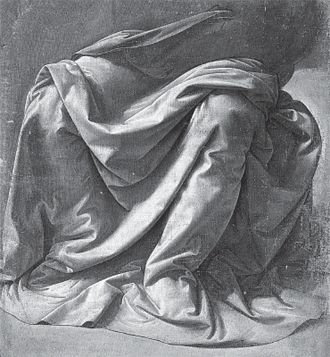
One of Leonardo’s drapery studies on linen.
Thin cloths, thick cloths, new and old cloths; with pleats broken up and with pleats entire; soft ruffles, shaded and less shaded, reflected and not reflected, expeditious and confused, according to their placing and their colours; garments according to rank, long and short, flying and stiff according to the movements, such as fit the figure and such as flutter upward or downward.40
Another early Leonardo drawing suggestive of the Annunciation is a study of a lily (Plate 3). It is crisply done in black chalk gone over with pen and ink, and given a sepia wash heightened here and there with white. It resembles the lily in the Annunciation, but is not an actual study for it as it slants the other way. It looks closer to the lily in Verrocchio’s Madonna and Child with Two Angels (National Gallery, London), but the painting has been cropped and only part of the flower is visible. The drawing has some faint lines in the lower third of the paper, hard to see in reproduction: these seem to be geometric studies of perspective, reinforcing the context of apprenticeship in which the drawing was done.
Also part of the apprentice’s curriculum was modelling in clay and terracotta. Vasari says that ‘in his youth’ Leonardo ‘made in clay several heads of laughing women, of which plaster casts are still being made, as well as some children’s heads executed as if by a mature artist’. No trace remains of any ‘laughing women’, and, though there are plenty of putti in Verrocchio’s monumental sculptures, there is nothing to suggest that any are by Leonardo.
Leonardo’s early career as a sculptor is mysterious. There is a beautiful terracotta head, a Cristo giovanotto or Youthful Christ (see page 122), which is thought to be his work, though opinions differ about whether it is an early work or from the mid-1490s (it has affinities with some studies for the disciples of the Last Supper). It may be the ‘little head’ later owned by Giovanni Paolo Lomazzo:
I have also a little terracotta head of Christ when he was a boy [fanciullo], sculpted by Leonardo Vinci’s own hand, in which one sees the simplicity and purity of the boy, together with a certain something which shows wisdom, intellect and majesty. He has an air which may be the tenderness of youth but which seems also old and wise.41
Lomazzo has interesting things to say about Leonardo’s activities as a sculptor because he had seen a manuscript, now lost, in which Leonardo speaks of sculpture as the ‘sister of painting’, and says, ‘I have delighted in her, and I delight in her still,’ instancing as ‘witness’ of this his various efforts as a sculptor – ‘horses, and legs, and heads, and also human [i.e. lifelike] heads of Our Lady, and youthful Christs both full length and in part, and numerous heads of old men’.42 This passage (assuming Lomazzo is reporting the lost manuscript faithfully) makes one look in turn at the famous list in the Codex Atlanticus, dated c. 1482, in which Leonardo catalogues various works he had completed before his departure to Milan. Some of these – ‘many heads of old men’, ‘many full-figure nudes’, ‘many legs, feet, and gestures [attitudini]’ – may be sculptures or clay models rather than drawings.43
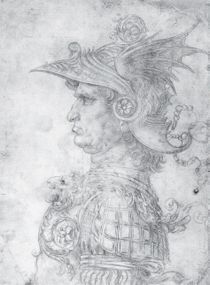
Metalpoint drawing of a warrior in profile, probably based on a bas-relief by Verrocchio.
He would also have learned the techniques of moulding and carving in relief (rilievo). There is a pair of terracotta angels in bas-relief in the Louvre which are certainly products of the Verrocchio workshop, and are sometimes attributed to Leonardo because of their similarity to the painted angel in the Baptism of Christ. Vasari mentions a bas-relief in bronze by Verrocchio showing the bellicose Persian emperor Darius; it is now lost, but is almost certainly recorded in Leonardo’s expressive metalpoint portrait of a warrior in profile, now in the British Museum.44
From life-drawing and perspective studies and clay-modelling, the pupil moves finally to the profession of painting. It is not certain when Verrocchio himself began painting, nor is it known who trained him. The first documentation of him as a painter is from 1468, when he submitted designs for a series of paintings of the Seven Virtues for the Palazzo della Mercanzia, though he was probably active before that.45 The studio’s chief output was small to medium-size Madonna and Child paintings. There are many of these in the style now called Verrocchiesco; their chief antecedent is the sweet and lustrous Madonnas of Fra Filippo Lippi, and through him the Netherlandish influence. They tend towards prettiness, but have also a robust sense of volume and movement derived from Verrocchio’s work as a sculptor. On stylistic grounds the small half-length Madonna and Child in Berlin is probably one of the earliest, c. 1468. Other examples are the Ruskin Madonna in Edinburgh; the Madonna and Child with Two Angels in the National Gallery, London; the Madonna of the Sea in the Accademia, Florence; the Dreyfus Madonna in Washington, DC; and the Madonna of the Carnation in Munich. Most of these are dated to the early to mid-1470s. They are all panel paintings, done on wood; canvas was not yet in use as a support, and there is no evidence that Verrocchio & Co. ever undertook fresco work, which was a speciality of the Ghirlandaio shop.
But long before Leonardo put brush to panel he would have toiled away at the basic mechanics of painting. He must learn the suitability of various different woods for the panel – poplar, walnut, pear, service-tree. Of these, poplar was the staple of the studios – especially the white poplar known as gattice, a cheap, serviceable wood much used by carpenters and joiners. He must learn to prepare the different types of gesso, the gypsum-based white distemper which was coated on to the panel, forming the ‘ground’ on to which the paint was applied: the final layers of silky gesso sottile arrived at a smooth, brilliant-white surface with low absorbency. Over the years Leonardo would experiment with ever more sophisticated custom-made gessoes:
Coat it [the panel] with mastic and white turpentine of the second distillation… then give it two or three coats of aqua vitae in which you have dissolved arsenic, or some other corrosive sublimate. Then apply boiled linseed oil in such a way that it penetrates every part, and before it cools rub it well with a cloth to dry it. Over this apply a liquid white varnish with a stick, then wash with urine.46
Thus prepared the panel was ready for the next step of the process: the transfer of preparatory drawings on to the virgin white surface. A full-scale drawing for the whole composition was often used: the ‘cartoon’, from the Italian cartone, a large sheet of paper. The outlines of the drawing were ‘pricked’ with little holes; one sees these perforations on many drawings. The cartoon was fixed flat against the panel and dusted with finely powdered charcoal or pumice. This is the process known as ‘pouncing’ (in Italianspolveratura); ‘pounce’ is a corruption of ‘pumice’. The dust passes through the perforations of the drawing and leaves a tracing on the panel, which is now ready for painting.
The tradition within which Leonardo first worked was that of tempera painting, though oil painting was soon to become the dominant new medium. A tempera is any kind of binding agent which will ‘temper’ powdered colours and make them workable, but in the Quattrocento the term invariably refers to egg tempera: colours mixed with fresh egg-yolk (or, for manuscript illumination, egg-white) and thinned with water. Egg tempera dries almost instantly, though several tones lighter than when wet, and is tough and long-lasting. The lustrous fresco cycles of Florence – Masaccio’s in the Carmine, Gozzoli’s in the Palazzo Medici, Ghirlandaio’s in Santa Maria Novella – were all painted a fresco (on fresh wet plaster) with tempera. To the sounds and smells of the bottega we must add those of the chickens that produced the eggs required for the pictorial output of a busy studio.
Oil painting was already established – a technique imported from the Netherlands – but was still mainly used as a finish, modifying the opaque tempera layer with a rich transparent film or glaze. It was a decorative adjunct to tempera work.47 Leonardo is on a technical cusp: he begins within the tempera tradition, but is soon enthused by the richness of oils, of which he became a master. He recognized the subtleties of modelling and shading which oils offered. The quick drying of tempera meant that you had to depict shadow by lines (‘hatching’ and ‘cross-hatching’), but with oils there was a new dimension of layered brushwork with which to achieve depth of tone and optical complexity – that ‘smoky’ look, or sfumato, which is one of his trademarks. And, crucial for Leonardo’s perfectionist style, there was no need to hurry.
The discepolo must also be versed in the arcana of colours – the materials which yielded them, the manner of preparing them, the effects of blending them. Some colours were from local earths (ochres, umbers, sienas), some were from plants (vegetable black), and some were products of noxious but fairly simple chemistry (lead white, lead–tin yellow). These provided a working basis for the painter’s palette. A traditional mix for flesh tones was yellow ochre, vegetable black and lead white; Cennino calls thisverdaccio.
But for the brilliant hues sought by the painter and his customers more exotic materials were needed. The pre-eminent pigment of early Italian painting was the vivid poetic blue called oltremare, or ultramarine, made by grinding lapis lazuli (‘stone of azure’: the Latin lazulus derives from the Persian lazhward). This ‘stone’ is a naturally occurring silicate rich in sulphur. The word ‘ultramarine’ sounds as if it refers to a blue more intense than sea-blue, but simply means that it came from ‘beyond the seas’. It was imported stuff, and fearfully expensive, and so became a byword for the value, and hence prestige, of a painting. The contract for Ghirlandaio’s Adoration of the Magi (1485) stipulates that ‘the blue must be ultramarine of the value of about 4 florins an ounce’ – though this sort of approach was dying out and cheaper substitutes like Prussian blue and azurite were becoming common.48
Other important mineral-based pigments were green malachite, widely used for landscape and foliage,49 and the brilliant red vermiglio, or vermilion, obtained from grinding cinnabar (red mercuric sulphide). The word comes from the Latin vermiculus, a little worm, because the red of cinnabar was compared to the red dye extracted from an insect, the kermes. Another insect was the source of ‘lac’ or ‘lake’, which was added to powdered pigments to produce a sheeny glaze.
Recipes for producing particular colour-effects fill the popular manuals like Cennino’s Libro dell’arte and Ghiberti’s Commentarii, and there are many in Leonardo’s manuscripts. In the Codex Atlanticus, written with the ornamental flourishes associated with Leonardo’s earlier writing, we find:
Take green [i.e. malachite] and mix it with bitumen, and this will make the shadows darker. And for lighter shades mix green with yellow ochre, and for even lighter green with yellow, and for the highlights pure yellow. Then take green and turmeric together and glaze everything with it… To make a beautiful red take cinnabar or red chalk or burnt ochre for the dark shadows, and for the lighter ones red chalk and vermilion, and for the highlights pure vermilion, and then glaze with fine lake.50
These raw materials explain why the painter was a member of the Arte dei Medici, Speziali e Mercai, the Guild of Physicians, Apothecaries and Mercers. The apothecary dealt in exotic stuffs of all sorts: you went to him for spices, drugs, herbs, potions and pharmaceuticals. Old-fashioned Italian pharmacies still refer to themselves as spezierie, spice-shops. From these pungent premises the painter purchased his visual spices. Also specializing in the supply of pigments in Florence were the Ingesuati friars of San Giusto alle Mura. Filippo Lippi, Botticelli, Ghirlandaio and Michelangelo are documented as customers, and so is Leonardo, who in the summer of 1481 paid 4 lire for ‘one ounce of azzuro [azurite] bought from the Ingesuati’.51
All this was required technical knowledge for the prentice painter, but there were other, less palpable, forms of knowledge he must learn. As well as a workshop or art factory, the bottega was a haunt of artists, a forum of discussion and gossip, a hotbed of new techniques and ideas. This was the university of the unlettered Leonardo.
A painter closely associated with the emergence of the Verrocchio style is Sandro Botticelli. He was an independent painter, but his earliest works are Madonna and Child panels much in the Verrocchio mould – or perhaps Verrocchio’s are in the Botticelli mould: we have no knowledge of Verrocchio’s training as a painter, and he was probably ready to learn from the younger artist, who had been trained by the great Filippo Lippi, and who became, after Lippi’s death in 1469, the master of his illegitimate son Filippino. Botticelli must be an important influence on Leonardo’s fledging as a painter in the late 1460s and early 1470s – an influence one could argue from the angel of the Annunciation, which has something of the stylized balletic look one associates with Botticelli. He was seven or eight years older than Leonardo. He was a rather highly strung man, and became a devotee of Savonarola, though Vasari also paints him as a habitual practical joker.
Leonardo left few comments on his artistic contemporaries, but he does comment on Botticelli. The tone is surprisingly critical. He speaks dismissively of Botticelli’s ‘dull landscapes’, and he is doubtless thinking of Botticelli’s unrealistic, mythological forests when he says, ‘Do not, as many do, paint all kinds of trees, even when equally distant, the same kind of green.’ Another tilt is found in Leonardo’s humorous complaint about lack of ‘decorum’ in an Annunciation: ‘I saw some days ago a picture of an angel making the Annunciation, who seemed to be chasing Our Lady out of the room, with movements which displayed the kind of offensiveness one might show to a hated enemy, and Our Lady seemed as if she was going to throw herself in despair out of the window.’ This probably refers to the Annunciation that Botticelli painted for the Guardi family chapel in about 1490, where the angel could be interpreted as crouching aggressively, though the interpretation is mischievous. A similar wilful criticism is found in a note about perspective which begins, ‘Sandro! You do not say why these second things seem lower than the third.’ This refers to Botticelli’s Mystic Nativity of 1500, where hierarchical ranks of angels are placed in defiance of the laws of perspective.52 All this carping seems uncharacteristic. It may have a psychological element: a desire to outshine an early influence, to define himself by his difference. Imitation for Leonardo was a form of weakness.
Another painter in the purlieus of the bottega was Pietro Vanucci, known as Il Perugino – ‘the Perugian’. Born near Perugia in the late 1440s, he had studied under an Umbrian master – probably Piero della Francesca – before coming to Florence, so he was not a junior apprentice like Leonardo. He is accorded the prefix ‘Mag’ (i.e. magister or maestro) in a Florentine document of 1472. Like Leonardo, he swiftly made the transition to oil painting. Perugino’s name is coupled with Leonardo’s in a rhyming chronicle by Giovanni de Santis, the father of the painter Rafaello, or Raphael:
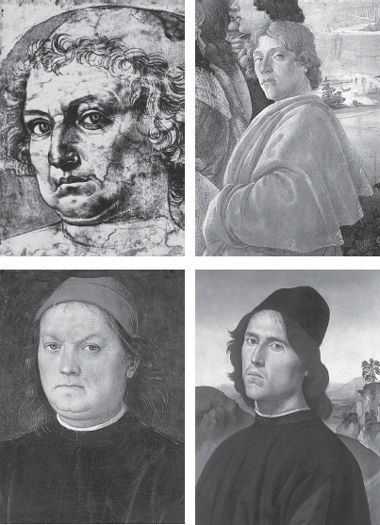
Colleagues in Florence. Upper left: probable portrait of Andrea del Verrocchio by one of his pupils. Upper right: Sandro Botticelli, probable self-portrait from his Adoration of the Magi, c. 1478. Lower left: Pietro Perugino, self-portrait, 1500. Lower right: Lorenzo di Credi, self-portrait, 1488
Due giovin par d’etade e par d’amori
Leonardo da Vinci e ’l Perugino,
Pier della Pieve, ch’e un divin pittor…
This describes Leonardo and Perugino as ‘two young men, equal in age and equal in love’, though of the two it is Perugino who is singled out as the ‘divine painter’.53
The other well-known pupil of Verrocchio was a handsome young goldsmith’s son, Lorenzo di Credi. Born in about 1457, he was younger than Leonardo and junior at the studio. The earliest of his accepted works, the Madonna and Child with St John the Baptist and St Donatus in Pistoia, was begun in about 1476. One of the predellas of this altarpiece was a small Annunciation which is obviously based on Leonardo’s painting of the subject, and was possibly a collaboration between them.54 In 1480 Credi’s widowed mother stated in her tax return that Lorenzo earned a wage of 12 florins a year at the studio. This would be a basic wage, augmented by payments for specific work on specific commissions. After Verrocchio’s departure for Venice in the early 1480s, Credi was in effective charge of the workshop, and he was named by Verrocchio as his heir and executor.55 According to Vasari, Verrocchio ‘loved’ Lorenzo more than any of his other pupils – perhaps an idea of homosexuality is being trailed here: how justly we do not know. The frequent claim that Leonardo was ‘introduced’ to homosexuality at Verrocchio’s studio is unsubstantiated.
We know nothing of Leonardo’s relations with Perugino or Credi. Neither is mentioned in his manuscripts – nor for that matter is his teacher, Verrocchio. Carping criticism or lofty silence: we do not get much sense of gratitude to the artists from whom and with whom Leonardo first learned his craft.
Finally the apprentice is ready to paint, which in practice means he is ready to paint some part of a painting. It is a truism of the Renaissance workshop that paintings were collaborative, and that a work ‘by’ a certain artist was often only partly painted by him, the rest being done by assistants and apprentices working under his supervision. Sometimes there were contracts that restricted the amount of delegation. One of Piero della Francesca’s contracts stipulated that ‘no painter may put his hand to the brush’ except Piero himself, and Filippino Lippi had to agree that his fresco in the Strozzi chapel in Santa Maria Novella would be ‘all by his own hand, especially the figures’.56 But in general it was accepted that a studio painting was not exclusively the work of the maestro.
One of the most charming products of Verrocchio’s studio is the small panel painting of Tobias and the Angel in the National Gallery, London. It was painted around 1468–70. The story of Tobias (or, in Italian, Tobiolo) is found in the apocryphal Book of Tobit: it tells of a boy’s quest to heal his father’s blindness, and of the guardianship of the angel Raphael during his adventures. It has the lineaments of a legend or fairy tale, and a comforting undertone of family values, and it had become a popular pictorial theme. Verrocchio’s Tobias is one of several from this time: there are very similar versions by the Pollaiuolo brothers and by Francesco Botticini, all featuring the fish and the dog which are part of the story. The Pollaiuolo painting, in oils, is the earliest of the three; Verrocchio follows its composition.57 He has given the two figures more energy and movement – the wind catches at their cloaks; the tassel of Tobias’s belt mingles wittily with a tiny tree in the distance. But the angel’s wings are not as good as the Pollaiuolos’, and the background is perfunctory – Verrocchio had no real feeling for landscape.
According to art historian David A. Brown, it is precisely this technical limitation which provides the clue to the painting’s combined authorship: ‘Verrocchio’s way of representing nature was inexpert, but contrary to expectation the creatures in the London panel, like the human figures in it, outclass those in the Pollaiuolo painting.’58 The animals, in other words, are too good for Verrocchio. The fish’s scales shimmer in tones of grey and white; though done in traditional tempera technique, a sense of light and surface is brilliantly caught. And the little white dog that skips along beside the angel: it is the same breed in both paintings – a Bolognese terrier – but in the Verrocchio painting it is alive, alert, trotting. Its long silky fur straggles and flows, painted with such finesse that the dog is diaphanous. You can see the line of the previously painted landscape beneath it. The animal seems to hover like a hologram just above the picture surface: a fairy-tale dog (Plate 4).
The dog and the fish are palpably not the work of Verrocchio himself, whose robust, sculptural style is seen in the two principal figures. They are the work of an assistant, and that assistant is surely Leonardo da Vinci. A comparison of the dog’s fur with the hair of Leonardo’s angels of the early 1470s shows close similarities. There is probably also a contribution by Leonardo in the curls of Tobias’s hair, which has the same unruly quiff as the angel of Leonardo’s Annunciation. Microscopic analysis shows left-handed brush-strokes in the curls above Tobias’s ear. Other Verrocchio paintings may contain early Leonardo brush-strokes in some fold of drapery or some corner of the landscape, but these are the first discernible contributions – a little dog, a fish, a cascade of curly hair, all done with that delicate, shimmery touch which would be perfected over the years, but which seems already to be the trademark of this remarkable apprentice.
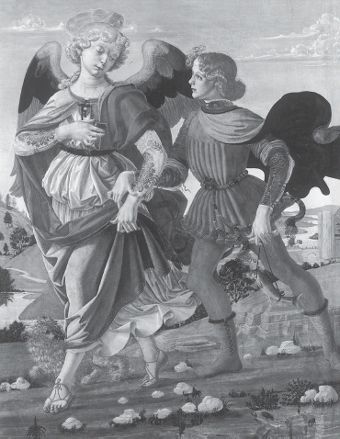
Verrocchio’s Tobias and the Angel.