

Part One
Things that happened many years ago often seem close and nearby to the present, and many things that happened recently seem as ancient as the bygone days of youth.
Codex Atlanticus, fol. 29v-a
Half a millennium ago the surroundings were not so very different. Standing on a hillside above the small Tuscan town of Vinci, one’s eye would have travelled, as it does now, over a landscape shaped by centuries of agriculture – the reed-beds along the river, the narrow vineyards, the houses framed by shade-trees, and above them the olive-groves, with their particular kind of glitter when they catch the breeze, climbing up on terraces towards that variable, snaky tree line where the uplands of the Mont’Albano begin. The high slopes were thickly forested: wild pine and laurel, turkey oak, sweet chestnut. The hill-farmers milled chestnut flour, as some of them still do today; the chestnut-tree was called albero di pane, the bread-tree.
It was all probably a bit scruffier then. The ratio of wild to cultivated land was different; so too was the whole pattern of land ownership. But the picture was essentially the same: that patchwork composition one sees today. And in the middle of it, on a saddle of hill which seems both sheltered and strategic, stood Vinci itself, with its cluster of stone buildings around the twin towers of the castle and the church. Politically it was an outpost of the Florentine republic – it had been a possession of Florence since 1254, and for more than two centuries before that a possession of the Counts Guidi, who built the landmark castle. Florence was a long day’s ride away via Empoli and Montelupo. Vinci was slow, provincial, agrarian; the countryside came right up to your windows.
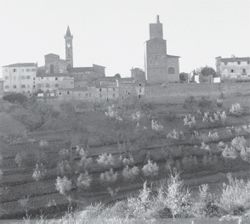
A view of Vinci.
Here Leonardo di Ser Piero da Vinci was born, on a spring evening in 1452. Exactly where – whether in the town or in the nearby countryside – remains unclear. The da Vinci, a respected local family with strong professional ties to Florence, certainly had a house in the town. In the catasto, or land-register, of 1451 it is described as ‘una casa posta nel borgo di Vinci’.1 It was situated, in other words, in the area of town immediately outside the castle walls: Vinci’s first, medieval suburb. It was probably located near the upper part of the sloping street now called Via Roma. It had a small garden about 3 staia in area. Among the family’s immediate neighbours were the blacksmith, Giusto di Pietro, and the parish priest, Piero di Bartolomeo Cecci. It remains entirely possible that Leonardo was born in this house, but a strong mix of supposition and tradition insists that he was not. The supposition is that the birth of an illegitimate child, as Leonardo was, would have been accomplished more discreetly in one of the family’s country properties. The tradition is that he was born in a small stone house which is still to be seen in Anchiano, a hamlet in the hills 2 miles north of the town.

The house at Anchiano in a photo of c. 1900.
It is not known how old this tradition is: the most one can say is that it was current by the mid nineteenth century. It was first mentioned in print by Emanuele Repetti in 1845. He refers to the house in Anchiano as the place where Leonardo ‘is reputed to have been born’. He stresses its modesty and typicality: a casa colonica, or tenant-farmer’s house, of the kind found all over Tuscany.2 Later in the century this identification was endorsed by the great Leonardo scholar Gustavo Uzielli, though he noted there was no ‘sure confirmation’ of it.
The house is a single-storey dwelling of local yellow-grey stone. The main building consists of three rooms, with a terracotta floor, a quantity of chestnut beams, and a large stone fireplace; at right angles to this is a smaller building with a bread-oven at the end of it. These two buildings correspond to the description of the house in old documents: a casa di signore for the owners to use when they wished, and a casa di lavoratori for the tenants who worked the land and paid their rent in the form of produce – oil, grain, wine, fruit, cheese, honey, timber, and so on. The L-shaped structure forms two sides of a courtyard open on the other two sides to the valley, though this area is now rather spoiled by municipal planting and paving. The exterior of the house seems in general over-restored, and one perhaps learns more from a hazy old photograph, dated around 1900, showing the place in its dilapidated, workaday state, with rough little windows punched through the façade, and a group of long-skirted women standing round a heap of harvested grapes.
Since the days of Repetti and Uzielli there has been a good deal of archival research on the house, which is documented back to the early fifteenth century. The tradition that connects it with Leonardo has some historical foundation, but the final step which makes it his birthplace is a leap of faith. The house certainly belonged to the da Vinci – the family crest, a winged lion, is carved on the façade – but the inconvenient fact of the matter is that it did not belong to them in 1452, when Leonardo was born. It was purchased by Leonardo’s father, Ser Piero da Vinci, some thirty years later; it remained in the family until 1624, when it was sold to a Florentine convent by a descendant of Leonardo’s half-brother Guglielmo. At the time of Leonardo’s birth the house was owned by a notary, Ser Tomme di Marco. It was then described as a frantoio, or olive-mill. (According to Uzielli, writing in the late nineteenth century, an old millstone was still to be seen lying close by the house.) There are some faint links between the notary Ser Tomme and the da Vinci: there is a general professional connection – the da Vinci were a family of notaries – and there is a tantalizingly particular connection, for on 18 October 1449 Ser Tomme had a contract drawn up conveying a part-share in the property to two others, and the man who wrote up the contract, and signed it as a witness, was Antonio da Vinci, Leonardo’s grandfather. Some notes relating to the contract show that Antonio was there at Anchiano, in a certain ‘farmer’s house’, when he was called on to draw up the contract. ‘Si giocava a tavola’: he was playing a game of backgammon when this interruption came.3
This is piquant as to Antonio da Vinci’s leisure pursuits, but his casual connection with the house cannot be counted as proof that his grandson was born there. It is certainly the kind of house the da Vinci would have had in the country. It expresses an important imagery of Leonardo’s upbringing – that it was rural, close to the land, modest though by no means humble. It also answers to our desire for tangibility: to give a local habitation to the fact of his birth.
Though the place remains unproven, the date and even the hour of his birth are certain. The event was precisely recorded by this same grandfather Antonio, then about eighty years old, on the back page of an old notebook that had once belonged to hisgrandfather. On it he had already noted the births and baptisms of his own four children. There was just room at the bottom of the page to record this new arrival, this new generation – ‘1452. There was born to me a grandson, the son of Ser Piero my son, on the 15th day of April, a Saturday, at the 3rd hour of the night. He bears the name Lionardo.’4 The clock was then reckoned from sunset (or more precisely from the ringing of the Ave Maria bell after vespers). The third hour of the night was about 10.30 p.m.
The baby was baptized, Antonio continues, by the parish priest, Piero di Bartolomeo: the family’s next-door neighbour in town. This probably means the baptism took place in Vinci, in the parish church of Santa Croce. The rough stone baptismal font has been there continuously since Leonardo’s time. The convention was to baptize the child the day after birth, in this case on Sunday 16 April, which in 1452 was the first Sunday after Easter, the domenica in albis. The baptism would have been entered in the Vinci baptismal register, but the earliest such register that survives dates from the 1550s.5 No less than ten godparents were present at the baptism: a very generous number. (Compare the six who stood for Leonardo’s father, Piero, and the average of two or four at christenings in Vinci in the sixteenth century.) Among Leonardo’s godparents were two of the da Vinci’s immediate neighbours in town: Papino di Nanni Banti, and Maria, daughter of Nanni di Venzo. Also present were Arrigo di Giovanni Tedesco, the German-born steward of the powerful Ridolfi family, which owned lands around Vinci, and a certain Monna Lisa di Domenico di Brettone, who reminds us that the name attached to Leonardo’s most famous painting was a common one. (‘Monna’ or ‘Mona’ means simply ‘Mistress’ or ‘Mrs’; it is a contraction of Madonna, ‘My Lady’, but is less aristocratic than that English equivalent.) If Leonardo’s actual birth was somewhat sequestered – as the proponents of Anchiano suggest – the baptism seems to have been a full-blown affair, probably rounded off with a festa of some sort, with plenty of fine ‘vermilion’ wine from the da Vinci vineyards. Despite his illegitimacy, Leonardo was welcomed into the world and into the family. Nothing in Antonio’s wording, or in the ceremony it records, suggests otherwise.
This precious record of Leonardo’s birth and baptism was unearthed in the Florentine archives in the 1930s by a German scholar, Dr Emil Möller. (The fact that Möller’s letter announcing the discovery has a postscript reading ‘Viva il Führer! Viva il Duce!’ may not endear him to us, but does not alter the value of his discovery.) Leonardo is elusive, and his elusiveness seems often to extend into the historical record: documents prove ambiguous; facts turn into riddles. One is grateful for this matter-of-fact account, written in the firm, clear hand of his octogenarian grandfather, and for its placing of Leonardo’s birth in the perennially tangible landscape of springtime in Vinci. The fig-trees are in bud, the terraces smell of wild marigold, and in sheltered spots the first olive-blossom is out: tiny yellow flowers foretelling the harvest to come.