
‘Leonardo, why so troubled?’ wrote the poet Cammelli, and something of this mood can be seen in Leonardo’s powerful and anguished St Jerome, begun in about 1480. The painting, now in the Vatican, is unfinished; it is in the same state of monochrome underpainting as the Adoration of the Magi, which was commissioned in early 1481 and abandoned when Leonardo left for Milan the following year. Preparatory studies – ‘many figures of St Jerome’ – are mentioned in the list of c. 1482, but do not survive. The only drawings that can be specifically related to the painting are a pair of lion’s heads seen at the bottom of one of his Madonna and Child sheets of the late 1470s.51
St Jerome in the wilderness was a very popular subject. There are versions by Masaccio, Piero della Francesca, Mantegna, Bellini and Lorenzo Lotto; the saint was also portrayed writing in his study, as in Ghirlandaio’s fresco in Ognissanti, which was painted around the same time as Leonardo’s picture. A Greek scholar of the fourth century, St Jerome (or Girolamo or Hieronymus) was the most learned and eloquent of the early Church fathers, famous for his Latin version of the Bible (the Vulgate). He symbolized a conjunction of religion and intellectual humanism, and was attractive to painters for the dramatic potential of his spell as a hermit in the Syrian desert. Historical sources suggest this was a sojourn of about five years, c. 374–8, when Jerome was in his thirties, but he is almost always depicted as an old man. So he is in Leonardo’s version, though unusually he is beardless. His features are reminiscent of a famous classical bust of the Stoic philosopher and dramatist Seneca, further stressing him as a classical as well as Christian figure.52
The painting shows the emaciated saint striking himself with a stone: the iconography of Jerome penitent. Every tendon is visible in the tautness of the neck and shoulders: this is in a sense the first of Leonardo’s anatomical drawings. Other conventional features of the Jerome iconography have been roughed in – the cardinal’s hat, which is the red blob immediately beside the drapery; the crucifix, just visible in the squiggled drawing at the upper right edge of the picture; the skull, bottom left, in the arc of the lion’s tail; and, of course, the lion itself. Among the painting’s dynamics is one of sightlines: the lion looks at the saint; the saint looks at the crucified body of Christ.
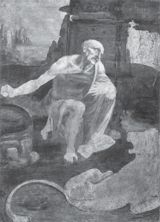
Leonardo’s unfinished St Jerome, c. 1480.
There is no early documentation of the painting, but in a curious little window in the rock in the upper right corner can be discerned the roughed-out sketch of a church. This is a typical allusion to St Jerome as a founding father of the Church, but it has also a more specific allusion. To a Florentine viewer, the church’s classical façade with two curved architraves would be instantly recognizable as that of Santa Maria Novella, designed by Leon Battista Alberti, and completed in 1472. This was a monument to the Rucellai family, whose name is carved on the front, and whose emblem of a sail (signifying good fortune) is mimicked in those distinctive curves. Its presence here may refer to the patron of Leonardo’s St Jerome – not Alberti’s great benefactor Giovanni Rucellai, who was now dead, but his son Bernardo. We have met him fleetingly in earlier chapters: an enthusiastic follower of Ficino, and a probable protector (or reputed ‘father’) of the eccentric young Tommaso Masini, a.k.a. Zoroastro. Generous, scholarly and deeply versed in classical antiquities – see his learned tract De urbe Roma, written in 1471 – Bernardo Rucellai seems a good candidate for the commissioner of the painting.53
As in all the paintings, Jerome is accompanied by a lion. This is actually a long-running Renaissance confusion: the saint who won the friendship of a lion by pulling a thorn out of its paw was San Gerasimo rather than San Girolamo, but the lion was by now ingrained in the latter’s iconography.
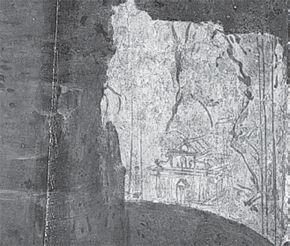
Detail from the background of St Jerome, showing a church similar to Santa Maria Novella (below).

Leonardo’s lion is brilliant: a few deft lines are all there is, but they give the creature a sleek, feline curve. It was almost certainly drawn from life. There was a famous ‘lion-house’ in Florence, round the back of the Signoria. On special occasions lions were brought out into the Piazza della Signoria for a ‘lion-hunt’: the young Luca Landucci witnessed one such, put on for a visit by the Duke of Milan in the early 1450s – the lion ‘threw himself upon a terrified horse, which dragged him from the Mercanzia to the middle of the piazza’. Landucci also records visiting the lion-house in 1487: ‘There was a keeper with whom they were quite tame, so that he could go into their cages and touch them – especially one of them.’54
Leonardo undoubtedly saw these lions, for in one of the anatomical manuscripts at Windsor he recalls, ‘I once saw how a lamb was licked by a lion in our city of Florence, where there are always twenty-five or thirty of them, which breed there. With a few licks that lion took off most of the fleece which covered the lamb, and having thus stripped it he ate it.’ The passage is datable to the 1500s, but may record a much earlier experience. It is an interesting counterpoint to a more literary passage in Leonardo’s ‘bestiary’: ‘When lambs are given as food to caged lions they submit to them as if to their own mother, so that it is often seen that the lions do not wish to kill them.’55 This is the emblematic and rather sentimental view of the lamb lying down with the lion. The actual reminiscence is by contrast precise, clipped, realistic, unflinching. We see him there, watching intently, grimly, the destructive efficiency of the beast.
In the St Jerome, by a perspectival twist, the lion in the foreground is the spectator of the saint’s mortification. It is watching him. Its mouth registers something between a leonine growl and a look of open-mouthed surprise: this gives the painting that quality of momentary drama which Leonardo seeks. In a sense – via a pun on leone and Leonardo – the lion stands for the artist himself. This verbal connection is found in one of Leonardo’s rebuses or picture-puzzles, drawn in the late 1480s for the delectation of the Milanese court. It shows a lion engulfed in flames next to a table. It is captioned ‘leonardesco’ (i.e. leone, lion + ardere, to burn + desco, a table or desk). Leonardesco is, of course, the adjective formed from Leonardo: the rebus is thus a punning self-portrait or logo. Leon Battista Alberti had used a similar pun (Leon/leone) in his Fables, comparing himself to the lion ‘burning with the desire for glory’: Leonardo probably knew this work.56
And so the presence of the painted lion also suggests the presence of the painter Leonardo, both of them witnesses of the saint’s suffering.
The topography of the painting is curious. Conventionally St Jerome is depicted sitting outside a hermit’s cave. That squarish space in the upper right of the painting might have suggested the entrance to his cave, but as it opens up to the distant view of a church it becomes a kind of window instead. Are we therefore in the cave, looking outwards? The painting, in its unfinished state at least, does not resolve this question. The haunting Virgin of the Rocks, begun a couple of years later, is also set in a fantastical kind of cave or grotto, with vistas glimpsed through rocky apertures.
These settings seem to link with an interesting text in the Codex Arundel, which describes Leonardo’s feelings as he looks in at the mouth of a dark cave.57 Its rather florid handwriting is typical of the first Florentine period: it probably dates from around 1480, and is broadly contemporary with these paintings. The page begins with four fragmentary drafts describing a volcanic eruption, rather hyperbolic and effortful – ‘the vomited-forth flames’, etc. – but then the writing changes gear, and a little story or episode emerges, a single paragraph set down simply and without any orthographic sign of hesitation:
Having wandered some way among sombre rocks I came upon the mouth of a huge cavern, in front of which I stood some while, astounded by this place I had not known about before. I stooped down with my back arched, and my left hand resting on one knee; and with my right hand I shaded my lowered and frowning brows; and continually bending this way and that I looked in and tried to make out if there was anything inside, but the deep darkness prevented me from doing so. I had been there for some time, when there suddenly arose in me two things, fear and desire – fear of that threatening dark cave; desire to see if there was some marvellous thing within.
This is a consciously literary piece – the earliest of Leonardo’s efforts in this direction – but it has a vividness which suggests that it may contain a stored-up memory, possibly from childhood. This would place it alongside the kite fantasy: a rare piece of personal narrative, expressing a similar kind of psychological ambiguity – ‘fear and desire’.
One could say that the Virgin of the Rocks precisely shows ‘some marvellous thing’ within the darkness of the cave: in that iconic grouping, the redemptive message of Christianity is foretold in the meeting of the infants Christ and St John. Part of the impact of the painting is this sweetness amid the gloomy, rocky setting. It reverses an opposite expectation, for in the medieval imagination such cavern-mouths suggested the entrance to the underworld or hell. This too is found in Leonardo’s work – not in a painting but in a stage-set, for a performance of Poliziano’s musical drama Orfeo, about the descent of Orpheus to the underworld to rescue Eurydice. Sketches show a range of rocky mountains which opens by cunning machinery to reveal a circular chamber within. This theatrical cavern is specifically an image of hell: it is the ‘residence’, as Leonardo puts it, of Pluto, the god of the underworld. In his notes he envisages the dramatic moment of disclosure: ‘When Pluto’s paradise opens up, there appear devils playing on twelve drums shaped like infernal mouths, and there is Death, and the Furies, and Cerberus, and many naked children weeping, and there are fireworks of various colours.’58
In these ways Leonardo revisits the ‘dark cave’ of the Arundel text, and the fears and desires it evokes. In his St Jerome it is a place of desolation and rigorous self-denial; in the Virgin of the Rocks it is a scene of serene benediction; and on a stage in Milan it is a vision of hellfire. What is revealed there remains ambiguous, as it is in the original text, and perhaps if the cave has a meaning it is precisely that: the ambiguity of the unknown. If one looks into the dark secrets of Nature, what will be revealed there – something terrible or something marvellous?59 Thus Leonardo, glimpsed in this rare little fragment of self-reflection: the hesitant explorer, loitering at the cave’s mouth. We sense again the edginess that accompanies the great Renaissance quest for knowledge: those moments when he wondered if the darkness were better left unilluminated.