
Let no one read me who is not a mathematician…
Forster III, fol. 82v
The year 1496, shadowed with the great enterprise of the Last Supper, saw also the blossoming of a great friendship, with the arrival in Milan of the mathematician Fra Luca Pacioli – ‘Maestro Luca’ as Leonardo calls him.
Pacioli, from the small town of Borgo San Sepolcro on the southern edge of Tuscany, was in his early fifties. In his youth he had studied under Piero della Francesca, who had a studio there; he was deeply influenced by Piero’s mathematical writings on perspective, and in Vasari’s view he plagiarized them in his own later writings. In the mid-1470s he threw up a promising career as an accountant to become a friar of the Franciscan order, vowed to poverty, and for twelve years he was a wandering scholar, lecturing on philosophy and mathematics; he is glimpsed at Perugia, Naples, Rome, Urbino and Zadar in Venetian Croatia. In 1494 he published his first book, the encyclopedic Summa de arithmetica, geometria e proportione. Covering 600 close-printed pages in folio, it is written in Italian and is thus part of the modernizing drift away from Latin. A note in the Codex Atlanticus records Leonardo’s purchase of a copy (‘Aritmetrica di Maestro Luca’) for 6 lire, and there are many extracts from it in his notebooks, some of them possibly related to the compositional geometry of the Last Supper.107 As its title states, it is a summary rather than a work of great originality. It has sections on theoretical and practical arithmetic, and on algebra, geometry and trigonometry; it has a treatise of thirty-six chapters on double-entry bookkeeping, some interesting discussions on games of chance, and a conversion-table showing the currencies, weights and measures used in various Italian states. For all his contemporary status as a philosopher, there is a strong practical streak in Fra Luca; he is remembered for his adage that ‘regular accounting preserves long friendships.’
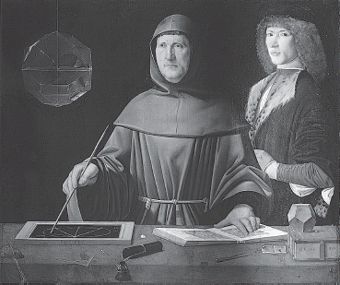
Fra Luca Pacioli in the portrait by Jacopo de’ Barbari, c. 1495.
The portrait of him by Jacopo de’ Barbari is dated 1495. It shows him in the Franciscan habit and cowl, one hand resting on a book of geometry, the other pointing to a slate bearing a geometrical figure and the name ‘Euclides’ inscribed on the side. On the desk are the tools of the geometer’s trade – chalk and sponge, set-squares, compass. A 3-D model of a polyhedron hangs like a giant crystal above his right shoulder. The large leather-bound book on the table, inscribed ‘LI. RI. LUC. BUR.’ (i.e. Liber reverendi Luca Burgensis – The book of the reverend Luca of the Borgo) refers to his Summa, published the previous year. The handsome young man standing behind him is probably Guidobaldo da Montefeltro, Duke of Urbino, to whom the Summa was dedicated.
Pacioli arrived in Milan in late 1495 or 1496, so this fine portrait shows him much as he was when Leonardo first knew him. He was personally invited by the Moor, but it is possible that Leonardo was instrumental in recommending this new mathematical guru. They seem to have swiftly become friends, and by the following year they were collaborating. Pacioli was writing his masterwork, Divina proportione, and Leonardo was supplying the geometric illustrations. The first of its three books was completed by the end of 1498; two manuscript copies dated 14 December 1498 were presented to Ludovico and to Galeazzo Sanseverino. In the preface to the printed edition of 1509 Pacioli asserts that the diagrams illustrating ‘all the regular and dependent bodies’ (i.e. regular and semi-regular polygons) were ‘done by that most worthy painter, perspectivist, architect, musician and master of all accomplishments [de tutte le virtù doctato] Leonardo da Vinci Fiorentino, in the city of Milan, where we worked together at the charge of the most excellent Duke of that city, Ludovico Maria Sforza Anglo, in the years of our health 1496 until 1499’.108 In the presentation manuscripts these drawings are in ink and watercolour: they are probably copies by assistants. Engravings of them appear in the printed text of 1509; thus these obscure polygons and polyhedrons qualify as the first works of Leonardo to be published within the covers of a book: the first mass-production.
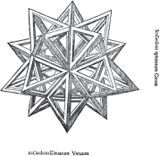
Dodecahedron designed by Leonardo, in an engraving from Pacioli’s Divina proportione (1509).
Mathematics, wrote Leonardo, offers ‘the supreme certainty’.109 It had been a part of his basic studio training, but now, under the wing of Luca Pacioli, he begins to plumb the more abstract world of geometry, the rule-book of harmony and proportion. His close study of Euclid can be found in two pocket-books of the late 1490s – Paris MSS M and I – though he was also conscious of lacunae in his knowledge of more elementary procedures, and issued one of his self-instructive memoranda: ‘Learn from Messer Luca how to multiply square roots.’110
The collaboration between Leonardo and Luca Pacioli – evidenced in Leonardo’s notebook and explicitly recalled in Pacioli’s preface to the Divina proportione – is one of the historical foundations of Leonardo’s elusive ‘academy’. The existence of this academy is much disputed: the most one can say for certain is that it exists on paper, in that series of beautiful knot-designs which feature the words ‘Academia Leonardi Vinci’ (variously spelt, sometimes abbreviated). They seem to be intended as a device or emblem for this august-sounding body, but many believe this was just a Leonardo pipe-dream.
The designs are known exclusively from engravings (see page 41), almost certainly done in Venice in the first years of the 1500s: there is strong evidence that Albrecht Dürer saw prints of them on his visit to Venice in 1504–5.111 The original drawings on which they are based do not survive, but a plausible account of them is that they were done in Milan in the late 1490s and that Leonardo brought them with him when he visited Venice – for the first time, as far as we know – in 1500. The originals would thus becontemporary with the complex interlacings of the Sala delle Asse ceiling, which Leonardo was working on in 1498, and which Lomazzo described as a ‘beautiful invention’ of ‘bizarre knot-patterns’. They would also be contemporary with the polyhedric designs done for Pacioli’s Divina proportione, which were drawn in Milan in or before 1498, and were also later engraved in Venice.
The original designs for the ‘academy logo’ seem to belong within the context of Leonardo’s collaboration with Pacioli. The idea that the two men were the nucleus of a definable intellectual group or sodality has perhaps been dismissed too easily. There is in fact an independent sighting of it in an obscure little book published in the early seventeenth century: Il supplimento della nobilita di Milano, by Giralomo Borsieri. In this the author refers to ‘the Sforza academy of art and architecture’, and to Leonardo’s role in it: ‘I myself have already seen, in the hands of Guido Mazenta, several lectures [lettioni, literally ‘lessons’] on perspective, on machines, and on buildings, written in a French script but in the Italian language, which had previously issued from this academy, and which were attributed to Leonardo himself.’112 The bibliophile Mazenta, who certainly owned many Leonardo manuscripts, died in 1613. Sometime before this date he showed Borsieri a manuscript containing certain lectures or lessons attributed to Leonardo. The manuscript appears to be sixteenth-century – its ‘French script’ implies that it was produced during the period of French rule in Milan – but the lectures it contains were originally delivered, or ‘issued’, under the aegis of this ‘Sforza academy’, which can only have existed before the fall of Ludovico Sforza in 1499. All this is taking Borsieri’s account at face value. The manuscript he describes has disappeared, and his description of its provenance cannot be verified. None the less, this is an independent account of Leonardo’s ‘academy’ and of the subjects discussed there: perspective, mechanics, architecture.
Who else might be seen at a meeting of this high-level talking-shop? One obvious candidate is Leonardo’s colleague Donato Bramante, architect of the Grazie, adept of Euclidian geometry, interpreter of Dante, and indeed another skilled creator of groppi or knot-patterns. (A manuscript note of Leonardo’s refers precisely to certain ‘groppi di Bramante’, and Lomazzo mentions his skill in this technique.) 113 Another possible luminary is the intellectual court poet Gasparé Visconti. He was a close friend of Bramante, of whom he wrote, ‘You could more easily count the holy spirits in the heavens than reckon up all the knowledge Bramante has in him.’114 Leonardo owned a copy of the ‘Sonetti di Messer Guaspari Bisconti’ (described thus in the Madrid book-list), probably referring to Visconti’s Rithmi, published in Milan in 1493. We might also include the brightest of Leonardo’s followers – Boltraffio or Bramantino perhaps – though whether there is room for the Zoroastrian showmanship of Tommaso Masini I am not sure. Other potential members can be found in Pacioli’s mention of a debate – ‘a notable scientific duel’, as he puts it – which took place at the castle, in the presence of the Duke, on 8 February 1498.115 Among the participants were the Franciscan theologians Domenico Ponzone and Francesco Busti da Lodi, the court astrologer Ambrogio Varese da Rosate, the doctors Andrea da Novara, Gabriele Pirovano, Niccolò Cusano and Alvise Marliano, and the Ferrarese architect Giacomo Andrea.
The last three on this list were certainly known to Leonardo. Niccolò Cusano, physician to the Sforza court, is briefly mentioned in a note (‘Cusano medico’), as is his son Girolamo, to whom Leonardo sends his commendations via Melzi in c. 1508.116 The Marliano family is mentioned frequently in his notes, mostly in connection with books –
An algebra, which the Marliani have, written by their father…
Concerning bones, by the Marliani…
Alchino on proportions, with notes by Marliano, from Messer Fazio…
Maestro Giuliano da Marliano has a beautiful herbal. He lives opposite the Strami, the carpenters…
Giuliano da Marliano the doctor… has a steward with one hand.117
Giuliano is the celebrated physician and author of Algebra; Alvise, who debated at the castle in 1498, is one of his sons. The architect Giacomo Andrea was Leonardo’s host, in the summer of 1490, at that supper where the urchin Salai broke the oil-flasks.
Also present at this symposium at the castle is the Moor’s son-in-law Galeazzo Sanseverino. Handsome, fashionable, intellectual, the famous champion of the tourney lists, and an accomplished singer, he was the ‘prime favourite’ of the Moor. Leonardo had known him at least since 1491, when he designed the ‘wild-men’ pageant for Galeazzo’s joust, and when he was keenly interested in the horses in his stable as possible models for the Sforza Horse. Galeazzo was also a patron of Pacioli’s, who was accommodated in his house when he arrived in Milan; one of the manuscripts of Divina proportione is dedicated to him. Pacioli also states that, among the sixty geometrical bodies designed by Leonardo for that treatise, a set of them was done for Galeazzo. If one is looking to give some reality to this fugitive little academy I would say that Sanseverino is a plausible patron or figurehead for it. Pacioli seems to say as much in his preface to the Divina proportione: ‘In the circles of the Duke and of Galeazzo Sanseverino are philosophers and theologists, physicians and astrologists, architects and engineers and ingenious inventors of new things.’
A Leonardo manuscript now in the Metropolitan Museum in New York has a cast-list for a masque on the subject of Jupiter and Danae, with sketches. The play is almost certainly the ‘commedia’ performed at the house of Sanseverino’s elder brother Gianfrancesco, Count of Caiazzo, on 31 January 1496, with the Duke present.118 It was written, in a mixture of ottava and terza rima, by Ludovico’s chancellor, Baldassare Taccone (whose poem on the Sforza Horse I mentioned earlier). Leonardo’s cast-list also names him – ‘Tachon’ – as one of the actors. A boy called Francesco Romano plays Danae; the priest Gianfrancesco Tanzi, former patron of the poet Bellincioni, plays Jupiter. This refined little cabaret on a classical theme, performed chez Sanseverino, is perhaps another emanation of the ‘Sforza academy’.
The words ‘Academia Leonardi Vinci’ emblazoned on those labyrinthine knot-designs may not refer to a formally constituted ‘club’, but it seems to be something more than a pipe-dream. For Leonardo the word accademia would recall that Platonic academy of Ficino’s, which he had known in Florence twenty years earlier – a nostalgia perhaps sharpened by the current fundamentalist climate of Savonarola’s Florence. We might think of this Milanese ‘academy’ as a version of that Ficinian prototype: its scope perhaps broader, more multi-disciplinary, more ‘scientific’. Pacioli’s influence may be discerned here – the philosopher-mathematician reintroducing Leonardo to Platonic ideas which he had earlier rejected in favour of a more Aristotelian regime of experiment and inquiry. One sees the ‘academy’ as a loosely knit group of intellectuals who meet and discuss and give lectures and readings, sometimes at the castle and sometimes at the house of Galeazzo Sanseverino outside the Porta Vercellina, and sometimes no doubt at the Corte Vecchia, that great factory of marvels where there is always some curious new gadget to inspect, where there are drawings and sculptures to look at, and books to refer to, and music to call for. The rackety element of the retinue – that ‘gang of adolescents’ – is banished to the periphery; Zoroastro is under orders to behave himself. The shabby old ballroom looks good in the torchlight, though once these ‘academics’ get going sheer brain-power would serve to illuminate it.
Two curious works – a poem and a fresco – seem to belong within the ambit of this Milanese ‘academy’.
The poem is an anonymous eight-page booklet called Antiquarie prospetiche Romane (The Antiquities of Rome in Perspective).119 It is undated, but internal evidence suggests it was written in the late 1490s – it cannot be earlier than 1495, since it mentions an incident when Charles VIII’s troops were in Rome (December 1494). The anonymous author styles himself ‘Prospectivo Melanese depictore’, which one can either take as a comic alias (‘Prospectivo Melanese the painter’) or as a self-description (‘the Milanese perspective painter’). The poem is written in what a recent editor calls ‘semi-barbarous terzine’, full of obscure Lombard colloquialisms, but among its obscurities one thing is certain: the poem is addressed, in very friendly terms, to Leonardo da Vinci – ‘cordial caro ameno socio / Vinci mie caro’ (‘dear cordial delightful colleague, my dear Vinci’). The author thus places himself as a member of Leonardo’s circle, and he refers to at least one other member of that circle – ‘Geroastro’, who is presumably Zoroastro. There is also a cryptic allusion to the ‘zingara del Verrocchio’ – ‘Verrocchio’s gypsy-woman’.
The poem is a sort of travelogue, describing the classical antiquities of Rome, and inviting Leonardo to meet the author there, to explore with him ‘the vestiges of the Antique’. (Whether it was actually written in Rome is debatable: it is clearly addressed to a Milanese readership, and may have been written in Milan.) It contains much fulsome praise of Leonardo, including the usual puns on Vinci and vincere, to conquer. He is particularly praised as a sculptor who is ‘inspired by antiquity’: he can fashion ‘a creature with a living heart and an aspect more divine than any other carving’ – presumably referring to the Sforza Horse. He is also praised, interestingly, as a writer or speaker:
Vinci, tu victore
Vinci colle parole un proprio Cato…
Tal che dell arte tua ogni autore
Resta dal vostro stil vinto e privato.
[Vinci, you the victor conquer with words, like a true Cato… and through your skill all other authors find themselves defeated and outshone by your style.]
These lines perhaps refer to the debates and lectures of the ‘academy’.
Some believe the author of the Antiquarie is Donato Bramante, who is known to have turned his hand to satirical sonneteering; but Bramante was not Milanese. Other attributions are to Ambrogio de Predis, Bramantino, Bernardo Zenale, and the up-and-coming young architect Cesare Cesariano, whose later writings on Vitruvius include an engraved version of Leonardo’s Vitruvian Man with an erection. Of these only de Predis is likely to have called Leonardo his socio – partner or colleague; he is also known to havevisited Rome at least once in the 1490s. The initials ‘P.M.’ which appear on the title-page presumably stand for ‘Prospectivo Melanese’, but could punningly stand for something like ‘Predis Mediolanensis’ as well.120 The title-page has a curious engraving, featuring a naked man down on one knee in a position reminiscent of Leonardo’s St Jerome. He holds a pair of compasses in his left hand and a sphere in his right hand, and he kneels inside a circle in which appear geometrical figures. In the background is part of a round colonnaded temple of the kind found in Paris MS B, and which is also associated with Bramante. The rocks in the background are perhaps a reminiscence of the Virgin of the Rocks. The accumulated references suggest the interests of the Milanese ‘academy’ – perspective, architecture, geometry, painting – and the whole tone suggests a coterie production for a private circle of intimates. It is possible that the ‘libro danticaglie’ (‘book of antiquities’) which appears in the Madrid book-list is a record of Leonardo’s own copy of it.
I would also relate to this sodality or academy Bramante’s enigmatic Men at Arms frescos, now in the Brera Gallery but formerly in the Casa Panigarola on Via Lanzone. The cycle featured seven standing figures in fictive niches, and a half-length portrait of two Greek philosophers, Democritus and Heraclitus. Only two of the standing figures survive entire: one is a courtier carrying a mace, the other a warrior in armour flourishing a large sword. The others, who have lost their lower halves, are harder to individuate, but one wearing a laurel wreath is clearly a poet, and another seems to be a singer. According to Pietro Marani, the cycle expresses a Neoplatonic idea of the ‘hero’, whose virtù comes from a tempering of physical force (the warriors with weapons) and spiritual elevation (the singer and the poet).121 The ‘LX’ monogram behind the philosophers may stand for lex, law, again with a Platonic overtone in which ‘law’ refers philosophically to the underlying harmonic order of things. The date of the frescos is uncertain, nor is it known who owned the house at the time they were painted there.122 The figures are comparable to Bramante’s fine panel painting Christ at the Column (also in the Brera), generally dated to the 1490s, and the philosophical tone seems to belong within the ambit of the ‘academy’.
My interest centres on that double portrait of the philosophers Democritus and Heraclitus, seated at a table with a large terrestrial globe between them. Their identities are signalled by their traditional attributes of laughter and tears. Democritus was said to have laughed at the follies of mankind, and Heraclitus was known as the ‘weeping philosopher’ because of his pessimistic view of the human condition. This painting has an even more precise connection back to the Ficinian academy, for a picture on exactly the same subject hung in what Ficino called the gymnasium, i.e. lecture-room, of the academy at Careggi. Ficino writes, in his Latin edition of Plato, ‘Have you seen, painted in my lecture-room, the sphere of the world with Democritus and Heraclitus either side of it? One of them is laughing and the other weeps.’123 Historically earlier than Plato, the two philosophers represent fundamentally opposite responses to the human condition – another dualism which the Platonic adept sought to rise above, or to ‘temper’ into equilibrium.
By the time of the fresco’s removal to the Brera, in 1901, the portrait of the two philosophers hung above a mantelpiece in the room containing the rest of the fresco, but an eighteenth-century description of the Casa Panigarola states that ‘Heraclitus and Democritus were to be seen above the door in the next room’, before being moved by the then owner into the frescoed room.124 So the picture was originally a kind of introduction to the Men at Arms fresco: as you walked towards that sumptuously decorated room, the two philosophers greeted you at the doorway, invited you in, and generally set the tone of the experience – that tone including, for those who knew about such things, a direct allusion to the imagery of the Florentine academy of Ficino.
According to Lomazzo, some of the figures in the Men at Arms were portraits of Milanese contemporaries. Technical analysis tends to confirm this: each of the heads constitutes a whole giornata (a day’s painting, measurable as a discrete area of plaster), which shows that Bramante was taking great care over their features. The philosophers certainly have a contemporary look. They do not have the usual attributes of ancient philosophers – no long beards or flowing antique robes. They are clean-shaven and, in the case of Heraclitus, in patently Renaissance costume. There is a good case for taking Democritus as a self-portrait. Comparison can be made with Raphael’s portrait of Bramante in the School of Athens fresco in the Vatican, where he appears as Euclid, and in a related chalk portrait in the Louvre. These show him round-faced and very bald. The School of Athens was painted in about 1509, more than a decade after the Panigarola fresco, but the generic resemblance is strong: one notes particularly the incipient baldness of Democritus.
If Democritus is Bramante, who is Heraclitus? It is surely his friend and fellow philosopher Leonardo da Vinci, whose fascination with flux and movement could be seen as parallel to the philosophy of Heraclitus (‘all things flow; nothing abides’), and whose general aura of mystery and wisdom might earn him the other epithet applied to Heraclitus, the ‘Dark One’.125
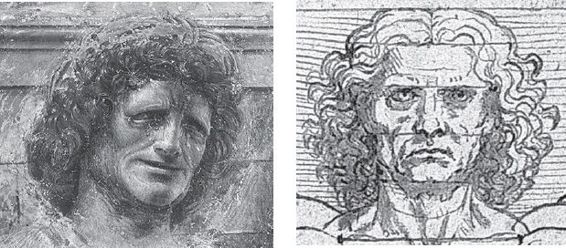
Two possible images of Leonardo in Milan. The philosopher Heraclitus, from a fresco by Donato Bramante (left), and the face of the Vitruvian Man.
There are further pointers to this identification. First, it has been noticed that the manuscript book on the desk in front of Heraclitus is written from right to left: the initial capital of the text is clearly shown at the top right-hand side of the page. Second, the depiction of the philosophers accords precisely with Leonardo’s own instructions in the Trattato della pittura: ‘He who sheds tears raises his eyebrows at their juncture and draws them together, producing wrinkles between and above them, and the corners of his mouth are turned down; but he who laughs has the corners of his mouth turned up, and his brows are open and relaxed.’126 It is also notable that in a later Milanese painting of Heraclitus and Democritus, attributed to Lomazzo, Heraclitus is almost certainly an image of Leonardo according to the later template of the long-bearded sage, suggesting a connection in Lomazzo’s mind which the Bramante fresco may have created.
Take away the tears and the wrinkled, sunken eyes – Heraclitan attributes of sorrow – and we see here a fresco portrait of Leonardo da Vinci painted by one of his closest friends (above). It shows him in his mid-forties, with long, dark curling hair, a fur-trimmed gown, and long-fingered hands elegantly laced together. It is one of only two images of Leonardo that remain from these years in Milan, the other being the ‘Vitruvian Man’ of c. 1490, whose face bears a strong similarity to Heraclitus.