

Part Six
Motion is the cause of all life.
Paris MS H, fol. 141r
Leonardo’s first port of call was Mantua, and the court of the young marchioness, Isabella d’Este. He had doubtless met her already in Milan: she was there in 1491, at the wedding of her sister Beatrice to Ludovico, and again in early 1495, when news came of the French victory over Naples – a matter that touched her more nearly because her husband, Francesco Gonzaga, was among those fighting the French. She knew of Leonardo’s portrait of Cecilia Gallerani, which she had had sent to her so she could compare it with portraits by the Venetian maestro Giovanni Bellini; and she knew of Leonardo’s musical protégé Atalante Migliorotti, whom she had summoned to Mantua in 1490 to sing the title role in a performance of Poliziano’s Orfeo. In short, she and Leonardo wereau courant, though whether there was much personal rapport between them is another matter.
Isabella d’Este was strong-willed, ferociously cultivated, and very rich. Though only in her mid-twenties, she ruled her court like an imperious maîtresse of a Parisian salon. The d’Este of Ferrara were one of the oldest and most illustrious families in Italy; their fiefdom included Modena, Ancona and Reggio. (There was also a German branch, founded in the late eleventh century, from which are descended the Este-Guelph houses of Brunswick and Hanover, and thence the British royal family.) Isabella was sixteen when, in January 1491, she married Francesco Gonzaga II, Marquis of Mantua, in a diplomatic triple-move of which the other parts were the marriages of her sister to Ludovico and of her brother to Ludovico’s niece Anna. The Gonzaga had been sworn enemies of the Visconti of Milan, but through the marriages of these eligible sisters the Sforza and the Gonzaga were now allies to one another and to Ferrara.
Isabella arrived in Mantua in style, sailing in an aquatic fantasia down the Po and entering the small, elegant fortress-city in a triumphal carriage, her possessions spilling out of thirteen painted marriage-chests. She swiftly became an icon of this era of conspicuous consumption, an avid and sometimes unscrupulous collector of precious and pretty things. She spoke petulantly of her sister’s fortune – the Sforza were even richer than the Gonzaga, but Beatrice was not a collector. ‘Would to God that we who spend willingly should have so much,’ Isabella said. She built on the Gonzaga collection of gems, cameos and intaglios – small, portable assets which were popular collectables – but in the later 1490s her letters show a broadening of interest. ‘You know how hungry we are for antiquities,’ she writes to her agent in Rome in 1499. And ‘We are now interested in owning some figurines and heads, in bronze and marble.’1 These antiques and figurines were for the display-rooms she was creating in the Gonzaga castle – her famousstudiolo and its companion room, the grotta. She began to commission paintings – her interest in Bellini and Leonardo, as evinced in her letter to Cecilia Gallerani, was part of this. Eventually the studiolo was decorated with nine large pictures: elaborate allegories specified by Isabella herself. Two were by the veteran Mantuan court artist Andrea Mantegna, two by Lorenzo Costa of Ferrara, and one by Leonardo’s old stablemate Perugino; but none, despite her efforts, was by Leonardo.
Isabella was a woman of high intelligence and discernment. She was a patron of poets and musicians, and was an accomplished lutenist herself; the light amorous love-song known as the frottola was a speciality of her soirées. But she was above all a collector, her enthusiasm tending to obsessiveness. Among her possessions when she died in 1539 were 1,241 coins and medals; 72 vases, flasks and cups, of which 55 were of pietre dure (agate, jasper, etc.); some 70 statues and statuettes in bronze, marble and pietre dure, and 13 portrait busts; watches, inlaid boxes, pieces of coral, an astrolabe, a ‘unicorn horn’, and a fish’s tooth ‘three palms long’.2
Leonardo’s half-length portrait drawing of Isabella, now in the Louvre, was almost certainly done in the winter of 1499–1500, while he was her guest at Mantua. One may call it his meal-ticket. It is a finished drawing done in black chalk, red chalk and yellow pastel. It has apparently been cropped at the bottom: an anonymous sixteenth-century copy (Christ Church, Oxford), which is close to the original in every other respect, shows that her hands are resting on a parapet, and that the extended index-finger of her right hand is pointing at a book which is also on the parapet. The drawing’s large format suggests a preparatory cartoon for a painting, so do the perforations around the outline of the image, for transferring it on to the panel. Leonardo never delivered a painted portrait to her, though there is evidence that he started on one – of this lost work, more later.
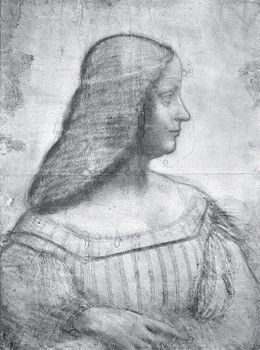
Isabella d’Este by Leonardo, 1500
The drawing presents a subtle contrast between the sweetness of the modelling and the intimated wilfulness in the profile. We see an aristocratic young woman complacent in the knowledge that her wishes will be satisfied by those – the portraitist, for instance – who are paid to satisfy them. The face is a little plump and a little ‘spoilt’: she might be given to pettishness; she might stamp her foot when vexed, or giggle when pleased. That Isabella was a princess of caprices we know from other sources. When her lapdog Aura died in 1512 she called for tributes – and got them, in both Latin and Italian. Machiavelli, a Florentine envoy in Mantua, noted testily that she got up late and received no official visitors before midday. The full profile – the ‘numismatic’ style of coins and medals – presents her in a noble, authoritative mode. The portrait shows both how she wanted to be seen and how Leonardo actually saw her, and so contains an ironic subtext about the expedient flatteries of the artist in need of protection in these difficult days.
Leonardo did not stay long in Mantua. He continued on to Venice, probably in February 1500. He was certainly there by mid-March, when he was visited by Lorenzo Guznago. A Ferrarese musician and instrument-maker now resident in Venice, Guznago had previously been at the Sforza court in Milan, and so probably knew Leonardo personally. On 13 March he wrote a letter to Isabella which included the following: ‘Also here in Venice is Leonardo da Vinci, who has shown me the portrait of Your Ladyship, which is very true to nature and beautifully done. It couldn’t possibly be better.’ Behind the curtain of bland superlatives one discerns Leonardo in his lodgings in Venice; and beside him on the easel a portrait of Isabella d’Este. Guznago describes it as a ritratto, which almost certainly means a painting rather than a drawing. (Ritratto can also mean a copy, and in that sense can be a drawing, but this cannot be the meaning of the word here.) This painting may not be finished, but it is substantive enough to be praised as very lifelike and ‘beautifully done’.3
This lost portrait of Isabella d’Este is of particular interest because it probably contained the first painted version of the hands of the Mona Lisa. The crossed hands of the cartoon – only partially present in the Louvre drawing, but reconstructable from the Christ Church copy (Plate 20) – are almost identical to those more famous hands: the fingers of the right hand and their light placing on the left forearm, which in turn rests flat on a solid surface (the parapet in the drawing, the arm of a chair in the Mona Lisa). Other anticipations of the Mona Lisa are discernible in the drawing. Isabella’s hair is not quite distinct, but its shape – its lack of free fall – suggests that it is covered, as is Mona Lisa’s, with a thin gauzy veil. And the bust is strongly suggestive of the Mona Lisa – the cut of the dress, the first faint indentation of cleavage, the position of the left shoulder – though of course in the Mona Lisa the sitter is turned slightly to her right (or to the left of the picture) while the bust of Isabella is turned to her left. This discrepancy can be removed by looking at the back of the Louvre drawing, where the figure of Isabella shows through in reverse (Plate 21). The image is extraordinary: a ghostly Mona Lisa hovers on the paper (though this is partly the result of staining, which obscures the profile of the face, so that the figure seems to have turned towards us).
There are many mysteries about the Mona Lisa, but here it seems we have something approaching a fact, which is that certain particulars of her pose and her appearance first appear in a portrait that Leonardo drew, and apparently began painting, in the first months of the year 1500.
Of Leonardo’s brief sojourn in Venice – his first as far as we know – there are some small but interesting remains. On a much folded, much corrected sheet in the Codex Atlanticus is the draft of a report to the ‘illustrissimi signori’ of the Venetian Senate concerning the possibilities of fortifying the Isonzo river (in the Friuli region north-east of Venice) against the threat of Turkish invasion. This appears to be an official commission. His visit to the area probably took place in early March, before a meeting of the Senate on 13 March at which they nominated certain ‘engineers’ to be sent to the Friuli.4 The folds of the paper suggest that the sheet was carried in Leonardo’s pocket, out in the field. A sketch in red chalk captioned ‘Ponte de Goritia’ and ‘alta vilpagho’ records his presence on the Wippach river near Gorizia. Another location is identified by a later note about the transport of artillery, which should be done ‘in the way I suggested at Gradisca in the Friuli.5
He affects a clipped, reportorial style: ‘I have carefully examined the conditions of the Isonzo river…’ He records the height of the floodwaters. He talks to the locals – ‘from the country people I have learned that…’ He comments dourly about the force of water being too powerful for man-made structures to resist. Some of his recommendations seem to have been put into practice, for in a late note in the Codex Arundel, referring to the French palace at Romorantin, he writes, ‘Let the sluice be movable, like the one I set up in Friuli.’6
Another rather different technology interested him in Venice – printing. The city was at the forefront of the new technology of copper-plate engraving, in which the image was etched with corrosive acid (aqua fortis, or strong water) on a sheet of copper. The technique was still at an experimental stage, but Leonardo no doubt understood its potential for the reproduction of his technical drawings. The copper etching had a finesse of line not approachable by the traditional woodcut. It was probably during his stay in 1500 that the ‘academy’ designs were engraved and printed; six early exemplars survive in the Biblioteca Ambrosiana in Milan. Despite this interest, Leonardo remained snobbish about the superiority of the unique painting over the multiple reproductions of print: ‘Painting does not produce endless children as printed books do; she alone is unique, and never gave birth to children who are exactly like her, and this singularity makes her more excellent than those that are published everywhere.’7
Of other artistic activities we know little. It is probable he met the new young maestro of Venetian painting, Giorgio da Castelfranco, known to the Venetians as Zorzi and to us today as Giorgione – ‘Big George’. Leonardo deeply influenced his work. A painting like The Tempest (c. 1508) is a tribute to Leonardo’s sense of colour and light, his sfumato technique, his dramatic momentary quality. Leonardo’s brief stay in the city in 1500 is a particular moment of interchange within this more general influence.
In mid-April 1500 news reached Venice from Milan. There had been a brief resurgence of Sforza fortunes in early February, when loyalist troops under Ascanio Sforza and Galeazzo Sanseverino re-entered the city. But the Moor’s bruited return was halted at Novara, and on 10 April his army of Swiss mercenaries was put to flight, and he himself was captured, ignominiously disguised as a servant. By 15 April Milan was back under French control.
On the inside cover of his pocket-book, Paris MS L, Leonardo jots down a brusque digest of this latest turn of events – the staccato sentences seeming to record this news almost as he hears it:
The governor of the castle made prisoner.
Bissconte [i.e. Visconti] dragged away and then his son killed.
Gian della Rosa robbed of his money.
Borgonzo began then changed his mind and so ran away from fortune.
The Duke lost his state, and his goods, and his freedom, and none of his works was completed.
Some commentators have dated this to September 1499 – the first incursion of the French – but that the Duke has ‘lost… his freedom’ clearly refers to the capture of Ludovico at Novara. The imprisoned castellano is the French governor, who had surrendered the castle to the Milanese in February and was imprisoned when the French recaptured the city on 15 April. Gian della Rosa is probably the Moor’s physician and astrologer Giovanni da Rosate, and Borgonzo is the courtier Bergonzio Botta. Leonardo does not mention the more dramatic fate of his friend the architect Giacomo Andrea. He was imprisoned by the French as a pro-Sforza conspirator, and despite influential pleas, was beheaded and quartered at the castle on 12 May. One infers that this had not yet happened when Leonardo wrote this note.
It was indeed true that the Moor had lost his freedom. He was taken to France and imprisoned at Loches, in the Touraine, and there he remained until his death, half-mad from captivity, eight years later. That ‘none of his works was completed’ is at once a reflection on the mutability of political fortunes and a more personal underlining of the abandonment of the Sforza Horse. Later he would learn of the vandalizing of the clay model of the Horse by French archers, as recorded by the chronicler Sabba Castiglione. ‘I remember,’ wrote Castiglione nearly fifty years later, ‘and with sadness and anger I say it now, this noble and ingenious work being used as a target by Gascon crossbowmen.’8
If Leonardo had been intending to return to Milan, these latest upheavals probably convinced him otherwise. Imprisonments, confiscations, murders. Sometime soon after 15 April he scribbles down these dire bits of news on a notebook cover. By 24 April he is in Florence.