
Just out of Vinci, on the right-hand side of the road leading north towards Pistoia, is a large stone house called Il Molino della Doccia. It is now a private house, but within living memory it was still a working olive-mill or frantoio, and it was certainly known as such to Leonardo, who captioned a swift but precise sketch of an olive-press with the words ‘Molino della Doccia di Vinci’. He drew this in about 1504 or 1505, presumably on a visit back home.33 It belongs to the same period as his note about the kite, and perhaps it too contains an element of reminiscence. Standing there in the Molino della Doccia he is surrounded by the sights and smells of his childhood.
Leonardo was a country boy. He grew up, broadly speaking, on the farm – whether at his stepfather’s smallholding at Campo Zeppi or his grandfather’s modest estates around Vinci – and he was immersed from his earliest years in the world of agricultural production: of ploughing and ditching, of planting and harvesting, of orchards and grain-fields and vineyards and olive-groves. Even more than wine, olive-oil was the typical, identifying product of the Tuscan hill-country. Besides its culinary virtues, the oil was used as fuel for lamps, as a lubricant, as a medicine or ointment, and for various other practical purposes. In Vinci and a thousand places like it the olive-harvest was an affair which involved the whole community; it still has a special place in Tuscan village life. An old country jingle announces that the olives are ready by early October – ‘Per Santa Reparata [8 October] l’oliva è oliata’ – but in fact the harvest is an event straggling over several weeks between October and early December. The fruit was beaten down with long sticks, typically a stem of the cane-grass Phragmites communis, which grows in profusion along the rivers. One of Leonardo’s ‘prophecies’ contains an image of the olive-harvest: ‘There will pour down from the direction of the sky that which gives us food and light.’ The answer to this riddle is ‘olives falling from the olive-trees’.34 Gathered up in baskets, the fruit was taken to olive-mills like the Molino della Doccia to be ground and pressed. Today’s olive-mills tend to be powered by electricity rather than by water or animals, but some still use the basic system of stone-milling and torque-pressing employed in Leonardo’s day. The frantoio’s humid aromatic air, the slithery floor, the pitchers of cloudy greenish oil, the prized olio nuovo – all these are unchanged.
Next to Leonardo’s sketch of the olive-press at the Molino della Doccia, and clearly inspired by it, is a more complicated mechanism which he captions, ‘Da macinare colon ad acqua’ – ‘For grinding colours by means of water’. This reminds us that the painter too worked with the fruits and products of the land. The colours he used came from plants, barks, earths and minerals, which needed to be milled and ground to turn them into usable powdered pigment. There are frequent references to studio apprentices having the job of ‘grinding colours’, usually with a pestle and mortar. The device sketched out on this sheet is designed to mechanize this task.35
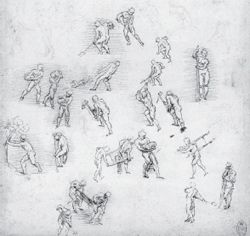
Agricultural labour, from a sheet of drawings of c. 1506–8.

Machine for grinding colours inspired by the Vinci olive-press.
There is a connection here between the processing of olives in the olive-mill and the processing of paints in the artist’s workshop. The connection is even closer when one remembers that Leonardo was pre-eminently a painter in oils. The oils most frequently used for painting were linseed and walnut: Leonardo experimented throughout his life with different mixes – adding various kinds of turpentine, crushed mustard seed, and so on – but these were the staples. Both were produced in the same way, and using the same kind of machinery, as olive-oil (which was not generally used for painting because it was too thick). A note in the Codex Atlanticus suggests his personal involvement in the pressing of walnut oil: ‘Walnuts are surrounded by a thick rind like a skin, and if you do not remove it when you make oil from them, this skin tinges the oil, and when you work with it the skin separates and comes to the surface of a picture, and this is what makes it change [i.e. discolour].’36
There are other drawings of olive-presses in his notebooks, and they may well belong within this context of producing oil for painting. A horse-drawn mechanism described as a ‘press for olives and nuts’ is closely analysed in one of the Madrid notebooks. The specifications for this are very precise: ‘The iron piece marked a is one finger wide,’ and ‘The bag which holds the nuts or olives is of thick wool, woven like the saddle-girth of a mule.’37
There is a continuity here from childhood. The olive-mills of Vinci are a kind of prototype of the artist’s workshop: the grinding and pressing, the pungent smell of fresh oils.
Another rural activity that Leonardo would undoubtedly have seen as a child was the weaving of wickerwork baskets out of shoots of osier. This was a speciality of the region, in which the osier willow (Salix viminalis) abounds. It is in fact connected with the very name of Vinci, and so had a special appeal for Leonardo.
In the days and afterdays of his fame Leonardo was addressed in many epigrams and epigraphs, and almost without fail they throw in a pun on Vinci and vincere, to conquer. In fact the origin of the name has nothing to do with conquest: it comes precisely from an old Italian word for the osier, vinco (Latin vincus). And the Vincio river which flows past Vinci is obviously ‘the river where osiers grow’. The word derives from the Latin vinculus, a bond (the osier shoot being much used for binding), and is found in Italian literature describing metaphorical types of bonds and bindings, as in Dante’s ‘sweet bonds’ (dolci vinci) of love.38 To pursue the etymology for a moment, the Latin vincus is connected to the old Norse word for an osier, viker, from which comes the English ‘wicker’, as in wickerwork, and also ‘weak’, which has a root-meaning of pliability. Thus, curiously, the Vinci word-game that begins with the idea of vanquishing arrives at weakness and pliability.
Leonardo took this local craft of wickerwork and made it his personal emblem, one might almost say his ‘logo’. There exists a series of engravings based on his designs, probably done in Venice shortly after 1500, which feature complex interwoven patterns, and in the middle the words ‘Academia Leonardi Vinci’. The play on vinci = osiers is undoubtedly intentional. The courtier and poet Niccolò da Correggio is known to have devised a ‘fantasia dei vinci’ – presumably a knot-design of some sort – for the Marchioness of Mantua, Isabella d’Este, in 1492.39 Leonardo doubtless found the pun on his own name irresistible, and perhaps part of its appeal was that it also contained a memory of the osier-weavers he had seen in his childhood around Vinci. The weaving was accounted woman’s work, and it is not unlikely that Caterina practised it, and so Leonardo’s knot-patterns would retrace on paper the mesmeric movements of his mother’s hands as she plaited the soaked shoots of osier into baskets. He was already producing this sort of design during his Florentine years, for in a list of his drawings written in about 1482 he mentions ‘molti disegni di groppi’ (‘many drawings of knots’). These were doubtless knot-patterns of the sort later exemplified by the Venice engravings: Vasari specifically uses the word groppo when talking about those engravings.40 These elaborate entwinings and intricacies are also found in decorative patterns on the dresses of the Mona Lisa and the Lady with an Ermine, in braidings of hair and purlings of water, and in the interwoven foliage of his frescos in the Sala delle Asse in Milan. Giovanni Paolo Lomazzo refers to the latter when he writes, ‘In the trees we find a beautiful invention by Leonardo, who makes all the branches form into various bizarre knot-patterns.’41Lomazzo seems to have understood the basic connection when he uses the verb canestrare to describe the creation of these knot-patterns: this means precisely ‘to weave like a basket [canestra]’.


Interweavings. Knot-design for Leonardo’s ‘academy’ (above), and braided hair in a study for the head of Leda.
Thus etymologically ‘Vinci’ leads, in a characteristic Leonardian way, away from the military machismo of vincere, as symbolized by the town’s fortress of Castello Guidi, to the ambivalent, circuitous, non-achieving form of the interwoven vinci – a fantasia, a visual riddle, a question which never reaches an answer.