
When I thought I was learning to live I was also learning to die.
Codex Atlanticus, fol. 252r-a
At Clos Lucé on Saturday 23 April 1519, the day before Easter, Leonardo da Vinci, ‘painter to the King’, drew up his will in the presence of the royal notary, Guillaume Borian, and seven witnesses: Francesco Melzi, Battista de Vilanis, two French priests and three Franciscan friars.88 Conspicuously missing from the list of witnesses is Salai. His absence from Amboise is confirmed by other documents, which locate him in Paris on 5 March and again on 16 May. On both occasions he met there with one Giovanni Battista Confalonieri, an agent of Massimiliano Sforza, Duke of Milan. On the second occasion he received a payment of 100 scudi, paid to him on behalf of the Duke, and the promise of a further 500 over the next four years. What sort of services was Salai offering in return? One possibility is that he was being paid to supply political information gleaned from his proximity to King François at Amboise – a last disreputable twist to his long and often ambivalent relationship with Leonardo.89
In the will Leonardo gives instructions for his burial in the church of St Florentin at Amboise; for the procession that will accompany his body ‘from the said place to the said church’; for the saying of three high masses and thirty low masses in his memory; for the distribution of 40 pounds of wax in thick candles to be placed in the churches where the masses were celebrated; and for the funeral itself, with ‘sixty tapers to be carried by sixty poor men who shall be given money for carrying them’.
The bequests of the will are as follows:
· To Messer Francesco da Melzo, gentleman of Milan, each and all of the books the Testator is at present possessed of; and the instruments and portraits appertaining to his art and calling as a painter… and the remainder of his pension, and all sums of money which are owing to him from the past until the day of his death; and each and all of his clothes which he now possesses at the said place of Cloux
· To Battista de Vilanis his servant, one half of his garden outside the walls of Milan… and the right of water which King Louis XII of pious memory gave to the said da Vinci, being the stream of the Naviglio di Santo Cristoforo; and each and all of the furnishing and utensils of his house at the said place of Cloux
· To Salai his servant, the other half of the same garden, in which garden the same Salai has built and constructed a house which shall be and remain henceforth the property of Salai
· To Maturina his serving woman, a cloak of good black cloth lined with fur, and a length of cloth, and a single payment of two ducats
· To his brothers now living in Florence, the sum of four hundred scudi which he has deposited with the treasurer of Santa Maria Nuova in the city of Florence, with all the interest and usufruct that may have accrued up to the present time
The apportioning is somehow elegant: to Melzi the unparalleled intellectual inheritance of his writings and paintings; to Salai and Battista property; to Mathurine a fur coat; and to the da Vinci brothers cash.90
The Florentines called it ‘entering the great sea’. Did Leonardo embark on this last journey philosophically, in the equanimity of pious resignation? His writings suggest not.
O slumberer, what is sleep? Sleep is the semblance of death. O why then do you not create such works that after your death will make you seem perfectly alive, instead of sleeping while you are alive and making yourself seem like the sad dead…
Every hurt leaves a displeasure in the memory, except for the supreme hurt, which is death, which kills the memory together with life…
The soul desires to remain with its body, because without the physical instruments of that body it can do nothing and feel nothing.91
Sleeping, forgetting, feeling nothing: these are images of death consonant with the essentially Aristotelian materialism of the Renaissance scientist. Of the resurrection and the life to come we hear nothing. And when Leonardo does write of the divinity of the soul it is still to maintain that it must ‘dwell in its works’ – the material world, the body – in order to be ‘at ease’: ‘Whatever it is, the soul is a divine thing, therefore leave it to dwell in its works, and be at ease there… for it takes its leave of the body very unwillingly, and indeed I believe that its grief and pain are not without cause.’ This is from an anatomical folio of c. 1510, where he writes exaltedly of anatomy as ‘this labour of mine’ wherein are discernible ‘the marvellous works of Nature’.92 Physical life is the soul’s habitat, death its eviction; it leaves ‘very unwillingly’, and does not seem headed for a home on high. Vasari engineers a deathbed repentance for Leonardo which sounds less than convincing: ‘Feeling he was near to death he earnestly resolved to learn the doctrines of the Catholic faith and of the good and holy Catholic religion, and then, lamenting bitterly, he confessed and repented, and though he could not stand up, supported by his friends and servants he received the blessed sacrament from his bed.’ It could be true, though this late conversion to the Faith sounds like something wished more by Vasari than by Leonardo. More convincing is Vasari’s further comment that Leonardo ‘protested that he had offended God and mankind by not working harder at his art, as he should have done’. It was not sin and hellfire he feared, but the dreadful weight of that last ‘etcetera’, and the empty grey paper beneath it – all that had not been completed.
He died on 2 May 1519, at the age of sixty-seven. According to Vasari, our only source, King François was present, and cradled him in his arms. As the final seizure came – ‘a paroxysm, messenger of death’ – the King ‘held his head up, to help him and bring him comfort’. It is an affecting image – if one detaches it from a pair of thoroughly over-egged French paintings on the subject, done in the early nineteenth century – but it has since been discovered that on 3 May, the day after Leonardo’s death, a royal edict was issued at Saint-Germain-en-Laye. As it took two days on horseback to travel there from Amboise, King François could not have been at Leonardo’s side on 2 May and at Saint-Germain on the 3rd. The veracity of Vasari’s account now hinges on the unresolved question of whether or not this edict – boldly inscribed ‘Par le Roy’, but not actually signed by him – required the King’s presence in Saint-Germain.93 Though ‘duly considering the certainty of death’, as the incipit of his will puts it, Leonardo departs on this characteristic note of uncertainty, and, in the absence of any known last words, the troublesome quirk of the Saint-Germain edict reminds us of his profound conviction that everything must be doubted, and tested, before it is held to be true.
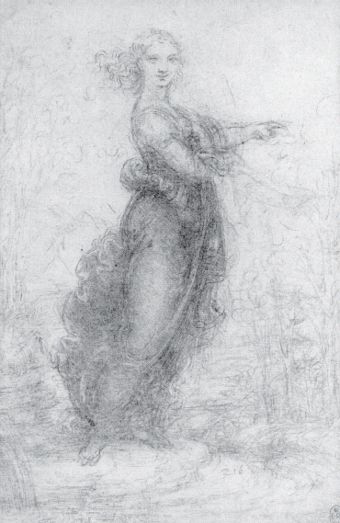
The Pointing Lady.
Vasari concludes, ‘All those who knew him grieved without measure the loss of Leonardo,’ at which point I forget about the King altogether, and see Francesco Melzi by the bedside in tears. It was not until 1 June that Melzi wrote to the half-brothers in Florence with news of the death. ‘He was like the best of fathers to me,’ he wrote. ‘As long as I have breath in my body I shall feel the sadness, for all time. He gave me every day the proofs of his most passionate and ardent affection.’94 Melzi, this young man of whom we know so little, repaid that affection: as the assiduous guardian and editor of that ‘infinity’ of writings and drawings which – perhaps even more than the paintings – take us directly into the life of Leonardo, as if they are themselves a kind of memory, cluttered with fragmentary records of the travails of his days, the secrets of his dreams, the flights of his mind.
His bodily remains fared less well than this metaphysical cargo of memories, dreams and reflections. There must have been a provisional interment in May, for the substantial funeral envisaged in the will did not take place for over three months; the burial certificate in the register of the royal collegiate church of St Florentin is dated 12 August 1519. The church suffered during the French Revolution, and in 1802 was deemed to be past saving. It was demolished, and the stones and leads – including those in the graveyard – were used for repairing the chateau. It is said that the gardener of the church, one Goujon, took up all the scattered bones and buried them in a corner of the courtyard, Leonardo’s perhaps among them.
In 1863 the poet and Leonardiste Arsène Houssaye excavated the site of St Florentin; among the shards he found fragments of a tomb-slab inscription (‘EO [… ] DUS VINC’) and one nearly whole skeleton whose remarkable skull-size immediately convinced him he had found the remains of Leonardo. ‘We have never before seen a head so magnificently designed by or for intelligence,’ he wrote. ‘After three and a half centuries, death had not yet been able to reduce the pride of this majestic head.’95 These bones now lie buried in the chapel of St Hubert, within the precincts of the chateau, beneath a plaque set up by the Comte de Paris. Their only connection with Leonardo, however, is the dubious phrenological deduction of Houssaye.
It is just possible that the capacious skull interred at St Hubert once housed the mind of Leonardo da Vinci, but one certainty, at least, is that it does so no longer. The cage is empty; the mind has flown.