

The value and rank of every art is in proportion to the mental labour employed in it, or the mental pleasure produced by it. As this principle is observed or neglected, our profession becomes either a liberal art, or a mechanical trade.
—Sir Joshua Reynolds, “Fourth Discourse on Art” (1771)
We are a people essentially active. I may say we are preeminently so. Distance and difficulties are less to us than any people on earth. Our schemes and prospects extend every where and to every thing.
—John C. Calhoun, speech in the U.S. Senate, June 24, 1812
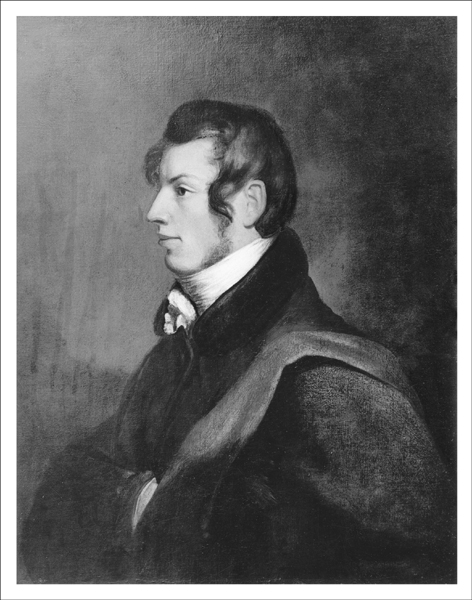
Samuel F. B. Morse, Self Portrait (1812-13) (Addison Gallery of American Art)
ONE
ON APRIL 30, 1789, Jedediah Morse was installed as pastor of the First Congregational Church of Charlestown, Massachusetts. The occasion was triply significant to him. Twenty-seven years old, he had come to his vocation by study at Yale and graduate work in theology. He felt eager to promote the interests of religion but awed to contemplate the degenerate state of his fellow mortals, who every day crucified their Redeemer anew. The labor now to be undertaken by him was worthy but daunting, “a good work,” he said, “but alas who is sufficient for these things.”
The place mattered to Jedediah no less than the occasion. The First Church was one of the oldest in America, a fit pulpit for a man whose ancestors had emigrated to the New World in 1635, among the first settlers of Puritan New England. The church stood, too, in the shadow of Bunker’s Hill. Just fourteen years earlier, armed provincials had defended the hill against three assaults by British infantry and marines.
And for Jedediah, the date was no less symbolic than the place. On the same day, on the balcony of New York City’s Federal Hall, George Washington was inaugurated as the first President of the United States and called on the new nation to preserve “the sacred fire of liberty.” Jedediah revered him as an epitome of republican virtue—self-sacrificing, pious, restrained, great because he was good, indeed, Jedediah said, “the greatest Man alive.”
Two weeks after the momentous day of his settlement, Jedediah married twenty-three-year-old Elizabeth Finley, a granddaughter of the president of Princeton College. In appearance they were unlike, to judge from a later family portrait: Jedediah tall, slender, old-fashioned-looking in his knee breeches and black silk stockings; Elizabeth stoutish, buxom, jowly—“no dwarf,” she said of herself. Their personalities differed, too. Jedediah’s well-bred manner and sweet voice set him off from his wife’s no-nonsense practicality and tart wit. Just the same they made a close, affectionate couple. In letters home he addressed her as “My dearest Life & Love.” He borrowed the salutation, he explained, from a letter of George Washington to Martha Washington: “as he is an excellent pattern in almost everything, so in this I would imitate him, believing that my Love for you is as great as his for Mrs. W.”
On April 27, 1791, two years after marrying, the couple had their first child, a son whom they named after Elizabeth’s father and grandfather: Samuel Finley Breese Morse. Finley, as the family called him, spent his first seven years in the parsonage, a two-story wooden building near the First Church. The household included a pious Baptist servant-nurse, Nancy Shepherd. For a time, a black boy named Abraham also lived with the family, tending the horse and cow. Jedediah ministered to the black population of nearby Boston and publicly condemned the slave trade as inconsistent with republican principles.
Few details of Finley’s early childhood remain. When about a year and a half old he contracted smallpox during an epidemic that struck a thousand people in Boston. At the age of four he began attending a dame school near the parsonage. Nancy Shepherd sometimes took him to Bunker’s Hill and recounted its historic battle, which she had witnessed.
During the first ten years of their marriage Jedediah and Elizabeth had six more children. Only two survived, Finley’s younger brothers Richard and Sidney. In the same period Jedediah became a national figure. While writing sermons and preaching about mankind’s fallen state, he issued atlases, school texts, and travel guides with such titles as The American Universal Geography (1793) and The American Gazeteer (1797). He put the books to press, arranged for British editions, looked after sales and distribution, each year publishing a new geography or revision of some earlier one.
Jedediah’s geographies became second in popularity only to Noah Webster’s spelling books and the Bible. Producing them put him in touch with notable men at home and abroad. He dined in Philadelphia with Benjamin Franklin and at Mount Vernon with George and Martha Washington. His many, far-flung correspondents included John Adams; the Bishop of London; and the French foreign minister, Talleyrand, who also visited him in Charlestown. His publications brought him an honorary degree from the University of Edinburgh and fame as America’s pre-eminent geographer. He did not hide his renown. On the title page of American Universal Geography he identified himself as a Doctor of Divinity, Fellow of the American Antiquarian Society, and Fellow of the Historical Society—as “Jedediah Morse, D.D.F.A.A.S.H.S.”
Jedediah became prominent in political life as well. Like the rest of the Congregationalist clergy he allied himself with the Federalist party. Against the more liberal, capitalistic social order taking shape in the wake of the American Revolution, he upheld the Calvinistic faith of his New England forebears, whose piety and sense of human dependence on God he considered essential to republican life. He hoped that the new United States would be left to itself, “kept out of the Whirlpool of European Politicks.” But there was no insulating the country from the long war for supremacy between Great Britain and Napoleon’s France. As the eighteenth century closed, Jedediah like most other Federalists viewed with growing alarm French interference in American affairs: use of American seaports as bases for privateering, attempted bribes to American envoys, manipulation of the American press—especially the export to America of deism, skepticism, Voltairean atheism, and other forms of French Infidelity.
Such ominous political-religious issues brought out a combative side of Jedediah’s personality, at odds with his usual mildness. He fought the French Antichrist from his historic pulpit, raging against France as the “destroyer of nations” that had enslaved millions and now menaced the independence of the United States. He sermonized against all the other enemies of Christian Republicanism as well: Masons, Illuminists, Roman Catholics—the last being not Christians but idolators, with a libertine priesthood. All were leagued with the French Imperium, Jedediah warned, in trying to foment revolution in America and ultimately seize the country.
Jedediah’s fiery sermons had no political effect. As the new century opened he grimly watched the nation choose for its president the gallified Thomas Jefferson, a man unaccustomed to attending public worship, a professed Infidel: “Unhappy indeed must that Christian people be,” Jedediah reflected, “whose Chief Magistrate is an Atheist.” George Washington had mercifully not lived to see it all: “Ever since his death the clouds seem to have been gathering for a storm.”
In 1799, as Jedediah thundered from his pulpit, Finley was sent from home for schooling. Now eight years old, he would spend most of the next decade living apart from his family. Jedediah enrolled him at Phillips Academy, in the isolated village of Andover, Massachusetts, some twenty miles from Charlestown. The well-regarded Academy had about sixty students. Its curriculum stressed classical languages, mathematics, and religious instruction suited to the sons of New England Congregationalists. The school’s Overseers included Jedediah himself.
Concerned above all with Finley’s growth in piety, Jedediah tried to board him with a prayerful family. He also wrote out a daily routine for his son to follow. It aimed at fashioning a Christian Gentleman—reverent, well mannered, and frugal, but aspiring to personal distinction:
1. Rise Early in the morning—read a chapter in the Bible, & say your prayers—Read the Bible in course. The Old Testament in the morning. The New Testament at night—
2. After a serious performance of these religious duties,—comb your head & wash your face, hands & mouth—in cold water, not hastily & slightly but thoroughly—
Next came instructions for Finley’s behavior at school:
3. Get your morning lesson well—Behave decently at breakfast. Go regularly & seasonably to the Academy—While there, in study hours, attend to your lesson, & get it thoroughly, & try to be the best scholar in your class.
4. In play hours, while at play, behave manly & honorably. Avoid every thing low, mean, indecent, or unfair—And endeavour to play in such a manner as that all may wish to have you on their side ….
“Take care to read your rules every day & observe them strictly,” Jedediah said.
Settled in the Academy’s preparatory school, Finley hastened to show his father that he understood and would obey. Probably only weeks after arriving in Andover, he sent home a scrawled reply: “I retire always by my self and say my prayers. I learn a hymn every sabbath.” Lest Finley forget his routine, Jedediah repeated the rules in nearly the same words week after week. And Elizabeth in her homelier voice repeated them, week after week: “make it your Daily business to obey your kind preceptors,” she wrote; “and above all things remember your duty to God pray to him Night and morning and read your chapter in the bible as often and do not read trifling books…. be as carefull of all your clothes as possible.” Jedediah directed Finley to fold the letters neatly after mastering their content, then tie them together and preserve them in his trunk.
The long-distance family discipline included detailed instructions to Finley on how, each week, he should respond: “You must write me long letters, & vary them as much as possible—avoid sameness,” Jedediah said. “Pay great attention to your handwriting.” His own letters could not be said to avoid sameness, and the hand was often crooked and blotchy. Nevertheless in letter after letter he insisted that his son reply pleasingly and by rule: “Avoid vulgar phrases…. Hold your pen properly and keep your elbow & arm in a right position…. Conclude your Letters in this way ‘I am your affectionate & obedient Son S. F. B. Morse.’ ”
The letters Finley received from home often came with longdistance kisses and concerns for his health, gifts of raisins or cake. But mostly they told him what to do and feel and think. At first, the all-seeing discipline did not take. He failed to write back. He got demerits in spelling and for whispering. A tutor reported that he had been idle and untruthful, and had ended up at the bottom of his class. “What a character, my son,” Jedediah moaned to him; “if you persevere in this conduct, you will fill our hearts with sorrow.” The sorrow was paternal but also personal, for Jedediah expected his children to reflect well on himself. He punished the boy by threatening to keep him at Andover during school vacations. Visits home were an “indulgence,” he said, to be granted only when Finley proved “peculiarly attentive to his studies.”
Jedediah rarely if ever enforced such threats, and Finley did often return to Charlestown at vacation times. But affairs at home were troubled. Angry party divisions had developed in the continued turmoil over American relations with France and England. Federalists and Jeffersonian Republicans held separate Independence Day ceremonies in Charlestown, both claiming to be the true heirs of the American Revolution. Jedediah’s affairs were troubled by more than politics. In many ways he enjoyed his situation in the First Church—a pleasant house and garden rent-free, just a mile from Boston. But the salary of only $ 11 a week was inadequate to support him and his family, and the congregation refused him a raise. “They are a people of a very peculiar character,” he complained. The congregation complained, too. As new editions of Jedediah’s geographical works appeared, they objected to the time he devoted to them and his frequent travel away from Charlestown to gather information. Their griping so wounded his feelings, and parish affairs became so disorganized, that he found it difficult to faithfully discharge his ministry. He seriously thought of leaving the place.
And Jedediah and Elizabeth lost another child, their fifth—a boy named Russell who died after a siege of dysentery. Finley learned of the event through a tutor at the Academy, who drew out for him the lesson: “Remember that good children only will hereafter meet in heaven to be forever happy. Earnestly endevour [sic] to be of that number that you may meet your little brother, and all good people in a better world.”
Once Finley left the Phillips preparatory school and entered the Academy proper his studies improved, some. Reading the Greek New Testament and the Aeneid, he sent home letters in Latin. Jedediah was pleased but, as usual, not entirely: “Write your Latin letters first on a piece of waste paper & shew them to your preceptor, for correction, & then copy them & send them to me.” Another time, Finley sent him a three-page summary in English of Plutarch’s life of Demosthenes: “written very well for one of his age,” Jedediah conceded. “He omitted an important circumstance, however.”
And Finley’s improvement turned out to be temporary, or worse. He soon wrote home asking Jedediah’s permission to quit Greek and Latin, to study English instead. He could not remember the lessons, he said, and was often put back. Jedediah recommended greater application and perseverance: “All good scholars have found it laborious to acquire knowledge—the ‘hills of science, is [sic] represented as steep & of difficult ascent.’ ”
Of Finley’s improvement in piety there was less doubt. In the evenings he began reading about and summarizing the lives of Protestant martyrs, devout ministers who for their faith had been jailed, assassinated, burned at the stake. When his younger brothers Sidney and Richard entered the Academy, he read them religious works. Sometimes he adopted with them the godly manner of their pious elders. When Elizabeth again gave birth to a stillborn child—the sixth of her children to die—he told Sidney and Richard: “Now you have three brothers & three sisters in heaven, and I hope you & I will meet them there at our death. It is uncertain when we shall die, but we ought to be prepared for it.” He presented them a copy of The Christian Pilgrim.
While becoming more learned and pious, as his parents wished, Finley also began finding his own way. In taking drawing as one of his academic subjects, at about the age of eleven, he discovered a talent for art. He sent samples of his work to Charlestown. The much-published Jedediah had his own share of worldly gentility, and boasted about his son’s gift: “he is self taught—has had no instructions.” He encouraged the boy, but reminded him that art should be “your amusement merely,” and that his approval was not a given but a reward. He promised Finley a drawing book—“if I find when he comes home that he is improved & grown manly & genteel in his manners.” Another time he promised Finley a paint box—if he learned by heart and recited well an oration on George Washington.
Finley’s talent developed quickly. By the age of twelve he was creating miniatures—small portraits painted on slices of ivory. And his handwriting began taking on the copperplate elegance it would retain to the end of his long life.
In the fall of 1805 Finley entered Yale College. The choice was inevitable. Not only was the school a Congregationalist bastion, but Jedediah had also earned two degrees there, taught there, and befriended Yale’s president, Timothy Dwight. A famous Congregationalist minister himself, called by some “The Pope of Federalism,” Dwight, too, had vigorously preached and written against the French peril. Under his effective administration, Yale was growing from a local college into a national university.
Finley now learned something of what it meant to have “The Father of American Geography” for his father. When he stopped at an inn during his first trip to New Haven, the owner treated him with special kindness, “more like his own son than a stranger,” he wrote home, “wholly on account of my being your son.” Once he arrived at the school, President Dwight took a personal interest in him. And fellow students nicknamed him “Geography.”
But attending Yale also had drawbacks for Finley. From Charlestown to New Haven was 160 miles, thirty dusty hours of horseback, chaise, stagecoach, and overnight taverns. He would rarely get home to see his family. And he was fourteen and a half, while most entering students were about sixteen. Jedediah and Elizabeth feared his falling in with older boys who might corrupt him. So instead of enrolling him as a regular member of the freshman class they boarded him off campus in the family of a Yale instructor. There he would do freshman work but postpone his formal admission until the following year.
Finley felt belittled by the arrangement, as he let his parents know by again getting off to a bad start. During his first month in New Haven, Jedediah and Elizabeth received only one letter from him. “We are extremely anxious to hear from you,” Jedediah informed him; “Your Mama is distressed & almost sick with anxiety lest you are sick.”
When Finley at last wrote to his parents, he sent more for them to be anxious about. He protested that because he had not been regularly enrolled he had already fallen behind the other freshmen in his studies. Elizabeth was unconvinced: “I am fearful my son that you think a great deal more of your Amusements than your studies and there lies the difficulty and the same dificulty [sic] would exist were you in Colledge.” Finley’s letter also served notice that when he officially became a student he would want brandy, wine, and cigars for his room. “Pray is that a custom among the students,” Elizabeth wanted to know; “your papa & myself positively prohibit you the use of these things.” As if this were not enough, Finley also mentioned that he had gone out hunting, on a “gunning party.” Elizabeth, always worried about his health and safety, gasped: “Does the Government of Colledge allow the Students to go a guning?”
The question of Finley’s status at Yale became a family quarrel. In letter after letter he bemoaned his failure to progress in his studies. The regular scholars got through fifty lines of Homer daily while he did twenty-eight: “I fall behind my class every day; it makes me homesick & very unhappy.” Every student that he knew advised him to get a room at the college as soon as possible. But Jedediah insisted he was “well situated” and Elizabeth told him to stop whining: “determine to be happy just in the situation that providence has plac’d you in & think that your Friends know better than you can possibly which situation is best for you.”
Finley retaliated in his own way. His letters shrank to a half page of large script: “I am in great haste to study, therefore … excuse my brevity & bad writing.” He had a headache, he said. An earache, a stiff neck. After months of bickering, Jedediah agreed to let Finley enter the regular class, on three conditions. First, he would have to catch up on his studies; second, Elizabeth said, “no use of Segars or Brandy or Wine or any thing of the kind”; third, their young son would have to board with a private family off campus.
The last condition set off a new struggle, fought on Finley’s side with more lightly veiled threats. He lived so far from school, he now protested, that he could not hear the campus bell—causing him to miss prayers: “It is very necessary that I should room in college as soon as possible. I am absent from prayers and resitation [sic] very often.” Living off campus made it necessary for him to go on gunning parties, too: “I need some exercise. If I walk that is no amusement & if I wish to play ball or any thing else I have no one to play with.”
Around the fall of 1807, when he was sixteen, Finley did at last settle in his own room at the College. Again Jedediah and Elizabeth reminded him weekly of his fallen state and need to seek Christ. But they stressed more urgently than before the need to economize. Scrimping by on Jedediah’s thankless salary, and with two other sons to raise, they sent Finley hand-me-down slippers, patches for his shirts and coats: “be careful my son not to dirt [sic] more Clothes than is necesary [sic],” Elizabeth wrote; “Washing is so Dear put on two clean Shirts a week two Neck Cloths & one pair of stockings is enough.” Finley wanted to show that he understood: “You expend & have expended a great deal more money on me than I deserve,” he said, “& granted me a great many of my requests & I am sure I can certainly grant you one, that of being economical.”
But Finley found his promise hard to keep. He ran up a staggering bill of $43 at the College Buttery—the campus outlet for ice cream, port (“for my health,” he explained), and the cigars that he continued to smoke. Elizabeth rebuked his money-wasting and condemned the place as a hangout for “Idle Gluttons among the scholars.” She thought no better of Finley’s desire for a new, fashionable coat. His brown one for every day and blue one for the Sabbath sufficed, she said, “quite enough for any boy that is not a going to be an extravagant foolish fellow. You will remember that you have promised in your first letter to be an oeconomist.”
Finley knew that his letters home often sounded grasping and manipulative. He parodied one of them for his brothers’ amusement: “Please send me a pocketbook, please send me some Hale cider, please send me some kittens and young puppies. I now take this opportunity of writing to you to inform you that I am sick.” But in truth one could not live at the College without spending money, and it irked him to be scolded for having his ice skates sharpened: “I think every minute I shall recieve [sic] a letter from home blaming me for not being more economical & thus I am kept in distress all the time.”
Jedediah and Elizabeth prodded Finley to stay at the head of his class. Despite his lively intellect, however, his academic record was mediocre. One time or another he studied history, philosophy, English composition, Greek and French, geometry and trigonometry. But he failed to earn such college distinctions as a junior-class “Appointment” (“I am ‘disappointed,’ ” he kidded). When his brothers joined him at Yale, about halfway through his schooling, they both outshone him. Richard was chosen to deliver a commencement address; Sidney made Phi Beta Kappa.
Finley’s lusterless performance confirmed his parents’ suspicion that their son was flighty. His moods and desires shifted in an unmanly way. Now he wanted to change roommates, then to room by himself, another time to drop his studies and come home for a while. Elizabeth chided him for “driving on from one foolish Whim to another.” Jedediah made it clear that between a resolute and a restless spirit the difference was success in life or failure: “steady and undissipated attention to one object, is a sure mark of a superior genius,” he wrote to Finley; “cease your fondness for continual change. It is a bad habit & you must strive to break it or it will be ruinous to you. Resolve to be steady.”
But at Yale as before at the Academy Finley, found a way to what interested him. He was drawn to science. Scientific training at most American colleges was outdated and meagerly equipped with apparatus. Through President Dwight’s efforts to hire outstanding faculty, however, Yale’s science offering was superior to that of most other schools. Finley attended the chemistry classes of Professor Benjamin Silliman (1779–1864), who later organized the Yale Medical School. Silliman’s lectures included demonstrations of galvanic electricity, in which he explained the construction and operation of such current-producing devices as the Voltaic pile and the Cruikshank battery. Apparently fascinated by the subject, Finley spent one school vacation in the college’s “Philosophical Chamber,” assisting a tutor in electrical experiments. He also attended the demonstrations given by Jeremiah Day, Professor of Natural Philosophy. Day had all of the students hold hands to form a circuit, which he electrified: “it felt as if some person had struck me a slight blow across the arms,” Finley wrote home; “we all received the shock apparently at the same moment.”
Finley developed literary interests as well. He swapped an eight-volume set of Montaigne for a copy of Gil Blas, “not so much for the books contents,” he tried to explain to his parents, “as its acquainting me more thoroughly with the Language.” Jedediah and Elizabeth insisted that he return the book. They were no happier when after selling his gun for $4 he bought a copy of Edward Young’s Night Thoughts and an unidentified play “which I consider as trash,” he wrote home, “… only took them that I might sell them again.” He tried writing verse himself, a dramatic dialogue in which an old Revolutionary War veteran prays to the Goddess of Liberty that “I may live forever free.” For one of his college compositions he also wrote an essay on “Beauty.” It treated painting and natural landscapes together, under the same three aesthetic principles of Variety, Proportion, and Uniformity.
Finley continued to paint, too, more seriously than before and now with some profit. His parents would not have approved what he reportedly sketched on the wall of his room—a scene of freshmen scrambling up the Hill of Science on their hands and knees, a burlesque of his father’s admonitions to him about the labor of acquiring knowledge. But he found Yale faculty and other New Havenites willing to pay a dollar for his watercolor profiles of them on paper or $5 for ivory miniatures. He did a miniature of himself as well, a Portrait of the Artist as a genial stylish Young Man. His commissions gave him the means not only to buy his own paint supplies, but also to pay off some of his buttery bills and treat himself to a fashionable double-breasted waistcoat.
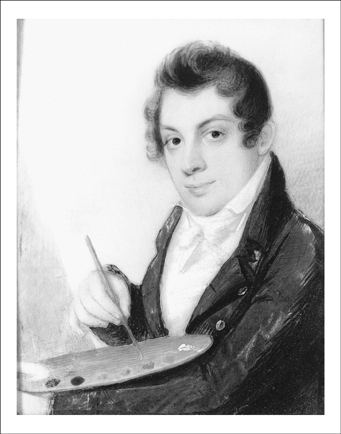
Samuel F. B. Morse, Self Portrait (ca. 1809) (National Academy of Design)
Jedediah and Elizabeth badly missed their sons. By her account, they often looked at the picture of the far-off College Finley had painted for them, saying, “Now the boys are going in to prayers & now to recitation & now to commons.” Nor did the couple find comfort in Charlestown. Jedediah’s disgruntled congregation excluded him from a commemoration of the founders of New England, determined, he said, “to mortify and ‘put me down’ as they express it.” And Elizabeth lost two more daughters, one a few days after birth. Eight of her children had died, leaving only Finley, Sidney, and Richard.
The world outside Charlestown offered not much comfort either. Jedediah was alarmed at the growing appeal in New England of liberal Protestant sects. Unitarianism did the most harm—“the democracy of Christianity,” he called it, softheaded optimistic worship with no vision of human degeneracy since The Fall. “It dissolves all the bonds of Christian union, & deprives religion of all its efficacy & influence upon Society.” He especially worried about the influence of Unitarianism at Harvard, the great training ground for the Congregationalist ministry: “the ancient fountain will be poisoned & its streams henceforth be the bane of evangelical religion.” To combat this threat to American Calvinism he launched the Panoplist, a militant religious periodical designed to uphold “the truth as it is in Jesus.” Relieved that his boys were at Yale and not at Harvard, he sent copies for them to read and keep for their libraries.
The political situation too had worsened. With France and Great Britain both harassing American commercial shipping in their never-ending conflict, Jedediah feared that the United States would come to war with one or the other. President Jefferson and Congress had tried to retaliate by restricting trade, forbidding any American vessel to sail from the United States to a foreign port. But the embargo crippled New England’s once-prosperous maritime business and disrupted the American economy. To Jedediah, the country’s future, clouded as well with Infidelism and Unitarianism, looked dismal: “Our Nation, alas, how fallen!—What is to become of us?”
Finley’s graduation from Yale, in 1810, was for him a mixed occasion of delight and misery. The delight he owed to a young Saybrook woman named Jennette Hart, apparently his first romantic attachment. During the commencement season he sat beside her at tea parties, walked with her in the evenings, read Milton to her—“and while my eye was on the book my heart was with you,” he said. He counted himself “the happiest mortal breathing.”
The misery arose from Finley’s vocational plans. He had decided, he wrote to his parents, to be a painter. The decision was chancy. America had no community of artists, no schools of instruction, no great collections, no part in the urgent continental debates on aesthetics. Paint, brushes, and other basic materials were scarce, and many Americans associated art with luxury and self-indulgence, forces that corrupted republics. Yet Finley asked his parents to arrange for him to study in Boston with Washington Allston (1779–1843), an American painter of growing prominence. Not surprisingly, “Geography” had developed a yearning to travel, and hoped that after studying with Allston in the winter he would be allowed to accompany the artist to London: “I should admire to be able to go with him.”
Jedediah put off a full response until he could speak with Finley during the Yale commencement, which he always attended. Meanwhile he told the boy to do nothing: “it will be best for you to form no plans. Your mama and I have been thinking and planning for you.” The plan, when he revealed it to Finley in New Haven, was for his son to become an apprentice to one of his publishers, the Boston booksellers Farrand & Mallory.
After learning the plan, Finley wrote to his mother assuring her that he would do what his parents thought best for him. “I was determined beforehand to conform to his and your will in everything.” The obligation to gratify his parents had been preached to him in letter after letter from home, week after week. But within and around their demands for compliance he had followed his own inclinations and talents, not to be sacrificed without pain. “I have been extremely low-spirited for some days past, and it still continues,” he added, without explaining to Elizabeth why or for what reason; “I am so low in spirits that I could almost cry.”
Returned to Charlestown, Finley started work at Farrand & Mallory’s bookstore at an annual salary of $400. He needed the money. He had left Yale with debts, a fact he concealed from his parents; creditors in New Haven were dunning him for payment. Lonely, he missed Jennette Hart, to whom he sent an edition of Sir Walter Scott. Evenings he spent painting, fitting up a room above the kitchen of the parsonage and working by lamplight.
Finley’s training for the book business lasted only about three months. Once again Jedediah softened and gave in, this time generously and on no small matter. He would afford Finley a chance to become an artist. “His parents had designed him for a different profession,” Jedediah explained, “but his inclination for the one he has chosen was so strong … that we thought it not proper to attempt to control his choice.” The new plan called for Finley to remain at home until the summer helping Jedediah prepare his geographies, then accompany Washington Allston and Allston’s wife to London for three years of study.

Washington Allston, Self Portrait (1805) (Museum of Fine Arts, Boston)
It was Allston himself who had changed Jedediah’s mind. He had been painting in a Boston studio, a pale, brooding, cultivated young man with large blue eyes and silken black hair. Seven years of training in London, Paris, and Rome had made him the most accomplished and promising American painter in the generation after Benjamin West and John Singleton Copley. Having seen and approved some of Finley’s works, he persuaded Jedediah and Elizabeth to allow Finley to join him when he returned to England.

Samuel F. B. Morse, Morse Family Portrait Group (ca. 1809) (National Museum of American History)
While waiting out the six months before his departure, Finley informally began his studies. He attended lectures on anatomy given in Boston by the eminent physician Dr. John Warren. With Allston’s guidance he also kept painting. Several works from the period of his late teens survive. They include an unfinished liny watercolor of his family, himself leaning in over his mother’s shoulder as Jedediah discourses on geography. Daring to paint a historical subject in the grand style, he at first considered depicting the defeated Roman general Marius viewing the ruins of Carthage—an image of the mutability of empires and of human fortune. Instead he chose a subject that might induce not only moral elevation but also patriotic pride—the landing of the Pilgrims at Plymouth, heroic windswept figures on a canvas some four feet by five, ambitious though crudely jumbled.
Having consented to Finley’s plans, Jedediah felt uneasy about them. Providing the boy’s expenses for a three-year stay in London would be a hardship. American-British relations were tense, too. President James Madison and Congress had reinstated a policy of non-intercourse that forbade American trade with England. And the boy was only nineteen years old: “what must be our solicitude for a son, at his critical age,” Jedediah confided, “removed at such a distance from us, with little experience or knowledge of mankind, in a land of strangers, & exposed to the various evils & snares of the world.”

Samuel F. B. Morse, The Landing of the Pilgrims at Plymouth (Boston Public Library)
Probably toward the end of June, Finley left Charlestown for New York City, there to depart for England in mid-July. Traveling first to New Haven in a stagecoach stiflingly hot under the summer sun, he stopped off at Yale to say good-bye to his brothers. His coastal packet boat to New York was becalmed for two days. And when he at last reached the city, it roasted him with its worst heat in fourteen years—116 degrees, he claimed.
Finley spent two weeks in New York before his departure. He bought the bedding he would need aboard ship—mattress, pillows, sheets. He enjoyed passing an afternoon with Allston’s Knickerbocker friend Washington Irving, just twenty-eight years old but already America’s first literary celebrity. He got to meet some of his thirteen fellow passengers, an exotic group that included a Prussian, a Russian, a Scotsman, and a minor comic dramatist, John Minshull, author of He Stoops to Conquer, or, The Virgin Wife Triumphant.
With two piano-playing passengers and a pianoforte aboard, the voyage promised to be agreeable and Finley felt in good spirits, although once the ship got under sail with a fair wind off Sandy Hook, he admitted to feeling also a bit strange, “rather singularly,” he said, “to see my native shores disappearing so fast and for so long a time.”