
THREE

LITTLE OF FINLEY’S vision of his next few years survived his return to America. As he had planned to do, he set out at once to earn money for further study in Europe. First he rented a large room in Boston to mount a show of his paintings. The ten canvases represented much of his best London work, including a scene from Don Quixote, John Howard Payne in costume, and the large Dying Hercules and Judgment of Jupiter.
Finley’s exhibition drew visitors and brought him publicity in the local press as an “accomplished young painter” with a “poetick imagination.” After hearing that the Pennsylvania Academy of the Fine Arts had purchased Allston’s Elijah for $3500—the most ever paid for an American painting—he offered his Hercules to the Academy for display and possible sale in Philadelphia. The directors accepted, remarking that Hercules showed “uncommon powers in an artist so young.”
With his most ambitious works on view in Boston and Philadelphia, Finley took to the road as an itinerant portrait painter—the drudging routine of most American artists since colonial times. Sketching along the way, he toured New Hampshire and Vermont. He put up in town only long enough to complete what commissions he could acquire, mostly for “cabinet” portraits painted on small millboards. The wandering by stagecoach, horse, or on foot was no more pleasant than he might have expected—muddy roads and loose wheels, animals that kicked and snorted, breakfast in a “hovel.” Just come from London, he thought some of the towns despicable: the natives of Windsor, Vermont, mistook “drunkenness and noise, for good humor, gambling, for sociability, and filth for wit.” Painting his sitters rapidly for about $15 a head, he did not much more than clear his travel expenses. He often thought of Allston, particularly when smoking an evening cigar.
In getting about New England, Finley called on Jennette Hart. His letters to her while abroad had spoken of their prospects in an off-putting tone of possibly-but-possibly-not, sounding much as if he wanted to wriggle out. He did not have to, for when he visited Jennette she “undeceived” him. Their college romance, she declared, could not become a marriage. Relieved, but eager to display sincerity and preserve his dignity, Finley told her brother-in-law that he would remove himself to Europe, “where I shall probably spend the greater part, if not the remainder of my life.”
Far from doing that, he quickly found a wife. Early in August 1816, while seeking portrait commissions in Concord, New Hampshire, he met Lucretia Pickering Walker, the daughter of a local lawyer. She knew of his arrival, having heard of him as “a celebrated painter lately returned from London…. very eminent in his profession.” He had enjoyed good health while overseas, and a resident of Concord later remembered him as strikingly attractive—tall, elegant in person, pleasing in address, with piercing eyes and black hair. A month later he and Lucretia became engaged.
Lucretia was seventeen, Finley twenty-five. Her youth appealed to him for its beguiling combination of modesty and frankness. And beauty. Her friends spoke admiringly of her delicately pretty features—rosy cheeks, slightly upturned nose, overflowing masses of dark curled hair. Altogether he counted Lucrece, as he called her, a special gift of Providence: “Never, never was a human being so blest as I am.”
In fact, Finley was swooningly in love. Arriving alone at another of his itinerant stopovers, he recollected in tearful detail a walk with Lucrece, their conversation in a garden, a parting kiss. He confessed to her his yearning: “As I write, the moon shines on my paper, as if to remind me that last night at this hour it shone on both of us to-gether; Oh, when, dear Lucrece, shall I again see you? When shall the moon shine again on both of us together?” He asked her to look at the moon for half an hour on Sunday evening, beginning precisely at eight o’clock. Precisely at eight o’clock he would look at the moon for half an hour, too, and think of her. When on the road, he poured out letters to her; when back in Charlestown he sometimes walked to Boston early in the morning to get her replies.
Considering that he had recently parted with Jennette, Finley realized that his parents might accuse him of haste in his engagement as in much else, thinking him “a terrible harum-scarum fellow.” Despite his many complaints about their attempts to control his life, he consulted them about his marriage plans often. They advised him to go slowly. Elizabeth stressed the “absolute necessity” of his becoming financially independent before settling down: “Remember it takes a great many hundred dollars to make and to keep the pot a-boiling.” She also had her own ideas about the characteristics of a good wife, including common sense, a decent dowry, and domestic skills—“a slutt is a terrible trial to a man.” In addition, it helped, she said, if “you love each other better than all the world beside.”
One thing about Lucrece troubled Finley: her religious life. Her father was unreligious; her younger brother, a Harvard student, was infected with the school’s Unitarianism; and her many friends were “all of the gay kind,” given to waltzing. She herself was surely open to genuine piety, but she had no adequate idea of it: “She seems willing to know the truth, but I fear she has not yet experienced a true change of heart. She believes in the truth of the gospel, but I fear it is only a speculative belief.”
As Finley’s qualms suggest, his nights at Covent Garden left his religious being unchanged. Spiritually he remained the adolescent who summarized the lives of Protestant martyrs, a descendant of the Calvinist-Congregationalist piety of New England that stretched back 150 years from Jedediah Morse to Jonathan Edwards to Increase Mather. And with his return to America and to his family he had been experiencing signs of conversion, “serious impressions,” Jedediah called them, marks of a “lively Christian.” Jedediah had undergone conversion at around the age of twenty—“a secret, inexpressible Pleasure arising in my Breast,” as he described the process at the time, “with a certain awe & reverence, of God.” To feel such a powerful change of heart, receive such an influx of divine grace, had been his parents’ fondest hope for Finley since the day of his birth.
While undergoing his own arduous conversion, Finley ministered as well to Lucrece’s “unrenewed heart.” In one way he felt uncomfortable presuming to lead her to experiential knowledge of the love of God. One might never be certain that one’s feelings had genuinely changed. His own ardor for God often waned, and he castigated himself for self-deception and spiritual sloth, “my coldness and indifference, my neglect of duty, & attachment to the world. Oh, that I could feel more heavenly mindedness.” Such backsliding and self-doubt, however, were normal, even conventional parts of the process. On his travels he sent Lucrece many letters of religious instruction, his swoony trifles about moonshine giving way to somber moralizings about dying unconverted—a fate that damned the soul to an “endless existence” without hope, he pointed out, “no offers of mercy, no chance of salvation … forever, through eternity.”
Finley found Lucrece eager for his teaching. It included tests by which she might recognize whether she had a truly gracious heart: “Do you love to pray? Do you hate sin? … Do you dread above all things lest you decieve [sic] yourself?” He emphasized the last, crucial question because saving grace might begin not as a sense of purgation, but the opposite: “the first indication of a renewed heart,” he explained to her, “is a willingness to believe the worst of ourselves.” Indeed the more she grew in grace, the more sinful and unworthy would she appear to herself. As a further test, he recommended that she write down her secret thoughts each day so as to bring them starkly before her eyes, a method of meditation he practiced himself. He sent her pious works to study but emphasized the all-important truth that they were merely incidental to faith, which consisted in sole and utter reliance on Christ for salvation.
Lucrece dutifully reported to Finley on her progress in the elusive work of self-examination. “I once knew nothing of the depravity of my own heart,” she admitted to him. But with his guidance she had begun to perceive her wickedness, “that dreadful opposition of the heart which we all feel towards the truths of the Gospel.” As she came to this understanding of her true state, much that had seemed innocent now appeared sinful. She began turning down invitations to the dances and card parties she used to attend—“the height of folly,” she now called them, “idle amusements.” She began quoting Scripture. She was beginning to understand, too, the central truth that grace is no human achievement but a miraculous gift of God: “I feel the dawning of religious joy in my soul,” she wrote to him, “and that my only hope of acceptance is through the merits of my Redeemer, with a sincere conviction of my entire inability to save myself—Your letters, dearest love, first awakened my attention.”
To foster Lucrece’s religious growth, Finley proposed that she stay awhile with his parents in Charlestown. They were eager to meet their future daughter-in-law, and the town was in the midst of a religious revival. Jedediah wrote to Lucrece’s father, formally requesting his permission for the visit, which lasted at least a month. With Finley away painting, Jedediah spoke with Lucrece often about her spiritual condition. He perceived that she was indeed undergoing gracious enlightenment, though the signs were at present faint: “She evidently relishes what no unrenewed heart ever relished, & dislikes what no such heart ever disliked.” Lucrece grew fond of Jedediah: “he is so mild and amiable.” And as she began joining in the Morses’ daily life, they more and more enthusiastically approved their son’s choice: “We think she has the right disposition & talents to make you, & us, happy,” Jedediah wrote to Finley; “All the family love her.”
Finley’s own conversion process fed and was fed by his preaching to Lucretia. On December 8, 1816, he presented himself for examination to the Charlestown First Church—his father’s church. His profession of faith satisfied the church officers that he had attained a grateful heart, and they admitted him to full communion—the passage to a new, enlarged participation in religious life.
Five months later, Lucrece felt convicted enough of her own conversion to also desire to take communion. “Oh, my dear Lucrece,” Finley wrote to her, “you cannot concieve [sic] the pleasure which it gives your Finley to think that his dear Lucrece, will shortly be a professor at the same table of the Lord.” Troubled by fresh doubts about the reality of her conversion, she delayed two months. But on Sunday, July 6, 1817, supported by divine grace, she took communion and was fully admitted to a Congregational church in Concord: “Oh!,” she wrote to Finley, “that I could serve him better and be enabled to make more suitable returns for his great goodness unto me a sinner.”
While Finley’s spiritual life flourished, his plans for studying in Europe collapsed. The Judgment of Jupiter, on display in Boston for a year, found no buyer. Neither did his Dying Hercules, on exhibition at the Pennsylvania Academy; the painting was too large for any private house, he was told. Some of his pictures had also been shown in New York, but a downturn in the city’s commercial affairs left no prospect of selling them for a reasonable profit. There were other discouragements. A Philadelphia bookseller commissioned from him a portrait of ex-president John Adams, to be engraved and included in a biographical encyclopedia of distinguished Americans. Finley produced a harsh memento mori of Adams in old age, shrunken and rheumy-eyed. The bookseller refused to publish it, advising Finley that those who saw the picture “universally disapproved” of it.
Anyway, Finley’s engagement to Lucrece had turned his attention from study in Europe to earning a dependable family income. He began to rethink his career. Before leaving England he had announced that he would never become a portrait painter. Now he thought that he should perhaps return to London to perfect himself in commercial portraiture. He had an even more extreme thought. He had announced that as a history painter his aim would be to lend his own Raphaelesque luster to America’s rising “constellation of genius.” Now it occurred to him that he should, perhaps, just give up art altogether.
Finley tried invention. Americans were becoming known for their “improvements”: new trusses for hernias, machines for making suspender buckles—better bobbins, doorknobs, pessaries, music stands. “There is no clinging to old ways,” a German visitor to the country remarked; “the moment an American hears the word ‘invention’ he pricks up his ears.” Finley set out to make a perhaps profitable “improvement,” together with his brother Sidney. Three years younger than Finley, Sidney too had recently undergone conversion, and he too was trying to find his place in the world. Finley believed that his brother had a gift for “philosophical research,” demonstrated in Sidney’s efforts to build a kite for human airborne navigation.
Experimenting together in the spring of 1817, Finley and Sidney invented a flexible leather piston. The device could be adapted to various methods of raising and forcing water—a bilge pump in ships, a machine for watering gardens. (Sidney satirized it as “Morse’s Patent Metallic Double-Headed OCEAN-DRINKER and DELUGE-SPOUTER VALVE Pump-Boxes.”) The brothers secured an American patent for their invention, sought an overseas patent as well, and tried to interest foreign investors in promoting the device.
Finley’s and Sidney’s most promising use for the piston was in fashioning an improved fire engine. Simpler and easier to work than current engines of the same capacity and power, and half the price, it would bring fire-fighting machinery within the means of every village in the country. Finley showed a model of the engine to Benjamin Silliman, his former science professor at Yale. It interested Silliman so much that he asked for a set of drawings and specifications to print in the first issue of his new periodical, the American Journal of Science, soon to become the country’s main channel for scientific papers. Finley also got a valuable endorsement from the famous inventor Eli Whitney, who pronounced the engine superior to those in common use. “Every one thinks we shall make our fortunes if it succeeds,” Finley wrote.
But at the same time he felt pulled toward an entirely different sort of work. His conversion had broadened and deepened his religious interests. He wrote a sermon-like essay about the false promise of Universal Salvation. He began teaching a Sunday school in Charlestown. The religious revival in the town, and reports from London that several deistic young artists he knew were turning to God, led him to suspect that the Millennium might be dawning: “not a wind blows but brings intelligence of the increase of the Redeemer’s Kingdom.” He now regretted his behavior overseas: “I am ashamed of much … very much of my life in England, but hope for forgiveness through the merits of my Savior.” The regrets came to include Covent Garden: “I am conscientiously opposed to the Theatre.”
In the summer of 1817, seven or eight months after his admission to the church, Finley made a startling announcement to Lucrece. He had new plans—“a change of profession,” he said, “for Divinity.” As a minister he could be more useful to others than as a painter. He was prepared to sacrifice his noble profession for the sake of duty and conscience. “The salvation of a soul! who can tell its worth!” he explained; “Oh that I might be made the instrument of turning many from the error of their ways unto the Lord.”
Finley planned to study at the Andover Theological Seminary for a year, then at the new Episcopal seminary in New York City. He would take orders in the Episcopal Church, whose form of worship he considered close to that of the Primitive Church, as described in the New Testament. Congregationalist friends and clergy approved his decision, he said, and he felt no misgivings except those arising from a sense of his own insufficiency to undertake so high an office. He would complete his remaining portrait commissions—as “the Painter Clergyman,” he joked. But after beginning his ministerial studies in the fall, he would abandon art, at least as a profession.
Finley kept to his new course barely two months. He began having serious doubts: his mediocre record at Yale implied that he did not have a scholarly temperament; his eight years of training as an artist had given him habits wholly different from those of a divine. After discussing the situation with his family and friends he concluded that it was not his duty to change professions.
Lucrece had affectionately approved Finley’s decision to enter the ministry, and affectionately accepted his counter-decision to go on as a painter. But his conscience accused him of rushing thoughtlessly into new schemes—shuffling about, he told himself, like “the most fickle being in the world.”
To restart his painting career Finley headed south. He had several ties to Charleston. His father had preached there and knew such prominent Charlestonians as Charles Cotesworth Pinckney, who invited him to visit. His mother was the niece of a prominent Charleston physician, James E. B. Finley, who thought him destined as an artist for America’s “earliest lists of its Great Men.” Charleston was the birthplace of Allston, too, and patronage in the city was said to be lively, with much demand for Northern painters.
Finley timed his arrival in Charleston to coincide with the beginning of the annual social season, in late January. From then through March the prosperous rice and cotton planters brought their families and slaves to town to enjoy the horse races, concerts, and theatrical performances. Finley’s impression of the place was mixed. The people seemed hospitable, their elegant brick homes graced with balconies and piazzas; gardenias and olive trees thrived in the sultry climate. On the other hand, the moral climate of the South seemed debased—“all the dirt, and indolence, and inconvenience, and comfortlessness, inseparable from slave population.” Both slaves and people of fashion in Charleston used the Sabbath not to pray or study but to pay visits. And with the social season came brothels and gambling tables—a “torrent of dissipation, and ungodliness.”
Staying with his uncle James, Finley established a studio on King Street, near the tall white steeple of St. Michael’s Church. This time his search for a living to support himself and Lucrece was repaid. He soon became a sought-after painter in Charleston, earning $60 and $70 apiece for his portraits—four or five times what he got for the same painting in New England. Over time, one rice and indigo planter hired him to do nineteen family portraits; in appreciation, Finley presented to him as a gift the still-unsold Judgment of Jupiter. By mid-March Finley had completed twenty-seven portraits and had commissions for forty more: “with application,” he wrote to Lucrece, “I can make a fortune in a few years.” He planned to return to Charleston for the next social season, this time bringing Lucrece as his wife.
With his first commercial success as a painter, Finley could afford to act on his pious belief in charitable giving, especially to religious causes. He sent $20 to the theological seminary at Princeton, another $20 to the Board of Missions—“little enough considering how abundantly the Lord is pouring wealth into my lap.” He forwarded several hundred dollars to his parents, as a loan to help them pay off their many debts.
Capable now of earning a thousand dollars a month, he wildly believed, Finley stopped peddling his and Sidney’s inventions. Although he had taken along a model of their fire engine to display in Charleston, he had become “heartily sick” of the whole business: “it yields much vexation, labor, and expense, and no profit.” Inquiries about foreign patents for the flexible leather piston revealed that a French patent would be costly, and that someone in England had already patented what appeared to be the same device. Moreover, a New Hampshire demonstration of the fire engine had failed, he learned, prompting a spectator to comment, “Mr Morse better stick to his brush, he will do well enough then but as to Engines he’d better let them alone.”
Finley’s plentiful commissions came with a price. His customers were demanding, in the way that made artists in the “higher branches” of painting look down on portraitists as mere servants, hired flatterers. One patron gave him an engraving of Chief Justice John Marshall and specified that he wanted his son depicted in the same attitude. And dressed in a black coat and white waistcoat. And seated in a beautiful chair at a handsome table—against a backdrop of magnificent scenery. Another patron required that the subject’s right hand must nestle in a partly buttoned coat, “his left arm being entirely exposed and the left hand with glove on, resting on the hilt of the sword.” Not all his employers were satisfied with the results, either. Some thought his pictures good likenesses but painted hastily.
Finley did tend to leave his portraits unpolished. Yet his popularity was the deserved reward of matured skill and insight. Despite his loving admiration for Allston, in depicting his sitters he departed from his arch-Romantic mentor. Where Allston suffused his paintings with an aura of moonlit fantasy, Finley clung to some advice by Gilbert Stuart: “Be rather pointed than fuzzy…. you cannot be too particular in what you do to see what sort of an animal you are putting down.”
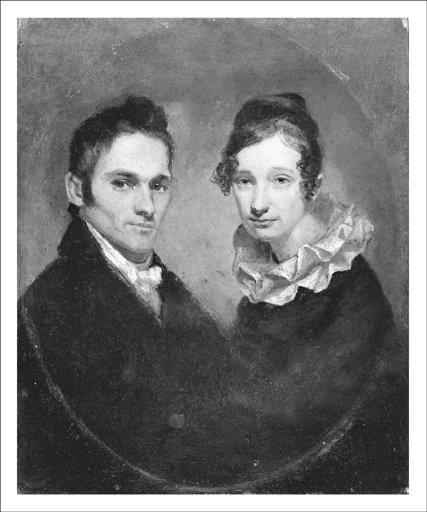
Samuel F. B. Morse, Rev. and Mrs. Hiram Bingham (Yale University Art Gallery)
Accordingly, he emphasized candid observation and concrete detail, conveying his sharp sense of character through careful representation of posture, hair, facial contours. He acknowledged his patrons’ wealth, elaborately rendering their clothing and jewelry. But he usually granted their faces no flattery. He bluntly depicted his sitters as lackluster, gawky, porcine, or whatever else his eye recorded, as in his portrait of the New England missionaries the Reverend and Mrs. Hiram Bingham.
During Finley’s six-month absence in the South, Lucrece remained with her family in New Hampshire. She missed him badly and wrote often: “dearest love,” one letter began, “how painful this separation is to me who love you with so much tenderness and affection.” But Finley’s return to Charlestown in the early summer of 1818 meant another three-month separation before their marriage. He had brought with him some unfinished portraits, and after visiting Lucrece briefly in Concord he went back to his parents’ house in Charlestown to complete them. “Oh my dear Finley how I do miss you,” she wrote after seeing him, “I was wholly overcome by my feelings, I felt ashamed of my weakness and strove to subdue my sorrow.”
As their separation continued and the wedding approached, Lucrece sent more professions of ardor and longing. They made Finley uncomfortable, perhaps representing to him a sexual challenge, certainly raising the danger of Idolatry. He instructed Lucrece that God caused their affections to flow out toward each other, but commanded their supreme affection to Himself: “let us not then idolise the gift instead of the Giver; let us be more earnest in our prayers that God would so direct our love as not to interfere with our Love to him.” Lucrece tried to show that she understood. “I view you, love, as the gift of God,” she replied, “and pray that in infinite mercy I may be preserved from setting my heart too much upon you or any other earthly blessing.”
Marriage also raised the more mundane but no less disturbing question of Lucrece’s dowry. Here Finley’s hope of becoming financially independent clashed with his fear of becoming worldly, the result being a draw. “I consider my Lucrece a fortune in herself,” he told her; “still,” he added, “for her sake I hope there will be something handsome for her.” Lucrece shrank from questioning her father, mindful that he had other children to support. From speaking to her mother she learned only that he would furnish the newlyweds’ house—should they get one. And when she did at last confront her father, he gave her nothing more encouraging to tell Finley than a promise to “fix me out.” Finley’s often proclaimed scorn of material things allowed no protest: “I can cheerfully leave all to the direction of our Heavenly Father who careth for us.”
The approaching wedding date made them both anxious. Their self-condemnations multiplied—attachment to vanities, want of confidence in God. Lucrece also suffered physical distress—exhaustion, colds, headache. She asked to postpone the marriage a week. The delay or loss of a letter brought on tiffs, as when Finley became unable to complete a certain portrait because he had not heard from her: “I cannot but feel, strongly too, this inattention,” he huffed, “you will not think that I am grieved without cause.” Jittery and impatient, they both literally counted the days.
Finley and Lucrece married in Concord on September 29, and settled before the end of the year in Charleston, for his second season. They lodged at a $10-a-week boarding house, a short walk from his painting room. Downcast at first to be living among strangers, Lucrece soon came to enjoy the hospitality and attention she received. The agreeable climate put color in her pale cheeks and she gained some needed weight: “she is esteemed quite a belle,” Finley noted. He learned that some local gossip criticized her clothing as ostentatious, but he dismissed it, knowing that her dresses had been made under his mother’s supervision. Perhaps, although in the portrait of Lucrece that he painted near this time, she wears a flouncy pink and yellow gown with a fur-lined satin cape, surely no couture of Elizabeth Morse.
The new social season brought Finley even richer returns than his first. In scarcely more than two months he booked over $4000 in commissions. “I am in the fashion,” he whooped. Already as prosperous as he could wish, he sent another few hundred dollars to his parents and raised his price for a portrait from $60 to $80. He earned the money, working long hours and trying hard to improve. He experimented with achieving delicate lighting effects by dropping a scrim of black gauze between himself and the background while he painted. He explored colors, mixing yellow ochre with chrome yellow to produce a flesh yellow that was effective for painting shadows of white drapery. He gathered a small collection of antique sculpture—an imported cast of the Venus de Medicis, a patched-together figure of Apollo, fragments of hands and feet. They made “a very good academy,” from which he drew two hours in the evenings, much as he had in London.
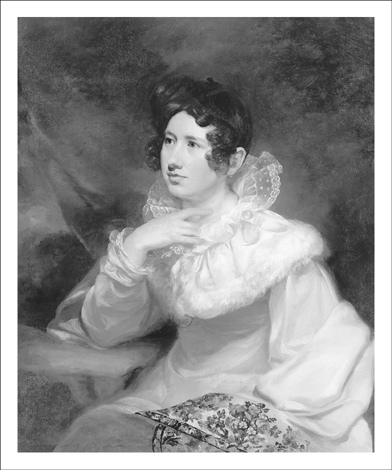
Samuel F. B. Morse, Lucretia Pickering Walker Morse (Mead Art Museum)
As summer approached, the air in Finley’s studio became oppressively close, and Lucrece found the city so hot that she badly wanted to leave. Even with a dozen other painters working in Charleston, however, his waiting list had kept growing—enough patrons to justify his returning for another five or six seasons. And he had a choice commission for later in the year. The city council, recognizing his ability, offered him $750 to paint a full-length portrait of President James Monroe, who was coming to town. Finley had a long interview with him but the President’s time was so taken up that no sittings could be arranged. Instead, Monroe agreed to have Finley paint him during the winter in Washington.
Lucrece was pregnant when she and Finley returned to Charlestown. As she came to term she was looked after in the Morses’ parish house by Elizabeth and by the aging family nurse, Nancy Shepherd, who nearly thirty years ago had attended Finley, too, and told him about Bunker’s Hill.
Jedediah had preached from the First Church pulpit since his settlement in 1789, on the day of George Washington’s inauguration. Now nearly sixty years old, his temples sunken, he was being forced out. Twenty-five members of his flock had requested him to convene a council to discuss whether he should be removed from his ministry.
The basis of the request was a new edition of one of Jedediah’s geographies, further evidence of his indifference to church matters. A deacon of his flock charged that he trifled away whole months, “without producing scarcely one, original, well studied discourse.” Elizabeth understood the situation differently: “if every Old woman in the Church & parish is not visited as often as she thinks she ought to be … there is a hue & cry raised and it is made the subject of constant reproach till we are sick of hearing it.” Jedediah viewed the objections to his geographies as a pretext, the dissenters’ real motive being to convert his church to Unitarianism.
Finley encouraged his father to leave. Although born in Charlestown he had never grown attached to the place or even spent much time there. Except for a few friends, he did not care to see Charlestown and Boston again, nor their provincial, self-important residents—“the meanest, most selfish, most narrow-minded set of beings in the world.” He thought of moving his parents to Charleston. In their advancing age they would benefit from the climate. And Jedediah could combat the “Unitarian Hydra” now rearing itself in Charleston, too, an indulgent place well suited to the sect’s easygoing religion.
But to Finley’s dismay, his father resisted leaving. Wounded and angry, Jedediah wanted to deny his enemies the triumph of making him seem cast out. He went along with a plan by supporters in his church to put off his departure and hope for an end to the dissent. To Finley, with his touchy sense of personal honor, the delaying tactics seemed “idle and mad,” certain to make Jedediah appear crafty. “Do determine speedily to go, dear Father, if you value your own reputation, peace, and usefulness and that of your loving family.”
But Jedediah, and everyone else, clearly understood that he must sooner or later resign his pulpit. He wanted to have at least the satisfaction of not being present when the congregation installed his replacement. So he informed the church board that he intended to seek a government commission to investigate the state of the Indians on the country’s borders. Just the same, he and Elizabeth felt evicted, thrown out of their only and lifelong home. They decided that, next year, they would pack up and move to New Haven, near Yale, his alma mater, a town with no trace of Unitarianism.
Over the summer, despite the turmoil in the church, Finley completed the portraits he brought from Charleston. He had the pleasure and advantage of guidance from Washington Allston. Although presumed to be next in line for the presidency of the Royal Academy, Allston had chosen to live and paint in Boston. He believed he saw signs of encouragement for the arts there, which he owed it to his country to foster. Finley did not share his faith in Boston: “I think it will be the last in the arts,” he once remarked. Nevertheless he went to Allston thirstily, “as to the sun to imbibe light.”
Probably inspired by his mentor’s presence, Finley painted an All-stonesque full-length of a girl wandering in the ruins of a Gothic abbey, emblematic of her failing health: “I always thought he had a great deal in him,” Allston commented. Allston himself began a mammoth painting of Belshazzar’s Feast, the canvas stretching across nearly the entire back wall of his studio. He expected to finish the picture in six or eight months, then put it profitably on exhibition. A perfectionist, however, he would do and undo Belshazzar’s Feast the rest of his life.
In September, Lucrece gave birth to the couple’s first child, a daughter they christened Susan Walker Morse. Finley was able to enjoy his infant barely two months, however, his here-and-there commissions making for a back-and-forth existence. He had to leave for Washington to do his portrait of President Monroe, and head from there to Charleston for the social season. His brother Sidney, now a ministerial student at the Andover Seminary, accompanied Lucrece, baby Susan, and nurse Nancy to the home of Lucrece’s parents in New Hampshire, where they stayed until Finley returned from Charleston some six months later.
The addition of Susan made this parting from Lucrece more than usually wrenching—“and I don’t care to try it again,” Finley said. Washington did not much lift his spirits. The nation’s capital had a “very mean aspect”—badly built houses scattered over a windy space of uneven ground without connecting streets, the landscape blotched with swamps and vacant lots. And the work was frustrating. The President treated him without formality, inviting him to dinner three times, and to tea. But the subject was often called away during the sittings, too busy to pose longer than ten or twenty minutes at a time.
Finley managed to do no more than take the President’s face, leaving his body to be filled in. He made a bust-length copy of the face for one of Monroe’s daughters, vividly rendering the President’s ruddy complexion and deeply cleft chin. She said that her father thought it the only portrait that really looked like him—although he had also been painted by Gilbert Stuart, many of whose portraits Finley ranked with Vandyke’s. When later completed, the full-length portrait won admirers too, despite its fuzzy unfinished-looking torso. The New York Academy of Arts asked to exhibit it, “presenting you to the New York public in the most graceful way.”

Samuel F. B. Morse, James Monroe (White House Collection)
From Washington, Finley set out for South Carolina through a violent December snowstorm that nearly upset his creaking coach, the horses toppling under their crust of ice and icicles. The tough going made an apt prelude to his season in Charleston. The city he returned to early in 1820 was in economic decline. Since the war with England, Americans had turned much of their attention from foreign affairs to internal improvement and domestic manufactures, with seemingly unlimited opportunities for average but energetic people to make money. The country was growing, too, at a rate that stirred hopes for national greatness—its territorial claims extending to the Pacific Ocean, more and more new states seeking admission to the Union. In 1819, however, the intense economic development withered into a financial depression that would last almost a decade. Businesses failed, some half-million workers were left without means of support, philanthropic groups doled out soup.
Finley discovered that the depression had reached Charleston, where cotton prices had plunged. He got some commissions, although the city swarmed with unemployed painters: “I wish I could divide with some of them, very clever men who have families to support, and can get nothing to do.” To save money he slept in his painting room. But he had fewer invitations than before, lost weight, yearned for Lucrece and little Susan. In letters from New Hampshire, Lucrece sent an unfolding account of the infant’s growth: Susan’s eyes follow her around the room; Susan has become afraid of strangers, especially if they wear black. “How often do I wish her dear Father could see her,” Lucrece wrote, “oh my husband I do long to see your dear face again, and once more hear the sound of your affectionate voice.”
Lucrece also reported her recurrent illnesses—more headaches, dizziness, pain in her side and breasts. Worries about Lucrece’s health intensified Finley’s yearning for her, so that for all his effort to center his affection on God, he was making her an idol: “My impatient longings to be with you as though you were not safe out of my presence tells me this, my constant fears of bad news from you tells me this, my dreams.” A steamship had come into service between New York and Charleston, and he sometimes felt tempted to drop everything and immediately return home.
Finley’s discontent may not have been much relieved by several visits from his brother Richard. Now twenty-five years old and a licensed minister, Richard was preaching for a while at the Presbyterian church on John’s Island, near Charleston. Even more restless than his brother, he had come out of their closely regimented childhood with no clear sense of what he wanted. Having failed as a schoolteacher, he accused himself of one defect after another—timidity, selfishness, impiety, a “moping melancholy” that made him unsociable and unpleasant. He still consulted his mother about how to get a new coat—a “quere [sic] creature,” Elizabeth thought him. Finley assured him that he would succeed in anything he undertook, “with a little self confidence”—a trait Richard wholly lacked. While in Charleston, Richard wandered about to relieve his ennui, bit his nails, brooded in his journal: “This evening I felt as if every one was my enemy.”
At the end of his dismal season, Finley returned not to the parsonage but to his parents’ temporary new home—a rented cottage in New Haven. Lucrece was there with little Susan, although now, a married woman and mother, she felt uncomfortable living with her in-laws: “I wish I could receive you at our own house,” she told Finley. Scraping by himself, he had sent what money he could to help pay for his parents’ move from Charlestown. They found some comfort in at least having their furniture with them. Jedediah borrowed $400 to have a studio built for Finley, and counted on loans from his son to partly finance the construction of a house in New Haven to accommodate the entire family.
Only a few months after relocating, Jedediah left for distant Buffalo and Detroit. Through highly placed officials in Washington who admired his geographies, he had obtained an appointment to collect information on the numbers, location, and institutions of all the Indian tribes outside the Northeast—“400,000 of our fellow beings,” he said. In this way he managed to be far from the Charlestown First Church when its new minister was installed in his place. Instead of preaching the customary farewell sermon, he sent a letter to be read to his flock.
Jedediah’s appointment took him to new scenes that he found fascinating—Mackinaw, with its waterside lodges and birch canoes, most of the villagers filthy, many naked, some in war paint. But he remained bitter at having been driven from his ministry by people he had counted friends—“conduct cruel as the grave,” Elizabeth called it. He fell prey to “depression of spirits,” developed an obscure numbness, constriction in his chest. The thought of separation from his wife and from the home he had had for thirty years sometimes made him weep.
Finley tried one more season in Charleston, then never went back. He lowered the price of his portraits and boosted his efforts to please. But most people who had once paid much attention to him now ignored him. His few patrons were harder than before to please, too, and slower to pay. “Cotton and rice are so dull,” he told Lucrece. “I know not how much I shall bring home.” He reminded himself to view his frustration from a religious perspective: should he receive good from God and not also evil? Still, he heard out advice from his parents and brothers that he think about spending the winters not in Charleston but in New Orleans, Savannah, or Washington. He reassured Lucrece that he favored New York: “if I can get established there I think it will be much better for me than to be so far from home.”
Finley considered another way out. At the moment, aspiring artists in America taught themselves or worked in the studios of established artists. He might open a school for painting and sculpture in New Haven, based on what he knew of the Royal Academy. He already owned nearly enough casts, prints, and books to equip such a school himself. Together with portrait commissions, ten or fifteen pupils at $100 a year would provide a livable income, especially if he also gave a course of public lectures on the fine arts. In the evenings he began devising a format for the talks, certain he could make them “highly popular.”
Finley realized that the whole scheme might seem another of his impractical flights. But teaching and lecturing in New Haven would keep him together with his family. And it would, after four years of distraction, return him to his vocation, “the higher branches of poetical and Historical Painting which it is high time I should begin to think of again if ever I mean to pursue them with success.”
Perhaps simply to test his idea, Finley tried to lay the groundwork in Charleston for a South Carolina Academy of Fine Arts. Collaborating with the Comptroller General of the state, an amateur painter-sculptor named John Cogdell, he drew up rules for the Academy and submitted a resolution asking the city council for a building site in the public square. He felt no great certainty that the Academy would win public support. “It looks prosperous now,” he wrote to Lucrece, “but I am not sanguine as to its success.” With good reason. Many of the subscribers he enlisted failed to pay up, a lottery to purchase plaster study-casts yielded little money, and the completed building ultimately cost three times the estimate. The Academy languished for a decade before vanishing in 1830, its property sold to pay debts.
Finley had planned to return home at the end of March, earlier than usual. Business was slack, and Lucrece was pregnant, expecting the birth of their second child. Some new commissions kept him in Charleston until April, however. Meanwhile Lucrece caught a severe cold that lamed her arm. “I dread the trial,” she said, “still I trust I can wait with humble submission to my heavenly Father.” Finley soon received news that he had another daughter, named Elizabeth Ann. “God did help you,” he wrote to Lucrece, “he made your trial short.” They asked God for grace to bring up their children in the admiration of the Lord. But fourteen days out of the womb the infant became critically ill and died, medicine having failed to cure her “canker of the bowels.”
Still without a home or an income, Finley returned briefly to New Haven then went off seeking portrait business in Massachusetts, Vermont, and upstate New York. Another rootless six months on the road, with the lonely wait for letters reporting that little Susan looked for him when she awoke, saying, “Papa all gone he don’t been in Mama’s bed now.”
During his tour, Finley conceived a bold new painting, the most novel and complex he had ever attempted. Its subject would be the monumental interior of the House of Representatives, newly rebuilt since the British torched the Capitol in 1814. The great canvas, eleven feet wide by over seven feet high, would include portraits of all the House members. The ambitious idea grew out of his experience and hopes. He considered architecture part of his province as an artist, and had even offered to design a library and chapel for Andover Theological Seminary. He had reason to hope, too, that he had conceived an aesthetically satisfying historical subject that might also be a popular success. A painting of the interior of the Capuchin Church in Rome had drawn crowds when shown in America, and the recent traveling exhibition of John Trumbull’s Declaration of Independence had reaped more than $4000. A comparable painting of the House of Representatives might be sent around the country—“one of the most popular subjects I could possibly undertake.”
Finley began the work in November 1821, in Washington. Well known in the city through his father and on his own, he was cordially received, given a painting room in the Capitol, so close to the House chamber that he could hear the sound of debate through the wall. President Monroe advised him to paint the House members first, then the room: “he seems pleased with the idea of all the pictures,” Finley wrote home, “and thought they would be popular.” But Finley chose to do both at once, taking the congressmen when they could sit for him in his studio, painting the chamber when they could not. He intended to depict the scene in the legislature as it appeared by lamplight, “when the room already very splendid will appear 10 times more so.” The venerable doorkeeper of the House agreed to light the chamber’s great chandelier for him two hours each evening, so that he could make sketches.
Up at dawn, Finley worked sixteen hours a day on the painting, he said, so intently that he confused one day with another. The subject required him to make small portraits of sixty-seven congressmen, and of another nineteen figures as well—Supreme Court justices, newspapermen, doorkeepers, servants. He was able to get in six sittings a day, of two hours each; one day he held eleven sittings, equivalent to painting five ivory miniatures. The sessions went well, the House members being not just willing to pose but deeming it an honor.
Yet the painting progressed far more slowly than Finley anticipated. The semicircular House chamber presented “Herculean difficulties” in perspective—an art, he realized, in which he had little skill. He tried using a camera obscura to puzzle out the technical problems, sometimes spending a whole day erasing and re-erasing. Three weeks passed before he drew a line of the chamber on his canvas. But he solved the problems, “by the assistance of God’s grace,” and in the process gained a satisfying new ease in drawing backgrounds. “I am certain, that with diligence & perseverance,” he wrote to Lucrece, “I can make a popular & profitable picture.”
Lucrece had expected Finley to return to New Haven late in December. But his labors stretched on through January, then beyond. He asked her whether he should finish the portraits and come back briefly in February, or complete the entire painting and return permanently in April: “Can you spare me till April dearest? … You shall decide for me, my dear wife, and dear little daughter.” Lucrece had never written her husband a letter even remotely critical of him, but the question for once angered her. During his absence her mother had died, an event not unexpected yet devastating. She was pregnant again, too, and felt drooping and dizzy. “I cannot feel at all reconciled to the thoughts of your absence for several months longer,” she replied. “Shall I tell you husband, that your letter made me feel dull and unhappy?”
Finley returned to New Haven in February, bringing some eighty heads he had painted on small panels, and the giant canvas on which he would copy and arrange them. In April Lucrece gave birth to a daughter, whom they named Lucretia Ann. Born one year after the death of their second child, the infant survived only twenty-five days. How the couple dealt with their new loss is unknown. Little information about such intimate crises appears in the extant letters and journals of Finley and his family; if more at some time existed, it may have been culled from the documentary record by a descendant. However affected, Finley strenuously resumed work on his picture, which he now believed he could complete by the fall.
He saw encouraging signs of how his efforts might be received. During his stay in Washington, the painting had become a town topic. After he left, notices of its progress appeared in several newspapers, anticipating how it would finally look and praising “the assiduous labour and distinguished talents of the artist.” As he worked on through the fall, he moved the estimated completion date forward to January. But by the new year he was at last done, having toiled over the canvas some fourteen months.

Samuel F. B. Morse, The House of Representatives (Corcoran Gallery of Art)
The House of Representatives shows a silhouetted figure lighting the thirty Argand oil lamps of the great three-tiered chandelier. Members of the House face the viewer as they stand around the glowing hall singly or in small groups, preparing to assemble. Finley intended not so much to portray the congressmen, however, as to show the American public its seat of government, to make “a faithful representation of the national hall, with its furniture and business during the session of Congress.” In doing so, he convincingly depicted the tricky-to-render half-dome and sloping concentric circles of seats, and minutely reproduced the chamber’s yellow curtain fringes, wall clock, inkstands, letterbox, and distant firelit lobby.
Regarded as a history painting, The House of Representatives lacks the memorable narrative content of such predecessors, and likely influences, as Trumbull’s Declaration of Independence or Copley’s Death of Lord Chatham. But it offers something as novel in its way as West’s Death of Wolfe—a history painting without history. Finley discovered a material symbol for his sense of America’s growing might and the superiority of its institutions, for the cultural nationalism that in London had animated his fierce denunciations of British policy. The somberly lit cavernous chamber and its twenty-two monumental columns, dwarfing the legislators who prepare to work into the night, dramatize the young republic’s seriousness, stability, and unostentatious grandeur.
Connecting the present with the foundational principles of the Constitution, the justices of the Court stand on a raised platform to the left. On the wall behind them, in a massive bronze-colored frame surmounted by an eagle, hangs a copy of the Declaration of Independence. Connecting the country’s destiny, too, with the Morse family, in the scarlet-draped gallery overlooking the legislative throng stands Jedediah Morse. Returned from his expedition to the Great Lakes as an Indian commissioner, he peers down upon the scene, near the Pawnee chief Petalasharo.
After displaying The House of Representatives briefly in New Haven, Finley sent it to Boston for exhibition in February, going along to help unpack the 640-pound canvas. Even Allston’s critical eye admired the perspective, the well-drawn figures naturally disposed, especially the exquisitely colored architecture—“really a very beautiful thing…. he has brought out more in this picture than I ever anticipated.” Were it shown in London, he said, Finley would be made an associate at the Royal Academy. Still, he suggested some small improvements, which Finley made, delaying the opening for two days.
The Boston exhibition took in some $40 the first day, including the sale of printed keys that identified each of the eighty-six figures. Admission was twenty-five cents, but Finley also sold thirty-five or so season’s tickets, for fifty cents. “Things look well,” he wrote to Lucrece, “every thing indicates success.” Having launched the show, he went back to New Haven and gave over its management to Henry Pratt, a young artist just out of his teens who had assisted him in Charleston and Washington.
In the changeable March weather, alternately cold and warm, Pratt averaged only about $3 a day. As receipts fell, he hired a man to distribute five hundred handbills around town; yet one day he took in only seventy-five cents. Finley instructed him to light the show in the evening, to extend the viewing time. Pratt put up tin lanterns, but attracted only one customer. Three further evening viewings produced $1.50. By mid-April, Finley ordered Pratt to close up.
Allston urged Finley not to be discouraged. Although the painting had brought in little cash it had gained him much praise, from the best judges. In Allston’s aristocratic logic, the meager cash return meant that the worst judges had ignored it: “the lower classes must have been wanting in curiosity, and as they make up the mass of the town, if it does not attract them, the receipts must of course be small.” The life of the painting had just begun, he said. “Be of good heart then. I have no doubt of your success.”
At the end of April, Pratt moved the heavy House of Representatives to Salem, Massachusetts, for display at a local coffeehouse—small but the best he could get. The local press took notice, the public did not. In two weeks he made just over $40, his expenses amounting to nearly $60. He sent the picture on for exhibition to New York City, where Finley went to receive it, now in no hopeful mood. “I cannot predict any thing concerning it, but I don’t expect much.”
Under Pratt’s management, The House of Representatives was presented to New Yorkers through June and July. Although he circulated seven hundred handbills and kept the hall open each evening, his receipts in the first twelve days averaged only about $4; on one day only $1.50 came in. The trouble this time, he believed, was that the painting faced too much competition—not only from simultaneous shows by Rembrandt Peale and Thomas Sully but also from the city’s many theaters, circuses, and pleasure gardens. “Exhibitions are so multiplied that people begin to think them not worth seeing,” he informed Finley; “it is worse than it was at Salem; as far as I can judge, there is not the least interest taken in the subject.” It did not help that the street outside the hall was being torn up and repaved, leaving stony rubbish that made it impassable. By the time Pratt closed the show, in July, he had only three and a half cents on hand, together with bills for rent and advertising amounting to $110.
After the miserable seven-week run in New York, Finley signed over to a man named Curtis Doolittle the right to exhibit his picture anywhere in the United States—Doolittle to pay costs, Finley to receive half the profits. But there were no profits. After trying out the painting in Albany, Doolittle reported that receipts were so small he blushed to relate them. When he moved it to Hartford and Middletown, Connecticut, he lost $20 to $30. Finley released him from their contract. Doolittle transported the eighty-square-foot canvas back to New Haven and gave up.
Lucrece worried about how the series of failures might affect Finley. “My dear husband I trust will not give way to any anxious, desponding feelings,” she said; “it has pleased our heavenly Father for wise reasons to disappoint our expectations in regard to your large Picture, and it is our duty to submit to the disappointment.” But although he had very often preached the same to her, he found submission difficult. He came to feel that most people who attended exhibitions had no ability to appreciate his picture: “its merit is of too refined and unobtrusive a character.” To achieve that subtlety he had given the painting his all—all his improving skill, all his hopes for becoming a history painter, all his commitment to the nation’s promise, all the little money he had saved from his itinerant portrait painting and from the liberality of his Charleston patrons—all this and more than a year’s work. He understood well enough what it all meant: “this picture has ruined me.”