
10
“… a tragedy took place that was to affect our lives forever.”
—C.A.L.
“GIVE THE LINDBERGH BABY A CHANCE!” BLARED A RECENT article in the National Affairs section of Time. The clarion call came in response to a widespread rumor in late 1931 that Charles Lindbergh, Jr., was deaf and had not learned to talk. “Cause of the affliction was supposed to have been the prenatal drumming of airplane motors in his ears, causing a trauma, while his mother, Anne Morrow Lindbergh, continued to fly during her pregnancy,” the article explained.
The rumor was completely unfounded but so widespread that some of America’s most eminent journalists had to go on record to squelch it. Even Will Rogers felt compelled to write a column about a Sunday visit to Next Day Hill in late February, at which time he saw the Lindbergh baby:
His dad was pitching a soft sofa pillow at him as he was toddling around. The weight of it would knock him over. I asked Lindy if he was rehearsing him for forced landings.
After about the fourth time of being knocked over he did the cutest thing. He dropped of his own accord when he saw it coming. He was just stumbling and jabbering around like any kid 20 months old.
The Lindberghs still had not moved into their new house outside Hopewell. Completing an uncomfortable first trimester of her new pregnancy, Anne was just as happy to be waited on in their suite at Next Day Hill. With the first intimations of spring, she found herself up and around, engrossed in two projects that had been offered to her husband and which he had proposed she pursue. The first was a public address in behalf of flood relief in China; the second was a book about their recent journey to the Orient. Intimidated by the size of the latter task, she followed Charles’s suggestion of breaking the journey into sections and jumping into the “Baker Lake” episode, that moment when they left civilization behind and Anne found herself the first white woman to appear in that region of Northern Canada. “If I get enough written, soon enough, & it isn’t too bad,” Anne thought, “then we’ll talk to publishers.”
For the most part, Anne devoted her time to little Charlie. She took to visiting the new house without nurse Betty Gow. “It is such a joy to hear him calling for ‘Mummy’—instead of ‘Betty’ once in a while!” she confessed to her mother-in-law. To the little boy, Charles was known as “Hi.” One day that February, while they were driving in New York, a car rear-ended them. Anne instinctively grabbed the baby, and Charles got out, while traffic stopped and irate drivers confronted each other. In the midst of the brouhaha, a small voice chirped, “Hi—all gone!”
On the afternoon of Saturday, February twenty-seventh, one of Mrs. Morrow’s chauffeurs took Anne, the baby, and one of the maids from Englewood to Hopewell. Arriving at 5:30, they were met by Olly and Elsie Whateley, who had moved into the servants’ quarters. Anne changed and fed the baby, putting him in bed by seven o’clock. He seemed to be coming down with a cold, sneezing several times. Anne checked on him a few minutes later; and at about eleven o’clock, both she and Charles entered the nursery, to medicate the baby’s nose.
Monday the baby was still sick. After lunch, Anne called Next Day Hill and told Betty Gow that they would not be returning to Englewood, as had become their routine. Little Charlie did not leave his room all day and neither did Anne, except for a few short walks, during which time she left the baby in Elsie Whateley’s care. Around seven, Lindbergh called from New York to say that he would be spending the night in town, not returning to Hopewell until the following night.
The next morning—Tuesday, March first—the baby was better but still croupy. Anne awoke with a cold as well. She called Betty Gow in Englewood and asked her to come to Hopewell and help out. There were still no definite plans as to where they would all spend the next few nights. Just before three o’clock, Anne and Betty went into the shuttered nursery, where Charlie had been napping; his health had noticeably improved. Anne took a walk down the long driveway and spent much of the afternoon with the baby downstairs in the living room. Around 5:30, he ran into the kitchen, where Betty was sitting with the Whateleys. The nursemaid took the boy by the hand upstairs, where she read to him before feeding him some cereal. Anne entered the nursery at 6:15, by which time he had finished his dinner.
She and Betty Gow prepared the baby for bed. After rubbing Charlie’s chest with Vicks VapoRub, they decided to make a flannel garment for him to wear beneath his nightclothes. A handy seamstress, Betty quickly ran up a little short-sleeved shirt from a remnant of cream-colored flannelette. The material had an embroidered hem in a scalloped pattern. She kept the left shoulder unsewn so that it could slip easily over the baby’s head and be pinned; the rest was stitched in blue mercerized thread. Over this the baby wore a sleeveless fine-woolen shirt, which was attached to the two diapers under his rubber panties. Over all this, the baby wore a gray, size-2 Dr. Denton sleeping suit. Betty lay him down and affixed his thumbguards. Then Betty put the baby under the covers of his crib—a dark-wooded four-poster which stood behind a portable green and pink screen with pictures of farmyard animals.
Anne and Betty went to close the shutters; but as they had found on previous evenings, those at the corner window were too warped to close, even with both women pulling on them. Anne did not leave the room until 7:30; Betty remained another few minutes, during which time she went to the southern wall and pulled open the French window halfway. She put out the light, closed the door, and went into the bathroom, where she washed the baby’s clothes. She reentered the room and found the baby fast asleep, breathing easily. She fastened the bedcovers to his mattress with two large safety pins and left the room, turning out the bathroom light. About ten minutes before eight, she went to the cellar to hang up the clothes she had washed, then joined Elsie Whateley for dinner in their sitting room.
Anne was in the living room waiting for Charles, who had called to say that he would be home a little late. Although his precise whereabouts that day were not recorded anywhere, he had been lost in his work at the Rockefeller Institute most of the week, completing experiments for a new technique of “washing” corpuscles, a method he was writing up for Science magazine. Some expected him at a dinner given by New York University at the Waldorf-Astoria, which was honoring Daniel Guggenheim among others; but there had, in fact, been a secretarial mix-up over his calendar, and he had planned all along to return to Hopewell.
Anne sat at her desk, writing. The lights in the corner library, directly below the nursery, were off; and the doors between that room and the living room were closed, shut off from the rest of the house. Outside, beneath a starless sky, a wuthering wind sent the temperature down into the thirties. For a moment, Anne thought she heard the sound of car wheels, but it was not for another fifteen minutes—at about 8:25—that Lindbergh came up the gravel driveway, parked the car in the garage, and entered the house through the connecting back hall and kitchen. After washing up, he joined Anne for dinner at 8:35.
They ate, then sat by the fire in the living room. A little after nine o’clock Charles heard a noise, which he attributed to somebody in the kitchen dropping something—“such as a wooden box.” At about 9:15, the Lindberghs went upstairs and talked for a few minutes, before he bathed, dressed again, and settled into the library downstairs to read, sitting next to the window directly below the nursery window whose shutters would not close. Anne drew a bath for herself and prepared for bed. She had left her tooth powder in the baby’s bathroom, which she retrieved without turning on the lights. After brushing her teeth in the master bath, she rang the bell for Elsie and requested a hot lemonade. It was approaching ten o’clock.
While the Lindberghs had been eating their supper, Whateley called Betty Gow to the telephone. Henry “Red” Johnson, a Norwegian seaman whom she had been seeing ever since their meeting at North Haven the preceding summer, was on the line. Johnson, in the country illegally, worked as a deckhand on Thomas Lamont’s yacht. He and Betty had a date for that evening, which she had canceled when Anne Lindbergh summoned her to Hopewell. Sorry they could not get together, he announced that he was going to drive to Hartford to visit his brother. Upon hanging up, Betty went into the servants’ sitting room and turned on the radio; the Whateleys joined her. After a few minutes, Betty went upstairs, where Elsie wanted to show her a dress she had just bought, then looked at her watch. “It’s ten o’clock,” she said, “I have got to go to the baby.”
Betty went into the baby’s bathroom and turned on a light. She thought of getting Mrs. Lindbergh so that they could check on the baby together, but Anne was still bathing. Betty entered the room, closed the French window, and plugged in the electric heater. Walking toward the baby’s crib, she realized that she could not hear the baby breathing. “I thought that something had happened to him,” Betty would later retell, “that perhaps the clothes were over his head. In the half light I saw he wasn’t there and felt all over the bed for him.”
Betty raced through the passageway into the master bedroom, just as Anne was exiting the bathroom. “Do you have the baby, Mrs. Lindbergh?” she asked. Bewildered, Anne said, “No.”
“Perhaps Colonel Lindbergh has him then,” she said. “Where is Colonel Lindbergh?” Anne instinctively went into the baby’s room while Betty ran downstairs, through the living room and up to the door of the library, where Lindbergh was sitting at his desk. “Colonel Lindbergh,” Betty said, trying to catch her breath, “have you got the baby? Please don’t fool me.”
“The baby?” he asked. “Isn’t he in his crib?”
Before she could answer, he had jumped from his chair and run upstairs to the baby’s room, Betty at his heels. Just from the look of the bedclothes, Lindbergh “felt sure that something was wrong.”
He went to the master bedroom, brushing past Anne, who asked if he had the baby. “He did not answer me,” she later recounted. “Someone had already told him.” Charles went to his closet and loaded the rifle he kept there. He headed back toward the nursery, followed by Anne and Betty Gow. “Anne,” he said, now looking right into his wife’s eyes, “they have stolen our baby.”
A chill came over the nursery. Lindbergh found its source, the southeast corner window, which was unlatched and open a crack. There, on top of the radiator case that formed the sill, he saw a small, white envelope—six and one-half by seven inches. He assumed it contained a ransom note, and he maintained enough composure not to touch it.
Lindbergh told Betty to get Olly Whateley, who ran upstairs. At Lindbergh’s direction, the butler called the sheriff in Hopewell; then Lindbergh called Henry Breckinridge in New York and the State Police in Trenton.
Lieutenant Daniel J. Dunn answered that 10:25 P.M. call. “This is Charles Lindbergh,” said the voice at the other end. “My son has just been kidnapped.” The lieutenant asked what time he had been taken, and the caller said, “Sometime between seven-thirty and ten o’clock. He’s twenty months old and is wearing a one-piece sleeping suit.” With that, Lindbergh hung up. Detective Lewis J. Bornmann, also on duty that night, asked what that had been about. “I don’t know,” said Dunn. “Some guy said he was Lindbergh—said the baby was kidnapped. Jesus! Now what am I supposed to do?”
Bornmann worried that the call might not have been a prank. He suggested that Dunn call the Lindbergh house and that if the same voice answered the telephone, then they should follow up. Lieutenant Dunn called the operator, who put him through. “Hello, this is Charles Lindbergh,” said the voice he had just heard. “This is Lieutenant Dunn, sir,” he said. “Men are on their way.”
Corporal J. A. Wolf was the first man in the field to be radioed, and he suggested the dispatcher also send Troopers Cain and Sullivan, who were on patrol that night as well. At 10:46 a teletype alarm was sent across the state: “COLONEL LINDBRGS BABY WAS KIDNAPPED … IS DRESSED IN SLEEPING SUIT REQUEST THAT ALL CARS BE INVESTIGATED BY POLICE PATROLS.” By eleven o’clock, checkpoints had been established at the Holland Tunnel, the George Washington Bridge, and all ferry ports along the Hudson River. New Jersey streets were road-blocked and hospitals were alerted to report the admission of any children fitting the Lindbergh baby’s general description. Police were notified in Pennsylvania, Delaware, and Connecticut.
Single-minded missions were Lindbergh’s specialty. Now, with only the thought of his son’s safe return in mind, he believed a coolheaded, methodical approach would bring him back. Refusing to allow panic to set in, he immediately asserted his authority. From that moment on, he acted as the man in charge of a situation that steadily proved to be beyond his control.
He issued orders that nobody was to enter the nursery or walk around the premises until the police had arrived. Betty Gow found herself searching the rest of the house, from cellar to attic, frantically opening closets and drawers along the way, finally dissolving in tears. Anne had already made one more brief check of the nursery before rushing back into her room. “Without realizing why I was doing it,” she recalled, “I threw open the window and leaned far out.” She heard what sounded like a cry, over to the right in the general direction of the wood pile. Before she could speak, Elsie Whateley said, “That was a cat, Mrs. Lindbergh.” Stunned, Anne dressed and automatically searched the house. The wind howled.
Lindbergh and Whateley investigated the house as well, then scouted the grounds for fifteen minutes, turning up no trace of the child. Harry Wolfe and Charles Williamson, special officers of the Boro of Hopewell, Mercer County, arrived at 10:35. They glanced into the nursery, where they detected muddy clumps on a leather suitcase that sat beneath the presumed window of entry. That drew them outside, where they found impressions in the mud, indentations where a ladder had evidently been placed. About seventy-five feet southeast of the house, they discovered a wooden ladder in two sections. Ten feet beyond that they found a third ladder section. They left everything untouched and returned to the house.
Corporal Joseph A. Wolf of the New Jersey State Police arrived a few minutes before eleven. He announced that superintendent H. Norman Schwarzkopf himself—a thirty-seven-year-old West Point graduate, who was the first man to lead the decade-old New Jersey State Police—was on his way, along with several other troopers. The two officers from Hopewell were for all intents and purposes dismissed. While some of the Lindbergh property was just outside Hopewell in Mercer County, the Lindbergh house itself stood in Hunterdon County, technically beyond the Hopewell jurisdiction.
In command of his house and his emotions, Lindbergh calmly explained to Corporal Wolf that he suspected nobody and could recall no suspicious behavior. The dog, Wahgoosh, had been in the opposite wing of the house that night; and, as Anne later noted, he “couldn’t have heard through the howling wind all that distance.” Lindbergh pointed out the presumed ransom note to Wolf, who moved it with his penknife to the fireplace mantle. He too observed traces of yellowish clay on the suitcase and on the hardwood floor of the nursery. He questioned Lindbergh about those present in the house. Schwarzkopf arrived shortly before midnight. Because his training was in the military, he acted more as an administrator than a detective. He turned those duties over to Captain John J. Lamb, who headed New Jersey’s investigative services, and his lieutenant, Arthur T. “Buster” Keaten, the local investigative bureau chief. Detective Bornmann began interrogating the household staff.
Students at nearby Princeton were just turning in for the night when word hit the airwaves—on WOR radio out of New York City. Henry Breckinridge’s stepson, Oren Root—a Princeton junior who periodically weekended with the Lindberghs—was returning to his dormitory room when a friend told him that the Lindbergh baby had been kidnapped from the Hopewell house. “Forget it,” Root told him. “The press is always distorting stories like that. Besides,” he added, showing off some of his personal knowledge, “the Lindberghs leave every Monday for Englewood.” A few hours later, Henry and Aida Breckinridge pounded on Root’s door, awakening him from a sound sleep. Afraid they would not be able to find the house in the dead of night, they asked Oren to guide them.
The Breckinridges had been unnecessarily cautious. Had they just driven through the next town of Hopewell, they could not have missed the place. Through the winter-bared woodlands, the normally obscured Lindbergh house stood out for miles. “It was blazing with lights,” remembered Oren Root more than sixty years later. “We arrived around two-thirty, and every light and lamp in the house was turned on. As we approached we could see flashlights, headlamps from police cars, even some men carrying torches all lighting the place up. Everyone was in a state of contained panic, with ‘Slim’ trying to be everywhere at once, keeping a lid on the excitement, keeping his voice down.”
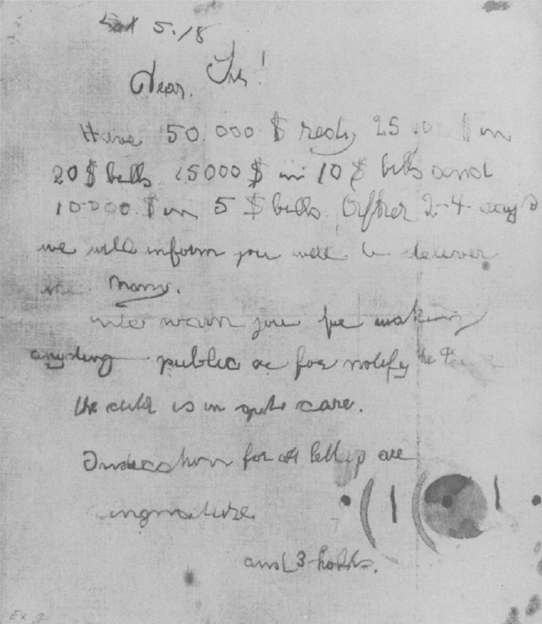
Through the night the troopers worked, waiting for daylight to permit them to extend their search into the surrounding woods. Until then, activity revolved around the nursery. Corporal Frank A. Kelly dusted the envelope for fingerprints but was able to procure only a worthless smudge. He slit open the envelope and carefully removed a single sheet of paper, folded once, which he handed to Lindbergh.
It was written in blue ink, in a strangely ornate but immature hand, full of eccentric embellishments and shaky penstrokes. “dear Sir!” it read:
Have 50.000 $ redy 25 000 $ in
20 $ bills 1.5000 $ in 10$ bills and
10000 $ in 5 $ bills. After 2–4 days
we will inform you were to deliver
the Mony.
We warn you for making
anyding public or for notify the Police
the child is in gut care.
Indication for all letters are
singnature
and 3 holes.
More difficult to decipher was an odd symbol in the lower-right corner of the note. The identifying mark consisted of two interlocking, silver-dollar-sized blue circles. In the oval formed by their intersection was a solid, penny-sized red circle. In each of the circles outside the oval was a wavy, vertical line. To the left, right, and center of these inked impressions were three square holes punched through the paper, in a straight line, one inch apart. The symbol would have to be kept secret if the Lindberghs wanted to ensure that any future correspondence was being conducted with the actual kidnappers.
Neither the notepaper nor a dusting of the room yielded a usable fingerprint, but the note itself offered enough peculiarities to provide clues about the kidnappers’ identity. The handwriting, positioning of the dollar sign, and spelling all suggested someone of European origin, probably German or Scandinavian.
First light increased the activity outside the house. A half-dozen troopers searched the surrounding woods. After twelve hours on the scene, the police had found no trace of the baby and only three clues beyond the note. Beneath the nursery window, next to the impressions left where the ladder had stood, was a shoeprint in the mud. Closer examination revealed a textile pattern, suggesting that the culprit had worn a sock or cloth bag over his shoes, to avoid leaving footprints, just as his evidently wearing gloves had kept him from leaving fingerprints. Having no ruler with him, the detective at the scene estimated the size of the shoeprint—twelve and one-half inches long and four and one-quarter inches wide. Nobody thought to make a plastercast of the print.
The second piece of evidence was a nine-and-one-half-inch-long, wood-handled, three-quarter-inch chisel, made by the Buck Brothers Company. It was found near the third, and most crucial piece of evidence outside the house—the ladder—which the police had brought indoors to examine more closely. Fearing somebody might walk off with it as a souvenir, they thought it more important to preserve the integrity of the evidence than the crime scene.
Even to the untrained eye, the extension ladder was revealing. It was homemade, crude but cunning. Each of its three pieces measured eighty and one-half inches in length, producing a ladder of more than twenty feet when assembled. It weighed only thirty-eight pounds. Considerable craftsmanship and forethought could be seen in its construction. Each of the three pieces was of a different width, so that it could nest into another, collapsing to a portable unit of six and one-half feet.
Part of the ladder had broken. One of the side rails of the center section had split along the grain, suggesting that while the kidnapper had been successfully able to climb into the nursery, the added weight of his victim was enough to crack the wood. The location of the break indicated that the kidnapper and the baby might have fallen as much as five feet to the ground.
By the time Corporal Wolf left the scene to write the Major Initial Report of the crime, he believed it must have involved at least two perpetrators. “It is obvious,” Wolf wrote, “that this crime has been carefully planned and the layout … [and] routine of the Lindbergh home studied.”
It was equally obvious, to Oren Root at least, that Lindbergh felt the need to supervise the case. The New Jersey State Police, from its chief down, was not yet old enough to have much experience in solving major crimes. One of Schwarzkopf’s detractors would later note that the only police experience he had was “as a floor-walker at Bamberger’s Department Store.” Few men on the scene that night had ever done more than write traffic citations. Corporal Kelly, dusting the ransom note for fingerprints, for example, had until recently been a road trooper. Efficient though all the police were trying to be, Root observed, “you could tell that every one of them was nervous just being in the presence of their local hero.”
For the second time in less than five years, the world revolved around Charles Lindbergh. Radio programs everywhere were interrupted and front pages of newpapers were remade, shunting the Sino-Japanese War and Congressional attempts to repeal prohibition aside. “LINDBERGH BABY KIDNAPPED FROM HOME OF PARENTS ON FARM NEAR PRINCETON; TAKEN FROM HIS CRIB; WIDE SEARCH ON,” read the headline in the The New York Times, which topped four columns on the right-hand side of page one. The back roads of central New Jersey were already crawling with reporters. Before dawn, one journalist pounded on the door of Paul T. Gebhart’s general store and hotel in Hopewell. “Wake up, Pop!” he yelled. “You’ll have three hundred here for breakfast.”
Anticipating public reaction, Lindbergh emphasized to all those within the estate walls the cruciality of controlling everything that was said and not said to the press. “I hope you boys will excuse me,” Lindbergh told the first wave of reporters, who had found their way to his secluded house in the predawn hours, “but I would rather the State Police answered all questions. I am sure you understand how I feel.”
Lindbergh ordered the immediate conversion of the Hopewell house into an auxiliary police station. A twenty-line switchboard was installed in the garage, which became headquarters. Because three dozen peace officers had been pulled from three counties to guard every entrance of the house and property, all available bedding in the house was set down in the living room and dining room, turning the ground floor into a makeshift dormitory. Lindbergh designated the guestroom for informal meetings and reserved his study for private conferences. Betty Morrow’s staff in Englewood cooked meals for forty men a day and delivered them to Hopewell.
Anne’s assignment during these first terrifying hours was to stay out of the way. Amid the bedlam, she maintained her composure in her bedroom, comforted by her mother. She wrote a long letter to Charles’s mother, and the mental exercise of setting down the details as best she knew them filled her with hope. The kidnappers’ “knowledge of the baby’s room, the lack of finger prints, the well fitted ladder,” she wrote “—all point to professionals which is rather good—as it means they want only the money—& will not maliciously hurt the baby.” That allayed her fears that a “lunatic” had taken the baby. Meantime, Anne noted, Charles, Henry Breckinridge, and the detectives appeared optimistic, thinking “the kidnappers have gotten themselves into a terrible jam—somuchpressure—such a close net over the country—such sympathy for us—& the widespread publicity.” Anne felt “dreadful” not to be able to “do anything to help”; but she found solace just in watching her “calm, clear, alert, and observing” husband.
Henry Breckinridge placed a call to a friend in Washington, J. Edgar Hoover, Director of the Federal Bureau of Investigation. Because of the initial suggestions that professionals had committed the crime, Hoover said his agents would tap into their underworld connections.
Official reaction to the crime was unprecedented, as every level of government joined forces in the most massive manhunt in history. Observed one reporter, “The world dropped its business, that day, to discuss in horrified and angry accents the most revolting crime of the century.” President Hoover and his Attorney General offered Colonel Schwarzkopf the fullest cooperation of every law-enforcement agency of the federal government, including not only the FBI but also the Secret Service, the Internal Revenue Service, and the Postal Inspection Service. Coast Guard stations were put on special watch. The Department of Commerce ordered the policing of the nation’s airports, and F. Trubee Davison, Assistant Secretary of War for aviation, placed the Army Air Corps at Lindbergh’s disposal. The Army signal corps lined the shortest distance between Trenton and Hopewell with communications cable, sometimes right across farms and fields. Customs and immigration officials from Canada to Texas, New York harbor to California went on alert. New Jersey’s Governor A. Harry Moore and New York’s Franklin D. Roosevelt offered their police resources as well.
Congress moved to the top of its agenda the pending legislation that would make kidnapping a federal offense punishable by death when two or more states were involved. Its subsequent passage became known as the Lindbergh Law.
President Hibben of Princeton drove to Hopewell to offer the resources of the university, specifically a few thousand students who were prepared to scour the woods for any trace of the baby. Lindbergh and Schwarzkopf declined the offer, for fear that amateurs might contaminate a crime scene; but undergraduate troops took to the woods anyway. Within twenty-four hours of the baby’s disappearance, it was estimated that one hundred thousand peace officers and cooperating citizens were involved in the nationwide dragnet. And that did not count the Boy Scouts of America, whose Chief Scout Executive, Dr. James E. West, called on his entire membership—past and present—“to be alert and watchful and cooperative in every way possible in seeking clues or information as to the Lindbergh baby.” That put another 914,840 boys and young men—forty percent in rural areas—into the field. William Green, president of the American Federation of Labor, urged the thousands of members of the trade unions to organize search brigades and blanket New Jersey and its neighboring states. Daniel Sheaffer of the Pennsylvania Railroad wired Lindbergh that “OUR FACILITIES ARE AT YOUR COMMAND WE ARE HAVING ALL OUR TRAINS AND STATIONS COVERED AND OUR DETECTIVE TRAIN AND STATION FORCE ARE ACTIVE.” Women’s organizations, such as the White Plains Contemporary Club, refrained from their usual activities so that they could search boardinghouses for stray children; and they urged other ladies’ groups to follow suit. Indeed, every baby in public was looked at twice by every passerby, and practically anyone seen with a blond tot was stopped and questioned. One solitary bank clerk from Trenton, driving home from a vacation out West, was pulled over 107 times just because of the New Jersey plates on his car.
“WE DONT NEED TO TELL YOU FOLKS HOW WE FEEL,” Will and Betty Rogers wired the Lindberghs. Most of the world felt the same, but many declared their feelings nonetheless. Privately, President Hoover wrote, “My heart goes out to you in deepest sympathy in your distress, and I do pray that you may speedily have your son restored to you.” Other heads of state, national legislatures, and the foreign press also expressed their sympathy. New York City’s municipal radio station broadcast a special service, in which Catholic, Protestant, and Jewish clergymen prayed for the speedy return of the child. Several state legislatures passed resolutions offering sympathy and prayers to the Lindberghs. Even the new invention of television was called into play, when Station W2XAB atop the Columbia Broadcasting Building uninterruptedly broadcast the photograph of the Lindbergh baby during the afternoon and every fifteen minutes during the evening. There were only a few thousand television receivers within the thousand-mile broadcasting radius that could pick up the fuzzy transmission; but for the first time television had instantly broadcast the image of a kidnapped person over an extensive range.
When neither a trace of the baby nor word from the kidnappers surfaced after the first day, Lindbergh felt his most critical task was in opening lines of communication with the kidnappers. He believed the media should be told that a ransom note had been left and that the Lindberghs fully intended to pay it. Anne appealed to the kidnappers’ hearts, releasing to the press the baby’s diet, in hopes that “whoever has taken the baby may see and understand the necessity for care” in light of the child’s recent illness.
On March second, a penny postcard arrived from Newark. It was addressed to “Chas. Linberg, Princeton, N. J.,” with the “J” looping backward. It said: “BABY SAFE, INSTRUCTIONS LATER, ACT ACCORDINGLY.” Even though the card bore neither the identifying symbol nor the same handwriting as the ransom note left on the window sill, its importance was in no way doubted. More than five hundred men—practically the entire Newark police force and several fire companies—were put on that one piece of potential evidence. A mail carrier had noticed it while emptying a box in the center of the rooming-house district of Newark; and he had brought it to the attention of the police, who searched two thousand homes within two square miles.
Meantime, law-enforcement officers nationwide traced countless drivers of cars that had been reported all day as appearing suspicious. Of particular interest was the observation of Benny Lupica, a student at Princeton Preparatory school, who lived a little more than a mile from the Lindberghs. On the afternoon of March first, he had gone to his R. F. D. mailbox on the road opposite the entrance to the Lindberghs’ farm. He was standing on this remote lane when a car drove by—a Dodge with what appeared to be two sections of a ladder poking out the empty right-hand side. Lupica caught a glimpse of the driver, a man with “a thin face,” wearing “a black overcoat and a fedora hat.”
The rural mail carrier from Hopewell appeared at the Lindbergh house several times a day, bringing hundreds of letters at a time. Detectives screened every item, most of which came from strangers. A man from Pulaski, Virginia, offered his pack of bloodhounds, and a veteran postal inspector from Minneapolis offered his professional services. Tips came from around the world. Astrologers and seers, from as far off as Trieste, sent accounts of their visions, while thousands of people sent accounts of their dreams in which the baby appeared—often fatally so. Crank ransom notes arrived by the thousand, mostly from people who were Depression-desperate, trying to get their hands on some cash. Kidnapping had, in fact, become one of the “big money crimes” in which the rackets trafficked—with kidnapping syndicates springing up in every major city. Four hundred such crimes had been reported since 1930 in Chicago alone.
A New Jersey bootlegger, con-man, and sometime stool pigeon named Morris “Mickey” Rosner got Henry Breckinridge on the telephone the day after the Lindbergh kidnapping. Under indictment for grand larceny in a stock swindle, Rosner said he had the contacts to ascertain who committed this crime. The next morning, he sat in the corner library in the Hopewell house with the three colonels managing the case—Lindbergh, Breckinridge, and Schwarzkopf—suggesting that two of his henchmen act as intermediaries to the criminals.
Lindbergh had been involved in enough dangerous ventures to know the imperative of backup plans. And so he elected to proceed unofficially with Rosner. Schwarzkopf was against Breckinridge’s giving this known criminal $2,500 “for expenses”; and he and “Buster” Keaten were aghast when Lindbergh also handed over the ransom note with its unusual identifying symbol of interlocking circles, the one touchstone they had to test the validity of any future communiqués from the kidnappers. But Lindbergh was so powerless that he felt obliged to follow every avenue, even down the most criminal alleys. His instincts told him there was a basic honor among thieves.
By the day after the kidnapping, there was already no question that Lindbergh was acting rashly and that he resented being forced into behaving that way. Keeping her distance, Anne thought he looked “like a desperate man”—so distraught that she was afraid even to speak to him. “It was probably the first time she realized her Lindy was not a god, but only a mortal,” Betty Gow observed. “We were all so helpless.” Anne confined her crying fits to the privacy of her bedroom.
The Lindbergh kidnapping affected every child and parent in America. The wealthy seemed prime targets, but fears did not stop there. If “Baby Lindy”—protected by servants within estate walls—could be abducted, then every child in America was vulnerable. Parents encouraged their children to come inside and play, and many were forbidden thereafter from walking even a block from home by themselves. For several generations the Lindbergh kidnapping became children’s first cautionary tale. They were told never to talk to strangers, and any adults in the vicinity of schoolyards were stopped and questioned. The House of Morgan commissioned a private force of two hundred and fifty bodyguards to protect the families of its partners.
Numerous letters streamed in to Hopewell advancing theories worthy of Agatha Christie. Some suggested that the kidnapping was the work of one of the many female admirers of Lindbergh who resented his marrying Anne Morrow. Many actually accused Elisabeth Morrow.
The absence of Anne’s older sister through most of the kidnapping crisis fueled speculation for more than sixty years that she was the perpetrator of the crime. Several people have suggested that she was mentally unstable and the family kept her locked up at Next Day Hill during this period. In truth, it was her physical, not mental, health that was failing. Her heart condition left her constantly fatigued. On top of that, on the night of the crime she was, in fact, in bed nursing an impacted wisdom tooth. Even madder theories sprang up and lingered to the end of this century. One propounded that Lindbergh himself killed his baby, accidentally or otherwise, and could not face the consequences. Such theories were based on a lack of information rather than any evidence.
Agatha Christie herself was inspired to capture some of the hysteria created by this case in her classic thriller Murder on the Orient Express. Maurice Sendak, a poor boy in Brooklyn, was so traumatized by the event that he admitted to having spent a lifetime trying to exorcise his fears through his macabre children’s books. The Lindbergh case inspired sculptor Isamu Noguchi to create his only “strictly industrial design,” the “Radio Nurse”—an intercom that served as “a device for listening in to other rooms within a house, as a precaution against kidnapping.”
“I am wondering if proper consideration has been given in the investigation … to the ‘Epileptic Colony,’ which … is located in the neighborhood,” a doctor wrote from Chicago. He observed that “it is definitely established, by members of the medical profession, who have done work with epileptics, that the outstanding characteristics are pathological irritability and revenge.” Even without the suggestion, the state home for epileptics four miles away, in Skillman, New Jersey, was investigated, as were all neighboring mental asylums and orphanages. The police obtained from the Lindberghs’ building foreman a list of everyone who had worked on the house so that they and their families could be questioned.
They also interrogated a man named Millard Whited, one of the illiterate backwoodsmen living in a shack in the Sourland Mountains. He told Lindbergh and officers Keaten, Wolf, and Lamb that on three occasions in the past two weeks he had seen a strange man nosing around the Lindbergh property. He provided specific dates and a general description of the man. When a pair of detectives later called on Whited, he declared he had never seen any suspicious people on the Lindbergh property. At every turn, the case produced a similarly surreal twist.
“No story was too fantastic for investigation,” reported The New York Times on March fourth. “No suspected place was too remote for search. The entire nation was aroused and there were stories of innocents being detained for questioning”—from Maryland to New Hampshire. A man in Long Branch, New Jersey, called the switchboard at the Lindberghs simply to present his suggestion that the famous flier use his influence with the government to obtain immunity for the kidnappers if they would return the baby unharmed. Before the conversation was completed, state troopers had the caller in custody for two hours of interrogation and another two days of investigation. Three suspicious characters who had been reported by a waitress in Pennington because they had asked for directions to the Lindbergh house the week before turned out to be newsreel photographers who simply wanted to photograph the house.
“It is impossible to describe the confusion,” Anne wrote her mother-in-law on Saturday, March fifth, “—a police station downstairs by day—detectives, police, secret service men swarming in and out—mattresses all over the dining room and other rooms at night. At any time I may be routed out of my bed so that a group of detectives may have a conference in the room. It is so terrifically unreal that I do not feel anything.”
At first, any reasonable-sounding person who telephoned the Hopewell house to say he had seen the baby was patched through to Lindbergh himself. But nobody described the baby to his satisfaction. Thousands of sightseers descended upon the Sourland Mountains, filling the streets of Hopewell from morning until night, and crowding around the entrance of the Lindbergh estate. One perfectly respectable-looking man insisted he had “a secret he would tell no one else but Anne Morrow Lindbergh.” Even he was ushered into the Lindberghs’ bedroom, where the anxious couple awaited his pronouncement. The man burst into some lines from Shakespeare, before the police carted him off.
After forty-eight hours with little sleep, insinuating himself in every aspect of solving the crime, Charles at last got a good night’s rest. It made a great difference in his attitude and, as a result, Anne’s. “He is tense and worried still,” she wrote his mother, who carried on teaching her Chemistry classes at Cass Technical High School, “but excited and buoyant.” Charles’s optimism—constantly staving off his and Anne’s worst fears by living in constant hope—dictated his every movement. Remaining active made him feel his baby remained alive.
In an attempt to nudge the abductors into making some kind of move, Lindbergh released a public statement urging them to “send any representatives that they desire to meet a representative of ours who will be suitable to them at any time and at any place that they may designate.” If that was acceptable, Lindbergh pledged not only confidentiality but also “that we will not try to injure in any way those connected with the return of the child.”
That very moment, the authorities apprehended a suspect whom they were convinced was the right man. “Red” Johnson, Betty Gow’s suitor, was taken into custody in West Hartford, Connecticut, just as another postcard allegedly mailed by the kidnapper was found in the Hartford post office. It too had the backward J in New Jersey and read, “BABY STILL SAFE. GET THINGS QUIET.” Because of his relationship with the Lindberghs’ baby nurse, he had knowledge not only of the Lindbergh house but also of the movements of all the people therein. Pouncing on his being an illegal alien, the police proceeded to find everything about the Norwegian sailor suspect. All but clinching the case for several police officers was their finding in his green Chrysler coupé—a car several witnesses had said they had seen in the vicinity of the Lindberghs’ house—an empty milk bottle! A milk-drinking sailor seemed beyond probability; and it took several people attesting to Johnson’s often drinking a quart at a time before they accepted the possibility of his innocence. The sender of the postcards was soon discovered to be a mentally disturbed young man.
After several days of relentless “grilling and criticism,” Betty Gow had also been cleared as a suspect. Because of her unusual opportunity to commit the crime, many considered her at least an accomplice if not the prime suspect. But Betty lacked motive altogether. She loved the baby as if it were her own and had been as desolated by his disappearance as the baby’s mother. Ironically, she could not help blaming herself for the crime, repeating to herself for years statements that began, “If only …” Charles felt that she and all the Lindbergh servants were completely above suspicion.
On March 5, 1932, another ransom note arrived, this one genuine, validated by the identifying symbol of interlocking circles and punched holes. “We have warned you note to make anyding Public also notify the Police,” said the note in the same wobbly hand, full of uncrossed T’s and many other idiosyncrasies in spelling, handwriting, and diction. “Now you have to take the consequences.” Because of the publicity, the note explained, their transaction would have to be postponed. “Dont by [sic] afraid about the baby,” the note added, assuring the Lindberghs that they were feeding him according to the diet and wished “to send him back in gut health.” This delay, however, meant they had to include another person in what they suggested was a conspiracy, thus necessitating an increase in their demands—to $70,000. A postscript added that this kidnapping had been prepared for years “so we are prepared for everyding.”
A virtual copy of the letter to Lindbergh arrived in care of Henry Breckinridge in New York City. While the syntax of this letter was as tentative as it had been in the first letter, the handwriting was noticeably steadier. The basic peculiarities of the cursive remained the same, but it was less crude in appearance, as if the writer was no longer trying to disguise his penmanship. This letter reiterated that the boy was being cared for; but it made clear that “We will not accept any go-between from your seid.” The Lindberghs would have to await further notification as to how the money would be delivered, but that would not occur “before the Polise is out of this cace and the Pappers are quite.”
These letters, kept from the public, thrilled Lindbergh, for they continued the dialogue that might lead to his son’s rescue. He issued another public statement announcing that if the kidnappers were not willing to deal with him and his wife directly, “we fully authorize ‘Salvy’ Spitale and Irving Bitz to act as our go-betweens. We will also follow any other method suggested by the kidnappers that we can be sure will bring the return of our child.” The newspapers explained that Bitz and Spitale were former associates of Jack “Legs” Diamond, the recently murdered gangster. The press themselves, however, were not told that Mickey Rosner had brought them into the case, so that they could act as independent agents.
In Chicago, Al Capone issued a statement while waiting to be transferred from the Cook County jail to the federal penitentiary in Atlanta to serve an eleven-year sentence. “I know how Mrs. Capone and I would feel if our son were kidnapped, and I sympathize with the Lindberghs.” To show the depth of his feelings, Capone offered $10,000 for information that would lead to the recovery of the child and the capture of the kidnappers. Amazingly, some of the nation’s most reputable attorneys urged Henry Breckinridge to allow Capone to rescue the Lindbergh baby.
Debate over the ethics of dealing with criminals raged across the country; but after meeting the “underworld kings,” Anne felt closer to them because of the sincerity of their sympathy than that which was offered by a lot of politicians, many of whom simply appeared on the Hopewell property for their own publicity, posing by the ladder, which had been releaned against the house to help the police reconstruct the crime. Charles continued to warn Anne, “never count on anything until you actually have it”; but having even miscreants on their side, she wrote her mother-in-law that the news was looking decidedly “good.”
Charles was visibly “buoyant and alive,” at last able to engage in what he considered a contest of wills, one which he believed he could win by making the right moves and by playing fairly. Feeding off his moods, Anne felt “much happier” herself, assured that their baby was safe. She wrote Charles’s mother almost daily.
Anne appreciated the fact that she was surrounded by people who were not only hopeful but also disciplined. “The tradition of self-control and self-discipline was strong in my own family and also in that of my husband,” she later wrote. “The people around me were courageous and I was upheld by their courage. It was also necessary to be disciplined, not only for the safety of the child I was carrying but in order to work toward the safe return of the stolen child.” Despite the hundreds of “dedicated people” assisting in this great effort, the Lindberghs were still stuck in the painful position of waiting, having to avail themselves to even the most improbable accomplices.
In Washington, D.C., a porcine middle-aged man named Gaston Means sat in the living room of Mrs. Evalyn Walsh McLean, one of the richest women in the world. Although he came from a distinguished North Carolina family, Means spent much of his life straddling the law. After being fired as an investigator for the Department of Justice, he took up bootlegging and eventually served time in Atlanta. Mrs. McLean was the daughter of a Colorado mining magnate, the estranged wife of the publisher of The Washington Post, and the owner of the Hope Diamond. Deeply moved by the plight of the Lindberghs, she consented to meet with Gaston Means when he called her with extraordinary news about the Lindbergh case. No fool, Mrs. McLean asked her friend “Jerry” Land—Evangeline Lindbergh’s cousin—to sit in.
During his criminal period, Means explained, he had met the leader of the ring that had kidnapped the Lindbergh baby. He said he could guarantee its safe return if he could deliver $100,000. His explanation was full of compelling detail, including the kidnappers’ insisting that a Catholic priest be the go-between. Mrs. McLean selected a local pastor and agreed to come across with the money. Jerry Land left for Hopewell, where he vouched to Lindbergh for the apparent veracity of Gaston Means. As Means’s suggestions of the underworld’s part in the crime seemed to match those of Rosner, Bitz, and Spitale, Lindbergh ordered the plan to proceed—with the understanding that he would reimburse Mrs. McLean if the transaction proved successful. The heiress withdrew the money from her bank—in old bills—plus $4,000 to cover Means’s expenses.
Meantime, in Norfolk, Virginia, John Hughes Curtis, president of the struggling Curtis Boat Building Corporation, went to the dean of Christ Episcopal Church, the Very Reverend Harold Dobson-Peacock, with an amazing story of his own. During the hard financial times, Curtis said, he had repaired the boat of a rum-runner who now claimed the kidnappers of the Lindbergh baby asked him to approach Curtis with the request that he serve as go-between. Curtis was a respected member of his community, but he did not have the credentials to reach the Lindberghs themselves. He knew, however, that Dobson-Peacock had become acquainted with the Morrows when he had been rector in Mexico City. Curtis’s story convinced the Reverend to place a call to the Lindberghs. He proved unable to get past a personal secretary who identified himself as Morris Rosner. The inmates had taken over the asylum.
Undeterred, Curtis followed another path to the Lindberghs’ door. Living in Norfolk was retired Admiral Guy Hamilton Burrage, the former commander of the Memphis, the cruiser that had carried Lindbergh home from Paris in 1927. Curtis convinced Burrage to reach Lindbergh. After proving his identity to him, Burrage put Curtis on the phone. But Lindbergh remained strangely noncommittal, leaving the puzzled Burrage to suggest to Curtis and Dobson-Peacock that they compose a letter requesting a meeting in New Jersey.
The reason for Lindbergh’s hesitancy was the sudden entrance of an even more clownish character into what had become a three-ring circus—John F. Condon. A former school principal, Mathematics teacher, and a Doctor of Pedagogy, the seventy-one-year-old Condon was a walrus of a man, with a bristly white mustache and large torso. He usually dressed in dark, three-piece suits and a black bowler, which he replaced with a straw boater in the summer. He was a flag-waving patriot and an habitué of the YMCA, where he refereed local athletic events; he still coached students at Fordham University in swimming, boxing, and body-building. Condon was so incensed that his hero Charles Lindbergh had to consort with common criminals in order to get his son back that he decided to do something about it.
Unsolicited, this lifelong resident of the Bronx offered his services as a go-between by sending a letter to his local newspaper, the Bronx Home News. Bumptious, verging on the foolish, Condon wrote in purple ink in a handwriting as flowery as his language, “I offer all that I can scrape together so a loving mother may again have her child and that Colonel Lindbergh may know that the American people are grateful for the honor bestowed upon them by his pluck and daring.” He offered $1,000 of his own to garnish the suggested $50,000 ransom money demanded of the Lindberghs. “I stand ready at my own expense,” he added, “to go anywhere, alone, to give the kidnapper the extra money and promise never to utter his name to any person.”
Condon was a minor celebrity in the Bronx. A subsequent FBI investigation found that his neighbors considered him “an altruistic and honorable educator…. On the other hand he also has the reputation of being somewhat of an eccentric, some persons even going so far as to state that he is a ‘nut.’” The Bronx Home News, with its circulation of 150,000 readers, had been running his letters, poems, and essays for years, often under his pseudonyms P. A. Triot and J. U. Stice. Many accused him of being a self-important windbag; others respected him for putting his money where his mouth was. Neither Lindbergh nor the New Jersey State troopers knew of his offer.
On the night of March ninth, Condon returned to his modest two-story house in the tree-lined Bedford Park section of the Bronx and found a personal letter addressed to him, printed in a neat but childlike scrawl. “dear Sir,” it read:
If you are willing to act as go-between
in Lindbergh cace pleace follow stricly
instruction. Handel incloced letter personaly
to Mr. Lindbergh. It will explan everyding. don’t
tell anyone about it as son we find out the Press
or Police is notifyd everyding are cansell and it
will be a further delay. Affter you gett the money
from Mr. Lindbergh put these 3 words in the New-York American
Mony is redy Affter notise we will give you
further instruction don’t be affrait we are not
out fore your 1000$ keep it. Only act stricly. Be at
home every night between 6–12 by this time you will
hear from us.
Enclosed was another sealed envelope, addressed to Lindbergh. Because of the poor handwriting, Dr. Condon considered the note to him a “crank” letter. But he thought he should get a second opinion from a few friends.
Condon took a trolley to a restaurant he frequented on the Grand Concourse near Fordham Road. He showed his letter to Max Rosenhain, the proprietor, who suggested they confide in another friend, who had a car, a clothing salesman named Milton Gaglio. They persuaded Condon to call the Lindbergh estate in New Jersey. Robert Thayer, a young attorney, came on the line. He asked Condon to read the note addressed to Lindbergh; and upon his describing the strange hole-punched symbol at the bottom of the page, Thayer asked him to come immediately to Hopewell.
Around midnight, the three men left in Gaglio’s car, stopping at the Baltimore Lunch Room in Princeton for a cup of coffee. They phoned the Lindbergh house to announce their imminent arrival and got directions to Hopewell from a policeman. Barely into the town, they were met by Colonel Breckinridge, who guided them to the house.
A little before three A.M., Breckinridge escorted Condon, Rosenhain, and Gaglio through the kitchen door of the Lindbergh house. Breckinridge took Condon to the nursery upstairs, which Lindbergh entered. Condon presented the two letters, the authenticity of which was obvious on sight. They agreed that Condon should serve as the official go-between.
Condon’s rendition of the next few hours involved his insisting on meeting Mrs. Lindbergh and admonishing her against crying—“If one of those tears drops, I shall go off the case immediately.” They did, in fact, meet, after Lindbergh suggested he spend the night there. There was not enough room to accommodate Gaglio and Rosenhain as well, so they departed. As it was, Condon spent the night on the floor in the baby’s nursery, on a mattress covered in Army blankets.
The next morning, Condon removed the two safety pins which still held down the blankets in the baby’s crib and a few of his toy animals—a lion, camel, and elephant. He told Lindbergh and Breckinridge that he wanted to use them as means of identifying both the kidnappers and the child, by asking the kidnappers where they last saw the pins and to watch the child’s reaction to the toys. He asked if the baby could identify the animals; and Lindbergh said his reaction to the first two animals would reveal nothing, but that his son called the third animal an “elepunt.”
After breakfast, Lindbergh entrusted the man from the Bronx with a one-sentence letter authorizing him to serve as go-between. Breckinridge drove Dr. Condon home—during which time he found his passenger fatuous but trustworthy. Condon placed the advertisement in the New York American as instructed, but because he was a well-known local figure, they agreed he should use an alias in the advertisement. John F. Condon suggested an acronym from his initials—Jafsie. With the appearance of the first “Jafsie” ad, hope returned to the Hopewell house.
“There really is definite progress. I feel much happier today. It does seem to be going ahead,” Anne wrote Mrs. Lindbergh after a lachrymose week. Even though she had tried to stifle her sobs with her pillow, Charles had heard them more than once and upbraided her in “sharp” tones, suggesting that sorrow implied hopelessness.
Confident though he was about the Jafsie connection to the kidnappers, Lindbergh still desperately welcomed anyone claiming the vaguest connection to his child. In the middle of one night, he met with a manacled convict from a nearby prison, who claimed to have information about the baby. Under the third degree from Lindbergh and the police, he broke down, proving to be yet another fake who, in the words of Betty Morrow, “wanted a joyride & the fun of seeing Lindbergh.” When the renowned psychic Edgar Cayce, of Virginia Beach, suddenly had a vision of the baby’s whereabouts, the FBI sent two special agents to an address he had conjured in East Haven, Connecticut. This trail came to a dead end, as neither the street nor anybody by the name he mentioned even existed.
The New Jersey police continued investigating even more vaporous leads. And they aggressively interrogated all the members of the Lindbergh and Morrow staffs. One of the waitresses at Next Day Hill, Violet Sharpe, seemed pivotal because she had known that Mrs. Lindbergh had asked Betty Gow to come to Hopewell on March first. In her police interview she came across as unusually high-strung. When the police tried to pin her down on the details of her date on the night of the kidnapping, she turned forgetful and even a little truculent. A search of her room revealed nothing unusual other than a bank book that showed a balance that was more money than she earned in a year.
In the early afternoon of Friday, March eleventh—just hours after Jafsie’s first ad appeared—Dr. Condon’s telephone rang. He was out, lecturing at Fordham. Mrs. Condon told the caller—whom she said had “a thick, deep, guttural accent”—that her husband would be home at six o’clock. Sometime around seven the phone rang again, and a man with a German accent asked, “Did you gotted my letter with the sing-nature,” unwittingly revealing himself as the author of the original ransom note, which spelled the word as he mispronounced it. They conversed for a few minutes, with the German caller instructing Condon to be at home between six o’clock and midnight every night that week, at which time he would receive his next set of instructions. Condon heard voices in the background, including one shouting in Italian, “State zitto,” which meant “Shut up.” Breckinridge spent the night at the Condons’. Between bouts in Madison Square Garden that night, the announcer asked the crowd of fifteen thousand to stand in silence for three minutes and “pray for the safe return” of the Lindbergh baby. “I think it is thrilling to have so many people moved by one thought,” Anne wrote of the communal prayer, happily recalling that similar invocations had helped deliver her husband to Paris in 1927.
The next evening at six, Breckinridge and Al Reich returned to 2974 Decatur Avenue. At 8:30, a cab driver named Joseph Perrone rang the doorbell and handed a letter to Dr. Condon, whose name and address were written in what had become familiar scrawl. “We trust you but we will note come in your Haus it is to danger,” it said. “even you can note know if Police or secret servise is watching you.” The cabbie waited at the door while Condon and Breckinridge read the instructions that followed: Condon was told to drive to the last subway station along Jerome Avenue; one hundred feet beyond, on the left side, he would find a vacant hot-dog stand with an open porch surrounding it; in the center of the porch, he would find a stone; and under the stone, a notice would tell him where to go next. The note also told Condon to bring the money with him—in “¾; of a houer.” It was validated with the strange symbol.
Breckinridge was taken aback. It was a Saturday, and he said it would be days before he could have the money in hand. Regardless, Condon said he must keep that appointment. As he got into Al Reich’s Ford coupé, Breckinridge urged him to be careful, reminding him that he was dealing with criminals. Breckinridge questioned the driver and learned that he had been hailed on Gun Hill Road at Knox Place by a man in a brown topcoat and a brown felt hat. After asking in a pronounced German accent whether Perrone could find 2974 Decatur Avenue, he had handed him the letter and a dollar bill.
It was little more than a mile to the Woodlawn station at the end of the IRT’s Jerome Avenue line. There was no confusion finding the next set of instructions. Heading back toward the car, Condon stood beneath a streetlamp to read the note aloud, so that Al Reich could hear it as well. “Cross the street and follow the fence from the cemetery direction to 233rd Street. I will meet you.” The tall, heavy-iron fence staked the western border of the four-hundred-acre Woodlawn Cemetery, separating the historical graveyard from Van Cortlandt Park. As Al Reich drove Condon toward the main entrance of the cemetery, he nervously kidded, “When they shoot you, they won’t have to carry you far to bury you.”
Condon waited at the big front gate, rereading the instructions and checking his watch. It was 9:15. A man approached him on Jerome Avenue, but walked right by. After another fifteen minutes in the cold, Condon saw a white handkerchief being waved through the bars of the gate from inside the cemetery. Condon approached, as the man with the handkerchief darted among the gravestones. He was bundled in an overcoat, had the brim of his fedora pulled down over his eyes, and held the handkerchief over his nose and mouth. “Did you gotted my note?” he asked. “Have you gotted the money?” Condon, recognizing the voice from their telephone conversation, said no, that he could not bring the money until he saw the baby. Suddenly, both men heard footsteps inside the cemetery. The man in the shadows feared the police. Condon insisted that he had not involved them; but in an instant, the stranger climbed over the fence, said it was too dangerous to meet, and ran up Jerome Avenue.
It had been a uniformed cemetery security guard. After assuring the guard that everything was all right, Condon pursued the man himself. Well into Van Cortlandt Park, at the southern tip of its lake, the man let Condon catch up with him. “You should be ashamed of yourself,” Condon reported having said. “No one will hurt you.” But the man worried that he could be sentenced to thirty years if caught, that he might even “burn.” And, he explained, he was only a messenger from the actual kidnappers.
With his hat pulled down and his coat collar turned up, the man walked with Dr. Condon to a bench near a tennis shack, where they sat. “What if the baby is dead?” the man asked, voicing a thought nobody in the case had yet uttered. “Would I burn if the baby is dead?” Taken aback, Condon asked why they were meeting if the baby was dead. The man with the concealed face assured him that the baby was not dead, that, in fact, he was being fed better than the diet in the newspaper had prescribed. Still he wondered, as he asked again, “Would I burn if I did not kill it?” He hastened to add that the Colonel need not worry, that “The baby is all right.”
Condon tried to ascertain that he was speaking with someone in direct contact with the child. “You gotted my letter with the singnature,” he said. “It is the same like the letter with the singnature which was left in the baby’s crib.” Condon hesitated, because he understood the ransom note had been left on the windowsill. But it reminded him to produce the safety pins he had taken from the crib and to ask the man if he had ever seen them before. The man correctly identified them as the pins fastening the blankets to the mattress.
According to Condon, they entered into a friendly chat. The man imparted that his name was John, that he was from Boston, that he was a sailor, and that he was Scandinavian, not German. Condon did his best to engage “John,” hoping to disarm him enough to provide information and perhaps a good look at his face.
They talked for more than an hour. John seldom lowered his guard, but Condon was at least able to discern that the man before him was probably in his mid-thirties, a lean five-foot-nine, a middleweight of 160 pounds, with a smooth, unblemished triangular face—high cheekbones and a small mouth, and deep-set, almond-shaped, blue-gray eyes. John said that the baby was on a “boad” some six hours away by air in the care of two nurses. He said the gang included a head man, who would take $20,000 of the ransom, while his three henchmen and two nurses would receive $10,000 each. He said neither “Red” Johnson nor Betty Gow was involved in the crime. Condon tried to get John to turn on the gang and come clean with the police, but he resisted. He said this crime had been planned for a year, and he stuck to his mission of convincing Dr. Condon to come forth with the money. To prove to his leader that he had performed his task, he told Condon to take another ad in the Bronx Home News, saying, “BABY IS ALIVE AND WELL. MONEY IS READY.” Because Condon insisted on a “cash-and-delivery” deal, John said that on Monday he would send proof that his gang was holding the actual baby. The two men shook hands on their agreement. At 10:45 John stole off into the woods almost as mysteriously as he had appeared.
Reich drove Condon home to Decatur Avenue, where Henry Breckinridge waited to hear every detail. The attorney was struck by John’s saying that the crime had been planned for a year, for that repeated what had been said in one of the ransom notes that Condon had never seen. Breckinridge was convinced that they were in touch with the actual kidnappers. Al Reich added that he got the distinct impression that the man who had walked by Condon on Jerome Avenue—whom he described as medium-sized and Italian—was in cahoots with “Cemetery John” and had probably signaled Condon’s approach. Although he was never able to see John’s face completely, Condon asserted that he could identify him if he saw him again.
Lindbergh refused to allow himself to believe the best, but he told his wife and mother-in-law that he considered the situation “very very good.” During this crucial period of secret negotiations the press banged out new stories, which threatened to frighten the kidnappers back into hiding. Gangster Mickey Rosner was suddenly telling interviewers that the baby was all right. Then, without anyone’s foreknowledge, the New York Daily Mirror anounced that prominent attorney Dudley Field Malone would act as an official intermediary delivering a $250,000 ransom. That seemed sure to stop the kidnappers from accepting the pittance they were about to settle on. Further rumors circulated that the Daily News itself may have engineered the kidnapping, because, as Betty Morrow noted in her diary, “the tabloids hate C. so!”
For several days everybody waited. As instructed, Condon placed an ad in the March thirteenth Bronx Home News: “BABY ALIVE AND WELL. MONEY IS READY. CALL AND SEE US. JAFSIE.” It brought no response. On March fourteenth, they ran another ad, stating: “MONEY IS READY. NO COPS. NO SECRET SERVICE. NO PRESS. I COME ALONE LIKE THE LAST TIME. PLEASE CALL. JAFSIE.” Getting no reply, they ran it the next day. Still receiving no reply, they amplified the statement: “I ACCEPT. MONEY IS READY. YOU KNOW THEY WON’T LET ME DELIVER WITHOUT GETTING THE PACKAGE. PLEASE MAKE IT SOME SORT OF C.O.D. TRANSACTION … YOU KNOW YOU CAN TRUST JAFSIE.”
The kidnappers might have had doubts. During those anxious days of waiting together, Condon and Breckinridge shared two minor suspicious incidents. One day a short, young Italian came to the house selling needles. The two men answered the door and Condon purchased some. When the Italian departed, Breckinridge observed that he left the block without stopping at a single other house. An hour later, another Italian appeared at the Condons’, this one carrying grinding equipment. Breckinridge thought he “looked the part of a scissors grinder,” and so they gave him a knife and a few household items to sharpen, for which Condon paid him a quarter. Like the needle salesman, the scissors-grinder left the block without soliciting any other business. Breckinridge believed one or both men were emissaries of the kidnappers, determining how guarded the house was.
Back in New Jersey, H. Norman Schwarzkopf was taking heat from the public. Having acceded to Lindbergh’s demand that he say nothing of the covert operation in the Bronx, he appeared to be making no progress in the Lindbergh case. All the sources of his State Police—both legitimate and underground—were drying up. Spitale and Bitz and Rosner were coming up empty-handed. Police from New Jersey were being routinely dispatched to Maryland, Tennessee, and Kentucky to check on sightings of the Lindbergh baby, but none returned with encouraging news. Schwarzkopf even took to the radio, appealing for the nation’s assistance. Lindbergh continued to trust him “absolutely,” finding him wonderful to deal with despite “hundreds of complications and difficulties, pressure of the press, petty jealousies, interference of politics, etc. etc.” With the first warm days of March, tourists flocked to the Lindbergh house. Barnstormers operating out of Hopewell’s emergency airfield offered sightseers the opportunity of flying over the estate for $2.50.
On March 16, 1932, a package mailed from Brooklyn arrived at Dr. Condon’s house. Recognizing the handwriting, he notified Breckinridge, who came from his office and opened it. Inside was a laundered, gray wool Dr. Denton sleeping suit, size 2. Breckinridge called Lindbergh and asked him to come to the Bronx to identify it. An accompanying note, complete with the signature of interlocking circles, said that circumstances now forbade the direct swap Condon had proposed, that the baby was well, and that eight hours after receiving their $70,000, the kidnappers would notify Condon where to find him. “If there is any trapp,” it concluded, “you will be responsible what will follows.” At 1:30 in the morning Lindbergh—in the hunter’s cap and large glasses he had worn to slip by the reporters—arrived at Dr. Condon’s. He examined the sleeping suit and said, “It looks like my son’s garment.”
Lindbergh was so excited he wanted to pay the ransom immediately. Condon asked if they should not see the baby before paying; but the boy’s father felt time was becoming their greatest enemy, as it infuriated the kidnappers and gave the press the opportunity to discover these secret negotiations. They would have to take the kidnappers at their word. Condon proposed that their ad at least suggest the need for “some sort of C. O. D. transaction”; but Lindbergh was adamant. The March eighteenth edition of the BronxHome News ran the simplest response possible: “I ACCEPT. MONEY IS READY. JOHN, YOUR PACKAGE IS DELIVERED AND IS O.K. DIRECT ME.”
In his anxious efforts to move the “transaction” along, Lindbergh made a heartfelt plea to the press. He said that he believed the return of the baby was being delayed by the “vast amount of space devoted to the case by the press of the country.” He asked, in this most sensitive moment, “that beginning at once the papers confine their accounts of the case to three hundred words each day, and that these brief stories be printed in single column form to effect a minimum of typographical display.” The request was observed, for a while: “Telephone calls are fewer, letters are fewer—the reporters no longer trail us,” Anne wrote her mother-in-law—“the publicity is dying down…. things are quieter every day—so we sit & wait & hope. C. is cheerful.”
As for herself, Anne had been rendered virtually devoid of feeling and suspended in time. Since the night of March first, she had hardly experienced all the emotional ups and downs because she had entered a kind of trance state, for self-protection. Charles had kept her uninformed about most of the efforts being made to retrieve their baby and he still insisted she cry alone, whenever she found the energy. “I have a sustained feeling—like a high note on an organ that has got stuck—inside me,” she wrote her sister Elisabeth. “The time since then has been all in one mood or color, no variation … It is just that night elongated. Of course, it has superficially been different. Every second, like a dream, the whole scene swings, melts, changes. Personalities change from black to white, faces look different, tones are different, the tempo of the activity speeds up and slows down, but always that high note that got stuck in the organ Tuesday night!”
On March twenty-second, at one o’clock in the morning, Lindbergh called his house from New York to say that someone was coming out in Colonel Breckinridge’s car. He said the passenger especially wanted to see her and Betty Gow, and also Whateley and Elsie. He asked Anne to be awake and dressed and to admit the visitors at once. Although Charles spoke in his usual guarded tone, Anne could not help reading between the lines of her husband’s message. She excitedly awakened her mother, who was staying at the house, and they prepared themselves, feeling their ordeal was almost over. They lay on Anne’s bed until three in the morning, when they heard the car pull up the driveway.
But when they rushed down to see the baby, they found instead “a dark dreadful looking man”—one Murray Garsson of the Labor Department. He and his assistant were investigating the kidnapping, claiming they could solve the mystery in forty-eight hours. They vigorously questioned everybody in the house until dawn. The worst part, observed FBI Special Agent J. M. Keith, was when Garsson “ordered Mrs. Lindbergh to show him the furnace, accompanied her to the cellar, and in her presence began poking around in the ashes … leaving the plain inference that the Lindberghs themselves had killed the youngster and burned the body.”
The Jafsie ads continued to run in the Bronx newspaper, but they elicited no response. Meantime, Condon picked up a wooden box he had ordered, made according to the specifications the kidnappers had dictated, while Lindbergh worked with the Morgan Bank on the box’s contents. Speaking only to Morgan partner Thomas W. Lamont, then considered the most powerful man on Wall Street, Lindbergh had the bank bundle the first $50,000 worth of ransom as stipulated in the notes. For three restless days, Condon kept the money in his house. Then he took it to the Fordham Branch of the Corn Exchange Bank, where he learned that no special account had to be opened, that it was simply there subject to his call.
The case dragged toward its second excruciating month, with Lindbergh still calling all the shots. He listened to his inner circle of advisers, but the only man to effect any change in his behavior proved to be the unimposing head of the Law Enforcement Division of the Internal Revenue Service. Elmer Irey, who had the further distinction of being the man who had outfoxed Al Capone, understood Lindbergh’s intention to hand over money without any guarantee that the baby would be returned. But he insisted that the serial numbers of the bills be recorded.
Irey further suggested that America would probably be going off the gold standard soon, calling in all its gold coins and currency. That being the case, he suggested that the ransom be paid in gold certificates, virtually identical to regular bills except for a round, yellow seal. Even if the country did not change standards, Irey suggested that the gold certificates would be easier to spot. Surely, Irey argued with Lindbergh, if the baby were returned, there was no reason the state should not exercise its duty to pursue the criminals. Lindbergh allowed the bundled money to be removed from the Bronx to J. P. Morgan & Company, where more than a dozen bank clerks and Treasury agents tied and banded another 5,150 bills, divided in two packets. They kept samples of the string and bands they used, for future identification in the event that the money should be recovered.
Seeing how any dealings forced Anne to face the reality of the crime, Charles continued to shield her as much as possible, excluding her from most of the details. She knew almost nothing, for example, of the meeting Charles held in the house with Admiral Burrage, Reverend Dobson-Peacock, and John Curtis, who arrived from Norfolk. Lindbergh did not believe that Curtis was in contact with the actual kidnappers; but, as always, he kept creating options for himself. He asked Curtis to obtain either a current photograph of the baby or a message with some kind of symbol that might suggest they were the right party. If nothing else, Lindbergh knew his meeting with the three men from Virginia would shift public attention to them and away from the secret negotiations in the Bronx.
Anne took part in a séance in the nursery with a medium from the New York Society for Psychical Research—who spoke intriguingly of three men and two women being involved, including Italians, Germans, and Scandinavians; but the episode only made her withdraw further from the specifics of the case. She chose to focus instead on the future. Mid-pregnancy, she realized that was the only way she could keep herself healthy for her second child. She thought of the white tulips she had planted—“so pure and clear and fresh”—and could hardly wait for them to flower, as though they harbingered happier times. As March came to an end, she resumed “regular life” as best she could. With the first tips of flowers poking through the warming ground, she exercised patience, even though the ad from Jafsie declaring “MONEY IS READY” had appeared every day for a week without a response. Anne’s mother did not tell her that one afternoon a black crow had flown into the nursery and perched on the baby’s crib.
The last day of March abounded with good omens, even though they were at cross purposes. In Washington, Gaston Means had given Evalyn Walsh McLean every reason to believe that the $100,000 she had surrendered was about to bring the Lindbergh baby home. Meantime, John Curtis was claiming that he had just received a letter from the gang with which he had been dealing, and they had lowered their demand to $25,000. That night Colonel Schwarzkopf told Anne and her mother that the police had made contact with a man who claimed to have seen the baby and that he was “safe & well,” that they knew who the kidnapper was, and they were just waiting for the baby’s return before apprehending him. And after a month of hundreds of people canvassing the Lindbergh estate, Betty Gow discovered one of the baby’s thumbguards along the gravel driveway, which everybody grasped as a talisman. Lindbergh himself quietly left for a Morrow townhouse at 2 East Seventy-second Street, where he said he would be staying for several days, the surest sign to Anne that the exchange was at last imminent.
On Friday, April first, Condon received a letter which contained another addressed to Lindbergh. It instructed him to have the money ready—“in one bundle”—by the following evening, at which time he would be given further instructions. If this was acceptable, the note read, he should state in the New York American, “YES EVERYTHING O. K.” The ad appeared the next morning. Lindbergh informed Colonel Schwarzkopf that the drop was about to occur, but he forbade the police chief from taking any part in the operation.
After spending Friday night in Hopewell, Lindbergh drove to the Bronx early Saturday afternoon, carrying $50,000 with him. As a security measure, he sent a package of $20,000 in another car. Lindbergh tried to pack all the ransom money into the wooden box Condon had ordered, but it would not fit. It could accommodate all $70,000 only by raising the lid and tying the box shut with cord. For the next six hours Lindbergh, Condon, Breckinridge, and Al Reich waited. Lindbergh, like Condon’s wife, feared for the old man’s life and assured him he no longer had to proceed with his duties. But Condon would not hear of backing out, saying, “I want to see those little arms around his mother’s neck.” Lindbergh, who intended to be his driver, was carrying a small handgun.
At 7:45 a letter arrived by cab—instructions to Condon to proceed to a flower shop at 3225 East Tremont Avenue in the East Bronx, where further orders would be waiting under a rock. Lindbergh drove Al Reich’s Ford to the address, J. A. Bergen Greenhouses, where Condon found the next message. He returned to the car and they read the note by flashlight. Several people walked by, but one of them—about thirty years of age, five-foot-nine, 155 pounds, with dark complexion—in a brown suit and brown felt hat with a snap brim caught Lindbergh’s attention. “He walked with an unusual gait rather awkwardly and with a pronounced stoop,” he later recalled in a confidential statement to the New Jersey police. “His hat was pulled down over his eyes. As he passed the car, he covered his mouth and the lower part of his face with a handkerchief, and looked at Dr. Condon and at me.” The note told Condon to cross the street and walk to the next corner, then to follow Whittemore Avenue.
Lindbergh wanted to accompany Condon, but the latter pointed out that the note said to come alone. Instructions to the contrary, Condon did not carry the money with him. He walked to Tremont and Whittemore, which marked the northern tip of St. Raymond’s Cemetery. He spoke to a man with a little girl at the unmarked intersection, asking if that was Whittemore Avenue, but they did not know. Seeing nobody else around, he headed back to the car. Halfway across the street, a voice came from the cemetery. “Ay, Doctor,” he said. “I could hear the call distinctly,” Lindbergh would later affirm, even though he was a few hundred feet away, “and the ‘Doctor’ was pronounced with a definite accent.” Condon walked down Whittemore on the cemetery side of the street.
Condon could see the man cutting across a road within the cemetery. When they finally caught up with each other, the man cried, “Here I am, Doc.” Standing just a few feet apart, Condon recognized the man as “John” from Woodlawn Cemetery. “Have you gotted the money?” he asked. “Yes, it is in the car,” he replied.
John asked who was in the car, and Condon told him Colonel Lindbergh. John asked if he was alone, and Condon replied that he always kept his word. He asked John where they had met before, and John correctly said at Woodlawn Cemetery. When John asked for the $70,000, Condon explained that times were hard and Lindbergh had a difficult enough time raising the $50,000 the kidnappers had originally asked for. “Well, I suppose that we will be satisfied to take fifty thousand,” John told Condon, “and in six hours I will send you the note telling where the baby is.” Condon said he could not agree to that, that he would rather go with John as a hostage until they were satisfied with their money. Short of that, Condon suggested a simple exchange of the directions for the money.
Back at the car, Condon explained to Lindbergh that he had talked John out of the extra $20,000. Lindbergh appreciated the gesture but did not wish to upset the kidnappers in any way. Condon returned to the hedge where they had just met and waited for John. From his vantage point, Lindbergh could not see either man; but he did see, across the street, the same man he had seen earlier near the Bergen greenhouses. Using his handkerchief, the man blew his nose—loudly enough to be heard by Lindbergh and, he presumed, anyone else in the area.
Down Whittemore Avenue, Condon handed the box with $50,000 over the hedge to John with his left hand and accepted a sealed envelope with his right. John thanked him and said that “all were satisfied” with his work. He got down on his knees and inspected the money, pulling out a sheaf of bills from the middle of the box. He arose and told Condon not to open the note for six hours. He shook Condon’s hand over the hedge, thanked him, and disappeared among the headstones in the dark. As Condon hastened back to the car, Lindbergh noticed the man blowing his nose did not put his handkerchief in his pocket but threw it down instead, beside the sidewalk. Then he disappeared.
“The baby—where is the baby?” the anxious father asked. Condon handed Lindbergh the sealed note and told him of his promise to wait before opening it. To Condon’s surprise, Lindbergh resisted tearing the envelope open, even as they drove off. Not far from the cemetery, they approached Westchester Square, with its Kiddy Corner. Condon suggested they pull to the side of the road. He argued that while he had given his word not to open the letter, Lindbergh had made no such promise. Out of the envelope he pulled a six-by-five-inch scrap of paper with five short sentences—the first definitive indication in thirty-two days of his son’s whereabouts.
The boy is on Boad Nelly. It is a small boad
28 feet long. Two person are on the Boad. The
are innosent. you will find the Boad between
Horseneck Beach and gay Head near Elizabeth Island.
Lindbergh knew those waters—between Martha’s Vineyard and the Massachusetts mainland—from his honeymoon.
They returned to Condon’s house in the Bronx, where they informed Breckinridge and Al Reich of the transaction. Word was transmitted in code to the house in New Jersey that the money had been handed over. But those in Hopewell did not understand that “no tooth” meant they did not have the baby.
Lindbergh, Breckinridge, Condon, and Reich drove to the Morrow town-house on Seventy-second Street, where they met several investigators from the IRS. A chuffed Condon boasted that he had saved Colonel Lindbergh $20,000 by withholding the smaller packet of money. Elmer Irey, the IRS crime-buster, explained how Condon had blundered, that the smaller packet was composed of fifty-dollar bills which had purposely been banded together because they would be easiest to spot.
Lindbergh went to the telephone to arrange for Navy airplanes to assist in the search for the boat Nelly. He asked that a Sikorsky seaplane be brought to the airport at Bridgeport. At two in the morning, Breckinridge, Irey, Condon, and Reich drove with him to the Connecticut airstrip, from which they took off at sunup. Al Reich remained on the ground, driving Lindbergh’s car to the Aviation Country Club on Long Island, where a trusting Lindbergh intended to land with his baby.
All morning, Lindbergh buzzed the water, circling the tiny Elizabeth Islands low enough for his passengers to get a good look at every boat that even approximated the description of the Nelly. A half-dozen Coast Guard cutters joined in the search. As noon approached, they became less choosy in their pursuit, chasing after anything afloat. As night fell, they landed on Long Island and piled into the car, silent and empty-handed. Lindbergh deposited his passengers in New York before continuing alone to New Jersey. As he dropped off Condon and Reich, he spoke at last—saying, “We’ve been double-crossed.”
Upon arriving in Hopewell, he spared Anne as much as possible, relating the last day’s events in hopeful obfuscation. He suggested that the kidnappers invented the story about the Nelly as a ruse to buy them extra time to escape or perhaps as a lever to pry more money out of them.
The next day Lindbergh and Henry Breckinridge took off from Teterboro Airport in Lindbergh’s Lockheed Vega. They returned to the area they had scoured the day before, widening the circumference of their scope with each hour. By dusk, they found themselves off the coast of Virginia.
After Charles’s second day of futile searching, Anne’s mood changed dramatically. For the first time in the five weeks that her baby had been missing, her mother observed, “she acts as if she had given up hope.” With Lindbergh’s approval, Dr. Condon placed a new ad in the Bronx Home News, which would run for the next two weeks: “WHAT IS WRONG? HAVE YOU CROSSED ME? PLEASE, BETTER DIRECTIONS. JAFSIE.”
Since the kidnapping, the Lindberghs had received almost forty thousand letters. While some included contributions toward the ransom, most contained useless information and advice. The most preposterous of those who wrote were divided into several categories of their own, including “wheels” (mental cases, whose wheels one could see spinning) and “butterflies” (clues that led nowhere). The hundreds who claimed they would deliver the child if the Lindberghs would only pay them slowly awakened Anne from her nightmare—in anger. With the mail at last dropping to a few hundred letters a day, even the newspapers had run out of articles to write. “We have been rather gloomy lately,” Anne wrote her mother-in-law in early April. “We are now living from day to day but realize we must look forward to weeks.”
The press pieced together much of the preceding week’s scenario. Reporters had sighted Lindbergh looking despondent; and people in the Bronx wondered if John F. Condon was not the Jafsie whose cryptic messages had been appearing in the paper all month.
Lindbergh felt a statement had to be released to the press. Colonel Schwarzkopf officially acknowledged that a $50,000 ransom had been paid and that the kidnappers had failed to return the baby or identify his whereabouts. Privately Lindbergh conferred with the major press services, asking them to soft-pedal the story, especially that the Treasury Department was actively hunting for the marked bills, distributing to banks a fifty-seven-page pamphlet listing the serial numbers. Within a day, the kidnapping was again front-page news. “That we can’t keep anything private is most discouraging,” Anne wrote Charles’s mother. “Although things are bad they are not hopeless,” she added, clinging to her husband’s Gibraltar-like optimism.
The mysterious “Jafsie” came out of hiding, thriving on every minute in the limelight. To keep his phone from ringing off the hook, he had his number unlisted. While Lindbergh appreciated Condon’s diverting attention from Hopewell, he regretted that it rendered him useless any longer as a go-between.
With little beyond stray clues to follow, the police returned to the Lindbergh and Morrow houses, where they again questioned members of the staff. They delved especially into the personal life of the evasive Violet Sharpe, but they came up with nothing.
Nobody followed the new barrage of stories more closely than Evalyn Walsh McLean. After reading of the Jafsie drop in the Bronx and hearing about John Curtis in Norfolk, she demanded that Gaston Means account for himself and her $100,000. Means told her that Curtis’s gang, Jafsie’s gang, and the one to which he was an intermediary, were all one and the same, and that the only reason the baby had not been returned was that the gang realized the money was “hot.” Insisting he had actually held the Lindbergh baby in his arms, he offered to take Mrs. McLean on his next mission to recover him. After accompanying Means to South Carolina and El Paso, and being told that the gang was demanding another $35,000, she realized that she was being swindled. When she demanded her $100,000 back, he said that it was too late, that he had just given it to one of the kidnappers. Mrs. McLean called her attorney, who called J. Edgar Hoover. Means would soon be indicted.
For days, no important leads surfaced, and despondency engulfed the Lindbergh estate. Then, on April sixteenth, John Curtis of Norfolk announced that the baby was safe!
Two days later, Lindbergh received Curtis in his study in Hopewell and heard a new installment to his story of the gang—five Scandinavian men—with which he had been communicating. Like Gaston Means, he said there was but one gang, and the man named John, whom Dr. Condon had met, was its leader. The conspiracy also included a German woman, a trained nurse, who wrote the ransom notes. Curtis said he had met John at his house in Cape May, at the southern tip of New Jersey.
According to Curtis, John said the plot to kidnap the baby originated “in the household,” with an employee, and that the kidnappers had been to the scene of the crime two or three times before March first. He said he and another man had climbed the ladder, chloroformed the baby, and carried him through the house and right out the front door. He said that the baby had been taken directly to Cape May and later by boat to the Martha’s Vineyard area. When Curtis insisted to John that he would need some proof for Lindbergh, John showed him ransom money, comparing serial numbers to those printed in the newspaper. Curtis admitted he had no tangible evidence of either the child or the kidnappers. Furthermore, he said John wanted another $25,000 and that it had better come soon, because there was a new wrinkle in this plot.
As Lindbergh later wrote it down, “The kidnappers told Curtis that a very powerful underworld organization was attempting to get the baby and was offering huge sums of money.” As a result, the baby was about to be transferred again, from a small boat near Martha’s Vineyard to a larger one—an eighty-foot-long two-master closer to Block Island. Neither Schwarzkopf nor his men believed any of Curtis’s story; neither did Colonel Breckinridge nor Anne. Lindbergh felt they had to play along.
On the night of April nineteenth, Lindbergh drove to a hotel in Cape May Court House. Curtis preceded him to arrange the meeting. Schwarzkopf, believing no harm could come from what he considered a bogus operation, agreed to hold his forces back, giving Lindbergh and Curtis as much elbow room as possible. Over the next three weeks this plan for Lindbergh to connect with the kidnappers and his son kept changing. After each disappointment, Curtis inflated Lindbergh’s hopes with an abundance of credible details.
While Lindbergh fundamentally felt Curtis was lying, lack of any alternative impelled him to buy into his far-fetched story. Charles kept “expressing faith in it,” Anne observed, “though never absolute faith. Still he has been rather encouraging, for him.” Anne was starting to open her eyes to certain realities, but her trust in Charles was enough to sustain her a little longer. “I have, of course, great confidence in his judgment,” she wrote Charles’s mother, “but I do not dare hope too much, especially in the face of the tremendous body of evidence which seems to say, ‘Don’t trust these people.’ In the meantime there is nothing else here.”
In all this time Colonel Schwarzkopf’s continuous investigation had turned up nothing of value in New Jersey. Nobody had heard another word from any of the gang in the Bronx. On May eighth, Mother’s Day, Lindbergh spent the night in New York City at the Morrows’ apartment with Anne—their first evening alone since the ordeal had begun. The next day, Anne went to her doctor who said both she and her baby, due in three months, seemed healthy. Charles left for the New Jersey shore, believing the meeting with the kidnappers was at hand.
In Atlantic City, Lindbergh met Curtis and a friend, who was lending them his eighty-five-foot ketch, the Cachalot. Curtis said his contact with the gang told him to meet them near Five Fathom Bank, off Cape May, and that the gang was aboard a black-hulled Gloucester fisherman called the Mary B. Moss. The Cachalot cast off at seven o’clock that Monday night. They reached the rendezvous point five hours later and spent the next six hours sailing in circles. When the Cachalot returned to port Tuesday morning, Lindbergh remained on board so that reporters would not see him.
He spent most of the next day, Wednesday, alone on the ship, waiting, while Curtis said he would try to reestablish contact. He reported that the gang-members were fighting among themselves over settling for so little money. Thursday, the twelfth, was rainy and windy. After lunching with Lindbergh on the Cachalot, Curtis left for Atlantic City. The weather showed signs of clearing, and he spoke of a rendezvous for that night.
At 3:15 that drizzly afternoon—the seventy-second day into what the Trenton State Gazette called “the most widespread search ever conducted in police history”—two men were driving along the Hopewell–Mt. Rose Highway. It was a little-traveled, muddy road. At a particularly isolated spot near the summit of a hill—about a half-mile out of the hamlet of Mt. Rose and two miles southeast of Hopewell—the passenger, a forty-six-year-old man named William Allen, asked the driver, Orville Wilson, to pull to the side of the road so that he could relieve himself. Allen wandered into the thick, damp woods about sixty feet. “I went under a branch and looked down,” Allen later recounted. “I saw a skull sticking up out of the dirt, which seemed to have been kicked up around it. I thought I saw a baby, with its foot sticking out of the ground.”
Allen called Wilson over to the macabre sight. “Well,” Wilson asked, “what are you going to do about it?” Allen said he was going to report it to the Hopewell police. They headed into town, where they found Patrolman Charles Williamson at the barber shop. Upon hearing Allen’s account, Williamson leapt from the chair. Within minutes, Allen and Wilson had led a team of New Jersey policemen to the Mt. Rose road.
There at the edge of Mercer County was a clear view of the Lindbergh house, some four miles away—its white walls plainly visible by day as its lights would have been by night. Upon exiting their cars, two of the officers observed a burlap sack—worn and bloodstained—on the ground just off the side of the road. Allen guided them into the woods. The police took one look down and asked Allen to go home, where they would question him later.
The officers had a badly decomposed child’s body before them, face down in the dirt. The size of the body, the shape of the skull, the still golden, curly hair all suggested the Lindbergh baby. More police were summoned to the makeshift gravesite. They carefully turned over what proved to be an incomplete corpse. Not only had the figure blackened severely, but its left leg was missing from the knee down as was the right arm below the elbow and the left hand. The body parts had probably been eaten by animals, as had most of its viscera. But the eyes, the nose, and the dimpled chin left little doubt as to the corpse’s identity. The clothes were in bad condition, but intact.
Before imparting the news of their discovery to the Lindberghs, one of the inspectors suggested they get a description of the baby’s outfit on the night of his disappearance. Two officers went to the Lindbergh house and questioned Betty Gow, who provided not only the details of every item he wore but also the remnant of flannel and the spool of blue thread with which she had sewn his undershirt.
The officers returned to the corpse with Colonel Schwarzkopf. Under his direction, an inspector cut and peeled off each layer of the baby’s clothes, manipulating the body with a stick. He accidentally pierced the softened skull, leaving a small hole below the right earlobe. Each article of clothing was exactly as Betty Gow had described, down to the scalloped flannel undershirt with its blue thread. A visible skull fracture suggested a violent blow to the head had been the cause of death.
Back in his office at the Lindbergh house, Colonel Schwarzkopf called the coroner, then approached Betty Gow with the two undershirts they had just removed from the baby’s body. Betty recognized them at once and asked from where they had come. He broke the news to her, which she fought hard against believing. A little before five o’clock, Schwarzkopf approached Anne’s mother, who had buried her husband but six months prior. She took the news calmly, immediately realizing that the baby had been dead since that first night and that the kidnappers had kept his sleeping suit as a bargaining chip.
With Colonel Schwarzkopf, she went upstairs to find Anne in the master bedroom. “The baby,” she said, approaching her daughter, “is with Daddy.” Anne sat there bravely, as her mother comforted her. Then she confessed that since the first night she had thought he had been killed.
Lindbergh was still in the dark—alone on the Cachalot off Cape May awaiting word from John Curtis. Colonel Schwarzkopf told Anne that men were en route to southern New Jersey to deliver the news to him in person. Upon learning from two members of the Curtis party that his son had been found, dead, Lindbergh asked if his wife knew and if she was all right. Then he left for home.
Colonel Schwarzkopf summoned the reporters hanging out at Pop Gebhart’s general store to the Lindbergh garage for an important announcement. It took the better part of an hour before their colleagues from Trenton arrived. Not until everybody had gathered did the somber police chief read his press release. He had not finished the first sentence before several of the men bolted for the door; but Schwarzkopf insisted that nobody leave the room until the entire statement had been read. Before dinner that night, the story had been broadcast across the country on all the major radio networks.
The baby’s corpse was removed to 415 Greenwood Avenue in Trenton, Swayze & Margerum, Funeral Directors. Walter H. Swayze was a mortician as well as the Mercer County coroner. Because the victim had met a violent death, state law required the county physician to perform an autopsy. While waiting for him to arrive, Betty Gow identified the remains in the embalming room. Although wholly unprepared for the grotesquerie of what she saw, she recognized the baby not only from his facial features and hair but also from his sixteen teeth, especially the eyeteeth, which had just cut through the gums, and the way in which the second toe almost overlapped the big toe. “There was absolutely no doubt,” Betty Gow would recall sixty years later, “this was my Lindbergh baby.” Dr. Philip Van Ingen, the pediatrician who had attended the child shortly before his kidnapping, also positively identified the body.
The autopsy by Dr. Charles H. Mitchell revealed no signs of strangulation or bullets. With so much decomposition to the body, there was little for him to add beyond the supposition that “the cause of death is a fractured skull due to external violence.” Because blood had been found nowhere near the crime-scene, not even on the chisel left behind, it seemed logical that when the ladder had broken, the baby had met his death smashing against the side of the house or onto the ground.
Lindbergh did not reach home until two o’clock in the morning, and he went directly to his wife. By then raw emotion had overtaken her, and she wept uncontrollably. On this occasion, Charles made no effort to stop her. He said little, but Anne clung to every measured word. “He spoke so beautifully and calmly about death that it gave me great courage,” she would write his mother afterward. He grasped any straw of consolation that he could find. That their baby was dead from the beginning meant that nothing they did could have made any difference in sparing his life. Learning that he suffered a blow to his head, Charles commented, “I don’t think he knew anything about it.”
Anne had a long sleepless night in bed, but she got more rest than her husband. Charles sat in a chair beside her the entire time, watching her. “His terrible patience and sweetness and silence—terrifying,” she noted the next day.
In thinking of the immediate future, Lindbergh told Colonel Schwarzkopf that Friday the thirteenth that he wished his son to be cremated. With vendors already selling food to the parade of tourists on the Mt. Rose road, he knew a gravesite would become nothing less than a carnival sideshow. Most distressing of all, a photographer had broken into the morgue in Trenton and snapped a picture of the dead baby, copies of which were being peddled for five dollars each.
Lindbergh felt he should view the body. Colonel Schwarzkopf assured him that the corpse had been positively identified. But Lindbergh insisted. That afternoon Colonels Schwarzkopf, Breckinridge, and Lindbergh drove up an alley to the back door of Swayze & Margerum, while a crowd of mourners congregated in front. Lindbergh ordered the sheet removed from the little body lying on the examining table, leaned over to inspect the teeth and toes, and walked out of the room in silence. A number of public officials were present when Lindbergh told the County Prosecutor, “I am perfectly satisfied that is my child.”
The body was wrapped in a shroud, placed in a small oak coffin, and driven by hearse to the Rosehill Cemetery and Crematory in Linden, New Jersey. Rubberneckers strained to look in the window of the car, hoping to get a glimpse of Lindbergh; others merely touched the car as it pulled away. Lindbergh and Breckinridge stayed inside the mortuary until the crowd had dispersed, then went to the house of Rosehill’s proprietor. Schwarzkopf followed the casket, to protect its contents. Until he could take to the air to scatter the ashes, Lindbergh requested that they remain at Rosehill.
For days, Anne could not help reliving her every minute with her child—“I am glad that I spoiled him that last weekend when he was sick and I took him on my lap and rocked him and sang to him. And glad that he wanted me those last days….” She heeded Charles’s words and considered it a blessing that the baby had not lived beyond that first night: “He was such a gay, lordly, assured little boy and had lived always loved and a king in our hearts. I could not bear to have him baffled, hurt, maimed by external forces. I hope he was killed immediately and did not struggle and cry for help—for me.” She found it nearly impossible to speak without crying.
Charles’s grief, Anne discovered, was different from hers. He kept talking about the bigger picture, how they must “find some way of making Time go backwards,” so that they could reclaim who they were before this catastrophe. He felt diminished by the whole experience—deceived and degraded. “And the security we felt we were living in!” he remarked, resolving never to be so naïve again. “Everything is chance,” he said. “You can guard against the high percentage of chance but not against chance itself.” Perhaps, he thought, America had become so barbaric that Lindberghs could no longer live there. In a rare unguarded moment, he said to Anne, “I hoped so I would bring that baby back.”
Charles insisted they start rebuilding their lives. Anne decided to concentrate on her new baby; Charles thought of returning to his scientific work. Future children, she believed, could not take little Charlie’s place; but she felt that he had “made something tremendous out of our marriage that can’t be changed now. And for the world, too, perhaps, the sacrifice will bring something.” Anne and Charles had never been so close as they were at his birth—except, she now observed, at his death.
Two images from this abysmal period haunted Anne forever. The first was of her white tulips, which finally struggled through the packed ground—even though countless policemen had trampled the flower beds. What was terrible, Anne wrote years later, “was that they all came up crooked…. crooked and misshapen and wizened, half-formed, faceless—not one erect and perfect and whole.”
The second image was even more chilling, a sight she regretted never witnessing. Anne Lindbergh never once saw her husband cry.