

The château of Saint-Germain-en-Laye where Louis was born in 1638.
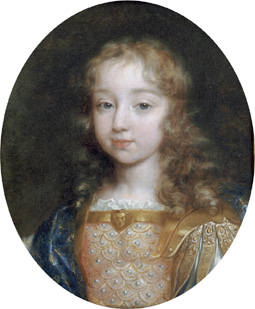
Louis XIV aged about twelve; the beauty of the boy King - the ‘Godgiven' child - was the subject of general comment, and his flowing, golden brown hair (which darkened with age) particularly admired.
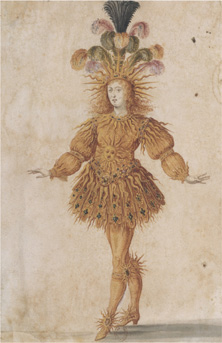
Louis XIV dancing the role of Apollo, God of the Sun, at the age of fourteen; the image of Louis as the ‘Sun King' was carefully cultivated.

Anne of Austria as a young woman was vivacious and attractive, also a noted equestrian, a taste Louis inherited; she had many admirers, including the Duke of Buckingham, although her intimates believed these flirtations remained chaste.
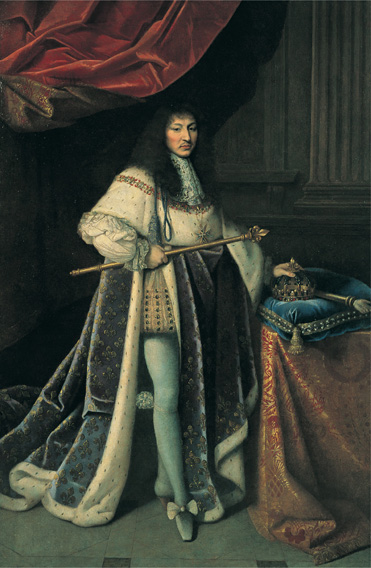
Louis XIV in his early, twenties about the time he began his personal rule. By Nicolas Mignard.
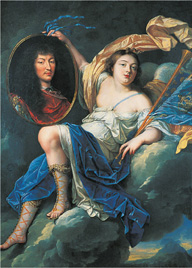
The figure of Reputation holds a medallion of Louis XIV.
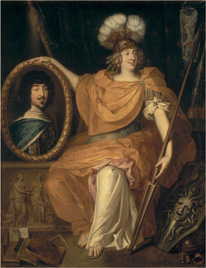
The Grande Mademoiselle as Minerva, patroness of the Arts; she holds a portrait of her father, Gaston Duc d'Orléans.
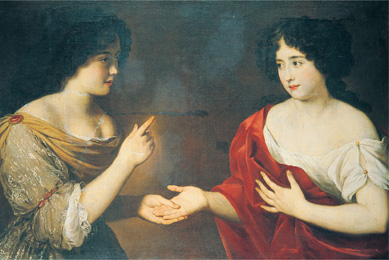
Marie Mancini (right), the first love of Louis XIV, with her sister Hortense; although Cardinal Mazarin was her uncle, he was horrified at the possibility of the King making such a comparatively lowly marriage.
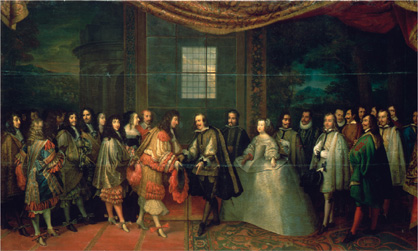
Philip IV greets Louis XIV on the occasion of his wedding to the Infanta Maria Teresa, 1660; her stiff ceremonial attire symbolizes her formal and restricted upbringing at the Spanish court.
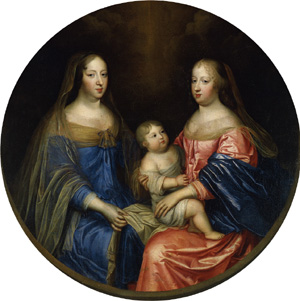
Two Queens of France: Anne of Austria with Marie-Thérèse, who was her niece as well as her daughter-in-law, with the Dauphin, from birth a remarkably robust child.
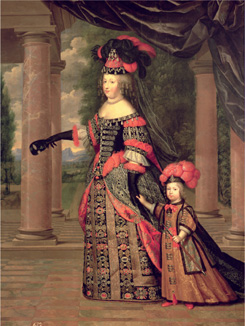
Queen Marie-Thérèse and her only surviving child, the Dauphin Louis de France, by Pierre Mignard.
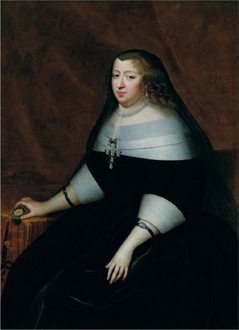
Anne of Austria, mother of Louis XIV, as a widow (her husband died when she was in her early forties); she retained her love of magnificent jewellery, her bracelets in particular drawing attention to her famously beautiful hands.
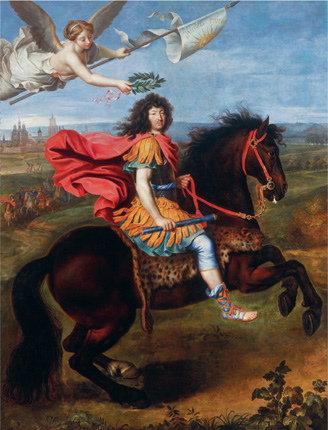
The triumphant figure of Louis XIV depicted on a warhorse outside Maastricht, which he besieged successfully in June 1673; a new militaristic image as his plans for conquest increased.
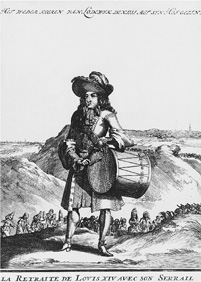
As European opinion turned against Louis XIV and his military ventures became less successful, here were numerous satirical attacks on him. An anonymous engraving of 1693, ‘Louis Retreats with his Seraglio', shows him with a column of ladies behind him.
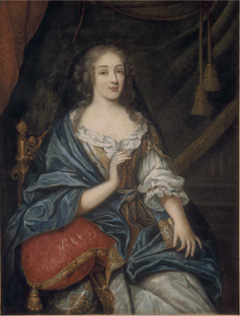
Louise de La Vallière, the virginal young girl whom Louis made his mistress and who bore him several children; no one described her as beautiful but everyone found her appealing.
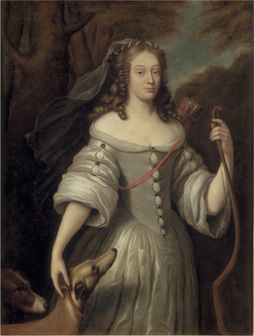
Louise de La Vallière as a huntress: despite her seemingly frail physique, Louise was an accomplished rider, something which made her an ideal companion for the King.
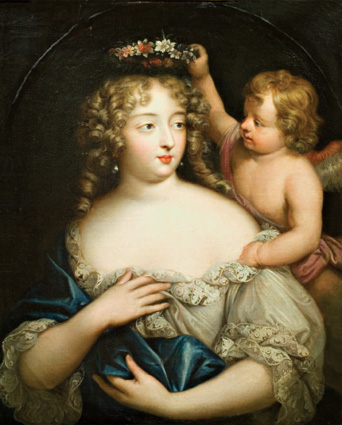
Athénaïs de Rochechouart de Mortemart, Marquise de Montespan, who was the King's maîtresse en titre for seventeen years; her beauty, including the curling hair admired by Madame de Sévigné and her large blue eyes, dazzled contemporaries. By Louis Elle Ferdinand II.
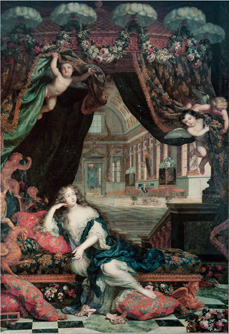
Athénaïs reclining in front of the gallery of her château at Clagny; her frequent pregnancies meant that she adopted elegant and languorous loose clothing to conceal her figure.
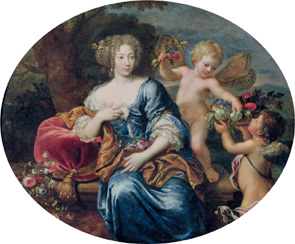
Athénaïs by Pierre Mignard.
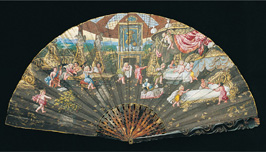
The Appartement des Bains where Madame de Montespan and the King relaxed, with a marble bath and couches, depicted on a fan.
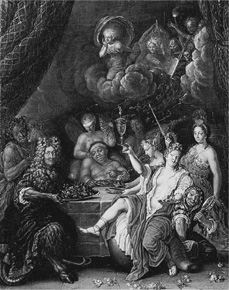
Satirists were happy to mock Athénaïs's voluptuous figure as it thickened with age; she is seen here feasting with Louis XIV and attendant goblins and devils. By Joseph Werner.
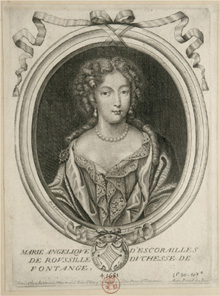
Angélique de Fontanges became the King's mistress at the age of eighteen when he was forty; she died two years later after a traumatic experience in childbirth. Some people thought she was the most beautiful girl ever to come to Versailles - ‘like a statue’ - but she lacked intelligence.
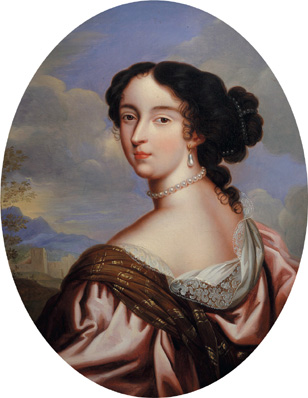
Françoise de Maintenon, shown as an attractive young woman whose dark hair and dark eyes were much admired; she also loved fine clothes, contrary to later sneers that she was a prude who always dressed in black.
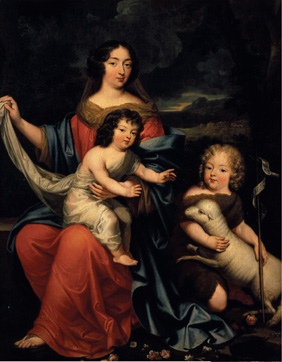
Madame de Maintenon with two of Athénaïs's children to whom she acted as governess in a secret house in the rue de Vaugirard: the Duc du Maine, her favourite, and the Comte de Vexin, who died young.
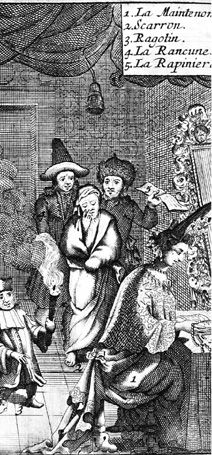
Engraved frontispiece to the satire Scarron appearing to Madame de Maintenon, 1664; the middle-aged playwright whom she married at the age of sixteen and who died nine years later here regards his widow in all her court finery with dismay.
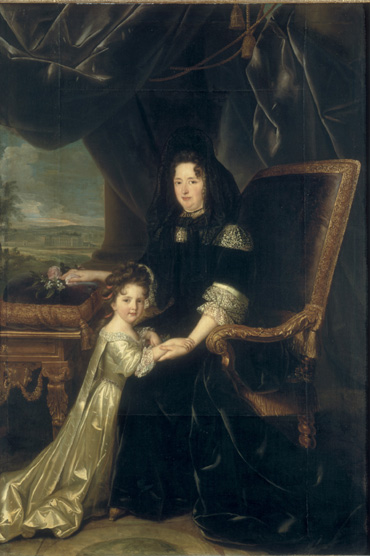
Madame de Maintenon with her niece Françoise-Charlotte, daughter of her reprobate brother Charles d'Aubigné; she made Françoise-Charlotte her heir, married her to the Duc de Noailles and gave her the Château de Maintenon.
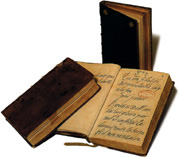
‘May your fidelity be inviolable to the end …' The ‘Secret Notebooks' of Madame de Maintenon which she kept from about 1684 onwards; noting religious texts, bibilical quotations and sayings of the Saints.
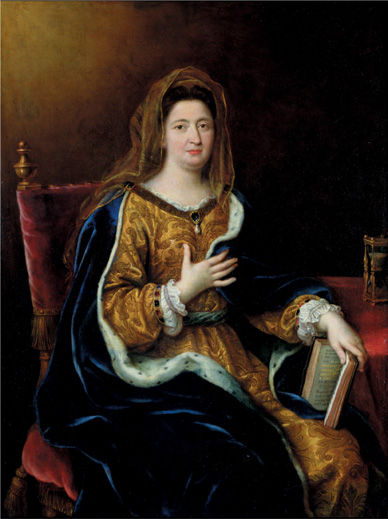
Madame de Maintenon painted as Saint Frances of Rome. Contemporaries wondered whether the ‘queenly' ermine indicated that she was secretly married to Louis XIV; when asked about the fur, the King commented that Saint Frances certainly deserved ermine.
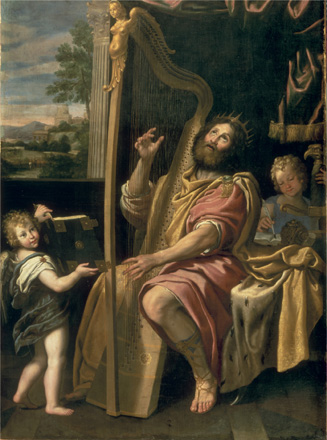
King David playing on his harp by Domenico Zampieri, which Louis acquired from the possessions of Cardinal Mazarin; it shows a more soulful David than the lecherous biblical King regularly denounced by preachers as a covert way of attacking Louis XIV's adulteries.
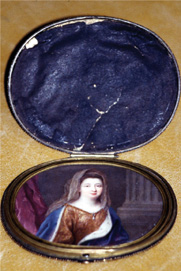
A miniature based on the Saint Frances portrait which Louis XIV carried in his pocket until his death.
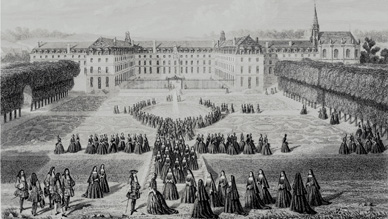
An engraving of the visit of Louis XIV to Saint-Cyr in 1704, the superior establishment for the education of poor but well-born girls founded by Madame de Maintenon; the King took a great interest in Saint-Cyr, enjoying music and theatricals there.
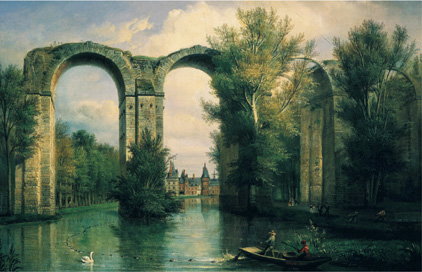
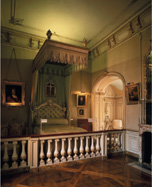
The Château de Maintenon bought by Madame de Maintenon with money given by the King, later donated to her niece Françoise-Charlotte on her marriage to the Duc de Noailles; as ever the King was interested in making improvements to it. Above, the aquaduct which was abandoned; right, Madame de Maintenon's bedroom as it is today.
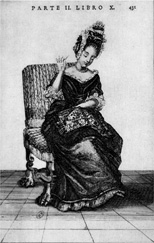
Marie-Jeanne d'Aumale acted as Madame de Maintenon's secretary, and is an important source for her later life; the King enjoyed her lively company.
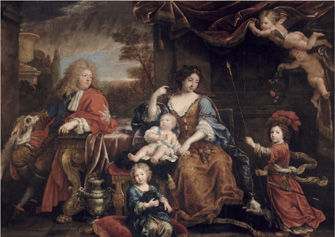
The Dauphin and Dauphine: the Dauphin was a good-natured man who lived only for hunting; Marianne-Victoire of Bavaria was intelligent and cultured but lacked any kind of beauty. They are shown here with their three sons the Ducs de Bourgogne (right), Anjou (centre) and Berry (on his mother's lap).
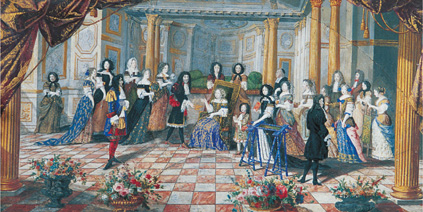
The betrothal of ‘Monsieur', the King's only brother, to his first cousin Henriette-Anne d'Orléans, 1661. From a fan.
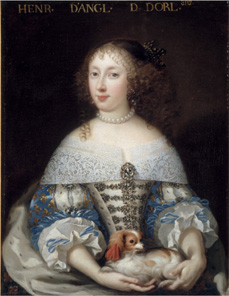
Henriette-Anne of England, first wife of Monsieur, Duc d'Orléans, with her favourite spaniel Mimi, given to her by her brother Charles II. Henriette-Anne loved the dog so much that she even danced holding her in the Court Ballet.
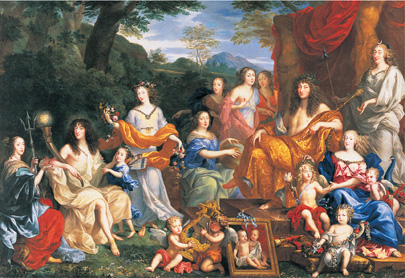
The royal family of France painted by Jean Nocret in 1670, at the request of Monsieur, in the guise of gods and goddesses. On the left Monsieur (seated) has his own family grouped round him, including his first wife, Henriette-Anne (standing). Louis XIV has his wife Marie-Thérèse of Spain (seated lower, on his right) patting the Dauphin's head and his cousin the Grande Mademoiselle (standing, right) at the edge of the picture.
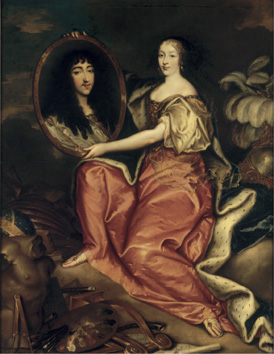
Henriette-Anne Duchesse d'Orléans with a medallion of her husband Monsieur; his appearance shows the dark ‘Medici' strain which many of the descendants of Henri IV and Marie de Médicis shared.
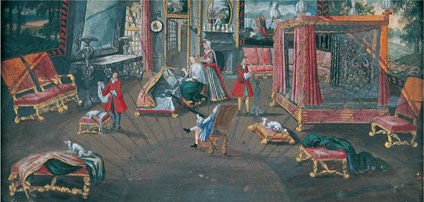
Henriette-Anne with her spaniel Mimi on a stool and a musician playing; the toilette of a great lady (held in her bedroom) was a social occasion. From a fan.
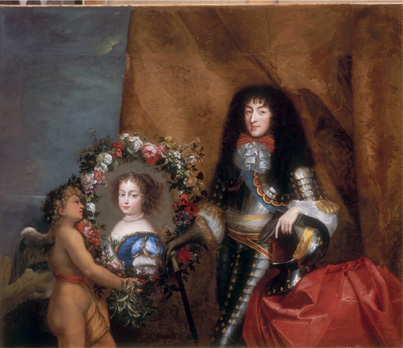
Monsieur holding a portrait of his favourite daughter, Marie-Louise d'Orléans.
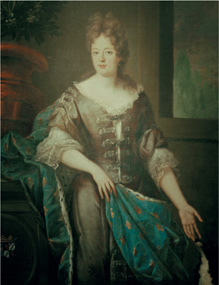
Liselotte, the German princess who became Monsieur's second wife, known as ‘Madame', and wrote amusing, often bawdy letters home describing the French court.
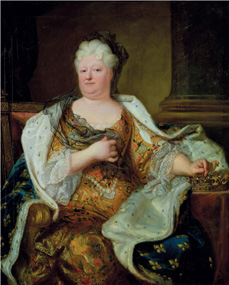
Liselotte, Duchesse d'Orléans, in later life; she herself mocked her vast figure and weather-beaten face, Duc to hunting for long hours without wearing a mask as was customary for ladies.
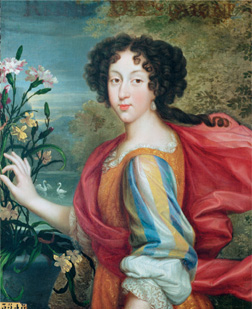
Marie-Louise d'Orléans, niece of Louis XIV and the highest-ranking young woman at the French court, since he had no legitimate daughters; she was married off to the grotesque King Carlos II of Spain for reasons of state; her beauty is a darker version of her mother, Henriette-Anne.
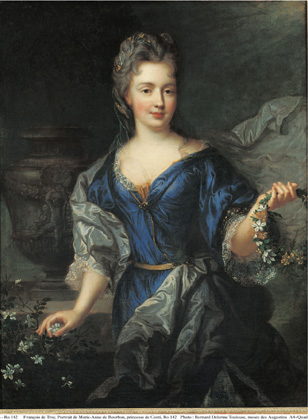
Marie-Anne, Princesse de Conti, daughter of Louis XIV by Louise de La Vallière, was generally rated the most beautiful of his daughters and he spoiled her; having been widowed childless very young, she declined to marry again but lived a life of happy dissipation at court.

The two surviving daughters of Louis XIV by Athénaïs de Montespan: Françoise-Marie who married the heir to the Duc d'Orléans and Louise-Françoise who married the Duc de Bourbon and was known as Madame la Duchesse. Both scandalised the court with their wayward and often louche behaviour.
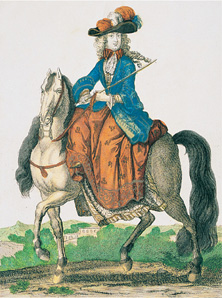
Bénédicte Duchesse du Maine, wife of the King's illegitimate son; tiny, described by Liselotte as ‘the little toad’, Bénédicte was extremely intelligent with a real interest in the arts which she patronised in her salon at Sceaux.
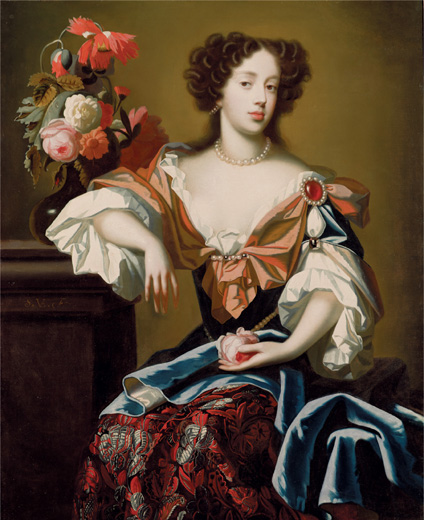
Mary Beatrice d'Este, daughter of the Duke of Modena, the Catholic second wife of James Duke of York, later James II; her combination of virtue, dignity and beauty impressed Louis XIV and Madame de Maintenon.
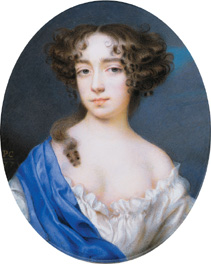
Queen Mary Beatrice.
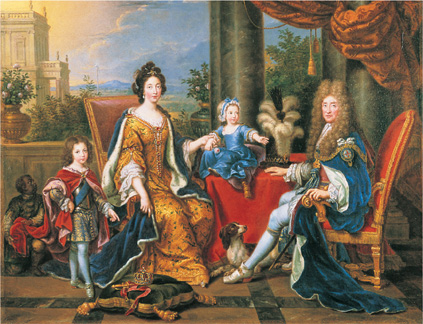
The English royal family in exile at Saint-Germain-en-Laye, as guests of Louis XIV in 1694: (left to right) James Edward Prince of Wales, whose birth as a Catholic heir helped to bring about the crisis of 1688 and led to his parents' ejection; Queen Mary Beatrice, Princess Louisa Maria, born in exile, aged two; James II, who was twenty-five years older than his second wife and died in 1701.
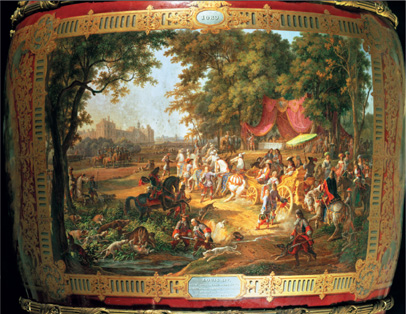
A hunting-party at Saint-Germain-en-Laye, given by Louis XIV ‘to alleviate the misfortunes' of James II and Mary Beatrice, depicted on a Sèvres vase.
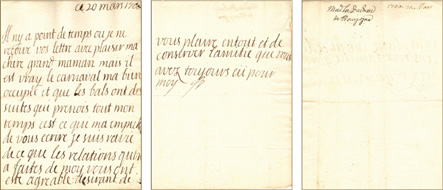
Letter from Adelaide, Duchesse de Bourgogne to her ‘dear grandmother' Madame Royale of Savoy when she was fifteen. Adelaide apologises for the fact that the entertainments of carnival have prevented her replying sooner; she is happy to hear that her grandmother has had good reports of her, wishing to please her in everything and preserve the friendship her grandmother has always had for her. From the State Archives of Turin.
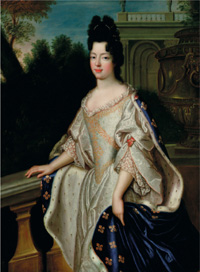
Adelaide Duchesse de Bourgogne.
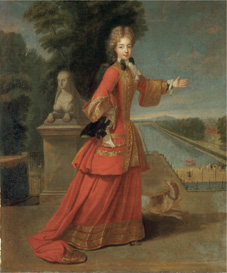
Adelaide Duchesse de Bourgogne in hunting-costume (red was a favourite colour) in front of the Grand Canal at Fontainebleau; her slim figure is well displayed.
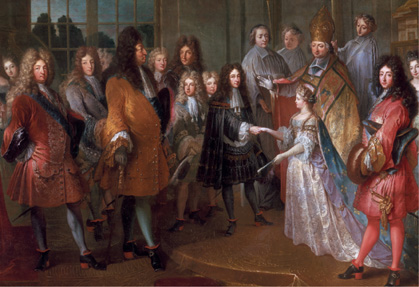
The marriage of Adelaide of Savoy and Louis Duc de Bourgogne, grandson of Louis XIV, on 7 December 1697, the day after her twelfth birthday, in the Royal Chapel at Versailles. Note the dominating figure of the King compared to the tiny bride and groom. By Antoine Dieu.
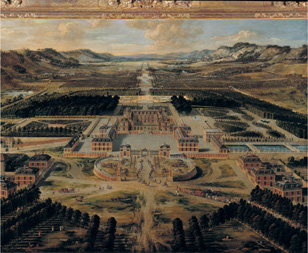
Perspective view of the Château de Versailles in 1668 before it had become the King's official seat.
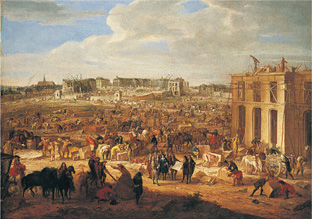
Construction of the Château de Versailles in about 1679; although the King moved there officially in 1682, when he was in his forties, building works continued for most of the reign, causing much discomfort to court ladies with the noise, the dirt and the smell of wet plaster.
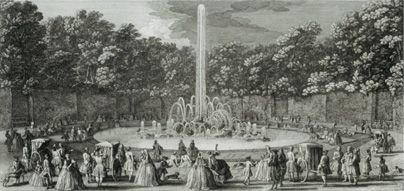
The Basin at Versailles containing the mute, agonised figure of the giant Enceladus with water spouting from his mouth. Louis XIV showed the same fortitude during the ordeal of his operation for a fistula.
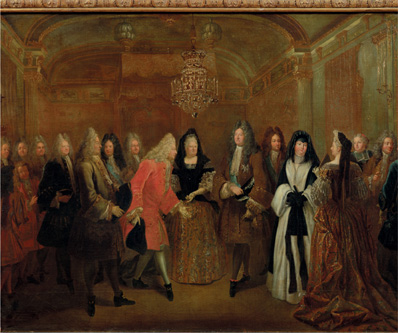
At a court function at Fontainebleau in September 1714, the Duchesse de Berry (born Marie-Élisabeth d'Orléans) can be seen in her black and white widow's weeds following the death of her husband earlier in the year (fourth from right).
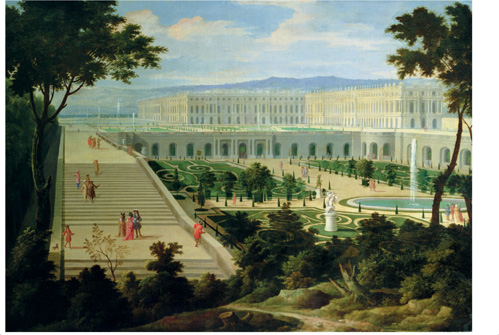
The Orangerie at Versailles which can still be seen; Louis XIV took much pleasure in his orange trees which he acquired from many sources and also gave as presents to his favourites.
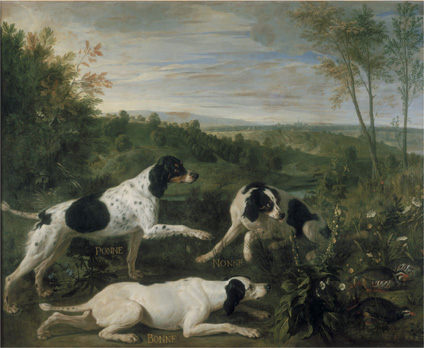
Louis XIV adored his sporting dogs: Bonne, Nonne and Ponne are here shown; he fed them himself in the luxurious closet known as the Cabinet des Chiens with biscuits specially made by the royal chef.
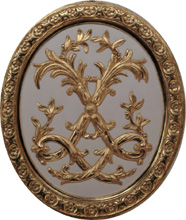
Interlaced double L is taken from the wood-carving round the windows of the King's chamber at Versailles.
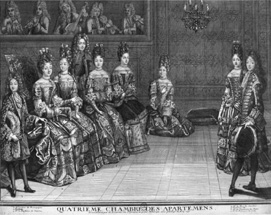
Appartement was a designated evening when theatricals, card games, billiards and music were enjoyed at Versailles; the orchestra can be seen in the box behind the ladies; the Duc de Chartres (later Duc d'Orléans Regent of France) performs with his sister Marie-Élisabeth (later Duchesse de Berry).
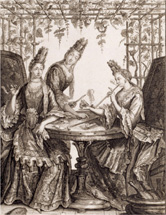
Tobacco was a taste enjoyed by women as well as men, including the illegitimate daughters of Louis XIV, although it scandalised their elders that ladies should smoke pipes ‘like sailors'.
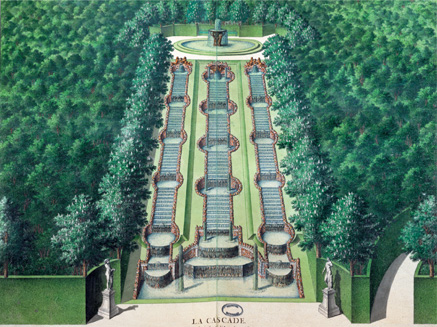
The cascade at Marly, the pleasure-house of Louis XIV, where formalities were minimal and invitations were coveted.
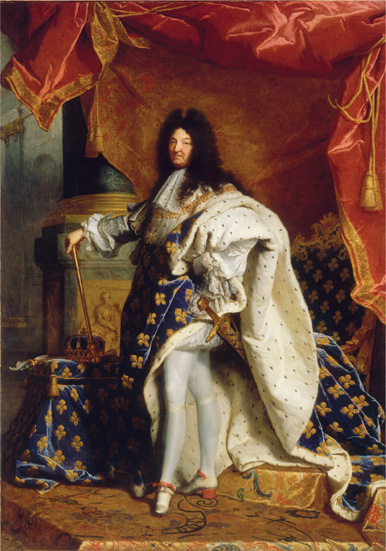
The most famous image of Louis XIV in later years, by Hyacinthe Rigaud in 1701. The heroic beauty of his youth has vanished while leaving an air of impregnable majesty tinged with melancholy.