

Chapter Five
General Wallis established his headquarters in Padua rather than Venice so as to have a stronger presence on the mainland. He speedily imposed Austrian rule over the former Republic with the assistance of conservative patricians who had fled to Vienna during the Bonapartist occupation and now had returned to take positions of responsibility in the new administration. Alvise knew all along that his collaboration with the French was going to cost him a period in purgatory; but he had not expected the degree of acrimony he and Lucia were subjected to during the first months of 1798, not so much by the Austrians—in fact relations with Wallis and his wife, Josephine, were friendly—but by those fellow Venetians who had reclaimed their position of privilege under the shadow of the House of Austria. They were ostracised everywhere. Many former colleagues from the Senate stopped exchanging even the most perfunctory greetings with Alvise. Those who mentioned his name, he complained, did so only “to say horrible things.”1 He spent as little time as possible in Venice, visiting one by one all the Mocenigo estates he had necessarily neglected during the last phase of the Republic. Lucia moved out to Padua, where there was less hostility towards her, and settled into the run-down Memmo palazzo with Paolina and her four children.*12 The two sisters had spent some happy times there during their childhood, when their father was governor of the city, and the return to that old family house alleviated the feeling of loss and displacement.
At a soirée given by Madame Wallis at the Governor’s Palace, Lucia and Paolina were introduced to an engaging Austrian officer of Irish descent, Baron Maximilian Plunkett. Although still in his early thirties, Plunkett was a battle-hardened colonel and one of General Wallis’s most trusted military aides. He had come to Italy after the Treaty of Campoformio at the head of the 45th Infantry Regiment, setting up camp near the village of Montagnana, between Este and Padua. He was always rushing in and out of the Governor’s Palace, advising General Wallis and staying on for meals and evening entertainment. Lucia was attracted by the mixture of Irish ruggedness and Austrian courtliness. He was not especially handsome, but she sensed the vigour in him, the courage, the discipline. She noticed how his generous character softened the qualities that made him a good soldier: he was warm and charming, and the more they saw each other the more she felt at ease with him.
Maximilian had an unusual background. He came from a prominent Irish family of soldiers, many of whom had emigrated to the Continent over the previous 200 years—at the end of the eighteenth century there were Plunkett officers in both the Austrian and the French armies. Maximilian’s father, Thomas Plunkett, had joined the Austrian army as a young man, quickly rising through the ranks to become one of Empress Maria Theresa’s favourite generals. His mother, Mary D’Alton, also came from a well-known family of Irish soldiers. Maximilian, one of nine brothers and sisters, was born in Linz in 1768. He was ten years old when his father died. Yet a career in the Austrian army was never in doubt. Still a teenager, he joined the 20th Infantry and went off to fight the Turks in the Ukraine. After the French Revolution, he was transferred to the western front, along the Rhine, and was badly wounded in the battle of Mainz. Promoted to the rank of lieutenant colonel, he took command of the 45th Infantry and joined Wallis’s occupation force in Italy.
The company of Lucia and Paolina gave Maximilian a welcome respite from his life at the military camp. He delighted in their bright conversation and bonded easily with both of them. They formed an unconventional trio; when they were not spending the evening at the Wallis residence, they were happy to stroll together down the main street in Padua, look into curiosity shops or savour ices at one of the cafés. Lucia absorbed Maximilian’s energy. She felt alive again, eager to be part of the world around her. She had not felt such longing since the death of her son three years earlier, and a sense of gratitude enhanced her admiration for Maximilian. Paolina’s presence did not inhibit her: on the contrary, it gave her the strength she needed to embrace her feelings.
Lucia and Maximilian fell in love in the spring of 1798 under the wary gaze of General Wallis and the more benevolent one of Madame Wallis. As a token of her affection, she gave the colonel, as she often called him, a cluster of decorative cordons and tassels she had secretly embroidered during the winter, with which to embellish the flag of his regiment—a gift which moved him deeply, and endeared her to his officers, who wrote her an enthusiastic “thank you” note. Evidently the relationship was widely known about in Austrian circles.
From the beginning of his assignment in Italy, General Wallis had felt it was in everyone’s interest to send Alvise abroad for a while, ostensibly to mark Vienna’s displeasure at his earlier ties to the French but really more to remove him from a hostile environment. Lucia and Maximilian’s burgeoning relationship may have encouraged the general to speed up the paperwork. In June he issued passports for Alvise and Lucia “to take the waters”2 in Tuscany. It is unclear how much Alvise knew at the time about his wife’s romantic involvement—he was seldom in Padua and only for brief stop-overs. In any case, he seemed glad to leave for he was tired of living as a pariah in his own homeland. A period of exile in Tuscany was sure to turn into a useful experience. It would allow him to observe up-close the progress of agriculture in Tuscany and to borrow ideas with which to improve productivity on his own estates.
Lucia was desperate at having to separate herself from the man she was just beginning to love. She was not even sure she would ever see Maximilian again. What if his regiment were transferred before she came back? What he if he had to go back to the front? How would they keep in touch? As a parting gift, Maximilian gave her a lovely writing set—a small inkwell and a quill made of finely blown glass from Murano. But how safe would it be to write to him?
The Grand Duchy of Tuscany was as pleasant a land of exile as Alvise could have hoped for. In travelling from Venice to the baths in Lucca and then on to Florence, he and Lucia had moved from one Habsburg dominion to another—Archduke Ferdinand being Emperor Francis’s younger brother. But unlike the rest of northern and central Italy, Tuscany had remained fairly untouched by Bonaparte’s invading armies and the strife that had come in their wake. “One enjoys perfect tranquillity here [in Florence],” Lucia wrote to her sister, longing for news of the colonel. “The people seem delighted with their government and the Archduke is universally esteemed.” The inn where they had settled was entirely satisfying: “We have an excellent cook, proper bathrooms and even carriage service.”3 From her room at the Corte d’Inghilterra, she had a full view of the Arno, with the Ponte Vecchio further downstream and olive groves shimmering on the other side of the river, up to the Belvedere.
Alvise and Lucia fell into an easy routine, visiting picture galleries and calling on Florentine friends from their youth. They watched the picturesque boat races down the Arno, which seemed quaint affairs in comparison to the magnificent Venetian regattas down the Grand Canal. “Four little vessels and a rather thin show…”4 Lucia commented. There was something endearingly passé in the way the Florentine ladies liked to dress “three years behind everyone else.” Some of the clothes she had brought down from Venice were frowned upon as being “excessively jacobinesque”—especially the airy, Grecian-style tunics which became fashionable in Paris during the Directoire, and which Lucia had occasionally worn during the French occupation.
Life was slow yet the atmosphere was cosmopolitan. Florence was a haven for Italian families escaping from either the French or the Austrians. Arch-conservative Roman aristocrats mixed with Bonapartist democrats. The most prominent refugee was Pope Pius VI, who had been run out of Rome by French troops a few months earlier, and was living temporarily in the charter-house overlooking the city. Lucia remembered the elderly pontiff with affection from her Roman days, when he had confirmed her and Paolina in Saint Peter’s basilica, and she made a special effort to seek him out. “He lives in the most unhappy state, sustained only by his faith and his courage,”5 she reported to her sister. But he had brightened up at the memory of his good friend Memmo and was curious to know “how the two of us have done in the world.”
Lucia had an ulterior motive in seeking out Pius VI. The convent of Celestia, in Venice, where she and her sister had lived during their childhood after their mother’s death and again, later on, as they waited for their marriage contracts to go through, was now off-limits to them as a result of the restrictive policies adopted by the local religious authorities after the arrival of the Austrians. In the face of unceasing turmoil, Lucia was not prepared to lose touch with the one place that had always offered her safe haven. She appealed to the Pope for a special permission to visit the enclosed nuns, and was relieved when he granted a written authorisation to enter the convent once a week. “The permission is for both of us,” she informed Paolina. “I couldn’t wait to tell you. It has given me such comfort.”6
The lazy Florentine summer came alive in early August with the stunning news that Lord Nelson had sunk Bonaparte’s fleet off the coast of Egypt. After his triumphant Italian campaign, Bonaparte had returned to Paris planning to invade England but had shelved the idea after taking a disparaging close look at the French fleet assembled in the Channel. Instead, he had decided to weaken England by conquering Egypt and threatening the route to India. Soon after his first, successful landing, lack of food and the hostility of the local population had convinced him to set sail again in search of a safer harbour. Lord Nelson had intercepted Bonaparte’s dispatch to the Directoire with his new plans. On 1 August he had come upon the French squadron at Aboukir and destroyed it.
It was hard to imagine the invincible Bonaparte stranded in a faraway desert, without a fleet left with which to sail home; but Lucia had, in Naples’s minister to Florence, the Duke of Sangro, an excellent source of information (Naples was Lord Nelson’s base in the Mediterranean). She filled her reports to Paolina with precise facts and figures, as if only hard news could convey the reality of what had occurred. “The English took nine ships, including a frigate,” she wrote in one meticulous account only days after the event.
Two ships went up in flames and sank, including one which carried all the riches [Bonaparte] had seized in Malta. Only eight French ships managed to get away. But then the Turks massacred the French soldiers as they hit the shore, leaving 4,000 dead in the sand and 1,500 wounded. 7
With Bonaparte seemingly out of play, Alvise and Lucia became more certain that their future lay in the German-speaking Habsburg Empire. They even embarked on a German-language course. As Lucia explained to Paolina, “[German] will become increasingly necessary to us.”8 Alvise, though talented, showed a singular lack of patience with grammar and put in an average effort. Lucia took the lessons very seriously, but then she had an incentive to learn the language quickly.
At the end of September, nearly three months after she and Alvise had settled in Florence, Maximilian paid a secret visit to Lucia. Preparations were made through Paolina, who had become a fully fledged go-between in the affair. Lucia did not write directly to her lover, and those few notes she received from him she destroyed immediately. Her sister’s help was indispensable. It was through her that she sent Maximilian a detailed map of Florence—a copy of the one she used—in order to plan their meetings with the greatest possible accuracy. Lucia’s letters to Paolina hint in the vaguest terms that they managed to have a few perfect days to themselves—certainly nothing occurred during Maximilian’s stay in Florence to spoil their reunion, and it is possible Alvise was away on a work-related trip somewhere in the Tuscan countryside. In one letter Lucia wrote to Paolina, Maximilian added his own playful note:
It is from Florence, my dear lady, that I write to you but even as I begin to address you these few words, your sister is already pulling the pen away from my hand. I do want to tell you that I have never been happier…If Lucia were not reading these lines I would tell you all the wonderful things she says about you. Forgive this hurried scribble; and tell those adorable creatures of yours I detest them as I detest their mother. Adieu, Madame, someone next to me is forcing me to stop writing, otherwise I would fill all four sides…9
As the two lovers took walks in the public gardens and visited churches in search of art treasures, Lucia was seeing with new eyes many of the sites she had first discovered with Alvise back in 1786. They made a few purchases together—Florentine fans for Paolina and her two daughters, and a set of paper fish and a rod for the two boys. “The Colonel can teach them how to use the magnet attached to the hook,”10 Lucia reassured her sister. She added, rather mischievously, that she was showing off her German by whispering a few well-practised sentences to her lover. “But I beg you not to tell a soul about the German lessons I am taking,” she insisted, suddenly worried by the possibility that some malicious gossip back in Venice or Padua might draw a connection between her friendship with the colonel and her sudden enthusiasm for the German language. “I wouldn’t want people laughing behind my back.”11
Lucia’s happiness was suddenly eclipsed by the news she had long been dreading. Plunkett had kept it to himself all along, so as not to spoil their time together, but at the end of his stay in Florence he confessed that he had been given the command of the newly formed 60th Regiment based in Theresienstadt in Bohemia, and would soon be on his way to Austria to resume fighting the French.
“We shall be losing our worthy friend,”12 Lucia wrote poignantly to Paolina in her last letter from Florence.
By the end of the summer, Alvise and Lucia were making preparations to leave as well. Alvise, growing restless in Florence, had wanted to spend the winter in Naples, but the arch-conservative Bourbon monarchy denied him passports. Fortunately General Wallis decided his brief exile had lasted long enough and granted him permission to visit his estates on the Venetian mainland. In mid October, Lucia returned to Padua. She was able to see Maximilian again on several occasions during the autumn and early winter before he left.
With Bonaparte still stranded in Egypt, Vienna decided the time was right to strike back at the French and recover its territorial losses in Italy and southern Germany. In January 1799, Maximilian received his marching orders: he was to join forces with General Hotze, in the Voralberg, at the head of two elite battalions from the 60th Regiment. The objective was to take the city of Zurich, a pivotal stronghold for the control of southern Germany. General Hotze, with Maximilian’s help, was to protect the right flank of the advancing 80,000-strong Austrian army, led by Archduke Charles.
When Maximilian left Padua, heading for the snow-bound Alps, Lucia was expecting his child. She was only a few weeks pregnant and it is quite possible she did not broach the subject before his departure because she herself was not yet sure of her condition. After the first couple of months, when she no longer had any doubts, communications with Maximilian’s regiment were fragmentary at best, and it is unlikely she would have informed him in a letter that had few chances of reaching him and which risked being read by others along the way.
Lucia may well have contemplated seeking the help of an abortionist but it was always a dangerous road to undertake. Besides, the memory of her painful miscarriages, not to mention the death of Alvisetto, probably contributed to push the thought away from her. In the absence of any evidence about how she handled her pregnancy, the simplest explanation seems the truest: she was deeply in love with Plunkett and she decided to have their child no matter what the consequences might be. In any case, she never tried to pass him off as Alvise’s issue—husband and wife had probably ceased to be lovers.
Having made her choice, she was relieved to learn that Alvise was about to embark on a long journey abroad. All his adult life he had been trained to govern, to participate in the affairs of Venice. A year had passed since the Austrians had taken power, yet he continued to be isolated. He felt useless, unable to fit in the new ruling class that was being groomed by Vienna. His trips to the countryside became increasingly frantic and soon he was overcome by what he called his rage de voyager, his irrepressible urge to travel as far and as long as his heart required. He had experienced such mad wanderlust before in his life, most notably when he had run away from Venice and his family after the humiliating divorce from his cousin, Pisana Mocenigo, and had travelled in Italy and France. This time he conceived a grand journey across the Habsburg Empire.
In late March, when Lucia was already in her fourth month and it was becoming increasingly difficult to dissimulate her pregnancy, Alvise obtained his travelling papers: they stated he was “moving to London with two servants and journeying through Trieste, Lubiana, Graz, Linz, Prague, Dresden, Berlin, Hamburg.”13 It was unclear when he would be coming back. Lucia chose not to tell him she was carrying her lover’s child.
It was not a rare thing for married women to have children out of wedlock and there were well-tested ways to give birth discreetly. A pregnant woman might stay on in the countryside long after the end of the villeggiatura or she might return to her family of origin for a prolonged stay. Or she might enter a convent “to restore her nerves,” as the expression went. Still, the strain on Lucia must have been excruciating, not just because of the daily complexities involved in a clandestine pregnancy but also because of the uncertain future she and her child would face. Was Maximilian coming back from the war? Would she ever have the courage to tell Alvise she had given birth to someone else’s child? Would her son or her daughter have to be given away to adoptive parents?
Photo Insert
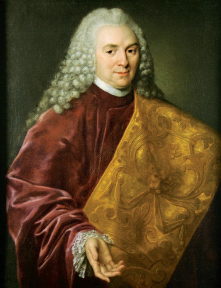
1. Andrea Memmo, Lucia’s father, was elected Procuratore di San Marco, the most prestigious political office in the Venetian Republic after the one of doge, in 1785, when he was serving as ambassador in Rome.

2. Sebastiano Mocenigo, Lucia’s father-in-law, was a complicated man and a difficult father. His rampant homosexuality and outrageous behaviour during his tenures as ambassador to Madrid and to Paris put an end to his diplomatic career: Maria Theresa of Austria refused to accept his credentials as ambassador to Vienna.

3. This ivory miniature of Lucia and her sister, Paolina, when they were little girls was commissioned in the mid-1770s. Their father probably took it with him to Constantinople, where he served as ambassador for four years (1779–82), to lessen the pain of his separation from his two daughters, who remained in Venice with their mother.

4 and 5. Lucia (left) and Paolina, aged sixteen and fifteen, sat for Angelica Kauffmann in the summer of 1786, in the artist’s studio in Rome.

6. In the same year Alvise Mocenigo wrote to Andrea Memmo asking for the hand of his daughter Lucia. This is Lucia’s reply to her future husband—a man ten years older than her, whom she did not know and who had already been married and divorced.

7. As Venetian Ambassador to Rome, Andrea Memmo and family lived in Palazzo San Marco, the “immense palace.” The Venetian ambassador lived in one wing, the Venetian cardinals in the other—an arrangement that led to constant bickering about keys and bills.

8. “I feel so lost when you are away from me,” Lucia wrote to her husband, Alvise, shortly after moving into Palazzo Mocenigo, the sprawling family home on Venice’s Grand Canal. It was, indeed, an intimidating world to enter for a seventeen-year-old bride, with its grand staircases, its endless halls and its innumerable apartments distributed on four floors, where a crowd of Mocenigo relatives lived on fairly unfriendly terms.

9. A highly symbolic moment in the fall of Venice: the lowering of the four bronze horses from the facade of Saint Mark’s Basilica by Bonaparte’s troops. The horses, which the Venetians had brought back from Constantinople after the Fourth Crusade, were shipped to Paris and placed atop the new arc de triomphe in the Place du Carrousel.

10. During the siege of Venice in 1849, the Austrians dropped bombs carried by air balloons that were strung together by very long ropes. To counter this move, Venetian engineers planned to launch projectiles with ropes attached.

11. Lucia’s husband commissioned this statue of Napoleon from Angelo Pizzi with the intention of placing it in the main square in Alvisopoli. Then Napoleon fell and Lucia no longer wanted it. Reluctantly, Lucia had the statue shipped up the Grand Canal to Palazzo Mocenigo. She put it in a shadowy corner on the water-level ground floor, where it stands today.
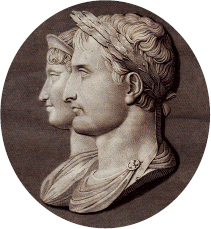
12. Alvise Mocenigo was especially proud of this etching of Emperor Napoleon and Empress Marie Louise; it was “the first work of art produced at Alvisopoli.”

13. The pro-French municipal government established in Venice proclaimed 4 June as a national holiday. The ceremonies were held in Saint Mark’s Square. In the foreground, Marina Querini Benzoni, clad in a light Greek tunic, is dancing with Fra’ Nani, a priest with strong Jacobin leanings. According to eyewitness reports, there were fewer spectators than those depicted in the painting, and the atmosphere was not cheerful.

14. Facade of the main villa at Alvisopoli and the ground-floor plan. Alvise Mocenigo wanted the main house to be simple, functional and well integrated into the working community. The estate remained in the family until my grandfather sold it in the 1930s. The park behind the villa has survived and is managed by the local branch of the World Wildlife Fund.

15. Empress Joséphine was very fond of this drawing and she gave it to her son, Eugène de Beauharnais. Lucia met the artist David in Paris in 1813 through an old friend of her father. She could see the artist’s studio from the window of her apartment.
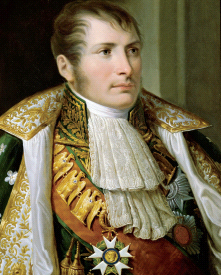
16. Lucia saw Prince Eugène frequently at the royal palace in Milan when she was lady-in-waiting to Princess Augusta.
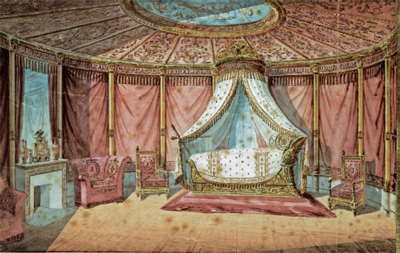
17. On one of Lucia’s first visits to Malmaison, Empress Joséphine took her upstairs to see her newly refurbished circular bedroom. “It is magnificent,” Lucia wrote in her diary. Today it is possible to see the same room at Malmaison just as Lucia described it.
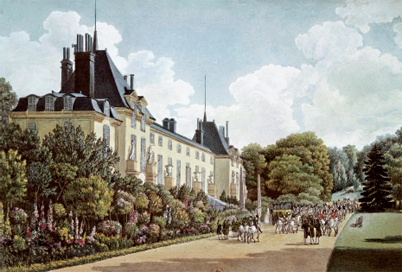
18. In the summer of 1813 Lucia often visited Empress Joséphine at Malmaison, her retreat outside Paris. The decor was very stylish and the atmosphere relaxed. The estate was given to Joséphine by Napoleon as part of their divorce settlement.

19. Lord Byron lived at Palazzo Mocenigo during part of his stay in Venice—here he is seen at work in his study overlooking the Grand Canal. He took a three-year lease at £ 200 a year—a considerable sum in the Venice of the post-Napoleonic years. His relationship with Lucia, however, grew steadily worse as she proved to be a tough and stubborn landlady.
They were daunting questions, which Lucia presumably shared only with Paolina. Indeed, it is hard to see how Lucia could have preserved her secret without her sister’s close collaboration. But very few other people knew, apart from her trusted maid, Margherita, and the midwife who was eventually called in to assist her during delivery. It helped, of course, that Alvise was away during this ordeal. But it is unlikely Lucia spent much time at Palazzo Mocenigo at all during her pregnancy. Padua would have been too risky as well. It is possible that she returned to her mother’s family estate, Castel Gomberto, north of Vicenza, which she had not visited in nearly a decade, since last taking the waters in Valdagno. There she would certainly have felt protected, in a familiar environment, away from prying eyes. Another possibility is that Lucia made the best of Pope Pius VI’s special authorisation to visit Celestia, and spent the latter part of her pregnancy attended by the nuns of the convent which had become, over the years, a second home to her.
At the end of May, six months into her pregnancy, Lucia was relieved to hear from her friends at the Austrian military command in Padua that Maximilian was alive and well. He had found himself thrown into battle as soon as he had joined up with General Hotze’s forces in the snowy Voralberg, where the gathering Austrian troops were under the constant fire of General Masséna’s soldiers. At the end of the winter, the French had begun their retreat towards Zurich, leaving a sea of melted snow and blood-stained mud in their wake. The Austrians had advanced into Switzerland, occupying the city of Chur, and had continued their pursuit of the French, marching north and taking the French-controlled city of Winterthur, some twenty miles east of Zurich.
According to the battle report now in Vienna’s Military Archive, a daring action on the part of Maximilian led to the crucial victory in Winterthur. After a day of fierce fighting, the French began to retreat towards the city, crossing the river Toess. They burnt all the bridges but one, across which the last soldiers scrambled to safety. Maximilian realised the gains of the day would be lost if the Austrians remained stranded on their side of the river. He led a platoon down to the banks of the Toess and followed it downstream until he found a bend where he and his men waded across. In certain points the water rose above their chests and the current was so strong it very nearly took them away. But they managed to reach the other side, climbed a steep ravine and surprised the French rear-guard from behind their lines, capturing the last bridge before it was blown up. Towards dusk the French abandoned Winterthur and began their final retreat towards Zurich.
“We have taken the city,” General Hotze wrote in his report, “thanks in large measure to the successful operation carried out by Graf Plunkett at his own initiative and with the help of his excellent troops.”14
In the early summer, Lucia received a letter from Maximilian telling her he was happy to be alive after falling with his horse over a precipice:
During the fall I managed to free myself of the stirrups and I landed, miraculously, on soft, marshy ground. I hardly felt the blow. The crowd of people peering down from the roadside were sure I was dead. I returned to our camp and rested. The next day I felt much better and rode from morning until evening to check all our positions.
This rare letter from her lover must have made Lucia very happy, though she told her sister with discomfiture that it was “not enough for Plunkett to face the daily dangers of bloody battles—he also risks his life in deadly accidents!”15
Lucia entered the final period of her pregnancy in the summer of 1799, and on 9 September she gave birth to a boy. Two weeks later the baby was christened in the church of Santa Maria Zobenigo, and declared son of parents unknown. However, the name inscribed in the birth registry—Massimiliano Cesare Francesco—left no doubt as to who the father of the little boy was. The Venice Patriarchy, which had control over the birth registry, certainly knew his true identity, and Lucia must have hoped the church would bury this secret as it had so many others. She put little Massimiliano in the care of a warm, friendly woman, Signora Antonia. Nothing else is known about the early stages of Lucia’s relationship with her son, though one longs to know whether she made furtive visits to cradle him, whether she nursed him as she had Alvisetto. As in the case of her love affair with Maximilian, she carefully covered her tracks, for she was sure that if the truth ever came out, she would be ruined.
Lucia had only a vague idea where Plunkett was when their child was born. But the military records tell us the story in detail. After the battle of Winterthur, the Austrians advanced towards Zurich and took the city in mid June, opening up the road to southern Germany. Archduke Charles headed towards the Rhineland, while General Hotze and Maximilian remained south of Zurich, waiting for their Russian allies led by General Suvorov to take over their position. The Russians, however, were slow in coming, and all during the summer Maximilian fought to hold the line along the Linthe, skirmishing daily with General Masséna’s troops on the other side of the river. When Masséna realised that Suvorov was on his way to join the Austrian contingent, he decided to strike before the Russians’ arrival. In the early morning, the French, hidden by the fog rising above the Walensee, attacked the Austrians near the village of Schannis. Maximilian was not with his men but a few miles north, at General Hotze’s headquarters in Kaltenbrunner. As soon as he learnt about the butchery taking place at Schannis he rode at full gallop towards the scene. General Hotze went with him, taking a small escort. As they approached the northern shore of the Walensee, the fog became thicker and suddenly they found themselves in a rain of bullets, vainly trying to seek cover from the invisible enemy. General Hotze was killed first. Then Maximilian was hit and fell to the ground, gravely wounded. He died in the arms of one of his soldiers on 25 September, two days after his son’s christening at Santa Maria Zobenigo.
The battle raged on all day as the French gained control of the right bank of the Linthe, then lost it, then gained it again. As the two armies clashed, Maximilian’s men fought hard to retrieve his body. All day long, as the battle line shifted, they carried the corpse with them and protected it. At the end of the day, the battle was lost. They retreated to the village of Lichtensteig and gave their beloved commandant “a burial worthy of a brave man.”16
Alvise reappeared in Venice in the late summer of 1801. He had not seen Lucia in twenty-eight months: he knew nothing of what she had gone through during his absence, and he knew nothing of little Massimiliano. For over two years he had zigzagged up and down central Europe, from Dresden to Berlin and all the way to Hamburg, and on to Stockholm, then back down to Brunswick, east to Prague and finally to Vienna. He had never made it to London, but then he had probably never intended to reach England. His itinerary, traceable thanks to brief entries in his diary, looks at first sight like the trail of an aimless wanderer. But closer examination reveals Alvise’s design: to make his way gradually to Vienna, gaining familiarity with the political institutions and the sprawling administration of the Habsburg Empire, and collecting useful contacts and letters of recommendation along the way. At the end of his journey he came to a halt in Prague, where he lobbied the Austrian government for a passport to Vienna—evidently the capital was still off-limits to him because of his supposed French sympathies. He bribed an official—he paid a certain Herr Jonek the princely sum of 200 sequins—and after a two-month-long wait, he finally got his passport. “Vienna becomes my fatherland,” he wrote in his diary, before heading down to Italy. “I shall buy a house in Austria and bring my family here and settle for good.”17
During Alvise’s long absence, the map of northern Italy had been redrawn in such a way that his estates were now separated by a border. Bonaparte had escaped from Egypt aboard a frigate in the summer of 1799, returning to Paris as a saviour. The corrupt and unpopular Directoire had lost control of the government. Everywhere the Grande Armée was in retreat. The country was in turmoil. Bonaparte became first consul after the coup d’état of 18 Brumaire (9 November), and established a de facto military dictatorship. Furious at the way his predecessors had lost “his” rich Italian provinces, he led a new campaign against Austria, driving his men through the Saint Bernard Pass and crushing the enemy in the battle of Marengo on 14 June 1800. Three days later he was back in Milan, the capital of his beleaguered Cisalpine Republic. With the Treaty of Lunéville, he enlarged the Republic to include the river Adige and the city of Verona. As a result, the western Mocenigo estates in the province of Verona were now under French rule, while the eastern estates—Valli Mocenighe, Villabona, Este and Molinato—remained part of the Habsburg Empire.
Alvise decided to sell the Mocenigo estates that were under French rule to raise the necessary cash for a substantial purchase in Austria. However, the legal complications soon confounded him. He abandoned the idea and left the Cisalpine Republic in a huff. The French-controlled territory was in “an appalling state,” he wrote in his diary. Bonaparte was “a greatly misunderstood man of evil” who merely wanted “to drain as much money as possible” out of the country. “[Money] is his only goal, his only ambition…Everything is in a state of anarchy…He destroys all local traditions, banishes religion…Nobody is interested in proper administration…Instead of putting roots here, the French merely take advantage of the moment.”18 Alvise showed disdain for the Italians in the Cisalpine Republic who had hitched their wagon to the French army. “There is not an honest man to be found in these local committees set up by the government. All they are interested in is their own personal profit.” They spent only public money to organise festas and to send presents to the French government. “A foreigner travelling through these sad districts in a hurry might draw a different picture,” he conceded. “Feasts and spectacles and cries of mirth and long live liberty are everywhere. But who are the actors on this scene? Only thoughtless young men, hiding behind their mighty sabres…”19
Alvise crossed back into the Habsburg-controlled Venetian territories and put his hopes in the rapidly changing tides of history. “Farewell, my lands,” he concluded melodramatically. “If all is temporary, then why shouldn’t these [new] borders also be?”20 He wrote as if he secretly wished Austrian officials would peek into his diary and judge for themselves the extent of his conversion to the Habsburg camp. Alvise was a true chameleon: one only wonders to what degree he was aware of his changing skin, if he was at all.
After the initial shock of her husband’s reappearance, Lucia withdrew back into her shell. She had not seen him for so long that he seemed like a stranger to her; and of course there was so much in her own life that she kept hidden from him. How did one resume a marriage after such a long interval and after all that had passed? It was a not a question for which she had a ready answer. Lucia lived in a state of aloofness, waiting passively for her life to lurch forward in a new direction. Several times she told her sister she felt like an “automaton.” And so she did not put up any resistance when Alvise, flush with cash from the sale of Villabona, one of the oldest Mocenigo estates, announced they were moving to Vienna. Lucia’s heart filled with dread at the idea of leaving her child behind, but still she went about preparing her travelling trunks, and organising the shipping of her winter clothes and of those treasured objects that she hoped would make her stay in Vienna a little easier.
They left Molinato for Vienna on 1 September 1801. The one thing Lucia was not able to face was the separation from her sister. Final arrangements were made in secret as Paolina was staying with them. On the eve of departure, Lucia bid her goodnight standing coldly on the staircase that led to the bedrooms upstairs, forcing herself not to hug her for fear of breaking down. She did not know when she was coming back to Italy—it would certainly be many months before she returned, maybe years. Paolina was her link to Massimiliano; she was the one person with whom she could talk about her son openly and without fear of betraying herself. But she knew that in order to protect her secret she would have to remain silent and never mention him in her letters to her sister—not even to ask what games he liked to play or whether he was eating properly or whether his health was holding up.