
Introduction
1. H. W. Brands, T.R.: The Last Romantic. New York: Random House, 2001.
2. Caleb Carr on The Naval History of the War of 1812.
3. Henry Graff, Columbia University.
4. Edmund Morris, Theodore Rex. New York: Random House, 2001.
5. Louis Auchincloss, Theodore Roosevelt. New York: Times Books, 2002.
6. Senator John McCain, with Mark Salter. Worth the Fighting For: A Memoir. New York: Random House, 2002.
From The Winning of the West
1. To this I can testify of my own knowledge as regards Montana, Dakota, and Minnesota. The mixture usually takes place in the ranks of the population where individuals lose all trace of their ancestry after two or three generations; so it is often honestly ignored, and sometimes mention of it is suppressed, the man regarding it as a taint. But I also know many very wealthy old frontiersmen whose half-breed children are now being educated, generally at convent schools, while in the Northwestern cities I could point out some very charming men and women, in the best society, with a strain of Indian blood in their veins.
2. This is true as a whole; but along the Mississippi, in the extreme west of the present Kentucky and Tennessee, the Chickasaws held possession. There was a Shawnee town south of the Ohio, and Cherokee villages in southeastern Tennessee.
3. The backwoodsmen generally used “trace,” where western frontiersmen would now say “trail.”
4. Dr. Thomas Walker, of Virginia. He named them after the Duke of Cumberland. Walker was a genuine explorer and surveyor, a man of mark as a pioneer. The journal of his trip across the Cumberland to the headwaters of the Kentucky in 1750 has been preserved, and has just been published by William Cabell Rivers (Boston: Little, Brown & Co.). It is very interesting, and Mr. Rivers has done a real service in publishing it. Walker and five companions were absent six months. He found traces of earlier wanderers—probably hunters. One of his companions was bitten by a bear; three of the dogs were wounded by bears, and one killed by an elk; the horses were frequently bitten by rattlesnakes; once a bull-buffalo threatened the whole party. They killed 13 buffaloes, 8 elks, 53 bears, 20 deer, 150 turkeys, and some other game.
5. Hunters and Indian traders visited portions of Kentucky and Tennessee years before the country became generally known even on the border. (Not to speak of the French, who had long known something of the country, where they had even made trading posts and built furnaces, as see Haywood, etc.) We know the names of a few. Those who went down the Ohio, merely landing on the Kentucky shore, do not deserve mention; the French had done as much for a century. Whites who had been captured by the Indians, were sometimes taken through Tennessee or Kentucky, as John Sailing in 1730, and Mrs. Mary Inglis in 1756 (see “Trans-Alleghany Pioneers,” Collins, etc.). In 1654 a certain Colonel Wood was in Kentucky. The next real explorer was nearly a century later, though Doherty in 1690, and Adair in 1730, traded with the Cherokees in what is now Tennessee. Walker struck the headwater of the Kentucky in 1750; he had been to the Cumberland in 1748. He made other exploring trips. Christopher Gist went up the Kentucky in 1751. In 1756 and 1758 Forts Loudon and Chissel were built on the Tennessee head-waters, but were soon afterwards destroyed by the Cherokees. In 1761, ’62, ’63, and for a year or two afterwards, a party of hunters under the lead of one Wallen, hunted on the western waters, going continually farther west. In 1765 Croghan made a sketch of the Ohio River. In 1766 James Smith and others explored Tennessee. Stoner, Harrod, and Lindsay, and a party from South Carolina were near the present site of Nashville in 1767; in the same year John Finley and others were in Kentucky; and it was Finley who first told Boon about it and led him thither.
6. The attempt to find out the names of the men who first saw the different portions of the western country is not very profitable. The first visitors were hunters, simply wandering in search of game, not with any settled purpose of exploration. Who the individual first-comers were, has generally been forgotten. At the most it is only possible to find out the name of some one of several who went to a given locality. The hunters were wandering everywhere. By chance some went to places we now consider important. By chance the names of a few of these have been preserved. But the credit belongs to the whole backwoods race, not to the individual backwoodsman.
7. August 22, 1734 (according to James Parton, in his sketch of Boon). His grandfather was an English immigrant; his father had married a Quakeress. When he lived on the banks of the Delaware, the country was still a wilderness. He was born in Berks Co.
8. The inscription is first mentioned by Ramsey, p. 67. See Appendix C, for a letter from the Hon. John Allison, at present (1888) Secretary of State for Tennessee, which goes to prove that the inscription has been on the tree as long as the district has been settled. Of course it cannot be proved that the inscription is by Boon; but there is much reason for supposing that such is the case, and little for doubting it.
9. He was by birth a Virginian, of mixed Scotch and Welsh descent. See Collins, II., 336; also Ramsey. For Boon’s early connection with Henderson, in 1764, see Haywood, 35.
10. Even among his foes; he is almost the only American praised by Lt. Gov. Henry Hamilton of Detroit, for instance (see Royal Gazette, July 15, 1780). John Finley.
11. “The Adventurers of Colonel Daniel Boon, formerly a hunter”; nominally written by Boon himself, in 1784, but in reality by John Filson, the first Kentucky historian,—a man who did history good service, albeit a true sample of the small hedge-school pedant. The old pioneer’s own language would have been far better than that which Filson used; for the latter’s composition is a travesty of Johnsonese in its most aggravated form. For Filson see Durrett’s admirable “Life” in the Filson Club Publications.
12. The Nieblung Lied tells of Siegfried’s feats with bear, Buffalo, elk, wolf, and deer:
“Danach schlug er wieder einen Büffel und einen Elk
Vier starkes Auer nieder and einen grimmen Schelk,
So schnell trug ihn die Mähre, dasz ihm nichts entsprang;
Hinden and Hirsche wurden viele sein Fang.
. . . . . . . ein Waldthier fürchterlich.
Einen wilden Bären.”
Siegfried’s elk was our moose; and like the American frontiersmen of to-day, the old German singer calls the Wisent or Bison a buffalo—European sportsmen now committing an equally bad blunder by giving it the name of the extinct aurochs. Be it observed also that the hard fighting, hard drinking, boastful hero of Nieblung fame used a “spür hund,” just as his representative of Kentucky or Tennessee used a track hound a thousand years later.
13. His name was John Stewart.
14. His remaining absolutely alone in the wilderness for such a length of time is often spoken of with wonder; but here again Boon stands merely as the backwoods type, not as an exception. To this day many hunters in the Rockies do the same. In 1880, two men whom I knew wintered to the west of the Bighorns, 150 miles from any human beings. They had salt and flour, however; but they were nine months without seeing a white face. They killed elk, buffalo, and a moose; and had a narrow escape from a small Indian war party. Last winter (1887–88) an old trapper, a friend of mine in the days when he hunted buffalo, spent five months entirely alone in the mountains north of the Flathead country.
15. Deposition of Daniel Boon, September 15, 1796. Certified copy from Deposition Book No. 1, page 156, Clarke County Court, Ky. First published by Col. John Mason Brown, in “Battle of the Blue Licks,” p. 40 (Frankfort, 1882). The book which these old hunters read around their camp-fire in the Indian-haunted primæval forest a century and a quarter ago has by great good-luck been preserved, and is in Col. Durrett’s library at Louisville. It is entitled the “Works of Dr. Jonathan Swift, London, MDCCLXV,” and is in two small volumes. On the title-page is written “A. Neelly, 1770.”
Frontiersmen are often content with the merest printed trash; but the better men among them appreciate really good literature quite as much as any other class of people. In the long winter evenings they study to good purpose books as varied as Dante, Josephus, Macaulay, Longfellow, Parton’s “Life of Jackson,” and the Rollo stories—to mention only volumes that have been especial favorites with my own cowboys and hunters.
16. MS. diary of Benj. Hawkins, 1796. Preserved in Nash. Historical Soc. In 1796 buffalo were scarce: but some fresh signs of them were still seen at licks.
17. Haywood, p. 75, etc. It is a waste of time to quarrel over who first discovered a particular tract of this wilderness. A great many hunters traversed different parts at different times, from 1760 on, each practically exploring on his own account. We do not know the names of most of them; those we do know are only worth preserving in county histories and the like: the credit belongs to the race, not the individual.
18. From twenty to forty. Compare Haywood and Marshall, both of whom are speaking of the same bodies of men; Ramsey makes the mistake of supposing they are speaking of different parties; Haywood dwells on the feats of those who descended the Cumberland; Marshall of those who went to Kentucky.
19. The so-called mound builders; now generally considered to have been simply the ancestors of the present Indian races.
20. Led by one James Knox.
21. His real name was Kasper Mansker, as his signature shows, but he was always spoken of as Mansco.
22. McAfee MSS. (“Autobiography of Robt. McAfee”). Sometimes the term Long Hunters was used as including Boon, Finley, and their companions, sometimes not; in the McAfee MSS. it is explicitly used in the former sense.
23. See Haywood for Clinch River, Drake’s Pond, Mansco’s Lick, Greasy Rock, etc., etc.
24. A hunter named Bledsoe; Collins, II., 418.
25. Carr’s “Early Times in Middle Tennessee,” pp. 52, 54, 56, etc.
26. The hunter Bledsoe mentioned in a previous note.
27. As Haywood, 81.
28. This continued to be the case until the buffalo were all destroyed. When my cattle came to the Little Missouri, in 1882, buffalo were plenty; my men killed nearly a hundred that winter, though tending the cattle; yet an inexperienced hunter not far from us, though a hardy plainsman, killed only three in the whole time. See also Parkman’s “Oregon Trail” for an instance of a party of Missouri backwoodsmen who made a characteristic failure in an attempt on a buffalo band.
29. See Appendix.
30. An English engineer made a rude survey or table of distances of the Ohio in 1766.
31. Collins states that in 1770 and 1772 Washington surveyed small tracts in what is now northeastern Kentucky; but this is more than doubtful.
32. All of this is taken from the McAfee MSS, in Colonel Durrett’s library.
33. McAfee MSS. A similar adventure befell my brother Elliott and my cousin John Roosevelt while they were hunting buffalo on the staked plains of Texas in 1877.
34. They evidently wore breech-clouts and leggings, not trowsers.
35. McAfee MSS.
36. Filson’s “Boon.”
37. October 10, 1773, Filson’s “Boon.” The McAfee MSS. speak of meeting Boon in Powell’s Valley and getting home in September; if so, it must have been the very end of the month.
38. The account of this journey of Floyd and his companions is taken from a very interesting MS. journal, kept by one of the party—Thomas Hanson. It was furnished me, together with other valuable papers, through the courtesy of Mr. and Mrs. Daniel Trigg, of Abingdon, Va., and of Dr. George Ben. Johnston, of Richmond, to whom I take this opportunity of returning my warm thanks.
39. From the house of Col. William Preston, “at one o’clock, in high spirits.” They took the canoe at the mouth of Elk River, on the 16th. Most of the diary is, of course, taken up with notes on the character and fertility of the lands, and memoranda of the surveys made. Especial comment is made on a burning spring by the Kanawha, which is dubbed “one of the wonders of the world.”
40. They received this news on April 17th, and confirmation thereof on the 19th. The dates should be kept in mind, as they show that the Shawnees had begun hostilities from a fortnight to a month before Cresap’s attack and the murder of Logan’s family, which will be described hereafter.
41. Which they reached on the 20th.
42. On the 22nd.
43. On May 13th.
44. There were quarrels among the surveyors. The entry for May 13th runs: “Our company divided, eleven men went up to Harrad’s company one hundred miles up the Cantucky or Louisa river (n. b. one Capt. Harrad has been there many months building a kind of Town &c) in order to make improvements. This day a quarrel arose between Mr. Lee and Mr. Hyle; Lee cut a Stick and gave Hyte a Whiping with it, upon which Mr. Floyd demanded the King’s Peace which stopt it sooner than it would have ended if he had not been there.”
45. They said that in a skirmish the whites had killed thirteen Shawnees, two Mingos, and one Delaware (this may or may not mean the massacres by Cresap and Greathouse; see, post, chapter on Lord Dunmore’s War).
46. Where the journal says the land “is like a paradise, it is so good and beautiful.”
47. The journal for July 8th says: “The Land is so good that I cannot give it its due Praise. The undergrowth is Clover, Pea vine, Cane & Nettles; intermingled with Rich Weed. It’s timber is Honey Locust, Black Walnut, Sugar Tree, Hickory, Iron-Wood, Hoop Wood, Mulberry, Ash and Elm and some Oak.” And later it dwells on the high limestone cliffs facing the river on both sides.
48. On July 25th.
49. I have given the account of Floyd’s journey at some length as illustrating the experience of a typical party of surveyors. The journal has never hitherto been alluded to, and my getting hold of it was almost accidental.
There were three different kinds of explorers: Boon represents the hunters; the McAfees represent the would-be settlers; and Floyd’s party the surveyors who mapped out the land for owners of land grants. In 1774, there were parties of each kind in Kentucky. Floyd’s experience shows that these parties were continually meeting others and splitting up; he started out with eight men, at one time was in a body with thirty-seven, and returned home with four.
The journal is written in a singularly clear and legible hand, evidently by a man of good education.
50. The latter, from his name presumably of Sclavonic ancestry, came originally from New York, always a centre of mixed nationalities. He founded a most respectable family, some of whom have changed their name to Sandusky; but there seems to be no justification for their claim that they gave Sandusky its name, for this is almost certainly a corruption of its old Algonquin title. “American Pioneer” (Cincinnati, 1843), II., p. 325.
From Theodore Roosevelt: An Autobiography
1. In the Naval Archives (“Masters’-Commandant Letters,” 1814, 1, No. 134) is a letter from Macdonough in which he states that the Saratoga is intermediate in size between the Pike, of 875, and the Madison, of 593 tons; this would make her 734. The Eagle was very nearly the size of the Lawrence or Niagara, on Lake Erie. The Ticonderoga was originally a small steamer, but Commodore Macdonough had her schooner-rigged, because he found that her machinery got out of order on almost every trip that she took. Her tonnage is only approximately known, but she was of the same size as the Linnet.
2. In the Naval Archives are numerous letters from Macdonough, in which he states continually that, as fast as they arrive, he substitutes sailors for the soldiers with which the vessels were originally manned. Men were continually being sent ashore on account of sickness. In the Bureau of Navigation is the log-book of “sloop-of-war Surprise, Captain Robert Henly” (Surprise was the name the Eagle originally went by). It mentions from time to time that men were buried and sent ashore to the hospital (five being sent ashore on September 2d); and finally mentions that the places of the absent were practially filled by a draft of 21 soldiers, to act as marines. The notes on the day of battle are very brief.
3. This is her armament as given by Cooper, on the authority of Lieutenant E. A. F. Lavallette, who was in charge of her for three months, and went aboard her ten minutes after the Linnet struck.
4. James stigmatizes the statement of Commodore Macdonough about the furnace as “as gross a falsehood as ever was uttered”; but he gives no authority for the denial, and it appears to have been merely an ebullition of spleen on his part. Every American officer who went aboard the Confiance saw the furnace and the hot shot.
5. Letter of General George Prevost, Sept. 11, 1814. All the American accounts say 13; the British official account had best be taken. James says only ten, but gives no authority; he appears to have been entirely ignorant of all things connected with this action.
6. James gives her but 270 men,—without stating his authority.
7. About; there were probably more rather than less.
8. The italics are mine. The letter is given in full in the “Naval Chronicle.”
9. The letters of the two commanders conflict a little as to time, both absolutely and relatively. Pring says the action lasted two hours and three quarters; the American accounts, two hours and twenty minutes. Pring says it began at 8:00; Macdonough says a few minutes before nine, etc. I take the mean time.
10. Midshipman Lee, in his letter already quoted, says “not five men were left unhurt”; this would of course include bruises, etc., as hurts.
11. A sufficient commentary, by the way, on James’ assertion that the guns of the Confiance had to be fired by matches, as the gun-locks did not fit!
12. Macdonough returned his loss as follows:
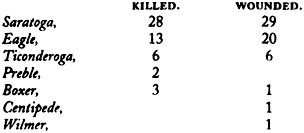
A total of 52 killed and 58 wounded; but the latter head apparently only included those who had to go to the hospital. Probably about 90 additional were more or less slightly wounded. Captain Pring, in his letter of Sept. 12th, says the Confiance had 41 killed and 40 wounded; the Linnet, 10 killed and 14 wounded; the Chubb, 6 killed and 16 wounded; the Finch, 2 wounded: in all, 57 killed and 72 wounded. But he adds “that no opportunity has offered to muster* * * this is the whole as yet ascertained to be killed or wounded.” The Americans took out 180 dead and wounded from the Confiance, 50 from the Linnet, and 40 from the Chubb and Finch, in all, 270. James (“Naval Occurrences,” p. 412) says the Confiance had 83 wounded. As Captain Pring wrote his letter in Plattsburg Bay the day after the action, he of course could not give the loss aboard the British gun-boats; so James at once assumed that they suffered none. As well as could be found out they had between 50 and 100 killed and wounded. The total British loss was between 300 and 400, as nearly as can be ascertained. For this action, as already shown, James is of no use whatever. Compare his statements, for example, with those of Midshipman Lee, in the “Naval Chronicle.” The comparative loss, as a means of testing the competitive prowess of the combatants, is not of much consequence in this case, as the weaker party in point of force conquered.
1815: The Battle of New Orleans
1. “Memoirs of Lieutenant-General Scott,” written by himself (2 vols., New York, 1864), i, p. 115.
2. Monroe’s biographer (see “James Monroe,” by Daniel C. Gilman, Boston, 1883, p. 123) thinks I made a good Secretary of War; I think he was as much a failure as his predecessors, and a harsher criticism could not be passed on him. Like the other statesmen of his school, he was mighty in word and weak in action; bold to plan but weak to perform. As an instance, contrast his fiery letters to Jackson with the fact that he never gave him a particle of practical help.
3. “The British infantry embarked at Bordeaux, some for America, some for England.” (“History of the War in the Peninsula,” by Major-General Sir W.F.P. Napier, K.C.B. New edition. New York, 1882, vol. v, p. 200.) For discussion of numbers, see farther on.
4. See, ante, p. 343.
5. Letter of Major-General John Keane, Dec. 26, 1814.
6. “Historical Memoir of the War in West Florida and Louisiana” (by Major A. Lacarriex Latour, translated from the French by H. P. Nugent, Philadelphia, 1816), p. 66.
7. Latour, 53.
8. Letter of Commodore Daniel G. Patterson, Dec. 20, 1814.
9. Latour, 110.
10. Latour, 111.
11. James (“Military Occurrences of the Late War,” by Wm. James, London, 1818), vol. ii, p. 362, says 2,050 rank and file; the English returns, as already explained, unlike the French and American, never included officers, sergeants, drummers, artillerymen, or engineers, but only “sabres and bayonets” (Napier, iv, 252). At the end of Napier’s fourth volume is given the “morning state” of Wellington’s forces on April 10, 1814. This shows 56,030 rank and file and 7,431 officers, sergeants, and trumpeters or drummers; or, in other words, to get at the real British force in an action, even supposing there are no artillerymen or engineers present, 13 per cent must be added to the given number, which includes only rank and file. Making this addition, Keane had 2,310 men. The Americans greatly overestimated his force, Latour making it 4,980.
12. General Jackson, in his official letter, says only 1,500; but Latour, in a detailed statement, makes 2,024; exclusive of 107 Mississippi dragoons who marched with the column, but being on horseback had to stay behind, and took no part in the action. Keane thought he had been attacked by 5,000 men.
13. I have taken my account of the night action chiefly from the work of an English soldier who took part in it; Ensign (afterward Chaplain-General) H. R. Gleig’s “Narrative of the Campaigns of the British Army at Washington, Baltimore, and New Orleans.” (New edition, Philadelphia, 1821, pp. 286–300.)
14. General Keane, in his letter, writes that the British suffered but a single casualty; Gleig, who was present, says (p. 288): “The deadly shower of grape swept down numbers in the camp.”
15. Keane writes: “The enemy thought it prudent to retire, and did not again dare to advance. It was now 12 o’clock, and the firing ceased on both sides”; and Jackson: “We should have succeeded … in capturing the enemy, had not a thick fog, which arose about (?) o’clock, occasioned some confusion.… I contented myself with lying on the field that night.” Jackson certainly failed to capture the British; but equally certainly damaged them so as to arrest their march till he was in condition to meet and check them.
16. 24 killed, 115 wounded, 74 missing.
17. 46 killed, 167 wounded, 64 missing. I take the official return for each side, as authority for the respective force and loss.
18. “While sitting at table, a loud shriek was heard.… A shot had taken effect on the body of an unfortunate soldier … who was fairly cut in two at the lower portion of the belly!” (Gleig, p. 306.)
19. Latour, 113.
20. Gleig, 307. The Americans thought the battery consisted of 5 18- and 12-pounders; Gleig says 9 field-pieces (9- and 6-pounders), 2 howitzers, and a mortar.
21. Gleig, 310.
22. 3,282 men in all, according to the Adjutant-General’s return for Dec. 28, 1814.
23. Latour, 121.
24. Gleig, 314. The official returns show a loss of 18 Americans and 58 British, the latter suffering much less than Jackson supposed. Lossing, in his “Field-Book of the War of 1812,” not only greatly overestimates the British loss, but speaks as if this was a serious attack, which it was not. Packenham’s army, while marching, unexpectedly came upon the American intrenchment, and recoiled at once, after seeing that his field-pieces were unable to contend with the American artillery.
25. 10 long 18’s and 4 24-pound carronades (James, ii, 368). Gleig says (p. 318), “6 batteries mounting 30 pieces of heavy cannon.” This must include the “brigade of field-pieces” of which James speaks. 9 of these, 9- and 6-pounders, and 2 howitzers, had been used in the attack on the Carolina; and there were also 2 field-mortars and 2 3-pounders present; and there must have been 1 other field-piece with the army, to make up the 30 of which Gleig speaks.
26. viz.: 1 long 32, 3 long 24’s, 1 long 18, 3 long 12’s, 3 long 6’s, a 6-inch howitzer, and a small carronade (Latour, 147); and on the same day Patterson had in his water-battery 1 long 24 and 2 long 12’s (see his letter of Jan. 2d), making a total of 16 American guns.
27. The British historian, Alison, says (“History of Europe,” by Sir Archibald Alison, 9th edition, Edinburgh and London, 1852, vol. xii, p. 141): “It was soon found that the enemy’s guns were so superior in weight and number, that nothing was to be expected from that species of attack.” As shown above, at this time Jackson had on both sides of the river 16 guns; the British, according to both James and Gleig, between 20 and 30. Jackson’s long guns were 1 32, 4 24’s, 1 18, 5 12’s, and 3 6’s, throwing in all 224 pounds; Packenham had 10 long 18’s, 2 long 3’s, and from 6 to 10 long 9’s and 6’s, thus throwing between 228 and 258 pounds of shot; while Jackson had but 1 howitzer and 1 carronade to oppose 4 carronades, 2 howitzers, 2 mortars, and a dozen rocket guns; so in both number and weight of guns the British were greatly superior.
28. In strong contrast to Alison, Admiral Codrington, an eyewitness, states the true reason of the British failure: (“Memoir of Admiral Sir Edward Codrington,” by Lady Bourchier, London, 1873, vol. i, p. 334.) “On the 1st we had our batteries ready, by severe labor, in situation, from which the artillery people were, as a matter of course, to destroy and silence the opposing batteries, and give opportunity for a well-arranged storm. But, instead, not a gun of the enemy appeared to suffer, and our own firing too high was not discovered till” too late. “Such a failure in this boasted arm was not to be expected, and I think it a blot on the artillery escutcheon.”
29. Gleig, 322.
30. Gleig, 323.
31. Speaking of Soult’s overthrow a few months previous to this battle, Napier says (v, 209): “He was opposed to one of the greatest generals of the world, at the head of unconquerable troops. For what Alexander’s Macedonians were at Arbela, Hannibal’s Africans at Cannæ, Cæsar’s Romans at Pharsalia, Napoleon’s Guards at Austerlitz—such were Wellington’s British soldiers at this period.… Six years of uninterrupted success had engrafted on their natural strength and fierceness a confidence that made them invincible.”
32. It was about 5 o’clock when Packenham fell upon Thomiéres.… From the chief to the lowest soldier, all [of the French] felt that they were lost, and in an instant Packenham, the most frank and gallant of men, commenced the battle. The British columns formed lines as they marched, and the French gunners, standing up manfully for the honor of their country, sent showers of grape into the advancing masses, while a crowd of light troops poured in a fire of musketry, under cover of which the main body endeavored to display a front. But, bearing onwards through the skirmishers with the might of a giant, Packenham broke the half-formed lines into fragments, and sent the whole in confusion upon the advancing supports.… Packenham, bearing onwards with conquering violence,… formed one formidable line two miles in advance of where Packenham had first attacked; and that impetuous officer, with unmitigated strength, still pressed forward, spreading terror and disorder on the enemy’s left.” (Napier, iv, 57, 58, 59.)
33. “A particular feature in the assault was our cutting a canal into the Mississippi.… to convey a force to the right bank, which … might surprise the enemy’s batteries on that side. I do not know how far this measure was relied on by the general, but, as he ordered and made his assault at daylight, I imagine he did not place much dependence upon it.” (Codrington, i, 335.)
34. James (ii, 373) says the British “rank and file” amounted to 8,153 men, including 1,200 seamen and marines. The only other place where he speaks of the latter is in recounting the attack on the right bank, when he says “about 200” were with Thornton, while both the admirals, Cochrane and Codrington, make the number 300; so he probably underestimates their number throughout, and at least 300 can be added, making 1,500 sailors and marines, and a total of 8,453. This number is corroborated by Major McDougal, the officer who received Sir Edward’s body in his arms when he was killed; he says (as quoted in the “Memoirs of British Generals Distinguished During the Peninsular War,” by John William Cole, London, 1856, vol. ii, p. 364) that after the battle and the loss of 2,036 men, “we had still an effective force of 6,400,” making a total before the attack of 8,436 rank and file. Calling it 8,450, and adding (see ante, note 10) 13.3 per cent. for the officers, sergeants, and trumpeters, we get about 9,600 men.
35. Letter of Major-General John Lambert to Earl Bathurst, Jan. 10, 1815.
36. 4,698 on the east bank, according to the official report of Adjutant-General Robert Butler, for the morning of January 8th. The details are as follow:
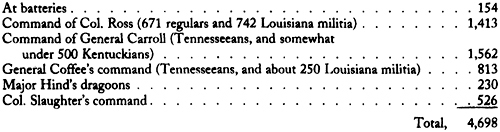
These figures tally almost exactly with those given by Major Latour, except that he omits all reference to Col. Slaughter’s command, thus reducing the number to about 4,100. Nor can I anywhere find any allusion to Slaughter’s command as taking part in the battle; and it is possible that these troops were the 500 Kentuckians ordered across the river by Jackson; in which case his whole force but slightly exceeded 5,000 men.
On the west bank there were 546 Louisiana militia—260 of the First regiment, 176 of the Second, and 110 of the Sixth. Jackson had ordered 500 Kentucky troops to be sent to reinforce them; only 400 started, of whom but 180 had arms. Seventy more received arms from the Naval Arsenal; and thus a total of 250 armed men were added to the 546 already on the west bank.
37. Two thousand Kentucky militia had arrived, but in wretched plight; only 500 had arms, though pieces were found for about 250 more; and thus Jackson’s army received an addition of 750 very badly disciplined soldiers.
“Hardly one third of the Kentucky troops, so long expected, are armed, and the arms they have are not fit for use.” (Letter of Gen. Jackson to the Secretary of War, Jan. 3d.)
38. Almost all British writers underestimate their own force and enormously magnify that of the Americans. Alison, for example, quadruples Jackson’s relative strength, writing: “About 6,000 combatants were on the British side; a slender force to attack double their number, intrenched to the teeth in works bristling with bayonets and loaded with heavy artillery.” Instead of double, he should have said half; the bayonets only “bristled” metaphorically, as less than a quarter of the Americans were armed with them; and the British breaching batteries had a heavier “load” of artillery than did the American lines. Gleig says that “to come nearer the truth” he “will choose a middle course, and suppose their whole force to be about 25,000 men” (p. 325). Gleig, by the way, in speaking of the battle itself, mentions one most startling evolution of the Americans, namely, that “without so much as lifting their faces above the ramparts, they swung their firelocks by one arm over the wall and discharged them” at the British. If any one will try to perform this feat, with a long, heavy rifle held in one hand, and with his head hid behind a wall, so as not to see the object aimed at, he will get a good idea of the likelihood of any man in his senses attempting it.
39. He committed every possible fault, except showing lack of courage. He placed his works at a very broad instead of at a narrow part of the plain, against the advice of Latour, who had Jackson’s approval (Latour, 167). He continued his earthworks but a very short distance inland, making them exceedingly strong in front, and absolutely defenceless on account of their flanks being unprotected. He did not mount the lighter guns of the water-battery on his lines, as he ought to have done. Having a force of 800 men, too weak anyhow, he promptly divided it; and, finally, in the fight itself, he stationed a small number of absolutely raw troops in a thin line on the open, with their flank in air; while a much larger number of older troops were kept to defend a much shorter line, behind a strong breastwork, with their flanks covered.
40. Latour, 170.
41. To prove this, it is only needful to quote from the words of the Duke of Wellington himself; referring, it must be remembered, to their conduct in a friendly, not a hostile, country. “It is impossible to describe to you the irregularities and outrages committed by the troops. They are never out of sight of their officers, I might almost say, out of sight of the commanding officers of the regiments that outrages are not committed.… There is not an outrage of any description which has not been committed on a people who have uniformly received them as friends.” “I really believe that more plunder and outrages have been committed by this army than by any other that ever was in the field.” “A detachment seldom marches … that a murder, or a highway robbery, or some act of outrage is not committed by the British soldiers composing it. They have killed eight people since the army returned to Portugal.” “They really forget every thing when plunder or wine is within reach.”
42. That these fears were just can be seen by the following quotations, from the works of a British officer, General Napier, who was an eye-witness of what he describes. It must be remembered that Ciudad Rodrigo, Badajos, and San Sebastian were friendly towns, only the garrisons being hostile. “Now commenced that wild and desperate wickedness which tarnished the lustre of the soldiers’ heroism. All, indeed, were not alike, for hundreds risked and many lost their lives in striving to stop the violence; but the madness generally prevailed, and as the worst men were leaders here, all the dreadful passions of human nature were displayed. Shameless rapacity, brutal intemperance, savage lust, cruelty and murder, shrieks and piteous lamentations, groans, shouts, imprecations, the hissing of fires bursting from the houses, the crashing of doors and windows, the reports of muskets used in violence, resounded for two days and nights in the streets of Badajos. On the third, when the city was sacked, when the soldiers were exhausted by their own excesses, the tumult rather subsided than was quelled.” (Vol. iii, 377.) And again: “This storm seemed to be a signal from hell for the perpetration of villainy which would have shamed the most ferocious barbarians of antiquity. At Rodrigo intoxication and plunder had been the principal object; at Badajos lust and murder were joined to rapine and drunkenness; but at San Sebastian the direst, the most revolting cruelty was added to the catalogue of crimes—one atrocity, of which a girl of seventeen was the victim, staggers the mind by its enormous, incredible, indescribable barbarity … a Portuguese adjutant, who endeavored to prevent some wickedness, was put to death in the market-place, not with sudden violence from a single ruffian, but deliberately, by a number of English soldiers.… and the disorder continued until the flames, following the steps of the plunderer, put an end to his ferocity by destroying the whole town.” Packenham himself would have certainly done all in his power to prevent excesses, and has been foully slandered by many early American writers. Alluding to these, Napier remarks, somewhat caustically: “Pre-eminently distinguished for detestation of inhumanity and outrage, he has been, with astounding falsehood, represented as instigating his troops to the most infamous excesses; but from a people holding millions of their fellow-beings in the most horrible slavery, while they prate and vaunt of liberty until all men turn in loathing from the sickening folly, what can be expected?” (Vol. v, p. 31.) Napier possessed to a very eminent degree the virtue of being plain-spoken. Elsewhere (iii, 450), after giving a most admirably fair and just account of the origin of the Anglo-American war, he alludes, with a good deal of justice, to the Americans of 1812, as “a people who (notwithstanding the curse of black slavery which clings to them, adding the most horrible ferocity to the peculiar baseness of their mercantile spirit, and rendering their republican vanity ridiculous) do, in their general government, uphold civil institutions which have startled the crazy despotisms of Europe.”
43. According to their official returns the British loss was 2,036; the American accounts, of course, make it much greater. Latour is the only trustworthy American contemporary historian of this war, and even he at times absurdly exaggerates the British force and loss. Most of the other American “histories” of that period were the most preposterously bombastic works that ever saw print. But as regards this battle, none of them are as bad as even such British historians as Alison; the exact reverse being the case in many other battles, notably Lake Erie. The devices each author adopts to lessen the seeming force of his side are generally of much the same character. For instance, Latour says that 800 of Jackson’s men were employed on works at the rear, on guard duty, etc., and deducts them; James, for precisely similar reasons, deducts 853 men: by such means one reduces Jackson’s total force to 4,000, and the other gives Packenham but 7,300. Only 2,000 Americans were actually engaged on the east banks.
44. Codrington, i, 386.
45. James says 298 soldiers and about 200 sailors, but Admiral Cochrane in his letter (Jan. 18th) says 600 men, half sailors; and Admiral Codrington also (p. 335) gives this number, 300 being sailors: adding 13/13; per cent. for the officers, sergeants, and trumpeters, we get 680 men.
46. 796. (Latour, 164–172.)
47. Report of Court of Inquiry, Maj.-Gen. Wm. Carroll presiding.
48. Letter of Col. W. Thornton, Jan. 8, 1815.
49. Letter of Commodore Patterson, Jan. 13, 1815.
50. Alison outdoes himself in recounting this feat. Having reduced the British force to 340 men, he says they captured the redoubt, “though defended by 22 guns and 1,700 men.” Of course, it was physically impossible for the water-battery to take part in the defence; so there were but 3 guns, and by halving the force on one side and trebling it on the other, he makes the relative strength of the Americans just sixfold what it was,—and is faithfully followed by other British writers.
51. The British Col. Dickson, who had been sent over to inspect, reported that 2,000 men would be needed to hold the battery; so Lambert ordered the British to retire. (Lambert’s letter, Jan. 10th.)
52. Letter of General Jackson, Jan. 19th, and of General Lambert, Jan. 28th.
53. “Towards the sea its fortifications are respectable enough; but on the land side it is little better than a block-house. The ramparts being composed of sand not more than three feet in thickness, and faced with plank, are barely cannon-proof; while a sand hill, rising within pistol-shot of the ditch, completely commands it. Within, again, it is as much wanting in accommodation as it is in strength. There are no bomb-proof barracks, nor any hole or arch under which men might find protection from shells; indeed, so deficient is it in common lodging-rooms, that great part of the garrison sleep in tents.… With the reduction of this trifling work all hostilities ended.” (Gleig, 357.)
General Jackson impliedly censures the garrison for surrendering so quickly; but in such a fort it was absolutely impossible to act otherwise, and not the slightest stain rests upon the fort’s defenders.
54. Thus Napier says (vol. v, p. 25): “Soult fared as most generals will who seek by extensive lines to supply the want of numbers or of hardiness in the troops. Against rude commanders and undisciplined soldiers, lines may avail; seldom against accomplished commanders, never when the assailants are the better soldiers.” And again (p. 150), “Offensive operations must be the basis of a good defensive system.”
55. The reverse has been stated again and again with very great injustice, not only by British, but even by American writers (as e.g., Prof. W. G. Sumner, in his “Andrew Jackson as a Public Man,” Boston, 1882). The climax of absurdity is reached by Major McDougal, who says (as quoted by Cole in his “Memoirs of British Generals,” ii, p. 364): “Sir Edward Packenham fell, not after an utter and disastrous defeat, but at the very moment when the arms of victory were extended towards him”; and by James, who says (ii, 388): “The premature fall of a British general saved an American city.” These assertions are just on a par with those made by American writers, that only the fall of Lawrence prevented the Chesapeake from capturing the Shannon.
British writers have always attributed the defeat largely to the fact that the 44th regiment, which was to have led the attack with fascines and ladders, did not act well. I doubt if this had any effect on the result. Some few of the men with ladders did reach the ditch, but were shot down at once, and their fate would have been shared by any others who had been with them; the bulk of the column was never able to advance through the fire up to the breastwork, and all the ladders and fascines in Christendom would not have helped it. There will always be innumerable excuses offered for any defeat; but on this occasion the truth is simply that the British regulars found they could not advance in the open against a fire more deadly than they had ever before encountered.
56. E.g.: The unexpected frost made the swamps firm for them to advance through; the river being so low when the levee was cut, the bayous were filled, instead of the British being drowned out; the Carolina was only blown up because the wind happened to fail her; bad weather delayed the advance of arms and reinforcements, etc., etc.
57. “He was the next man to look to after Lord Wellington” (Codrington, i, 339).
From The Rough Riders
1. Lieutenant Tejeiro, p. 154, speaks of this attempt to retake San Juan and its failure.
2. According to the official reports, 5,104 officers and men of Kent’s infantry, and 2,649 of the cavalry had been landed. My regiment is put down as 542 strong, instead of the real figure, 490, the difference being due to men who were in hospital and on guard at the seashore, etc. In other words, the total represents the total landed; the details, etc., are included. General Wheeler, in his report of July 7th, puts these details as about fifteen per cent of the whole of the force which was on the transports; about eighty-five per cent got forward and was in the fight.
3. The total Spanish force in Santiago under General Linares was 6,000: 4,000 regulars, 1,000 volunteers, and 1,000 marines and sailors from the ships. (Diary of the British Consul, Frederick W. Ramsden, entry of July 1st.) Four thousand more troops entered next day. Of the 6,000 troops, 600 or thereabouts were at El Caney, and 900 in the forts at the mouth of the harbor. Lieutenant Tejeiro states that there were 520 men at El Caney, 970 in the forts at the mouth of the harbor, and 3,000 in the lines, not counting the cavalry and civil guard which were in reserve. He certainly very much understates the Spanish force; thus he nowhere accounts for the engineers mentioned on p. 135; and his figures would make the total number of Spanish artillerymen but 32. He excludes the cavalry, the civil guard, and the marines which had been stationed at the Plaza del Toros; yet he later mentions that these marines were brought up, and their commander, Bustamente, severely wounded; he states that the cavalry advanced to cover the retreat of the infantry, and I myself saw the cavalry come forward, for the most part dismounted, when the Spaniards attempted a forward movement late in the afternoon, and we shot many of their horses; while later I saw and conversed with officers and men of the civil guard who had been wounded at the same time—this in connection with returning them their wives and children, after the latter had fled from the city. Although the engineers are excluded, Lieutenant Tejeiro mentions that their colonel, as well as the colonel of the artillery, was wounded. Four thousand five hundred is surely an understatement of the forces which resisted the attack of the forces under Wheeler. Lieutenant Tejeiro is very careless in his figures. Thus in one place he states that the position of San Juan was held by two companies comprising 250 soldiers. Later he says it was held by three companies, whose strength he puts at 300—thus making them average 100 instead of 125 men apiece. He then mentions another echelon of two companies, so situated as to cross their fire with the others. Doubtless the block-house and trenches at Fort San Juan proper were only held by three or four hundred men; they were taken by the Sixth and Sixteenth Infantry under Hawkins’s immediate command; and they formed but one point in the line of hills, trenches, ranch-houses, and block-houses which the Spaniards held, and from which we drove them. When the city capitulated later, over 8,000 unwounded troops and over 16,000 rifles and carbines were surrendered; by that time the marines and sailors had of course gone, and the volunteers had disbanded.
In all these figures I have taken merely the statements from the Spanish side. I am inclined to think the actual numbers were much greater than those here given. Lieutenant Wiley, in his book In Cuba with Shafter, which is practically an official statement, states that nearly 11,000 Spanish troops were surrendered; and this is the number given by the Spaniards themselves in the remarkable letter the captured soldiers addressed to General Shafter, which Wiley quotes in full. Lieutenant Tejeiro, in his chap. xiv, explains that the volunteers had disbanded before the end came, and the marines and sailors had of course gone, while nearly a thousand men had been killed or captured or had died of wounds and disease, so that there must have been at least 14,000 all told. Subtracting the reinforcements who arrived on the 2d, this would mean about 10,000 Spaniards present on the 1st; in which case Kent and Wheeler were opposed by at least equal numbers.
In dealing with the Spanish losses, Lieutenant Tejeiro contradicts himself. He puts their total loss on this day at 593, including 94 killed, 121 missing, and 2 prisoners—217 in all. Yet he states that of the 520 men at Caney but 80 got back, the remaining 440 being killed, captured, or missing. When we captured the city we found in the hospitals over 2,000 seriously wounded and sick Spaniards; on making inquiries, I found that over a third were wounded. From these facts I feel that it is safe to put down the total Spanish loss in battle as at least 1,200, of whom over a thousand were killed and wounded.
Lieutenant Tejeiro, while rightly claiming credit for the courage shown by the Spaniards, also praises the courage and resolution of the Americans, saying that they fought, “con un arrojo y una decision verdaderamente admirables.” He dwells repeatedly upon the determination with which our troops kept charging though themselves unprotected by cover. As for the Spanish troops, all who fought them that day will most freely admit the courage they showed. At El Caney, where they were nearly hemmed in, they made a most desperate defence; at San Juan the way to retreat was open, and so, though they were seven times as numerous, they fought with less desperation, hut still very gallantly.
From Through the Brazilian Wilderness
1. The first four days, before we struck the upper rapids, and during which we made nearly seventy kilometres, are of course not included when I speak of our making our way down the rapids.
2. The above account of all the circumstances connected with the murder was read to and approved as correct by all six members of the expedition.
3. I hope that this year the Ananás, or Pineapple, will also be put on the map. One of Colonel Rondon’s subordinates is to attempt the descent of the river. We passed the headwaters of the Pineapple on the high plateau, very possibly we passed its mouth, although it is also possible that it empties into the Canama or Tapajos. But it will not be “put on the map” until some one descends and finds out where, as a matter of fact, it really does go.