
BOOK THREE

CHAPTER THIRTEEN
And all should cry, Beware! Beware!
His flashing eyes, his floating hair!
AS THE YÜAN DYNASTY TREMBLED, Marco carefully distanced himself from his one-time mentor, Kublai Khan. To hear the Venetian tell it, his primary motive for leaving the court and all its intrigues was his insatiable desire to see more of the world than anyone before him. He presented this new phase of his travels as a case of urgent wanderlust. He had fallen under the spell of India, and had arranged for Kublai Khan’s permission to visit.
Marco, like other Western wayfarers of the era, remained vague about what he meant by “India.” Europeans often referred to “the Three Indias” or to a “Greater” and a “Lesser” India—all rather flexible terms. Each writer or traveler reconfigured “India” to suit his purpose or preconceptions, and Marco was no exception. In any case, India was for him a byword for escape more than an actual place on the map.
En route to India, Marco the overland explorer metamorphosed into Marco the navigator, as might be expected of a gentleman of Venice, the empire by the sea. As a remedy for his malaise, he discovered, nothing surpassed the ocean. Marco reveled in blue water’s therapeutic buoyancy, expansiveness, and sense of freedom.
“WE SHALL BEGIN first of all to tell about the great ships in which the merchants go and come into Indie,” Marco announces. These were sophisticated vessels of Arab and Chinese design, constructed of fir and pine, and fitted with a broad deck. For his European readers, accustomed to primitive sailing vessels, the surprise was their sheer size. The ship on which he sailed featured sixty cabins, each sufficient for a merchant to “stay comfortably.” It was equipped with a rudder, four masts, and four sails. “They often add…two masts more, which are raised and put away whenever they wish,” Marco reports. The larger ships boasted as many as thirteen holds, “so that if it happens by accident that the ship is staved in any place”—by a rock, for instance, or an aggressive whale “in search of food”—the injured craft would stay afloat.
Six centuries before Herman Melville’s Moby-Dick, Marco described how an Arab ship survived a deadly encounter with a cetacean. “If the ship sailing by night [and] making the water ripple passes near a whale, the whale, seeing the water glisten as it moves, thinks there will be food for it, and, moving quickly forward, strikes against the ship and often staves the ship in some part. And then the water entering through the hole runs to the bilge, which never remains filled with anything.” Here Marco mentions a piece of nautical technology unknown to Europeans: a watertight hold. It was nothing short of an engineering marvel. “And then the sailors find out where the ship is staved, and then the hold that answers to the break is emptied into the others, for the water cannot pass from one hold to another, so strongly are they shut in; then they repair the ship and replace the goods that have been removed. They are nailed in such a way; for they are all lined, that is, two boards, one above the other,…[and] they are, in the common speech of our sailors, caulked both outside and inside, and they are nailed with iron pins.”
Relying on his study of Arab shipbuilding methods, Marco describes a technique for making craft watertight, one that would have been of great interest to the shipbuilders of Venice’s Arsenal. “They are not pitched with pitch, because they have none of it,” he says. “I tell you that they take lime and hemp chopped fine, and they pound it all together, mixed with an oil from a tree…. And with this thing, they smear their ships, and this is worth quite as much as pitch.”
Not only were the Arab ships better engineered and safer than their Western counterparts, they were so large that Marco could not resist another opportunity to dazzle his audience with statistics. The vessels were operated by between 150 and 300 sailors, and they carried far more cargo than anything afloat in Venice. Ships of bygone days had been larger still, before a series of storms, or what he termed “the violence of the sea,” made harbors and coastlines too shallow to accommodate “those great ships, and so they are now made smaller; but they are [still] so large that they carry five thousand baskets of pepper, and some six thousand.”
The great vessels also had “tenders” large enough to carry a thousand baskets of pepper. Flourishing his nautical expertise, Marco explains precisely how the tenders were deployed in this distant land: “They help to tow the great ship with ropes, that is, hawsers, when they are moved with oars, and also when they are moved with sails if the wind prevails rather from the beam, because the smaller go in front of the larger and tow it tied with ropes; but not if the wind blows straight, for the sails of the larger ship would prevent the wind from catching the sails of the smaller.”
Such maneuvers were undertaken to bring the larger vessels in for refurbishing. “When the great ship…has sailed a year or more and needs repair, they…nail yet another board over the two all round the ship, and then there are three of them and they also caulk and oil it.” This arduous procedure was repeated as necessary until there were six layers of boards, at which point “the ship is condemned and they sail no more in her on too high seas but [only] in near journeys and good weather.” In the end, Marco says, “they dismantle and break them up.”
DESPITE THEIR superior technology, the sailors of India slavishly followed bizarre nautical superstitions. Marco was startled to learn how they predicted the outcome of a voyage. A ship, a strong wind, and a hapless drunk were required.
“The men of the ship will have a hurdle, that is, a grating made of wickerwork, and at each corner and side of the hurdle will be tied a cord, so that there will be eight cords, and they will all be tied at the other end with a long rope,” he explains. “They will find some stupid or drunken [man] and will bind him on the hurdle; for no wise or sane man would expose himself to that danger. When a strong wind prevails, they set up the hurdle opposite the wind, and the wind lifts the hurdle and carries it into the sky and the men hold it by a long rope…. If the hurdle makes for the sky, they say that the ship for which that proof has been made will make a quick and profitable voyage, and all the merchants flock to her for the sake of sailing and going with her. And if the hurdle has not been able to go up, no merchant will be willing to enter the ship for which the proof was made, because they say that she could not finish her voyage and many disasters would afflict her. So that ship stays in port that year.” Marco notes this behavior as dispassionately as an ethnologist observing an unusual tribal custom.
Having seen and experienced so much more of the world than other Europeans, he brought a mature sense of judgment, tolerance, and skepticism to bear on his experiences in India, etched in bulletins from the farthest reaches of the globe.
INDONESIA
At the outset, Marco describes Indonesia as having eight kingdoms, six of which he visited, “namely,…the kingdoms of Ferlec, Basman, Sumatra, Dagroian, Lambri, and Fansur.” Perhaps the most primitive was Basman, whose inhabitants had “no law except like beasts.” He remarks, “They are claimed by the Great Khan, but they make him no tribute because they are so far off that the people of the Great Khan will not go there.”
It was an enchanted kingdom, stocked with a varied bestiary including elephants, unicorns, “and specially of a kind of black goshawk.” Once again, Marco’s “unicorn” was the Asian rhinoceros, as his gruesome description makes clear: “It has the hair of the buffalo; it has the feet made like an elephant. It has one horn in the middle of its forehead very thick and black. And I tell you that it does no harm to men and beasts with its horn, but only with its tongue and knees, for on its tongue it has very long spines and sharp; so that when it wishes to hurt anyone it tramples and presses him down with the knees, afterward inflicting the harm with its tongue.”
The “monkeys” of Basman were even more disturbing. “In this isle there is a kind of monkey which is very small and has a face that is altogether like the face of men, and they have other parts of the body resembling them. So they say these monkeys are men and deceive others.” The monkeys provided cruel sport, according to Marco. “Now the men who are hunters take such monkeys as those and boil them and strip them all bare of all hair with a certain ointment, and fix and leave them the long hairs in the chin in place of beard and on the chest, and paint the skin with some color to make it like human skin. And when the skin is dry, the holes where the hairs are fixed are shrunken [so] that it seems as if they grew there naturally. And the feet and hands and the other limbs which are not quite like human limbs they stretch and reduce and fashion them by hand to the human likeness. Then they have them dried and put them in wooden molds with salt and smear them with saffron and with camphor and with other things that they may not decay, in such a way that they seem to have been men. And they sell them to merchants who carry them through the world for profit and give men to believe that there are men so small.”
Marco was talking not about monkeys but about pygmies—“men so small”—generally defined as humans less than sixty inches tall. Although frequently associated with Africa, pygmy communities or their remains have been found in Indonesia and throughout Southeast Asia. Asian pygmies have been labeled Negritos, in contrast to the name given to the pygmies of Africa, Negrillos, but both names have lately fallen into disfavor. Even today, the origins of pygmies are not fully understood. It is believed, but has not been proven, that all pygmies share a common ancestry, and common DNA, and in general, pygmy communities remain apart from the dominant community in which they live.
Sumatra.
The monsoon season arrived with him, to his dismay: “I myself, Marco Polo, stayed with my companions for about five months because of the unfavorable weather which we had, which forced me to stay there, and contrary winds which did not let us go our way.”
During his layover, Marco remained confined with two thousand other stranded travelers, who took up residence in five temporary wooden structures—“there is much timber here,” he explains. He asserts that he assumed a leadership role in defending the travelers against rising floodwaters during those five rain-sodden months. But Marco had assigned phantom heroic roles to himself in the past, and may have done so in this case. “Toward the island I caused great ditches to be dug round us,” he says, “of which the ends finished on either side upon the shore of the sea, for fear of beasts and of those bad beast-like men”—ravenous cannibals, it seems—“who gladly catch and kill and eat men.”
With the crisis behind him, Marco reveals that experienced merchants traded at a safe distance with the cannibals for food and other necessities for survival, especially rice and fish, for which he exhibited a fondness born of the fear of starvation, declaring it “the best fish in the world.” He passed the time drinking the local wine to ease the boredom and fear. “They have a kind of tree of which they cut off the branches,” he notes, “and from the branches flows water…which is wine. One puts a trough or very large jar at the stump that is left on the tree where the branch is cut off, just as they catch the sap of the vines…. Those branches drop [wine] very quickly, and in a day and night it is filled, and it is very good wine to drink, like our local wine.”
Dagroian.
When the rainy season ended, Marco groggily exchanged the shelter of wine-producing trees for the road leading to the next kingdom. There he came across appalling rituals for dealing with the sick, who were examined by “magicians”—seers who predicted whether the afflicted “must recover or die.”
The lucky ones were spared any further attention, and left to recover, but those pronounced doomed were subjected to a primitive form of euthanasia, followed by a banquet of cannibalism: “Some of these men who know how to kill sick persons most easily and gently come and press down the sick man who will soon be dead and…suffocate him immediately, and kill him before the time of his death. And when he is dead they cut him up and have him skillfully cooked. All the relations of the dead come and have a friendly feast together and eat him up stump and rump after he is cooked and roasted.”
Marco recorded these customs in horrifying detail, conveying the cannibals’ reverence, and perhaps fear, of the souls of the dead. “They eat and suck out also the marrow inside the bones, leaving no moisture or fat in them at all,” he goes on. “They do this because they do not wish any atom of him to remain, so that it may not decay. For they say that if there were to remain any substance in the bones, that it would make worms, and the worms would die at last for want of food…. After they have eaten him, they take the bones and put them in a casket of stone, and then they carry them and hang them in great caves of the mountains in such a place that no beast or other evil thing could touch them.”
Marco proclaims his revulsion: “This is a very evil way and bad custom, and so it is a very cruel and evil people.”
Fansur.
As he recounts his travels through Indonesia, Marco ceases to extol the grandeur of the Mongol Empire and concentrates on his preoccupation with food. By the time he arrived in the kingdom of Fansur—the word means “camphor”—he was so ravenous that he ignored the region’s celebrated natural resource in favor of bread made from the sago palm. Preparing it was simple enough: the locals opened the trunk of a mature sago and ground the pulp into a starchy substance that they washed, sieved, pulverized, and then baked into dense, nearly tasteless loaves that he claims were “very good to eat.” In fact, he says, “the bread of that flour is like barley bread and of that taste.”
He invites his readers to visualize him feasting at last: “I, Master Marco Polo who saw all this, tell you that we ourselves tried it sufficiently, for we often ate them [the loaves].” He became so enamored of sago flour that he gathered a supply to take with him on his travels. “I took some of this flour to Venice with me,” he confides, but it is difficult to imagine Venetians sharing his enthusiasm for it.
CEYLON
“Noble and good rubies are produced in this island,” Marco has heard. Even more enticing, “the king of this province has the most beautiful ruby in all the world.” Marco describes it with authority, because, he says, “I, Marco Polo, was one of the ambassadors and saw the said ruby with my eyes; and when that lord was holding it in his closed hand, it projected below and above the fist, which the lord put to his eyes and to his mouth.” Marco makes the ruby sound larger still: “It is about a large palm long and quite as thick as the arm of a man. And it is the most splendid thing in the world to see. It has no flaw in it. It is red like fire.”
Kublai Khan had declared that he must have it, and so, Marco reports, “the Great Khan sent his messengers to this king,…saying that he wished to buy this ruby, and that if he would give it to him, he would have the value of a city given him for it.” It would not be easy to obtain the ruby, for “the king of Seilan said that he would not give it for anything in the world, because he said that it belonged to his ancestors, and for this reason he couldn’t have it”—words that Kublai Khan could not tolerate or understand.
With stories such as these, Marco acknowledges that even Kublai Khan, the mightiest ruler in the world, was mortal, and, even more painful, was rapidly losing his powers.
INDIA AND THE GULF OF ADEN
Maabar.
Here, in “the noblest and most rich [province] in the world,” Marco felt that he was in his element, for once. He found himself among wealthy merchants trading for pearls, which could be found in the shallow waters just off the mainland. “In all this gulf there is no water more than ten or twelve paces deep, and in some places there is some that is not more than two paces. In this gulf the best pearls are taken,” he reports. Drawing on his experience with the precious commodity, Marco explains the process of harvesting and selling pearls, all of it little changed from the earliest accounts two thousand years before. “There will be several merchants who will form a company and agreement together and will take a large ship specially fitted out for this on which each by himself will have a room fitted and furnished for him, and in it a tub full of water and other necessary things.”
During the short harvesting season, April to May, the ships sailed to a “place where the scallops are found in greater number, which is called Bettala, which is on firm land. And from there they go into the sea…, sixty miles straight toward midday, where they cast their anchors, and then from their large ships enter into those small barques…. There will be many ships like this”—as many as eight thousand, according to other contemporaneous accounts—“because it is true that there are many merchants who pay attention to this fishing; and they make many companies. All the merchants who are associated on one ship will have several boats that will tow the ship through the gulf. The small boats carry the anchors of the large boats to land. They [employ] many men who can swim well, clever pearl-fishers for hire, with whom they make agreement by the month; that is, they give them so much for the whole month of April till mid-May or so long as the fishery lasts in the gulf.”
Harvesting posed hazards, especially “great fishes” ready to strike and kill the fishermen. The merchants protected themselves with “magicians” known as “braaman, who with their enchantments and diabolical art control and stupefy those fishes so they can hurt no one. Because this fishing is done by day and not by night, those magicians make spells by day that they break for the following night.”
At last “the ship is anchored and the men who are in the small barques…leave the barques and go under the water some four paces and some five, up to twelve, and stay under water as long as ever they can; and when they are at the bottom of the sea, they find on it scallops that men call sea oysters, and bring them up in a little bag of net tied to the body.”
Marco proceeds to describe the timeless process of extracting pearls: “These scallops are indeed split and are put in the aforesaid tubs full of water that are on the ships, for the pearls are found in the flesh of those scallops. And while they stay in the water of the tub, those bodies decompose and rot and are made like the white of an egg, and then they float at the top and the pearls stay on the bottom clean.” When Marco avers that “the pearls that are found in this sea are distributed through all the world,” he does not exaggerate.
The inhabitants of Maabar adorned themselves lavishly with the pearls they acquired. At times, that was all they wore. “There is no need of a tailor or stitcher to cut and sew cloth because they go naked at all times of the year,” Marco notes, with the exception that “they cover their natural parts with a little cloth.” The king of the realm was distinguished by a broad gold collar studded with “large and beautiful pearls and…precious stones,” including rubies, sapphires, and emeralds. From his collar hung a long “cord of thin silk” strung with exactly 104 choice pearls and rubies, the number of precious stones determined by the 104 prayers the wearer uttered each day. The king also wore pearl-studded golden bracelets—“a marvel to see”—covering his arms and legs, and even his fingers and toes. Marco estimated these gems to be “worth more than a good city.” The king jealously guarded his treasures, “commanding that all those who have beautiful pearls and good stones must bring them to the court; and that he will have twice as much as the cost.” The offer enticed merchants like Marco, as well as the king’s subjects, to “take them gladly to the court because they are well paid.”
As always, sexual excess preoccupied the Venetian, who revealed that the king had five hundred wives. “As soon as he sees a beautiful lady or girl then he wishes her for himself and takes her to wife,” Marco states. “In this kingdom are women very beautiful of themselves; and besides this they make themselves beautiful in the face and in the whole body.”
Despite the ease with which he acquired wives, this privileged king had resorted to an “unfitting” deed to win a “very beautiful woman” who happened to be his brother’s wife. Undaunted, the king “took her from him [his brother] by force and kept her many days for himself. His brother, who was a prudent man and wise, showed no sign but suffered him in peace and made no quarrel with him.” There was an extraordinary reason for his reticence: “He was many times on the point of stirring up war against him because he [the king] had taken his wife from him, but their mother used to show them her breasts and say, ‘If you stir up a quarrel between you, I shall cut off my breasts that nourished you.’ And so the trouble was stayed.”
The king had much else to occupy his thoughts—countless children, for one thing, and a large, fanatically devoted retinue of servants. Coming of age when the legacy of feudalism still retained its power, Marco understood the bond between lords and servants—after all, he had been the vassal of Kublai Khan for nearly two decades—but the ties between this king and his servants were another thing entirely, as Marco relates. “When the king dies and his body is burnt in a great fire, then…many of the company and also of all these barons who were his faithful ones…throw themselves into the fire together with the king of their free will, and are burnt with the king to bear him company in the other world; for they say that since they have been his companions in this world, they ought to be so and to serve their lord in the other, also.” This startling custom afforded Marco his first exposure to suttee, widely practiced through the world he now explored. “When a man is dead and his body is being burnt, his wife throws herself on the fire herself and lets herself burn with her lord,” he marvels, adding that the “ladies who do this are much praised,” while those who refrained from self-immolation invited scorn.
The kingdom’s approach to criminal behavior diverged sharply from Western conventions as well. “When a man has done a crime such that he must die and that the lord wishes to have him killed, then he who must be killed says that he wishes to kill himself for the honor and for the love of such an idol. The king tells him he is quite willing for this.”
Marco depicted the ritual punishment that followed with macabre flourishes: “All the relations and the friends of this one who must kill himself take him and put him on a chair and give him twelve swords or knives well ground and sharp, and tie them round his neck, and carry him through all the city, and go saying and crying, ‘This very valiant man is going to kill himself for the love, honor, and reverence of such an idol.’” When the procession comes to a halt at the appointed place,
“then he who must die takes a knife and cries with a loud voice, ‘I kill myself for the love of such an idol.’ After he has said these words, he strikes himself with the knife in the middle of the belly…. He gives himself so many blows with these knives that he kills himself.” In another version, perhaps even more gruesome, he places the knife “at the back of his head and drawing it violently to him cuts through his own neck, for that knife is very well sharpened, and dies in the very act.”
Having shocked his audience, Marco offhandedly comments, “When he is killed, his relations burn the body with great joy and with great festivity, thinking that he is fortunate.”
Madness, he implied with a stern Venetian squint, resided in the eye of the beholder.
MARCO ALSO ACQUAINTED his audience with the curious ciugi, or yogis, devout Indians distinguished by their “great abstinence” and the “strong and hard life” they led for “love of their idols.”
Their appearance was arresting: “They go naked without wearing anything above so that their natural parts are not covered, nor any member.” Marco says that they worshipped the ox and most of them carried “a little ox of copper or of bronze gilded in the middle of their foreheads.” They burned ox dung, then anointed themselves with the ashes “with great reverence…as Christians do with holy water.” They ate nothing green, believing that all living things, including plants and leaves, have souls, and they slept naked on the ground “without keeping anything whatever in the world neither below nor above.” It was a “great wonder” they did not all die from the practice. To complete the harshness of their lives, “they fast all the years and drink water and nothing else.”
The yogis confronted sexuality in their “churches” or “abbeys,” where they enacted bizarre rites that Marco describes with lascivious relish. When one of their number who served their “idols” died, the candidates for successor entered the abbey and tested their steely self-control against the warm, sweet caresses of various maidens. “They [the maidens] touch them both here and there in many parts of the body,” Marco says, and “they embrace and kiss them and put them in the greatest pleasure in the world…. If his member is not moved at all except as it was before the maidens touch him, this one is counted good and pure and they keep him with them, and he serves the idols.” As for a candidate unable to resist the maidens’ touch, “if his member is moved and rises, this one they do not keep at all but drive him away immediately from the fellowship of the monks for ever and say they refuse to keep a man of self-indulgence with them.”
OBSERVING THESE outlandish customs, Marco neither judged them nor recoiled in horror. He remained objective, if baffled, always absorbed by the astonishing variety of behavior on display in the provinces through which he traveled. Beneath the welter of observations he offered his audience, he moved ever farther from the touch-stone of his youth, Christianity, into the realm of Buddhism.
He fastened on Saint Thomas, one of the twelve apostles, as the chief point of comparison between Christianity and Buddhism. In both Aramaic and Greek, the saint’s name means “twin,” and John 11:16 identifies him as “Thomas who was called the Twin.” Alone among the disciples, Thomas doubted news of the Resurrection—this is the origin of the phrase “doubting Thomas.” (Only when Thomas touched Jesus’s wounds did he become a fervent believer.) The subject of a large body of apocryphal literature, including the Acts of Thomas, he was said to have been martyred in AD 53 in Madras, India, on what later came to be known as Mount Thomas.
As Marco traveled through India, his thoughts turned occasionally to this martyr as to no other figure in Christianity. “The body of Master Saint Thomas the Apostle, who endured martyrdom for Christ in the province, is buried in…Maabar…in a little town, for there are no men at all, and few merchants, nor do merchants come there because there is no merchandise that they could well take away from it, and also because the place is much out of the way.” So Marco heard, and he could not resist going there. Years before, in Armenia, he had missed what he believed was his chance to confirm the presence of Noah’s Ark on Mount Ararat; now he had an opportunity to confirm the existence of an apostle, and this time he was determined to pursue it.
He made the pilgrimage in the company of both Christians and Muslims. “I tell you the Saracens of that country have great faith in him and say that he was a Saracen”—an affecting but illogical assertion, because Thomas’s life and works predated Islam by several centuries. Nevertheless, those Saracens “say that he was a very great prophet and call him aviarun in their tongue, which means ‘holy man.’” Marco’s confusion about Thomas’s identity may reflect a blending of religious traditions in the region, or it may reveal his own misunderstanding of what he had been told.
No matter who the “holy man” had been in life, his burial place was rife with mystery and miracles. Trees produced nuts—Marco calls them “Pharaoh’s Nuts”—that furnished both food and drink. “They have an outside shell on which there are as it were threads that are used in many things and avail for many purposes. Under that first shell is a food on which a man feeds sufficiently. It is indeed very savory and sweet as sugar, white as milk, and is made cup shaped like the outer shell. And in the middle of that food is so much water that a phial would be filled, which water is clear and cold and of a very perfect taste,” says Marco, plainly amazed. The mysterious nuts were, of course, coconuts.
The very earth, rich and red, contained magical healing properties. “The Christians who go there on pilgrimage take of the earth of the place where the holy body of Saint Thomas was killed and reverently carry that earth into their country and give a little of this earth, mixed with water or other liquid, to the sick to drink when he might have quartan fever or tertian fever”—that is, malaria—“and as soon as the sick man drinks it he is healed by the power of God and of the saint.”
Marco declares that he himself “carried some of this earth to Venice with him and healed many with it.” Marco the merchant did not assume the mantle of healer naturally. While it is entirely possible that he returned to Venice with a sample of the magical soil, there are no reports of his employing it to cure others, nor was it listed among his effects. More likely, his amanuensis Rustichello or a pious translator of the manuscript added this flourish to portray Marco as a man of faith.
HE WAS, IN FACT, BECOMING more spiritually inclined. No longer did Marco Polo dismiss the hundreds, and then thousands, of images of Buddha he encountered—wooden statues, stone carvings, illustrations—as idols. Now he plunged into the history of this singular figure in an attempt to fathom the Buddha’s mysterious appeal.
The first stirrings of Buddhist sympathies in Marco may have come from his contact with the Mongols, who were succumbing to Buddhism in ever-increasing numbers. They had originally encountered it from their neighbors to the west, the Uighurs, but the Uighurs’ version of Buddhism issued not from India but from Tibet. Steeped in magic rituals, this form spread east along the Silk Road to Cambulac and reached Kublai Khan, who endorsed it, as he did the other major belief systems in his empire. In India, Marco encountered a more ancient form of Buddhism, and he found it intoxicating. Ever the chameleon, he altered his persona once more: Marco the Mongol became Marco the Buddhist.
MARCO SET HIMSELF the task of educating his Western audience about the Buddha’s significance. The traveler’s portrayal of his encounter with Buddha conveyed a suggestion of destiny, as if Marco had come all this distance to meet the great teacher who would bestow a sense of purpose and clarity upon his wayfaring. The Buddha’s coming of age resembled Marco’s, and the Venetian merchant naturally identified with the spiritual journey of the Indian sage. Marco offered an account of the Buddha’s life that was drastically simplified, yet heartfelt rather than dismissive or condescending. He provided his earliest audiences with their first exposure to the Buddha and the Buddhist mystique.
Marco called the Buddha by an unusual name: Sagamoni Burcan, “the Divine Buddha.” The first part is his transcription of S’akyamouni, a Sanscrit term meaning “the religious saint of the royal family of S’akya.” The second part comes from a Mongol term,burkhan, meaning “god,” “divine being,” or “saint.”
“This Sagamoni was the first man to whose name idols were made,” Marco explains, proceeding to describe him as “the most holy and best man who ever was among them.”
Marco continues: “He was the son of a great king, both rich and powerful. And this his son was of so good life that he did not wish to hear any worldly thing, nor did he wish to be king. And when his father saw his son did not wish to be king…he was [in] very great vexation at it. He offered him a very great offering, for he told him that he would crown him king of the kingdom and he should be lord of it at his pleasure.
“His son indeed said that he wanted nothing. And when his father saw that he did not wish to rule in any way in the world, he had so great vexation in it that he nearly died of grief. It was no wonder, because he had no more sons than this one, nor had he any to whom he should leave the kingdom after his death. The king after deep thought…made him move into a very beautiful palace and gave him thirty thousand very beautiful and winning maidens to serve him, and commanded them to play with him all day and all night, promising the one who would be first to induce him to lie with her that she would be his wife and queen.”
The maidens did as ordered. They played, danced, and sang. They “served him at table and made him company all day.” And still the son refused to be moved to “any act of self-indulgence” and continued to lead a virtuous life and retain his singular innocence. “I tell you,” Marco says, “that he was so delicate a young man that he had never gone out of the palace of his father in his youth nor had ever seen a dead man nor any other who was not sound in his limbs, for the father let no old and no decrepit man go before him.” That state of innocence could not endure.
“Now it happened that this young man, having leave of his father to go out with a very fine company, was riding one day along the road through the city and then he saw a dead man whom they were carrying to bury, and he had many people following. He became all dismayed at it. So he asked immediately of those who were with him what thing it was, and they told him it was a dead man.
“‘What?’ said the son of the king. ‘Do all men die?’
“‘Yes, truly,’ they said.
“Then the young man said nothing and rode on very thoughtful. After this, he had not ridden far before he found a very old man bent down with age who could not walk and had no teeth in [his] mouth, but had lost them all through great old age…. The youth said, ‘How from youths do they become old and bent like this?’ To whom the servants answered, ‘Sir, all those who live long in this world must become old like this man and then die.’ And then, when the son of the king had well understood about the dead and about the old, he went back to his palace frightened and all astonished.”
Marco recounts this story with more conviction and precision than he brought to other spiritual episodes. Of all the legends he heard during his travels, the story of the young son’s response to the death and decay of the world around him had the greatest resonance. He continues: “He went off to the mountains very great and out of the way seeking still the rough and wildest places and stayed there all the days of his life very uprightly and chastely, and led a hard life, living on roots and herbs and wild fruits and made very great abstinence, just as if he had been a Christian.”
For Marco, this account of the privileged young son’s life marked the point of contact between East and West, between the Christian faith and the Buddhist worldview. More than that, it prompted him to dare to elevate the central Buddhist system to the same level as Christianity, as heretical as that idea would seem in Venice. Nevertheless, he hammers the point home: “For truly, if he had been Christian he would have been a great saint with our Lord Jesus Christ for the good life and pure that he led.”
Marco pauses, and then brings the story to its conclusion: “When this son of the king died, he was carried to the king, his father. When he saw him dead, whom he loved more than himself, there was no need to ask if he has vexation and grief; he almost went out of his senses. He made great mourning, with bitter lamentation of all the people. Then he had an image made in his likeness all of gold and precious stones and made it honored by those of the land with the greatest reverence and worshipped as their god.”
A change in the narrative’s pitch signals that although Marco was willing to embrace the Buddha, he remained skeptical concerning the doctrine of reincarnation: “They said that he was God, and they say it still, and also that he was dead for eighty-four times; for they say that when he died the first time that he became a man, and then he revived and became an ox, and revived and became a horse, and thence an ass, and so they say that he died eighty-four times, and every time they say that he became an animal, either a dog or other thing, but at the eighty-fourth time they say he died and became a god; and him the idolaters hold for the best god and for the greatest that they have.”
MARCO’S VERSION of Buddhism was heavily influenced by the Mongol interpretation of the Buddha as a potent source of magic. But Marco also put a personal slant on the Buddhist traditions he encountered in India, seeking both an idealized father figure who would not abandon him as his own father had done years before, and a cynosure who transcended the carnality and mortality of Kublai Khan. Ever elusive, the Buddha filled this exalted role, and appreciation of Buddhist precepts liberated Marco from his past.
In the realm of the Buddha, nothing was shocking or blasphemous—a change in perspective that marked the first revolution in Marco’s consciousness since his illness in the poppy fields of Afghanistan. This time, his enlightenment was entirely natural, yet bewildering. He verges on confessing that, for once, language is inadequate to explain his expansion of consciousness. In India, his powers of description lag behind his experience. No longer does he relive his adventures for the benefit of his readers, performing the task of imagining for them. Instead, he offers sketches for an uncompleted canvas. He seems to be soul-searching and thinking aloud rather than re-creating his experiences for one and all. All the glorious battles and alluring concubines on which he had lavished attention fade in significance before the spiritual journey unfolding before him and his newest, and greatest, discovery: himself.
IN HIS ACCOUNT of Ceylon, Marco had referred in passing to a steep, inaccessible mountain at whose peak stood a “monument” to Adam, or so he had heard from both Christians and Muslims. But after paying lip service to this traditional interpretation, he immediately moved on to the Buddhists’ interpretation of the “sepulcher.” No matter who was commemorated in this remote location, all faiths agreed that it consisted of the “teeth and the hairs and the bowl”—that is, the food bowl—of a venerable figure. Marco carefully noted that he did not agree with those who insisted Adam’s remains would be found there, “for our scripture of the holy Church says that he is in another part of the world. The decision of this I wish to leave to others.”
In 1281, Kublai Khan learned from Muslims who had visited this mountaintop that the remains of Adam could be found there. “He says therefore to himself that it is necessary for him to have the teeth and the bowl and the hair.” This wish, no matter how unrealistic, was in keeping with Kublai Khan in his dotage. As he did on many other occasions, “he sent an embassy to the king of the island of Ceylon to ask for these things.” It was just the kind of expedition that Marco himself might have been selected to join, if at that point he had not been maneuvering to go home, and he describes it with an insider’s appreciation.
Three years later, the emissaries reached their quarry. As Marco relates, “[They] exerted themselves so much that at last they have the two molar teeth which were very thick and large, and again they had some of the hair and the bowl in which he [the revered person] used to eat. The bowl was of very beautiful green porphyry. When the messengers of the Great Khan had these things of which I have told you, they set themselves on the road and go back to their lord. When they were near to the great town of Cambulac, where the Great Khan was, they made him know that they were coming and bringing the holy things for which he had sent them.” Kublai received the items gratefully, and paid particular attention to the bowl, having heard that if food for just one person was placed in it, “five men would have enough from it.” Seeking proof, he ordered it filled with a portion fit for one, and then declared that it did, indeed, feed five—or so Marco says. He tells the story of the magical bowl with obvious skepticism, although he refrains from labeling Kublai Khan as credulous, even while raising the possibility.
WHEREVER MARCO TRAVELED along India’s coast, the “fervent heat” tormented him. “The sun is so hot that one can scarcely bear it there,” he complains. “Even the water is so hot that if you were to put an egg into some river when the sun is shining brightly on it, it would be cooked before you were gone at all far, just as in boiling water.” Despite the oppressive climate, merchant ships from the four corners of the earth converged to trade.
Exotic and terrifying creatures populated the region, and they were “different from all the others in the world,” according to Marco. There were “black lions” (probably panthers); beautiful “parrots” as white as snow, with red beaks and feet (Marco apparently had another bird in mind, for which he lacked a name); peacocks larger than any to be found in Venice; hens bigger and better than any he had ever encountered; and fruit, the likes of which he had never seen, and which he could not name. For once, the variety of flora and fauna rendered Marco Polo speechless.
Melibar.
Upon reaching this “great kingdom to the west,” Marco posts an urgent warning concerning the scourge of pirates. He denounces them as “great robbers of the sea” and describes their modus operandi, apparently from anxious personal experience: “Most of the ships of these evil corsairs are parted hither and thither to wait for and find ships of the merchants who pass by.” He says that they are so adept at catching their prey that “no merchant ship may pass that is not taken, for they go together in companies of twenty or of thirty ships of these corsairs and form a great line on the sea.” Anchored about five miles apart, “twenty pirate corsairs control over one hundred miles of open water with this strategy.”
The hunt went on day and night. “As soon as they [the pirates] see any merchant ship they make a light of fire or smoke for a signal, and they all collect together and go there hard and take everything.” The cargo consisted of items as varied and valuable as copper (used for ballast), silk, and pepper, spikenard, cloves, and other spices concealed aboard the unlucky ships. As a merchant, Marco realizes that his colleagues “know well the way of these evil corsairs and know well they are bound to find them,” so “they go many together and so well armed and so well prepared that they have no fear of them when they find them, for they defend themselves bravely and very often do them great harm.”
Occasionally, the pirates ensnared one of the merchant vessels, taking the goods aboard but sparing the lives of the men, whom they taunted by saying, “Go home to gain some other goods, so you will give them to us again!”
Goçurat.
Here the pirates were even more “cruel and evil” than elsewhere. Cringing with empathy for the victims, Marco tells how they “seize the merchants and beside taking the goods from them, torture them and put a ransom on their persons; and if they do not quickly pay the ransom, they give them so great torments that many die of it.”
Nothing that Marco had seen, not even among the Mongols, notorious for their savagery, affected him as deeply as the reports of the torments inflicted on merchants by Arab pirates. Waxing increasingly indignant on the part of his fellow merchants, he describes the lengths to which the merchants would go to prevent their tormentors from succeeding. If they are carrying pearls and other precious stones, he says, “they swallow them that they may not be snatched from them by the pirates,” and thus manage to keep some of their goods.
But the pirates are “infected with evilness,” Marco warns, “for you may know that when these wicked corsairs take some ship of the merchants and find no stones and pearls, they give them to drink a certain drug called tamarind and seawater, so that the merchants go much below and pass or vomit all that they have in belly.”
A long-lived, massive tree, the tamarind is distinguished by graceful, feathery dark-green foliage that withdraws by night. Lost in this profusion are the tamarind’s flowers, which harbor abundant cinnamon-brown pods that are as long as a banana and contain acidic flesh and soft seeds. As they mature, the pods fill out, the juicy, acidulous pulp turns brown or reddish-brown, and the seeds harden. Tamarind is used as a staple in Indian food and medicine, and the pirates described by Marco made it into a powerful purgative. The seawater the merchants ingested caused them to vomit, bringing up some of the items they may have swallowed, while any items that had passed farther down the alimentary canal mixed with the tamarind bulk and passed out in the stool.
“The corsairs have all that the merchants pass collected and have it searched to see if there are pearls or any other precious stones,” Marco explains, with mingled sympathy and disgust. “The merchants can in no way escape without losing everything if they were taken.” Either way, the pirates claimed their loot and inflicted a humiliating lesson on the merchants in the process. “Now you have seen…great malice,” Marco snorts, as he considers these maritime thugs.
Tana.
Marco implies that he has visited the place, without insisting on it. His casual handling of his sources of information becomes increasingly apparent as he traces his course through India, relying ever more heavily on secondhand information. Whether or not he stretched a point to include it in his travels, Tana suited his theme: the dangers of piracy to merchants and the India trade, otherwise so profitable. Here pepper and incense abounded, as did buckram and cotton. “Great trade is done there and ships and merchants go there in plenty,” he informs his public, “and the merchants who come there with their ships bring and carry in with them several things; these are gold, silver, and brass, and many other things that are necessary to the kingdom from which they trust to profit and gain.”
Here, too, pirates infested the waters, earning another rebuke from the Venetian: “Many corsairs come out from this kingdom, who go about the sea doing great harm to the merchants.” Oddly, they plied their nefarious trade in collusion with the king of Tana, in exchange for horses, which his kingdom needed. “The king has made this agreement with the corsairs that they are pledged to give him all the horses that they take.” At the same time, “all other goods, both gold and silver and precious stones, belong to the corsairs.” In the face of this corruption, damaging to merchants throughout India, the Venetian could only lament, “…this is an evil thing, and it is not kingly work.”
Socotra.
Marco’s yearning for the sea, and, by extension, the voyage home, prompted him to sail across the Indian Ocean to the island of Socotra, at the entrance to the Gulf of Aden.
Part of an archipelago of much smaller islands, Socotra seems to stand alone as it rises out of the sea on massive coral banks. Home to an ecosystem that had been isolated for millions of years, the island held many biological rarities. The Venetian had just entered a biologist’s dream in which about one-third of the plants and animals surrounding him were found there and only there; the unique specimens included land crabs living at more than two thousand feet above sea level, rare birds, and a profusion of exotic reptiles. The most celebrated of the island’s flora was the Dragon’s Tree, whose astringent resin was used to treat wounds. So impressed was Marco by the island’s flora and fauna, its giant lizards and fanlike Dragon Trees standing in isolation against the infinite sky, that he came to declare it “the most enchanted place on earth.”
To his delight, Marco discovered that this remote but strategically located outpost supported thriving tuna and whaling industries, which appealed to his mercantile instincts. The whale was well known, if poorly understood, in Europe. For centuries, the giant mammal had furnished meat, blubber, and teeth to northern Europeans. Whalebone was especially prized for fashioning weaving tools, gaming pieces, and chopping blocks. In the eleventh century, an Arab traveler wandering far from home discovered that people living on the islands off the coast of England used whale bones, not wood, for construction. Whaling was a popular pursuit in Scandinavia as well as Ireland.
Marco explains how Arabs caught their whales, and how merchants turned a handsome profit from the creature’s by-products. He begins with the procedure for preparing tuna, used as bait. “The tuna is very fat, and they cut it into pieces and place it in large vases or jars and put in salt and make much brine,” he says. “This done, there will be perhaps twelve who will take a small ship and, putting on board this fish with all the brine or salt broth of the fish, will go out to sea. And then they will have some remnants of torn pieces or of other cast-off things, and they will soak these leavings tied in a bundle in the brine that will be very fat, and afterward they will throw them into the water; and they will be tied to the little ship with a rope. They will then hoist sail and will go all day wandering through the high seas hither and thither; and wherever they pass the fat that is in the brine leaves as it were a path on the water.”
Marco was astonished by the whale’s endurance—“If it happens that they pass by a place where a whale is, or by some means the whale perceives the scent of the fat of the tuna, [the whale] follows that track…for a hundred miles”—and its vulnerability. When the hunters reached their elusive prey and threw it “two or three pieces of tuna,” the whale, on devouring the bait, was “immediately made drunk as a man is made drunken with wine.”
The bravest whale hunters clambered out of their craft onto the back of the slippery wet beast and attempted to balance themselves. One held a “stake of iron barbed at the end so that if it is fixed in, it cannot be pulled out because of the barb.” At the first opportunity, one of the hunters “will put the stake on the head of the whale and another will strike the stake with a wooden mallet and will immediately fix it all in the head of the whale. For the whale through drunkenness hardly feels the men who stand on it, so that they can do whatever they wish.”
By “stake,” Marco meant a harpoon; once it was fixed, the stage was set for the wildest of rides. “When the whale plunges and flees, it drags the boat to which the rope is tied after it. If it seems to succeed in drawing the boat downward too much, then another barrel with another flag is thrown out, because it cannot draw the barrels under water, and so it is so tired by dragging them after it that in the end it is weakened by the wound and dies.”
At the moment of the whale’s death, the small vessel following the beast approached; the men tied the whale securely to their craft and towed it to “their island or to one that is near them, where they sold it. They took the ambergris”—a waxy excretion of the whale’s intestines—“out of the belly,” and “many butts of oil from the head.” Marco estimated that one whale produced a thousand pounds of oil.
Whale by-products were just one feature of Socotra’s abundant marketplace. In the course of his strolls along the waterfront, Marco noted that “many ships come to this island with many merchants and with many wares that they sell in this island, and carry away again with them of the things that are in the island, of which they make great gain and profit.” Amid the abundance, piracy flourished openly: “Corsairs come to this island with their ships when they have made their cruise, and make camp there and sell all the things that they have stolen at sea.” Most everyone on the scene knew about the pirates, and most everyone looked the other way, including Christians who were aware that “all those things are robbed from idolaters and from Saracens.” At the same time, Marco says, the Christians “hold that they can lawfully buy them all gladly,” and so they financed the pirates whom they condemned.
In these lawless waters, magicians, charmers, and necromancers all practiced their versions of extortion, meeting with much criticism but little interference. The archbishop himself “does not wish them to do those enchantments and forbids as much as he can and chastises and admonishes them for it, and says it is a sin.” But, Marco adds with a sigh of resignation, “it avails nothing because they say that their ancestors did them of old.” And so the archbishop “bears with it so far.” Even the threat of excommunication had no effect on the necromancers’ practice of black arts.
According to popular belief, which Marco uncritically repeats, the magicians dared to defy the pirates: “If any of the pirates were to cause any loss to the island, they detain them with their enchantments so their ships can never freely leave this island till that which was taken has been wholly replaced. I tell you that if a ship may be going with sails set and have a good wind and fair enough on her way, they will make another contrary wind come to her and will make her turn back to the island.” These enchanters could just as easily quiet the sea, or, if it suited their fancy, summon a devastating storm.
TO ADVANCE HIS ACCOUNT, Marco Polo increasingly drew on information gathered from reasonably reliable sources such as merchants, traders, and local officials during his coastal travels, rather than on personal experience. Although he did not set foot in them, the regions with elaborate mating and marital customs, and varieties of worship, seem designed to appeal to his lurid taste and overheated imagination, especially the pair of islands known as Male and Female.
Male, he informs his readers with as much confidence as he can muster, was a Christian land populated mostly by men. “When [an inhabitant’s] wife is pregnant, he does not touch her afterward until she has given birth, and from the time when she has given birth he leaves her again without touching her for forty days. But from forty days onward he touches her at his pleasure…. I tell you,” Marco asserts, “that their wives do not live in this island, nor any other ladies, but they all live in the other island that is called Female. And you may know that the women never come to the island of the men, but when it comes to the month of March the men of this island go off to this island of Women and remain there for three months, these are March, April, and May.” During that time, the men “take great enjoyment and pleasure” with their wives, then afterward they return to their bachelor quarters on Male Island, to “plant, harvest, and sell their produce.”
The islands were about thirty miles apart, and couples learned to incorporate child rearing into their domestic arrangements. “Their children which are born to their mothers nourish in their island, and if it is a girl, then the mother keeps her there till she is of the age to be married, and then at the season marries her to one of the men of the island. Yet it is true that as soon as they are weaned and the male child has fourteen years, his mother sends him to his father on their island.” To Marco, the plan made for careful, considered child rearing and respectful, cooperative relations between the sexes. “Their wives do nothing else but nourish their children,” he observes, “for the men supply them with what they need. When the men come to the women’s island, they sow grain, and then the women cultivate and reap it; and the women also gather any fruit, which they have of many kinds in that island.” In light of the excesses of sensuality and asceticism he had witnessed, the inhabitants of Male and Female islands had, in his view, evolved a satisfying, if strenuous, design for living.
ALTHOUGH BRIEF in comparison with the long years Marco spent in China, his sojourn in India prompted a spiritual transformation. Marco had begun his travels wanting only to reach Kublai Khan’s court in one piece; later, he sought to travel and comprehend all of China, and then India. En route, he evolved from apprentice merchant and traveler (and bumbling student of history) to pilgrim and explorer of the spirit. By this late point, his inner lens had opened wide enough to take in all humanity, or so he believed. Yet nothing had prepared him for the spectacle of the river of the plains, the Ganges, the holiest river to the Hindus—perhaps the holiest river on earth.
Photo Insert 3
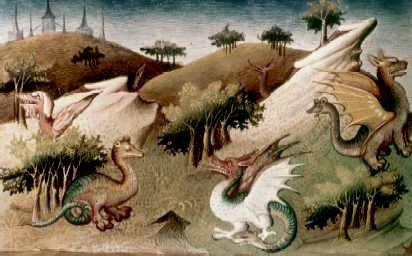
Marco Polo’s vivid and occasionally misinterpreted descriptions of his travels inspired this medieval artist to depict dragons in China.
(Granger)
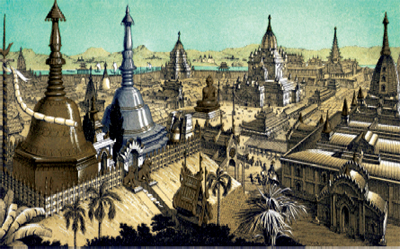
A rendering of the city of Pagan, whose gold and silver towers so impressed Marco Polo
(Imageworks)
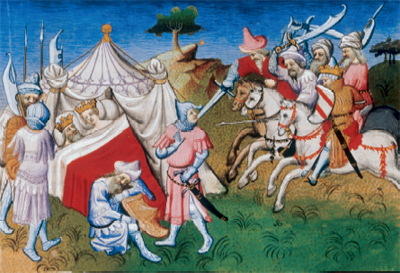
Kublai Khan attacks his rival, Nayan.
(AKG)
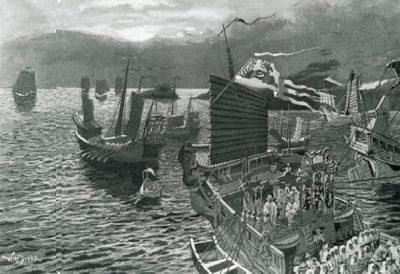
Kublai Khan’s mighty fleet tried to extend the Mongol Empire with repeated attempts to conquer Korea and Japan, but came to grief.
(Corbis)
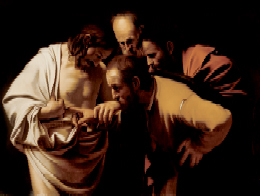
Saint Thomas, whose exile fascinated Marco Polo, in a dramatic portrait by Caravaggio (1601–1602)
(Bridgeman)
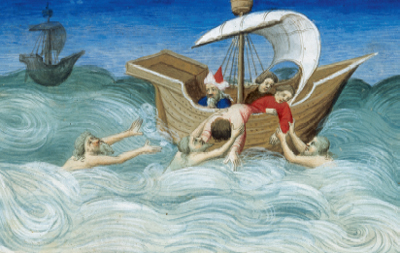
A European depiction of a Mongolian ship foundering at sea. Marco barely escaped with his life from a shipwreck during his journey home.
(Bibliothèque Nationale de France)
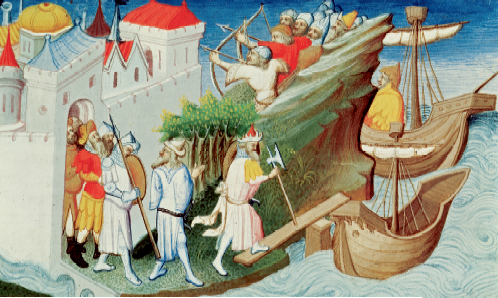
Mongol forces attempt to take Japan in this illustration from the Book of Marvels. Until Marco Polo wrote of the epochal struggle at sea, Europe knew nothing of it.
(Bridgeman)
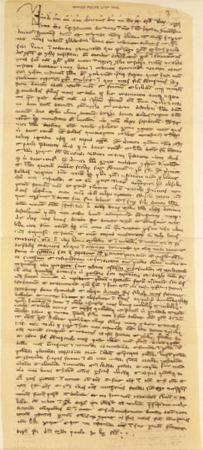
Marco Polo’s last will. In his careful allocation of resources, he proved to be a diligent merchant until his final hour.
(Bridgeman)
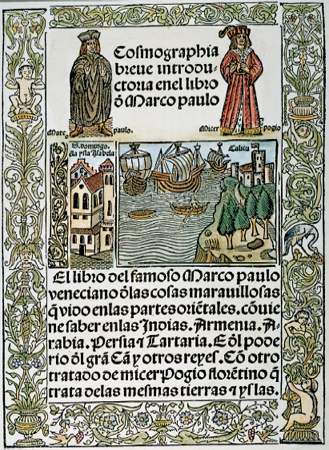
Frontispiece of an early published edition of Marco Polo’s Travels
(Granger)
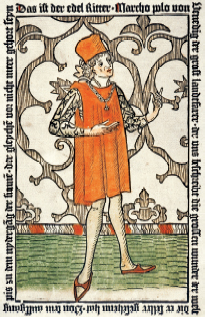
Frontispiece of an early published edition of Marco Polo’s Travels, Nuremberg, Germany, 1477
(Granger)
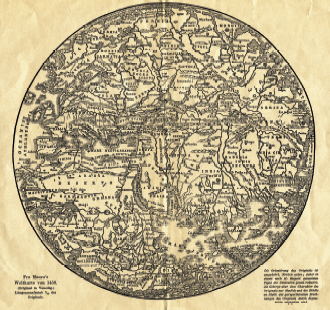
Fra Mauro’s renowned map of the world (1459) drew on Marco Polo’s account
(Corbis)
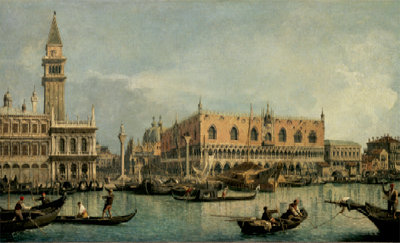
Venice in the eighteenth century, by the prolific artist Canaletto (Giovanni Antonio Canal)
(Art Resource)
The Ganges was not the longest river in Asia—at fifteen hundred miles, it was surpassed by many others—but from its origins in the Himalayas to its final destination in the Bay of Bengal, it was the most revered, as Marco acknowledged. He probably visited the river during January or February, when the celebrated bathing festival known as the mela took place; during the ceremony of purification, pilgrims from afar immersed themselves in its waters. “Both men and women wash themselves twice a day in the water,” he says, “their whole bodies, that is, morning and evening.” Refusing to wash was tantamount to heresy. He observes with fascination: “Naked they go to the river and take water and throw it over their head, and then they rub one another.”
The obsession with cleanliness took many other forms. “In eating they use only the right hand, nor with the left hand do they touch anything of food. And all clean and beautiful things they do and touch with the right hand, for the office of the left is only about unpleasant and unclean necessities like cleansing the nostrils, anus, and things like these. Again, they drink with cups only, and each with his own; nor would anyone drink with the cup of another. When they drink they do not put the cup to the mouth, nor with those cups would they give to drink to any strangers.”
THE LOCAL SYSTEM of justice struck Marco as equally stringent, but far from illogical. He says that if a debt goes unpaid, and the debtor makes empty promises to fulfill his obligation, “the creditor is able to catch the debtor in such a way that he is able to mark a circle round him, [and] the debtor will not leave that circle unless he shall first have satisfied the creditor or shall make him a proper pledge and bond that he shall be wholly satisfied the same day.” If the debtor attempted to flee without paying, “he would be punished…with death as a transgressor of right and of the justice established by the lord.”
In Marco’s hands, the following tale becomes an intriguing study in commercial conflict: “And this Master Marco saw in the king, being in the kingdom on the way home. For when the king himself was bound to satisfy a certain foreign merchant for certain things had from him, and though many times asked by the merchant had often on account of inconvenience fixed a later date for payment, the merchant, because the delay was hurtful to him on account of his business, being ready one day while the king was riding about the place immediately surrounded the king himself with all his horse with a circle on the ground. And when the king saw this, he let his horse go no farther, nor did he move himself from the place before the merchant had been wholly satisfied.” The sight surprised onlookers, who exclaimed, “See how the king was obedient to justice.” And the king replied to them, “I who established this just law, shall I break it because it was against me? No, I am bound before others to observe it.”
THE MINGLING of religious observance and fertility rites drew Marco’s curiosity. He became aware of multitudes of young girls who visited monasteries where they sang and danced to entertain the idols, that is, the images of various divinities, and to feed the monks and priests dwelling within; the custom continued, he says, until the girls took husbands. He found the girls slim and surpassingly lovely: “These maidens…are so firm in flesh that none can by any means take hold of them or pinch them in any part,” except that “for a small coin they will allow a man to pinch them as much as he can.” On the basis of hints he drops, one can imagine the Venetian merchant staring, considering, and finally parting with a coin, or several, to satisfy his curiosity and his libido.
The maidens’ behavior raised an urgent question: “Why do they make these entertainments for the idols? Because the priests of the idols often say that the god is vexed with the goddess, nor is one united with the other, nor do they talk together. And since they are angry and vexed, unless they are reconciled and make peace together all our affairs will be contrary and will go from bad to worse because they will not bestow their blessing and grace.”
In the service of this goal, “the damsels go…naked except that they are covered in the natural parts, and sing before the god and goddess. For the god stays by himself on one altar under one canopy and the goddess stays on another altar by herself under another canopy, and those people say that the god often takes his pleasure with her and they are united, and that when they are vexed they do not join together. Then these damsels come there to pacify him, and…begin to sing, dance, leap, tumble, and make different entertainments to move the god and goddess to joy and to reconcile them, and thus they say as they make entertainment, ‘O Master, why are you vexed with this goddess and do not care for her? Is she not beautiful, is she not pleasing?” This plea was accompanied by some astonishing gyrations. “She who has said so will lift her leg above her neck and will spin round for the pleasure of the god and goddess. And when they have solaced enough they go home. And in the morning, the priest of the idols will announce as a great joy that he has seen the god and goddess together and that peace has been made between them, and then all rejoice and are thankful.”
NO MATTER HOW diligently Marco tried to come to terms with the people and practices he witnessed, India remained surpassingly strange and constantly challenging to the Venetian traveler. He observes that “certain animals by the name of tarantula” infested homes; these hideous carnivorous arachnids were everywhere, even overhead, startling him. They resembled “lizards that climb up by the walls,” and they had “a poisonous bite and hurt a man very much.” They even screamed, or so Marco claims.
To make matters worse, he considered tarantulas bad omens for merchants. “When some people were trading together in a house where these tarantulas are, and a tarantula may cry to the merchants there above them, they will see from what side of the merchant, whether of the buyer or of the seller, namely whether it cries from the left side or from the right, from the front or back, or over the head,…they know whether it means good or ill; and if good, they finish the dealing, and if it mean ill, that dealing is never begun. Sometimes it means good for the seller and bad for the buyer, sometimes bad for the seller and good for the buyer, sometimes good for both or bad for both; and they guide themselves by that.”
To sleep safely amid such peril, he relied on the inhabitants’ clever apparatus. “The men have their very light bed of canes so contrived that while they are inside, when they wish to sleep they draw themselves up with cords near to the ceiling and tie themselves there. They do this indeed for the sake of escaping the tarantulas that bite much and fleas and other insects, and also for the sake of catching the air to do away with the heat that reigns in those parts.”
Travelers such as Marco also employed their suspended beds to safeguard their valuables. “When men are traveling in the night and may wish to sleep (for on account of the lower heat they make their journey by night rather than by day), if they have a bag of pearls or other treasure they will put the bag of pearls under the head and sleep there, nor does anyone ever lose anything by theft or otherwise. And if he does lose [it], it is made good to him immediately provided that he has slept on the street.” If he has not slept on the street, “evil is presumed against him, for the government says, ‘Why didst thou sleep off the street unless because thou hadst proposed to rob others?’ Then he is punished, and the loss is not returned to him.”
AFRICA
Zanzibar.
“A very exceedingly great and noble island,” Marco declares. “It is two thousand miles around.”
For once, he had strayed into a territory with an abbreviated history. The island’s first inhabitants apparently had emigrated from the African mainland and reassembled in small villages reminiscent of those in Africa. Soon they were confronted with Arab traders, who may have been aware of the island even before it was settled. Skillful and courageous sailors, the traders caught the monsoon winds to speed them across the Indian Ocean, and they found a makeshift harbor where the town of Zanzibar now stands. Eventually they settled there, as well, and interbred with the African emigrants. Not long before Marco’s arrival, the emerging Zanzibar community established a ruler, the Jumbe. Although he was neither a great warrior nor bold leader, he helped to give the island a semblance of political unity.
Despite oft-repeated claims that the first European to visit Zanzibar was Vasco da Gama in 1499, Marco, according to his account, set foot on the island about 205 years before the Portuguese navigator sailed into its harbor. If true, Marco was the first European to do so—or at least the first to write about Zanzibar. Marco’s account captures Zanzibar in its precolonial state, as a primitive and isolated island capable of startling even the experienced Venetian traveler.
Once there, he feels as if he has entered another world, a very menacing one. The men are all “very large and stout,” so much so that if they were as tall as they are stout, they would “seem without doubt to be giants.” Nevertheless, he says, they are “immensely strong, for they carry a load for four other men who are not of the island. And this is no wonder, for I tell you that [each one] eats food for five men of another country.” These superhumans “are all black and go naked except that they are covered in their natural parts”—much to his relief—“for they have them very large and ugly and horrible to see.” Even their hair takes him aback, “so curly and black like pepper that it could hardly be made to stretch out with water.” And their faces startle him to the point of trauma: “They have so great a mouth and the nose so flat and turned upward the forehead, and beards, and nostrils so thick that it is wonderful. They have large ears, thick lips, turned outward, and eyes so large and so bloodshot and so red that they are a very horrible thing to see; for whoever should see them in another country would say of them that they were devils.”
The women of this land strike Marco as repulsive, “a very ugly thing to see,” he states. “They have great mouths and large eyes and large, thick, and short noses. They have breasts four times as large as other ordinary women, which adds to the ugliness. They are black as a mulberry and of great stature.” And they also “look like devils.”
Marco’s exceptionally harsh and racist portrayal of the Zanzibaris raises questions about its authenticity. He may have been conflating tales of nearby East Africa with accounts of Zanzibar, recklessly embellishing as he went. But after venting his spleen, he softens his characterization, as if to make amends, by acknowledging a common interest. “They are great merchants,” he says, “and do great trade.” With this endorsement, he implies that, first impressions notwithstanding, the inhabitants are fully human. To his way of thinking, trading virtually defines their humanity.
Elephants were bred on the island, and the local merchants made “a great trade of the tusks.” Fascinated, Marco includes a graphic account of elephant breeding rites: “When the bull elephant wishes to pair with the female elephant, he hollows out a great pit in the ground until he may put the female elephant there turned over in the manner of a woman because she has the natural parts far toward the belly, and the bull elephant mounts upon her as if he were a man.”
The island’s inhabitants, whom Marco considered “good fighters” and “strong”—though not “in proportion to their size”—relied on the elephants in battle, equipping them with “castles of wood” covered with the “skins of wild beasts and with boards.” Outfitted in this manner, they could hold “sixteen to twenty men with lances and with swords and with stones.” Marco says that to prepare the elephants for battle, the warriors “give them plenty to drink of their wine…so that they make them half tipsy, and they do this because they say that when an elephant has drunk of that drink it goes more willingly and becomes more fierce thereby and more proud and is of much better worth for it in the battle.”
Marco insists, without proof, that the elephants were preyed upon by an even larger beast, the “grifon bird.” Those whom he asked about the strange creature likened the grifons to “immeasurably great” eagles. He reports: “They say it is so great and so strong that one of these birds, without the help of another bird, seizes the elephant with its talons and carries it off high into the air. Then it lets it drop to the ground so that the elephant is all broken to pieces, and then the grifon bird comes down upon the elephant and mounts up on it and tears it and eats it and feeds itself upon it at its will.” It is a sight he would dearly love to see, but the best he can do is convey what he has heard of the improbable spectacle.
ALTHOUGH MARCO did not visit Ethiopia—did not even claim to have done so—the oversight did not stop him from offering a few more nuggets. He speculated that Prester John, the legendary Christian ruler, might live on in this remote African territory. Relying heavily on hearsay, Marco claims, “The greatest king in all the province is Christian and all the other kings of the province are subject to him.”
There were six kingdoms, he reported, three of them Christian, and three Saracen—that is to say, Muslim. “I was told,” he says, “that all the Christian people of this province have three golden marks on their faces in [the] form of a cross that they may be known as more noble by others, that is, one on the forehead, two on the cheeks; and the mark that is on the forehead stretches from the forehead to the middle of the nose, and they have one of them on each cheek. And these marks are made with hot iron, and they make them when they are small, and it is for their second baptism with fire, for when they are baptized in water, then…those marks of which I have told you are made.” He also states that “many Jews” inhabit Ethiopia, “and these also bear like marks on their faces, but Jews have two marks, that is, one long line on each cheek.” As for the Saracens, they have “only one such mark alone, that is, from the forehead to the middle of the nose. And they do it with the hot iron.”
Ethiopian religious customs held special interest for Marco, for the land had been home to his spiritual beacon, “Master Saint Thomas the glorious Apostle.” The saint’s disciple recounts with fascination that Thomas had preached in Ethiopia “and after[ward] he converted some of this people with his preaching and miracles to the Christian faith” before he went to the “province of Maabar in India where, after he had converted infinite people, he was killed, and his most holy body is.”
Although Marco looked warmly on Ethiopia’s Christian king and people, and longed to see nearby Aden, he admitted that, were he to visit, he would be ostracized, because “merchant Christians are much hated in this kingdom, for the [inhabitants] do not wish to see them, but hate them like their mortal enemies.” That realization came as something of a shock. He had gone to considerable lengths to persuade himself, and others, that he was a Mongol official, a Buddhist student, a gentleman wayfarer. All the while, he had engaged in a search for his identity, trying out the roles of a businessman, storyteller, adventurer. Yet those around him saw through his various guises and regarded him simply as another “merchant Christian.” No matter how far he traveled, even to the ends of the earth, or how well he adapted to his changing surroundings, even to the point of persuading himself that he had become someone else, he had yet to transcend himself.
Marco Polo had reached the end of his personal quest and of Kublai Khan’s protection. He had seen the world, or what was known of it. But how would he find his way home?