
BOOK ONE
CHAPTER ONE
Then all the charm
Is broken—all that phantom-world so fair
Vanishes, and a thousand circlets spread….
SHE HID from her enemies amid a seductive array of islands, 118 in all. Damp, dark, cloistered, and crowded, she perched on rocks and silt. Fortifications and spectacular residences rose on foundations of pinewood piles and Istrian stone. In Marco Polo’s Venice, few edifices—with the exception of one huge Byzantine basilica and other large churches—stood entirely straight; most structures seemed to rise uncertainly from the water.
Marco Polo came of age in a city of night edging toward dawn; it was opaque, secretive, and rife with transgressions and superstitions. Even those who had lived their entire lives in Venice became disoriented as they wandered down blind alleys that turned without warning from familiar to sinister. The whispers of conspiracy and the laughter of intimacy echoed through narrow passageways from invisible sources; behind dim windows, candles and torches flickered discreetly. In the evening, cobwebs of mist arose from the canals, imposing silence and isolation, obscuring the lanterns in the streets or in windows overlooking the gently heaving canals. Rats were everywhere—emerging from the canals, scurrying along the wharves and streets, gnawing at the city’s fragile infrastructure, bringing the plague with them.
The narrow streets and passageways, some barely shoulder-width, took bewildering twists and turns until, without warning, they opened to the broad expanse of the Grand Canal, which divided one-half of the city from the other before running into the lagoon and, beyond that, the expanses of the Adriatic Sea.
In winter, the city hosted Carnival (literally, the playful “bidding farewell to meat” before Lent). Carnival became the occasion for orgies taking place just out of sight behind high courtyard walls and opaque curtains. Rumors of foul play ran rife amid the gaiety and sensuality of the Republic. Venetians bent on evil preferred quiet means of imposing death, such as poisoning or strangulation, and they usually got away with it.
IN AN UNCERTAIN WORLD, thirteenth-century Venetians could feel certain of a few things. Two hundred years before Copernicus and three hundred before Galileo, it was an article of faith that the Sun revolved around the Earth, that the heavenly spheres were perfectly smooth, and that Creation occurred exactly 4,484 years before Rome was founded. Jerusalem was considered “the navel of the world.” Entrances to Heaven and Hell existed, somewhere.
The day, for most people, was subdivided into times for prayer: matins at midnight, lauds three hours later, prime at daybreak, terce at midmorning, sext at noon, none at midafternoon, vespers at sunset, and, at bedtime, compline. In the Age of Faith, science consisted largely but not entirely of spurious pursuits such as alchemy—the effort to transmute so-called base metals into gold—and astrology, which went hand in hand with astronomy.
People depended on wind, water, and animals for power. In Western Europe, coal had yet to be exploited as an energy source; paper money and the printing press also lay two hundred years in the future. The most advanced technology consisted of ships—considered a marvel of transport, though very dangerous.
Throughout Europe, travel was exceedingly slow and hazardous. Crossing the English Channel was a dreaded undertaking; those who completed the ordeal would claim that the effort had impaired their health. Over land, people moved no faster than a horse could take them; the average land journey covered eight to ten miles a day, or under special circumstances, for brief durations, fifteen to twenty miles. Superstition led those who undertook such journeys to seek shelter at nightfall in primitive inns, infested with vermin, where two or three sojourners shared a single bed. It took five harrowing weeks to ride by cart from Paris to Venice.
But in Venice, conditions were very different. Tiny in size, yet global in outlook, Venice was entering the Late Middle Ages, a period of economic expansion, cultural achievement, and the lowering of barriers to commercial activity. Travel was not the exception, it was the norm. Everyone in Venice, it seemed, was a traveler and a merchant, or aspired to be. Across Europe, political power, formerly scattered among disorganized and crumbling empires reaching back to Roman times, had coalesced in well-armed and well-organized city-states, such as Venice. The growth in commerce among European city-states contributed to rapid advances in art, technology, exploration, and finance. The compass and clock, windmill and watermill—all vital to the smooth functioning of European economies—came into being, and great universities that survive to this day were being founded. As a result of all these advances, Venice—indeed, all of Europe as we know it—began to emerge.
VENICE—SEDUCTIVE, Byzantine, and water-bound—was among the most important centers of commerce and culture in thirteenth-century Europe, a flourishing city-state that lived by trade. Her economy thrived thanks to her aggressive navy, which vigorously defended the city from repeated onslaughts by rapacious Genoese rivals and Arab marauders. Unlike other medieval cities, Venice had no walls or gates. They were not necessary. The lagoon and swamps protected Venice from invaders by land or by sea.
As the gateway to the riches of the East, Venice gave rise to a sophisticated merchant aristocracy, including the Polo family, known for frequent journeys to the East, especially Constantinople, in search of jewels, silks, and spices. Venice was highly structured, fiercely independent and commercial, and based on a unique combination of feudal obligation and global outlook.
Because Venice was compact, hemmed in by the lagoon and by its enemies, the sense of common cause among its inhabitants was strong. “By virtually confining the Venetians to so restricted a space,” says the historian John Julius Norwich, “it had created in them a unique spirit of cohesion and cooperation…not only at times of national crisis but also, and still more impressively, in the day-to-day handling of their affairs. Among Venice’s rich merchant aristocracy everyone knew everyone else, and close acquaintance led to mutual trust of a kind that in other cities seldom extended far outside the family circle.”
As a result, Venetians developed a reputation for efficient and thorough business administration—the most advanced in Europe. “A trading venture,” Norwich says, “even one that involved immense initial outlay, several years’ duration, and considerable risk, could be arranged on the Rialto in a matter of hours. It might take the form of a simple partnership between two merchants, or that of a large corporation of the kind needed to finance a full-sized fleet or trans-Asiatic caravan.” Either way, Norwich concludes, “it would be founded on trust, and it would be inviolable.”
JUST ABOUT EVERYONE in Venice engaged in commerce. Widows invested in merchant activity, and any young man without means could describe himself as a “merchant” simply by launching himself in business. Although the risks were great, riches beyond imagining lured the adventurous, the willing, and the foolish. Fortunes were made and lost overnight, and Venetian family fortunes were built on the success of a single trade expedition to Constantinople.
Venetian merchants had developed all sorts of strategies for dealing with the vagaries of their livelihood, global trade. In the absence of standard exchange rates, the many types of coins in use created a nightmare of conversion. The Byzantine Empire had its bezants, Arabic lands their drachmas, Florence its florins. Venice, relying on the ratio of gold to silver in a given coin to determine its true value, tried to accommodate them all. Merchants such as the Polos sought to circumvent the vexed system of coins, with its inevitable confusion and debasement, by trading in gems such as rubies and sapphires and in pearls.
To meet these sophisticated and exotic financial needs, Venice developed the most advanced banking system in Western Europe. Banks of deposit on the Continent originated there. In 1156, the Republic of Venice became the first state since antiquity to raise a public loan. It also passed the first banking laws in Europe to regulate the nascent banking industry. As a result of these innovations, Venice offered the most advanced business practices in Europe.
Venice adapted Roman contracts to the needs of merchants trading with the East. Sophisticated sea-loan and sea-exchange contracts spelled out obligations between shipowners and merchants, and even offered insurance—mandatory in Venice beginning in 1253. The most widespread type of agreement among merchants was the commenda, or, in Venetian dialect, the collegantia, a contract based on ancient models. Loosely translated, the term meant “business venture,” and it reflected prevailing customs of the trade rather than a set of consistent legal principles. Although these twelfth-and thirteenth-century contracts seem antiquated, they are startlingly modern in their calls for precise accounting. Contracts like these reflected and sustained a rudimentary form of capitalism long before the concept came into existence.
For Venetians, the world was startlingly modern in another way: it was “flat,” that is to say, globally connected across boundaries and borders, both natural and artificial. They saw the world as a network of endlessly changing trade routes and opportunities extending over land and sea. By ship or caravan, Venetian merchants traveled to the four corners of the world in search of valuable spices, gems, and fabrics. Through their enterprise, minerals, salt, wax, drugs, camphor, gum arabic, myrrh, sandalwood, cinnamon, nutmeg, grapes, figs, pomegranates, fabrics (especially silk), hides, weapons, ivory, wool, ostrich and parrot feathers, pearls, iron, copper, gold dust, gold bars, silver bars, and Asian slaves all poured into Venice via complex trade routes from Africa, the Middle East, and Western Europe.
Even more exotic items flowed into the city aboard foreign galleys. Huge marble columns, pedestals, panels, and blocks piled up on the docks, having been taken from some ruined temple or civic edifice in Constantinople, or another Greek or Egyptian city. These remnants of antiquity, the very headstones of dead or moribund civilizations, would wind up in an obscure corner of the Piazza San Marco, or on the façade of some ostentatious palazzo inhabited by a duke or a wealthy merchant of Venice.
The variety of goods moved Shakespeare to observe, through the character Antonio in The Merchant of Venice, that “the trade and profit of the city / Consisteth of all nations.” Venetian trade was synonymous with globalization—another embryonic concept of the era. To extend their reach, Venetians formed partnerships with distant governments and merchants that cut across racial and religious divisions. Arabs, Jews, Turks, Greeks, and eventually the Mongols became trading partners with Venice even when they seemed to be political enemies. The Polos were not the first merchants to travel from Venice to Asia, but thanks to Marco Polo’s exploits, they became the most celebrated.

WHEREVER VENETIANS WENT, they announced themselves with their distinctive accent and dialect, veneto. This tongue, like other Romance languages, was based on Latin, and it incorporated vocabulary, syntax, and pronunciation from other languages—some German and Spanish (in the form of the Castilian s, pronounced “th”), and some Croatian. There was even a little French thrown into the mix. There are lots of x’s and z’s in veneto, but almost no l’s. Lord Byron, who claimed to have enjoyed two hundred women in Venice in as many consecutive evenings, called veneto a “sweet bastard Latin.” To further complicate matters, veneto had numerous variants. The Polos of Venice would have strained to understand the dialect spoken elsewhere in the area by the inhabitants of Padua, Treviso, or Verona.
Some distinctive words in Marco Polo’s world have leapt from veneto to English. Venetians of Polo’s day bade one another ciao—or, to be more precise, sciavo or sciao vostro—which means, literally, “I am your slave.” (The word came into the Venetian language from Croatian.) Gondola is another Venetian word, although it is not clear when the long, elegant, black vessel itself came into use. It is likely that in Marco Polo’s day, a wide variety of small craft, including sailboats, rowboats, and galleys, jostled one another in the city’s winding canals.
And arsenal, or a place where weapons are manufactured and stored, entered the Venetian language by way of the Arabic term dar al sina’ah, meaning “workshop.” When Europeans of Marco Polo’s era employed this word, they meant the Arsenal in Venice, renowned as a center of shipbuilding. Here shipwrights operated an early assembly line devoted to turning out galleys at a furious rate from standardized, prefabricated components such as keels and masts. A Spanish visitor named Pero Tafur described the precisely choreographed activity devoted to launching the galleys: “Out came a galley towed by a boat, and from the windows they came out to them, from one the cordage, from another the bread, from another the arms, and from another the ballistas and mortars, and so from all sides everything that was required. And when the galley had reached the end of the street all the men required were on board, together with the complement of oars, and she was equipped from end to end.”
Tafur counted the launching of ten “fully-armed” galleys within a six-hour span: one new warship every thirty-six minutes. No wonder that the speed with which the Arsenal of Venice could turn a bare keel into a fully rigged craft was admired throughout Europe. And commanders could have their galleys in any color they wanted—as long as it was black.
VENICE’S SUCCESS DERIVED, in part, from its single-minded sense of civic and spiritual destiny. Venetian mythology was potent and telling. Marco’s namesake, Saint Mark, was the city’s patron saint. In 828, a group of Venetian merchants conspired to snatch Mark’s body from its resting place in Alexandria and deliver it in triumph to the doge of Venice.
To justify their deed, the merchants devised a theory that they were preserving the body from the evil designs of Muslims, and they concocted a beguiling but apocryphal story that Mark, while sailing the waters of the Adriatic, encountered a storm that blew his craft into the lagoon on which Venice would later rise, and the boat remained overnight at just the spot on which the Doge’s Palace would be built. To top off the story, an angel supposedly appeared to Mark in a dream, uttering the comforting words “Be at rest here.” Over time, those words came to mean both that Mark would be safe from the storm in the lagoon and that he belonged—where else?—in Venice. The transfer of Mark’s body to Venice became perhaps the most prominent theft of a relic in all Christian history.
Mark’s body remained in Venice up to Marco Polo’s day and beyond, sheltered in the private chapel of the doge. The doge’s residence was the only building in Venice known as a palace; every other dwelling, no matter how large or prominently situated, even those along the Grand Canal, was known as a casa—that is, a home—usually abbreviated as “Ca’.” Thus, the Polos’ home was known as the Ca’ Polo, and is to this day.
Venice was an oligarchy ruled by 150 families comprising the city’s merchant aristocracy. Less than 1 percent of the population controlled the destiny of the other 99 percent. Occasionally, a family managed to break into this tightly knit fraternity to become new aristocrats, but the practice was ended in 1297. The Council of Venice did permit the city’s middle class to form guilds to further commerce. These associations and schools trained workers and craftsmen and helped the poor, and even paid for hospitals. It is possible that the Polos belonged to one or more guilds to further their commercial interests. They were recognized as prosperous merchants, but not civic leaders. It seems unlikely they would have been remembered at all, were it not for Marco Polo’s fantastic exploits and his zeal for self-promotion.
DOGE IS A Venetian word, as well as a Venetian concept. It comes from the Latin dux, or leader. The first doges were military commanders appointed by the Byzantine emperor. Once Venice started to emerge from obscurity, the city needed its own leader, and the concept of the doge became localized and self-perpetuating.
The secular doge retained a close connection with the imported saint, and was required to defend the holy relic in his charge. In exchange, Saint Mark was believed to offer Venice his blessing and protection. The peculiar nature of the agreement ensured that Venice would retain a Western, and Christian, ethos rather than align with Eastern sects, whose saints yielded to Mark in the Venetian pantheon. Henceforth, Saint Mark and the doge shared control of Venetian destiny.
The combination of the doge’s secular power and Mark’s spiritual authority imparted a sense of political destiny to the Republic—a secular destiny, despite everything.
THE DOGE was a mystical figure, rarely glimpsed by the public, who presided over Venice’s longstanding, mystical relationship with the sea, often portrayed as a marriage. Venetians took this concept to such an extreme that every spring, the doge tossed a gold ring into the Adriatic in a ceremony designed to renew the partnership, much as he signed his mutual-protection contract with Mark.
The cult of the doge received affirmation each year on Ascension Day, the most important holiday in the Venetian calendar. The date marked the Venetian occupation of Dalmatia in AD 1000 under the leadership of Doge Pietro Orseolo II. Henceforth, all Venice—doge, citizens, and clergy—would remember the event by blessing the Adriatic Sea. Venetians were addicted to displays of color and spectacle, and none surpassed the rites of Ascension Day.
The ceremony began when officials carrying water, salt, and olive branches—all blessed for the occasion—boarded a convoy of galleys known as a mude. Along the way, the doge, atop an ornate barge, joined them. As they made their way to the Lido, the clergy chanted as a bishop prayed to God “to grant unto us this sea.”
Evolving into a symbolic marriage between the doge and the Adriatic, the Sposalizio del Mare, the ceremony became even more elaborate and revealing of the Venetian psyche. In 1177, Pope Alexander III went so far as to present a ring to the doge, declaring, “Receive this as a pledge of the sovereignty that you and your successors shall have in perpetuity over the sea.” Rising from his throne with a flourish, the doge hurled the consecrated ring into the Adriatic, intoning, “We wed thee, O Sea, in token of the true and perpetual dominion of the Most Serene Venetian Republic.”
After attending Mass, the doge hosted an elaborate banquet for the clergy and dignitaries. The Piazza San Marco became the scene of eight days of nonstop feasting and drinking that culminated in a trade fair famous throughout Europe for offering goods carried to Venice from the ends of the earth. Even the Church entered the festivities, offering indulgences to everyone in attendance.
IN 1268, when Marco was fourteen, the celebration surrounding the installation of the new doge, Lorenzo Tiepolo, outdid even the annual rite of marriage to the sea.
The ceremony began on a gracious note, as the doge formally met with all his political and personal enemies to establish a new tone of goodwill and trust.
With the conclusion of this private ceremony, the captain of the Republic’s fleet led the ships past the Doge’s Palace as he recited prayers for the doge and for Venice, ending with the words “May Saint Mark aid you!” The galleys dispersed through the canals of the city, and waterborne craft of every description from the surrounding islands followed.
Later the spectacle moved to land, where guild members marched through the narrow streets of Venice two by two, resplendent in the costumes representative of their various trades, all of them passing before the new doge and his wife, the dogaressa. There were sailors clad in white accented with red stars; furriers distinguished by their ermine-trimmed capes; textile workers bearing olive branches and wearing olive wreaths; master craftsmen attired in clothing of gold and purple; even quilt makers, their cloaks adorned with fleurs-de-lis, and garlands of beads wrapped around their heads; shoemakers; barbers; glassblowers in scarlet cloaks trimmed with fur—the wealth and finery of Venice on display.
Beneath the celebrations, life in Venice could be cruel. Women, considered second-class citizens, were treated as chattel. Slavery was common, especially the ownership (and abuse) of female slaves by masters, who, married or not, used them for sexual services. Ingrained social customs reinforced the inferior status of women. A popular piece of advice to prospective Venetian husbands about their wives-to-be urged, “The husband should not be guided by the advice of his wife, who has not sound judgment, because she has neither a sound nor a strong constitution, but one poor and weak.”
Yet, in the midst of this gloomy social environment, the Polo home, with its complement of illegitimate children and slaves, was stable and secure, and in a scandalous city, it remained relatively scandal free.
LESS THAN two hundred years after the arrival of Saint Mark’s body consecrated Venice, the Republic was well on its way to conquering the Adriatic and surrounding regions.
Venetian fleets became adept at engaging would-be invaders, such as the Normans, led by Robert Guiscard, whose armada threatened to obstruct Venetian access to the Mediterranean. In a fierce engagement with Guiscard’s vessels in the Adriatic, off the west Albanian city of Durazzo, Venetian ships, prevented from entering the harbor, were grappled together to form a floating island blocking the entrance. When enemy craft approached, the Venetian sailors, poised in boats suspended from their floating “island,” thrust primitive torpedoes in the form of logs at the oncoming ships, sinking or badly damaging them. Nevertheless, the Normans eventually claimed Durazzo, even as Venetian merchants and battleships roamed the Mediterranean in search of profit. In perhaps no other city-state did the exercise of commerce approach the practice of war as it did in Venice, where the two became virtually synonymous. The Republic existed amid an almost continual state of warfare, sometimes in the form of a distant guerrilla struggle, sometimes in a cold war designed to rebuff rivals, and sometimes in furious battles against determined enemies. Venice did not always win, but the city’s soldiers and sailors were expected to fight for their commercial enterprises.
No other city-state equaled Venice’s skill and daring on the sea. If the Republic was celebrated for its merchants, it was equally feared for its ruthless naval warriors. In time, Marco Polo would have a chance to play both roles, a trader in peacetime and as a commander in battle.
IN 1204, Venice celebrated a major victory: the capture of Constantinople, by combined European forces, at the height of the Fourth Crusade.
The triumph of Christianity was not a sure thing in Marco Polo’s day. The Church of Rome was fighting for its place in the world against an array of enemies—Islam, the Mongols, the Greek Orthodox Church, even itself. The Age of Faith was also an age of peril, turmoil, and war.
The Crusades began with a simple goal: to permit Christians to continue to make pilgrimages to the Holy Sepulcher, the tomb in Jerusalem in which the body of the crucified Jesus was believed to be laid to rest. Pilgrims had been visiting this holiest of Christian shrines since at least the eighth century AD. Matters changed dramatically in 1009 when Hakim, the Fatimid caliph—that is, Muslim ruler—of Cairo, called for the Holy Sepulcher’s destruction. Afterward, unlucky Christians and Jews who found themselves in Jerusalem were likely to be persecuted, and the city’s Christian quarter was surrounded by a forbidding wall that controlled access. Within five years, thousands of churches had been burned or ransacked.
The violence only increased the desire of Christians to make the pilgrimage to Jerusalem, and the Church undertook a series of Crusades, eventually eight in all, with the avowed goal of delivering places sacred to Christians from the Muslim oppressors. Conceived as religious wars against a suddenly ascendant Islam, the Crusades quickly deteriorated into a series of battles for political and military spoils. By the time of the brief Fourth Crusade (1202–1204), the Papacy was losing its grip on the endeavor, as secular leaders across Europe acquired ever more power and influence. Eventually, individual monarchs launched their own Crusades.
The original plan for the Fourth Crusade was simple enough: Pope Innocent III and the preacher Foulques of Neuilly-sur-Marne proposed to conquer the Muslim warriors. The Crusaders planned ultimately to take Jerusalem by way of Egypt, and they wanted the support of Venice.
VENETIANS, true to their commercial agenda, had maintained an arm’s-length relationship with the Crusades. But in this case, Venetian authorities realized there might be some money to be made out of a religious war. From their point of view, it was actually a military campaign with a political and financial agenda, and that was something Venetians could understand and endorse. After a careful negotiation lasting eight days, the Republic agreed to furnish 35,000 knights, squires, and foot soldiers; 4,500 horses; ships specially built for the occasion; and supplies—all for a steep price. The idea of harnessing Venetian naval prowess to their cause proved irresistible to the French leaders of the Crusade, no matter what the cost, but they proved slow to pay, and as a result, thousands of would-be Crusaders congregated on the outskirts of Venice, on what is now the Lido, awaiting orders and diverting themselves with gambling and whoring.
Realizing that France would not be able to honor its obligation, Venetian representatives proposed a new deal; they would forgive the debt if the unemployed Crusaders would assist them in achieving a slightly different goal: subduing Zara, a rebellious city across the Adriatic Sea. The French agreed. Zara fell, and the two sides shared the plunder equally. The arrangement completed the transformation of the Crusade from a religious campaign into a commercial enterprise.
The emboldened Crusaders then sailed to Constantinople, the capital of the Byzantine Empire, which was the successor to the Eastern portion of the Roman Empire. Named after the Roman emperor Constantine the Great, who ruled in the fourth century AD, Constantinople was a city of many faiths, but Orthodox Christianity predominated. In the mental calculus of the Crusaders, the Orthodox Church had come to seem almost as nefarious as Islam, and therefore deserving of vengeance. Any justification, no matter how far-fetched, would do, because Constantinople was an extremely rich and vulnerable prize.
Constantinople boasted not of its military prowess but of its libraries, works of art, and public monuments on a scale far greater than those in Western Europe. The architectural style of much of the city drew on Roman principles; Roman arches, columns, and adornments—along with Eastern elements—became the basis of Byzantine architecture. The population was immense, as many as a million people, more than ten times greater than that of Venice. And the city was ripe for conquest.
The sack of Constantinople in April 1204 lasted for three days of destruction and death. Laymen and clergymen, women, children—everyone fell beneath the Crusaders’ swords. When the worst of the violence was over, mobs rushed into churches, broke up altars, and carried off sacred vessels. Drunken soldiers snatched priestly vestments, which they used to cover their horses. A drunken prostitute danced on the patriarch’s throne as she sang out obscene ditties. Tombs and statuary dating back to antiquity were shattered—or carried off. Afterward, many of the city’s artworks, manuscripts, and religious items were spirited away to relative safety in outlying villages, towns, and monasteries. Even after the Crusaders left, the looting continued for years.
Venetians excelled in plundering; they knew all the best religious artifacts, the most precious gems, the most important statuary to carry away. As a visible symbol of conquest, four bronze horses were taken out of Constantinople to adorn the façade of the Basilica di San Marco; they represented the choicest booty of empire, another stolen treasure that came to reside in Venice.
The best craftsmen from Constantinople also found their way to Venice. Legions of glassblowers, silversmiths and goldsmiths, iconographers, artists, and sculptors were brought to Venice, where they practiced trades that in time came to seem synonymous with their adoptive city rather than their homeland.
POPE INNOCENT III professed himself horrified when news of the sack of Constantinople and the atrocities undertaken in the name of Christendom reached his ears. He excommunicated multitudes of Crusaders before realizing that they had been absolved of their crimes in advance, and that his stance might weaken the Papacy in the face of determined adversaries. At that, he fell silent, and stood by as the wealth of Constantinople found its way into Roman churches and cathedrals.
The Orthodox Church never forgave Venice for its role in the sack, and Constantinople never fully recovered its former glory. The conquest reversed the balance of power and brought major parts of the empire under Venetian control. Constantinople eventually resumed its role as an important commercial center, a gateway to the East for Marco Polo and other merchants, but it had lost its coherence and luster, and, with a population consisting of Greeks, Venetians, Egyptians, and Turks, among others, was more notable for disarray than for splendor.
VENICE, BY COMPARISON, presented a unified front to the world, a society dominated by a handful of powerful families. Marco Polo’s ancestors, although reasonably prominent, were hardly the wealthiest or grandest clan in Venice. That honor resided with the Zenos, Querinis, and Dandolos, who all produced doges to rule the city-state and admirals to defend it. In this highly stratified society, the Polos came in several notches below those civic leaders. They were a respected family of substance, but beholden to Venice’s rulers for their continued prosperity.
Although complete agreement on the origins of the family is lacking, one tradition suggests that the Polos migrated from the Dalmatian town of Sebenico to the Venetian lagoon in 1033. At various times, Sebenico was ruled by Hungarians and Croatians, and it would later join the Venetian empire. Another tradition holds that Marco Polo was born on Curzola, the island where he would later be captured by the Genoese, while a third asserts that Polos had been entrenched in the Venetian lagoon prior to all these events. No matter what his origins, Marco had a foot in both the fading civilizations of antiquity and the bold Renaissance that was beginning to appear throughout Europe.
The name Polo—Venetian vernacular derived from the Latin Paulus—appears with frequency in civic records beginning in 971, when a Venetian named Domenico Polo signed a petition forbidding commerce with Arabs, and later entries show that various Polos owned land and salt mines, and served as judges throughout the realm. This activity suggests that Marco Polo’s ancestors shuttled between Venice and her embattled satellite, Dalmatia.
The Polo family’s trading ambitions took one branch to Constantinople. In 1168, with the Byzantine Empire still at its height, records show Marco Polo’s great-uncle, bearing the same name, borrowing money and commanding a ship in Constantinople, much as the younger Marco would later do in the Battle of Curzola.
Other members of the Polo family continued the pursuit of wealth and honors in Venice. Marco Polo’s grandfather, Andrea Polo of the parish of San Felice, had three sons, Maffeo, yet another Marco, and Niccolò, the traveler’s father, and they likely were counted among the nobility of Venice, even if they did not belong to the upper echelons. Venetian archival records refer to young Marco as a nobilis vir, or nobleman. The title mattered greatly to Marco Polo, who thought of himself as nobility, the holder of a rank that gave him status wherever he went. In his mind, the title of Venetian nobleman constituted his passport to the world. He always acted on the assumption that being of noble birth would protect him from the depredations of thieves and scoundrels who preyed on lesser mortals. No matter how far he ventured from home, he made sure that his hosts, no matter how strange or august, understood that he was a Venetian nobleman and expected to be treated accordingly.
MARCO POLO’S FATHER, Niccolò, and uncle Maffeo operated a prosperous, tightly knit family trading business in Venice. In 1253, the two brothers left home for an extended trading journey to the East. Niccolò may not have known that the wife he left behind was pregnant; the following year, 1254, Marco Polo was born.
By that time, the infant’s father and uncle were in Constantinople, long past its glorious prime, but still under Venetian control imposed after the sack of 1204. Their apparently routine excursion from one trading center to another was, by the standard of the day, exceedingly adventurous. Ships were outfitted and operated by the Republic of Venice. Passengers brought their own trunks, bedding, water, and biscuits. And they had to be prepared to endure the rigors of combat. The ships were capable of doing battle against any enemy that might attack them, and passengers were expected to join in the conflict.
Even a peaceful voyage was remarkably distasteful, uncomfortable, and dangerous. The dank, crowded ships stank of rotting food and human waste. Vermin ran riot, and passengers like the Polos had to coexist with cockroaches, lice, and rats. After a month or more of enduring all these conditions, with sleeplessness and seasickness thrown in to complete their misery, the two Polo brothers arrived safely in Constantinople. In no hurry to risk another grueling voyage, they remained for six years, managing an outpost of their little empire, and trading with merchants from across the globe, especially those from the East.
During their stay, Constantinople sank ever deeper into debt. Baldwin II, the last in a line of Latin emperors, was forced to sell off priceless relics to Venice to liquidate debts and retain his slender grasp on power. Matters became so dire that he pledged a relic supposed to be Jesus’s crown of thorns to Venetian bankers willing to accept it as collateral for their loans. He even pawned his son to the Venetians. Eventually Louis IX of France came to Baldwin’s aid, while a rival, Michael VIII Paleologus, descended from the city’s former Greek emperor, entered into a pact with Genoa to rip Constantinople from the arms of Venice. The unsettled political climate led to rioting in the streets among the Venetians, Genoese, Greeks, and other groups who had coexisted uneasily there after the city’s fall.
NICCOLÒ AND MAFFEO POLO decided to flee the unstable city for Soldaia (now known as Sudak), where the Polo family also maintained an outpost. This was a rugged fortress of a town on the Crimean Peninsula with a spectacular view of the Black Sea. (The name Black Sea, by the way, was something new in the Polos’ era. Before then, this immense inland waterway was known to all who plied its waters simply as “the Sea.”) What little is known of the Polo brothers’ time in Soldaia suggests that they did not prosper.
Early accounts show that the brothers wanted nothing more than to return home to Venice, but travel was too unsafe to permit the journey. On land, murderous thieves patrolled the paths; on water, pirates laid waste to any ship they spied. Given these forbidding conditions, the brothers Polo would not soon be returning to Venice.
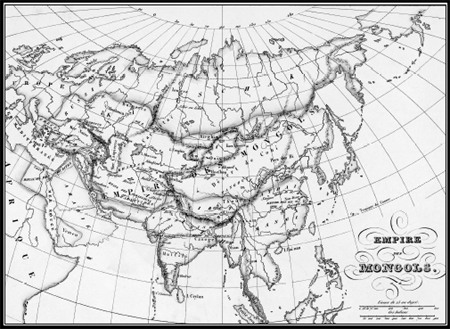
TRAVEL AND TRADING conditions to the east were better, thanks to the most unlikely of causes: the Mongols, who had violently conquered most of Asia and a significant part of Europe, all the way to the eastern shore of the Danube. (Mongols were sometimes called “Tartars,” but the Tartars were, in reality, just one of the tribes belonging to the Mongol Empire. Russians originally used the name to describe Mongols, as well as other invaders from the east, and Europeans followed suit.)
By any name, the Mongols were considered Satan’s spawn, among the most lawless, violent, and sinful people on the face of the earth. In 1260, Pope Alexander IV issued a papal bull, Clamat in auribus (the Latin title taken from the opening words), to warn Christendom of the Mongol threat: “There rings in the ears of all, and rouses to a vigilant alertness those who are not befuddled by mental torpor, a terrible trumpet of dire forewarning, which, corroborated by the evidence of events, proclaims with unmistakable sound the wars of universal destruction wherewith the scourge of Heaven’s wrath in the hands of the inhuman Tartars, erupting as it were from the secret confines of Hell, oppresses and crushes the earth.” The pope went on to condemn the Mongol Empire as a “peril impending and palpably approaching.”
While the pope was busy denouncing the Mongol threat, the object of his fury had been transformed. Genghis Khan’s quest for an endlessly expanding Mongol Empire had given way to a relatively stable regime under his enlightened grandson Kublai Khan. “Kublai was not a barbarian,” Venetian historian Alvise Zorzi observes. Rather, he was “a monarch pursuing high standards of governance, dedicated to learning and implementing the most efficient means to that end,” which meant that “he was constantly seeking better ways to govern and apply spiritual pressure points that would serve his aim of authority better than force.”
Kublai’s most potent weapon was not the sword or spear, fire or poison, but commerce with the world beyond the borders of his empire. Indeed, the Mongols needed European, Persian, and Arab goods and technology to survive in the new world order they had created. To this end, they reopened a series of trade routes that much later—in the nineteenth century—came to be known as the Silk Road. The routes carried all manner of goods—gems, fabrics, spices, precious metals, weapons—as well as ideas and religions. Buddhist monks and Christian missionaries made use of it, as did Venetian, Genoese, Arab, and Jewish merchants.
To make this exchange of ideas and commerce possible, Kublai Khan imposed on his unruly realm a Pax Mongolica, achieved at the cost of harsh oppression. To Zorzi, the Pax Mongolica was a “peace of smoking ruins.” Yet, as a direct consequence of Mongol tyranny, the Silk Road became safe for commerce, so safe that one traveler claimed “a young woman would have been able to travel with a golden tray on her head with no fear.” And it was safe enough for merchants like the Polos to travel its great length into the heart of Asia and the Mongol Empire.
The Mongols and Venetians had both made the world “flat,” the Venetians traveling over water with their ships, and the Mongols over land by reviving the Silk Road. And in a flat, interactive world, goods and ideas mingled in surprising ways, and empires flourished.
NICCOLÒ AND MAFFEO POLO traveled east along a northern branch of the Silk Road, venturing ever deeper into the Mongol Empire. In his book, Marco offers only scant details of the trek his father and uncle took, but it is likely that they traveled on horseback and by cart.
While traversing what is now Iraq, Marco relates, his father and uncle entered the realm of Barka Khan—another of Genghis’s many grandsons—“who had the reputation of being one of the most liberal and civilized princes among the tribes of the Mongol Empire.” Sometimes known as the Western Khan, Barka received them with “great honor,” which was reciprocated. “The two brothers gave him freely, seeing that they pleased him, all the jewels which they had brought with them from Constantinople,” Marco says. Not wanting to be out-done by his visitors’ generosity, Barka “directed double the value of the jewels to be paid to them,” along with “generous presents.” The merchants of Venice had found a safe haven in the Mongol Empire.
In Barka’s realm, the brothers probably pursued their primary interest: drawing on their store of jewels and coins and fabrics to enrich themselves in dealings with other merchants. They might be compared to a traveling emporium, ready to deal in anything that would bring a profit. Marco frequently notes different types of fabrics being traded—muslin, damask, and of course silk—and it is reasonable to assume that his father and uncle did a brisk business in those items with other traders, the Muslims, Jews, and other Europeans, especially those from Genoa, who were better represented in Asia than Venetians. They may have traded in slaves on a very limited scale and returned to Venice with an Arab indentured servant.
After a year, the brothers had had enough of Mongol hospitality and wished to return home, but by then Barka had become enmeshed in a civil war with another grandson of Genghis Khan, Hülegü, who ruled over eastern territories. “In a fierce and bloody battle,” says Marco, “Hülegü was victorious, in consequence of which, the roads being rendered unsafe, the brothers could not return by the way they came.” They were told that the best way to reach Constantinople in wartime was to “skirt the limits of Barka’s territories,” and in following this advice, they incurred considerable hardship. They reached a desert, “the extent of which was seventeen days’ journey, wherein they found neither town, castle, nor any substantial building, but only Mongols with their herds, dwelling in tents on the plain.”
During the trek, they became familiar with the circular gers, felt tents, in which the Mongols lived, and with koumiss, the fermented mare’s milk they drank. Koumiss has a strong, sour taste, and the brothers resisted it at first. (When they did consent to drink, the Mongol who had offered it violently pulled their ears to make sure that they imbibed deeply.) In the same spirit of accommodation, the brothers learned to adapt to the Mongols’ aversion to bathing. True, Venetians of that era rarely bathed, but the Mongols’ abhorrence of water, combined with their proximity to animals, rendered them and their odors profoundly repugnant to Westerners who wandered into their midst. In time, the Polos mastered their revulsion and began to feel at home with their rough-hewn hosts. Even more important, they learned to converse with the Mongols, and that, more than any amount of koumiss they drank, established a bond between the merchants and their hosts.
THE BROTHERS POLO made their way to Bukhara, located in today’s Uzbekistan and the capital of several empires from the ninth to the thirteenth century. The Polo company found Bukhara and its varied population hospitable; the city had long been a crossroads for traders from the East and the West trading in silk, porcelain, spices, ivory, and rugs. But beyond Bukhara’s ramparts, chaos ruled. Strife between various tribes rendered the local branches of the Silk Road impassable, and the Polos found to their dismay that they could not reach home anytime soon. Marco tersely comments, “Unable to proceed further, they remained here three years.” The delay made all the difference in their fortunes.
During their extended stay in Bukhara, Niccolò and Maffeo encountered “a person of consequence and gifted with great talents.” He was, as it happened, an ambassador from Hülegü on his way east to visit Kublai Khan, “the supreme chief of all the Mongols, who lived at the far edge of the continent.” If the Polo brothers were skillful in their negotiations, the ambassador could open the way to the entire Mongol Empire for them.