
CHAPTER 4
‘HER HANDS ON THE REINS.’
The siege of Nancy began on 22 October and despite the most urgent arguments of his advisers Charles refused to withdraw for the winter. Throughout December, as the snow began to fall and ice gripped the countryside, the Burgundian army remained in position. The reinforcements sent from the Low Countries went little way to replacing those who deserted or died in the harsh winter weather of Lorraine. In his camp Charles continued to plan for his victory and to read about the heroes of ancient Rome. But his enemies were also making preparations and by late December they had collected together a huge army at least three times larger than the Burgundian force. During the last days of December this army of more than 20,000 men set off over the frozen roads towards Nancy. As at Grandson and Murten before, Charles appears to have been totally oblivious to the advancing danger and he continued to expect the imminent surrender of the town.1
On 5 January it was snowing steadily and by midday with hardly any warning the besiegers found themselves surrounded by a large force of Swiss infantry supported by mounted knights led by René, Duke of Lorraine. In a devastating attack the Burgundian artillery was overrun, their infantry wiped out and many great lords were taken prisoner in the confusion. All the cannons, tents and baggage were seized and the last of the four great Valois Dukes of Burgundy vanished into the mêlée. It took two days to find his body and then only after a patient and macabre search over the battlefield. It appeared that his horse had fallen while trying to jump a frozen stream and the Duke had been killed by a mighty blow to the head, which left him totally unrecognizable, except to his Italian valet who knew him by his long fingernails, and to his Portuguese doctor who identified him by the old battle scars on the stripped and frozen corpse.2
The news of first the defeat and then the death of Duke Charles spread across Europe in a frisson of both horror and delight. Here was the most feared and redoubtable prince, the richest tyrant in Europe laid low by an army made up from cities and small principalities, albeit with the covert support of the King of France. The imagination of writers ran riot: ballads, epitaphs and epics poured from their pens in German, Dutch, French, Spanish, Italian and Latin. The ambitious Duke would have been well satisfied to find himself compared to all his old heroes, to Hercules, Hannibal, Caesar and Alexander and to hear his military and political exploits exalted and extolled. Many could not believe the news, the whole story seemed incredible, and for several decades rumours circulated that Charles was still alive and concealed either as a prisoner in some Rhenish castle, or as a penitent hermit in a cave high up in the forests. He was absorbed into the world of sub-history and legend as another Arthur awaiting a resurrection.3 The Duke’s death was one of the momentous events of the century. As the Venetian Senate concluded with their usual circumspection:
The fate of the Duke of Burgundy cannot be otherwise than that of the greatest importance and seriousness because so much depended on him. It should surely provide food for thought for many a year in the minds of all intelligent men who are concerned with what the future will bring.4
For those who seek to parcel out our unwieldy past into neat packages, the Duke’s death might be regarded as the end of the Middle Ages. The period from Nancy to the accession of the Duke’s great-grandson as Emperor Charles V was to be half a century of dramatic transition. The maritime monarchies of England, France and Spain became increasingly powerful and there were fewer opportunities for the assembly or survival of those opportunistic collections of fiefs, which had been so well exemplified by the Duchy of Burgundy. It is ironic that the victors of Nancy, the free cities of the Rhine valley, also suffered and their independence, security and prosperity also declined along with the vanquished Burgundy.
Nowhere were the shock waves felt more strongly than in the Duke’s own lands. With his death the whole process of Burgundian expansion was halted. Up to 1477 it had seemed likely that the Burgundian Dukes would succeed in establishing themselves as new monarchs controlling the crucial wedge of strategically valuable territory between France and the Empire. With historical hindsight, the political unreality of the old middle kingdom of Lotharingia is in sharp contrast to its geographical, economic and cultural unity, but Duke Charles’ efforts to consolidate these lands had been taken very seriously by his contemporaries. Moreover the dream of a middle kingdom did not die with Charles. As late as 1903 the Kaiser Wilhelm II was reported to have told an astonished King of the Belgians that he would remake Lotharingia. In 1476 Lotharingia had been closer to reality than at any time since the tenth century. This had been the achievement of the four Valois Dukes, who had patched together one of the greatest patrimonies in Europe. But with the sudden death of Charles and the accession of a young, unmarried and inexperienced heiress, the whole edifice cracked from top to toe.
In spite of the loss of the Duchy of Burgundy itself, together with most of the southern French lands, enough was salvaged for the inheritance to be known as Burgundy for yet another half century. This was largely due to the valiant rearguard action fought by the Duke’s inheritors. No one fought for the inheritance with more stubborn determination than Margaret herself, who was resolved to thwart Louis XI’s plans to dismember and destroy the duchy forever. Without Margaret’s intervention, 1477 would have been an even more decisive date in European history and little of the administrative and political unity of the Low Countries would have survived.
All her life both as Duchess of Burgundy and, before 1468, as a daughter of the House of York, was a preparation for the catastrophe which confronted Burgundy in January 1477. For Margaret at least there was a strong sense of déjà vu about the dreadful news which began to reach Ghent on the 8 or 9 January. Sixteen years earlier she had waited with her mother for the confirmation of the deaths of her father and her brother at Wakefield. Nor was it the first time that Margaret and her stepdaughter had received reports that Charles was dead. This had happened after the battle of Murten, when they were relieved to hear that he was alive and safe in Franche Comté. No doubt this time too they continued to hope for better news, before confronting the full extent of the disaster. The grim wheel of fortune had certainly taken a sharp downward turn. Margaret was well steeled to face this downfall and she was also able to draw on her deep religious faith. The new Duchess Mary would have received strong and reassuring support from her stepmother during the dark days of January and February.
It is not known exactly when the first news reached the two women at the heart of the crisis. Louis XI heard the first reports of the battle late on 8 January. He announced the Duke’s defeat on the following day and gave orders for his armies to seize the Duchy of Burgundy, Mâcon, Picardy and the Somme towns. He was not, however, entirely confident in the accuracy of his messengers for he qualified his instructions to the Lord of Craon to move into Burgundy with the phrase, ‘if it is true that the Duke of Burgundy is dead’.5 Four days later however, he was certain of the Duke’s death and commanded the citizens of Poitiers, where he was staying, to stage a procession celebrating the deaths of his two greatest enemies, Charles and the Sforza Duke of Milan, who had been murdered on 26 December.
The palace of Ten Waele at Ghent is hardly any further than Poitiers from Nancy. Like Louis, Margaret and Mary may have had the first bad news by the night of 8 January. However they continued to hope that the rumours were unfounded. On the 15th, Margaret was still writing to Malines that ‘we are hoping that by the grace of God he is still alive and well and out of the hands of his enemies’.6 In their first letter to Louis on 18 January the two women repeated their increasingly forlorn hope that Charles might still be alive. It was not until three days after this that the official memorial service was held at St Jan’s Church in Ghent (now St Bavo’s) and it was four days later before Margaret assumed full mourning for her husband.7
In this interim period Margaret and Mary acted jointly, Mary using the title of Duchess and Margaret styling herself ‘Duchesse Mere de Bourgogne’. In spite of their hopes that Charles was still alive they had to act with speed and resolution for the situation was truly appalling. Not only was the French King invading all the French fiefs, but internal rebellions were beginning to erupt all over the Low Countries in an immense upsurge of anger and frustration. Since 1475 three ducal armies had been destroyed and there was general horror at this waste of men and money and at the oppression which had put these lost armies into the field. With few troops left to defend either their territories or themselves, Mary and Margaret faced assaults on ducal authority from every direction. David of Burgundy, Bishop of Utrecht, was driven out of his bishopric and revolt swept the ducal officials from Guelders. In Flanders the cities were united in their resolve to claw back the rights and privileges which they had been forced to abandon to the powerful and despotic Duke. In their fury they even turned against the popular Mary, for as Commynes sagely commented, ‘the men of Ghent always love the son of their prince but never the prince himself’.8
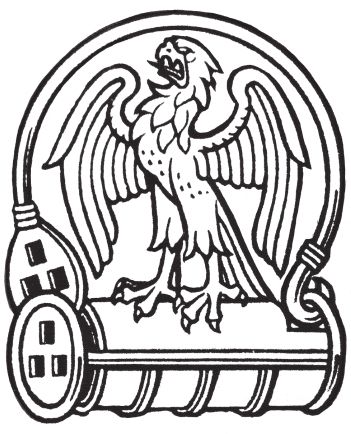
1. Falcon and fetterlock badge.
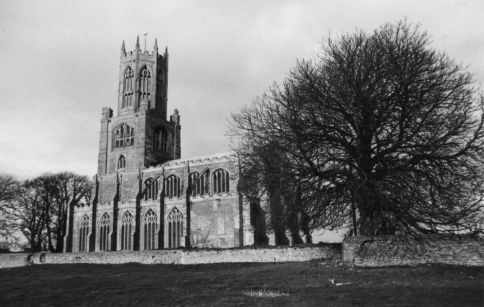
2. Fotheringhay Church, Northamptonshire.
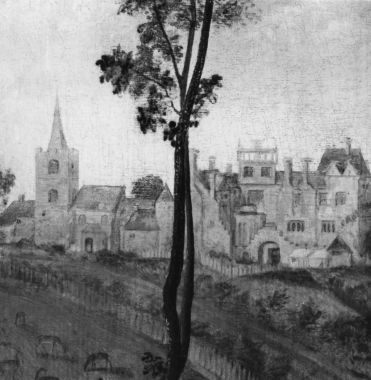
3. Hunsdon House, detail from sixteenth century portrait of Edward VI as Prince of Wales, by W. Scrots.
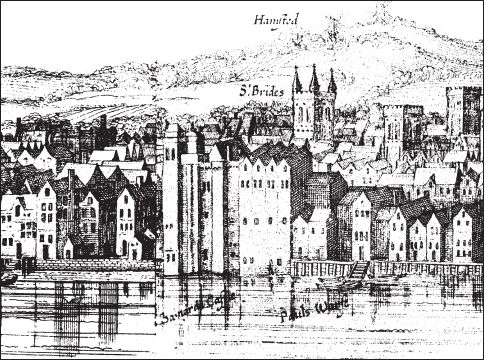
4. Baynard’s Castle, detail from engraving, View of London, by Claes Visscher, c. 1625.
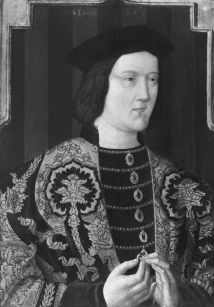
5. King Edward IV.
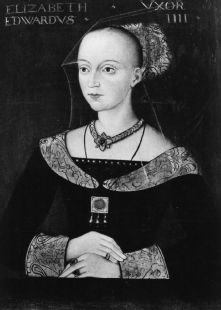
6. Queen Elizabeth Woodville.
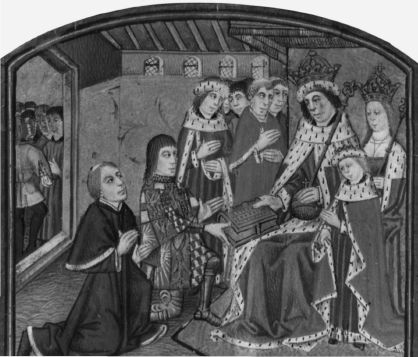
7. Anthony Woodville, Earl Rivers, presenting his translation of the Dictes and Sayings of the Philosophers to King Edward IV.
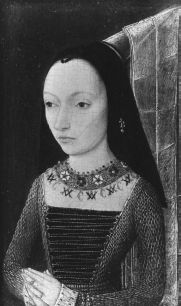
8. Margaret of York, artist unknown.
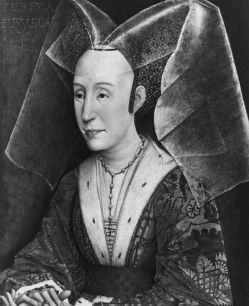
9. Isabella of Portugal, by Rogier van der Weyden.
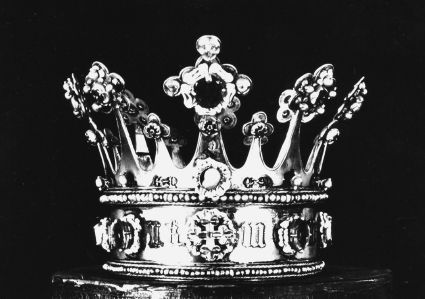
10. The Coronet of Margaret of York.
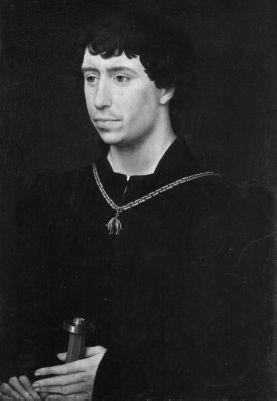
11. Charles the Bold, by Rogier van der Weyden..
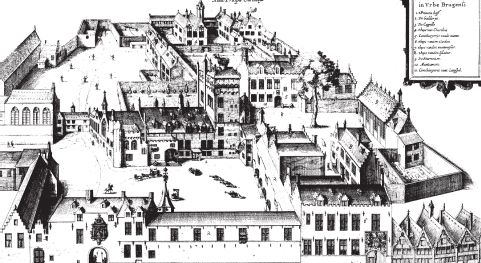
12. The Palace at Bruges from an engraving by A. Sanderaus in ‘Flandria Illustrata’ 1641.
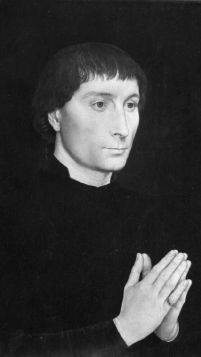
13. Tommaso Portinari by Hans Memlinc.
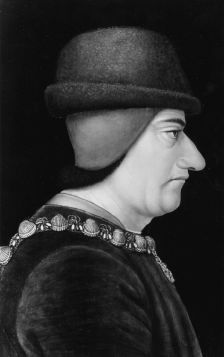
14. King Louis XI, J. Fouquet.
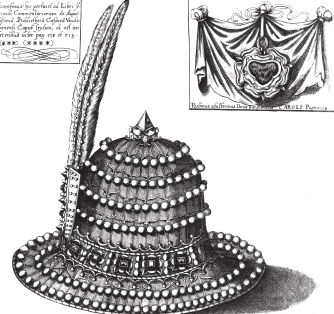
15. Jewelled hat of Duke Charles, engraving after a drawing by J. J. Fugger.
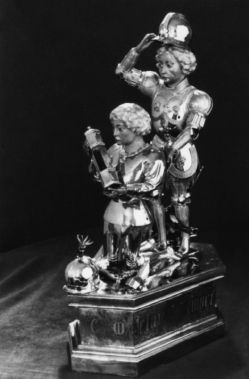
16. Reliquary by G. Loyet.
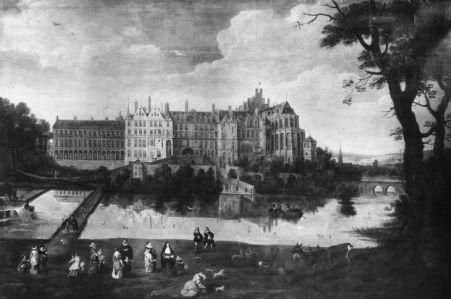
17. The Ducal Palace at Brussels in the seventeenth century.
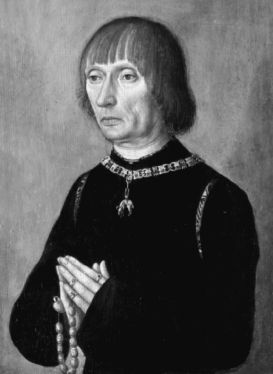
18. Louis, Lord Gruuthuyse, artist unknown.
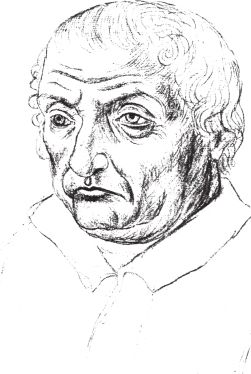
19. Olivier de La Marche, drawing from the Recueil d’Arras.
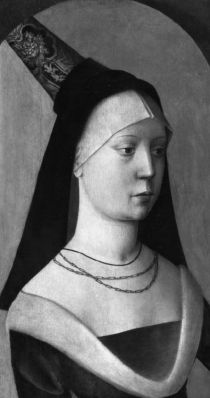
20. Portrait of a woman, possibly Margaret of York, artist unknown.
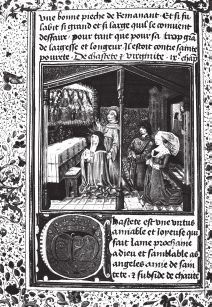
21. Margaret and Charles kneeling behind St Colette and St Francis, miniature from Vie de Sainte Colette, manuscript in the Convent of the Poor Clares at Ghent.

22. Margaret of York, artist unknown.
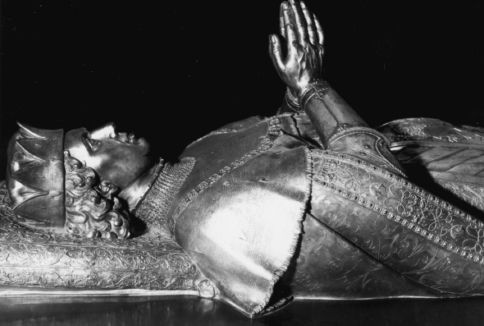
23. Tomb of Charles the Bold in the Church of Our Lady, Brugge.
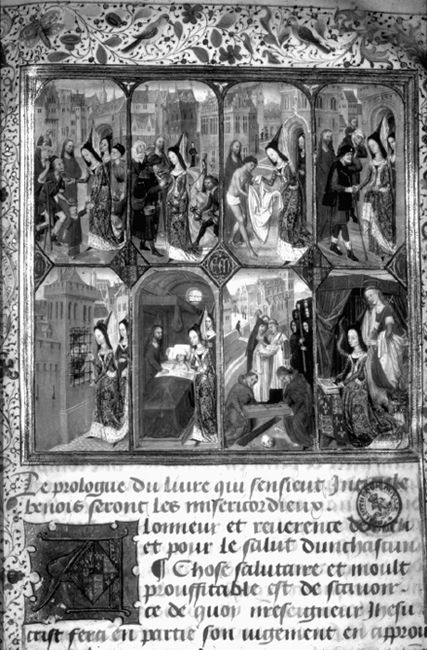
24. Miniature depicting Margaret performing acts of charity from Benois seront les Miséricordieux.
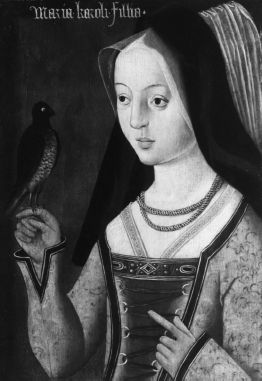
25. Mary of Burgundy as a young girl, artist unknown.
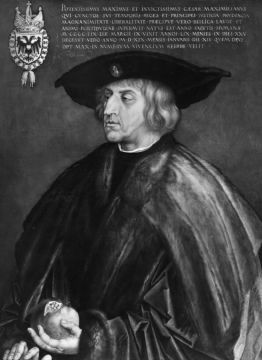
26. Emperor Maximilian I, 1519, by Albrecht Dürer.
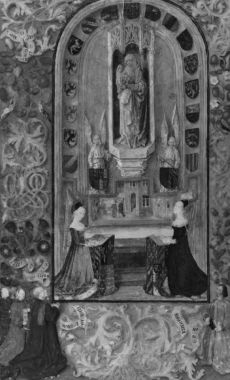
27. Margaret and Mary kneeling in the Chapel of St Anne, Registre de la Guild de Sainte Anne à Gand, in the style of the ‘Master of Mary of Burgundy’.
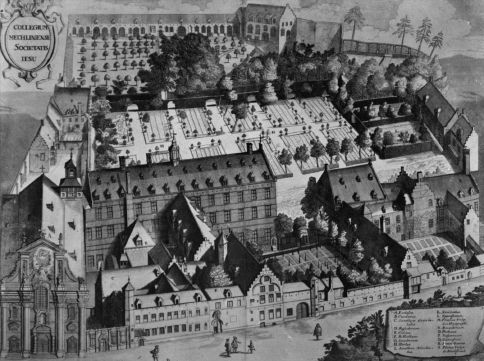
28. The Palace of Margaret of York at Malines, engraving R. Blokhuyse, Chorographia Sacra Brabantiae.
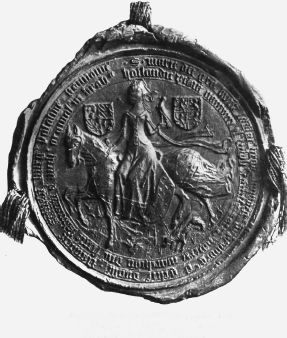
29. Equestrian Seal of Mary of Burgundy, 1477.
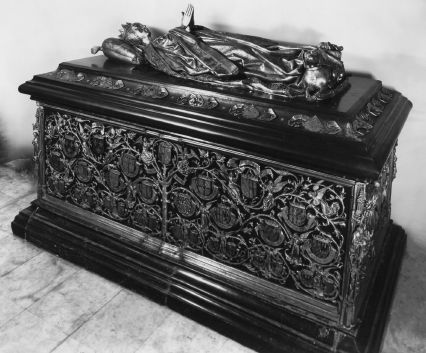
30. Tomb of Mary of Burgundy in the Church of Our Lady at Bruges.
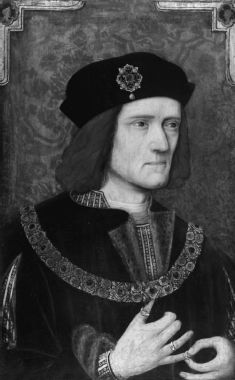
31. King Richard III, artist unknown.
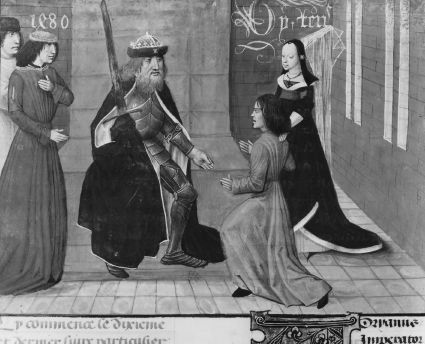
32. Edward IV as Hadrian kneeling before Trajan with Margaret of York beside him.
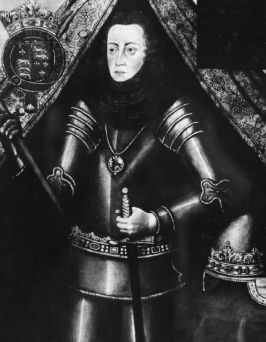
33. George, Duke of Clarence, artist unknown.
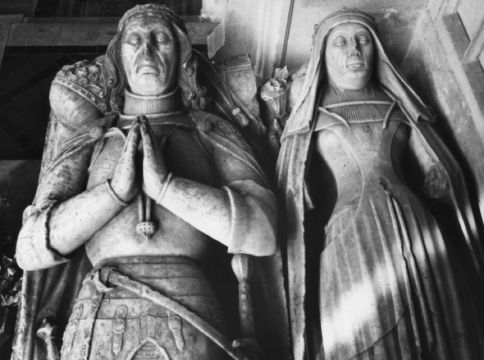
34. Tomb of John de la Pole, Duke of Suffolk and his wife Elizabeth, Wingfield Church, Suffolk.
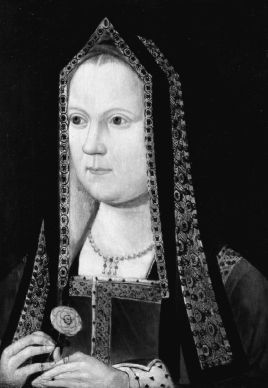
35. Queen Elizabeth of York, artist unknown.
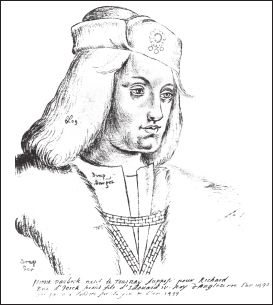
36. Perkin Warbeck, drawing from the Recueil d’Arras.
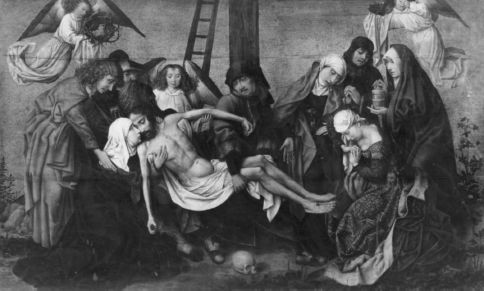
37. Deposition, by a follower of Rogier van der Weyden.
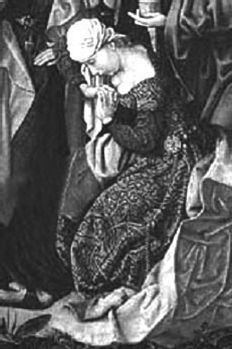
38. Detail of Deposition.
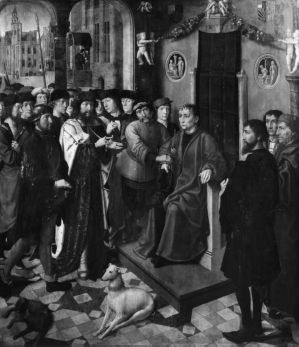
39. The Verdict of Cambyses or The Arrest of the Unjust Judge, Gerard David.
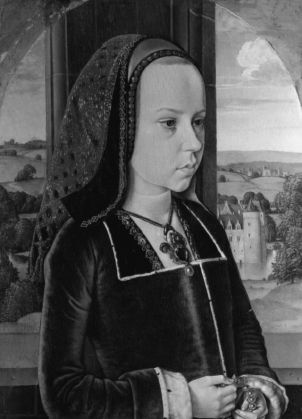
40. Probable portrait of Margaret of Austria, Portrait of a Young Princes, Master of Moulins.
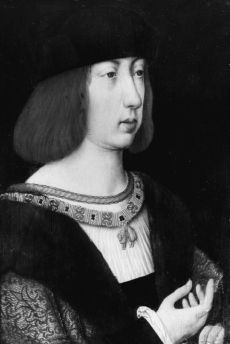
41. Philip the Fair, Archduke of Austria and Duke of Burgundy, artist unknown.
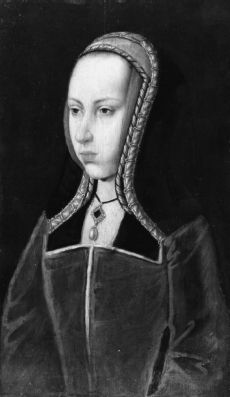
42. Joanna of Castile, Archduchess of Austria and Duchess of Burgundy, artist unknown.
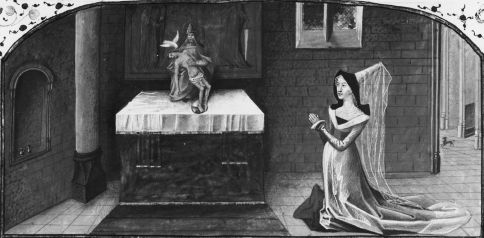
43. Margaret kneeling before the Trinity, miniature in grisaille, from Traites de morale, ms.
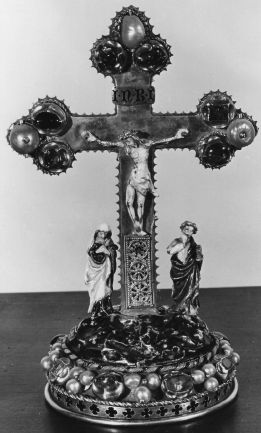
44. Reliquary presented by Margaret to St Ursmer’s Church, Binche.
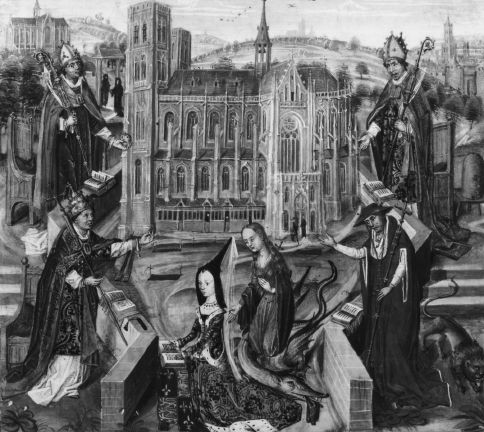
45. Margaret at prayer, miniature from Benois seront les Miséricordieux studio Jean Dreux.
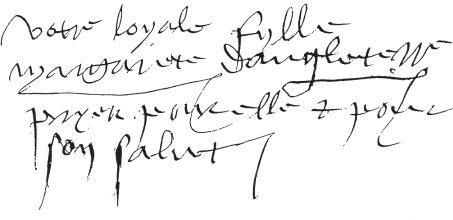
46. Autograph dedication on the final folio of Vie de Sainte Colette manuscript.
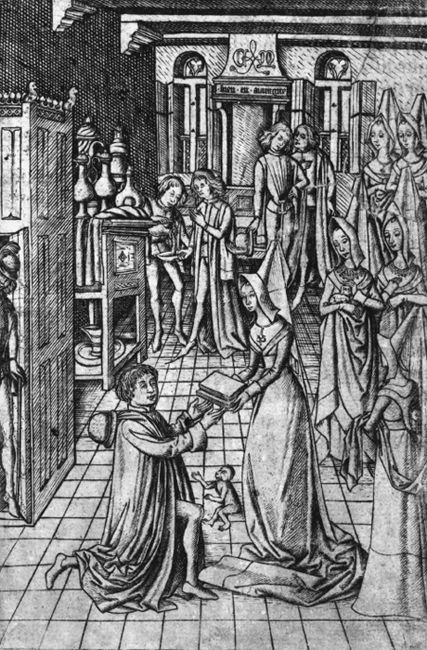
47. William Caxton presenting his book to Margaret, frontispiece to Caxton’s edition of the Recuyll of the historyes of Troy by R. LeFevre.
Margaret was well acquainted with the problems affecting the duchy and she knew that they must be resolved quickly if they were to present a united defence against France. Two days after the first news of Nancy, on 11 January, Margaret and Mary sent out a summons for the Estates General to assemble at Ghent on 3 February. During the next two weeks, messengers were despatched to the cities and provinces urging them to support the new Duchess against the French invaders and promising alleviation of the harsh taxation, better government and more gentleness from the ruler.9 Margaret, then thirty-one years old and with considerable experience in government, was the most constant adviser and supporter of the twenty-year-old Duchess. Their close and trusting relationship ensured that they could cooperate fully.
Margaret appreciated the need to win the support of the Estates and she was well aware of their complaints. She had had to listen to their protests regularly during the past two years and her approach had certainly been more conciliatory than that of the other ducal councillors such as the Chancellor Hugonet.10 By the time the Estates began to assemble late in January, Mary was well prepared to meet their demands. In her opening speech she renounced the remainder of the 500,000 crowns levy which had been granted to Duke Charles for six years.
Within a week the ducal councillors had accepted the draft of the Great Privilege, a charter designed to satisfy the many demands for the restoration of local rights and privileges.11 The new Duchess promised to rule with the advice of the Great Council, which would include delegates from the Estates, and she assured them that all major decisions, such as her choice of husband and matters of war and peace, would be submitted to them for their approval. The Estates would be permitted to assemble whenever they considered it necessary and the rights of regional courts were upheld against the much-hated central court at Malines. The extent of these concessions and the fact that the Great Privilege was available in both Dutch and French by 11 February, suggests that it had been in preparation for some time. Margaret’s advice together with that of the Lords of Ravenstein and Gruuthuyse (who were also in close contact with the opinion in Flanders, Holland and Brabant) guided Mary to make this major move of conciliation as speedily as she did.
Margaret’s presence during the first months of 1477 was especially important because the young Duchess had so few experienced advisers on whom she could depend. Louis’ claims that, in the absence of a male heir, he had the right to repossess all the French fiefs of Burgundy, caused a clash of loyalties for many of the great lords of the duchy who owned lands in the south. There had already been a drift away towards France during Charles’ lifetime. Commynes was not the only one who preferred the adroit and clever King Louis XI to the hard and stubborn Duke. The calamity of Nancy turned this drift into a landslide. Amongst those who abandoned Mary were her step-uncle Anthony, Count of La Roche, Phillippe de Crèvecoeur, the ducal governor of Picardy and William Biche, Charles’ first chamberlain.12
As well as the defectors to France, many Burgundian nobles and officials had been taken prisoner at Nancy. It took time to arrange and pay all their ransoms and some of them were not freed until July when Maximilian rode north to his marriage. Among the prisoners were Josse of Lalaing, who had been appointed by Charles as the tuteur for Margaret’s dower lands, Olivier de La Marche and the Counts of Chimay and Nassau. La Marche was fortunate enough to be back in the Low Countries by Easter but Chimay did not return until July.13
Ravenstein and Gruuthuyse were both members of the Council established by Duke Charles to advise and guide Margaret in his absence. They had long experience, much local prestige and were loyal servants of the duchy. Three others who had also served Margaret and Charles well, but who were not so well trusted by the people of Flanders, were the Chancellor Hugonet, Lord Humbercourt and the Bishop of Tournai. They had earned their unpopularity as the chief instruments of Charles’ oppressive taxation and recruitment policies and were held responsible for the harsh and tyrannical administration. Mary was to find that although these men were both loyal and zealous, she could neither profit from their counsel nor save them from the attacks of the people. In addition to her official counsellors, Mary had one other trusted companion, the Lady Hallewijn, who had been with her for many years. When Margaret had to leave Ghent, leaving Mary a virtual prisoner, it was through this lady that the two women were able to keep in touch.14
Thus Mary had a limited number of advisers available to help her in Ghent and she had little hope of any real assistance from abroad. Since 1475 the Anglo-Burgundian alliance had become a pale shadow of its former strength and although the Emperor had assented to the marriage of Mary and Maximilian, he was in no position to send an army into the Low Countries quickly. Margaret did her best to stir Edward IV into action and she was also soon in touch with the Emperor, urging him to press ahead with the promised marriage. The death of Charles was known in England by mid January but as late as the 24th of that month Richard Cely was unsure as to what was happening in Burgundy.15 Margaret had contacted her brother by early February and on the 14th the Great Council met at Westminster to discuss Charles’ death, and decide upon their response to the events in Burgundy and also to the French invasion of the duchy.
Sir John Paston, in common with many others, thought that the Dukes of Clarence and Gloucester would soon be setting off for Flanders at the head of an army to assist both their sister and the new Duchess.16 But Edward was loathe to lose his French pension and the betrothal of his daughter Elizabeth to the Dauphin, so he adopted a policy of neutrality. Lord Hastings was despatched to Calais with reinforcements in case the garrison should be attacked by either side. No doubt he was also there to collect intelligence and to keep the King well informed concerning the course of
the war.
Margaret must surely have hoped that Sir John Paston would be proved right. She may well have tried to encourage English intervention by reviving the old idea of a marriage between Mary and her brother Clarence, who was once more eligible for marriage after the death of his wife Isabel Neville in December 1476. English and French contemporaries certainly considered that Margaret, ‘whose affections were fixed on her brother Clarence beyond any of the rest of her kindred exerted all her strengths and energies that Mary … might be united in marriage to that Duke.’17
But there are few signs of these ‘strengths and energies’ being used to promote a marriage with Clarence on the Burgundian side. Whether the idea came from Margaret, from Clarence or from Louis XI, who was trying to undermine Margaret’s influence both in England and in Flanders, it is hard to determine. An English embassy led by Sir John Donne and John Morton, which arrived in Ghent late in February, certainly proposed a bridegroom for Mary, but Edward’s candidate was the Queen’s brother, Anthony Woodville.18 As a mere Earl he was not considered as a possible contender either by Mary or Margaret, neither of whom ever seem to have seriously considered any bridegroom other than the long promised Archduke Maximilian.
Maximilian wrote on 24 January assuring Mary of his intention to marry her. Throughout the next three months embassies went to and fro between Mary and Margaret on the one side and the Emperor and Maximilian on the other. Margaret’s close involvement is shown through the prominence in the negotiations of her chevalier d’honneur Guillaume de la Baume, the Lord of Irlain. Later it was he who covered the expenses of Maximilian’s German retinue when they arrived penniless at Ghent.19
However, in January 1477, the arrival of Maximilian was still six months away and Burgundy had to withstand the invasion by France with no help from outside. While her forces were still inadequate to drive back the French, the Duchess could only hope to buy time until the army had been rebuilt. In an effort to do this, Mary and Margaret opened negotiations with King Louis XI. They sent off a joint letter appealing to him to halt his invasion of their territories. The letter was dated 18 January and was probably an immediate response to the French assault on St Quentin.
The letter reads like a very naive attempt by two weak women.20 They inform the King of their ‘harsh fortune’ but add that they still trust that Duke Charles would return to them. Reminding Louis that he was Mary’s god-father, they appeal to his ‘goodness and mercy’, urge him to end his assaults on their territories and to extend to them the ‘Christian and seignorial protection due to all widows and orphans’. They sign themselves as ‘your very humble small relatives to you our protector’. At first glance the letter was such an abject plea that it could do their cause little good, but was it in fact a well judged piece of diplomacy? Only the events of the next few months would show.
Their appeal was sent off in the care of two officials, Jacques de Tinteville and Thibault Barradot,21 who tried to contact Louis at Peronne, but having missed him there, they were sent on to Paris. As a result, the letter was not delivered for some considerable time and, it seems, not before the first official ducal embassy had reached the King. This delegation included Humbercourt, Hallewijn, Gruuthuyse, Hugonet, the Bishops of Tournai and Arras and Guillaume de Clugny, the brother of the Bishop of Tournai.22
Louis brushed aside all their protests against the French invasion, maintaining that the Burgundian lands were, in default of a male heir, forfeit to the French crown. However, his interest in Flanders and Hainault could not be based on this principle, since both these counties had come into the possession of the Dukes of Burgundy through the inheritance of the female line. Louis responded to negotiations by proposing a betrothal between Mary and the seven-year-old Dauphin (who was already betrothed to the English Princess Elizabeth), with the cession of Artois and Boulogne to France as sureties for the marriage. On these terms he would agree to renew the Franco-Burgundian treaties of 1475 and to accept Mary’s homage. In spite of these proposals, he continued with his invasion and on 26 January, three days after Louis’ meeting with the Burgundian delegation, the Hainault delegates arrived in Ghent complaining bitterly at the French attacks on their towns and villages.
While the Burgundian embassy was meeting the French King, preparations were in full swing at Ghent for the assembly of the Estates.23 Mary and Margaret both attended the opening session on 26 January and, after the announcement of the death of Duke Charles, Mary appealed for their loyalty and help against France. The Great Privilege and her other gestures of conciliation were largely successful and during the first week of the assembly a levy of 100,000 men was promised for the war against France, 34,000 of whom were to be recruited at once. The delegates from Hainault were particularly strong in their support of the Duchess and in their resolution to drive back the French.
On the other hand the Flemish delegates were anxious to avoid the costs of yet another wasteful war and it was their arguments which persuaded the Estates to send another delegation to Louis, including their own representatives, which was instructed to try to negotiate a peace. This embassy left at the end of February and reached Louis at Lens on 3 March but were obliged to follow him to Arras, which was surrendered to the French the following day.24 Some of the delegates from the Estates believed that Hugonet and Humbercourt were responsible for surrendering the city and anger with these two officials was growing. Both Humbercourt and Hugonet owned lands under French suzerainty and they may well have taken the opportunity of their first meeting with Louis to do homage for their lands. This, and the surrender of Arras, led to accusations of treason being levelled against them.
By the time the delegation from the Estates arrived at his court, Louis had received the first letter from Mary and Margaret and he had also conquered large areas of Burgundy. Confident now of the success of all his plans, he determined to isolate the young Duchess from all her most experienced advisers and so force her to accept a settlement agreeable to France. He therefore retracted his earlier marriage offer, preferring to maintain his original marriage treaty with England and set to work to make things more difficult for Mary within the Low Countries. Olivier le Daim, Louis’ barber-valet, who had risen to become the Captain of Meulun and was one of the King’s most trusted agents, was despatched to stir up trouble, first at Tournai and later at Ghent.25 Louis himself fostered the distrust which already existed between the delegates from the Estates and the Duchess’ advisers by showing the delegates a secret letter, purporting to come from Mary, informing Louis that her chief advisers were Ravenstein, Humbercourt, Hugonet and the Dowager and that he should deal only through these persons.26 Thus the wily Louis identified Mary’s most resolute supporters and set about reducing their influence. He was particularly keen to undermine Margaret’s position and he warned the delegates that she was planning a marriage between Clarence and Mary. He even suggested that she was planning to kidnap her stepdaughter and have her taken to England. He used the same story to undermine Margaret’s credibility with her brother Edward.27
When the delegation from the Estates arrived back in Ghent it seemed at first as if Louis’ scheming would be wholly successful. The presence of the Estates General had raised the political temperature within the city and the pressure for the arrest and punishment of hated ducal officials increased. There were daily parades and demonstrations by craftsmen denouncing bad government and corruption. In an attempt to rally support about her person, Mary was formally inaugurated as Countess of Flanders and Duchess of Burgundy.28 However uproar broke out when the Pensioner of Ghent, the city’s chief delegate to the Estates, confronted Mary with the secret letter and denounced the advisers who were named in it. When Mary denied the existence of the letter, the Pensioner produced the copy that had been obligingly provided by Louis. It looked as if the Duchess had been trying to deal with the French King behind the backs of both the Grand Council and the Estates and that she was acting through those very advisers who were held most responsible for all the bad government of the past. Popular demands for revenge and satisfaction could no longer be contained. Leading citizens of Ghent, who had submitted to Charles in 1468, were dragged out and executed and threats were made against many other ducal officials.
Of the four ducal advisers named in the secret letter, Ravenstein had too much power and influence in the Low Countries to be attacked openly. Margaret was in a more difficult position, she was now merely the Dowager and she had been closely involved in the recruitment of the ducal armies. Moreover, the accusation that she was plotting to marry the Duchess to her brother Clarence amounted to a charge of treason. Realising that her presence would only inflame matters and make things more difficult for Mary, and also alarmed at the possibility of a direct attack upon herself, Margaret was forced to leave Ghent. In her train she took some of the threatened officials such as Olivier de La Marche, who later recorded his relief at being able to escape. ‘As for me I was advised not to fall into their hands and I went to Malines with Madame’.29
Margaret did not leave without making a public protest and she insisted on receiving a personal message from Mary who was, by this time, a virtual prisoner in her own castle. On the square outside the castle gates, Margaret made a spirited defence of her own position declaring that although she was a foreigner by birth, she was no foreigner in her heart nor in her courage.30 Escorted by her personal bodyguard of 300 English archers and followed by a convoy of carts and carriages, she then rode off to her dower town of Oudenaarde. On her arrival she organised a solemn and impressive service in honour of the late Duke. The long procession, which took place at night, wound its way through a city draped in black velvet and illuminated by torches and flambeaux. It included twenty paupers dressed in new black mourning clothes, paid for by Margaret.31 Oudenaarde was in southern Flanders and nearer to the French invaders. When the French reached Binche, another of Margaret’s dower towns in Hainault, she removed her court further north to Malines in Brabant, which was to become her principal residence during the twenty-six years of her widowhood.
With Margaret out of Ghent the anger was turned against the remaining officials, especially against the hated ‘foreigners’ Hugonet and Humbercourt who were now without protection. They were arrested on 19 March together with Jan van Melle, the ducal treasurer for Ghent, and the Papal Pronotary, Guillaume de Clugny.32 These four men were particularly unpopular. Humbercourt had been in charge of both Dinant and Liège after their suppression and was hated throughout the Low Countries. Hugonet, one of the late Duke’s most talented officials, was regarded as the chief enforcer of the harsh taxation through the unpopular central courts at Malines. He was also notorious for his interminable Latin speeches and he had harangued and threatened the Estates General whenever they had resisted the ducal will. Jan van Melle was known as the most corrupt official in Ghent where he had enriched himself as a tax collector. When his house was plundered, the contents were estimated to be worth the equivalent of twenty-three years’ earnings for a skilled craftsman and one of his fur and velvet cloaks alone was valued at a year’s wages.33 Both Guillaume de Clugny and his brother Ferry, the Bishop of Tournai, were blamed for forcing unpopular levies on the Church and also simply because they were well-known ducal administrators. All these men were paying for Charles’ unpopular policies and for his failures.
Humbercourt pleaded that he could only be tried by his peers in the Order of the Golden Fleece, but his protests were ignored. Guillaume de Clugny was more successful in pleading benefit of clergy. They were all well aware of what lay in store for them. In the days before and after their arrests, there had been daily executions of minor officials. All this was taking place during Easter week and the townspeople paraded every day with banners and arms. Mary did not lack courage, going into the Square to plead in public for her officials. She also tried to get a proper commission established in an attempt to give them a fair trial, but there was no time for this to operate.34
Accused of surrendering Arras to the French, of trying to force Mary to marry the Dauphin and of trying to kidnap her when she was out hunting, the three counsellors were found guilty of treason. In spite of Mary’s tears, Humbercourt and Hugonet were tortured and condemned to death. The executions took place on 3 April. Van Melle died at 9 am and Hugonet at 12 pm. The latter, who had risen to power as a protégé of the old Chancellor Rolin, met his fate with resignation. He wrote to his wife, ‘I expect to die today and to leave this world as one could say, to satisfy the people’.35 At 5 pm Humbercourt perished on the same scaffold. The cautious magistrates of Ghent ensured that they received pardons from the Duchess for any offence they might have committed on that day.
Both Humbercourt and Hugonet had been associated with Margaret for the whole of her married life. They had taken part in the negotiations which had led to her marriage. Their execution could certainly be seen as a threat against the Dowager herself. Both Margaret and the Duchess did their best for the families of the dead officials. On 24 April Mary wrote to the magistrates of Malines, asking them to give shelter and protection to the widow and children of ‘our very dear and faithful cousin the lord of Humbercourt’. The widow, Antoinette de Rembures, and her family went to Malines under the protection of the Dowager.36 The deaths of these men, together with another sixteen of Charles’ servants, finally satisfied the people and even provoked a certain reaction in favour of the Duchess. Gruuthuyse used his influence to persuade Bruges to withdraw their support from the hard men of Ghent. On 2 April Mary was allowed to leave for her inauguration at Bruges and she stayed away from Ghent until 26 April.
Meanwhile both Mary and Margaret pressed ahead with the plans for the Duchess’ marriage to the Archduke of Austria. On 26 March, in the midst of all the troubles in Ghent, Mary had written to Maximilian urging him to hasten to her aid. On the day of her inauguration at Bruges, she received a personal reply from the Imperial ambassador informing her that Frederick III had publicly invited the bishops and nobles of the Empire to accompany his son to his wedding in the Low Countries.37 But there were still rival candidates for the Duchess’ hand and Maximilian had not yet set off on his journey. Louis XI had withdrawn his proposal for a marriage with the Dauphin, but he offered other French princes such as the Count of Angoulême. Closer to home there were candidates whose names were put forward by the different factions within the Low Countries.
The Ghent Council supported either a French marriage or a marriage to Adolphe of Egmond, the heir to the Duchy of Guelders. After the Burgundian seizure of Guelders, Adolphe and his brother had been kept under the eye of the Burgundian court. He was well-known and popular in Ghent, where he had been made an honorary citizen. His candidature was supported by the French agent Olivier le Daim whose intention was to thwart the Imperial marriage while supporting the wishes of the Flemish. Moreover, the English, hostile to the prospect of a Franco-Burgundian marriage, might also support Adolphe of Egmond. Adolphe was appointed as leader of the Flemish militia, but his candidature came to an end when he was killed at the siege of Tournai on 27 June.38Another suitor from the Low Countries was Philip of Cleves, the son of Lord Ravenstein, and Mary’s childhood companion and cousin. How much his candidature was merely a matter of gossip or even a calculated effort to hasten Maximilian’s arrival it is hard to judge. Certainly Philip welcomed Maximilian when he came to the Low Countries. He was made Lieutenant General of all the Burgundian forces, fought valiantly for Maximilian at Guinegatte in 1478 and helped to restore order after the uprising in Liège. During the first decade of Maximilian’s government, Philip cooperated very closely indeed. Lord Ravenstein certainly did not push his son’s candidature with any real determination.39
While Europe speculated on the fate of both Mary and Burgundy, Mary and Margaret stuck to their decision that only an Imperial marriage could save Burgundy from France and they resolved to follow the policy which had been laid down for them by Charles. They were supported in their determination to bring about the long planned marriage by Lord Gruuthuyse, who acted as one of the chief negotiators for the marriage.40 Margaret also took the matter firmly in hand and although away from court she pressed ahead with the negotiations and arrangements throughout March and April. She communicated with the Emperor promising ‘on the word of a princess’ to support the match.41
An Imperial embassy visited her court at Malines on 15 April on their way to the Duchess at Bruges. Margaret’s chevalier d’honneur and chamberlain Guillaume de Baume was a signatory to the marriage treaty, and from the very beginning the Dowager made her total commitment to Maximilian very clear. On his arrival she promised loyalty and fealty to the Archduke and she helped Maximilian to alter the marriage treaty so as to give him more authority within the Low Countries. The original marriage treaty has not survived.42 It was destroyed, perhaps by Mary and Maximilian themselves because it cut Maximilian out of the succession, leaving all the Burgundian lands to the children of the marriage and specifying that all Burgundian possessions must be under Burgundian rule. This was overruled by an act of 17 September, annulling the relevant articles and leaving all Mary’s lands and goods to her husband. The act was signed and sealed by Margaret, Mary and Maximilian. The only Burgundian official to sign this agreement was Guillaume de Baume.
A week after the arrival of the Imperial embassy in Bruges, Mary married Maximilian by proxy. There was some agitation when the marriage was made public six days later, because the Duchess had not, as she had promised, consulted the Estates or the Grand Council. However, the bloodletting at Ghent seems to have exhausted the opposition. When the Estates General reassembled on 7 May they accepted the statement by Jean de la Bouverie, the head of the Grand Council, that the marriage required no approval since it was merely the completion of arrangements made by the late Duke.43 Most of the delegates were by now much more sympathetic towards the Duchess and the Imperial marriage. The French destruction of farms and villages in Artois, Hainault and southern Flanders had rallied support to the Duchess. The Estates therefore approved the marriage on the condition that Maximilian would confirm the Great Privilege and they voted more money to help the Archduke to recover his wife’s lands.
By the end of April Louis must have realised that far from achieving the rapid disintegration of the Burgundian government, his policies had allowed the marriage of Mary and Maximilian to win wide support across the whole of the Low Countries and increased the opposition to the French invasion of Hainault and Flanders. Perhaps that first plaintive letter from Mary and Margaret had made him underestimate entirely the strength and resolve with which the two women intended to withstand a French takeover. Perhaps too, that is exactly what the letter was intended to do. Realising that his plans were now going awry, Louis sent a succession of embassies to the Duchess, urging her not to marry a ‘rude German’. But the devastation of the harvest by the French army was not likely to increase the number of francophiles in the Low Countries.44
Maximilian’s progress towards his beleaguered bride had been far from speedy. Indeed he made one of the slowest journeys down the Rhine on record, scarcely in keeping with his armorial device of ‘halt mass’ (keep pace). He left Vienna on 31 May and did not reach Maastricht until more than two months later on 5 August. In his own account of the journey, which was written many years later in the allegorical Weisskünig and Teuerdank45 Maximilian tried to explain the ten-week journey in terms of monsters and perils which beset the route of a young knight. However the more cynical Commynes saw the delay as caused by a shortage of funds, and reported that the Archduke’s long stay at Cologne was due to the fact that he had to wait for the Duchess to send him more money.
The time was also spent collecting troops and making careful diplomatic soundings. He checked out exactly how remunerative the Burgundian inheritance would be and both he and the Emperor were reported to be delighted when they learnt that the annual revenues had been estimated at over a million florins. Throughout these months, Margaret remained in direct correspondence with the Emperor, who promised to protect her dower lands with the Imperial armies. It was an empty assurance since the Emperor Frederick had no spare troops at his disposal, but the promise of Imperial protection must have pleased Margaret. Moreover the presence in the Low Countries of Georg Hessler, one of the most important Imperial councillors who had been working on this marriage for two years already, must have given her confidence that the arrival of Maximilian was imminent.
The young man on his slow journey to the Low Countries was certainly the most eligible of all the candidates proposed for Mary. Eighteen years old and two years younger than Mary, Maximilian was a blonde-haired elegant young man, well educated and with a talent for languages, being competent in seven, including Dutch and English which he learned after his arrival in the Low Countries. Like Mary, he enjoyed riding and hunting and their union does seem to have been a particularly happy one. After Mary’s early death, Maximilian remained a widower for many years and his second marriage was a purely diplomatic affair. His own account of his first marriage was written in the language of chivalry and romance, the story of a young knight setting off on a great adventure to rescue a princess who was under attack from all the forces of evil.46 Maximilian was certainly an amiable and pleasant young prince, and his relations with the Dowager were to be useful to them both. Margaret gave Maximilian her firm support throughout the rest of her life and there were never any signs of friction between them.
Maximilian arrived at the castle of Ghent on 18 August, escorted by 700 to 800 horsemen in a glittering cavalcade. He rode a mighty chestnut horse and was clad in silver armour. On his long golden hair was a diadem of pearls and precious stones. He was the ‘White King’ of his future autobiography. Margaret returned to Ghent with him and it was the Dowager and the Lady Hallewijn who arranged the first meeting between Mary and Maximilian. According to the delegate from Brandenburg who was in Maximilian’s retinue, the two ladies organised one of those little scenes so dear to the chroniclers of the fifteenth century. ‘At last you have everything that you desired so much’ said Margaret as she introduced Mary to her bridegroom.47 Maximilian was given to understand that the Duchess had a carnation hidden in her bosom and that it was his duty to find it. In a portrait of Maximilian painted shortly after his arrival in the Low Countries he is shown holding a carnation. This flower was the symbol of a betrothal and was often shown in marriage portraits.48 As soon as Maximilian arrived the wedding was celebrated. Compared to Margaret’s marriage, it was a low-key affair but the bride wore ‘the crown of Burgundy’ and the groom wore armour, indicating his resolve to drive out the French.
This marriage, achieved within nine months of the disaster at Nancy and in the face of internal revolts and a French invasion, was the result of the clear and skilful diplomacy of a very small number of people. Louis at least had no doubt at all that it was Margaret’s hands which had been ‘on the reins’.49 The events of 1477 ensured that France was prevented from gaining Hainault and Flanders. Margaret had encouraged Mary to make any concessions which would keep the French King at a distance and to preserve her freedom of action on the question of her marriage. Margaret’s part was also recognised by the Emperor, who thanked her personally for all her assistance.50 Throughout the difficult months of 1477 the Dowager had played a vital supportive role.
Moreover by steering Mary away from a French wedding and bringing a Habsburg into the Low Countries, she contributed to a major reorientation in European history. Her Belgian biographer, Luc Hommel, went so far as to claim that she was ‘greatly responsible for the existence of the present-day kingdom of Belgium’.51 The ‘most important political combination that ever involved the Low Countries’ had been achieved in spite of all the obstacles which had been put in its way.52
Apart from the major question of Mary’s marriage, Margaret had many other preoccupations during the first year of her widowhood. Her own position as Dowager was far from secure.53 Two types of dower settlements operated in Burgundy, the legal and customary arrangements made by most people who had properties to leave, and the contractual arrangement which was based on a treaty or contract made before marriage. Marriages involving great estates usually came within contract arrangements, as did the marriage of Margaret and Charles. This meant that Margaret’s whole position on the death of her husband was dependant on the marriage treaty of 1468. Margaret’s marriage contract had been modelled on earlier contracts drawn up for the marriage of previous Duchesses of Burgundy and particularly on the contract made for the marriage of Isabelle and Philip the Good. Isabelle had brought with her a dowry of only 154,000 crowns, but King Edward had promised Margaret a dowry of 200,000 crowns. Margaret’s dower was reckoned in terms of a fair return on this capital sum and in Margaret’s case this has been calculated as an eight to ten per cent. During the lifetime of Charles her dower had been administered as part of the ducal estates, but on his death it reverted to her. Her future income was to be derived from the revenues from Malines, Termonde, Oudenaarde, Cassel and Le Quesnoy
However, the reversion of the dower on the death of Charles was entirely dependant on the full payment of her dowry and this had not been achieved. Edward had made the first payment on the wedding day, but the second payment was still incomplete. In May 1476 he had paid 16,000 crowns off the debt but in July of the same year the Burgundian treasury calculated that he still owed 115,000 crowns. When Margaret enquired in March 1477 as to the state of her dowry payments, she was told that Edward still owed more than half. This was bad news for Margaret because it meant that she was liable to lose half her dower. She was well aware of the problem and must have already discussed the situation with various officials. Immediately after Charles death she lost no time in trying to get the position clarified and corrected and she was astoundingly successful.
Although she inherited a most unsatisfactory settlement and in spite of a raging national crisis, Margaret still managed to secure a very rich dower. Her first letter to the central courts at Malines went off as early as 15 January, when she began collecting together all the relevant documentation. There was an initial delay in locating the documents, many of which were still being kept at Lille, and it took Mary and Margaret several months to find them all. Margaret had to send her own financial official Hippolyte de Berthoz to collect them. There was a further obstacle in that the officials both at Malines and Lille were alarmed at what they were being asked to do. They pointed out that there was a large debt on the dowry and registered the effect of this on the dower.
The officials were reluctant to make up the value of the dower as if the dowry had been paid in full. They tried to prevaricate and insisted that all the orders should be counter-signed by Mary, Margaret and Ravenstein. Considering the fate that had befallen the ducal officials in Ghent, their caution was perhaps understandable. However, Mary was determined that Margaret should have her dower in full and she ordered the officials to end their delaying tactics and make Margaret’s dower arrangements immediately ‘reserving only the rights of sovereignty to us and to our heirs’ (sans aultre chose réserver pour nous et nozdis hoirs que le ressort et souveraineté).54
In her letter of 28 January, Mary stated very clearly her reasons for her generosity towards her stepmother. Margaret, she said, had always held ‘our person and our lands and lordships in such complete and perfect love and goodwill that we can never sufficiently repay and recompense her’. Moreover since the death of the Duke, Margaret had ‘given freely and cordially of her help and shared in and supported all our affairs with all her might’. Two days later the Duchess added more reasons for her resolution that Margaret should receive her full dower, declaring:
And above all for the sake of the deep love and reverence that we have for our said lady and step-mother, and in consideration of all the great goodness help and assistance that she has given us, when we were in her care and we hope she will still give hereafter in all our affairs.55
Mary added another reason for the favoured treatment which she was demanding for her stepmother. She justified her grants to Margaret in these terms:
she [Margaret] is fully occupied in dealing with the very high and very mighty prince, our well beloved lord and cousin the King of England, to persuade him to come to our aid and to uphold the everlasting alliances and treaties which were signed between him and our late lord and father.56
By 10 March the officials had surrendered and Margaret had secured all the dower lands which had formerly belonged to Isabelle of Portugal. She was formally invested with them on 30 May, when her tuteur Josse de Lalaing, the Lord of Montigny, took the feudal oaths on her behalf at Louvain. Since the French had seized Chaussin and Le Perriere in Franche Comté, Cassel in southern Flanders and Le Quesnoy in Hainault, Margaret was given Brielle and Voorne in Zeeland in their place. A full valuation was made of all her lands, and when the revenues did not reach the promised income of 20,000 crowns, the customs dues of Rupelmonde were also added to Margaret’s possessions.57
When Maximilian arrived in August, Margaret acted swiftly to obtain his full agreement to all the arrangements which she had made with Mary. Indeed she seems to have been very impatient, trying to discuss the matter of her dower on the eve of the wedding, when Maximilian preferred to talk about the arrangements for the marriage.58
As the Duchess had explained to her officials, Margaret’s chief role in the affairs of Burgundy was to draw in the support of England. It was a role clearly recognised by Louis XI, who regarded her as one of the greatest obstacles to his ambitions vis-à-vis Burgundy. After Charles’ death, Edward IV came under a double obligation towards Burgundy, firstly to maintain his treaty obligations towards the duchy and secondly, as Margaret’s nearest male relative, to uphold his sister’s rights. The English King acknowledged his brotherly duties when he thanked the Duchess Mary for her great generosity towards his sister.59 But as the Paston letters and the ‘White Rose Chronicle’ show, there were many in England who expected Edward to do more than this, and were sure that he would send over an army in support of his widowed sister.60
No doubt Margaret also hoped that he would send military assistance and help to defend Burgundy against Louis XI, though by this time she must have been well aware of Edward’s hesitation in such matters. It was in an effort to remind Edward of his moral and military responsibilities towards her that she wrote to him shortly after the fall of Cassel. It was a very strong letter indeed. She reminded Edward that he had made her ‘one of the most important ladies in the world,’ that he was now her ‘only lord, father, husband and brother’ and that her situation was harsh and grim. She had become ‘one of the poorest widows deserted by everyone, especially by you,’ and she appealed to him not to ‘leave me in such a miserable estate, to rescue me from the King of France who does his best to reduce me to a state of beggary for the rest of my days’. She begged him to send over 1,000 or 1,500 archers, who would be used for her protection and to intercede personally on her behalf with Louis.61
If Margaret really expected military support from Edward to defend her dower lands against Louis XI, then she hoped in vain. Nevertheless, for honour’s sake he was obliged to show some diplomatic effort on behalf of his sister. Although he had no intention of going to war on her behalf, he did make very vigorous protests to Louis and he also used the threat of his intervention to keep up the pressure on Louis and to ensure the payment of his own annuity. He even tried to persuade the French King to make payments for the upkeep of his daughter Elizabeth of York as the future Dauphine, but in this he was not successful.
As early as February 1477, Edward warned Louis to respect Margaret’s property.62 Louis’ initial response was an attempt to discredit the Dowager, both in Flanders and with Edward, by spreading rumours of a plot by Margaret, Hastings and Clarence to kidnap Mary and marry her off to Clarence. The Dowager, Louis assured the Flemings and Edward, was behind the whole enterprise and was secretly in touch with great lords in England to conspire against the King. Edward was unimpressed by these tales and although Clarence was to be arrested and killed in 1478, it was not because of this alleged plot and both Margaret and Hastings remained in the King’s favour.63
Besides trying to alarm Edward with stories of conspiracy against him, Louis also instructed his ambassadors to assure the King that Margaret had no rights to these dower lands. Since all the Burgundian inheritance must devolve to him as the late Duke’s sovereign, it was not in Mary’s power to invest Margaret with any territory in France. This too was given little credence by King Edward. After the French had burned and plundered Cassel together with fifty-two villages and whole areas around Oudenaarde, Le Quesnoy and Binche in August 1477, Edward sent his almoner, Thomas Danet, to make indignant objections at the French ‘attacks upon the King’s sister without reason’ and to claim compensation of 40,000 crowns on her behalf.64 An English embassy was also despatched to Flanders to give some support to the Duchess. When Louis heard of John Coke’s arrival at Ghent he immediately sent Edward the annuity which was overdue. He instructed his ambassadors to woo Edward with soft words, assuring him of his love and care for Margaret, promising to extend towards her all his protection as soon as she would submit to him as her sovereign lord. He insisted that Margaret had no grounds for complaint against him, either on the question of her dower lands or in any other matter.
Throughout 1477 to 1480 the ambassadors went to and fro between England, France and the Low Countries and Louis repeated his offers to protect Margaret if she would put herself and her lands into his care. He would then restore all her dower lands to her and make reparation for any damage caused by the war. In the meantime the French attacks on Burgundy continued, although there was a brief truce in July 1478. Margaret continued to appeal to Edward and he agreed to renew the Anglo-Burgundian treaties. During all this time Louis continued to regard Margaret as a major impediment to his plans. He warned his ambassadors that they would be stupid to expect any success from the Franco-Burgundian conference because Margaret was in control and she would do all in her power to prevent a settlement.65 Finally Louis was obliged to negotiate. The treaty of Arras saw all Margaret’s lands restored and she was promised satisfactory reparations. Edward did little to bring about this settlement but he made some slight economic gestures towards his sister. His concessions to Malines in November 1478, allowing the merchants of that city to trade in England on the same preferential terms as the members of the Hanseatic League, were presumably a sop to Margaret and he also renewed her trading licences.66
Immediately after the marriage of Maximilian and Mary, Margaret established herself at Malines in Brabant. Her choice of this city as her chief residence was governed by several factors, not least of which was the fact that it had become the home of the central court during the lifetime of her husband. His selection of the city as the judicial centre of the Low Countries may have weighed heavily with her since she was zealous in the preservation of his memory. The central courts of the Low Countries remained at Malines right up to the French revolution and earned for the city its soubriquet of ‘Malines La Prudente’.67 Brabant was also much more accommodating to the will of their ducal rulers than was Flanders and Malines was a very loyal city compared with Ghent or Bruges. It was also the richest and most centrally situated of all her dower towns. She owned seventeen villages in the area as well as the nearby castle of Arkel, which she had repaired and where she installed Engelbert de Falleton as her constable.68
Malines was a pleasant and prosperous city lying on the River Dyle. It was easily defended, surrounded as it was by a series of moats and walls. The city had been largely rebuilt in the late fourteenth and early fifteenth century following a great fire which had destroyed a third of the town in 1342, and the corporation had had the foresight to see that all the main roads inside the walls were paved. Domestic animals were not allowed to wander about soiling the well-kept streets, and it had the reputation of being very clean indeed. The population of about 25,000 made it one of the larger cities of the Low Countries and there was a strong industrial base to support all its commercial enterprise. There was a busy port with a series of quays and a large city crane dominated the waterfront. Malines had a long-standing feud with Brussels over its right to levy tolls on the traffic which passed up the Dyle and along the Senne to its neighbour. It competed with Brussels for the lion’s share of the trade of central Brabant. Although its cloth industry was by this date well in decline, lace-making provided work for the women of the town and carpet weaving was a growing business. Glass and pottery were manufactured on a large scale and the city had a reputation for quality metal crafts and fine leather work, which was said to rival Cordova. It had attracted skilled workers from the crushed cities of Dinant and Liège and there were several firms making armour and armaments, and also a number of bell foundries.69
Throughout Margaret’s lifetime the great tower of St Rombout’s Church was being built. The city fathers were hoping to build a landmark of 150 metres which would rival the height of towers at Antwerp, Bruges and Louvain. By 1477 the tower had reached roof height and building continued up to 1520, but the work had to stop at a height of 92 metres because the foundations would not support any more weight. By the sixteenth century this great tower housed forty-nine bells, the forerunners of today’s fine carillon.
It was an ideal city for the Dowager’s court but there was no ducal palace. Margaret remedied this by purchasing its largest house which had belonged to John of Burgundy, the Bishop of Cambrai. It was bought for her by Guillaume de Baume and Corneille de Barre in the November of 1477 and at the same time she purchased seven adjoining houses and all their land. During the following year the old house was totally rebuilt and greatly extended under the supervision of Anthony Keldermans, one of the family of well-known architects based in Malines. The house had cost 4,000 florins and the rebuilding must have added a great deal more to the price. The city corporation, enthusiastic at the idea of attracting the Dowager into permanent residence, offered 2,000 florins towards her expenses. Throughout her residence, she received many such gifts towards the costs of maintaining and improving her house.70
Margaret’s house, which evolved into the ducal palace during the minority of Mary’s son Philip, had a long façade with many windows facing onto the road, now known as the Keyserstraat. It was built in red brick decorated with white stripes, having a hexagonal tower at one corner and a stone balcony supported by four griffins and four lions on the second floor. Here the Dowager could appear before her people. In front of the entrance there was a court of honour and behind the palace there were extensive gardens, and later also a tennis court, a shooting gallery and baths. Hot baths of an almost Roman style were still very popular in the Low Countries and most of the nobles had their own private baths. In Malines there were also several public baths but not as many as at Bruges, which was notorious for its public baths, many of which were also centres of prostitution.
Margaret lived on the upper floor of the two storied building and her reception rooms were splendid. Her great council chamber was magnificent and vast, so large that it is now the site of a theatre, and it had several monumental marble fireplaces. The state rooms were painted by Baudouin van Battel of Malines, who worked for many of the noble families of Brabant, and her chair of state was upholstered in the finest black velvet. The walls of her private study were hung with violet taffeta and her library of illuminated manuscripts and printed books was kept safe behind a wrought iron grill made by Gauthier van Battel, the brother of Baudouin.
Paintings hung on the sombre walls, surely some of the van Eycks which belonged to the Burgundian court, as well as the van der Weydens, Memlincs and Bouts which later came into the collection of Margaret of Austria. The portrait of her husband by Rogier van der Weyden, now hanging in Berlin, would have had pride of place in her collection. As well as her books and paintings Margaret had a rich collection of tapestries and plate, some of which she bought at the sales of Hugonet’s estates in September 1478.71Within her private chambers the dowager passed her leisure time in prayer, reading and perhaps playing chess, a subject upon which she had several books in her library.
The Dowager’s household was large, probably over one hundred and fifty persons. At its head was her knight of honour, Guillaume de Baume whose family continued to serve at the ducal court for several generations. Under his command there was a small bodyguard of knights and archers, captained by Olivier de Famars, who escorted Margaret on her travels. She was attended by ladies of honour, maids and valets as well as having her own chaplains, almoner and confessors. From 1490 her confessor was Jan Briart of Ath a well-known theologian.
The Dowager employed several doctors, including Lambert de Poorter and William Roelandts, and a number of surgeons whose chief task was bleeding their mistress to preserve the balance of her ‘humours’. Margaret had an intelligent interest in preventative medicine, especially in how to avoid the epidemics of plague which swept through the Low Countries during her lifetime. The pestilence was particularly bad in 1479 and it was at this time that ‘Mastur John de Wymus Doctor Servant to the Lady Margret of Borgon’ wrote out a regime for her to follow. She was advised not to walk at midday, or when it was hot or cloudy, and never to walk with a full stomach or to do anything at a fast pace. She was also warned never to sleep during the daytime, to avoid swift changes of temperature and to abstain from eating sweet milk and cheese. Doubtless she also drank the various mixtures devised to ward off the plague, remedies which included herbs like feverfew, burnet, sorrel, rue and marigolds.72
In addition to all her personal attendants there was the usual staff of a great household including the footmen, stable boys and farriers who looked after the dogs, horses and falcons. Many of the staff lived outside the palace in the town. Each morning and evening the porter checked the servants as they came in and out. At noon all the staff dined at the palace and a strict etiquette was maintained on the rights and privileges of every member of the household. Margaret usually dined alone using her ivory and ebony handled knives. She concluded each meal by sipping her ‘spices of the table’ or digestive powders. She was sufficiently interested in her food to award a pension of £73 to her jam maker, Gontier Postel, who was commended for his special ‘jams and conserves of roses and other flavours’.
The citizens of Malines benefited greatly from the presence of the Dowager. They were granted trading privileges from England and from the Emperor and received special concessions from Maximilian and from his son Philip the Fair which put them on the same terms as their great rival Brussels.73 They could expect visits from the ducal court, great nobles and foreign embassies. The Imperial and the English ambassadors called frequently. All this brought wealth and prosperity to the town. Understandably the corporation was anxious when Margaret left to visit her other properties, writing to enquire after her health and urging her to return to them. There was great rejoicing when she returned from England in 1480 for alarming rumours had circulated that she had chosen to remain in her native land.74
However there was little that would have tempted Margaret away from Burgundy where, within a year of her husband’s death, she had established herself in a very grand estate. She was one of the richest widows in Europe, she had secured a very generous dower settlement and had a comfortable and opulent household. All this had been achieved in the midst of a national crisis and while she was being so pathetically ‘beggared’ by the King of France.