
CHAPTER 27

THE EMPEROR AND PAPAL CURIA DID NOT IMMEDIATELY RECOGNIZE the new king. In the eyes of Catholic Europe, Edward was illegitimate and Mary the lawful heir. Charles returned Edward’s greetings without explicitly acknowledging his title. “We went no further than this with regard to the young King,” he explained to Ambassador van der Delft, “in order to avoid saying anything which might prejudice the right that our cousin the Princess might advance to the throne.”1
Similarly, Charles’s sister, Mary of Hungary, regent of the Netherlands, wrote to van der Delft, “We make no mention at present of the young prince, as we are ignorant as yet whether or not he will be recognised as King…. We likewise refrain from sending you any letters for our cousin, the Princess Mary, as we do not yet know how she will be treated.”2 Meanwhile, the French, always keen to drive a wedge between English and imperial interests, claimed that the emperor planned to make war on the English in support of Mary’s claim.3 As it was, Mary accepted her brother as Henry’s rightful heir and made no challenge.
In his will, Henry had confirmed Mary in her right to the succession and granted her and Elizabeth a yearly income of £3,000 “in money, plate, jewels and household stuff” and, upon their marriage, a dowry of £10,000 each. But amid the general sharing of lands, titles, and estates among the regency councillors, aimed at securing their support for the new regime, Mary received a much more generous provision. She was granted lands and estates in East Anglia and the Home Counties valued at £3,819 18s. 6d.4 Most of her endowment consisted of properties in Norfolk, Suffolk, and Essex, including Hunsdon and Beaulieu (New Hall), where she had spent much of her time, and Kenninghall in Norfolk, the home of the Catholic Thomas Howard, duke of Norfolk, before his attainder on the eve of Henry’s death. In all, Mary received thirty-two principal manors and a number of minor ones, which were later exchanged for Framlingham Castle in Suffolk.
Now thirty-one, Mary was one of the wealthiest peers in England and a significant regional magnate. She could choose her own household personnel and surrounded herself with Catholic men local to her estates, such as Sir Francis Englefield, Sir Robert Rochester, and Rochester’s nephew Edward Waldegrave, who shared her commitment to the faith. Many of the women she chose, such as Jane Dormer, Eleanor Kempe, and Susan Clarencius, had been in her service and would remain with her for many years. Mary’s household would become a bastion of Catholic loyalty. Ordinances were drawn up at Kenninghall providing for religious services. Particular importance was attached to the observance—by all her servants—of Matins, Mass, and Evensong. “Every gentleman, yeoman and groom not having reasonable impediment” was to be at the services every day.5 To be in Mary’s service was to live as a Catholic. Service and sanctity were inextricably bound together.

IN APRIL 1547, Mary left Katherine Parr, with whom she had remained since her father’s death, and journeyed north to her new estates. Within weeks, Katherine had rekindled her relationship with her old love Thomas, Lord Seymour of Sudeley, and in May they were secretly married. Seymour sought to win Mary’s approval, but she responded with thinly veiled disapproval, declaring that “being a maid,” she was “nothing cunning” about “wooing matters.” Henry was “as yet very ripe in her own remembrance,” and she found it “strange news”: “it standeth lest with my poor honour to be a meddler in this matter, considering whose wife her grace was of late.”6
Initially relations between Mary and the Edwardian regime were distinctly amicable. The lord protector, Somerset, had previously been in the service of the emperor at the imperial court, and Anne, duchess of Somerset, formerly in the household of Katherine of Aragon.7 Mary addressed her as “my good gossip” and “my good nann” and signed off a letter to her “your assured friend to my power, Mary.”8 As Christmas approached, Edward wrote to Mary, inviting her to spend the festive period with him and Elizabeth at court:
Right dear and right entirely beloved sister,
We greet you well. And whereas our right dear and right entirely beloved sister, the Lady Elizabeth, having made suit to visit us, hath sithence [since] her coming desired to remain with us during all this Christmas Holydays, like as we cannot but take this her request in thankful part, so would we be glad, and should think us very well accompanied, if we might have you also with us at the same time.
However, Edward concluded with the suggestion that if Mary’s health was not good, she might postpone her visit to another occasion “when both the Time and your Health shall better suffer.”9
ALTHOUGH THE NEW evangelical establishment was determined to overturn Henry’s Act of Six Articles, at first it proceeded cautiously. Negotiations for peace with France had ended with the French king’s death at the end of March, and in April Charles had defeated the German Protestants at Mühlberg. England was diplomatically isolated; it was not a good time to champion religious reform. But such prudence was short-lived, and the government was keen to press ahead with the process of reformation.
On July 31, 1547, new Church “Injunctions” were issued in the king’s name and a general visitation ordered for the whole Church. Though the wording on the Mass was cautious and conservative—“of the very body and blood of Christ”—it was ordered that “abused” images be destroyed, processions abolished, the ringing of bells and use of rosary beds condemned, and the lighting of candles on the altar forbidden.10 The same year The Book of Homilies, which set out the Lutheran doctrine of justification by faith alone, was written by Cranmer and issued to be read in all churches. A translation of Erasmus’s Paraphrases on the Gospels—which Mary had had a role in translating under the sponsorship of Katherine Parr—was also to be placed in every church. Within three months, each parish was to possess the Bible in English. Sermons were to be preached regularly and priests instructed to recite the Lord’s Prayer, creed, and Ten Commandments in English. When Bishops Edmund Bonner and Gardiner protested against the Injunctions, they were imprisoned. It was the prelude to further change. In Edward’s first Parliament, which opened on November 4, 1547, the Act of Six Articles and Treasons Act were repealed. Marriage was made legal for the clergy, and the laity were to receive Communion in both kinds.
As the practices of the “old religion” came under attack, Mary made her Catholic devotion stridently clear, hearing up to four Masses every day in her chapel at Kenninghall.11 In a dispatch of October 4, 1548, Jehan Dubois, the imperial secretary, described how Mary had just returned from Norfolk, where she had inspected her estates “and was much welcomed in the north country and wherever she had the power to do it she had Mass celebrated.”12 Mary wrote to Somerset, protesting at the “fantasy and new fangleness” and declaring that the Henrican religion had been established by parliamentary statute and it was illegal to defy it. Her father, she claimed, had left the realm in “Godly order and Quietness,” which the Council was now disrupting with innovations.13 No change should be made to the religious settlement imposed by the Act of Six Articles until the king came of age and was old enough to make his own decisions about religion. Somerset professed astonishment at Mary’s attitude, believing that her words could not have “proceeded from the sincere mind of so virtuous and wise a lady, but rather by the setting on and procurement of some uncharitable and malicious persons.” Henry had, Somerset continued, died before he had achieved all that “he purposed to have done” in religion.14
AS THE ACT OF Uniformity made its way through Parliament in January 1549, making the Book of Common Prayer the only legal form of worship, confrontation between Mary and the Edwardian government seemed inevitable. While maintaining doctrinal conservatism, the book represented a significant break with the past. The number of saints’ days was reduced; only plain vestments were to be worn by the priest; and the Latin Mass was to be said in English and was now described ambiguously as “the supper of the Lord and the holy communion commonly called the mass.”15The Elevation of the Host was abolished and the Catholic doctrine of the sacrifice of the Mass omitted.
When van der Delft visited Mary in late March, she complained bitterly of the changes brought about in the kingdom and of her private distress, saying she would rather give up her life than her religion. Once again she looked to the emperor for protection against the law that was shortly to come into effect. She explained how “in these miserable times,” Charles was her “only refuge.”16
Days later Mary addressed a letter directly to the emperor:
We have never been in so great necessity and I therefore entreat your Majesty, considering the changes that are taking place in the kingdom, to provide, as your affairs may best permit, that I may continue to live in the ancient faith and in peace with my conscience.
She feared that, except by way of his Majesty, the emperor, she would “not be permitted to do so, judging by what has been settled in Parliament,” and she reaffirmed her commitment “that in life and death I will not forsake the Catholic religion of the Church our mother.”17
Charles was determined that he would “suffer no pressure to be put upon her [Mary], our close relative, or allow religious innovations to cause them to assume a different and less suitable manner towards her.”18 He ordered his ambassador to obtain a written assurance,
in definite, suitable and permanent form, that notwithstanding all new laws and ordinances made upon religion, she may live in the observance of our ancient religion as she has done up to the present, so that neither the King nor Parliament may ever molest her, directly or indirectly by any means whatever.19
His dispatch to his ambassador on June 8 underlined his position:
With regard to the Princess our cousin, the Protector and all other worthy people must understand that, her near kinship to us and close affinity, the perfect friendship we have always felt and feel for her, make it impossible that we should ever desist from our endeavours to save her from molestation in the free practice and observance of her faith … the Protector’s answer that the Princess must obey the laws of the realm, is too bare and harsh to our cousin, the King’s own sister … neither we nor our brother, the King of the Romans, nor any of the relatives of the Princess could tolerate such attempts, as the Protector might well suppose.20
Under instruction from the emperor, van der Delft went to Somerset to try to get a guarantee of Mary’s freedom of worship. Somerset made it clear that “it was not in his power to act against the laws passed by Parliament” and that the ambassador had “asked for something dangerous to the kingdom”:
If the King and his sister, to whom the whole kingdom was attached as heiress to the crown in the event of the King’s death, were to differ in matters of religion, dissension would certainly spring up. Such was the character of the nation … he [Somerset] hoped the Lady Mary would use her wisdom and conform with the King to avoid such an emergency and keep peace within the realm.21
Keen to preserve his good relationship with the emperor, Somerset was conciliatory. Though he could not act against statute and would not grant a formal dispensation for Mary to be immune from the laws, he made it clear that he had no intention of inquiring into the worship of her household until the king came of age.22 Many on the Privy Council, however, disagreed, and they demanded that Mary submit to the law.
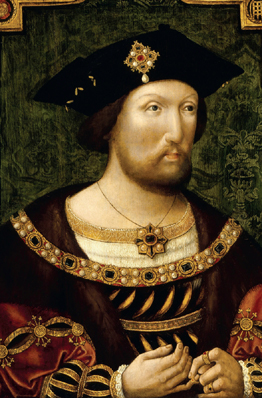
Henry VIII by unknown artist
c. 1520:THE YOUNG HENRY IN THE
EARLY YEARS OF HIS REIGN. (photo credit 1.1)
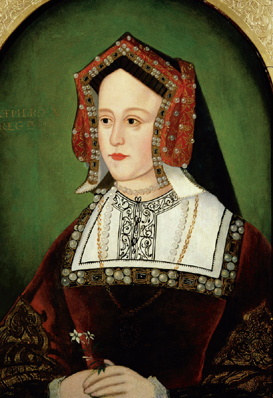
Portrait of Katherine of Aragon: MARY’S MOTHER PICTURED C. 1525 WHEN HENRY’S AFFECTION WAS BEGINNING TO WANE AND SHE WAS CONSIDERED TO BE PAST THE AGE OF CHILDBEARING. (photo credit 1.2)
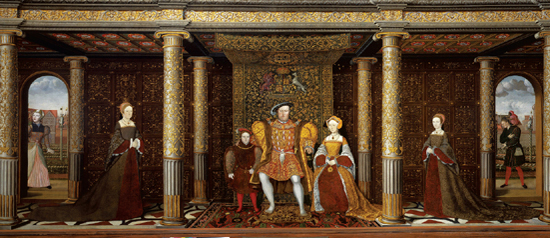
The Family of Henry VIII by Horenbolt: THE PAINTING COMMEMORATES THE RESTORATION OF MARY AND ELIZABETH TO THE LINE OF SUCCESSION. MARY IS ON THE RIGHT, ELIZABETH ON THE LEFT, WHILE EDWARD AND JANE SEYMOUR STAND NEXT TO HENRY. KATHERINE PARR, HENRY’S WIFE AT THE TIME WHO WAS CHILDLESS, IS NOT PICTURED. (photo credit 1.3)
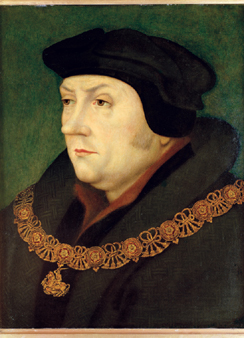
Lord Cromwell, Wearing the Order of St. George, by Hans Holbein: THE KING’S CHIEF MINISTER, WHO BROKERED MARY’S RECONCILIATION WITH HER FATHER IN 1536. (photo credit 1.4)
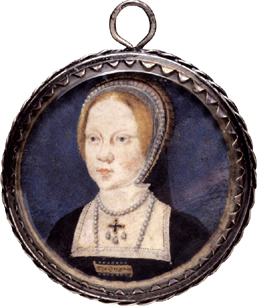
Princess Mary: THIS PORTRAIT MINIATURE WAS PAINTED AT THE TIME WHEN MARY WAS BETROTHED TO THE EMPEROR CHARLES V. THE LETTERS OF HER BROOCH SPELL OUT “THE EMPEROUR.” THE PORTRAIT WAS ALMOST CERTAINLY INTENDED AS A GIFT FOR CHARLES. (photo credit 1.5)
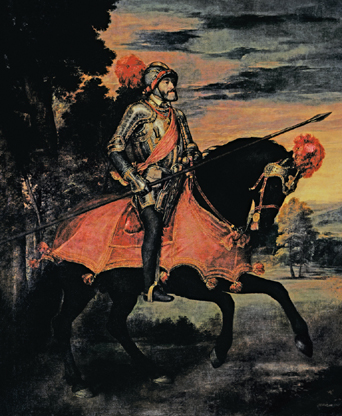
The Emperor Charles V on Horseback in Muhlberg by Titian: MARY’S COUSIN, UPON WHOM SHE RELIED THROUGHOUT HER LIFE AS HER “SECOND FATHER.” (photo credit 1.6)
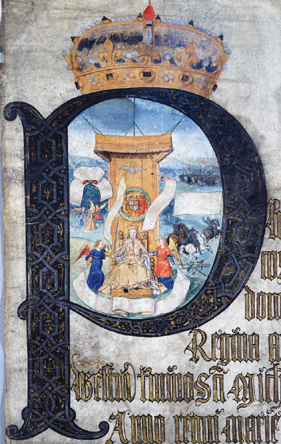
Michaelmas Plea Roll (1553):
MARY AS A TRIUMPHANT QUEEN HAVING WON THE THRONE IN JULY 1553. SHE IS PICTURED IN THE FULL PANOPLY OF A QUEEN REGNANT. (photo credit 1.7)
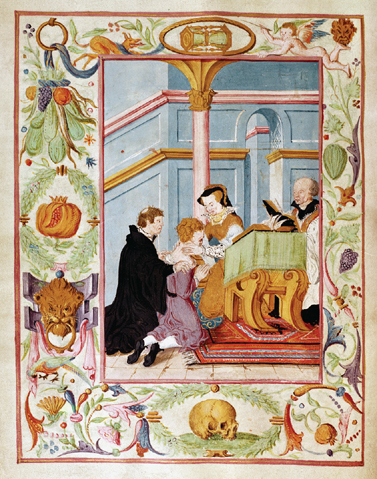
Mary Tudor curing the King’s Evil:
MARY IS PICTURED HERE PERFORMING THE ROYAL TOUCH TO HEAL THOSE SUFFERING FROM THE “KING’S EVIL” (SCROFULA) AND DEMONSTRATING THAT SHE WAS INVESTED WITH THE TRADITIONAL QUASI-PRIESTLY POWER OF MALE MONARCHS. (photo credit 1.8)
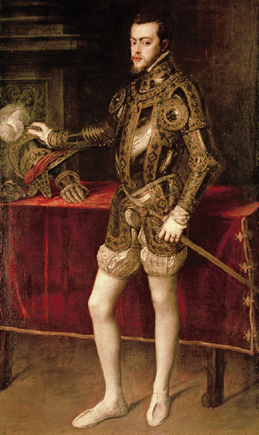
King Philip II by
Titian c. 1550. (photo credit 1.9)
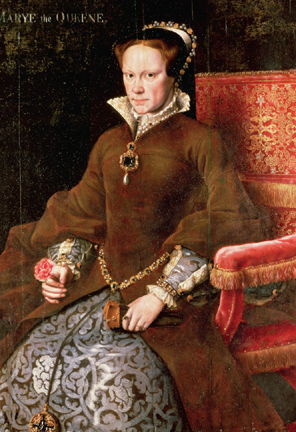
Queen Mary I of England by Antonio Moro: MARY PAINTED AS A HABSBURG CONSORT. THE FLOWER IS ASSOCIATED WITH BETROTHAL AND MARRIAGE. SHE IS WEARING A JEWELED PENDANT THAT SHE HAD RECEIVED FROM PHILIP ON THE EVE OF THEIR MARRIAGE. (photo credit 1.10)
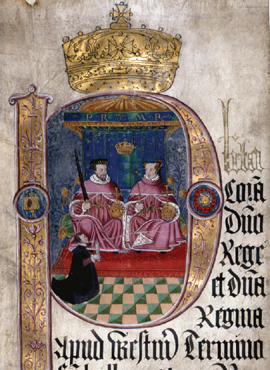
Michaelmas Plea Roll (1556): THE KING AND QUEEN PICTURED TWO YEARS AFTER THEIR WEDDING. PHILIP ASSUMES THE DOMINANT POSITION ON MARY’S RIGHT WHILST A CROWN FLOATS BETWEEN THE TWO, SUGGESTING SHARED ROYAL POWER. (photo credit 1.11)
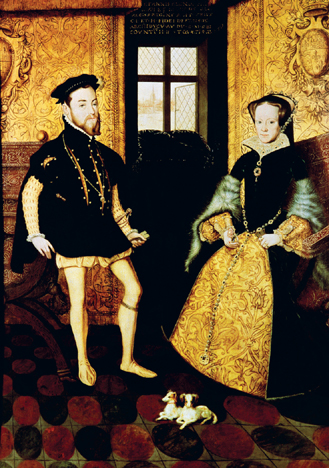
Philip II and Mary I by
Hans Eworth c. 1558. (photo credit 1.12)
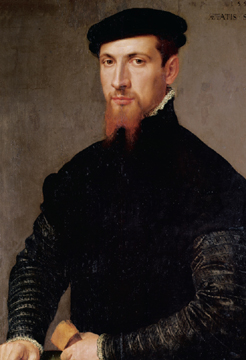
Simon Renard by Giacomo Antonio Moro c. 1553: THE IMPERIAL AMBASSADOR UPON WHOM MARY DEPENDED AS HER CHIEF CONFIDANT DURING THE FIRST YEAR OF HER REIGN. (photo credit 1.13)
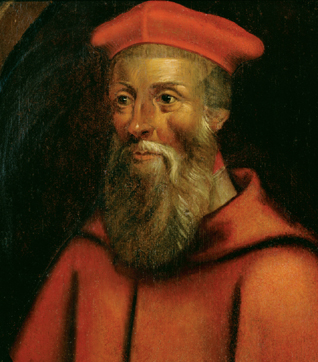
Cardinal Reginald Pole, Archbishop of Canterbury: MARY’S COUSIN AND THE SON OF HER FORMER GOVERNESS, REGINALD POLE ABSOLVED ENGLAND FROM ITS SCHISM WITH ROME. MARY RELIED HEAVILY ON HIM IN PHILIP’S ABSENCE DURING THE LATTER PART OF HER REIGN. (photo credit 1.14)
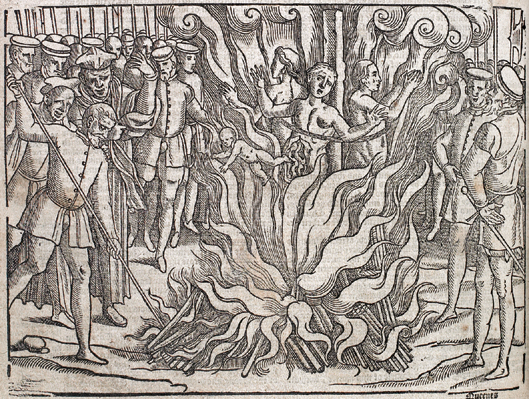
“A Lamentable Spectacle of three women, with a sely infant brasting out of the Mothers Wombe, being first taken out of the fire, and cast in agayne, and so burned together in the Isle of Garnesey,” from Foxe’s Book of Martyrs (1563). (photo credit 1.15)
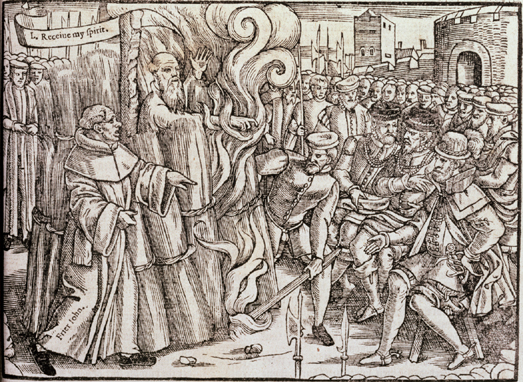
The Burning of Thomas Cranmer, Archbishop of Canterbury, from Foxe’s Book of Martyrs (1563): IT HAD BEEN MORE THAN TWENTY YEARS SINCE CRANMER HAD PRONOUNCED THE MARRIAGE OF MARY’S PARENTS TO BE INVALID AND HAD MARRIED HENRY TO ANNE BOLEYN. MARY NEVER FORGAVE HIM. (photo credit 1.16)
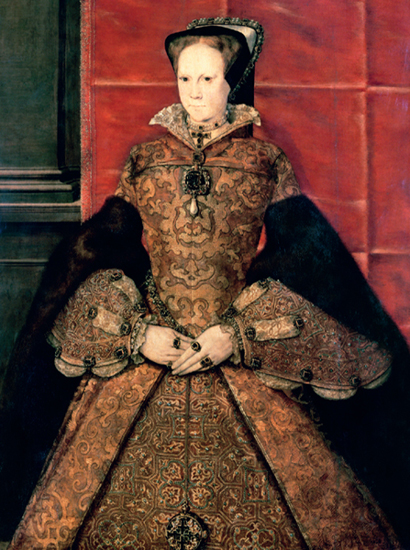
Queen Mary I by Hans Eworth: A PORTRAIT OF A MAGNIFICENT QUEEN. SHE LOVED TO DRESS EXTRAVAGANTLY AND KNEW THE IMPORTANCE OF DISPLAYING A STRIKING IMAGE OF ROYAL MAJESTY. MARY IS AGAIN PICTURED WITH THE PENDANT JEWEL THAT SHE HAD RECEIVED FROM PHILIP. (photo credit 1.17)

The signature of Mary I. (photo credit 1.18)

The head of Mary’s funeral effigy, displayed at Westminster Abbey. (photo credit 1.19)
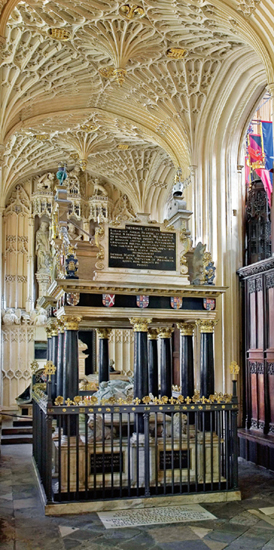
The tomb of Mary and Elizabeth at Westminster Abbey: ELIZABETH’S BODY WAS MOVED HERE BY JAMES I, THREE YEARS AFTER HER DEATH, BUT MARY’S PRESENCE IS BARELY ACKNOWLEDGED. (photo credit 1.20)