
XIII
In the fall of 1933 Scott Fitzgerald, though still not quite finished with his novel, was already laying out its advertising campaign. Just before sending off the first installment for the magazine serialization he and Perkins had agreed upon, he wrote Max, “I should say to be careful in saying it’s my first book in seven years not to imply that it contains seven years work. People would expect too much in bulk & scope.... This novel, my 4th, completes my story of the boom years. It might be wise to accentuate the fact that it doesnot deal with the depression. Don’t accentuate that it deals with Americans abroad—there’s been too much trash under that banner.... No exclamatory ‘At last, the long awaited, ect.’ That merely creates the ‘Oh yeah’ mood in people.”
Fitzgerald took the title Tender Is the Night from Keats’s Ode to a Nightingale. The story, Perkins told James Gray of the St. Paul Dispatch, concerned “the brilliant surface of life on the Riviera and among wealthy and futile people, through the eyes of a simple, raw, and young person.” That person was Rosemary Hoyt, a young actress enamored of the attractive psychiatrist hero, Richard Diver. Fitzgerald flashed back to the beginning of Dr. Diver’s relationship with his wife and former patient, Nicole, moving forward to the conflict of their lives in the Midi. “The book is truly very fine as a whole,” Perkins wrote Hemingway. “It has a very tight plot.... It is the sort of story you can imagine Henry James writing, but of course it is written like Fitzgerald, and not James.” Max said it came from deeper inside Scott than had his earlier works and that “Scott could never have written it unless he had come into contact with sanitariums, psychiatrists, etc. etc. on account of Zelda’s illness.” It was so complex a work, Perkins believed, that it really ought not to be chopped up and serialized. But “authors must eat and magazines must live.” Perkins felt that it was his suggestion to serialize that had compelled Fitzgerald to finish the book: “He had to do it once that was agreed upon.”
Scott had raced to produce the magazine excerpts in time. Now Max was anxious for him to ready the whole manuscript for publication in book form. He suggested that Fitzgerald send him pages in batches, as he finished polishing them, so that they could be set in type while he worked on the rest. The suggestion proved wise, because Scott was proceeding slowly. He was still his own most punctilious editor. He checked every sentence not just for literary perfection but for medical accuracy. When it looked as if weeks would pass before he would be satisfied, he wrote his editor, “After all, Max, I am a plodder.” He rewrote the entire novel by the spring of 1934.
Once he got the complete manuscript, Perkins gave it a consecutive reading. He felt there was a lag in the beginning of the book, largely because of a sequence at the train station that was peripheral to the main story; he asked Fitzgerald to consider cutting it because “as soon as people get to Dick Diver their interest in the book, and their perception of its importance increases some thirty to forty percent.”
Fitzgerald valued Perkins’s advice as much as ever, but he could not see deleting the trainside incident. He maintained:
I like the slow approach, which I think has a psychological significance affecting not only the work in question, but also having a bearing on my career in general. Is that too damn egotistical an association?
When the book went into galleys, Fitzgerald kept picking at it until the proofs were almost illegible. Scribners had another set run off, and then another. “This is an awful mess,” Fitzgerald concluded, returning one set, but he could not stop. At the same time he sent Max instructions about getting review copies to the right people, suggested advertising copy, and even complained that the dust jacket, with its reds and yellows, evoked the Italian Riviera more than the Cote d‘Azur’s white and blue sparkle. “Oh God, it’s hell to bother you with all this,” Scott said, “but of course the book is my whole life now and I cannot help this perfectionist attitude.” Later he said:
I have lived so long within the circle of this book and with these characters that often it seems to me that the real world does not exist but that only these characters exist, and, however pretentious that remark sounds (and my God, that I should have to be pretentious about my work), it is an absolute fact—so much so that their glees and woes are just exactly as important to me as what happens in life.
Fitzgerald naturally needed money, but the well of advances against this book’s royalties had dried up. Perkins divined a new source: He had a check drawn for $2,000 as a loan from Scribners at 5 percent, to be repaid upon the sale of the motion-picture rights to the novel.
The circulation of Scribner’s had increased with each installment of Tender Is the Night. That was encouraging. But there was little direct response. The only personal acknowledgments Fitzgerald received were from a few writers and motion-picture people. “Alas,” he wrote to Perkins, “I may again have written a novel for novelists with little chance of its lining anybody’s pockets with gold.”
Max’s hopes were higher. “Unless for some reason the book is above the general public’s head—for some reason I cannot see, in view of its fascination, —” he wrote back, “it ought to be more than a sucess d‘estime.”
When Fitzgerald at last decided to dedicate his novel to Gerald and Sara Murphy, his models for Dick and Nicole Diver at times during the book, he wrote Perkins, “My only regret is that the dedication isn’t to you, as it should be, because Christ knows you’ve stuck with me on the thing through thick and thin, and it was pretty thin going for a while.” By mid-March the first printing of Tender Is the Night was being stitched and glued.
Zelda was now spending hours each day painting and reading Scott’s book. To her dismay she found it contained almost verbatim transcriptions of her own letters and her own case history posing as fiction. The effect on her was visible: The lines in her face deepened and her mouth began twitching. She had agreed to let an art dealer named Cary Ross exhibit her paintings at his Manhattan gallery, but she could not cope with the preparations. She relapsed and returned to Phipps Clinic. After she had gone a month without improvement, Scott placed her in a luxurious rest home called Craig House, two hours up the Hudson River from New York.
Scott and his daughter came to New York at the end of March for the opening of Zelda’s show. Scottie stayed at the Perkins’s. Zelda was released one afternoon for her exhibit and lunched with Max and Scott. Perkins did not find her well at all. Her eyes were sunken and swimming; her hair, once golden against her Riviera-bronzed skin, looked mousy. Her show was only moderately successful. Scott, curiously, was better than Max had seen him for years. Perkins wrote Hemingway:
I believe that Scott will be completely reinstated, if not more, by his Tender Is the Night. He has improved it immensely by his revision—it was chaotic almost when I read it—and he has made it into a really most extraordinary piece of work.... Domestically things are still bad with him but about himself he feels like a new man, I could see. He has all kinds of plans now for writing—wants to begin another novel immediately.
Louise threw a dinner party that week for Scott Fitzgerald. Allen Campbell and Dorothy Parker were there, recently married after living together during the preceding year, and so was Elizabeth Lemmon. It was an odd assortment. Scott got drunk and boisterous, and Dorothy Parker became acerbic and stung everyone at the table with her sharp words. Louise tried hard to find fun in it all. Max sat stiff as a board all evening. Elizabeth looked lovely in a pale-gray Empire-style dress with a huge velvet rose in front—apart from that, he found nothing to enjoy about the evening. “He felt uncomfortable with the Allen Campbells around,” Elizabeth said, “because he thought they were still living in sin.” At the end of the evening Cary Ross, who had tried to outdrink Scott and had passed out, was lying on the sofa groaning. “I’m sure if we had known him under different circumstances, we’d like him,” Louise commented charitably. “Oh, Louise,” Dorothy Parker interjected, “you talk as if God were always listening.” In the confusion of leaving New York, Fitzgerald forgot to pay the bill for his room at the Algonquin. Max took care of that.
In mid-April, 1934, Tender Is the Night was published. Fitzgerald was anxious for a selling trend to develop. “The Great Gatsby had against it its length and its purely masculine interest,” he wrote to Perkins, “while this book ... is a woman’s book. I think given a decent chance, it will make its own way in so far as fiction is selling under present conditions.” The reviews were prominent and some were favorable. Kind personal letters from James Branch Cabell, Carl Van Vechten, Shane Leslie, John O‘Hara, and various members of The New Yorker crowd fell like flower petals before Fitzgerald. Morley Callaghan, to whom Perkins had sent a copy, wrote his editor: “It’s a fascinating book, an absolutely unrelenting book.... Scott is about the only American, at least the only one I know, who has that French classic quality of being able to note a point of character and then make a general observation with some wit, and yet make it a part of the fabric of the prose.” Scott appreciated all the kind words, but waited most eagerly for the opinion of Ernest Hemingway, who had not yet rendered his verdict.
After seven months abroad, one third of which was spent in Africa, Hemingway was back in Key West. He told Perkins he hoped Tender Is the Night was getting good reviews, though after reading it himself, he had some opinions of his own. He thought it had the same brilliance and most of the same defects as all Fitzgerald’s writing. There were the splendid cascades of prose, but there seemed to be something wrong beneath the surface, behind “the worn Christmas ornaments that are Scott’s idea of literature.” Ernest believed the characters suffered from juvenile, even silly, romantic notions Scott had about them as well as about himself, and so it appeared that their creator knew nothing about them emotionally. Hemingway saw that Fitzgerald had fictionalized Gerald and Sara Murphy, for example, and got the “accent of their voices, their home, their looks marvellously.” But then he transmuted them into romantic figurines, not understanding what they were really about. He cast Sara into a psychopathic case, then into Zelda, back into Sara, and “finally into nothing.” Similarly, Dick Diver was made to do things that happened to Scott but never could have befallen Gerald Murphy.
Perkins agreed with Hemingway’s observation about Fitzgerald’s fight to hang onto his youthful dreams, but believed “a great deal of the good writing he has done has come from the very fact of a sort of adolescent romanticism.” Max had just seen Scott in Baltimore and discussed that very point. He explained to Hemingway:
There are certain fundamental things about which he has the strangest, most unreal ideas. It has always been so of him. But about one of these delusions I think I made an impression. Here he is, only about 35 or 6 years old, with immense ability in writing and in a state of hopelessness. But it is useless to try to talk directly to him about it.—The only way one could make an impression would be by some oblique method, and that takes a cleverer person than I am.
Tender Is the Night became the best seller in New York for a short time, but nationally sales barely exceeded 10,000 copies, nothing near as good as those of several other novels. Hervey Allen’s Anthony Adverse, for example, sold over 1 million copies between 1933 and 1934. Fitzgerald was even outdone by a lesser-known Perkins writer. Stark Young, after a string of unsuccessful books, produced a novel of the old South, under Max’s guidance, called So Red the Rose. It became one of the most talked-about books of the year.
Fitzgerald’s descent into debt resumed. He got Zelda “out of hock at the exorbitant clinic” in New York, and entered her into the Sheppard and Enoch Pratt Hospital outside Baltimore. She was virtually catatonic. To cover Fitzgerald’s immediate needs, Perkins squeezed $600 more from Scribners as an advance on Scott’s next anthology of stories. Preparing that book for publication proved more arduous than either Perkins or Fitzgerald had anticipated. Many of the stories in the new collection had been written during the final siege of his novel, and Scott had “stripped” and “bled” their strongest passages to build up anemic sections in Tender Is the Night. Because the novel had gone through so many revisions, Fitzgerald could not remember what was finally retained and what was not. Now he had to thumb through the novel to see which phrases had already been used. When Perkins said he saw no reason why an author could not repeat himself occasionally, as Hemingway had done, Scott accused his editor of “specious reasoning.”
Each of us has his virtues and one of mine happens to be a great sense of exactitude about my work. He might be able to afford a lapse in that line where I wouldn’t be and after all I’ve got to be the final judge of what is appropriate in these cases. Max, to repeat for the third time, this is in no way a question of laziness. It is a question absolutely of self-preservation.
Four months later, when he was still putting in days combing the novel for sentences he had cribbed from himself, Fitzgerald wrote Perkins, “Certain people I know read my books over and over again and I can’t think of anything that would more annoy or disillusion a reader than to find an author using a phrase over and over, as if his imagination were starving.”
To pay off his debts, Fitzgerald went back to moonlighting for the Saturday Evening Post, but after a few weeks of it he collapsed and took to his bed. In his Ledger he noted: “Hard times begin for me.” While he was recovering, Thomas Wolfe sent him a warm note about Tender Is the Night.“Thanks a hell of a lot for your letter which came at a rather sunken moment and was the more welcome,” Fitzgerald replied. “I am glad to hear from our common parent, Max, that you are about to publish.” As in the case of putting together Fitzgerald’s anthology, that was easier said than done.
Wolfe’s new agent, Elizabeth Nowell, said, “In publishing, a novel by an unknown writer is a very difficult thing to sell. The only thing more difficult is a novel by a writer who had some slight success and then, through failure to produce, has become a has-been.” Since Look Homeward, Angel,Max Perkins’s foremost interest had been Wolfe’s career. But Perkins was powerless to further it until that second book reached print. For months Tom had been spinning events of his life into fiction so frantically that Perkins feared he was approaching exhaustion. Max also worried that if Wolfe continued writing, his book could never be contained within two covers. It was already four times as long as the uncut manuscript of Look Homeward, Angel, over ten times the length of most novels. And Wolfe was adding 50,000 words a month. For the author’s welfare, Perkins was considering drastic action.
By the end of 1933 Tom’s mounting tension was manifesting itself in insomnia or guilt-filled nightmares. “He can’t go on like that!” Max said repeatedly to John Hall Wheelock. Max explained later in an article for The Carolina Magazine, “Time, his old enemy, the vastness and toughness of the material, the frequent and not always sympathetic inquiries of people about his progress toward another book, and financial pressure too—all were closing in on him.” Perkins was convinced Wolfe was headed for a breakdown, fearful that he might go insane. One day, while standing in the common area central to the editorial offices, Max shook his head and announced to his colleagues, “I think I’ll have to take the book away from him.”
Wolfe remembered Perkins’s action precisely. “In the middle of December of that year,” he recorded in a short documentary book called The Story of a Novel, “the editor ... who during all this tormented period had kept a quiet watch upon me, called me to his home and calmly informed me that my book was finished.” Wolfe also recalled his own reaction:
I could only look at him with stunned surprise, and finally I could only tell him out of the depth of my own hopelessness, that he was mistaken, that the book was not finished, that it could never be complete, that I could write no more. He answered with the same quiet finality that the book was finished whether I knew it or not, and then he told me to go to my room and spend the next week in collecting in its proper order the manuscript which had accumulated during the last two years.
Tom obeyed. For six days he hunkered down in the middle of his apartment floor, encircled by a mountain range of manuscript. On the night of the fourteenth of December, at about half-past eleven, Wolfe arrived customarily late for his appointment with Perkins. He entered Max’s southwest-corner office and unloaded a heavy bundle on his editor’s desk. It was wrapped in brown paper, twice tied with string, and stood two feet high. Perkins opened it and found it packed with typescript—more than 3,000 rough-draft pages, the first part of the novel. The sheets, all different kinds of paper, were not consecutively numbered, since the sections had not been consecutively written. “God knows a lot of it is still fragmentary and broken up,” Tom explained afterward in a letter to his mother, “but at any rate he can now look at it and give me an opinion on it.”
“You have often said that if I ever gave you something that you could get your hands on and weigh in its entirety from beginning to end, you could pitch in and help me to get out of the woods,” Wolfe wrote Perkins the following day. “Well, now here is your chance. I think a very desperate piece of work is ahead for both of us, but if you think it is worth doing and tell me to go ahead, I think there is literally nothing that I cannot accomplish.... I don’t envy you the job before you.”
In spite of all the rhythms and chants—which Perkins called “dithyrambs” —marbled throughout the manuscript, Tom noted, “I think you will find when I get through that there is plenty of narrative—or should I say when you get through—because I must shamefacedly confess that I need your help now more than I ever did.”
Wolfe meant that literally, and Perkins knew it. Years later in his article for The Carolina Magazine, Perkins revealed what really lay at the heart of his task:
I, who thought Tom a man of genius, and loved him too, and could not bear to see him fail, was almost as desperate as he, so much there was to do. But the truth is that if I did him a real service—and in this I did—it was in keeping him from losing his belief in himself by believing in him. What he most needed was comradeship and understanding in a long crisis, and those things I could give him then.
Years later Max wrote John Terry: “I swore to myself that I would get it done if it killed me,—as Van Wyck Brooks once said it would when I left dinner early to come to the office to meet Tom.”
Two days before Christmas, 1933, Wolfe delivered the rest of his pages. Max had seen most of them as fragments during the preceding years. For the first time he could peruse them in sequence. Wolfe left Perkins believing, as he acknowledged in The Story of a Novel, that once again Perkins’s intuition had been right—“He had told me the truth when he said that I had finished the book.
It was not finished in any way that was publishable or readable. It was not really a book so much as it was the skeleton of a book, but for the first time in four years, the skeleton was all there. I was like a man who is drowning and who suddenly at the last gasp of his dying efforts feels earth beneath his feet again. My spirit was borne upward by the greatest triumph it had ever known.
In reading the manuscript all together, 1 million words, Perkins discovered that it actually contained two separate cycles, both chronologically and thematically. The first, as Wolfe later came to see and articulate, “was a movement which described the period of wandering and hunger in a man’s youth.” This was the story which grew out of the idea that “every man is searching for his father.” Its hero was Eugene Gant again, finding himself. It was called Of Time and the River. The other “described the period of greater certitude, and was dominated by the unity of a single passion.” This was George “Monkey” Webber’s story, and it still fell under the title The October Fair. The second part was the more finished, but the author agreed with his editor that they ought to publish the other material first, thus continuing Eugene Gant’s odyssey.
Thinking the book could be published in the summer of 1934, Perkins and Wolfe began working at Scribners for two hours every afternoon, Monday through Saturday. Max inspected the material and found it wanting in two ways. Half of Of Time and the Riverwas completed but needed cutting; the other half remained to be written. Each day they argued. Perkins insisted that it was an author’s duty to be selective in his writing. Wolfe asserted that it was an author’s primary task to illuminate a whole way of life for the reader. Once the first few hundreds of shards of manuscript were assembled, Perkins realized that it would take months of labor before it would be ready for the printer. He and Wolfe decided to work nights in the office, six times a week, from 8:30 on.
Sometimes Perkins wrote short directives right on Tom’s detailed breakdown of the book: “Insert section in train” or “Conclude Leopold.” Other instructions were more comprehensive:
THINGS TO BE DONE IMMEDIATELY IN FIRST REVISION
1. Make rich man in opening scene older and more middle-aged.
2. Cut out references to previous books and to success.
3. Write out fully and with all the dialogue the jail and arrest scene.
4. Use material from Man on the Wheel and Abraham Jones for first year in the city and University scenes.
5. Tell the story of love affair from beginning to end describing meeting with woman, etc.
6. Intersperse jealousy and madness scenes with more scenes of dialogue with woman.
7. Use description of the trip home and the boom town scenes out of the Man on the Wheel. You can possibly use the trip home and boom town scene to follow on to the station scene. Play up desire to go home, feelings of homesickness and unrest and then develop idea that hometown has become unfamiliar and strange to him and he sees he can no longer live there.
8. Possible ending for book with return to the city, the man in the window scenes and the passages, “some things never change.”
9. On the Night Scene which precedes the station scene, write out fully with all dialogue the episodes of night including the death in the subway scene.
10. Cut out reference to daughter.
11. Complete all scenes wherever possible with dialogue.
12. Fill in memory of childhood scenes much more fully with additional stories and dialogue.
Wolfe and Perkins kept to themselves but rumors of their work swirled around New York. They became the butt of jokes at almost every literary gathering. “The man with a legitimate grievance is Maxwell Perkins, the Scribners editor,” critic John Chamberlain wrote in Books of the Times.“They tell stories about Mr. Perkins wrestling with Thomas Wolfe for three days, catch-as-catch-can, over the attempted excision of a phrase. Trucks are popularly supposed to deliver Wolfe’s manuscripts to the Scribners door.” Most of the stories were manufactured; few were completely untrue.
In the spring of 1934 Wolfe had decided to let his newest typist—who could interpret what Tom called “my most indecipherable Chinese” —type up everything of his that was still in manuscript so that Max could “see the whole works so far as possible.” It was a necessary step. Tom admitted to a writer—friend named Robert Raynolds, “I no longer seem to be able to tell what’s what myself.” Of Perkins, he wrote Raynolds further:
God knows what I would do without him. I told him the other day that when this book comes out, he could then assert it was the only book he had ever written. I think he has pulled me right out of the swamp just by main strength and serene determination.
Perkins and Wolfe struggled through the spring. “I am cutting it hard now, and reducing it very greatly,” Max wrote Frere-Reeves in London. “Although there will, of course, be an argument later with Tom.” Chapter by chapter—the endings of which Perkins often designated—they examined each paragraph and sentence. “Cutting had always been the most difficult and distasteful part of writing to me,” Wolfe admitted in The Story of a Novel. Perkins supplied the objectivity and perspective toward the material that Wolfe lacked.
Max started with the scene on top of the bundle of Tom’s pages, which picked up where Look Homeward, Angel left off. Eugene Gant, about to go beyond the hills to Harvard, stands on the platform of the railroad station in Altamont saying good-bye to his family. The passage ran over 30,000 words. Perkins told Wolfe it should be shrunk to 10,000. In the Harvard Library Bulletin, he recorded what he told Tom: “When you are waiting for a train to come in, there is suspense. Something is going to happen. You must, it seemed to me, maintain that sense of suspense and you can’t to the extent of 30,000 words.” Perkins marked the material that could go and showed Wolfe, who understood. The author himself wrote Robert Raynolds:
I suffer agony over some of the cutting, but I realize it’s got to be done. When something really good goes it’s an awful wrench, but as you probably know, something really can be good and yet have no place in the scheme of a book.
As with Look Homeward, Angel, Perkins said in his article for Harvard, “there never was any cutting that Tom did not agree to. He knew that cutting was necessary. His whole impulse was to utter what he felt, and he had no time to revise and compress.”
It was not just the number of scenes in Wolfe’s book that made it so difficult to condense. Another troublesome aspect of his writing was what he later described as his attempts “to reproduce in its entirety the full flood and fabric of a scene in life itself.” In one section of the book, for example, four people talked to each other for four hours without an intermission. “All were good talkers; often all talked, or tried to talk at the same time,” Wolfe wrote. When he got all their thoughts expressed, he had 80,000 words—200 printed pages for a minor scene in an already enormous book. Perkins made him realize that “good as it was, it was all wrong and had to go.” As usual, Tom argued, then agreed.
Hemingway invited Perkins to Key West in June, but Max would not leave New York. “I am engaged in a kind of life and death struggle with Mr. Thomas Wolfe still,” he explained, “and it is likely to last through the summer.” Max wrote his other author in Florida, Marjorie Kinnan Rawlings:
If he will go on for six weeks more at the present rate, the book will be virtually done. I could even now, if I dared, send a third of it to the printer. But Tom is always threatening to go back to the early part, and if he does that, I do not know what the result will be. We might have to go through the whole struggle over again. It has become an obsession with me now, one of those things that you get to tell yourself you have got to do even if it costs your life.
Tom and Max now were working on Sunday nights as well. Sometimes Wolfe pulled a chair up to a corner of Max’s desk and feverishly scribbled one of the requested connecting passages right there. Facing him from the other side of the desk, with the bulk of the manuscript before him, Max would read slowly. In his high jagged script he would make his notations. Every time he slashed a page from corner to corner, Perkins could see that Tom’s eye was following his hand. Wolfe winced with pain, as though Max had gouged his skin. Perkins would glance at one of his notes, clear his throat, and speak up. “I think this section should be omitted.”
After a long sulky pause Wolfe would say: “I think it’s good.”
“I think it’s good too, but you have expressed the thing already.”
“Not the same thing.”
It was on one such night that summer when Tom, after arguing over a big deletion, looked fixedly at the rattlesnake skin hanging with Max’s hat and coat and said, “Aha! The portrait of an editor!” After the laughter, Tom and Max quit for the night and went to the Chatham Walk, an open-air extension of the Chatham Hotel’s bar, and talked for another hour under the stars.
Convincing Tom of the necessity of cuts was only one aspect of Perkins’s task. He had allocated space for certain missing material, and now Wolfe was trying to compensate for his earlier losses by jamming verbiage into those lacunae. When they came to the point in the narrative where the hero’s father died, for example, Max said that it must be written about. Because Eugene was away at Harvard at the time, he said, Tom need only record the shock of the news and Eugene’s return for the funeral. Perkins figured it was a matter of 5,000 words. Tom agreed.
The next night Wolfe came in with several thousand words about the life of the doctor who attended old Gant. “This is good, Tom,” Perkins said, “but what has it to do with the book? You are telling the story of Eugene, of what he saw and experienced. We can’t waste time with all this that is so outside it.” Tom accepted that, but the next night he brought in a long passage about Eugene’s sister Helen, her thoughts while shopping in Altamont and then at night in bed when she heard the whistle of a train. “How in God’s name will you get this book done this way, Tom?” Max asked. “You have wasted two days already, and instead of reducing the length and doing what is essential, you are increasing it and adding what doesn’t belong here.”
Tom was penitent. He did not argue back. He promised to write only what was needed. The next night he brought in thousands of words more about Gant’s illness, all extraneous to what Perkins thought was wanted. Max laughed at the whole matter and said, “Really this does not seem to me to be essential to the book and we ought to get forward.” But Perkins also felt that those pages were too good to let go. Gant’s death scene remained in the book. It was one of the finest passages Wolfe ever wrote. During the course of the year, Wolfe estimated that he composed over a half million words of additional manuscript, of which only a small part was finally used.
“A couple of nights ago,” Max wrote Hemingway in June, 1934, “I told Tom that a whole lot of fine stuff he had in simply ought to come out because it resulted in blurring a very important effect. Literally we sat here for an hour thereafter without saying a word, while Tom glowered and pondered, and fidgeted in his chair. Then, he said, ‘Well, then will you take the responsibility?’ And I said, ‘I have got to take the responsibility—And what’s more,’ I said ‘—I will be blamed either way.’ ”
Sometimes Max was at fault for the lengthening. He recalled that wonderful scene that for five years he had regretted deleting from the beginning of Look Homeward, Angel—about young Gant and his brother watching the Confederate troops march by to Gettysburg. He saw how that could be shoehorned into this volume as a part of old Gant’s dying memories, and it was.
One night Max set aside his red pencil and took Wolfe to Lüchow’s restaurant. After a few hours there, Tom wanted to walk off the hearty German food. He insisted that Perkins accompany him to Brooklyn Heights to see the apartment where he had written so much of his manuscript. Absentmindedly, Wolfe led Max to a brownstone he had vacated just a few weeks before. When he found his door locked, he searched for his keys, then growled something about having lost them. He led Max up the fire escape and into the large furnished railroad flat on the top floor of the building. Tom pointed out the refrigerator on which he had written the book, then offered Max a chair and poured a whiskey from the bottle sitting on the living room table. Several drinks later, the couple who lived in the apartment walked in. Max understood the situation in an instant and sank deeper into the chair.
After the wife ran for the police, Wolfe poured the husband a drink of his own whiskey and was soon slathering on his charm in his honeyed drawl. “That man hadn’t read anything but Dodger box scores in twenty years,” Perkins recounted years later, “but Tom treated him as though he were the editor of the Atlantic Monthly. He asked his advice on how to write short stories and begged for help on his next book.” By the time the police arrived the man was regaling Perkins and Wolfe with stories from his own life. Max and Tom remained another hour. Several days later Tom brought in 35,000 words that he wanted incorporated into Of Time and the River. It was an account of their night in Brooklyn. It was not used.
Into July they worked, now searching for the book’s conclusion. Max thought they might not ever finish because what seemed to him the very hardest part still remained—those pages about Eugene Gant’s association with Esther Jack, the character modeled after Aline Bernstein.
Max and Aline Bernstein had been aware of each other for five years, but Perkins did not meet her until he was working on Of Time and the River. Then a man introduced them in Cherio’s one day. Max was so skittish that little was said. Not long thereafter, however, Mrs. Bernstein called Perkins for an appointment in his office. There she swore that she would do everything in her power to prevent the publication of that book if she was a character in it. Perkins had to represent Tom, and so he could not agree to any concession whatever, but he remained cordial and open-minded. When she was leaving he held out his hand. Aline swung hers behind her back, saying, “I regard you as an enemy.”
The entire section that Wolfe had written about Aline Bernstein had never rung true to Perkins. He thought it was “too fresh to be written of objectively,” and he dreaded the struggle he knew they would have over it. Then it occurred to him that they might just end this large volume with Eugene’s first meeting Esther Jack on his return trip from Europe to America—and nothing more. By putting their story off into another book, Max knew he would not be eliminating the problem, but he could at least postpone it. Of Time and the River had its dramatic conclusion at last.
Until this time, Perkins’s office life and homelife had been two separate zones. He and Louise socialized with a few of his authors, but she saw to it that business seldom mixed with pleasure. Thomas Wolfe was the only author in Max’s life to pass freely from one sector to the other. Once the Perkinses had moved to New York, Wolfe took frequent advantage of his editor’s hospitality. Even the Perkins girls, who were afraid of him, came to realize that Tom was by nature extremely gentle, though he could be ranting at the top of his lungs in an instant. They all found Wolfe terrifying to sit close to at the dinner table. In the end, the youngest proved her valor. One night, Nancy recalled, “I was sitting on Daddy’s left at dinner and Wolfe was on his right. Tom was at his most horrid, cursing and raving at Daddy as though nobody else was in the room.” His words hurt her so that she burst into tears and yelled at Wolfe not to talk to her father that way. Max smiled gently and calmed her with a low voice. “It’s all right, Duck,” he said. “Never mind. Honestly, it’s all right.” Perkins never apologized for Wolfe, but he did try to explain his behavior, as he did once to Wolfe himself. “Tom,” he said, “you have in you ten thousand devils and an archangel.”
The weather in New York turned torrid but Perkins and Wolfe kept at their work. On the seventh of July, Tom lunched with Max and Scott Fitzgerald, who had come to town from Baltimore. Fitzgerald tried to console Wolfe about the truncating of his manuscript by saying, “You never cut anything out of a book that you regret later.” The next day Tom wrote Robert Raynolds, “I wonder if this is true. Anyway, I shall do all I can in what time is left to me, and then I suppose I will have to leave the matter on the lap of the gods and Maxwell Perkins.” Three days after that, the arguments between them grew so intense that Perkins packed up part of the manuscript and, without further discussion, sent it to the press.
Tom panicked and protested. When he came to his senses he wrote to his friend Catherine Brett, “I suppose I have got attached to it, as one might get attached to some great monstrous child, and I was a little terrified when I had to give it up.
It means that the proof will start coming back within a few weeks now, and it also means that all I expect or want, or hope to get done must be done within a little more than two months. After that the die is cast. I think Mr. Perkins is right in feeling that I ought to submit to this necessity, and that with a book which is as long as this and which has taken as much time, it is possible to get a kind of obsession, so that one can perfectly well work on it forever in an effort to perfect it and to get in everything he wants to get in, but I believe it is more important to get this one done now and to go on to other work.
Perkins had never spent so little time with his family as during the last year. That summer, his women scattered in all directions. Louise took a cruise, Bert was married and living in Boston, Zippy and Peggy traveled to Struthers Burt’s ranch in Wyoming, and the youngest girls, Jane and Nancy, went to New Canaan. Zippy and Peggy came back from the West saying they would never marry, Max wrote Elizabeth Lemmon, “because cowboys couldn’t support them and all Eastern men are as nothing beside them.” Max understood their reaction entirely:
I never was so flattered as when a man pointed me out as Will James—and Bill gave a very wan smile when I told him of it. It’s one reason we have wars: a man who wends his life with his knees crooked under a desk is not more than half a man, and we all know it. And Dr. Johnson said, when they were running down the military, “If a general walked into this room now we’d all be ashamed.” And if a good workman, a mechanic, walked into a boardroom at a directors meeting, the directors would all feel ashamed. And if old Zimmerman, foreman at our press, a man like Adam Bede, in a striped apron, walked into our directors meeting we’d all feel ashamed. And that is true and must mean something, but what, I don’t know.
On September 8, 1934, Max’s first grandchild, Edward Perkins Frothingham, was born to Bertha and her husband. Perkins referred to the baby with feminine pronouns for months, insisting that it was from force of habit.
Somehow Max had found time in the last few months—usually in the hours when Wolfe was overdue for his appointments—to dispatch several bulletins of his progress with Tom to Elizabeth Lemmon. A few days before he was scheduled to visit Dr. Bordley in Baltimore, he wrote her again to report that he was coming and to say he hoped she’d meet him there. “I’ll pretend to myself you’re not anyhow,” he said, “to avoid as much disappointment as I can.” On the eve of Max’s departure, Elizabeth thought of making a small party of the trip by asking Tom Wolfe to accompany Perkins. She correctly guessed where Max and Tom would be that night, and paged Wolfe at the Chatham Walk. She invited them both to Welbourne. Tom gave his regrets. There was still a great deal that he wanted to do to his manuscript and time was running out. Instead, he said, he wished Elizabeth could lure Max from Baltimore to Virginia for a while. “I think he is very tired, and know that a vacation would do him a lot of good,” Tom wrote the next day, adding, “He has sweated and labored and lavished untold care and patience upon this huge ms. of mine. There is no adequate way in which I can ever express my gratefulness, but I can only hope the book may have something in it which will in some measure justify his patience and care.”
After his ear treatment at Johns Hopkins, Perkins visited Scott in Baltimore, and then the two of them went by train to Washington. Elizabeth met them with her car in Georgetown and drove them on to Middleburg. Max had known Elizabeth for more than a decade, but this was his first visit to Welbourne. It seemed at first exactly as he had envisioned it. But he was on edge after a few minutes. He did not want to examine the place too closely for fear that its reality might mar his idealized image. (“The haze of glamour vanishes under the sun of fact,” he had written her ten years before.) He felt like a trespasser in forbidden land, and so he suggested taking in some Civil War monuments. Elizabeth agreed to drive them to Appomattox. After touring the site, Max insisted on returning to New York. Elizabeth, a little surprised she had gotten him to stay so long as he did, drove him to the Washington station. Before putting him aboard an air-cooled train, she extended an open invitation for a longer visit to him and Fitzgerald, as well as to Thomas Wolfe. “I only wanted to thank you for your great kindness in taking us to Welbourne,” he wrote Elizabeth the following week. “It’s as if I had drunk the milk of Paradise once and seen an enchanted place.”
Thomas Wolfe wrote Miss Lemmon that Max had “talked about the place a hundred times since he was there. He says it is the finest place he ever saw. I think you almost made a Rebel out of him, and I didn’t think that was possible.” Fitzgerald thanked Perkins for taking him into that “novel and stimulating atmosphere” for he had been in a “hell of a rut.” Even so, Max did not think his authors should avail themselves so readily of Welbourne’s splendors. It was not jealousy that made him say that. He tried to explain to Elizabeth that it was professional concern, but he found it hard to get his point across because of “the ancient trouble of a woman not understanding how things are with men.”
“You want to have Tom Wolfe and Scott play, and I want to have them work,” he reproved Elizabeth, going on to say,
It’s enormously more for their own sake than for Scribners that I want them to do it. If the time I’ve given, and the neglect of other things on account of it were reckoned, it would be inconceivable that Scribners could be repaid by what Tom’s book might do. But for his sake he must finish it. It’s a desperate matter for him.... As for Scott: he’s easily beguiled from work to drink.... There is no one I so dislike to displease as you. ... But Elizabeth, you must forgive me about Scott and Tom. I truly know more about that than you do.
Besides, Max once told her, if she continued to invite them, she would find herself a character in their fiction. “Scott will disguise you,” he said, “but Tom will write you exactly as you are.”
Fitzgerald was disappointed that the sales of Tender Is the Night had stopped at 15,000 copies. He was selling stories regularly since its publication, but his heart was not in them. Whenever his working spirit took leave, he turned south to Virginia. He went to Middleburg, to mingle among the wealthy gentry and play to the hilt the part of the gentleman novelist. But Elizabeth knew that the water pitcher Fitzgerald emptied during the course of the afternoon was filled with straight gin. He brought along the galleys of his short-story collection, now titled Taps at Reveille, but would not even look at them. When Elizabeth pointed out that he had given one character two different names, he threw the galleys at her and said, “Here, you correct them.”
On Perkins’s next visit to Baltimore he met again with both Scott and Elizabeth. Fitzgerald was still going through a period of despair and he discussed his state of mind. “I am ashamed and felt very yellow about it afterwards,” he admitted to Perkins. “But to deny that such moods come increasingly would be futile.” What weighed heaviest on Max was his inability to help him. “I can’t seem to,” he wrote Elizabeth, “perhaps because I never had trouble comparable to what he has had. And so I can’t feel what he does. Then too he and I are really friends, but he doesn’t think I know much.”
Years later Elizabeth wrote Louise that “Scott sobered up and tried to put on a show when Max came to Baltimore, and to this day I don’t know if Max actually saw through him, but those efforts kept Scott going and Max accepted them as though they were genuine—perhaps they were, perhaps Max reached the truth in him as he did in everyone.” Still later she realized that Max had been wise to Scott all along. Perkins did know how annoying Scott Fitzgerald could be, but he preferred to ignore it. One night at a display of modern Pullmans in the middle of Washington’s Union Station, Scott drunkenly hurled himself onto a bed and cried with outstretched arms, “Louise, come to me!” Max looked the other way. Once while having “tea” at the Plaza, Scott, intoxicated again, poked Zippy Perkins in the arm and said, “I could take you upstairs anytime.” She remembered, “Daddy gave me a look that meant we should feel sorry for Fitzgerald, but then pretended that he didn’t hear what he said.” Elizabeth Lemmon recalled another occasion when Perkins was not present. “Scott introduced me to Archibald MacLeish, saying, ‘This used to be Max Perkins’s girl,’ implying that I was now his girl,” Elizabeth said. “But my God, after knowing Max Perkins, how could anyone be Scott’s mistress!”
Fitzgerald thought “Beth” Lemmon was “charming” and wondered “why the hell she never married.” Perkins was pleased that Scott liked Elizabeth. (“Don’t call her Beth,” he told Fitzgerald; “the name does not suit her at all, and I have always refused to use it.”) On the train home Max wrote a letter to her, which he destroyed because it seemed to make little sense. He explained later, “The trouble is that after seeing you I stay for about four days in a kind of bemused state resembling that of the knight-at-arms Keats wrote about.”
In November, 1934, Fitzgerald’s story “Her Last Case” appeared in the Post. Welbourne provided the background. Without the $3,000 the Post paid him for it, Scott could hardly have gotten through the year, because Charles Scribner’s Sons was run differently than it had been. The house now had a half-dozen different departments, and the heads of all of them had a say in the business policy of the firm. Perkins was more sympathetic to Fitzgerald’s financial situation than ever before; but, he wrote, “It is impossible to make such a one, for instance, as the head of the educational department (which by the way, does better than we do in the depression) understand it. He would think we were just crazy, having all but cleared up your indebtedness by the way we arranged for Tender Is the Night, to let it all pile up again. I wish to Heaven—and I know you do too—that we could work out some way. But you have had a run of mighty bad luck and have struggled against it very valiantly, and it still is true, as the feller says, that the only sure thing about luck is that it will change.”
In October, 1934, Tom Wolfe grew so weary of words that he left town for a few days to visit the World’s Fair in Chicago. It was his first extensive vacation after a year of work. While he was gone, Max had his whole manuscript set in type: 450,000 words in 250 galleys would appear as 900 pages of book. When Wolfe returned to New York, he learned that his editor had made an even more arbitrary decision during his absence. He was going to send the galleys back to the typesetters without waiting for the author to look at them. Perkins had seen Wolfe pore over the galleys of the first section of the book for weeks in the Scribners library without correcting them. Without an ultimatum he might hold onto them forever. Perkins told him he was going to send out twenty galleys a day, proofread by Wheelock, to be set into pages.
“You can’t do it,” Tom protested. “The book is not yet finished. I must have six months more on it.” Perkins answered that the book was indeed finished; further, that if Wolfe took an additional six months, he would then demand another six months and six months more beyond that. He would become so obsessed with this one work that he would never get it published. Wolfe recorded the rest of Perkins’s argument in The Story of a Novel:
I was not, he said, a Flaubert kind of writer. I was not a perfectionist. I had twenty, thirty, almost any number of books in me, and the important thing was to get them produced and not to spend the rest of my life perfecting one book.
In his piece for the Harvard Library Bulletin Perkins wrote, “It is said that Tolstoi never willingly parted with the manuscript of War and Peace. One could imagine him working on it all through his life.” So it was with Wolfe and Of Time and the River.
“I think I’m peculiarly cursed in almost always knowing what I ought to do,” Max wrote Elizabeth Lemmon. “If you don’t know it’s all right enough; but if you do know and don’t do it, that’s bad.” As a result, he confided, “I’ve taken awful risks about that book, but I had to do it. It had to be done, and because of the peculiar circumstances of the case I almost know that no one else could have done it as well and finished it. You may hear me damned for it some day but I reckoned that in from the start. I’m mentally prepared for it but whether emotionally I don’t know.”
Late that fall, Wolfe resisted Elizabeth Lemmon’s invitations no longer. After Max had spoken so much about each of them to the other, they met in Middleburg. Elizabeth adored Tom. She said, “He was a much more natural person than Fitzgerald. Scott’s inferiority complex made him always the show-off. Tom had a more basic kind of dignity. He was completely honest.” Because of Wolfe’s genuine warmth and interest in everyone around, she was inclined to overlook his occasional vituperation. She showed him around Middleburg one day, and one woman with whom they started talking about literature thoughtlessly dropped the comment that she never remembered the name of the author of any book. Elizabeth remembered that “Tom sulked the rest of the time we were there; but when we left he blew up. ‘W-W-Why did she h-h-have me over if she w-w-wanted to insult me?’ he bellowed.”
After leaving Welbourne, he wrote Elizabeth:
Your America is not my America and for that reason I have always loved it even more—there is an enormous age and sadness in Virginia—a grand kind of death ... I’ve got to find my America somehow here in Brooklyn and Manhattan, in all the fog and the swelter of the city, in subways and railway stations, on trains and in the Chicago Stock Yards. I’m so glad you let me see your wonderful place and see a little of the country and the kind of life you have down there.
That October, out of the clear blue, Aline Bernstein contacted Perkins. The passing of time and the acceptance of the truth had diluted her earlier antagonism to him but left her worn down. She knew that Of Time and the River was approaching publication and that the character of Esther Jack was now limited to the final scene. Now she told Perkins that years earlier, when Tom went abroad on his Guggenheim Fellowship, he had presented her with the manuscript of Look Homeward, Angel. Recently, she said, she had been hospitalized and unable to work. She was going to California to rest and was eager to give up her house in Armonk, New York. Before leaving she wanted that manuscript, like its author, out of her life. “I want to give you the manuscript, if you care to have it,” she wrote Perkins, “on the condition that you will never under any circumstances return it to Tom. If you do not want it, I will destroy it before I leave, as I do not care to have it fall into other hands than yours or mine.”
Perkins offered to keep the manuscript safely at Scribners, but said, “I could never regard it as anything but yours since I know the circumstances in which it was given to you.”
Aline appreciated Perkins’s generosity toward both herself and Tom. Later she wrote Max, “My wound is as fresh today as the day [Tom] found it necessary to turn away from me.” But she added, “I have always believed Tom to be the greatest artist writing today, and I think it is wonderful that you have been at his side all this time.” She accepted Max’s proposal but insisted the manuscript eventually go to the editor, “for you have done all the good things for Tom that I had hoped to do.”
There was, in fact, still more that Perkins wished he had been able to do to Wolfe’s new manuscript, but he realized that an editor too must eventually give up a book. He wrote Elizabeth Nowell: “The book will contain many too many adjectives, and much repetition of a sort, and too much loud pedalling. Those are faults that Tom won’t dispense with as yet.” Still, he maintained, it would make a great impression and be a success, and he thought the criticism on such points would drive Wolfe to sterner discipline.
All year, Ernest Hemingway had been aware that Perkins had shifted most of his attention toward Thomas Wolfe. In October, 1934, he told Max outright that he thought Wolfe’s short stories were getting “quite pretensious” and that the subtitle for his novel—A Legend of Man’s Hunger—was just plain bad. Hemingway believed the reason Perkins’s “world geniuses” stalled so long was that they feared their works would be found to be “phoney” instead of being “world masterpieces.” He said it was better to create books one at a time, let the critics jump on what they did not like, and have orgasms about what they did, because the author himself would know which were good.
Hemingway admitted he was getting a little “snooty” because he had just completed the project he started two seasons earlier, and he needed nobody to help him cut or finish it. Smugly he decided it was best not to speak ill any further of his “overassed and underbrained contemporaries”—but there was no feeling, he told Max, like knowing you can do the “old stuff” even though it makes you “fairly insufferable at the time to your publishers.”
Hemingway had finished his “long bitch” of a work about Africa on the morning of November 13. The 70,000-word manuscript, which started as a story and kept spreading, was tentatively entitled The Highlands of Africa. Ernest insisted it was not a novel in form, but more like “Big Two-Hearted River” than anything else. It had a definite beginning and an end and a “hell of a lot” of action in between. Before this, Hemingway said, he had never known a book that made him see and feel Africa as it actually was. He said he had written the book absolutely truly, with no fudging of any kind, and that he was the only “bastard” just then who could do it.
Hemingway felt he had lost a large part of his following after A Farewell to Arms, and he wanted to win his readers back now by giving them what was really literature without being arty, leaving Perkins’s “pompous guys” to blow themselves up like balloons until they burst. He supposed that 70,000 words was long for a story, but he wanted to publish it with something else in the book to give the people a “super-value.” He proposed running it with his recent Esquire articles. Perkins objected. Whether or not Hemingway regarded this as a novel, he pointed out, it was a whole unit and considerably longer than would be necessary to make a full book. Max thought combining the story with other pieces would only distract the critics from the main work. “I hope you will publish it by itself,” he stated.
Hemingway’s, Fitzgerald’s, and Wolfe’s books were practically done, and Perkins felt he could go down to Key West to read Ernest’s manuscript. “I’d like to do it mighty well,” he told him. “I would like to spend an afternoon on the dock looking at those lazy turtles swimming around.”
On the eve of Perkins’s departure for Key West, the second week in January, only two parts of Tom Wolfe’s book remained to be agreed upon. The first was a foreword, which Wolfe had written. Max urged him to drop it. He explained: “A reader is meant to enter into a novel as if it were reality and so to feel it, and a preface tends to break down that illusion, and to make him look at it in a literary way.” The other part of the book to be discussed was the dedication page, which Wolfe had been drafting in the back of his mind since he had first begun the manuscript. In recent weeks John Hall Wheelock had been helping him polish it. Max knew little about it but had suspicions. Now, about to leave for Florida, he decided to speak his mind. “Nothing could give me greater pleasure or greater pride as an editor,” he wrote Tom, “than that the book of the writer whom I have most greatly admired should be dedicated to me if it were sincerely done.
But you cannot, and should not try to change your conviction that I have deformed your book, or at least prevented it from coming to perfection. It is therefore impossible for you sincerely to dedicate it to me and it ought not to be done. I know we are truly friends and have gone through much in company and this matter, for my part, can have nothing to do with that, or ever shall. But this is another matter. I would have said this sooner, but for some fear that you would misinterpret me. But the plain truth is that working on your writing, however it has turned out, for good or bad, has been the greatest pleasure, for all its pain, and the most interesting episode of my editorial life. The way in which we are presenting this book must prove our (and my) belief in it. But what I have done has destroyed your belief in it and you must not act inconsistently with that fact.
Louise accompanied Max to Key West this time, and during their eight fine days in the Gulf Stream, Max caught a whopping sailfish. On a postcard to Scott Fitzgerald from Key West, he wrote: HEMS BOOK IS ABOUT HIS OWN HUNTING IN AFRICA, BUT DIFFERENT FROM ANY OTHER HUNTING BOOK MAGICAL IN THE LAST THIRD. LOUISE TURNS OUT A GREAT FISHERMAN. MY FACE IS BURNED BLACK. BE BACK MONDAY.
When Perkins returned from his vacation he found that he had succeeded in getting Wolfe to leave out his long foreword, but he had failed to keep Wolfe from dedicating the novel to him. Of Time and the River was entirely in print—including Wolfe’s lavish inscription. “I fought with Tom to keep it at a minimum,” Wheelock said later, “to a level of propriety that would not embarrass Max altogether.” The dedication read:
TO MAXWELL EVARTS PERKINS
A great editor and a brave and honest man, who stuck to the writer of this book through times of bitter hopelessness and doubt and would not let him give in to his own despair, a work to be known as “Of Time and the River” is dedicated with the hope that all of it may be in some way worthy of the loyal devotion and the patient care which a dauntless and unshaken friend has given to each part of it, and without which none of it could have been written.
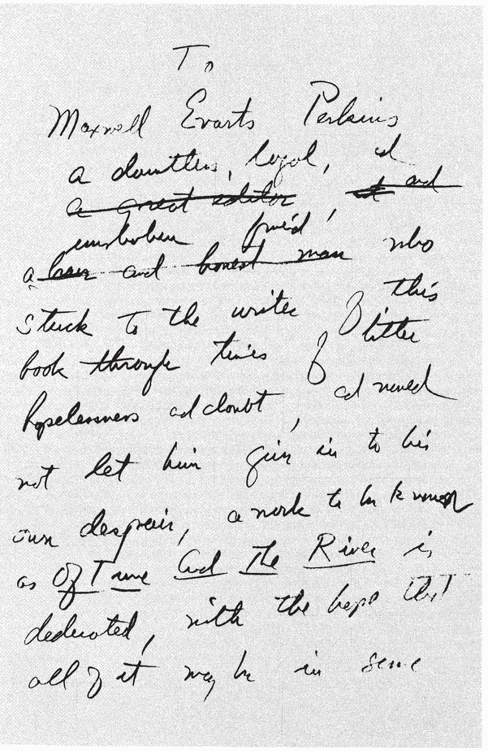
Once Perkins saw it he wrote Wolfe, “Whatever the degree of justice in what it implied, I can think of nothing that could have made me more happy. I won’t go further into what I feel about it: I’m a Yankee and cannot speak what I feel most strongly, well, but I do wish to say that I think it a most generous and noble utterance. Certainly for one who could say that of me I ought to have done all that it says I did do.”
Of Time and the River sprang from the symbiotic union of two artistic forces—Wolfe’s passion and Perkins’s judgment. The two men had been at frequent odds, but together they both had accomplished the greatest work of their careers.
Max wrote Tom on February 8, 1935, “I swear, I believe that in truth the whole episode was a most happy one for me. I like to think we may go through another such war together.”
A torn fragment in Wolfe’s journals, never sent to Perkins, states: “In all my life, until I met you, I never had a friend.”