
XVIII
Shortly after Christmas, 1937, Thomas Wolfe, now a Harpers author, was forced to ask Max Perkins for help. The trial involving Wolfe and Murdoch Dooher, the twenty-one-year-old manuscript agent, was impending, and Tom wrote Max to ask him to testify, “not only for personal or friendly reasons, but just because it’s taking a stand in favor of the human race.” Perkins was glad to oblige, especially pleased that Wolfe showed neither remorse nor anxiety in asking him to appear. By now many of the specifics of the case had become fuzzy in Perkins’s mind, and on the evening of February 1 he and Tom met in the lobby of the Chelsea Hotel—where Wolfe had recently moved, at Max’s suggestion—to clarify them. It was their first encounter in seven months, and it was painless.
The case involved the manuscript of Of Time and the River. Earlier, Dooher had successfully sold a few small items of Wolfe‘s—books and papers—and so Wolfe had authorized him to sell the manuscript of this novel. Dooher picked up the heap of material at Scribners and set about to collate it. As he worked he discovered that what Wolfe had given him was not the manuscript that had been published but pages cut from that book. At Wolfe’s insistence he went to Scribners to work with the writer on sorting this unpublished material.
As it happened, Wolfe’s English publisher, A. S. Frere-Reeves, had just arrived from London that day, and Perkins, who knew him only slightly, was to meet him at the Chatham at five that afternoon. Max thought it would be nice to have Wolfe join them briefly, and so he went into the room where Wolfe and Dooher were working and took Wolfe away “for just one drink.” But Wolfe had many drinks, and Dooher was kept waiting for hours. When Wolfe returned, Dooher was angry; then Wolfe got angry and discharged him. Dooher stormed out and sent Wolfe a bill of $1,000 for services rendered—specifically, lining up a buyer and working with the material—and for loss of commissions to which he felt entitled. Dooher still had in his possession many pages of Wolfe’s manuscript which he refused to return without payment. Whereupon, Wolfe began legal proceedings to recover his property. Max, in his way of bearing the brunt of responsibilities, later said: “I was to blame for Dooher’s having the wrong material, and also for getting both of them into an unreasonable frame of mind.”
In the meeting with Wolfe to prepare for the trial, Max remembered that Tom, just before he went to Europe in 1935, had given Perkins his written power of attorney. Max’s recollection was greeted joyfully by Wolfe; he regarded it as a key to his defense, for to him it clearly indicated that Wolfe had never intended Dooher to act on his own and consummate any deal without approval—of Max, if not of Wolfe himself.
On February 8, 1938, Perkins went to Jersey City for the trial. He found Wolfe “all fidgety and frowning under the slings and arrows and all” but thought Tom gave an overwhelming impression of sincerity and dignity in the courtroom. A procession of witnesses appeared in Wolfe’s defense, and soon it seemed so obvious to Max that Wolfe’s case was won that he believed he would not have to testify. But he was called to the stand just the same. By the time Max had his hand on the Bible, Wolfe could hardly contain his emotion; Elizabeth Nowell observed that Wolfe was moved almost to tears, because—for the first time in public—Max was wearing a hearing aid. He had stubbornly refused to use one on any previous occasion, even though everyone he spoke with had noticed how bad his hearing had grown. But Perkins felt a kind of duty to Wolfe, an obligation to understand all the proceedings clearly, that outweighed the embarrassment and the discomfort of the clumsy contraption. He proved to be the most scrupulously honest and least cooperative witness. The lawyer asked Perkins twice if the power of attorney had been given expressly for the purpose of controlling Dooher. “I felt like a silly little prig in saying that I could not actually say so,” Max recounted to John Terry. “I’m sure the lawyer despised me, as I sort of despised myself.” All Perkins could truthfully testify was that no such power had ever been given him before and thus it was evidently for that purpose.
By lunchtime Wolfe was acquitted, and Perkins, relieved that his ordeal was over, considered his morning in court “good fun.” Perkins believed Wolfe’s vindication had “more or less restored Tom’s faith in at least one American institution.” Together, they ferried back to Manhattan and lunched at Cherio’s. Afterward, Max realized that there no longer remained any professional reason for his ever seeing Thomas Wolfe again.
Max wrote several of his authors about the split between himself and Tom. He insisted it was in Wolfe’s best interests to leave, and so it was inevitable. Hemingway, for one, thought Perkins wrote “very chic-ly” about it all, while Wolfe had acted like an enormous baby. Ernest wondered why the man could not just write, then sneered that it must be very difficult to be a genius.
In January, Hemingway returned from the Spanish Civil War. The Loyalist offensive had hardly made a dent anywhere. In fact, for months there was so little action that Ernest had not even bothered to write dispatches for the North American Newspaper Alliance. He had taken advantage of the lulls to go back to his own work. By winter’s end he had finished his first play, set in the very hotel in which he was staying, the Hotel Florida in Madrid. Once word had got out, many people in the theatrical world called Perkins. Max wrote Ernest, “I cannot imagine your writing a play that would not be a sensation and a success,” though he knew nothing about it except its locale.
Back in Key West, Hemingway admitted to Perkins that he was in an “unchristly jam of every kind.” He was concerned about the war in Spain but was too far from it; he was eager to cast his fresh material from Spain into fiction but was too close to it. He was also engaged in a domestic battle with Pauline, who was trying to hold on to him as his relationship with Martha Gellhorn deepened. Perkins offered aid with the problems over which he had some control. If it would help get a production together, Perkins said Scribners would publish his play right away, even though the usual procedure was to publish when the play opened. (Robert Sherwood’s The Road to Rome, Reunion in Vienna, and The Petrified Forest were the most successful examples on Perkins’s list.) “But this play of yours,” Max assured Hemingway, “will sell without a production,” if only because of the public’s desire to find out the way things were in Spain.
Hemingway’s yearning to get back to Spain took over. He told Max he felt like a “bloody shit” lounging in Key West when war threatened Aragon and Madrid. Against Pauline’s and Max’s wishes, he returned in the middle of March, 1938. He assured his editor that he had not forgotten the collection of stories that was to come out in the fall. He promised to mail it to Max from Paris, en route to Spain, and even to add several more stories just before the book went to press.
The publication of Hemingway’s play was set for the fall. Ernest had left a copy with Perkins, though he still had revisions to make—among them, he said, a probable change in the title, The Fifth Column. GREATLY MOVED BY PLAY. IT IS MAGNIFICENT ALL GOOD LUCK, Perkins cabled Hemingway. “And by the way,” he wrote the next day, “I think that you will have a hard time beating the present title.” Unaware of the Hemingways’ domestic estrangement, Max wrote to Pauline. “That play,” he said, “made me see plenty why Ernest had to go back to Spain.” Speaking of the play as a work of literature, he said: “It shows what To Have and Have Not did, only more so, that Ernest has moved forward into new territory and larger territory, I guess.”
Aboard ship, Hemingway wrote Perkins a long letter apologizing for having been “trying” during the last few weeks. In a funereal tone Ernest thanked Max for being so loyal to him through all the times of bad temper and “general shittiness.” Max assured him that no thanks were necessary. “I think you have treated us swell. We all do. I owe you plenty,” he wrote back. But Perkins could not shake a feeling of depression. The letter upset him all through the weekend because it sounded as if Hemingway did not think he would ever get back from Spain. “But I haven’t much faith in premonitions,” Max wrote Fitzgerald, trying to dredge up some optimism. “Very few of mine ever developed. Hem seemed very well, and I thought he was in good spirits, but I guess he wasn’t. I thought I would tell you that he especially mentioned you.” Fitzgerald was touched that he too had been remembered in Hemingway’s “premonitory last words.” He was fascinated as always by the man’s “Byronic intensity.”
Scott Fitzgerald had come through New York early in 1938. Max had lunched with him and an attractive thirty-year-old blonde whom Scott introduced as his “girl friend” from Hollywood. Perkins was pleased to learn she was not an actress. The “girl friend” was Sheilah Graham, an Englishwoman who wrote a column about Hollywood for the North American Newspaper Alliance. Perkins knew little more about her, except that she seemed to have a good effect on Scott. Sporting a California tan, he had not been drinking, looked wonderfully healthy, and acted lively. Fitzgerald had also paid off most of his debts—including all he owed Max—and had an even better film contract for another year, which promised to get him out of debt altogether.
Upon his return to Hollywood, Scott immediately sent Max a check, the first portion of the sum he still owed Scribners. “I’d said he would do it but nobody would believe it,” Max wrote Elizabeth Lemmon, “—and sometimes I didn’t either.” In a letter accompanying the check, written from his hotel room at the Garden of Allah on Sunset Boulevard, Fitzgerald confessed to having gone on a binge in New York after he had left Max. He swore that this bender had lasted only three days and that he had not had a drop since. As long as he was confessing, however, he thought he should admit to one other, back in September, likewise for three days. Save for those two lapses, alcohol had not passed his lips for a year. “Isn’t it awful that we reformed alcoholics have to preface everything by explaining exactly how we stand on that question,” he wrote Perkins. Scott said he was working on the script for a motion picture for Joan Crawford called Infidelity. Perkins’s steady flow of letters from New York were Fitzgerald’s only evidence that he existed, albeit barely, in the literary world there.
Scott felt even more estranged that spring when Scribners’ vice-president in charge of sales and promotion, Whitney Darrow, informed him that This Side of Paradise was officially “out of print,” eighteen years after it had ignited the youth of the twenties. Fitzgerald was disappointed but not surprised. “Looking it [the novel] over,” he told Max, “I think it is now one of the funniest books since ‘Dorian Gray’ in its utter spuriousness—and then, here and there, I find a page that is very real and living.” He knew that, to the generation that had replaced his, the children of his contemporaries, the concerns of the book were remote and that escapades which were startling then would now be considered tame. “To hold them [the new generation] I would have to put in a couple of abortions to give it color,” Scott said, “(and probably would if I were writing it again).” Its faults aside, he wanted to know exactly what “out of print” meant. Did it mean, he asked, that he was now free to find another publisher to reprint it? And if he did, would that have the effect of suddenly making the book valuable again to “Whitney Darrow or Darrow Whitney, or whatever his name is?”
When a book was declared out of print, it meant that the publisher, because of lack of demand for the book, had decided not to print any more copies and to let the current inventory run out; the author was indeed free to seek a new publisher. But, said Perkins, he had his own plan for keeping the book alive at Scribners. “I ought not to even breathe it to you because it will probably never turn out,” he wrote the author, “but I have a secret hope that we could some day—after a big success with a new novel—make an omnibus book.” It would combine This Side of Paradise, The Great Gatsby,4 and Tender Is the Night, complete with a lengthy introduction by the author. “Those three books,” Perkins wrote, “besides having the intrinsic qualities of permanence, represent three distinct periods.—And nobody has written about any of those periods as well.” Perkins did not want to spoil an opportunity with the premature publication of the three-in-one volume. He explained:
There comes a time and it applies somewhat now to both Paradise and Gatsby, when the past gets a kind of romantic glamour. We have not yet reached that with Tender Is the Night and not to such a degree as we shall later even with Paradise, I think. But unless we think there never will be good times again—and barring a war there will be better times than ever, I believe—we ought to wait for them.
Perkins wished Fitzgerald would turn back to his novel about the Dark Ages, Philippe, but Scott had no time for that. He said the amazing business of movie-making had a “way of whizzing you along at a terrific speed and then letting you wait in a dispirited half-cocked mood when you don’t feel like undertaking anything else, while it makes up its mind.” Hollywood studios were filled with a “strange conglomeration of a few excellent overtired men making the pictures and as dismal a crowd of fakes and hacks at the bottom as you can imagine.” The consequence, Scott said, “is that every other man is a charlatan, nobody trusts anybody else, and an infinite amount of time is wasted from lack of confidence.” It was a peculiar stretch in Fitzgerald’s career, he thought, but as he looked around, he realized that he was not the only literary fish out of water. “What a time you’ve had with your sons, Max,” he wrote Perkins on April 23, 1938, “—Ernest gone to Spain, me gone to Hollywood, Tom Wolfe reverting to an artistic hill-billy.”
As for Max himself, it was an opportunity for him to catch his second wind and redistribute his energies. After a peaceful summer in New Canaan, the Perkinses moved back there permanently. Max hoped to keep Louise in the country for good, but again she found herself with an excess of energy, a surplus that city life had used to burn off. Her passion to perform on stage had eased, but a restlessness still flickered within her. She searched for a life of her own outside the house, and soon she found it.
Early in 1938 several nuns from the local Roman Catholic parish came to the Perkinses’ door to speak to their Catholic cook. Louise chatted with the sisters for a few minutes, then wrote their church a generous check. The nuns stayed to talk some more, and by the time they left, Louise had become impressed with Catholicism. She looked into it a bit further, and several weeks later she found herself in earnest conversation with the parish priest. “What means the most to you apart from people?” he asked her. Her reply came without hesitation: “Talent in the theater.” The priest told her to “take that and lay it on the altar of Jesus Christ.” At age fifty, Louise emerged from the wings into her new holy theater with all the vitality of an ingenue and the enthusiasm of a convert. As Elizabeth Lemmon noted, “Louise always had a passion for purple.” Whether or not her motivation was truly religious, it was strong. Friends and relatives indicated that Louise’s conversion had more than theatrical implications. Several people said it was her “rebellion against the family.” One daughter suggested it was another stage in “Mother’s lifelong struggle to be creative.”
Max was not convinced by Louise’s new devotion. Once, when she began one of her crusades, attempting to reform her entire household, he pointed out, “Your voice takes on a phony tone whenever you talk about the Church.” When she asked for the umpteenth time, “Max, why won’t you try it once?”—as though it were some new headache remedy—he responded, “And have you tried Buddha?” The harder she fought to save his soul, the harder Max resisted. It was a new version of their perennial battle—silent reserve versus unrestrained enthusiasm. Louise proselytized wherever she went, often to Max’s embarrassment. She sprinkled holy water all over the house, dousing Max’s pillow several times a week. With a sigh he would ask his daughters if they could not “do something” about their mother. One evening, when she was running low on reasons why Max should convert, she told him if he did not start confessing his sins and taking Communion he would burn in hell. “Thank God I’m not going to heaven—” he came back, “with all you Catholics.” By June she was cloistering herself on week-long retreats. Max continued to observe his wife’s interest in Catholicism with disdain, but, he told John Hall Wheelock, he did not especially want it to wear off entirely. He tired of her relentless attacks on the Protestants but saw how fulfilling the Church was for her.
Because of the intensity of their working relationships with Perkins, many of his women writers felt that they understood him better than Louise did. Too quickly concluding that his discordant marriage was the cause of his evident unhappiness, and unaware of his deep love and respect for Louise, some of them readily offered unsolicited comfort and advice, especially during Louise’s period of religious fervor. Marjorie Rawlings wrote Max that year that his wife “is very sweet and a little pathetic, and I understand her. You are so much wiser than she—you must not be intolerant. The Catholic matter will probably fade away.” Max may have thought that too, at first; he had once written Elizabeth Lemmon that “Louise feels things passionately but soon gets over them to a great extent, which is the best way; but that is so different from the way I do that it always frightens me.” But a few weeks after his wife’s introduction to the Church, Max wrote Elizabeth, “Louise is now a complete Roman Catholic; the house is full of Roman Catholic literature and now and then a nun blunders in, and I always think there may be a priest on the back stair.”
With Louise completely wrapped up in church affairs, Max’s correspondence with Elizabeth Lemmon picked up considerably for a while. “Whenever I get a pen into my hand I can’t resist writing you,” he told her in February. But a few months later he said: “I could write you about a thousand things, but I am so busy. I always supposed I worked pretty hard, but I have more to do all the time and other people like me seem to have less, and I don’t understand it. I work faster too and I always was good that way. I can’t make out what has happened.”
One thing that had happened was the advent of a talented but time-consuming new author, an English-born woman named Janet Reback. Since childhood she had been accumulating stacks of her own unpublished manuscripts. In 1937, as she approached the age of forty, she submitted a novel to the Macmillan company and had it refused, leaving her despondent. One of Macmillan’s associate editors insisted that Max Perkins at Scribners would give her work, Dynasty of Death, a fair reading.
From the first few pages Perkins was captivated. Charles Scribner and he had lunch while he was still reading it, and Scribner remembered Max expressing his certainty even then “that this was the first book of an author who would make her name as an outstanding novelist.” Perkins wrote Nancy Hale that Mrs. Reback’s novel was “a regular fine old-time novel, full of characters,” covering three generations—“one of those books which is good even when it is bad.”
Perkins wanted to meet the writer before accepting her manuscript because he had quite a number of changes to propose. Mrs. Reback eagerly came to New York City from her home near Rochester, but left her interview extremely embarrassed. When she tried to express herself in the presence of strangers, an old speech impediment asserted itself, and all her energies were absorbed in suppressing it. The result, she feared, was “that I appeared subnormal in intelligence, and close to imbecility.” The taciturn editor, whose hearing missed much, was favorably impressed anyway.
Perkins’s criticisms had largely to do with overstatement. He suggested cuts in scenes where she exposed more plot than was necessary—“because I thought they could be spared and were superfluous”—and where she was more descriptive than she had to be—“It is better they should see for themselves that he had a hard, literal, inflexible nature, than that you should tell them.” Wherever she posted comments like traffic signs, directing actions and emotions (“Then May did the most heroic thing in her life”), Max suggested cutting, “for the reader will know what she is doing, and will feel it poignantly without an intervention of the writer.” Max’s great-grandfather used to say: “One should always leave the dinner table a little hungry.” Similarly, Perkins often told writers: “It is always better to give a little less than the reader wants, than more.”
Mrs. Reback was also partial to melodrama. Many of her plot developments were too fortunate and neatly arranged. This was a fault common to many of Perkins’s authors, who often argued that such coincidences truly reflected reality. Mrs. Reback agreed to make the events in her novel appear somewhat less contrived and to play down the melodrama, though she insisted, “I do love a death with thunder and gestures!”
Janet Reback decided to publish her novel under a pseudonym. “Foreign names seem rather suspect in the United States at the present time,” she wrote Perkins, “and Reback is rather foreign.” She proposed combining the surnames of her grandparents—Taylor and Caldwell. Perkins thought highly of the idea, not so much for the reason she cited as “for the fact that a book so largely about business affairs stands a better chance under a name that might be a man’s.”
Taylor Caldwell “worked and stewed” over the changes her editor had suggested. “Whatever else happens,” she wrote Perkins, “this book has taught me more than a college course in fiction-writing.” Perkins warned her, “Editors are extremely fallible people, all of them. Don’t put too much trust in them.”
After extensive revision Dynasty of Death was published in the fall of 1938. It received a number of superior reviews by critics who had gobbled it up for the pure pleasure of it. Perkins was furious when other critics and even some pedantic editors at Scribners attacked Taylor Caldwell as a pulp writer. He had generated excitement over her book because, whatever one said about her writing, she was a wonderful storyteller. The book became a best seller, giving Charles Scribner fresh reason to believe that Perkins’s judgment was exceedingly sound. Taylor Caldwell was worth the extra hours that Perkins had devoted to her book, time that probably would not have been available if Thomas Wolfe still had been on the Scribners list.
Max and Tom Wolfe had reached a parting of the ways, but Wolfe was under his usual compulsion to masticate every experience, in this case his years with Perkins. To Belinda Jelliffe, whose autobiographical novel, For Dear Life, Perkins had published in 1936 at Tom’s suggestion, Wolfe wrote that the working relationship with his former editor was “so completely and sorrowfully over that it can never be brought to life again; and now, since I have finally won through to a strength and repose that I have never had before, it can surely serve no good purpose on the part of those who count themselves my friends—and I know you are one of these—to attempt to revive it.” Wolfe dismissed all the gossip swirling around New York that said Perkins was secretly wishing for Tom’s failure, which would underscore his own importance. Wolfe believed Perkins had all but performed wizardry over his manuscripts, but that those days of magic had ended. The author could now think of no more appropriate shrine to his working relationship with Maxwell Evarts Perkins than to immortalize him in fiction. So Wolfe began creating a new character, an editor. He called him Foxhall Morton Edwards, “the Fox,” for short.
The Fox would figure in the book Wolfe was writing for Harpers, for Tom was thinking of concluding that book by recapitulating his own career. The recapitulation would end with an open letter entitled “A Farewell to the Fox.” That last section, Wolfe wrote Elizabeth Nowell, “would be a kind of impassioned summing up of the whole book, of everything that has gone before, and a final statement of what is now.... If I succeed in doing ... ‘A Farewell to the Fox’ as I want to do it, it will stand most tremendously on its own legs.”
In May, 1938, Wolfe told his editor, Edward Aswell, that he had reached the “same state of articulation as with Of Time and the River in December, 1933”—the time when Max Perkins saw the manuscript in its entirety for the first time. ”What he saw, of course, was only a kind of enormous skeleton,“ Wolfe wrote Aswell, ”but at any rate, he was able to get some kind of articulate idea of the whole.“ Wolfe warned Aswell that this new work would make an even bigger book than Of Time and the River. He guessed it would take him a year of uninterrupted work to produce the final draft.
By the end of the month, he declared himself “dog-tired” from all the writing he had done and from legal ordeals, personal upheavals, and public outcries. He needed a change of scenery and knew that the “old beaten path” was no good anymore. Wolfe was going west again, to take in America’s tallest trees, largest mountains, and cleanest air. In his absence he wanted Aswell to familiarize himself with his manuscript. Tom promised him, “I will not be gone for long and will see you early in June, at any rate.”
The week before he was to leave, Wolfe approached with trepidation the job of assembling his manuscript. As he arranged the material, he became less certain that he should let Aswell read it. “I know where I stand,” Wolfe wrote his agent, “but it is like presenting someone with the bones of some great prehistoric animal he has never seen before—he might be bewildered.” Tom wavered for days but, before he left, the manuscript went to Harpers.
Perkins occasionally lunched with Elizabeth Nowell, but now the meals were not as cheery as they used to be. Perkins’s remarks were tinged by wistfulness. One afternoon in June, for example, while Wolfe was away, Max dolefully asked her about Tom and all that he was doing. Thirteen years later Miss Nowell remembered Perkins that very day as seeming “terribly old and tired and discouraged and tragic.” She wrote Wolfe a complete report of the luncheon and all that was discussed. After sealing the envelope she realized that she had described their conversation in a somewhat tattling, though certainly not malicious way. “I just felt very sad that Perkins should seem so old and tragic, about Tom and about the world,” she recalled. She sent the letter anyway.
By the third week of June, Tom had passed through the Midwest and was on his way to Seattle. After long battles with his conscience, he decided to extend his trip. He was enthralled with the West, but he was still tired and depressed. Miss Nowell’s letter about Perkins grieved him, and Wolfe was soon brooding again, this time over the literary gossip concerning his leaving Scribners. Tom’s imagination acted up and he began thinking about Perkins in a different light. He wrote his agent:
For six years he was my friend—I thought the best one I ever had—and then a little over two years ago he turned against me—everything I have done since was bad, he had no good word for it or for me, it’s about as if he were praying for my failure.... What is this thing in life anyway that causes people to do things like this?
When he began hearing stories about Scribners salesmen running him down all across the nation as some kind of turncoat, he believed they had “been instructed to pass around” that accusation and assumed they had taken their cue from Perkins who, “under this mask of friendship, is doing the same thing.
It’s almost as if unconsciously, by some kind of wishful desires, he wants me to come to grief, as a kind of sop to his pride and his unyielding conviction that he is right in everything—the tragic flaw in his character—that keeps him from admitting he has wronged anybody or made a mistake. That is really his great weakness, and I believe it is at the root of his failure —his growing reaction, his sense of defeat, his personal tragedy in his own life and in his family life that has been so marked in recent years.
By the time he reached Portland, Oregon, Wolfe was convinced Max Perkins stood against him and his work. “I want to sever the connection entirely. Someday, perhaps, if he is willing, I’ll take it up again,” he wrote to Miss Nowell, “—but meanwhile, let’s not play with fire.” He gave her explicit instructions: “Tell him nothing about me or what I’m doing: that’s the only way, believe me, to avoid trouble.” It was no longer a matter of personalities. “If I am wrong it will show in my work,” he wrote Miss Nowell; “if he’s wrong it’s going to show in his life.”
In the last two weeks of June, Wolfe traveled the entire Pacific Coast from Seattle to the Mexican border, then journeyed inland 1,000 miles, and then northwest to the Canadian border. Meanwhile Edward Aswell had journeyed through the material Wolfe had left with him. YOUR NEW BOOK IS MAGNIFICENT IN SCOPE AND DESIGN, WITH SOME OF THE BEST WRITING YOU HAVE EVER DONE, he wired Tom in Seattle on July 1, 1938. I AM STILL ABSORBING IT, CONFIDENT THAT WHEN YOU FINISH YOU WILL HAVE WRITTEN YOUR GREATEST NOVEL SO FAR. HOPE YOU COME BACK FULL OF HEALTH AND NEW VISIONS.
The author wanted to stay in Seattle a few more weeks to work on his notes of his trip and get them typed. He described his western journal to Aswell as “a kind of tremendous kaleidoscope that I hope may succeed in recording a whole hemisphere of life and of America.” Aswell replied: “Not since Whitman has anybody felt America in his blood and bones, and been able to voice the feelings the way you do.”
On July 12, 1938, Dr. E. C. Ruge in Seattle sent Aswell a telegram: THOMAS WOLFE IS QUITE ILL AND CONFINED IN SANATARIUM WIRE INSTRUCTIONS AS TO FINANCE. Aswell promptly replied that Wolfe’s bank account was sufficient to cover all reasonable expenses, and that the doctors should give him the best care possible. Ruge soon wired again: THOMAS WOLFE TAKEN SICK IN VANCOUVER PNEUMONIA DEVELOPED EXHAUSTED FROM STRENUOUS SIGHTSEEING HIGH BLOOD PRESSURE AND FEVER RAPID HEART AND BREATHING TERRIFIC COUGH AND TEMPERATURE 105 MONDAY NIGHT WEDNESDAY MORNING TEMPERATURE 100 SEEMS TO HAVE PASSED CRISIS MUCH BETTER KIDNEY COMPLICATION ALSO MUCH BETTER.
Miss Nowell decided she had to tell Perkins something about the illness, but in remaining vague about the condition, she worried him all the more. On July 25 Max wrote to Fred Wolfe asking him for at least a postcard about Tom. “I haven’t been able to find out anything that one could depend upon,” he explained, “but I know he must have been mighty sick, and maybe still is.” Perkins wanted to write Tom himself, but Miss Nowell intimated that even a letter from Perkins might upset Tom’s convalescence.
Fred Wolfe joined his brother in Seattle. From there he wrote to Perkins that Tom had a bad case of bronchial pneumonia. By August the doctors were indicating that Wolfe was coming around, though his strength was slow in returning. When he was well enough, Fred told him of Perkins’s concern. Tom asked Fred to send Max his love and best wishes. “I guess the plain truth is old Tom just wore himself down so that he had to get sick,” Max wrote Fred again, adding, “I shall wait until I hear that Tom is really recuperating and then I am going to write to him, whatever they say.”
Perkins heard nothing for days, but wrote anyway. He thought Wolfe might like to hear “some of the gossip” about New York. “As I am once more a commuter, as I was born and always should have been,” he wrote Tom, “I do not get around so much. But whenever I do go to any of the old places like Cherio’s or Chatham Walk or Manny Wolf’s, everybody asks for you.” In New Canaan, Max said, he found himself with a houseful again. Visiting grandchildren—Bertha now had a daughter and Zippy a “fierce looking” son—stayed in the empty bedrooms. Everything in business was looking up, Max said, and he thought it might stay that way for another year. Marjorie Rawlings’s The Yearling remained Scribners’ great success. Everyone at the office was just as Tom remembered except for John Hall Wheelock who, Max said, was threatening to “commit the folly” of getting married. All of Wolfe’s friends there were “mighty concerned” about his illness. “But honestly, Tom,” Perkins wrote in closing, “it may well be the best thing that ever happened to you, for it will give you a fresh start after a good rest.”
Before mailing his letter, Perkins heard from Miss Nowell that Tom had suffered a minor setback, so instead of sending it directly he addressed it to Fred and asked him to decide whether it would do Tom good or harm. “If you think he ought not to see it for any kind of reason,” Max wrote, “throw it away.”
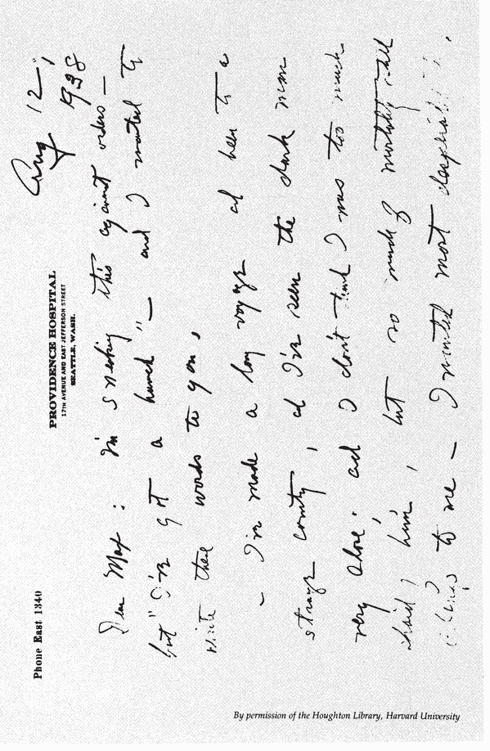
Perkins’s letter stirred Wolfe. He rallied what strength he had and called out for paper and a pencil. In a wobbly hand he wrote:
Dear Max:
I’m sneaking this against orders—but “I’ve got a hunch”—and I wanted to write these words to you.
—I’ve made a long voyage and been to a strange country, and I’ve seen the dark man very close; and I don’t think I was too much afraid of him, but so much of mortality still clings to me—I wanted most desperately to live and still do, and I thought about you all a 1,000 times, and wanted to see you all again, and there was the impossible anguish and regret of all the work I had not done, of all the work I had to do—and I know now I’m just a grain of dust, and I feel as if a great window had been opened on life. I did not know this before—and if I come through this, I hope to God I am a better man, and in some strange way I can’t explain I know I am a deeper and wiser one—If I get on my feet and out of here, it will be months before I walk back, but if I get on my feet, I’ll come back
—Whatever happens—I had this “hunch” and wanted to write you and tell you, no matter what happens or has happened, I shall always think of you and feel about you the way it was that 4th of July day 3 yrs. ago when you met me at the boat, and we went on top of the tall building and all the strangeness and the glory and the power of life and of the city were below
Yours Always
Tom
“I was most happy to get your letter,” Max wrote back to Tom in Seattle on August 19, “but don’t do it again. That is enough, and will always be valued. And I remember that night as a magical night, and the way the city looked. I always meant to go back there, but maybe it would be better not to, for things are never the same the second time.”
The next week Fred told Perkins that perhaps Tom should not have written him. Wolfe’s effort ran his fever up and set him back. Tom’s condition appeared more serious than bronchial pneumonia, but he seemed to be reviving. “Let us pray together that he will,” Fred wrote Max.
Hemingway had come home from Spain on Memorial Day and met Perkins at the Stork Club. Perkins found him “weary and worried but otherwise well.” Hemingway flew to Key West that night. Through the summer Max deliberated about how to publish Ernest’s play, The Fifth Column, and his short-story collection. The decision, arrived at while Max was on tenterhooks over Wolfe’s failing health, was to publish it all as one book under the title The Fifth Column and the First Forty-nine Stories. Perkins arranged the book’s contents and checked to see that Scott Fitzgerald’s name had been cut from “The Snows of Kilimanjaro.” He found Hemingway now identified him only as “Scott.” Knowing how sensitive Fitzgerald was, he urged Ernest to use another name altogether.
Hemingway arrived in New York again on August 30 and breakfasted with Perkins at the Hotel Barclay. He agreed to change “Scott” in his story to “Julian,” then asked Max what he thought about his starting a novel and several short stories about the Spanish war. He wanted to take one more look at Spain, then write in Paris, where he could work in peace but keep an eye on the fighting.
Perkins realized that the left-wing American intellectuals supporting the Loyalists kept Hemingway from doing any real work while he was in the United States. They regarded him as one of themselves now, and they kept pestering him to make public appearances. So Perkins thought well of Ernest’s idea of getting out of the country.
Max had been kept informed of Scott’s summer activities through Harold Ober. He heard Fitzgerald’s plans for a new novel and praise of his screen adaptation of Erich Maria Remarque’s Three Comrades. “I knew you would be mighty good out there, and only feared you would be too good,” Max wrote him. “I still do fear that too because if you get deeply interested it will keep you from getting back to writing.”
Max told Scott that he had just heard from Elizabeth Lemmon. She was moving into a house bordering the grounds of Welbourne which had once been the chapel for the estate’s servants. The modest Church House would be her home for the rest of her life. “She seems very happy,” Max wrote Scott, adding reflectively: “But it seems all wrong that she should be living alone.”
In the late summer, Max asked both Scott and Elizabeth if they could not find the time to write to the old “lone Wolfe.” Tom had run a high fever for seven weeks, and the doctors were gravely concerned. By the end of the first week of September they suspected that he had some type of brain disease, a condition more serious than they could treat in Seattle. At the urging of the hospital staff, the Wolfe family arranged to transport Tom across the continent by train to Johns Hopkins University Hospital in Baltimore, where Dr. Walter Dandy, an eminent neurosurgeon, might be able to save Tom’s life.
Wolfe’s trip eastward began on the night of September 6. He was wheelchaired aboard the Olympian, and a doctor gave the attending nurse, a girl from Asheville, a tube of morphine to keep him “snowed under” should the pain or any convulsions get out of control.
By September 10, Wolfe was resting at Johns Hopkins, his mind sometimes alert enough to understand what was happening to him. Dr. Dandy operated that afternoon. When he trephined Wolfe’s skull, cranial fluid spurted across the room from built-up pressure. Tom’s severe headache went away and for a while he thought he was cured. Dr. Dandy diagnosed Wolfe’s condition as tuberculosis of the brain. The only hope for him was that instead of many tubercles, there might be just one, which could be removed in a second operation.
Fred Wolfe arrived in Baltimore at four o‘clock Sunday morning and sent Perkins a telegram: PLAN OPERATING ON TOM TOMORROW MORNING FEEL YOUR PRESENCE WOULD HELP IF YOU CAME TONIGHT. As soon as Perkins got the wire, he left for Baltimore alone. Aline Bernstein wanted to go as well, but Max dissuaded her, knowing how much her presence would upset Tom’s mother, who despised her. Aswell, who had been at the hospital since Saturday, went back to New York to prepare the people at Harpers for the worst. Wolfe was so heavily sedated that Perkins could not bear to see him. He never even let Wolfe know he was there but just sat quietly as one of the family, cramped in the small waiting room, anxious about the results of the operation. Tom’s sister Mabel and Fred and their mother were all in a highly emotional condition. Max went up to Mabel and said, “Oh, gee, let’s go somewhere and get a drink.”
“We can’t,” she told him. “There’s not a drink to be had in Baltimore. It’s Election Day ... and they close everything in Baltimore on election days.” They sipped cups of coffee, waiting. After several hours, Dr. Dandy and the nurse who had been with Tom since Seattle came in. The doctor explained that he had hoped to find only one tumor, but when he uncovered Wolfe’s brain he discovered “myriads.”
Perkins’s gentle blue eyes looked from person to person. Wolfe’s mother took the news stoically. The others went to pieces. Max had never heard such wailing in his life. He tried to calm Mabel, placing his hand on her shoulder. Dr. Dandy said Tom might possibly live a month and that during that time he might return to a state of mental lucidity. All that anyone could do for him was to try to make his last days as free from pain and fear of death as possible.
Perkins saw no point in lingering and he left for home. “It was a harrowing day,” Max wrote to his own mother, “... exactly like the scene in Look Homeward, Angel. They are fine people, but superhuman in their energy and the power of their emotions. But the old mother is wonderful, like a New Englander.”
Three days after the operation—on September 15, 1938, eighteen days short of his thirty-eighth birthday—Thomas Wolfe died. Perkins’s telegram to Fred was all that he could put into words: DEEPLY SORRY. MY FRIENDSHIP WITH TOM WAS ONE OF THE GREATEST THINGS IN MY LIFE. GIVE MY LOVE TO MABEL AND YOUR MOTHER. I ADMIRED YOU ALL SO MUCH ONE CAN SEE HOW TOM CAME BY HIS GREAT QUALITIES.
A line from King Lear kept drumming in Max’s ear as a kind of consolation. “He hates him that would upon the rack of this tough world stretch him out longer.” Perkins believed Wolfe “was on the rack almost always, and almost always would have been,” for his task as a writer was Herculean, beyond even Wolfe’s mighty grasp.
He was wrestling as no artist in Europe would have to do, [Perkins wrote afterward for The Carolina Magazine] with the material of literature—a great country not yet revealed to its own people. It was not as with English artists who revealed England to Englishmen through generations, each one accepting what was true from his predecessors, in a gradual accretion, through centuries. Tom knew to the uttermost meaning the literature of other lands and that they were not the literature of America. He knew that the light and color of America were different; that the smells and sounds, its people, and all the structure and dimensions of our continent were unlike anything before. It was with this that he was struggling, and it was that struggle alone that, in a large sense, governed all he did. How long his books may last as such, no one can say, but the trail he has blazed is now open forever. American artists will follow and widen it to express the things Americans only unconsciously know, to reveal America and Americans to Americans. That was at the heart of Tom’s fierce life.
Given twenty years and perhaps just as many volumes, Perkins thought Wolfe might have achieved a proper form. But just as “he had to fit his body to the doorways, vehicles, and furniture of smaller men, so he had to fit his expression to the conventional requirements of a space and time that were as surely too small for his nature as they were for his subject.” Perkins revealed his personal feelings about Tom’s death only to Elizabeth Lemmon. And to her he imparted little more than: “It is hard to think that Tom wouldn’t have been utterly tortured as things are in the world. It was in him to do more than he ever did, but he would have suffered all the time.”
Louise and Max went down to the funeral in Asheville in K19, the same Pullman car on the express night train that Tom had written so much about. After they had arrived at their hotel, they hired a taxi and drove along the ridges of the mountains that walled in the town. Upon seeing them, Max instantly realized how great an effect they had had upon Tom’s development. Perkins wrote years later: “A boy of Wolfe’s imagination imprisoned there could think that what was beyond was all wonderful—different from what it was where there was not for him enough of anything.” All the vast world that he had read and dreamed about lay beyond those surrounding hills. Later Max and Louise walked to the town square and asked directions from a man in front of a gas station. The man said he had known Tom when he was young, and Louise asked what Tom was like then. The man replied, “Just like it says in the book.”
It was a thoroughly miserable day for Perkins. “It is probably better to be emotional on occasions like that,” Max said long afterward, “but it is wholly contrary to our Yankee and Episcopalian ways.” Max felt that he had to go to the Wolfe home and look at Tom’s body in the coffin. Wolfe was powdered and wearing a wig to cover the wounds left by the brain surgeon. Max thanked God that the corpse did not look much like Wolfe. Fred implored him to say something to Tom, but Perkins could not bring himself to do it. He stood in rigid silence.
That same morning, Louise went to the Catholic Church to ask that a Mass be said for Tom’s soul. The priest was reluctant. “Ah,” he said, “they were a rowdy family.” Perkins knew they could not help but be, what “with all that tremendous energy in them, and the other ingredients. They must have been somewhat of a scandal.” Max told John Terry, “I am sure that Tom was very sensitive to this fact, much more than any of the others were. It affected his entire life.”
But most of the town paid homage to its famous son. People jammed into the First Presbyterian Church to sing hymns and hear the eulogy, which included a passage from Of Time and the River. Men lining the streets to Riverside Cemetery doffed their hats as the hearse drove by. At the burial Perkins did not see much, though he was an honorary pallbearer. He stood apart from all the rest, alone, in a cluster of trees. He hated the whole business. Exactly as he had during Wolfe’s lifetime, Perkins stayed in the background.
The next morning a great hurricane brushing along the Atlantic Coast blew northward, as though following Max Perkins’s train back to New York. Then it raged into New England. From the forests atop Mount Ascutney down to the riverbanks of Windsor, all was ravaged. Paradise was destroyed.