
V
By April, 1924, F. Scott Fitzgerald had fallen away from his third novel a dozen times. Maxwell Perkins thought he should buckle down and get it finished. But he was tactful. Scribners was preparing its fall list, Max told him, and he wanted Scott’s novel on it. That got the author absorbed in his book once again, a work that he was deliberately undertaking for the enrichment of his craft more than his bank account. It was called Among the Ash-Heaps and Millionaires . He replied that he had every hope of finishing it by June. But, he told Max, “You know how those things often come out. And even if it takes me 10 times that long I cannot let it go out unless it has the very best I’m capable of in it or even as I feel sometimes, something better than I’m capable of.” Fitzgerald was pleased with much of what he had written the preceding summer, but the book had been interrupted so many times that it was jagged. He smoothed the uneven writing down and cut away whole sections of manuscript—in one case 18,000 words, from which he salvaged a short story, “Absolution.”
Religious overtones darken this story of a poor young Midwestern boy who, confused by his first sexual stirrings and romantic desires, finds solace in an imaginary alter ego. Perkins read it in the American Mercury and wrote Fitzgerald, “It showed a more steady and complete mastery, it seemed to me. Greater maturity might be the word. At any rate, it gave me a more distinct sense of what you could do.” Scott was glad Max liked the story because it set the scene for his new novel. In fact at one time, he said, it was to have been the prologue to the book, but now it interfered with the schema he was following.
Like young Rudolph Miller in “Absolution,” Scott Fitzgerald had been mulling over his own Catholic roots. Within days of Easter, he talked with Perkins, after which he haltingly confessed in a letter, “It is only in the last 4 months that I’ve realized how much I‘ve—well, almost deteriorated in the 3 years since I finished The Beautiful and Damned.” He admitted to the meagerness of his output in the last two years: one play, a half-dozen short stories, and three or four articles—an overall average of 100 words a day. “If I’d spent this time reading or travelling or doing anything—even staying healthy—” he told Perkins, “it’d be different but I spent it uselessly —neither in study nor in contemplation but only in drinking and raising hell generally. If I had written the B & D at the rate of one hundred words a day, it would have taken me 4 years. So you can imagine the moral effect the whole chasm has had on me. I’ll have to ask you to have patience about the book and trust me that at last or at least for the first time in years I’m doing the best I can.”
Fitzgerald realized that he had acquired numerous bad habits:
1. Laziness
2. Referring everything to Zelda—a terrible habit, nothing ought to be referred to anyone until it is finished
3. Word consciousness—self doubt ect. ect. ect. ect.
and was trying to get rid of them all.
Scott’s new self-understanding buoyed him up. He wrote Max, “I feel I have an enormous power in me now, more than I‘v ever had in a way but it works so fitfully and with so many bogeys because I’ve talked so much and not lived enough within myself to develop the necessary self reliance. Also I don’t know anyone who has used up so much personal experience as I have at 27.” Neither did Perkins.
“If I ever win the right to any leisure again,” Scott vowed, “I will assuredly not waste it as I wasted the past time.... So in my new novel I’m thrown directly on purely creative work—not trashy imaginings as in my stories but the sustained imagination of a sincere and yet radiant world. So I tread slowly and carefully & at times in considerable distress. This book will be a consciously artistic achievement & must depend on that as the 1st books did not.”
“I understand exactly what you have to do,” Perkins replied, “and I know that all these superficial matters of exploitation and so on are not of the slightest consequence alongside of the importance of your doing the very best work the way you want to do it, that is according to the demands of the situations.” So far as Scribners was concerned, he assured Fitzgerald, “you are to go ahead at just your own pace and if you should finish the book when you think you will, you will have performed a very considerable feat, even in the matter of time, it seems to me.”
Perkins told Fitzgerald that he did not like the title Among the Ash-Heaps and Millionaires and that if he had another, Scribners could prepare a jacket and hold it in readiness, thereby gaining several weeks if the book should be written in time for the fall. “I do like the idea you have tried to express,” Perkins explained. “The weakness is in the words ‘Ash Heap’ which do not seem to me to be a sufficiently definite and concrete expression of that part of the idea.” Perkins had only the vaguest knowledge of the book and its protagonist, but one title Fitzgerald had thrown out some months earlier stuck with him. He told Scott, “I always thought that The Great Gatsby was a suggestive and effective title.”
As had Fitzgerald’s own life, the scene of his novel shifted from the Midwest at the turn of the century to what he called that “slender riotous island which extends itself due east of New York.” Fictionalizing his glamorous neighbors’ lives was not coming easily, however, and his remedy was typical of him. “I would take the Long Island atmosphere that I had familiarly breathed,” Fitzgerald wrote years later in his essay “My Lost City,” “and materialize it beneath unfamiliar skies.” The Fitzgeralds sailed to France.
Perkins sent a copy of War and Peace to meet Scott there, with instructions not to feel compelled to read it. Max presented copies of Tolstoi’s novel in the same spirit that Gideons dispense Bibles. He gave one to almost every friend and author, and there was always a copy close to him at work and at home which he read time and again from start to finish. “Every time I read it,” Max once wrote Galsworthy, “its dimensions seem to grow larger and its details to have more meaning. I have always tried to get other people to read it, but they, most of them, trip on the crowd of characters with unrememberable names, at the beginning.”
Between his reading and writing that summer Scott was so preoccupied that he hardly noticed his wife’s involvement with a French aviator named Edouard Jozan. Shortly after their affair was discovered, the Fitzgeralds were reconciled and he sent his editor a sixteen-point checklist of the season’s labor. Item six was an emphatic plea not to let any other book have the early dust jacket sketch that Max had casually shown him months earlier. It featured two gigantic eyes—supposedly those of the heroine, Daisy Fay Buchanan—brooding over New York City. That illustration had inspired Fitzgerald to create an image for the book—the billboard of an oculist named Dr. T. J. Eckelburg; the sign had two enormous eyes on it, which would stare from above onto the novel’s proceedings. The other highlights of Fitzgerald’s letter were:
1.The novel will be done next week. That doesn’t mean however that it’ll reach America before October 1st as Zelda and I are contemplating a careful revision after a weeks complete rest.
7.I think my novel is about the best American novel ever written. It is rough stuff in places, runs only to about 50,000 words&Ihope you won’t shy at it.
8.It’s been a fair summer. I’ve been unhappy but my work hasn’t suffered from it. I am grown at last.
In closing, after filling several pages with the names of books and authors that interested him that year, Scott wrote Max, “I miss seeing you like the devil.”
In his position as a leader among young writers, Fitzgerald continued to recommend promising talents to Perkins. Max appreciated Scott’s concern for the unpublished, but few of his prospects in the last few years had panned out. In early October, 1924, Scott sent Perkins still another name, that of a young American living in France who wrote for the transatlantic review. Scott said he “has a brilliant future. Ezra Pound published a collection of his short pieces in Paris at some place like the Egotist Press. I havent it hear [sic] now but its remarkable and I’d look him up right away. He’s the real thing.” Fitzgerald gave his name as “Ernest Hemming-way” —a misspelling he would not learn to correct for years. Grateful for the tip, Perkins sent to Paris for copies of his books.
It would take months for Hemingway’s stories to arrive, but within three weeks Perkins received another package from France—Fitzgerald’s third novel, The Great Gatsby. “I think that at last I’ve done something really my own,” his covering letter read, “but how good ‘my own’ is remains to be seen.” The book was only a little over 50,000 words long, but he believed that Whitney Darrow, Scribners’ sales director, had the wrong psychology about prices and about what class constituted the book-buying public now that “the lowbrows” were queuing up at motion-picture theaters for their entertainment. Fitzgerald still wanted to charge the standard two dollars for his novel and publish it as a full-sized book. He did not want any signed blurbs on the jacket eulogizing his past. “I’m tired of being the author of This Side of Paradise,” he told Max, “and I want to start over.”
Almost simultaneously Perkins received another letter announcing the author’s decision to stick to the title he had placed on the book at the last minute: Trimalchio in West Egg. He had several others that he was considering as well. Furthermore, he was not completely satisfied with the manuscript, especially the middle of the book, but he felt he had been with it alone long enough. “Naturally I won’t get a night’s sleep until I hear from you,” he wrote Max, “but do tell me the absolute truth, your first impressions of the book, & tell me anything that bothers you in it.”
Perkins tore into the novel and read it in one sitting. Immediately he cabled, THINK NOVEL SPLENDID. He meant much more than that and wrote Fitzgerald the next day:
I think the novel is a wonder. I’m taking it home to read again and shall then write my impressions in full; but it has vitality to an extraordinary degree and glamour, and a great deal of underlying thought of unusual quality. It has a kind of mystic atmosphere at times that you infused into parts of Paradise and have not since used. It is a marvelous fusion, into a unity of presentation, of the extraordinary incongruities of life today. And as for sheer writing, it is astonishing.
Nobody at Scribners liked Trimalchio at West Egg as a title except Max, he reported to Scott. “The strange incongruity of the words in it sound the note of the book. But the objectors are more practical men than I.” He thought book buyers would not know that West Egg in the title referred to the locale of the novel, a community somewhat like Great Neck, or that Trimalchio referred to the ostentatious multimillionaire in Petronius Arbiter’s Satyricon, who was famous for his colossal and extravagant banquets. “Consider as quickly as you can a change,” Max wrote, urging him to “judge the value of the title when it stands alone.”
The book was a tragic romance about a bourgeois Midwesterner named James Gatz, who had made a fortune in shady business dealings, changed his name to Jay Gatsby, and moved to Long Island to be near the woman he had long pined for—Daisy Fay, now married to Tom Buchanan. After another few days with the typescript, Perkins wrote Fitzgerald, “I think you have every kind of right to be proud of this book. It is an extraordinary book, suggestive of all sorts of thoughts and moods.” He praised it at length but said he had several points of criticism, all of which stemmed from his dissatisfaction with the character of Gatsby himself.
Perkins pointed out “that among a set of characters marvelously palpable and vital—I would know Tom Buchanan if I met him on the street and would avoid him—Gatsby is somewhat vague. The reader’s eyes can never quite focus upon him, his outlines are dim. Now everything about Gatsby is more or less a mystery, i.e. more or less vague, and this may be somewhat of an artistic intention, but I think it is mistaken.” To correct that, Perkins suggested:
Couldn’t he be physically described as distinctly as the others, and couldn’t you add one or two characteristics like the use of that phrase “old sport,” not verbal, but physical ones, perhaps. I think that for some reason or other a reader—this was true of Mr. Scribner and of Louise—gets an idea that Gatsby is a much older man than he is, although you have the writer say that he is a little older than himself. But this would be avoided if on his first appearance he was seen as vividly as Daisy and Tom are, for instance; —and I do not think your scheme would be impaired if you made him so.
Perkins knew that Gatsby’s career must also remain mysterious but he did not want Fitzgerald to shortchange the reader. “Now almost all readers numerically are going to be puzzled by his having all this wealth and are going to feel entitled to an explanation,” he wrote Scott. “To give a distinct and definite one would be, of course, utterly absurd.” Max went on:
You might here and there interpolate some phrases, and possibly incidents, little touches of various kinds, that would suggest that he was in some active way mysteriously engaged. You do have him called on the telephone, but couldn’t he be seen once or twice consulting at his parties with people of some sort of mysterious significance, from the political, the gambling, the sporting world, or whatever it may be. I know I am floundering, but that fact may help you to see what I mean. The total lack of an explanation through so large a part of the story does seem to me a defect;—or not of an explanation, but of the suggestion of an explanation. I wish you were here so I could talk about it to you for then I know I could at least make you understand what I mean. What Gatsby did ought never be definitely imparted, even if it could be. Whether he was an innocent tool in the hands of somebody else, or to what degree he was this, ought not be explained. But if some sort of business activity of his were simply adumbrated, it would lend probability to that part of the story.
The feeble explanation Fitzgerald had offered caused the sagging which both editor and author detected in Chapters Six and Seven. In those scenes Gatsby’s love for Daisy is revealed, the principal characters meet, and they all drive to the Plaza Hotel. Their confrontation in New York is the novel’s fulcrum, on which the lives of all the characters teeter. Tom Buchanan’s crucial dialogue in which he calls Gatsby’s bluff never was as effective as it should have been because Buchanan was fighting an always shadowy opponent. “I don’t know how to suggest a remedy,” Perkins wrote the author. “I hardly doubt that you will find one and I am only writing to say that I think it does need something to hold up to the pace set, and ensuing.”
Perkins’s final criticism of the book concerned the way Fitzgerald conveyed those bits of Gatsby’s past that he did divulge: He lumped them. “In giving deliberately Gatsby’s biography when he gives it to the narrator,” Max wrote Scott, “you do depart from the method of the narrative in some degree, for otherwise almost everything is told, and beautifully told, in the regular flow of it,—in the succession of events in accompaniment with time.” Max acknowledged that Scott would be obliged to recite a certain amount of Gatsby’s background, but he suggested a subtler way to deal with some of it:
I thought you might find ways to let the truth of some of his claims like “Oxford” and his army career come out bit by bit in the course of actual narrative. I mention the point anyway for consideration in this interval before I send the proofs.
Having done his duty as a critic, Perkins hastened to assuage his author. “The general brilliant quality of the book makes me ashamed to make even these criticisms,” he wrote.
The amount of meaning you get into a sentence, the dimensions and intensity of the impression you make a paragraph carry, are most extraordinary. The manuscript is full of phrases which make a scene blaze with life. If one enjoyed a rapid railroad journey I would compare the number and vividness of pictures your living words suggest to the living scenes disclosed in that way. It seems in reading a much shorter book than it is, but it carries the mind through a series of experiences that one would think would require a book of three times its length.... The presentation of Tom, his place, Daisy and Jordan, and the unfolding of their characters is unequalled so far as I know. The description of the valley of ashes adjacent to the lovely country, the conversation and the action in Myrtle’s apartment, the marvelous catalogue of those who came to Gatsby’s house—these are such things as make a man famous. And all these things, the whole pathetic episode, you have given a place in time and space, for with the help of T. J. Eckleberg [sic] and by an occasional glance at the sky, or the sea, or the city, you have imparted a sort of sense of eternity.
Perkins could not help recalling Fitzgerald’s once telling him he was not a “natural writer.” “My God!” Max now exclaimed. “You have plainly mastered the craft, of course, but you needed far more than craftsmanship for this.”
“Your wire and your letters made me feel like a million dollars,” Scott replied from Rome. Fitzgerald said that he would rather have Max like his book than anyone he knew; and he thought that all the editor’s criticisms were valid.
He began his revisions with the very first page, the title page. He now thought that maybe the book should be called Trimalchio. Or just Gatsby. Within weeks, however, Fitzgerald had brought the title back to the one Perkins first liked, The Great Gatsby.
Along with this news, Scott tendered a request: He wondered if Perkins could deposit several hundred dollars more into his account, making his advance on the book an even $5,000. Perkins agreed, but he confessed he was somewhat puzzled about another request of Fitzgerald’s: The author had asked for royalty percentages on this book that were lower than those on his previous books. Scott explained that this was his way of paying Scribners interest on all the money he had been advanced over the last two years. Max made a counterproposal and they dickered in reverse until they struck a compromise—15 percent of the retail price (two dollars) on the first 40,000 copies and 20 percent thereafter. For the moment, money seemed secondary to Fitzgerald. He and Zelda moved into a small, unfashionable, but comfortable hotel in Rome, planning to stay there until he had finished revising the novel.
“With the aid you’ve given me,” Scott wrote Max, “I can make ‘Gatsby’ perfect.” But he excepted the crucial scene at the Plaza Hotel. He told Max he feared that it would “never quite be up to mark—I’ve worried about it too long and I can’t quite place Daisy’s reaction. But I can improve it a lot. It isn’t imaginative energy that’s lacking—its because I’m automatically prevented from thinking it over again.” He had driven his characters along the road from Long Island to New York and up to the plot’s climax so many times, he said, that there was “no chance of bringing the freshness to it that a free conception sometimes gives. The rest,” Scott wrote Max, “is easy and I see my way so clear that I even see the mental quirks that queered it before.” Perkins’s letter of editorial comments made him realize he had played the reader false. He admitted to Max:
I myself didn’t know what Gatsby looked like or was engaged in & you felt it. If I’d known & kept it from you you’d have been too impressed with my knowledge to protest. This is a complicated idea but I’m sure you’ll understand. But I know now—and as a penalty for not having known first, in other words to make sure[,] I’m going to tell more.
It seemed of almost mystical significance to Fitzgerald that Perkins envisioned Gatsby as an older man, because in fact the actual model whom Scott had half-consciously used, a man named Edward M. Fuller, was older. Fuller, one of Fitzgerald’s neighbors in Great Neck, and his brokerage firm partner, William F. McGee, had been convicted, after four trials, of pocketing their customers’ order money. One month after receiving Perkins’s list of suggestions, Fitzgerald wrote him, “Anyhow after careful searching of the files (of a man’s mind here) for the Fuller McGee case & after having had Zelda draw pictures until her fingers ache I know Gatsby better than I know my own child. My first instinct after your letter was to let him go & have Tom Buchanan dominate the book (I suppose he’s the best character I’ve ever done—I think he and the brother in ‘Salt’ & Hurstwood in ‘Sister Carrie’ are the three best characters in American fiction in the last twenty years, perhaps and perhaps not) but Gatsby sticks in my heart. I had him for awhile then lost him & now I know I have him again.”
F. Scott Fitzgerald is generally regarded as having been his own best editor, as having had the patience and objectivity to read his words over and over again, eliminating flaws and perfecting his prose. Most of the writing in the draft of The Great Gatsby was polished, but it was not until the final revision of the manuscript that it acquired its brilliance.
Fitzgerald did some cutting—he deleted a few scenes that were unimportant to the main story, Gatsby’s love for Daisy—but the bulk of his work was in additions. Not counting Chapter Six, which Fitzgerald junked and completely rewrote in proofs, he spliced in some twenty fresh passages, which together accounted for about 15 percent of the new version. This amplification is evident in the work he did on the first close description of Gatsby. In the draft version, Fitzgerald, speaking through Nick Carraway, the narrator of the novel, had described Gatsby’s face in one sentence: “He was undoubtedly one of the handsomest men I had ever seen—the dark blue eyes opening out into lashes of shiny jet were arresting and unforgettable.” This was merely a rewording of a description Fitzgerald had used before, that of his boy hero in his short story “Absolution.” Now, revising the novel, Fitzgerald returned to the Gatsby portrait and developed it from a simple observation into a perception of character:
He smiled understandingly—much more than understandingly. It was one of those rare smiles with a quality of eternal reassurance in it that you may come across four or five times in life. It faced—or seemed to face—the whole external world for an instant, and then concentrated on you with an irresistible prejudice in your favor. It understood you just so far as you would like to believe in yourself and assured you that it had precisely that impression that, at your best, you hoped to convey. Just at that point it vanished—and I was looking at an elegant young roughneck, a year or two over thirty, whose elaborate formality of speech just missed being absurd.
Fitzgerald inserted comments on Gatsby’s smile several more times until it became the dominant feature of his appearance and a mark of his personality.
The author responded creatively to nearly all of Perkins’s suggestions. As Perkins had urged him to, he broke up the block of information on Gatsby’s past and sprinkled the pieces in earlier chapters. Picking up on a comment of Perkins’s, he made Gatsby’s purported career at Oxford University a recurring topic of conversation, so that each time Fitzgerald touched upon Gatsby’s claims, he brought the entire mystery of Gatsby’s origins closer to the truth. Again stimulated by something Perkins had said, Fitzgerald worked a small wonder with a certain habit of Gatsby’s. In the original manuscript Gatsby had called people “old man,” “old fellow,” and a number of other affected appellations. Now Fitzgerald seized upon the one Perkins had liked so much, adding it a dozen times, making it into a leitmotiv. This phrase became so persistent a mannerism that in the Plaza Hotel scene it provoked Tom Buchanan into an outburst: “That’s a great expression of yours, isn’t it? All this ‘old sport’ business. Where’d you pick that up?”
Fitzgerald did major work on a matter Perkins had considered important, the clarification of the sources of Gatsby’s wealth. Three conversations on the subject were added in Chapter Five, and later in the book, after Gatsby’s death, there now was a phone call from a business associate of Gatsby’s named Slagle, about some dealings in bad bonds.
One of the ways Fitzgerald intensified the somewhat limp confrontation scene at the Plaza was to strengthen an accusation Tom Buchanan had made against Gatsby concerning his money. Buchanan had learned, he said, from a private investigation of Gatsby’s affairs, a shocking fact:
“I found out what your ‘drugstores’ were.” He turned to us and spoke rapidly. “He and this Wolfsheim [a gangster] bought up over a hundred side-street drugstores here and in Chicago and sold grain alcohol over the counters. That’s one of his little stunts. I picked him for a bootlegger the first time I saw him and I wasn’t far wrong.”
Before Perkins nobody at Scribners had edited so boldly or closely as he did Fitzgerald, and some of the older editors considered the practice questionable. They liked Max and sensed his ability, but they did not always understand him. In small ways as well as large, Max was different. He raised eyebrows, for example, by having a special desk built for himself. It was a high, broad-surfaced lecternlike affair, at which he could work standing up, his theory being that if he could not be outdoors exercising, he could at least avoid sitting down so much. People passing his office door could look in and see him at his peculiar desk, immersed in a manuscript, one leg bent at the knee and resting against the other, like a flamingo.
It took some time for the older editors to appreciate what Max was accomplishing at that desk, or indeed to value the new writers Perkins had brought into their house. Fitzgerald, more than the rest, seemed brash and impetuous, and a few of the more dignified staff members resented his storming of their bastion of conservatism and good taste. It was a memorable occasion, then, when Brownell emerged from his office one day and called to his colleagues: “May I read you something beautiful?” And then, loudly and with savor, he recited two pages from Gatsby.
Fitzgerald himself never doubted the worth of Max’s assistance. For the first time since the failure of The Vegetable, he wrote to his editor, he believed he was “a wonderful writer” ... “& its your wonderful letters that help me go on believing in myself.” Years later he remarked: “I had rewrittenGatrby three times before Max said something to me [that is, before Fitzgerald had submitted the draft to Perkins for criticism]. Then I sat down and wrote something I was proud of.”
He made that admission to a friend of Perkins’s, perhaps the most important friend Max made outside his work, a woman named Elizabeth Lemmon.
They were introduced in the spring of 1922. Elizabeth Lemmon was eight years younger than Max, and unlike any other woman he had met. She was the embodiment of his nineteenth-century romantic vision of womanhood. She was from a large old family rooted in Virginia and Baltimore, the youngest of eight daughters, but she was not effete or spoiled. A hearty laugh enlivened her gentility. She was equally comfortable among Baltimore society or on the family’s country estate, Welbourne, in Middleburg, Virginia. She had always loved to read. As a schoolgirl she had come to know a girl named Wallis Warfield. “Wally always had ‘crushes’ on the older girls and used to follow us as closely as a shadow,” Elizabeth remembered. “That was before she decided to marry a king.” Elizabeth made her debut in Baltimore, where she was known as the “second-best dancer” in the city; studied voice—she had trained for an operatic career, but her mother had allowed her to take lessons on the condition that she never perform in public; taught singing and dance at the fashionable Foxcroft School in Middleburg; and, the year she met Max, managed the Upperville, Virginia, baseball team.
Miss Lemmon went north for six weeks every spring to visit family and friends in Plainfield, New Jersey, and to attend concerts in New York. During her trip in April, 1922, she met Max and Louise Perkins. Before returning south she went to their home one evening to say good-bye.
Max Perkins had always been attracted to blondes, finding them especially womanly. When Elizabeth Lemmon strode confidently through the Perkinses’ front hall that night, her golden hair set off by a gray dress, Max was entranced. Their evening together was full of warm conversation, often about authors Max worked with. She was literate but not literary; engaging but not demanding. Louise believed Max had fallen in love again that night, but not in a way that threatened her at all. Max’s ardor was like that of heroes in ancient mythology or romantic poetry: It was of the spirit, not of the flesh; he wanted to put Elizabeth on a pedestal.
Miss Lemmon left behind an almost empty, cream-colored box of Pera cigarettes, a mild Turkish blend she liked. When Max came across them he sat down to write a letter. “Dear Miss Lemon,” he wrote, misspelling her name:
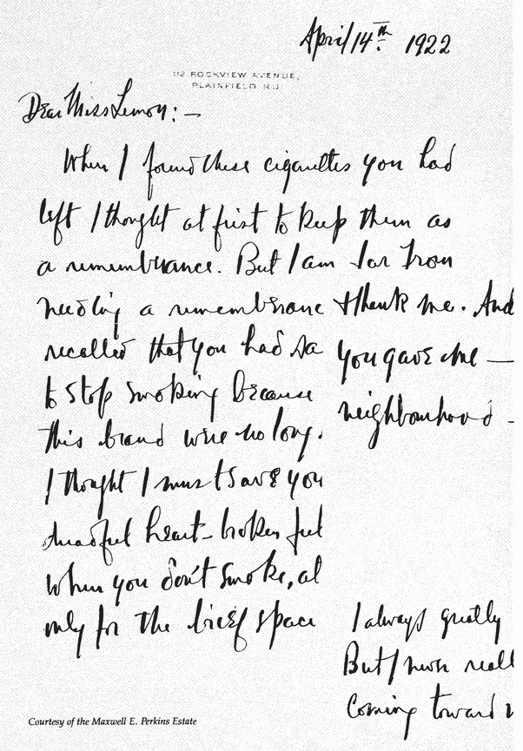
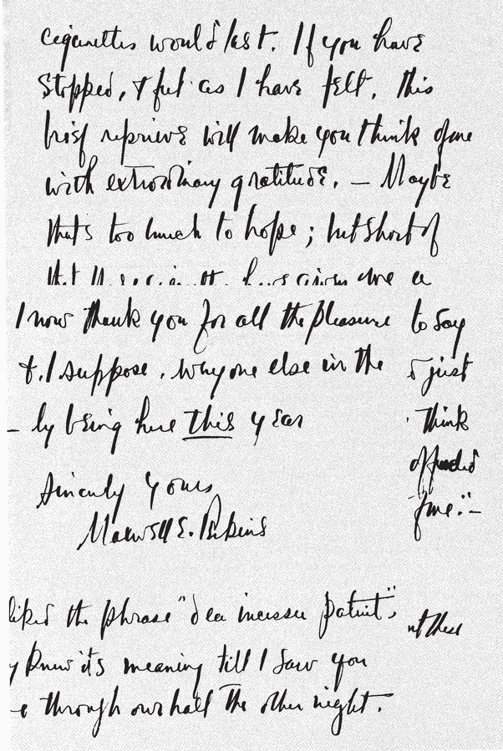
When I found these cigarettes you had left I thought at first to keep them as a remembrance. But I am far from needing a remembrance. I then recalled that you had said you meant to stop smoking because cigarettes of this brand were no longer made & I thought I must save you from that dreadful heart-broken feeling you have when you don’t smoke, at times, if only for the brief space these two cigarettes would last. If you have stopped, & feel as I have felt, this brief reprieve will make you think of me with extraordinary gratitude.—Maybe that’s too much to hope; but short of that, these cigarettes have given me a chance to say something too trivial to say without an excuse. It is, that I had just the faintest fear you might really think me so pusilanimous as to have been offended that you “could not bear the sight of me.” I guess not though.
Next year, please remember I sent these and thank me. And I now thank you for all the pleasure you gave me—& I suppose, everyone else in the neighborhood—by being here this year.
After closing the letter with his formal, high, angular signature, Perkins added a postscript. He had always, he wrote, greatly liked Virgil’s phrase dea incessu patuit (“and she revealed herself to be a goddess,” as Venus did before Aeneas). “But I never really knew its meaning till I saw you coming toward me through our hall the other night.”
“You can’t in all honesty say Max Perkins fell in love with me,” Elizabeth Lemmon said fifty years later. “We were, after all, Victoria’s children—we met at a time when a smile across a room meant as much as two kids in the back seat of a car today. I think Andrew Turnbull came closest when he said Max and I had a ‘true friendship.’ ” The evaluations of both Miss Lemmon and biographer Turnbull are accurate to a point, but incomplete. Perkins had a deeper feeling—a golden love—that Elizabeth modestly refused to admit. He adored her. She became an oasis of warmth and understanding in an increasingly difficult marriage.
Max’s atavistic yearnings were at odds again, and they led him into a unique love affair—a Yankee editor’s romance. Perkins allowed himself to be drawn to Elizabeth Lemmon, but he felt compelled to make any relationship with her hard on himself. He was never so at peace as when she was near, but he did everything he could to make her unreachable. He restricted their contact largely to the mails.
For the next twenty-five years they wrote privately to each other. It was the longest sustained personal correspondence in his life. In times both of happiness and of tragedy—usually out of loneliness, when he felt unfulfilled—he poured lovely thoughts onto paper, constantly expressing gratitude to Elizabeth for being not merely an inspiration but a divine creature. A year might pass between letters, or three might be bunched in a month, but the continuity was maintained. Elizabeth kept the letters, and they are the only diary he left. Except for a few pages her replies do not exist. “Thank God for that,” Miss Lemmon remarked decades later. “I really had nothing to say worth saving.”
Max neither expected nor required of her anything more than an occasional response to assure him that she was still there, unchanged and constant. When his homelife seemed empty or his work life hectic, writing to Elizabeth remained his outlet, the least complicated, most perfect pleasure in his life. In the entire quarter-century of their friendship, Max visited her in Middleburg only twice.
Within weeks of their meeting in 1922, Miss Lemmon invited the Perkinses for an informal weekend at Welbourne. She wrote of mint juleps, polo, and amateur horse shows. Louise replied that “Max was almost overcome at your invitation, especially as you said that he might wear his sneakers all the time.” She thought her husband was “tempted to give up his position in Scribners to accept it.” But faithful employees worked on Saturdays, and, Louise wrote, Max said he was sorry he could not go.
Louise went by herself. It was still cold in Plainfield on the twentieth of May, but she left for Virginia with suitcases packed with summer clothes, not realizing it was just as cold where she was going. She found the rolling green hills of northern Virginia the most sublime horse country she had ever seen and the Lemmons’ estate glorious. The long serpentine drive up to Welbourne made its way through an untended lawn past big trees up to the same front door that long ago had opened for guests such as Jeb Stuart. On a small scale the house resembled Mount Vernon, with its simple lines and tall pillars in front. Two graceful one-story wings flanked the stocky central box of the mansion. Welbourne was built in 1821 and pre-Revolution family portraits hung in the parlors. An airy verandah looked out onto the overgrown grounds in the back. A Yankee cannonball had gone through one of the windows in the greenhouse, and though the pane was replaced in 1865, it was still referred to as the “new window.”
Louise Perkins, in her light clothing, was cold most of the time, but she felt comfortable with Miss Lemmon and her family in their magnificent house. When Elizabeth’s mother asked her how Mr. Perkins was, she replied, “Very enamored of Elizabeth.” Louise grew especially fond of her hostess. Elizabeth was just developing an interest in the occult, and she recommended a fortune teller for Louise to consult up north.
When Louise returned to Plainfield she filled Max’s ears with stories of Welbourne. He was sorrier than ever that he had not gone, but in another sense he was just as glad. From his wife’s descriptions, Welbourne seemed like a mythical kingdom to him, one better visited in dreams.
In late May, 1924, Louise joined friends for a cruise to the Caribbean. Max was again unable to accompany her because of work, this time with his newest writer, Douglas Southall Freeman. Freeman had a doctorate in history from Johns Hopkins University and was editor of the RichmondNewsLeader . The history of the Confederacy was his passion, and he had edited the wartime correspondence between Robert E. Lee and Jefferson Davis. In 1914 Scribners had commissioned him to write a short biography of Lee, on which he worked under Edward L. Burlingame. Almost a decade later the book still had not appeared. Burlingame had died, and Perkins, with a lifelong interest in the Civil War, was assigned to assist the author. In 1924 Freeman wrote his new editor:
The whole trouble about my Lee is that I have been waiting to have a view of the final cache of Lee papers in the Confederate Memorial Institute. I did not think it quite fair, nor in any sense desirable to publish a book on Lee until I was able to examine this material. It seemed quite stupid to go into print when the last remaining collection of Lee matter was almost in one’s hands.
The papers were due to be turned over forthwith, but Freeman projected another long delay before he could meet the demands of his contract. The thought of compacting all the material into 100,000 words, as Scribners expected, was mind-boggling. During his nine years of waiting for the manuscript, Burlingame had always been patient in dealing with Freeman. “I hope a like mantle covers your shoulders,” the author wrote Perkins. Max had more than patience. He had a new plan which would postpone the appearance of Dr. Freeman’s work for another decade but might ensure its place for centuries. Perkins suggested that Freeman undertake a definitive biography of Robert E. Lee, without regard for time or length.
In May, 1924, Max went to Virginia to discuss the project with him. On the way down, he considered the idea of seeing Elizabeth Lemmon; in Richmond he made inquiries about how he could get to Middleburg. But, just a few hours’ drive away, he could not bring himself to approach her. Max stuck to business instead, staying in Richmond with Freeman and trooping across the city that would be the backdrop for so much of Freeman’s writing. It would be ten more years before Freeman would present Max with a completed manuscript of his monumental work.
A letter Max received from Elizabeth Lemmon after his return to New York made him wish he had seen her when he was in Virginia. She mentioned a haircut that had given her a new look, and said her deepening involvement in astrology had added to the “transformation.” Just the thought that Elizabeth might somehow be different from the first vision he had of her disturbed him. He replied:
I can imagine no substitute that would be even “just as good.” Will the new Elizabeth lack that Goddesslike repose which was among the qualities that so distinguished her from all the others—eager, restless, striving women. And if she should I’d almost rather not see her, for to do so would be to impair the image of The Elizabeth who would otherwise, at least survive in my memory.
“You make me still more regret that I did not risk the digression from Richmond,” he wrote, explaining, “I dreaded arriving in the midst of one of those Virginia parties where a block of New England granite would be only an obstacle.” Louise had called Max “a block of New England granite” just nights earlier, because he had not wept over Lillian Gish in The White Sister.
Several times that summer Max went to Great Neck, Long Island, ostensibly to talk to Ring Lardner about his writing. They drank what would ordinarily have been a dangerous number of highballs, but, Perkins said, they felt no serious effects because of the heat.
Lardner was planning to go to Europe and to see the Fitzgeralds there, but he hardly looked well enough to make the trip. He was coughing a great deal, eating almost nothing, and chain-smoking when he did eat. He told Perkins that he was giving up alcohol and cigarettes so he could get enough ahead on a comic strip he wrote with cartoonist Dick Dorgan to go abroad.
With Lardner’s approval, Max again searched through Ring’s syndicated newspaper and magazine articles until he found enough material to fill a book. The collection would be brought out in 1925, and Max was happy to publish it, though he wished Ring would attempt something ambitious. “Ring,” he said, “if it were a matter of money we would be willing to help toward a novel, you know. But I judge the $5,000 or so we’d gladly put up wouldn’t count.” Lardner said it was not at all a question of money. It was rather that his métier was the shorter forms.
By Christmas, 1924, Ring had gone to Europe and returned, and his anthology, What of It?, was set in type. A new article opened the book, a piece called “The Other Side,” about his companions and recent adventures “acrost the old pond” in Europe. In it he wrote, “Mr. Fitzgerald is a novelist and Mrs. Fitzgerald a novelty.”
Never before had Ring been so pleased with his literary work—he had previously been quite cynical about it—and he believed he owed his growing stature as a writer to his relationship with Perkins. How to Write Short Stories had passed the 16,000 mark in sales; and, as Max had predicted, the Scribners republication of his old works in new wrappers gave fresh life to all the other Lardner books on the market. Excellent reviews were being written about the new book everywhere, including one by Mencken.
Ring Lardner, Jr., wrote in his family memoir, The Lardners: “It took the unexpected success of How to Write Short Stories, the extent to which reviewers hailed him as a master of the form, and unremitting pressure from Perkins to bring him back to the work on which his reputation was ultimately to rest.” In December, 1924, Ring wrote Perkins, “I think I am going to be able to sever connections with the daily cartoon. This ought to leave me with plenty of time and it is my intention to write at least ten short stories a year.” Three months later, Perkins read Ring’s story “Haircut,” a small-town barber’s account of how a practical joker was shot to death by the local half-wit. It was darker than most of his earlier tales. “I can’t shake it out of my mind,” Max wrote Ring; “in fact the impression it made has deepened with time. There’s not a man alive who could have done better, that’s certain.” Lardner replied with a formally typed, one-word letter: “Thanks.”
After another Lardner anthology, Scott Fitzgerald wrote Max to express his concern that Ring would stagnate if he kept on writing nothing but stories. “God, I wish he’d write a more or less personal novel,” he told Perkins. “Couldn’t you persuade him?” Fitzgerald’s suggestion was timely. At that moment Max was about to come upon a big idea for Lardner. It all began when Max decided there ought to be a “sort of burlesque on those dictionaries of biography,” satirizing those “most astonishing pieces of bunk, written in all solemnity.” Perkins thought of asking celebrated wits such as Lardner, Robert Benchley, Donald Ogden Stewart, George Ade, and Scott Fitzgerald each to “do a number of fictional biographies which hit off various types of people. And then to illustrate, make and bind the book in imitation of these volumes.” Perkins talked the idea around at the same time that he was urging Ring to compose some long work. Within the week Max found before him the first chapter of Ring Lardner’s “autobiography.”
“For Heaven’s sake,” Perkins pleaded, “keep it up to the length of twenty-five thousand words at least, and the more beyond, the better.” Lardner said there was no chance of stretching it out that long because “it would get to be a terrible strain on both readers and writer,” but Perkins persisted. He said the complete “autobiography” should be published by itself, fattened with illustrations, if necessary, and that it ought to be published quickly, “for ever so many of its hits are of the moment.” Within weeks the installments amassed to 15,000 words, and Lardner called the work The Story of a Wonder Man.
Lardner’s actual life provided only the barest structure for his parody of autobiographies. He recorded such events as: “It was at a petting party in the White House that I first met Jane Austen. The beautiful little Englishwoman had come to our shores in response to an attractive offer from the etro-Goldwyn-Mayer people, one of whose officers had spelled out her novel Pride and Prejudice and considered it good material for a seven-reel comedy.” Perkins selected the installments that he thought should be included in the book and tacked a title onto every chapter. “I am not under any illusions about myself as a humorist,” he told Ring, but he went about writing titles anyway and was teeming with more ideas for Lardner: “Why don’t you write about the boy who believed the ‘ads’ ... read up on all the highbrow stuff and tried it on the gals!” “Some day you ought to take a shot at the ’Clean Desk‘ executive.” “Did you ever discuss hay fever? ... The wretched patient has to pretend he thinks it’s funny too. If you consider the topic, I’ll submit myself, in the interests of science, to scrutiny.” Perkins never stopped urging Ring to write a novel, or at least one long story to lead off a book, but other projects kept catching Lardner’s eye, including a collaboration on a musical with George M. Cohan.
That summer the Perkinses had taken a cottage on the outskirts of New Canaan, Connecticut. “You would hate it,” Max wrote Fitzgerald, “but I like it.” In due course Max and Louise began to think about living in New Canaan permanently. Max had lived in Plainfield all his life, and he believed once a man had put roots down somewhere, he should not dig them up. But he believed Plainfield had sprouted into “a damnable, flat, damp, dull, cheap place.” As for Connecticut, he wrote to novelist Thomas Boyd, “The people thereabouts are the right sort, at least to one of New England descent. In fact, if we could only get rid of that house in Plainfield, we would buy one here in a minute, and if controversies between Louise and me end the way they usually do, we’ll buy one anyway. But I hope not. I know it would be a risky business.”
Louise had given Max a list of reasons for buying a new house, beginning with her hatred of the one they owned in Plainfield. She detested the place because she associated it with the slow death of her mother. It was also costly to keep up. Added to those reasons for moving, Max wrote, “is the charm of New Canaan, a New England village at the end of a single track railroad with almost wild country in three directions, i.e. wild to an Easterner. An ideal place for bringing up children in the way they should go, girls anyhow.”
Louise was already eyeing the home she wanted, and they bought it that season. Max was most impressed with the exterior of the place. It had four fluted wooden columns—“one,” he wrote Elizabeth Lemmon, “for each daughter to lean against when the young men drive up in their buggies.”
On January 16, 1925, Louise made what Max called another “gallant attempt to become the mother of a manchild.” “It ended in failure,” he wrote Elizabeth Lemmon. “They tell me what strength, what a splendid physique the girl has. That if she had been a boy it would have been a fine boy—quarterback on a Harvard Eleven and leader of an army into Germany perhaps. But as it is, what use is strength?” One New Canaanite asked Max at the train station one day what he was going to name his fifth daughter. “Blaspheme,” he said, but in a more reasonable moment he and Louise chose Nancy Gait Perkins instead. The day the fifth girl “materialized” Perkins again wired his mother just one word: ANOTHER.
The Perkinses enjoyed a more active social life in New Canaan than they had in Plainfield. There were several minor literary celebrities living nearby, and Max took an instant liking to the Colums, intimate friends of James Joyce, both authors and critics in their own right. Mary—Molly to all her friends—was a big, redheaded woman. She was not at all pretty, but Max found her a “wonder, quick as a cat.” Padraic, he wrote Elizabeth, “trails clouds of Irish geniality and comfort, a most charming, amusing, kindly man, who though youngish, has a kind of tolerant wisdom and an air of learning that make him seem like sixty.” William Rose Benét and his wife, the poet Elinor Wylie, also lived in the neighborhood, and Max was especially eager to know her better. He did not find her much of a beauty either—“her features are small and undistinguished of a blunt, squarish sort, and her figure is angular, and I thought awkward,” he wrote Elizabeth —“though Louise was scornful when I said so.” But her personality was alluring: “It is that of a brave sensitive person, wholly herself ... She holds her head back, rather her chin up, and all together says,—but not proudly or aggressively—‘I represent myself.’ ”
“We had many good literary evenings, though it was by no means a literary neighborhood,” Molly Colum recalled in her memoirs, Life and the Dream. The Perkinses, Benéts, and Colums often gathered for dinner, sometimes inviting the Van Wyck Brookses, who were living in Westport, and Hendrik Willem van Loon, an “enormous Dutchman with a kind of ill-natured sneer for almost everything,” who wrote the popular Story of Mankind.
In a short time Perkins recognized Elinor Wylie as the real spark in New Canaan. “The true basis for friendships is a prejudice or two in common,” Max liked to say. With each conversation between them, he grew fonder of Elinor, for she disliked many of the same things he did, including the sort of flashy, glib writing that had become popular. They both found little that was worthy in Michael Arlen’s best-selling The Green Hat, which was the literary rage that year. Max was also aware of Elinor’s vulnerability; when she was reflective she reminded him of a waif. He felt sorry for her at the same time that he admired her. “There’s something tragic in her,” Perkins mused in a letter to Elizabeth Lemmon, “as if she were one who, desiring the opposite, was destined to bring sorrow to those who loved her. An ill-beloved.”
As though it were written into the deed of the new house, the Perkinses promptly joined the New Canaan Country Club, and Max became a regular in the New York, New Haven & Hartford club car. Molly Colum constantly accused him of being “highly conventional and genteel,” but Max said it was just that “in a town like this it’s regarded as a matter of patriotism to join everything joinable.” He admitted, however, that his life in Connecticut had become gayer than he liked. Preferring to spend more time with his adolescent girls, he began turning down dinner invitations. “I only see my children two hours a day at best, and I’m not going to give that little up,” he insisted. That did not stop Louise, who happily went to parties alone. Left in the evenings with his daughters, Max read aloud to them, most often from War and Peace. During crucial battle sequences he laid out matchsticks to show his devoted girls how the Russian and French troops had been arranged. He thought all his daughters should hear that story, “for in it,” he once wrote Peggy, “is the best man that ever was written about, except Hamlet. He is Prince Andrei. I wish each of you, if you mustmarry, would find a Prince Andrei for a husband,—even if he is a little too scornful and impatient.”
Max corresponded steadily with Elizabeth Lemmon that year. From any of his clubs—which grew to include the Harvard Club, the Century Association, and The Coffee House in New York—he sent newsy letters about his family and town and work. In the spring of 1925, he also sent her several books. One was Lardner’s latest anthology, What of It? Another was Scott Fitzgerald’s novel. Max told her The Great Gatby was better than anything the author had done, “a combination of satire and romance that no one else can give. It comes from the fact that even while he sees things with a critical eye there still hangs over them the glamour of his youthful illusions. This gives the story a kind of wistful quality.”
Perkins had examined Fitzgerald’s revised proofs and then written the author, “I think the book is a wonder and Gatsby is now most appealing, effective and real, and yet altogether original.” All of the editor’s criticisms of several months earlier had been dealt with. He wrote Scott, “Gatsby ought to do much for his creator.”
As publication neared, Fitzgerald lacked Perkins’s confidence. He was shakiest about the title. In early March he wired Max, asking if it was too late to change it to Gold-Hatted Gatsby. Max cabled that such a change would cause not only a harmful delay but also considerable confusion. The author tried to live with The Great Gatrby, but he still believed in his heart that the title would forever stand as his book’s one flaw.
Perkins went right on making the final preparations for The Great Gatsby’s April 10 publication; but on March 19 Fitzgerald could not refrain from sending him an exigent telegram from Capri: CRAZY ABOUT TITLE UNDER THE RED WHITE AND BLUE. WHAT WOULD DELAY BE? Perkins responded that there would be a delay of several weeks. Besides, he wired, THINK IRONY IS FAR MORE EFFECTIVE UNDER LESS LEADING TITLE. EVERYONE LIKES PRESENT TITLE URGE WE KEEP IT. Three days later Fitzgerald acceded. He wired: YOU’RE RIGHT. But his nervousness mounted.
By publication day Fitzgerald was so overcome with “fears and forebodings” that, in a letter to Max, he turned on The Great Gatsby, calling it a certain disappointment to the public, the reviewers, and himself. “Supposing women didn’t like the book because it has no important female characters in it,” he said, “and the critics didn’t like it because it dealt with the rich.” Worst of all, wrote Fitzgerald, “Suppose it didn’t even wipe out my debt to you—why it will have to sell 20,000 copies even to do that! In fact all my confidence is gone ... I’m sick of the book myself.”
It was an entire week before Perkins had a trend to report, and then it was with great sorrow that he found Fitzgerald’s worries were borne out. He cabled: SALES SITUATION DOUBTFUL EXCELLENT REVIEWS. This was more optimistic than was the case on both counts. Later that day he wrote the qualifying details to Fitzgerald, explaining that “the trade” had been skeptical. One reason seemed to be the small number of pages in the book, only 218. This was an old objection which Perkins had thought the book market had gotten past.
To attempt to explain to them that the way of writing which you have chosen and which is bound to come more and more into practice is one where a vast amount is said by implication, and that therefore the book is as full as it would have been if written to much greater length by another method, is of course utterly futile.
Several major distributors had, in fact, drastically reduced their orders upon receiving the short book.
Knowing how trying this period must be for Scott to bear, Perkins promised to cable any significant developments, especially the appearance of more good reviews. “I like the book so much myself and see so much in it that its recognition and success mean more to me than anything else in sight at the present time,” he told Scott, “—I mean in any department of interest, not only that of literature. But it does seem to me from the comments of many who yet feel its enchantment, that it is over the heads of more people than you would probably suppose.” He assured Scott, “I shall watch [its progress] with the greatest anxiety imaginable in anyone but the author.”
Just a week earlier Fitzgerald had hoped his book would sell over 75,000 copies. Now he wished for but a fraction of that—enough to clear his $6,000 advance from Scribners. If the final sales projection were as low as it threatened to be, Fitzgerald said, he would give himself just one more book to decide whether or not he would continue as a serious writer. “If it will support me with no more intervals of trash I’ll go on as a novelist,” he told Max. “If not I’m going to quit, come home, go to Hollywood and learn the movie business. I can’t reduce our scale of living, and I can’t stand this financial insecurity. Anyhow there’s no point in trying to be an artist if you can’t do your best. I had my chance back in 1920 to start my life on a sensible scale and I lost it and so I’ll have to pay the penalty. Then perhaps at 40 I can start writing again without this constant worry and interruption.”
Two weeks after publication Perkins still had little basis for optimism. DEVELOPMENTS FAVORABLE REVIEWS EXCELLENT MUST STILL WAIT, he wired, and then wrote to explain: “While most of the reviewers seem rather to fumble with the book, as if they did not fully understand it, they did praise it very highly, and better still, they all show a kind of excitement which they caught from its vitality.” The people who remained to be heard from were those who fully grasped the book, as thus far nobody had done. Perkins remained confident that “when the tumult and shouting of the rabble of reviewers and gossipers dies, The Great Gatsby will stand out as a very extraordinary book.”
To blot out Fitzgerald’s debt to Scribners, Scott offered his collection of stories for the fall, once bullishly entitled Dear Money, now more reflectively called All the Sad Young Men. Max thought the title was excellent, and he was pleased that Fitzgerald had made no further mention of going to Hollywood. He well knew that Scott hated to linger in debt, but he did not want Scott’s debt to prey on his mind. He must not think Scribners was anxious about it. “If we wanted to be utterly hard-boiled we could look upon it as a good investment,” he told him.
Perkins himself took plenty of knocks because of The Great Gatsby. The sales and advertising departments had bet heavily on the book because of Perkins’s previous record, and they made their anger known when the book did not pay off. Several critics he knew personally took shots at the book in their reviews, then told him point-blank that he was foolish to have published such a trivial mystery novel. Ruth Hale, in the Brooklyn Eagle, wrote that she found “not one chemical trace of magic, life, irony, romance or mysticism in all The Great Gatsby.” At a party a few weeks later she told Perkins, “That new book by your enfant terrible is really terrible.”
“So many people have attacked me about [The Great Gatsby] that I feel bruised,” Max wrote Elizabeth Lemmon, “but they don’t know. They can’t see that Fitzgerald is a satirist. The fact that he throws a glamour over vice—if it didn’t have it there would be none—prevents them from seeing that he lays a lash upon the vicious.” Perkins realized that Fitzgerald had outgrown his public. “His virtuosity has made a ‘popular novelist’ of one who is above the heads of the multitudes.” Max believed they never looked deeply intoThis Side of Paradise. “It was a bag full of jewels, some, cheap imitations, some pretty pebbles,” he wrote Elizabeth, “and mixed among them pure and priceless ones.” The Great Gatsby was more like one exquisitely cut gem, with more brilliant facets than anyone in America had seen before.
“Perhaps it’s not perfect!” Max wrote Scott on April 25, 1925. “It is one thing to ride a sleepy cob of a talent to perfection and quite another to master a wild young thoroughbred of a talent.”
By late spring—after all hopes of The Great Gatsby’s success had faded—fine reviews did appear, and Willa Cather, Edith Wharton, and T. S. Eliot all sent Fitzgerald personal letters praising the book.
Fitzgerald himself realized how far he had advanced since the beginning of the Jazz Age, and he never failed to express his appreciation to those who helped him. “Max,” he wrote his editor in July, 1925, “it amuses me when praise comes in on the ‘structure’ of the book—because it was you who fixed up the structure, not me. And don’t think I’m not grateful for all that sane and helpful advice about it.”
Along with the somber news of Gatsby’s sales, Fitzgerald heard from Perkins of a rumor circulating about his dissatisfaction with Charles Scribner’s Sons and his plans to transfer to Boni & Liveright for his books. Max hesitantly mailed a longhand letter from New Canaan to Paris requesting the details of the story.
LIVERIGHT RUMOR ABSURD, Scott wired. In fact, Fitzgerald had heard from an editor at Boni & Liveright who asked for Scott’s next book in the event that he was not satisfied with Scribners. Fitzgerald responded at once, affirming that Max Perkins was one of his closest friends and that his relations with Scribners had always been so cordial and pleasant that he could not even think of changing publishers. The rumor was apparently a thirdhand rendition of a misunderstanding, and Fitzgerald became depressed that Perkins should have believed it enough to mention it.
Now Max, [Scott wrote] I have told you many times that you are my publisher, and permanently, as far as one can fling about the word in this too mutable world. If you like I will sign a contract with you immediately for my next three books. The idea of leaving you has never for one single moment entered my head.
Fitzgerald enumerated four reasons why he could not change publishers, ranging from corporate matters to personal allegiances. One was his strong feeling about having one house’s support from book to book—if only to have uniform bindings on all his works; another was the “curious advantage to a rather radical writer in being published by what is now an ultra-conservative house.” Thirdly, Fitzgerald felt that it would be awkward to sign with another publisher while he had a debt, which was “both actual and a matter of honor,” of several thousand dollars. The foremost reason for Fitzgerald’s loyalty had been swelling within him since their first correspondence. “Tho, as a younger man, I have not always been in sympathy with some of your publishing ideas (which were evolved under the pre-movie, pre-high-literacy-rate condition of twenty to forty years ago),” Scott wrote Max, “the personality of you and of Mr. Scribner, the tremendous squareness, courtesy, generosity, and open-mindedness I have always met there and, if I may say it, the special consideration you have all had for me and my work, much more than make up the difference.”
Maxwell Perkins gave all his authors the feeling that he cared as much for their work as they did themselves. Even Scott Fitzgerald, the keystone of Scribners’ revitalized success, needed that assurance. Max never asked Fitzgerald (or any writer) to sign a permanent contract for “the simple reason that it might be right for you sometime to change publishers, and while this would be a tragedy to me, I should not be so small as to stand in the way on personal grounds.” Indeed, dozens of Perkins’s agreements to publish were oral—and inviolate.
Perkins was still casting his lot with the up-and-coming and challenging those he already published to attempt the untried. In 1944, Malcolm Cowley commented on the effect that this policy had on Perkins’s company. “Scribners, when he went to work there, was a fantastic publishing house, with an atmosphere like Queen Victoria’s parlor,” he said. Because of Perkins and his sweeping changes, that house “took a sudden leap from the age of innocence into the midst of the lost generation.”