
PERSPECTIVE IS EVERYTHING.
What looked from Washington, D.C., like a distant battlefield of the Cold War, appeared completely different from the vantage point of North Vietnam.
In the late 1800s, long before the start of the Cold War, France took control of Vietnam, Cambodia, and Laos, ruling the three countries as a colony known as French Indochina. This is the world Nguyen Tat Thanh was born into in 1890. Nguyen grew up watching French colonists abusing workers at plantations and mines, ripping out and exporting the country’s natural resources. He joined anti-French protests as a teenager. In his twenties he became a communist; communism’s promise to redistribute land and wealth among the people seemed an attractive alternative to French oppression. After studying in the Soviet capital of Moscow, he spent much of the 1920s and 1930s traveling through Asia, organizing covert communist groups. When Japan occupied Indochina during World War II, he slipped across the border from China into Vietnam and formed the Viet Minh, a guerrilla force that began battling the invaders. This is when he started calling himself Ho Chi Minh—“Bringer of Light.”
And the United States was on his side.
In July 1945, toward the end of World War II, American soldiers parachuted into North Vietnam with orders to find and to help Ho Chi Minh. The Americans were greeted by friendly villagers and a banner reading, “Welcome Americans.” The villagers slaughtered a cow and treated their guests to barbecue and beer. It was an auspicious beginning to America’s military involvement in Vietnam.
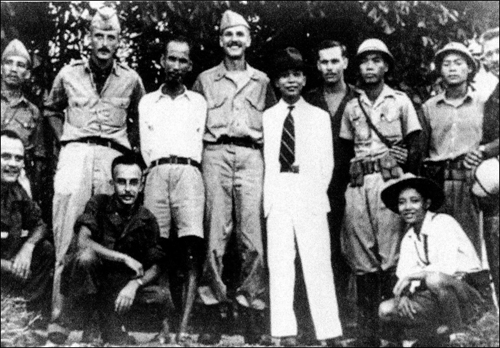
Future North Vietnamese leader Ho Chi Minh (standing, third from left) with U.S. military personnel in 1945, shortly after the end of World War II.
American soldiers worked with the Viet Minh, helping train the troops for the fight against their mutual enemy, Japan. Three weeks later, two American atomic bombs forced Japan to surrender. Ho Chi Minh seized the opportunity to fill the power vacuum left by the Japanese defeat.
On the morning of September 2, more than half a million people crowded into an open square in the city of Hanoi. Homemade banners hung limp in the hot, humid air.
“Vietnam to the Vietnamese”
“Independence or Death”
Soldiers blew on whistles and the crowd quieted as men began walking up the stairs onto a wooden platform in the square. Ho Chi Minh, a frail figure in his mid-fifties, with a wispy gray goatee, stepped toward the microphone.
Seeing him, the crowd began to cry: “Doc-Lap! Doc-Lap! Doc-Lap!”—Vietnamese for independence. The chant continued for several minutes. Ho listened, smiling, savoring the moment. Then he raised his hands and the square went silent.
“All men are created equal,” he began. “The creator has given us certain inviolable rights: the right to life, the right to be free, and the right to achieve happiness.”
Ho stopped and asked, “Do you hear me distinctly, fellow countrymen?”
“Yes!” roared the crowd.
“These immortal words,” he continued, “are taken from the Declaration of Independence of the United States of America in 1776. In a larger sense, this means that all the people on earth are born equal; all the people have the right to live, to be happy, to be free.”
* * *
If Ho Chi Minh hoped quoting from the Declaration of Independence would help win him friends in Washington, D.C., he was mistaken. Ho sent a series of messages to President Harry Truman, asking the United States to recognize the independent nation of Vietnam.
Truman never responded. Perspective is everything.
Yes, the United States supported every country’s right to self-determination—in theory. In the real world, Ho Chi Minh and his followers were Communists. An independent Vietnam might ally itself with the Soviet Union. Truman’s other option was to back France. With World War II over, France wanted its old colony back. French rule in Vietnam would deny power to the Communists.
Which goal was more important: supporting Vietnam’s right to independence, or containing the spread of communism?
Containing communism won. Truman agreed to support France’s bid to retake its former colony. French forces returned to Hanoi, sparking all-out war between France and the Viet Minh.
The Soviets shipped weapons to Ho Chi Minh; the Americans supplied weapons to the French.
In May 1954, just as Daniel Ellsberg was beginning his Marine training in Virginia, Viet Minh fighters surrounded French forces at a remote military outpost called Dien Bien Phu. The French surrendered on May 7.
“Your rifles had better be clean,” Ellsberg’s drill sergeant told the men, “because Dien Bien Phu just fell.”
But American troops did not go to Vietnam, and neither did Ellsberg. Not yet.
* * *
The Geneva Accords, which officially ended France’s eight-year war in Vietnam, temporarily divided the country into North and South. Ho Chi Minh and his communist allies gained control of North Vietnam, with their capital in Hanoi. Ho consolidated power by arresting anyone suspected of disloyalty to his regime, executing many, and sending thousands more to prison camps.
In South Vietnam, a U.S.-backed leader named Ngo Dinh Diem took power in the capital city of Saigon. Diem was a firm anti-communist, though hardly committed to democracy. In one early referendum on his rule in the South, Diem’s agents openly intimidated and beat up voters. Diem claimed to have won a ludicrous 98.2 percent of the vote; in Saigon, he somehow received more votes than there were registered voters.
The Geneva Accords called for a national election in 1956. The plan was for the citizens of both the North and South to choose a single government that would lead a reunited Vietnam.
It never happened. American intelligence agents in Southeast Asia reported to Washington that a national election would almost certainly be won by Ho Chi Minh. Again, the United States faced the possibility of a communist Vietnam. Again, this proved unacceptable.
“You have a row of dominoes set up,” said President Dwight Eisenhower. “You knock over the first one, and what will happen to the last one is the certainty that it will go over very quickly.”
According to the Domino Theory, which dominated American foreign policy during the Cold War, countries were like dominos standing on end. If one fell to communism, it would knock over the next one, and so on—one country after another would fall into communist hands. Determined not to allow the Vietnamese domino to topple, American agents worked in secret to prevent elections in Vietnam.
The Communists, meanwhile, were busy violating the Geneva Accords themselves. Viet Minh fighters were supposed to have left the South, but thousands stayed behind and helped to form a new guerrilla force calling itself the National Front for the Liberation of South Vietnam. The Americans called them the Viet Cong—short, in Vietnamese, for Vietnamese Communists. When it became clear there would be no national elections, Viet Cong forces launched a guerilla war against Diem’s government in South Vietnam. Ho Chi Minh, who was determined to unite Vietnam with or without elections, worked closely with the Viet Cong.
Eisenhower responded by sending weapons and military advisors to South Vietnam. President John Kennedy, elected in 1960, increased the number of American soldiers from a few hundred to over sixteen thousand. When Lyndon Johnson took over after Kennedy was assassinated in 1963, he promised to continue backing South Vietnam.
“Lyndon Johnson,” he told his advisors, “is not going down as the president who lost Vietnam.”