Chapter 9
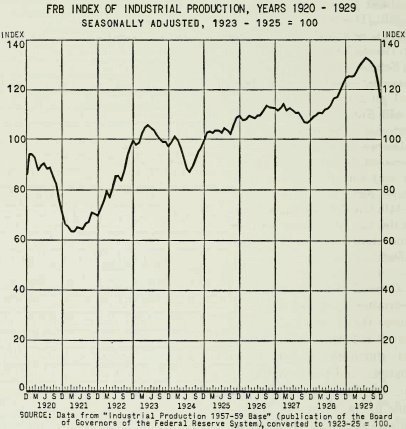
By the middle of the 1920s General Motors had accomplished some things, but apart from survival and reorganization, they were more in the realm of the mind than of reality. We knew, as I have related, the strategy with which we proposed to approach the car business, how we proposed to manage the enterprise financially, and the relationships we wanted to establish among persons in different roles. But by the end of 1924 little of this was reflected in our activities in the automobile market. That our volume of business had increased after the slump of 1921—and especially in 1923—could be attributed less to our own wits than to the improvement in the general economy and the rising demand for automobiles. While internally we had made much progress, externally we had marked time. But the time had come to act.
Now it so happened—luckily for us—that during the first part of the 1920s, and especially in the years 1924 to 1926, certain changes took place in the nature of the automobile market which transformed it into something different from what it had been all the years up to that time. (Seldom, perhaps at only one other time in the history of the industry—that is, on the occasion of the rise of the Model T after 1908—has the industry changed so radically as it did through the middle twenties.) I say luckily for us because as a challenger to the then established position of Ford, we were favored by change. We had no stake in the old ways of the automobile business; for us, change meant opportunity. We were glad to bend our efforts to go with it and make the most of it. We were prepared, too, with the various business concepts which I have described, though I must say we saw them as merely our way of doing business and not as having any general application or logical involvement in the future of the industry.
To set the scene, let me divide the history of the automobile, from a commercial standpoint, into three periods. There was the period before 1908, which with its expensive cars was entirely that of a class market; then the period from 1908 to the mid-twenties, which was dominantly that of a mass market, ruled by Ford and his concept of basic transportation at a low dollar price; and, after that, the period of the mass market served by better and better cars, or what might be thought of as the mass-class market, with increasing diversity. This last I think I may correctly identify as the General Motors concept.
All three of these periods have in common the long-expanding American economy, the horizon of each period having been formed by the respective degrees of that rise and its spread through the population. The willingness of the relatively few who could afford them to buy expensive though unreliable cars—by today's standards—enabled the industry to get going. Then when a large number of individuals were able to afford a few hundred dollars of expenditure, they made possible the development of the inexpensive Model T (it is possible that such a market was long waiting for the offering of a car like the Model T). As the economy, led by the automobile industry, rose to a new high level in the twenties, a complex of new elements came into existence to transform the market once again and create the watershed which divides the present from the past.
These new elements I think I can without significant loss reduce to four: installment selling, the used-car trade-in, the closed body, and the annual model. (I would add improved roads if I were to take into account the environment of the automobile.) So embedded are these elements in the nature of the industry today that to conceive of the market without them is almost impossible. Before 1920 and for a while thereafter the typical car buyer was in the situation of buying his first car; he would buy it for cash or with some special loan arrangement; and the car would be a roadster or touring car, most likely of a model which was the same as last year's and could be expected to be the same as next year's. This situation was not to change for some years and the change would not be sudden except at its climax. For each of the new elements of change had a separate beginning and rate of development before they all interacted to cause complete transformation.
Installment selling of automobiles in regularized form first appeared in a small way shortly before World War I. This form of borrowing, or inverse saving, when placed on a routine basis, enabled large numbers of consumers to buy an object as expensive as an automobile. The statistics of installment selling in those days were very poor, but it is clear that it grew from some very low level in 1915 to around 65 per cent for new cars in 1925. We believed that with rising incomes and the expectation of a continuance of that rise, it was reasonable to assume that consumers would lift their sights to higher levels of quality. Installment selling, we thought, would stimulate this trend.
As the first car buyers came back for the second round and brought their old cars as down payments, the custom of trading was established. That the industry was engaged in a trading business had revolutionary significance not only for dealer arrangements but for manufacturing and the whole character of production, since dealers usually had to sell to a man who already had a car with mileage left in it.
The statistics for used-car trade-ins before 1925 are as poor as those for installment selling. It stands to reason, however, that there was some kind of upward curve in used cars traded from World War I on, if only because there were relatively few cars in existence before that time. Until some unknown date in the early 1920s, the majority of car buyers were buying their first car. The total number of passenger cars in operation in the United States from 1919 through 1929 rose by years in millions approximately as follows: 6, 7.3, 8.3, 9.6, 11.9, 13.7, 15.7, 16.8, 17.5, 18.7, 19.7. The industry, on the other hand, produced in those years passenger cars for domestic and export markets in approximate millions as follows : 1.7, 1.9, 1.5, 2.3, 3.6, 3.2, 3.7, 3.7, 2.9, 3.8, 4.5. (Note 9-1.) This production was enough to cover both the growth in numbers and the scrappage. The used car was traded perhaps two or three times on the way to the scrap heap. So I assume there must have been a rising curve of used-car trade-ins.
The closed body was a specialty and mainly a custom-job affair before World War I. In the years 1919 through 1927, in round numbers by years, the industry sold closed cars in the following uninterruptedly rising percentages: 10. 17 . 22. 30. 34, 43, 56, 72, and 85
Of the annual model I shall say more later; suffice it to say here that in the early twenties it was not a formal concept as we know it today, except as it was negatively expressed in Ford's concept of a static model.
We were not unconscious of the unfolding of these four elements when the administration of General Motors changed in 1921. We started GMAC in the installment financing field in 1919. We had an interest in Fisher Body, which made closed bodies. As large sellers of medium and high-price cars, we met the used-car trade-in early. And we tried to make our models more attractive each year. Yet we did not see the movement— especially the interaction—of these elements in the whole automobile market as I can see it today looking back. We saw them then as uncertainties, unknown and trends, in the form of figures to study at a desk. However, the plan of campaign laid down in the product program of 1921 logically fitted better and better the unfolding situation.
It was that plan, policy, or strategy of 1921—whatever it should be called—which, I believe, more than any other single factor enabled us to move into the rapidly changing market of the twenties with the confidence that we knew what we were doing commercially and were not merely chasing around in search of a lucky star. The most important particular object of that plan of campaign, which followed from its strategic principles, was, as I have said, to develop a larger place for Chevrolet between the Ford car below and the medium-price group above, a case of trying; to widen a niche. That was all, in the beginning, despite the completeness of the plan with regard to the whole market.
There was the pause while we settled the copper-cooled-engine matter, in which we gave up die commercial-mindedness of our original strategic plan to pursue an engineering dream. We were rescued from that folly by the four-million car-and-truck year of 1923, which absorbed some 450.000 Chevrolets. and we saw the illusions of the upward swing; of that year dashed in the recession of 1924. It was thus made clear to us that the plan of 1921 would have meaning only if meaning were given to it in the design of the product itself.
Certain facts of failure in particular were impressed upon us. During the year 1924, while the industry's passenger-car sales in the United States fell 12 per cent, General Motors' sales fell 28 per cent. Of the industry's decline in sales of about 439,000 car units, almost half was represented by the decline in General Motors' car sales. Our share of the passenger-car market in units dropped from 20 per cent to 17 per cent, while Ford's share went up from 50 per cent to 55 per cent. Some of the General Motors decline was in Buick and Cadillac, as was to be expected of higher-priced cars in a period of economic recession. (Olds increased. Oakland was unchanged.) But most of it was in sales of the Chevrolet, which fell 37 per cent while sales of its opposite number, the Ford, fell only 4 per cent. Of course, what happened was not due entirely to the events of 1924, including some bad management, but to the recession of that year combined with earlier events. The lag between automotive design and production is a peculiar feature of the automobile industry. The events in a current year are always in part due to decisions taken from one to three years earlier. Hence the extent of the Chevrolet slump of 1924 could properly be laid to the retarded development of Chevrolet's design during the previous three years. Among other things, it had an infamous rear end; but there is no use specifying its deficiencies. The curious thing was that there we were with a plan that rested upon the concept of better and better cars, with a bigger package of accessories and improvements beyond basic transportation, and the concept of a Chevrolet at a higher price that would be so compellingly attractive as to draw buyers away from the Model T. It would be difficult to find a wider margin between aspiration and realization than that represented by the plan of 1921 and the Chevrolet of 1924. Nevertheless, we did not alter the original plan, perhaps because we knew better than anyone the causes of our decline.
Indeed from the time the copper-cooled-engine program was abandoned, in the summer of 1923, Chevrolet's engineers, headed by Mr. Hunt, had worked intensively on redesigning the old car into a new model, known as the K Model, for the 1925 model year. The K Model had among its new features a longer body, increased leg room, a Duco finish, a one-piece windshield with automatic wipers on all closed cars, a dome light in the coach and sedan, a Klaxon horn, an improved clutch, and a sound rear-axle housing in place of the old one which had given so much trouble. It was far from being a radically new car but it was much better than it had been, and in the particulars noted above it gave the first real expression of what we had in mind to do. The K Model came on a rising market in 1925 and recovered Chevrolet's position sharply with factory sales of 481,000 cars and trucks, a 64 per cent gain over 1924 and a level 6 per cent above the 1923 peak.
Ford's sales held about even in 1925 with a volume of about two million cars and trucks. But since the market as a whole in that year rose substantially over 1924, Ford's share declined relatively from 54 to 45 per cent, a sign of danger, if Mr. Ford had chosen to read it. Yet he still held almost 70 per cent of the low-price field, and his touring car, priced at $290—without a starter or demountable rims—seemed unbeatable in that area. The Chevrolet touring car in 1925 was selling at $510, though with its extras it was not exactly comparable with the Ford. The Ford sedan—with starter and demountable rims—then sold at $660; the Chevrolet K Model at $825. Chevrolet's dealer discount was larger than Ford's, which made a difference in trading.
Chevrolet's internal statement of policy at this time was that it was our objective to get a public reputation for giving more for the dollar than Ford. As a matter of fact, when the Ford and Chevrolet were considered on a comparable-equipment basis, the Ford price was not far below that of Chevrolet. On the quality side we proposed to demonstrate to the buyer that, though our car cost X dollars more, it was X plus Y dollars better. Too, we proposed to improve our product regularly. We expected Ford, generally speaking, to stay put. We set this plan in motion and it worked as forecast.
Nevertheless, despite the success of the K Model Chevrolet, it was still too far from the Ford Model T in price for the gravitational pull we hoped to exert in Mr. Ford's area of the market. It was our intention to continue adding improvements and over a period of time to move down in price on the Model T as our position justified it.
As we said in our product policy of 1921, any given car was related to other cars that impinged upon it below and above in price and engineering design. Hence when looking at the Chevrolet in relation to the Ford below it, it was logical to consider equally what might happen to Chevrolet as a result of similar actions by competitors above it. This question was very much on our minds while the Chevrolet 1925 K Model sedan was being prepared during the year 1924, and for good reason.
A glance at the General Motors price list that year shows that we had still to realize the ideal or theoretical list set up in the 1921 plan. The list for the still-dominant touring cars in 1924 was as follows: Chevrolet, $510; Olds, $750; Oakland, $945; Buick "4," $965; Buick "6," $1295; and Cadillac, $2985.
The most obvious gaps in this line were between the Cadillac and Buick "6" at the top and between the Chevrolet and Olds at the bottom. To fill the gap between the standard Cadillac and the Buick "6," I proposed that Cadillac study the possibility of making a family-type car to sell at about $2000, which eventually resulted in the famous La Salle car, introduced in 1927. From the strategic standpoint at that time, however, the most dangerous gap in the list was that between the Chevrolet and the Olds. It was big enough to constitute a volume demand and thereby to accommodate, on top of Chevrolet, a competitor against whom we then had no counter. It was therefore an important gap to fill both offensively and defensively; offensively because there was a market demand to be satisfied there, and defensively because competitive cars could come in there and come down on Chevrolet as we planned for Chevrolet to come down on Ford. On this reasoning, we made one of the most important decisions in the history of General Motors, namely to fill the gap above Chevrolet with a brand-new car with a new six-cylinder engine. We had come to believe from an engineering standpoint that the future favored sixes and eights. However, to make the strategy effective, it would be necessary to fill the gap with a car that also had some volume economies. Otherwise, because the new car would draw some volume away from Chevrolet, reducing its economies, a loss would result for both cars. We concluded, therefore, that the new car must be designed in physical co-ordination with Chevrolet so as to share Chevrolet's economies, and vice versa.
The idea for such a car was first discussed by Mr. Hunt, Mr. Crane, and myself a few months after I became president. We had learned something of value in trying to make dual-purpose bodies and dual-purpose chassis for the copper-cooled and water-cooled engines in the period of uncertainty in those matters. We talked now about the development of a six-cylinder car based on the use, if possible, of such Chevrolet body and chassis parts as would fit the new design. As a "6," it would be a smoother-running car than the Chevrolet "4" and would require a longer wheel base, greater engine displacement and horsepower, and increased car weight. A longer and deeper frame, a heavier front axle, and a short-stroke six-cylinder L-head engine, proposed by Mr. Crane, were the principal new units in the design.
While the corporation's engineering committee worked on the design, I remained uncertain where to place the car in the divisional picture. Mr. Hannum, general manager of Oakland, wrote to me proposing that his division undertake the development phase of the work. My reply to him, on November 12, 1924, shows how I felt about the new car then, from the point of view of co-ordination with Chevrolet and of competition. I quote:
Your letter of October 11th reached me in Detroit but I did not have, you will remember, a clear viewpoint with relation to the so-called Pontiac car. I have been, in a way, up in the air on the Pontiac car development and did not reply to your letter although I read it over several times very carefully pending a crystallization of a viewpoint on what appeared to be the best policy to pursue.
I am thoroughly convinced, and have been from the beginning, that there was a place for such a car and, second, that if General Motors didn't go in there someone else sooner or later would. If the whole field was left to General Motors I do not know as I would be so anxious about it but, of course, fortunately for us, I presume it is not, therefore, we must give weight to what the other fellow is likely to do.
One very difficult thing has developed in all the discussions there have been and that is the tendency to get away from the Chevrolet part of the idea. Every time it comes up some one wants to make something different and the result of that is that if everybody had their way we would have a second Olds or probably an Oakland car, more likely a second Buick or Cadillac. In other words, we are never going to make a success I think you will agree with me unless we st[i]ck to the principle, namely, a Chevrolet chassis with a six-cylinder engine.
That being the case, I have definitely come to the conclusion that the only thing to do in order to work along the lines of least resistance is to have the development undertaken by the Chevrolet Engineering organization, because in so doing there will be every tendency to use what we can of Chevrolet as against the other method—the tendency to use something different, due to the natural and very proper tendency of an independent engineer to inject his own personality and ideas into the picture, perhaps to the detriment of the car but certainly not to the detriment of this particular development, which must follow along Chevrolet lines if we are going to capitalize Chevrolet components, plants and assembly plants, either at the beginning or at some future date when volume justifies same.
Therefore, I have been discussing the matter with Mr. Knudsen and feel that we should turn over to Mr. O. E. Hunt, his Engineer, all that we have accomplished, let him weigh it carefully, let him undertake to work out for us a six-cylinder engine along constructive lines, recognizing, as he does, what the picture has got to be. As a matter of fact, Chevrolet should be experimenting with engine developments on its own account and these two things should work along concurrently . . .
On the same day, I crystallized my thoughts on the subject in a report to the Executive Committee under the title, "Status of the Pontiac Car So-Called." I quote from this report the passages relating to costs, competition, co-ordination, and assignment in the corporation, these being the final questions to be resolved in a decision:
Mr. Brown has had his Staff develop some costs which, although not in any way conclusive, appear to demonstrate what we have felt was reasonable, namely, that even loading the cost with such overhead as it should logically carry, that is, on a basis of equal distribution with other items, there remains considering a fist price of something like $700, a profit which will give us a very excellent return on the capital employed. This data has been laid down using figures on the Olds engine, the cost of which we know to be excessive and which for that reason will probably not be used. Looking at the development from the standpoint of the economic cost or real profit to the stockholders, the result is very satisfactory and of such a nature as really requires us to go ahead.
In addition to the above, information not conclusive seems to indicate that one or two of our competitors are going to attempt the same thing which brings us to the consideration that although this development will probably take business from both Olds and Chevrolet, it will be better that we take business from our own Divisions than have competitors do so. It looks now as if both things would ultimately happen.
We have been working on this proposition for about a year and I am frank to say we have made little headway. It seems as if every time we bring it up for discussion that an uncertainty develops in the minds of the Executive Committee as to its practicability. I have come to the definite conclusion that we are never going to get anywhere along the lines we must proceed to make it a success if we have it developed by an independent engineering department or by the Oakland Division where it was originally started. I am further definitely of the opinion that the only chance for success is to have it developed in the Chevrolet Division. Under such auspices coordination as to the chassis will come about as a natural course of events and there will be no tendency to introduce this and that difference simply because the engineer wishes very naturally and properly to inject his own personality into the picture. In other words, it will logically follow a development it has got to follow if we are to come through at all.
The thing especially worth noting in this report is the consideration given to the question of co-ordinating the manufacture of one car with another. For the Pontiac represented the first important advance in co-ordinating the physical product in manufacturing. Physical co-ordination in one form or another is, of course, the first principle of mass production, but at that time it was widely supposed, from the example of the Model T, that mass production on a grand scale required a uniform product. The Pontiac, co-ordinated in part with a car in another price class, was to demonstrate that mass production of automobiles could be reconciled with variety in product. This was again the opposite of the old Ford concept, which we persistently met and opposed at every turn. For General Motors, with its five basic price classes by car makes and several subclasses of models, the implication of the Pontiac idea was very great for the whole line. If the cars in the higher-price classes could benefit from the volume economies of the lower-price classes, the advantages of mass production could be extended to the whole car line. This gave new significance to the product plan of 1921, and was in fact eventually applied in varying degrees by all the General Motors car divisions.
The proposed Pontiac was assembled and road tested at Chevrolet and then assigned back to Oakland with full responsibility to that division for its final development, production, and ultimate sale as a companion car to the Oakland. We scheduled it for the model year 1926.
During the time of this development, another more or less independent event took place which was profoundly to influence the fortunes of the Pontiac, the Chevrolet, and the Model T. In 1921 Roy Chapin of the Hudson Motor Company had introduced the Essex coach at a price of $1495, or $300 above the Essex touring car.
This was a relatively smaller price difference for the closed body than had been the case for the lines of other manufacturers. By 1923 the Essex "4" coach had been reduced to $1145. Early in 1924 the Essex "6" superseded the "4" and came on the market at a price of $975 for the coach model, which was $125 over the touring-car price. In June of that year prices were increased to $1000 for the coach and $900 for the touring car. Then, beginning in 1925, Mr. Chapin cut the price of the coach model to $895, or $5 below the touring-car model. Nothing like that had ever been seen before in the automobile industry, and the Essex coach had a considerable vogue. This suggested that closed cars, priced on a volume basis, could in the future dominate even the low-price field.
Such a development doubtless was inevitable, but in fact the Essex competition stimulated us in two matters at once, first our general closed-body development, and second, our preparations for the forthcoming Pontiac car.
General Motors had already been changing over to closed bodies. On September 18, 1924, the Executive Committee "expressed the sentiment that our Managers should be cautioned to be very careful about open car schedules as the trend seems to be very rapidly turning to closed jobs." In October we raised the proportion of our production of closed cars from about 40 per cent, where it had been for most of that year, to 75 per cent for November. A year later, at the end of 1925, the proportion of closed-car production for the corporation as a whole was up to almost 80 per cent.
I do not recall that the Essex coach influenced the Pontiac program directly, but the Essex and the future Pontiac were clearly to be competitors, and in point of fact we designed our first Pontiac cars exclusively with closed bodies, a coupe and a coach.
In the Executive Committee meeting of September 30, 1925, I reported confidently: ". . . when the 'Pontiac' car comes out in December it will give us everything for which we have been working, namely, the lowest priced 6-cylinder car that is possible, constructed with Chevrolet parts."
At the Executive Committee meeting of October 21, 1925, I reported on the over-all situation of growing tension in the market. From the minutes of the meeting I glean the following: "Attention was called to the fact that the Essex is attacking the Chevrolet market from the top while the Ford Company (whose policy now seems to be that of improving the quality of its car rather than reducing the price) is a strong competitor on the other side."
The Pontiac went on the market on schedule for the model year 1926 with the coach priced at $825, that is, about halfway between the Chevrolet coach, priced at $645, and the Olds coach, priced at $950; and the gap in our car line was closed.
That event settled General Motors' basic car positions for many years. The Cadillac and the Buick were first and second from the top of the price pyramid. Chevrolet was always the base of the pyramid. The Oakland organization, which produced the Pontiac car, later became the Pontiac Division, and the manufacture of Oakland cars was discontinued. The Pontiac became a distinctive car in its own right while maintaining its original economies. That put Olds between Pontiac and Buick, making the basic price line: Chevrolet, Pontiac, Olds, Buick, and Cadillac, more or less as it is today.
I shall not deal here with the evolution of all the cars in the line in the 1920s. I observe only that Olds and Oakland were not very lively lines. Buick, though always basically strong, had its ups and downs. Cadillac, as always, was strong in its price class, though it was superseded as sales leader for a time, beginning in 1925. I pass over the interesting record of these divisions to concentrate upon the most important changes that took place in that period, namely, those in the low-price, high-volume area where we were seeking a position against Ford.
The last decisive element in this competition, I believe, was the closed body, which itself was by far the largest single leap forward in the history of the automobile since the basic car had been made mechanically reliable. The closed body expanded the use of the automobile by making it a comfortable all-year-round vehicle, and added substantially to the price of the product. The 1925 Model K Chevrolet coach sold for 40 per cent and the sedan for 57 per cent more than the roadster.
Although the Essex was the first spectacular demonstration of volume production of a closed car at a price comparable to an open car, the price of both Essex cars was still relatively high. The Essex threatened the Chevrolet from the top, but was not really in the low-price field. Although Chevrolet in 1925 was still higher priced than Ford, it had a very good position in the low-price closed-car field, partly because of its relationship to Fisher Body.
A few words about Fisher Body, which had the responsibility for building most of General Motors' car bodies. General Motors, as I said earlier, acquired a 60 per cent interest in the Fisher Body Corporation in 1919, with arrangements that Fisher supply all General Motors' passenger-car body requirements that it could. In 1926 we purchased the remaining 40 per cent interest in Fisher Body and absorbed it into General Motors as a division. There were a number of reasons for doing this. As early as February 3, 1925, in the Executive Committee, "Attention was called to the fact that Chevrolet's sales are at present limited by its ability to produce new models, which is largely determined by the ability of Fisher Body Corporation to supply closed bodies." There were operating economies to be gained by co-ordinating body and chassis assemblies, and with the closed body becoming dominant in the industry, it seemed sensible to bring the body operation entirely under the General Motors roof. And it was felt desirable also to bring the Fisher brothers into closer relationship with our organization.
The story of the Fisher brothers is a remarkable family saga which I hope they will sometime record. I do not know it far back by personal association, since I came into the industry through the chassis, so to speak, while they were fabricating bodies. But I knew of them as skilled artisans with a background in the carriage industry. The Fisher Body Company was organized in 1908, the Fisher Closed Body Company—with an order for 150 Cadillac bodies—in 1910, and the Fisher Body Company of Canada in 1912. The three companies were brought together in the Fisher Body Corporation in 1916. They had made bodies for several automobile companies, including Buick and Cadillac. I first came to know Fred J. Fisher well when he came on the General Motors Executive Committee in 1922, and he was a valued member of that early team. In 1924 he was made a member of the Finance Committee. In that year Charles T. and Lawrence P. Fisher were made members of the Executive Committee and in 1925 I appointed the latter to head Cadillac. The other brothers, William A., Edward F., and Alfred J., remained with Fisher Body Corporation, with William A. as its president. Lawrence P. Fisher played an outstanding part in the evolution of styling in General Motors, a story I tell in a later chapter.
As the closed body developed rapidly from 43 per cent of the industry in 1924 to 72 per cent in 1926 and 85 per cent in 1927, Chevrolet's percentage of closed-body production rose from about 40 per cent in 1924 to 73 per cent in 1926 and on to 82 per cent in 1927. A big change in every respect.
The rise of the closed body made it impossible for Mr. Ford to maintain his leading position in the low-price field, for he had frozen his policy in the Model T, and the Model T was pre-eminently an open-car design. With its light chassis, it was unsuited to the heavier closed body, and so in less than two years the closed body made the already obsolescing design of the Model T noncompetitive as an engineering design. Mr. Ford, nevertheless, put closed bodies on the Model T and sold 37.5 per cent of his production in this form in 1924. Although the market for closed bodies rose sharply in the next three years, he sold only 51.6 per cent in 1926 and only 58 per cent in 1927, while Chevrolet's sales of closed bodies during that period rose to 82 per cent.
From 1925 to 1927 the Chevrolet, as its cost position justified a lower price, became more competitive with Ford, as we had hoped, the Chevrolet two-door coach going in that period progressively from $735 to $695 to $645 to $595, while the Ford Tudor Model T went from $580 in 1925 to $565 in June 1926, and to $495 in 1927. Thus the old strategic plan of 1921 was vindicated to a "T," so to speak, but in a surprising way as to the particulars. The old master had failed to master change. Don't ask me why. There is a legend cultivated by sentimentalists that Mr. Ford left behind a great car expressive of the pure concept of cheap, basic transportation. The fact is that he left behind a car that no longer offered the best buy, even as raw, basic transportation.
It was not difficult to see in 1925 and 1926 that Chevrolet was closing in on Ford. In 1925 Chevrolet had about 481,000 U.S. factory sales of cars and trucks, while Ford had approximately two million factory sales. In 1926 Chevrolet moved up to about 692,000 factory sales of cars and trucks, while Ford moved down to about 1,550,000. His precious volume, which was the foundation of his position, was fast disappearing. He could not continue losing sales and maintain his profits. And so, for engineering and market reasons, the Model T fell. And yet not many observers expected so catastrophic and almost whimsical a fall as Mr. Ford chose to take in May 1927 when he shut down his great River Rouge plant completely and kept it shut down for nearly a year to retool, leaving the field to Chevrolet unopposed and opening it up for Mr. Chrysler's Plymouth. Mr. Ford regained sales leadership again in 1929, 1930 and 1935, but, speaking in terms of generalities, he had lost the lead to General Motors. Mr. Ford, who had had so many brilliant insights in earlier years, seemed never to understand how completely the market had changed from the one in which he made his name and to winch he was accustomed.
Go back for a moment to the first four-million car-and-truck year, 1923. From then to 1929, setting aside variations in the years, there was a seven-year plateau in new-car sales. And yet the total number of cars in use, as I have shown, continued to rise. While the total market, including used cars, expanded, the new-car market leveled off, and, as I have said, the role of the new car was to cover scrappage and growth in car ownership. Meanwhile the used cars at much lower prices dropped down to fill the demand at various levels for basic transportation. Mr. Ford failed to realize that it was not necessary for new cars to meet the need for basic transportation. On this basis alone Mr. Ford's concept of the American market did not adequately fit the realities after 1923. The basic-transportation market in the United States (unlike Europe) since then has been met mainly by the used car.
When first-car buyers returned to the market for the second round, with the old car as a first payment on the new car, they were selling basic transportation and demanding something more than that in the new car. Middle-income buyers, assisted by the trade-in and installment financing, created the demand, not for basic transportation, but for progress in new cars, for comfort, convenience, power, and style. This was the actual trend of American life and those who adapted to it prospered.
It was thus that the four elements with which I began the discussion in this chapter, installment selling, the used-car trade-in, the closed-car body, and the annual model, interacted in the 1920s to transform the market. But I have not completed the picture. What of the annual model?
The annual model was not a declared policy of General Motors, or of anyone, I believe, in the 1920s. It was, however, inherent in the policy of creating a bigger and better package each year. With this concept necessarily went the need for salesmanship.
At a General Sales Committee meeting on July 29, 1925, I stated our commercial policy as follows:
We have elected, as a large Corporation, to build quality products sold at fair prices and while there are others in the industry who do not follow quite this policy, I am sure that we are in pretty general agreement that it is the correct policy. At the same time, however, we must admit that such a policy throws the added responsibility upon our sales departments to get the cost of quality plus a profit on quality.
In justice to our sales departments, it is a fact that we have been handicapped by past reputation in connection with certain of our products, but as we pass into our new manufacturing year we have a line of cars that we can be proud of, without exception. I believe that we will all agree that these new products are thoroughly dependable and priced in the proper levels, both competitively and from the standpoint of costs. Some of the reductions in sales prices have come out of savings in cost, particularly in closed bodies, as a result of Fisher's increased volume; other savings have been effected through changes in design which have not affected quality. At the same time, however, it must be recognized that we have reduced our profits.
To give some idea of what this means, I might say that if we take our earnings for the past six months of 1925 and re-figure these earnings on the basis of the new list prices and the new costs—in other words, the new spread between cost and selling price—and assume the volume to be the same, we would have reduced our profits by about twenty-five percent.
As we are now running, General Motors hasn't increased its volume of business very much. Our success during the first half of the year results from a favorable margin between costs and selling prices. Our sales to consumers so far this year are just about the same as last year and while our prices have not been out of line, except in a few instances, our price line-up as of August first should certainly place us in a position to expand our sales in relation to competition. In fact, the only justification for our new prices, as I see it, is on the assumption that we are going to get added volume, and this added volume will mean a greater responsibility on our sales departments. With our present line-up as regards prices and quality, we must agree that it is a question of selling, directly up to our sales organizations.
I then gave a pep talk on avoiding inertia in large-scale operations and concluded my remarks on commercial policy with the observation that the industry had at that time entered a new period:
There are many things in connection with marketing concerning which we should be more progressive and aggressive. In my judgment, General Motors as a whole is relatively weak in sales endeavor. As a matter of fact, the entire automobile industry has been built up by and around people of mechanical and technical characteristics, rather than commercial, and I think we are just beginning to realize the great importance of the commercial side of the business.
As events proved, I was mistaken in worrying about the inertia of General Motors— like a football coach roasting a championship team. The words "quality products sold at fair prices" described the basic policy of selling the bigger and better car—a policy consistent with the product plan of 1921. Along with this went a policy of building strong dealer organizations in each of the divisions. We believed it was essential to have a prosperous, energetic, strategically located body of dealers to do the selling and the trading. There is a chapter on that subject later on.
So it was all of a piece. You started on a course with a policy and things not foreseen fell into place. When it came to the product, the policy meant continuous, eternal change. I have described some of the changes we made in the K Model Chevrolet in 1925. In that same year we began work on a new six-cylinder Chevrolet engine. In 1926, in the Cadillac Division, we introduced styling as a separate concept and, for the first time, as a specialization in the industry. In 1927 and 1928 we made styling changes in Chevrolet. In 1928 we put four-wheel brakes on the Chevrolet and lengthened its wheel base by four inches for the new six-cylinder engine. But we held off the new engine until 1929, after Mr. Ford had come out with his four-cylinder Model A.
At the General Sales Committee meeting on July 29, 1925, mentioned above, we called our new cars "annual models" but did our best to avoid a formal commitment to the concept. The record of this discussion is entitled, "Annual Models Versus Constant Improvement." The colloquy that took place under this heading, the only one I have a record of in the 1920s, may be of some interest:
MR. SLOAN: While the bringing out of yearly models results in many disadvantages and, for that reason, we are all against yearly models, I don't see just what can be done about it.
MR. [Richard H.] GRANT [general sales manager of Chevrolet]: I am against the yearly model idea and I think that instead of holding up our improvements until some given date of the year, we should work them in gradually and say nothing about them.
MR. SLOAN: Of course, that might be best in connection with some changes, but in the case of a different body it presents serious difficulties.
MR. GRANT: The question is "Shall we have Yearly Models?" I say "No", we should not have ["] yearly models." We ought to make all invisible changes without announcement. Now when we change the lines or change the bodies, then I think we have to have a new model, but I don't think there should be anything yearly about it. It might be a year and seven months or two years between the introduction of models. I don't feel we should concentrate everything on the first of August. On the other hand, I don't think we ought to follow the Dodge policy and say we will never have any new models.
MR. SLOAN: When you adopt their policy you are just saying that industry does not develop. Although you can make a few minor changes, the time certainly comes when you are forced to bring out a new model. You can say you are not going to do it, but you will have to do it sooner or later. The only two concerns who have successfully followed that policy are Dodge and Ford. Now Ford is bringing out a new model for the very reasons we are talking about. He has been driven to it. Dodge was driven to it in the beginning of 1923. The 31-State Report [on new-car registrations] showed how they had been slipping. Now we are all in the same fix and I think General Motors as a policy has been too easily influenced to make changes, but I think that was due to the fact that our products were not sufficiently stabilized.
MR. GRANT: Maybe the way this was put up here was a little confusing. If this means that if we had a bang-up new model to bring out and weren't going to capitalize on it, then I am not in harmony with it, but I do believe that the thought of the yearly model ought to be gotten away from and we should only bring out a model when we have a necessity of bringing it out and then we should handle it to our best advantage and advertise it. I think the people who are advertising this policy of not eve[r] bringing out a new model are storing up a lot of grief for themselves. Lines are going to change and bodies are going to change.
MR. [Lynn] McNAUGHTON [general sales manager of Cadillac]: We have felt in getting away from the name of a model we might get the attention of the public on the name "CADILLAC", instead of the designation of the model, and we are not going to call the new car by any model name, but it is just a new line of Cadillac cars. For the past three or four months people have asked us when we were going to bring out the new V-65 but we are not going to have anything else except, so far as the public is concerned, a new line of Cadillac cars without model designation. We are going to advertise the Cadillac instead of the model.
MR. SLOAN: Of course, there is one thing about it from the Fisher Body standpoint. The strain on their organization in bringing out all these dies at one time is something terrific and well nigh impossible.
MR. GRANT: I think what we ought to do is change our method of handling our policy and I think we ought to get a new model out when we have an advantage in getting a new model out, but I don't think we ought to set a date of August first, and I don't think if we are going to have changes in two different divisions they should necessarily come out on August 1st. It might serve one division better to come out January 1st like we did last year.
MR. SLOAN: You are really forced to change on August 1st, because any other date runs into your selling season. It must be done between August 1st and November 1st. You certainly wouldn't want to come out January 1st, as a matter of policy, unless you were driven to it as Chevrolet was last year.
MR. GRANT: It looks this year, from the way we are heading, January 1st might be a good time, yet you take the year after that it might be the poorest time, because I don't think we are going to have much stock on hand January 1st.
MR. [Dan S.] EDDINS [general sales manager of Olds]: If we could throw a new model in production the first of December we would build up the stock by spring to meet the spring demand but from January 1st to February 1st your plants can't get underway. On the other hand, other manufacturers bringing in their lines on August 1st would beat us to it and get a lot of our business.
MR. SLOAN: Between August 1st and September 1st is about the only logical time because if you move it back from August 1st you will minimize your spring business and if you attempt to change on November 1st there will be thousands of cars on the hands of your dealers which will be very hard to sell. You would have to liquidate your merchandise in an off season.
MR. GRANT: I think we ought to keep our policy just as it is but work to the end of avoiding as many drastic model changes as we can. In other words, we should change our method of manipulating the present policy.
General Motors in fact had annual models in the twenties, every year after 1923, and has had them ever since, but as the discussion above shows, we had not in 1925 formulated the concept in the way it is known today. When we did formulate it I cannot say. It was a matter of evolution. Eventually the fact that we made yearly changes, and the recognition of the necessity of change, forced us into regularizing change. When change became regularized, some time in the 1930s, we began to speak of annual models. I do not believe the elder Mr. Ford ever really cared for the idea. Anyway his Model A, which he brought out in 1928, as fine a little car as it was in its time, it seems to me was another expression of his concept of a static-model utility car.
At the time when Ford's plants were shut down for lack of a new model design, I thought that both his and our policies would survive—Ford's in the form of the new car, which would express the old policy adapted to the then higher state of the art. In other words, I had no idea in 1927 that the old Ford policy was washed out and that the General Motors policy of upgraded cars had won in a much larger sense than was reflected in the rise in sales of Chevrolet.
FRB index of industrial production, 1920 - 1929