
11
‘We are struggling against ice, snow, storms and avalanches. The St Bernard Pass, astonished to see so many persons crossing it, throws obstacles in our way.’
Napoleon to the Second and Third Consuls, May 18, 1800
‘Caesar was right to cite his good fortune and to appear to believe in it. That is a means of acting on the imagination of others without offending anyone’s self-love.’
Napoleon, Caesar’s Wars
Napoleon began to prepare for a renewed outbreak of fighting against Austria from the moment he became First Consul, sending Berthier, soon to be his chief-of-staff again, twenty-eight memoranda on the subject over the next six weeks. On January 7, 1800 he ordered the covert formation of a 30,000-strong Army of the Reserve based at Dijon. Many of its soldiers were veterans who knew the hardships of war, others were brought in from demi-brigades on garrison duty in the provinces. Some were transferred from the Vendée, but there was also a large number of conscripts who would learn how to load and fire their muskets only after the campaign had begun. The ‘canteen’ system, whereby groups of eight veterans and eight recruits would march, eat and bivouac together under the command of a corporal, allowed the recruits to learn soldiering fast.
‘You will keep thoroughly secret the formation of the said army,’ Napoleon ordered Berthier on January 25, ‘even among your office staff, from whom you will ask nothing beyond the absolutely necessary information.’1 The thoroughness of this secrecy may be inferred from the fact that even General Moreau assumed the force being assembled really was a reserve, rather than an army that Napoleon was going to lead over the Italian Alps to attack the exposed right flank of the septuagenarian Austrian General Michael von Melas. (Napoleon was being kept abreast of Austrian movements by French detachments in Italy, particularly those stationed in Genoa.) Despite his age von Melas was a formidable opponent, a senior lieutenant of the great Russian commander Marshal Alexander Suvorov, who never lost a battle but who had died in St Petersburg on May 18.
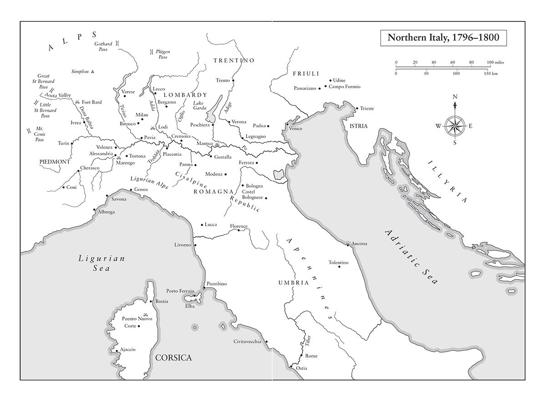
Napoleon would have to choose by which pass to cross the Alps into northern Italy. He would have preferred the easternmost ones – Splügen or St Gothard – so that he could carry out his favoured manoeuvre sur le derrière, but the speed of the Austrians’ westward advance through northern Italy towards southern France forced him to choose between the 8,100-foot Great St Bernard or the 7,100-foot Little St Bernard. The Little St Bernard was too far west, so Napoleon sent only one division there and decided on the Great St Bernard for the main body of the army. He also sent one division under General Adrien Moncey over the St Gothard Pass.
He was counting on an element of surprise: no one had taken an army over the Alps since Charlemagne, and before him Hannibal. Although Napoleon wouldn’t be travelling with elephants, he did have Gribeauval 8-pounder and 4-pounder cannon, whose barrels weighed over a quarter of a ton, to heave over the mountain range. Snow was still thick on the ground in early May, when the advance began, so Marmont devised sledges for the barrels made out of hollowed-out tree-trunks, which one hundred men at a time hauled up the Alps and then down again, to drumbeats. (Since the Italian side is much steeper than the French, they found it harder going down than up.) Money and supplies were sent ahead to the monasteries and hostelries along the route, and local guides were hired and sworn to secrecy. Napoleon, Berthier and, after April 2, Carnot – who had been appointed minister of war when Napoleon despatched Berthier to the Army of the Reserve – together organized every facet of an operation that was to become one of the wonders of military history. ‘An army can pass always, and at all seasons,’ Napoleon told a sceptical General Dumas, ‘wherever two men can set their feet’.2
On March 17 Napoleon held a consuls’ meeting, which he did most days at this time, a Conseil d’État, which he did every couple of days, and then a military strategy session with his chief cartographer, General Bacler de l’Albe, kneeling on huge large-scale maps of Piedmont spread out on the floor and covered in red and black wax-tipped pins to show the positions of the armies. (Sometimes, when crawling around the floor together on the maps, Napoleon and de l’Albe would bump heads.) In the strategy meeting he allegedly asked Bourrienne where he thought the decisive battle would be fought. ‘How the devil should I know?’ answered his Brienne-educated private secretary. ‘Why, look here, you fool,’ said Napoleon, pointing to the plains of the River Scrivia at San Giuliano Vecchio, explaining how he thought Melas would manoeuvre once the French had crossed the Alps.3 It was precisely there that the battle of Marengo was fought three months later.
On April 19 the 24,000 men under the Austrian General Karl von Ott laid siege to Masséna’s 12,000 men inside Genoa. There was little food to be had in the city, which the Royal Navy was blockading. Lieutenant Marbot recalled that over the following weeks they had to live on a ‘bread’ that was ‘a horrible compound of bad flour, sawdust, starch, hair powder, oatmeal, linseed, rancid nuts, and other nasty substances, to which a modicum of solidity was given by a little cocoa’.4 General Thiébault likened it to peat mixed with oil. Grass, nettles and leaves were boiled with salt, all the dogs and cats were eaten, and ‘rats fetched a high price’. Civilians and soldiers started to die in their thousands of starvation and the diseases associated with malnutrition. Whenever more than four Genoans were gathered together, French troops had orders to fire on them for fear they might surrender the port.
Napoleon was itching to act, writing to Berthier on April 25, ‘The day when, either because of events in Italy or because of those on the Rhine, you think my presence will be necessary I will leave an hour after receiving your letter.’5 In order to calm speculation and deal with the wider logistical problems of the coming campaign, Napoleon stayed at Malmaison and in Paris, reviewing his worst-equipped troops in full view of the populace (and Austrian spies) and going to the opera on the night of Monday, May 5. The whole balance of the war seemed to be tipped towards the German theatre, where Moreau had far larger forces and was doing well, crossing the Rhine on April 25 to Napoleon’s effusive and almost deferential private congratulations. To those unversed in the realities of power-politics, it might even have seemed that Napoleon was the Grand Elector and Moreau his consul for war.
Then Napoleon struck. Leaving Paris at 2 a.m. only a few hours after the end of the opera, he was in Dijon the next morning, and by 3 a.m. on May 9 he was in Geneva. Once there he made himself conspicuous at parades and reviews, and gave out that he was going to Basle, despite the fact that the vanguard of General François Watrin’s division was already starting to ascend the Great St Bernard Pass, soon followed by the forces under Lannes, Victor and General Philibert Duhesme. Napoleon kept Bessières’ Consular Guard and Murat’s cavalry back with him.6 (Duhesme, who owned a vineyard, sent Napoleon some wine, receiving the reply: ‘We’ll drink it in honour of the first victory you win.’7)
It had been a hard winter and the track – there was no road over the St Bernard until 1905 – was icy and banked high with snow, yet Napoleon was extremely lucky with the weather, which was much worse both before the army started crossing the Alps on May 14 and after it had finished eleven days later (half the time it took Hannibal). Only one cannon out of forty was lost to avalanche. ‘Since Charlemagne, it has never seen such a large army,’ Napoleon told Talleyrand on the 18th, ‘it wanted above all to block the passage of our large campaign equipment, but finally, half our artillery is in Aosta.’8 Napoleon didn’t lead his army over the Alps, but he followed it once the most important logistical issues – food, ammunition and mules – had been dealt with.9 He kept a constant pressure on the ordonnateurs, with warnings such as ‘We risk dying in the valley of Aosta, where there is only hay and wine.’10 He himself crossed the most difficult part, at Saint-Pierre, on May 20, by which time Watrin and Lannes were 40 miles inside Piedmont.
In all 51,400 men crossed the Alps, with 10,000 horses and 750 mules. They went by single file in some places, and had to start at dawn every day to reduce the risk of avalanches once the sun had risen.11 When they reached the formidable Fort Bard at the entrance to the Aosta valley, which commands a narrow gorge high above the Dora Baltea river, four hundred Hungarians under Captain Joseph Bernkopf held out for twelve days, blocking the advance of almost all of Napoleon’s heavy traffic – the guns, thirty-six caissons and one hundred other vehicles – which therefore fell far behind, severely disrupting the campaign. Some wagons managed to get past at night, with dung and straw strewn in the path of the covered wheels to deaden the noise, but it was not until the walls of the fort were breached in several places and it fell on June 2, at the cost of half of Bernkopf’s forces, that the rest were able to follow. The delay at Fort Bard meant that Napoleon went forward desperately short of artillery and ammunition, and had to scour Lombardy and Tuscany to requisition whatever he could.
Managing expectations was a vital part of Napoleon’s statecraft, and he knew better than to allow his countrymen’s to be stoked up after his departure from Paris. Angry that the newspapers there were claiming he had predicted he would capture Milan within a month, he wrote on May 19, ‘That is not in my character. Very often I do not say what I know: but never do I say what will happen.’12 He ordered that ‘a jocular note’ to that effect be inserted in the Moniteur. In fact, he was indeed in Milan within a month of leaving Paris.
Napoleon rode a horse for almost the whole journey over the Alps, and a mule (as it was more sure of foot) for the iciest stretch around Saint-Pierre.13 He wore civilian dress under his customary grey overcoat. When he asked his guide what he wanted for taking him over the mountains, he was told that, at twenty-two, all he desired was ‘the happiness of those who possessed a good house, a number of cattle, sheep, etc.’ which he needed in order to marry his girlfriend.14 When, having ordered that he be given 60,000 francs to purchase all those things, Napoleon discovered that the lad was twenty-seven, already married and owned his own house, he gave him 1,200 francs instead.15
• • •
By May 22 Lannes had taken Ivrea and Piedmont lay before the French army, yet the reports that von Melas (who had by then captured Nice) was receiving still maintained that there were only 6,000 Frenchmen in the valley of Aosta. In allowing Melas to take Nice, Napoleon was drawing the Austrian further and further westwards before unleashing his blow. By the 24th he was at Aosta with 33,000 men and Moncey’s division of 12,500 was on its way. ‘We have struck here like lightning,’ Napoleon told Joseph, who was now a member of the Legislative Body in Paris, ‘the enemy wasn’t expecting anything like it and can hardly believe it. Great events are going to take place.’16
It was at this stage of the campaign that the sheer ruthlessness that helped make Napoleon so formidable a commander revealed itself once again. Instead of marching south to relieve starving Genoa, as his troops and even his senior commanders assumed he would do, he wheeled eastwards towards Milan to seize the huge supply depot there and cut off Melas’s line of retreat towards the Mincio river and Mantua. Ordering Masséna to hold out for as long as possible so that he would tie down Ott’s besieging force, Napoleon outfoxed Melas, who had taken it for granted that Napoleon would try to save Genoa. He had therefore left Nice and marched back from Turin to Alessandria to try to head Napoleon off.
On June 2 Melas ordered Ott to lift the siege of Genoa in order to concentrate his army. Ott ignored him, as Masséna had just asked for terms of surrender. At 6.30 p.m. that same day Napoleon entered Milan by the Verceil Gate in the pouring rain and installed himself at the archducal palace, staying up until 2 a.m. dictating letters, receiving Francesco Melzi d’Eril, who had run the Cisalpine Republic, setting up a new city government and releasing political prisoners interned by the Austrians, who had used Milan as their regional headquarters. He also read Melas’s captured despatches from Vienna, which told him the enemy’s strengths, dispositions and state of morale. Moncey joined Napoleon in Milan with his division, but with few guns and little ammunition. Meanwhile Lannes entered Pavia, and although the thirty guns he captured there had been spiked, he managed to get five working again. To Napoleon’s amusement a letter was intercepted from Melas to his mistress in Pavia telling her not to worry, as a French army could not possibly appear in Lombardy.17 On both May 11 and 16 Napoleon wrote to Josephine, asking her about ‘the little cousin’ and sending her news of her son Eugène. On the 29th he wrote again, saying: ‘I hope to be in the arms of my Josephine in ten days, who is always good when she doesn’t cry and isn’t coquettish.’18
Genoa surrendered on June 4, by which time around 30,000 of its 160,000 inhabitants had died of starvation and of diseases associated with malnutrition, as had 4,000 French soldiers. Another 4,000 soldiers who were fit enough to march out were allowed to return to France with the honours of war, and a further 4,000 sick and wounded were transported to France in Royal Navy ships under Admiral Lord Keith, who had blockaded the port but saw the advantage of evacuating so many French away from the theatre of war.19 Masséna’s health was broken, not least because he had insisted on only eating what his troops did. He never wholly forgave Napoleon for not rescuing him. Equally, Napoleon – who was never besieged in the whole of his career – criticized Masséna for not having held out for ten days longer, recalling when in exile on St Helena, ‘A few old men and some women might have died of hunger, but then he would not have surrendered Genoa. If one thinks always of humanity – only of humanity – one should give up going to war. I don’t know how war is to be conducted on the rosewater plan.’20 He even castigated Masséna in his memoirs, contrasting his actions with those of the Gauls under Vercingetorix when besieged by Caesar at Alesia. If Masséna had indeed managed to hold out another ten days, Ott might not have arrived in time at the battlefield of Marengo.
Napoleon was playing for far larger stakes than one city; he wanted to kill or capture every Austrian west of Milan.21 It was Genoa’s resistance that allowed him to get behind Melas, who then had to abandon his plans of taking Toulon in conjunction with Admiral Keith and somehow get back east to re-establish his severed lines of communication. Piacenza and Valenza were now the last major crossing-points over the Po that were not in French hands, so Melas despatched several columns towards both cities.
In Milan, Napoleon questioned spies such as the double (or possibly triple) agent Francesco Toli as to Austrian dispositions. On June 4 he attended La Scala, where he received a huge ovation, and that night he slept with its star singer, the beautiful twenty-seven-year-old Giuseppina Grassini, with whom Berthier found him breakfasting the next morning.22 ‘I don’t invite you to come here,’ Napoleon told Josephine coolly in his next letter. ‘I shall be on my way back in a month. I hope that I shall find you very well.’23Later on that day, presumably after Signorina Grassini had left, two hundred Catholic priests arrived at the palace to discuss theology. Napoleon asked them to allow him to ‘acquaint you with the sentiments which animate me towards the Catholic, Apostolic and Roman religion’.24 He made no reference to the view he had expressed to the Cairo diwan less than a year before, that ‘There is no other God but God; Mohammed is his prophet,’ but instead explained that Catholicism ‘is particularly favourable to republican institutions. I am myself a philosopher, and I know that, in no matter what society, no man is considered just and virtuous who does not know whence he came and whither he is going. Simple reason cannot guide him in this matter; without religion one walks continually in darkness.’25 Faith, for Napoleon, was an evolving concept, even a strategic one. When he said he adopted the faith of wherever he was fighting at the time he was quite serious, and in northern Italy that meant Roman Catholicism.
• • •
Melas had three routes to safety: via Piacenza and along the southern bank of the Po, towards Genoa and evacuation by sea courtesy of the Royal Navy, or crossing the Ticino river at Pavia. Returning to the field on June 9, Napoleon attempted to block all three, but in doing so he had to violate his own first principle of warfare: concentration of force. That day Lannes defeated Ott between Montebello and Casteggio, forcing the Austrians to withdraw westwards over the Scrivia to Alessandria, where he joined Melas. ‘Without exaggerating,’ Napoleon told State Councillor Claude Petiet the next day, ‘the enemy had 1,500 killed, one can imagine twice as many wounded.’ Of course he was exaggerating, as usual; 659 had been killed and 1,445 wounded.26
Over the next three days, Napoleon waited at Stradella to see what Melas intended. The night of June 11 he spent talking with Desaix, who had arrived from Egypt just in time for the coming clash, albeit without his men, having taken advantage of a brief armistice with the British signed by Sir Sidney Smith but not ratified by the British government. The previous month Napoleon had written to Desaix that theirs was ‘a friendship that my heart, which today is very old and knows men too profoundly, has for no other’.27 He immediately gave Desaix a corps made up of Monnier’s and Boudet’s divisions.
At 10 a.m. on the 13th Napoleon rode to San Giuliano Vecchio. Before him were the fields adjoining the village of Marengo, about 21/2 miles east of Alessandria near the confluence of the Tanaro and Bormida rivers. Three roads converge at Marengo, beyond which a bridge crosses the Bormida for Alessandria; a double bend in the Bormida created a natural bridgehead position. The villages of Castel Ceriolo, Marengo and Spinetta line the Bormida, and 4 miles to the east is San Giuliano. The ground between the Bormida and Marengo was broken by vineyards, cottages, farms and some marshland, but beyond it the plain was so broad and flat that the military historian Colonel Henri de Jomini, who, years later, was attached to Napoleon’s staff, described it as one of the few places in that part of Italy where masses of cavalry could charge at full speed. (The fields are much more cultivated today, but in 1800 the taller crops could still obscure vision.) In the pouring rain of June 13, the small numbers of French cavalry (generally put at 3,600) failed properly to scout the 140-square-mile plain and merely accompanied the infantry marching towards Tortona. It was to prove a costly error.
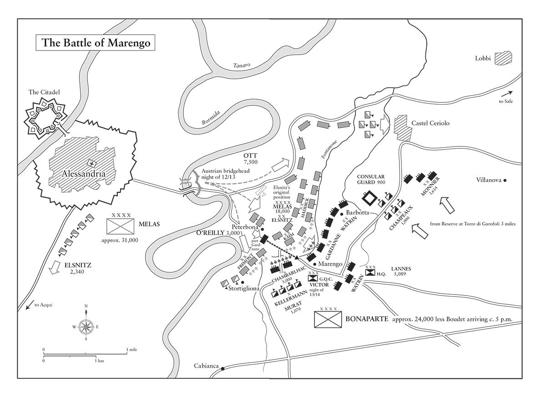
An hour after arriving at San Giuliano, Napoleon was informed that Melas was preparing to march to Genoa. It looked as if he had entirely abandoned the plain and was covering his retreat by holding Marengo. Napoleon left Lapoype’s division north of the Po with the task of seizing the crossing-point at Valenza, and allowed Desaix to take Boudet’s division and march for Novi, to head off Melas. Victor, commanding a corps in the vanguard, was ordered to take Marengo: at 5 p.m. General Gaspard Gardanne engaged some 3,000 Austrians there. As General Achille de Dampierre closed in from the south, Gardanne charged into the village. A heavy downpour of rain slowed the action for a while, filling up the streams and rivers before the French took the village, two guns and about a hundred prisoners. Though the Austrians halted the French pursuit by 7 p.m. with vigorous cannonading from the other side of the Bormida, which went on till 10 p.m., the French assumed that they had no intention of fighting there the next day.
There were no campfires visible and French patrols and their piquets (infantry) and vedettes (cavalry) did not report any unusual activity, so Napoleon was not expecting Melas’s major counter-attack across the river the next day. Intelligence was often scrappy. Cavalry patrols counting troops at a distance through telescopes, often under threat, couldn’t be exact, and in this case there was a major river in the way. ‘The Consul, with his horse guards,’ recalled Joseph Petit, a Consular Guard horse-grenadier, ‘skirted Marengo. We saw him almost the whole time, at a distance from us, traversing the plain, examining the terrain with attention, by turns profoundly meditating, and giving orders.’28
Napoleon questioned deserters, including an émigré officer wearing the Bourbon cross of St Louis, ‘with considerable earnestness’, and, as Petit recalled, ‘All the prisoners were astonished when they learned that the person they had just been speaking with was Bonaparte.’29 Yet nothing he was told led him to expect that the Austrian rearguard had secretly turned around and been joined by the rest of the Austrian army, or that Melas had decided to use his numerical advantage over Napoleon in cavalry and artillery to attack in force. So on the morning of Saturday, June 14, 1800, Napoleon had only around 15,000 men in three infantry divisions and two cavalry brigades on the field of the battle of Marengo. Monnier and the Consular Guard were a full 71/2 miles in the rear around the farmhouse of Torre Garofoli, about 21/2 miles further east along the main road from San Giuliano where Napoleon had spent the night and from where he viewed the terrain from the bell-tower of the sixteenth-century church of St Agnes (which is still there today). Victor was in Marengo, but Desaix was 5 miles back behind San Giuliano, heading off towards Novi, and Lapoype was marching towards the north bank of the Po.30
The Bormida river has very steep sides, but the Austrians built floating bridges and tethered them into place on the night of the 13th, established bridgeheads and then slept without bivouac fires to lull the French into misapprehending their positions and numbers. When the sun came up at 4.30 a.m. on what was to be a very hot day, 15,000 French soldiers with only 15 guns faced 23,900 Austrian infantry, 5,200 cavalry and 92 guns.31 Yet even at daybreak Victor failed properly to warn Napoleon, who recognized the seriousness of the situation only when the Austrian artillery opened fire at 9 a.m., as Gardanne’s pickets were thrust back. An early and vigorous French attack on the bridgehead might have halted the Austrian debouchment, but by 9 a.m. that was impossible. If the Austrians had simply surged forward as each unit crossed the bridge, instead of wasting an hour forming up in order to move off together, they might well have overwhelmed Victor. A major defeat at Marengo could have toppled the Consulate, as Sieyès and others were already plotting in Paris.
Murat ordered the cavalry brigade of François-Étienne Kellermann (the son of the victor of Valmy) forward from San Giuliano, as Berthier, who had a fine view from a small hill at Cascina Buzana, ordered Victor to offer stubborn resistance and sent word to Napoleon to bring up the troops from Torre Garofoli as quickly as possible. By 9.30 a.m. Gardanne was under heavy artillery fire, which on that hard and flat plain involved much ricocheting, but as the French fought this battle in line their losses were minimized. The firefight raged for two hours, the French firing steadily by platoon volley, but Gardanne’s six battalions were pounded by the Austrian guns and had to fall back slowly to the Fontanone brook, whose steep sides can be seen today outside the Marengo museum. Dampierre’s small force on the Austrian right, well hidden in ditches and ravines, wasn’t overwhelmed until 7 p.m. when he surrendered, having fired off all his ammunition and finding himself surrounded by hussars.
By 10 a.m. on June 14 Napoleon had ordered Lannes towards Cascina La Barbotta to shore up Victor’s right. Singing the ‘Marseillaise’, the 6th Légère and 22nd Line launched attacks that pushed the Austrians back over the Fontanone, swollen from the rains of the previous night. ‘The Austrians fought like lions,’ Victor later acknowledged. The French refused to abandon the Fontanone line when the Austrians counter-attacked; soldiers urinated on muskets that had become too hot to handle from the constant firing. By noon the French line was being pounded by forty guns and incessant musketry, and was running low on ammunition. ‘Bonaparte advanced in front,’ recalled Petit, ‘and exhorted to courage and firmness all the corps he met with; it was visible that his presence reanimated them.’32
At this point the Austrian Archduke Joseph, Archduke Charles’s younger brother, crossed the Fontanone with his infantry – the sides were too steep for cavalry or artillery. The French failed to dislodge him and his men started building a trestle bridge, covered by artillery firing canister shot which flayed the French brigade sent to stop them. By 2 p.m. Marengo had fallen: the Austrians had brought eighty guns into play, the Fontanone was being crossed everywhere and Gardanne’s division was broken, fleeing the field, though not before it had bought Napoleon 31/2 hours’ respite with which to organize his counter-attack. Only Kellermann’s cavalry brigade, carefully retiring squadron by squadron, intimidated the Austrians from releasing their numerically superior cavalry force. As the Austrians deployed into line of battle beyond Marengo, Victor was forced to retreat almost to San Giuliano before he could re-form his ranks, which he did across the plain in squares, suffering severe losses from a battery of fifteen guns that the Austrians brought well forward. By this point the Austrians were taunting the French, twirling the bearskins of dead French grenadiers around on their sabres.33
Meanwhile, Lannes was thrown on to the defensive by Ott’s infantry advance, his right bent back and short of ammunition. With no artillery, almost surrounded, and pounded by enemy guns, he ordered a retreat over the plain at less than a mile per hour, retiring by echelon in a disciplined but expensive movement in front of the Austrian guns. Napoleon, who now had only Monnier’s division and the Consular Guard in reserve, had sent desperate word to Desaix at 11 a.m. to return with Boudet’s division as quickly as possible. ‘I had thought to attack the enemy, instead it is he who has attacked me,’ went his message; ‘in the name of God, come back if you still can!’ Luckily for Napoleon’s consulship, Desaix had been severely delayed by the swollen Scrivia. He sent a messenger back at 1 p.m. telling Napoleon to expect him at about 5 p.m. He and Boudet had to halt the division, turn it around and march it back 5 miles in the searing heat to the sound of guns, but they managed it in the nick of time. Napoleon’s similar message recalling Lapoype from much further afield didn’t reach him until 6 p.m., by which time it was too late.
When Napoleon and Monnier arrived at the battlefield, at 2 p.m., the situation could hardly have been more serious, with the French slowly retreating in the centre, broken on the left and seriously menaced on the right.34 Napoleon knew he had to defend the Tortona road but couldn’t do so frontally, so he deployed his reserves off to the right. Lannes could be relied upon to hold the line there, which if necessary could be used as an alternative line of retreat. Ott was the foremost problem: he was only held back by six hundred men. In order to help disengage Lannes, Monnier sent General Claude Carra Saint-Cyr and seven hundred men of the 19th Légère into a thinly held Castel Ceriolo while the 70th Line moved to take Ott in the rear and the 72nd Line was held in reserve. Ott was initially driven back into the Bormida marshes, but he retook the village after an hour-long firefight with Saint-Cyr.
This was therefore emphatically not the time for Melas, who had had two horses shot from under him and had suffered a slight contusion to his forearm, to quit the battlefield, return to Alessandria, announce a victory to Vienna and give orders for his deputy to take over, capture San Giuliano and send cavalry to pursue the routed French. Yet, astonishingly, that is what he did.
At 3 p.m., as more Austrian cavalry rode out onto the plain to threaten Lannes’ flank, Napoleon decided to commit nine hundred infantry of the Consular Guard, who were deployed between La Poggi and Villanova in column, singing ‘On va leur percer le flanc’ (We’ll pierce their flank). The 96th Line later said they had saved the day by handing over some of their ammunition as they marched up. When one of Ott’s dragoon regiments charged them they formed a square, and beat them off aided by their skirmishers and four regimental guns. The Guard were then attacked by infantry, with whom they traded volleys for forty minutes at ranges from 50 to 100 yards; 260 of them were killed that day, and roughly the same number wounded. They beat off three cavalry charges, but, as the Austrian infantry fixed bayonets and charged home, they were forced to make a fighting retreat in square back towards La Poggi. This sacrifice by the Guard nonetheless bought the time Monnier needed to complete his manoeuvres, which, in turn, bought time for the whole army to reorganize. Napoleon later spoke of the ‘fortress of granite’ that had been his Consular Guard that day, and awarded twenty-four decorations to their infantry, eighteen to their cavalry and eight to their artillery.
By 4 p.m. both the Consular Guard and Monnier’s division were in controlled retreat as the Austrians closed in on San Giuliano. The French moved backwards in good order, one battalion at a time, fighting as they went. It was an utter test of discipline not to succumb to the temptation to break ranks under those circumstances, and it paid off. The day continued very hot, with no water, little artillery support, and sustained attacks from the Austrian cavalry, but some units retreated steadily from 9.30 a.m. to about 4 p.m. over 5 miles, never breaking ranks.
Napoleon calmly called out encouragement and exuded leadership ‘with his accustomed sangfroid’, in the words of one of his guards, ensuring that his infantry, cavalry and paltry artillery each supported one another.35 ‘The Consul seemed to brave death,’ recalled Petit, ‘and to be near it, for the bullets were seen more than once to drive up the ground between his horse’s legs.’36 He had now completely used up his reserves, had barely 6,000 infantry across a 5-mile front, with 1,000 cavalry and only 6 usable guns, and his army was exhausted, desperately thirsty, low on ammunition and one-third hors de combat, but he behaved as if victory were certain.37 He even managed to be light-hearted; noticing that the horse Marbot was riding was slightly wounded in the leg, he ‘took me by the ear and said, laughing, “You expect me to lend you my horses for you to treat them in this way?”’38
With a dense mass of Austrian infantry preparing to advance, Napoleon ordered Berthier to organize a safe retreat while he went to the Villa Gholina to scout for Desaix from the roof. Seeing the dust rising from Desaix’s column, he rode over to speed them up and then quickly countermanded his retreat order to Berthier. When the army saw Desaix arrive, riding a little ahead of his men who were on foot, their morale was reignited. Once Boudet reached San Giuliano, and Lannes, Monnier and Watrin got their men into something like a line of battle, the Austrians halted their columns and started to deploy into line for what they assumed would be a final triumphant assault. ‘We have gone back far enough today,’ Napoleon harangued his men. ‘Soldiers, remember it is my custom to bivouac on the field of battle!’39
With the six still-usable guns on the field joined by five from the reserve and eight from Boudet, Marmont now had a respectable battery to deploy on a slight elevation. Boudet deployed his 4,850 infantry in the ordre mixte onto the main road, partly hidden by hedges and vineyards. Napoleon rode along the line encouraging the men; he now had 11,000 infantry and 1,200 cavalry for his long-awaited counter-attack.
When the Austrians came forward at 5 p.m., the front of their centre regiments were ripped apart by canister fire from Marmont’s battery. As at Rivoli, a lucky shot hit an ammunition wagon that exploded and caused chaos. The Austrians recoiled sharply and the shock effect was serious, especially once Boudet’s division advanced upon them. Aggressive Austrian charges soon threw Boudet on the defensive, but just as nearly 6,000 Austrian infantry fired a musket volley and then charged with their bayonets, Kellermann unleashed his cavalry, which had moved up concealed by vines in the trees. As a result, the Austrians’ muskets were unloaded when four hundred men of the 2nd and 20th Cavalry regiments crashed into the left flank of the central column of Hungarian grenadiers. The 2nd Cavalry sabred three battalions, taking 2,000 prisoners and sending 4,000 men fleeing. Immediately afterwards, Kellermann turned the 200 men who had been at the rear of the last charge and attacked some 2,000 Austrian cavalry that were standing inactive, routing them as well.
The French army then advanced across the whole front. It was at this triumphant moment that Desaix was struck in the chest and killed. ‘Why am I not allowed to weep?’ a grief-stricken Napoleon said on being told the news, but he had to concentrate on directing the next assault.40 Kellermann’s next attacks sent Austrian cavalry charging back into their own infantry, completely disorganizing them and giving Lannes, Monnier and the Consular Guard the chance to complete the victory by moving forward on all fronts. ‘The fate of a battle is the result of a single instant – a thought,’ Napoleon was later to say about Marengo. ‘The decisive moment comes, a moral spark is lit, and the smallest reserve accomplishes victory.’41 Austrian troops who had fought bravely all day simply cracked under the shock and strain of seeing victory snatched from them, and fled back to Alessandria in disorder.
The exhausted French indeed slept that night on the battlefield. In total, 963 Austrians were killed, 5,518 wounded and 2,921 captured; 13 guns indeed were seized and a further 20 dumped in the Bormida. Just over 1,000 Frenchmen were killed, 3,600 wounded and 900 captured or missing, but the numbers mask what was a crushing strategic victory for Napoleon.42 According to the terms of the armistice that Melas signed soon afterwards, Napoleon would be given the whole of Piedmont, Genoa, most of Lombardy, 12 fortresses, 1,500 guns and massive ammunition magazines. When the news of Marengo reached Paris, government bonds that had been standing at 11 francs six months earlier, and 29 just before the battle, shot up to 35 francs.43 After the battle, Napoleon gave orders to Masséna on July 22 to ‘plunder and burn the first village which revolts in Piedmont’, and to Brune on November 4: ‘All foreigners, but especially Italians, need to be dealt with severely from time to time.’44 But now that the Austrians had been expelled for the second time, northern Italy was swiftly pacified with a minimum of repression, and was to remain quiescent for the next fourteen years. Marengo confirmed Napoleon in his position as First Consul, and added to the myth of his invincibility.
• • •
Napoleon had worked his three arms of infantry, artillery and cavalry together perfectly at Marengo, but it was still a very lucky victory, won largely by the shock value of Desaix’s arrival on the field at precisely the right psychological moment, and Kellermann’s superbly timed cavalry charges. The French reconquered a plain in one hour that it had taken the Austrians eight to occupy. The conscript French troops, guided by the veterans, had acquitted themselves very well.
‘After a great battle,’ wrote Captain Blaze, ‘there is plenty of food for the crows and the bulletin-writers.’45 Napoleon had made three major errors: in going onto the plain in the first place, in not anticipating Melas’s attack and in sending Desaix so far away. But he had won, and for political reasons it was imperative that Marengo be seen as his triumph, or at least one shared with the dead Desaix. The post-battle bulletin was thus pure propaganda, implying that the Austrians had fallen into his trap. ‘The battle appeared to be lost,’ it stated somewhat fancifully. ‘The enemy was allowed to advance within musket range of the village of San Giuliano, where General Desaix’s division was drawn up in the line of battle.’46 Napoleon also invented some last words for Desaix: ‘Go tell the First Consul that I die with the regret of having not done enough to live in posterity.’ (In fact he had died instantaneously.) Berthier’s official history of the battle had to go through three revisions before Napoleon approved it. By January 1815 Napoleon was uncharitably claiming that Marengo had been won before Desaix arrived.47 The view of Desaix’s aide-de-camp Anne-Jean-Marie-René Savary was that ‘If General Desaix had delayed an hour in arriving, we’d have been driven into the Po.’48
The day after the battle, Napoleon wrote to the other consuls that he was ‘in the deepest pain over the death of the man I loved and respected the most’.49 He took Savary and Desaix’s other aide-de-camp, Jean Rapp, onto his staff as a sign of respect, and he allowed the 9th Légère, which Desaix had been leading when he was killed, to sew the word ‘Incomparable’ in gold onto their standard.50 He had Desaix’s corpse embalmed, and a medal struck in his honour, as well as one commemorating Marengo.* All that he said to Kellermann after the battle was, ‘You made a pretty good charge,’ which infuriated him, especially as he had gushed to Bessières, ‘The Guard cavalry covered itself with glory today.’51 (Kellermann is supposed to have replied in anger, ‘I’m glad you are satisfied, general, for it has placed the crown on your head’, but it is doubtful that he really did.52) Privately, Napoleon admitted to Bourrienne that Kellermann had ‘made a lucky charge. He did it just at the right moment. We are much indebted to him. You see what trifling circumstances decide these affairs.’ Kellermann was given his own division within a month, and later in his career Napoleon turned a blind eye to his outrageous looting. Perhaps the best summing up of the battle was Napoleon’s terse statement to Brune and Dumas: ‘You see, there were two battles on the same day; I lost the first; I gained the second.’53
• • •
On June 16 Napoleon offered Emperor Francis peace once again, on the same basis as Campo Formio, writing: ‘I exhort Your Majesty to listen to the cry of humanity.’ In his Order of the Day he claimed the Austrians had recognized ‘that we are only fighting each other so that the English can sell their sugar and coffee at a higher price’.54 The next day ‘the Liberator of Italy’ was back in Milan again, enjoying the charms of Giuseppina Grassini, whom he invited to sing in Paris at the Quatorze Juillet celebrations and at Desaix’s obsequies. ‘Berthier informs me that he is counting on sending either Mrs Billington or Madame Grassini,’ he wrote somewhat disingenuously to Lucien on June 21, ‘who are the two most famous virtuosi in Italy. Have a fine piece composed in Italian. The voices of these actresses should be known to Italian composers.’55 Grassini complained that Napoleon’s ‘caresses were on the furtive side’, and often left her unsatisfied, and in this she wasn’t alone. He never took time over his lovemaking, once reporting to an aide, ‘The matter was over in three minutes.’56
• • •
For all his military genius, intellectual capacity, administrative ability and plain hard work, one should not underestimate the part that sheer good luck played in Napoleon’s career. In May 1800 there was a gap in the weather for crossing the Alps, and in June the rains slowed Desaix’s march away from Marengo enough so that he could return to the battlefield in time to save his commander-in-chief. In 1792 Colonel Maillard’s report on the events in Ajaccio was swamped under war ministry paperwork on the outbreak of war; in 1793 the pike-thrust at Toulon didn’t go septic; in 1797 Quasdonovich’s ammunition wagon received a direct hit at Rivoli, as Melas’s did at Marengo; in 1799 the Muiron had perfect winds on leaving Alexandria; the same year Sieyès’ other choices for the Brumaire coup were unavailable, and Kléber’s report on the Egyptian campaign didn’t arrive in Paris before the coup, during which Thomé’s sleeve was torn enough to anger his comrades. Napoleon recognized this, and spoke more than once of ‘the goddess Fortune’. Later in his career he would believe that the goddess was spurning him, but for now he was persuaded that she was on his side.