
13
‘What a pity the man wasn’t lazy.’
Talleyrand on Napoleon
‘After great revolutions all sorts of events are to be expected, before things calm down.’
Napoleon to Jourdan, January 1800
‘I shall blow into Paris unexpectedly,’ Napoleon wrote to Lucien from Lyons on June 29, 1800. ‘I want no triumphal arches or any such colifichets [fripperies]. I have too good an opinion of myself to care about such nonsense. The only real triumph is the satisfaction of the people.’1 Napoleon arrived at the Tuileries at 2 a.m. on July 2, and on the 14th, by now a firm date in the republican calendar, huge parades were organized on the Champ de Mars (where the Eiffel Tower stands today) featuring captured standards, as well as ceremonies at Les Invalides, the Place de la Concorde and the Place Vendôme. He told his fellow consuls he didn’t want a re-enactment of a chariot race, which ‘might have been very good in Greece, where one fought on chariots, but that doesn’t mean much chez nous’.2 The Consular Guard had arrived only that morning, so they paraded in their tattered and bloodstained uniforms. Lucie de La Tour du Pin was surprised to find the crowd quiet and shocked at the sight of the wounded; she concluded that above all they wanted an early peace.3 Although peace terms were being negotiated with Austria from as early as July, they wouldn’t be signed until Moreau inflicted a crushing defeat on Archduke Johann at Hohenlinden on December 3, capturing 8,000 prisoners, 50 guns and 85 ammunition and baggage wagons. The Austrians fought on listlessly until Christmas Day, when the Archduke Charles agreed an armistice at Steyr, only 90 miles from Vienna. ‘You surpassed yourself again in this campaign,’ Napoleon wrote to Moreau. ‘These wretched Austrians are very obstinate. They were relying upon the ice and snow; they weren’t yet acquainted with you. I salute you affectionately.’4
The end of the Quasi-War with America came on October 3, with a treaty negotiated by Joseph and signed at Mortefontaine, his chateau on the Loire. This meant that France no longer had to face the threat of a nascent American navy co-operating with the British Royal Navy. ‘The First Consul was grave,’ wrote the American envoy William Van Murray after its ratification, ‘rather thoughtful, occasionally severe – not inflated nor egotistical – very exact in all his motions which show at once an impatient heart and a methodical head . . . of a most skillful fencing master . . . He speaks with a frankness so much above fear that you think he has no reserve.’5 Four days later, France and Spain agreed to the secret Convention of San Ildefonso, which provided that when France made peace with Austria, Habsburg-owned Tuscany would be ceded to the Bourbon heir of the Duke of Parma, King Charles IV of Spain’s son-in-law Don Louis; in return Spain would cede Louisiana (then a vast territory covering land in thirteen modern-day US states from the Gulf of Mexico to the Canadian border) to France.* Under one of the provisions of San Ildefonso, France promised not to sell Louisiana to a third power.
Meanwhile, the prospect of Malta, which had been subjected to a two-year blockade by the Royal Navy, falling to Britain led Napoleon formally to give the island to Paul I of Russia, in the Tsar’s capacity as the new grand master of the Knights of St John. Although this didn’t carry any weight with the British once they captured the island on September 5, it served to improve Franco-Russian relations, and the Tsar offered to recognize the Rhine and the Alpes-Maritimes as France’s natural borders. By the end of the year he had inaugurated the League of Armed Neutrality, by which Prussia, Sweden and Denmark joined Russia in opposing Britain’s harsh and deeply unpopular maritime trade laws, particularly its unlimited searches of neutral shipping for French contraband. So friendly were Napoleon’s relations with Paul by early 1801 that plans were even drawn up for Masséna to enter Astrakhan with 35,000 men, join up with 35,000 Russians and 50,000 Cossacks, and then cross the Caspian Sea to take Kandahar, from where they would invade India.6 It was another of Napoleon’s far-fetched Oriental schemes, though not so fantastical as a march from Aleppo.
• • •
Just after 8 p.m. on Wednesday, December 24, 1800, Napoleon and Josephine took separate carriages to the Opéra to listen to Haydn’s oratorio The Creation. At the corner of Place du Carrousel and rue Saint-Niçaise, gunpowder had been placed in a water-barrel on a seed-merchant’s cart, drawn by a small dray horse, by Joseph Picot de Limoelan, a Chouan who had arrived from London just over a month earlier.* The fuse was lit by a former naval officer, Robinault de Saint-Régant, an accomplice of the Chouan leader Georges Cadoudal, who gave the horse’s reins to a young girl to hold as he made off. A combination of the fuse being slightly too long and the speed with which Napoleon’s coachman César was driving, swerving past the cart in the street, saved Napoleon’s life.7‘Napoleon escaped by a singular chance,’ recorded his aide-de-camp Jean Rapp, who was in the following coach with Josephine at the time. ‘A grenadier of the escort had unwittingly driven one of the assassins away from standing in the middle of the rue Niçaise with the flat of his sabre and the cart was turned round from its intended position.’8 Josephine’s carriage was far enough behind for all its occupants to survive the massive explosion too, although Hortense was lightly cut on her wrist by the flying glass of the carriage windows. The machine infernale, as it was dubbed, killed five people (including the young girl holding the horse) and injured twenty-six.9 It could have been far more, since no fewer than forty-six houses were damaged.
Both carriages came to a halt, and through the scene of carnage Rapp got out of Josephine’s carriage to check on Napoleon. When Josephine was told that her husband was unharmed, and indeed insisted on continuing to the Opéra, she bravely followed and found ‘Napoleon was seated in his box, calm and composed, and looking at the audience through his opera-glass.’ ‘Josephine, those rascals wanted to blow me up,’ he said as she entered the box, and he asked for the oratorio’s programme.10 Napoleon’s performance was as masterly as anything they were likely to see on stage that night. When the audience learned what had happened, they cheered his escape.
Ever since Napoleon had replied to the would-be Louis XVIII explaining the impossibility of a Bourbon restoration there had been plots of differing degrees of seriousness against his life. On September 4, seventeen men had been arrested and accused of a projet d’assassination.11 Then on October 11 a conspiracy was uncovered to stab Napoleon as he left the Opéra. One of the plotters, Joseph-Antoine Aréna, was the brother of the Corsican deputy who had allegedly brandished the knife during Brumaire.12 ‘I didn’t run any real danger,’ Napoleon told the Tribunate when it congratulated him on his escape. ‘The seven or eight wretches, in spite of their desire, were unable to commit the crimes they meditated.’13 On October 24 a dozen more people were arrested for a plot which involved throwing oeufs rouges (hand grenades) into Napoleon’s carriage on his way to Malmaison.14 The pyrotechnician Alexandre Chevalier escaped the net, as did another plotter, Thomas Desforges, who had been a friend of Josephine’s before her marriage.
Two weeks after that, on November 7, the royalist Chevalier was finally arrested and a multi-firing gun was seized, along with plans for fireworks to frighten Napoleon’s horses and for iron spikes to be laid across the street to prevent the Consular Guard from coming to the rescue. A week later yet another plot, involving the blocking of a street down which Napoleon was to pass, was discovered by a hardworking Fouché. In an official report he listed no fewer than ten separate conspiracies against Napoleon’s life since he had come to power, including by accomplices of Chevalier who were still at large.15 Police reports began to indicate that the public assumed Napoleon would indeed be assassinated sooner or later.
Of all these plots, the machine infernale came closest to success. Some excellent forensic work by Fouché’s detectives reassembled the horseshoes, harness and cart, and a grain merchant identified the man to whom he had sold it.* As the net tightened, Limoelan escaped, perhaps to become a priest in America.16 Although everything pointed to the Chouan royalists, the incident was too good an opportunity for Napoleon to waste politically and he told the Conseil that he wanted to act against ‘the Terrorists’ – that is, the Jacobins who had supported the Terror and opposed Brumaire. Six years after his imprisonment in 1794 for his Jacobin loyalties Napoleon now believed them to be enemies of the state even more dangerous than the Chouan assassins, because of their ideology, familiarity with power and superior organization. ‘With one company of grenadiers I could send the whole Faubourg Saint-Germain flying,’ he said at this time of the royalist salons found there, ‘but the Jacobins are made of sterner stuff, they are not beaten so easily.’17 When Fouché ventured to blame British-backed royalists such as Cadoudal, Napoleon demurred, referring to the September Massacres of 1792: ‘They are men of September [Septembriseurs], wretches stained with blood, ever conspiring in solid phalanx against every successive government. We must find a means of prompt redress,’ and adding that ‘France will be tranquil about the existence of its Government only when it’s freed from these scroundrels.’18 So, emotionally at least, Napoleon left behind his revolutionary past.
On New Year’s Day 1801, Louis Dubois, who was then a member of the central police bureau but the following month was appointed prefect of police, read a report to the Conseil about the various assassination plots, including one to infiltrate assassins into the Guard Grenadiers, another where a man called Metgen was going to try to stab Napoleon at the Comédie-Française during Racine’s Britannicus (which Napoleon hadn’t attended that particular night) and a third from a M. Gombault-Lachaise who had invented a machine containing ‘Greek Fire’ explosives that he was to have launched at Napoleon during Desaix’s obsequies, before he found that heavy decorations were in the way.19 ‘Chouannerie and the émigrés are skin diseases,’ Napoleon said at that meeting. ‘Terrorism is an internal malady.’*
On January 8, 130 Jacobins were arrested and deported – mainly to Guiana – by means of a sénatus-consulte passed three days earlier. (Although the sénatus-consulte was originally intended to be used only to alter the constitution, Napoleon found it increasingly useful as a way of bypassing the Legislative Body and Tribunate.) Guiana was nicknamed ‘the dry guillotine’ because its climate was almost as lethal as a death sentence. There was no public outcry. Even though they were innocent of plotting themachine infernale, many had been involved in judicial murders, especially those who had been in decision-making roles during the Terror. When Théophile Berlier sought to argue with Napoleon over the fates of two Jacobins called Destrem and Talon, the First Consul replied frankly that he was deporting them not because he thought they were behind the machine infernale, but ‘for their conduct during the Revolution’. Berlier countered that without the bomb going off the question of transporting Destrem and Talon would never have arisen, upon which Napoleon merely laughed and said: ‘Aha, Monsieur Lawyer, you won’t allow that you are beaten!’20*
Unusually, unless there was another agenda lost to us, Fouché’s list of deportees was idiosyncratic and slapdash; one Jacobin had been a judge in Guadaloupe for five years, another had been dead for six months, and several others had made their peace with the new regime and were even working for it. It was the last of the mass roundups that had characterized the previous twelve years of French politics. ‘From that time the spirit of the capital changed as if by the waving of a wand,’ Napoleon later reminisced.21Simultaneously with his wholly political purge of the Jacobins, the real Chouan plotters were also rounded up, and nine, including Chevalier, were guillotined on January 30–31, although the Comte de Bourmont was merely imprisoned (and escaped in 1804, later fighting for Napoleon in Portugal). When, in December 1804, evidence was produced that there had been yet another assassination plot similar to Cadoudal’s, Napoleon merely exiled one of its members, Jean de La Rochefoucauld-Dubreuil.22
Before the machine infernale, Napoleon had attempted to introduce draconian security laws that extended the use of extraordinary military tribunals into civilian life. The Conseil d’État thought them over-authoritarian and they had to be withdrawn on the protests of liberal and moderate legislators in the Tribunate, including Pierre Daunou, the poet Marie-Joseph Chénier (who had written the lyrics to ‘Le Chant du Départ’) and the writer Benjamin Constant.23 After the explosion they were quickly passed. Napoleon had taken an aggressive stance towards the Tribunate almost as soon as he had invented it, denouncing Constant, Daunou and Chénier as ‘Metaphysicians whom it were well to duck in water . . . You must not think that I will let myself be attacked like Louis XVI. I will not allow it.’24 In a bid to foil future plots, he never let it be publicly known where he meant to go until five minutes before his departure.25
• • •
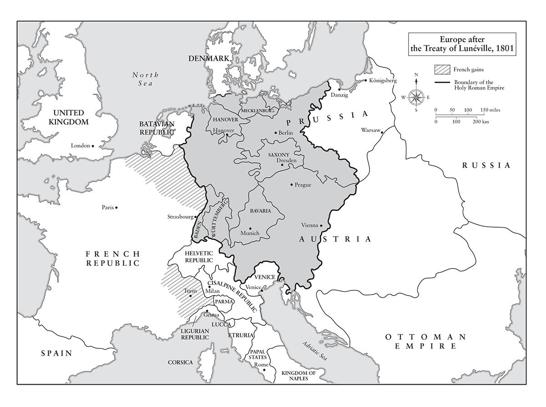
On February 9, 1801, the Peace of Lunéville, negotiated by Joseph and Talleyrand and an eventually exhausted Count Ludwig von Cobenzl, finally ended the nine-year war between Austria and France. The treaty was loosely based on Campo Formio, securing French gains in Belgium, Italy and the Rhineland, but stripping Austria of much of the territorial compensations she had received in northern Italy in that treaty four years earlier, to which Francis would have done well to adhere. The Franco-Russian rapprochement, and the fact that Moreau was within striking distance of Vienna, gave Cobenzl little room for diplomatic manoeuvre. Austria lost Tuscany to France, which under the terms already agreed between France and Spain at the Convention of San Ildefonso then became the Kingdom of Etruria and was bestowed upon Don Louis, the ‘astonishingly stupid’ (according to Laure d’Abrantès) twenty-eight-year-old great-grandson of Louis XV who had married the Infanta María Luisa of Spain. ‘Rome will be tranquil,’ Napoleon said of the new king. ‘This one won’t cross the Rubicon.’26
Etruria was only nominally independent, of course; despite having Bourbons at its head it paid heavily to maintain its French garrison.27* Napoleon’s creation of a kingdom rather than a sister-republic was rightly seen in France as a step towards conditioning the French people for a monarchy at home, but when King Louis I of Etruria visited Paris in January 1802 and Napoleon took him to the Comédie-Française to watch Oedipus, the audience heartily cheered Philoctetes’ line from Act II scene 4: ‘I have made sovereigns, but have refused to become one.’28 Napoleon still needed to tread with caution.
The Lunéville peace was greeted with huge relief in France, especially when it was announced that most of the conscripts who were going to be called up from the class-year 1802 would not now be needed, and that soldiers who had served in four campaigns – up to one-eighth of the army – could be demobilized.29 In his message to the Senate of February 13, Napoleon declared that he would ‘fight only to secure the peace and happiness of the world’, although he could not resist threatening to ‘avenge’ the ‘insults’ suffered from a boundlessly ambitious Britain, which he always called England.30 Yet Britain too was tired of continual conflict, and almost ready to sheathe the sword after nearly a decade of war.
On February 17, Napoleon attended Talleyrand’s fête to celebrate the Peace of Lunéville held at the foreign ministry, the Hôtel Galifet in the rue du Bac, which extended southwards from the Pont Royal through the Faubourg Saint-Germain and contained a long gallery with a theatre attached. Among those present was the American consul-general Victor du Pont.* ‘It was the most magnificent thing of the kind I ever saw,’ du Pont recorded of the fête.* Giuseppina Grassini ‘displayed all the charms of a most delicious voice. She is a very handsome woman and had more diamonds on her neck, head, breast and arms than I remember to have seen on any woman before.’ It was said that Napoleon had given these to her in Italy when she became his mistress, although diamonds were ‘very abundant since generals and commissaries of the government get them so cheap’. Napoleon ‘seemed very much pleased during her singing and Madame Bonaparte quite out of humour; for she is very jealous’. Josephine, too, wore ‘very large’ diamonds.
After the concert, the actors of the Théâtre de Vaudeville performed a light comedy about the peace ‘in which almost every verse was a praise of Bonaparte’ and of what du Pont inaccurately but prophetically termed ‘the royal Family’. After a short ballet sequence, the waltzing began. ‘I have never seen such a display of human flesh,’ wrote the thirty-four-year-old diplomat. ‘Their arms are naked up to the armpit, their breasts entirely uncovered and their shoulders bare below the middle of their backs.’ Moreover their petticoats were short, thin and few, ‘to expose all the shape of their limbs’.31 Napoleon walked from room to room with four tall handsome aides-de-camp in hussar uniform whose cap-feathers were ‘as high as the ceiling’. Meanwhile Talleyrand, ‘dandling along on his lame feet, kept close, to do honours of the fête’.32 These were celebrations he could well afford. Knowing that under one of the clauses of the treaty Austrian bonds issued in Belgium would be honoured at par, Talleyrand had made a fortune buying them up at their discounted rates.33 Even in an age where insider-dealing was considered almost a perk of the job and had few of the moral or legal implications of today, Talleyrand was in a class of his own.
• • •
An even more momentous peace treaty came into prospect in March 1801, when Lord Hawkesbury, the foreign secretary in Henry Addington’s new government in London, opened discussions with the French diplomat Louis-Guillaume Otto, who had been in the British capital for several years organizing prisoner-of-war exchanges. William Pitt the Younger’s government had fallen in February over the issue of Catholic Emancipation and Hawkesbury, although a follower of Pitt, cautiously began to explore the possibility of an accommodation with France, which had been anathema to the Pitt ministry. At the same time, a British expeditionary force landed at Aboukir in Egypt on March 8. With generals Friant, Belliard, Lanusse and Menou still unable to evacuate their troops because the Royal Navy was off Toulon blockading Admiral Ganteaume, who was supposed to go to pick them up, Napoleon faced a seriously deteriorating position in Egypt.
The assassination of Tsar Paul I on March 23 came as a blow to Napoleon, who is said to have cried out in rage at the news. He suspected British spies were behind the murder, although the actual perpetrators were a group of Russian nobles and the Hanoverian General Levin von Bennigsen.34 Paul was mentally unstable, although not certifiably insane like George III of Britain, Christian VII of Denmark and Maria ‘the Mad’ of Portugal, who all occupied European thrones at the time, albeit with regencies exercising actual control. Paul’s policies supporting the middle classes had been seen as threatening the Russian nobility. His twenty-three-year-old son and heir Alexander, who was in the palace at the time of the assassination, may have had an intimation that the nobles were going to demand his father’s abdication (which they did indeed secure, before they stabbed, strangled and kicked the Tsar to death). Alexander was crowned tsar later that year. Although he theoretically had absolute power, he knew that he had to work with the nobility if he were to escape his father’s fate.
Alexander I was a riddle. Reared in the Enlightenment atmosphere of his grandmother Catherine the Great’s court, and taught Rousseauian principles at a young age by his Swiss tutor Frédéric de La Harpe, he was nonetheless capable of telling his justice minister, ‘You always want to instruct me, but I am the autocratic emperor, and I will this and nothing else!’ He has been described as combining a theoretical love of mankind with a practical contempt for men. Well-meaning, impressionable and egotistical, he was so good at playing a part that Napoleon later dubbed him ‘the Talma of the North’, and on another occasion ‘a shifty Byzantine’. He claimed that he would happily abolish serfdom if only civilization were more advanced, but never genuinely came close to doing so, any more than he ever carried through the codification of Russian law that he promised in 1801 or ratified the liberal constitution he had asked his advisor Count Mikhail Speranski to draw up a few years later. Although La Harpe had initially enthused Alexander about Napoleon’s reforms as First Consul, when the tutor returned from Paris he was so disillusioned that he wrote a book, Reflexions on the True Nature of the First Consulship for Life, that described Napoleon as ‘the most famous tyrant the world has produced’, which had a great effect on the young tsar. Since Alexander ultimately did more than any other individual to bring about Napoleon’s downfall, his emergence on to the European scene with his father’s assassination was a seminal moment.
Napoleon rightly feared that Alexander and the Russian nobility, which tended to be pro-British because they profited from the Baltic trade with them, would now make Russia leave Tsar Paul’s League of Armed Neutrality. The League was badly weakened on April 2 when Nelson attacked Copenhagen and captured twelve Danish ships and destroyed another three. When, years later, Napoleon met a Royal Navy officer called Lieutenant Payne who had fought at the battle of Copenhagen, he said: ‘You had warm work there for the time it lasted.’35 It was true; the Danes put up a strong fight and remained thereafter loyally in Napoleon’s camp. Napoleon ordered the Moniteur to state ominously in its report of the Tsar’s assassination and the attack on Copenhagen: ‘History will unveil the connection which may exist between these two events.’36 (It hasn’t.) To the courier carrying his message of friendship to Tsar Alexander, Napoleon said: ‘Go, sir, gallop, and don’t forget that the world was made in six days.’37
On April 14, Hawkesbury proposed that the French should evacuate Egypt in return for the British evacuation of Minorca, thus leaving Britain with Malta, Tobago, Martinique, Trinidad, Ceylon and the Dutch Guianan sugar colonies of Essequibo, Demerara and Berbice as the price of peace. Napoleon refused, demanding instead that Britain give up all of those wartime gains as well as the territory taken from the late Tipu Sahib in India. The mutual outrageousness of both proposals implies that both sides knew these to be merely opening gambits with months of haggling ahead, and so it turned out. On April 24 Napoleon sent Duroc to see the King of Prussia in Berlin and the new Tsar in St Petersburg and ‘speak as if we are sure of being able to hold Egypt’ – a clear sign that they weren’t. Duroc was told to say that if the British expedition there ‘should succeed, it will be a great misfortune for Europe’.38 Time seemed to be on Britain’s side, however, as Paul’s assassination led to the collapse of the League of Armed Neutrality in May and June when first Sweden, then Denmark and finally Russia herself signed peace treaties with London.
Napoleon spent May attempting to cajole admirals Bruix, Ganteaume, Villeneuve, Rosily and Linois to relieve the army in Egypt. They used news of missing Spanish ships, vessels going aground, epidemics and anything else that occurred to them to avoid sailing across the Mediterranean on what they feared might be a suicide mission against the Royal Navy. (Napoleon’s understanding of naval affairs was dismal. He never truly grasped that the British ability to fire broadsides far more often per minute made the sheer numbers of ships in any engagement largely irrelevant, and that blockading France at sea strengthened rather than weakened British fighting ability.) Frustrated by the slow pace of negotiations, the British began besieging Alexandria, intending to expel the French from Egypt altogether.
On August 5 Hawkesbury told Otto that he might allow Malta to become independent. This – denying the use of the strategically vital island to the Royal Navy – was the concession Napoleon had been seeking. When he learned that Menou had capitulated to British forces on September 2 after a two-week siege, he ordered Otto to offer a French withdrawal from Egypt, Naples and the Papal States in exchange for peace, before the news reached the British Government.* Not knowing that the French had been defeated in Alexandria, Hawkesbury agreed.
On October 1, 1801 Otto signed the fifteen articles of an accord, and celebrations broke out in both France and Britain. ‘The public were so impatient to express their feelings on the occasion of the news of the preliminaries of peace being signed’, reported The Times, ‘that almost all the public streets were illuminated last night.’39 Otto’s portrait was exhibited in shop windows and his praises sung by balladeers. When Napoleon’s aide-de-camp General Jacques de Lauriston arrived in London with the official ratification a few days later, the crowd detached the horses from his coach and pulled it themselves from Oxford Street to St James’s Street, and then from Downing Street to the Admiralty and through St James’s Park, while celebrations carried on throughout the night despite a thunderstorm and torrential rain.40 All this was deeply unwelcome to Hawkesbury, who believed it would only strengthen Napoleon’s negotiating position prior to the ratification of the full treaty.41*
Under Article 2 of the preliminary treaty, Britain restored to France, Spain and Holland nearly all the territories she had captured since 1793, encompassing the Cape of Good Hope, Dutch Guiana, Tobago, Martinique, St Lucia, Minorca and Pondicherry, retaining only Trinidad and Ceylon (present-day Sri Lanka). Article 4 stipulated that Britain would return Malta to the Knights of St John within a month, who would then be protected by a third power to be decided by the final treaty (it was eventually six powers); Article 5 returned Egypt to the Ottoman Empire; Article 7 required France to evacuate Naples and the Papal States and Britain to evacuate Elba and ‘all the ports and islands which she may occupy in the Mediterranean or in the Adriatic Seas’. Other, unremarkable articles, covered the Ionian Islands, prisoner exchanges and fishing rights in Newfoundland.42
Napoleon had been able to extract great concessions due to the British desire for peace, which, because of the disruption of trade with Europe from nine years of war, amounted almost to desperation. The treaty was a massive diplomatic coup, since Egypt was being evacuated anyway after Menou’s defeat, as the British discovered on October 2, the very day after its signature. The whole of France’s overseas empire was returned to her for the cost of parts of Italy that Napoleon was under pressure from Russia – which retained interests in the Mediterranean and had an army in Switzerland as recently as 1800 – to give up in any case, and which he could easily recapture if necessary. Territorially, all Britain had gained after nearly a decade of war and £290 million – which more than doubled her National Debt – were Trinidad and Ceylon, neither of which had belonged to France anyway.43 By contrast, French troops were on the Rhine, in Holland and in north-west Italy, and France had hegemony over Switzerland and influence over her ally Spain – none of which the treaty mentioned.
Despite all that, London continued to celebrate. ‘The Peace is an event which had excited a tumult of joy such as I never before saw equalled,’ a friend wrote to the diarist Henry Crabb Robinson.
The Funds were falling and the expectation of an invasion very general . . . The demonstrations of joy have risen almost to madness. Illuminations have been general throughout the kingdom . . . It is said that ‘Long live Buonaparte!’ was repeatedly cried in the streets . . . Indeed it is curious to observe the change of style in the Government papers. The ‘Corsican adventurer’, ‘the atheistical adventurer’, is now ‘the august hero’, ‘the restorer of public order’, etc, etc, in fact everything that is great and good. It reminds one of the transformation in a pantomime, where a devil is suddenly converted into an angel.44
Napoleon signed a treaty of friendship with Bavaria in August 1801, then a peace treaty with Russia on October 8, 1801, by which 6,000 Russian prisoners were returned home with their arms and uniforms. The next day a peace treaty was also concluded with Turkey, by which each country’s ports were opened to the other. Thus within the space of a year, Napoleon had made peace with Austria, Naples, Turkey, Russia, Britain and the émigrés. Prussia would follow in the early summer of the following year. On October 14 the sixty-three-year-old Lord Cornwallis, the British general who had surrendered to Washington at Yorktown in 1781, was welcomed to Calais with a salute of cannon and a guard of honour and conducted first to Paris, where there were celebrations and public illuminations,* and then to Amiens to conduct the detailed negotiations of the treaty with Joseph and Talleyrand.45 (Amiens was chosen for its good omens; Henry VIII and François I had signed a peace treaty there in 1527.)
• • •
On November 20, 1801, Napoleon appointed the first functionaries for the Tuileries: chamberlains, chancellors, almoners, equerries, footmen and even tranchants (carvers), whose job it was to cut his meat for him.46 Miot de Melito noted that instead of high cavalry boots, sabres and cockades there were now knee-breeches, silk stockings, silver-buckled shoes, dress swords and hats carried under the arm.47 These liveried flunkeys and courtiers were instructed in etiquette by Marie Antoinette’s former first lady of the bedchamber, who explained who might approach the First Consul, when and under what circumstances.48 Within six months the Marquis de Lucchesini, the Prussian ambassador to Paris, was reporting that ‘Everything around the First Consul and his wife is resuming the general character and etiquette of Versailles.’49 Small wonder that men like Moreau wondered why France had gone to the bother of decapitating Louis XVI.
• • •
A week after Cornwallis arrived in France, Otto informed Hawkesbury that now that the Atlantic Ocean was safe to cross, France was going to send an expedition of 12,000 men from Rochefort and Brest ‘to re-establish order on Saint-Domingue’ (present-day Haiti).50 In the early 1790s the produce of this former slave colony of 8,000 plantations was greater than all of Europe’s other Caribbean and American colonies combined, providing 40 per cent of Europe’s consumption of sugar and 60 per cent of its coffee, and accounting for 40 per cent of all of France’s overseas trade.51 By 1801, however, because of the slave revolt led over the course of the previous six years by Toussaint l’Ouverture, sugar exports were a mere 13 per cent of their 1789 total and cotton 15 per cent.52The effects on French trade, and thus on the prosperity of ports such as Bordeaux, Nantes and Le Havre, had been devastating, and merchants were calling loudly for the reintroduction of direct French control – and that meant slavery too. The Jacobins who had abolished slavery in 1793 and the slave trade in 1794 were either dead, in disgrace or in prison. Napoleon was keen to return to the days when Saint-Domingue produced 180 million francs per annum for the French treasury, gave employment to 1,640 ships and thousands of seamen, and kept the French Atlantic ports thriving. He hoped it might even provide a strategic springboard for a new French empire in the western hemisphere, especially now that France had exchanged Tuscany for Louisiana.
Although Napoleon wrote proclamations to the Saint-Dominguans about how all men were free and equal in the sight of God, and to l’Ouverture – significantly for the first time using the royal ‘we’ – of ‘these brave blacks whose courage we like and whom we would be most regretful of punishing for rebellion’, this was only for show.53 Napoleon had bought slaves when in Egypt, and he now ordered his brother-in-law, the twenty-nine-year-old General Charles Leclerc (married to his sister Pauline), whose expedition of 20,000 men arrived on the island on January 29, 1802 and was soon reinforced by 8,000 more the next month, to reintroduce slavery as soon as he safely could.54 As Napoleon warned the local population, anyone daring to ‘separate himself from the Captain-General [Leclerc] shall be considered a traitor to his country, and the wrath of the Republic shall consume him as the fire burns up your withered sugar-canes’.55 He ordered Leclerc to follow a three-stage plan: first, to promise the blacks anything and everything while he occupied the key strategic positions on the island, secondly, to arrest and deport all potential opponents, and only then to embark on the reintroduction of slavery.56
The charismatic and ruthless Toussaint l’Ouverture, a black freeman who had himself owned slaves, had imposed a constitution on Saint-Domingue in May 1801 that made him dictator for life, ostensibly in the name of the French revolutionary principles of liberty and equality. He had also created an army of 20,000 former slaves and taken over the whole island, expelling the Spanish from the eastern half (the present-day Dominican Republic).57 He was not about to fall for Leclerc’s fine words, and fighting broke out before Leclerc could implement the first stage of Napoleon’s plan. While Leclerc’s armada of fifty-four ships was on its way, l’Ouverture had put down an internal uprising, executing the ringleader (his own nephew) and 2,000 rebels. His plan to defeat the French was to destroy any resources they might find on the coast and then to retreat into the mountainous jungle interior to conduct guerrilla warfare.
Leclerc had failed to take into account the horrific ravages that malaria and yellow fever would wreak on his army. Once a shortage of supplies and the outbreak of those diseases struck he faced impossible odds. His only reinforcements were a few Polish and Swiss conscripts.58 (Two Swiss brigades mutinied at Toulon the moment they learned where they were headed.) The war swiftly turned into a bloody campaign of racial extermination, for which the absent Napoleon must take a large share of the responsibility. Although there is no evidence to support the modern accusation that, as one historian recently put it, ‘Bonaparte hated black people’, he undoubtedly shared the widespread Western assumption of the day that whites were superior to all non-whites, and he expected Leclerc to prevail easily with such a large, well-armed force against native fighters, just as he had at the battles of the Pyramids and Aboukir.59 ‘If I were black,’ Napoleon said, ‘I would be for the blacks; being white, I am for the whites.’60 At Jaffa, as we have seen, he had executed several thousand non-European prisoners-of-war. Now he was harsh on miscegenation, ordering that ‘White women [in Saint-Domingue] who have prostituted themselves to blacks, no matter what their rank, will be sent to Europe.’61
On May 20, 1802, Napoleon passed a law reintroducing the slave trade (though technically not slavery itself) to all French colonies according to the rules pertaining in 1789.62 Britain – which punished the murder of a slave in Barbados in 1802 with a fine of £11 4 shillings, and retained slavery until 1834 – sent a large watching force to Trinidad in case either the slave revolt or Napoleonic imperialism spread there. In America President Thomas Jefferson, who also owned slaves, declared American neutrality, watching equally nervously.63
The fighting on Saint-Domingue was brutal. Plantations were torched, massacres and torture were common, towns were razed; there were mass drownings; corkscrews were used to draw out the eyes of French prisoners, and the French even constructed a makeshift gas chamber (etouffier) on board a ship in which volcanic sulphur was used to asphyxiate four hundred prisoners, before the ship was scuttled.64 Toussaint l’Ouverture finally surrendered on May 1 on terms whereby the freedom of Saint-Domingue’s blacks was officially guaranteed, black officers were accepted into the French army, and l’Ouverture himself and his staff were allowed to retire to one of his several plantations.65 However, on June 7, on his own initiative, Leclerc suddenly reneged on the deal, kidnapped l’Ouverture and sent him to prison in France. The guerrilla war continued, and on October 7 Leclerc wrote to Napoleon: ‘We must destroy all the mountain negroes, men and women, only keep children under twelve years old, destroy half the ones of the plains, and so not leave in the colony one coloured man who wears the epaulette.’66 Napoleon did not respond directly to this, but certainly did not forbid it.
On November 27 Napoleon wrote to Leclerc about Pauline, who had bravely gone out on the expedition, saying he was ‘highly satisfied with the conduct of Paulette. She ought not to fear death, as she would die with glory in dying with the army and being useful to her husband. Everything passes rapidly on earth, with the exception of the mark we leave on history.’67 At the time he wrote, Leclerc himself was nearly four weeks dead from yellow fever. ‘Come back soon,’ Napoleon wrote to Pauline on learning of Leclerc’s death, ‘here you will find consolation for your misfortunes in the love of your family. I embrace you.’ Pauline – whom Laure d’Abrantès described as ‘a less-than-desolate widow’ – returned with the body on January 1, 1803, and by the end of August she was remarried, to the handsome and rich Don Camillo Filippo Ludovico Borghese, Prince of Sulmona and of Rossano, Duke and Prince of Guastalla, whom she privately thought ‘an imbecile’ and to whom she was soon wildly unfaithful.68*
The extermination on Saint-Domingue continued unabated after Leclerc’s death, as l’Ouverture’s lieutenants and successors continued the struggle against his exceptionally cruel second-in-command, the Vicomte de Rochambeau, who, despite receiving large numbers of reinforcements, managed to sail only 8,000 men back to France in May 1803. Twenty generals, 30,000 Frenchmen and possibly as many as 350,000 Saint-Dominguans (of both races) had died.69 Toussaint l’Ouverture, ‘the Black Spartacus’, died of pneumonia on April 7, 1803 in a large cold cell that can be visited today in the Fort de Joux in the Jura mountains.70
‘The Saint-Domingue business was a great piece of folly on my part,’ Napoleon later admitted. ‘It was the greatest error that in all my government I ever committed. I ought to have treated with the black leaders, as I would have done the authorities in a province.’71 One lesson he did learn was that blacks could make excellent soldiers, and in November 1809 he set up a unit called the Black Pioneers, made up of men from Egypt and the Caribbean under a black battalion commander, Joseph ‘Hercules’ Domingue, to whom he gave a special award of 3,000 francs. By 1812 Napoleon didn’t believe any colonies could be held in perpetuity, predicting that they would all eventually ‘follow the example of the United States. You grow tired of waiting for orders from five thousand miles away; tired of obeying a government which seems foreign to you because it’s remote, and because of necessity it subordinates you to its own local interest, which it cannot sacrifice to yours.’72 The defeat in Saint-Domingue ended for ever Napoleon’s dreams of a French empire in the West.