
16
‘There is a moment in combat when the slightest manoeuvre is decisive and gives superiority; it is the drop of water that starts the overflow.’
Napoleon on Caesar at the battle of Munda
‘For myself, I have but one requirement, that of success.’
Napoleon to Decrès, August 1805
A few days after the coronation the army’s colonels descended on Paris to receive eagle standards from the Emperor in a ceremony on the Champ de Mars. ‘Soldiers!’ he told them, ‘here are your colours! These eagles will always be your rallying point . . . Do you swear to lay down your lives in their defence?’ ‘We swear!’ they ceremoniously replied in unison.1 Cast out of six pieces of bronze welded together and then gilded, the eagles each measured 8 inches from eartip to talons, 91/2 inches between wingtips, and weighed 31/2 pounds.* They were mounted on a blue oaken staff with the regimental colours and the role of eagle-bearer was much prized, although with the customary irreverence of soldiers the standards were soon nicknamed ‘cuckoos’.2 In the 55th bulletin of the Grande Armée in 1807, Napoleon stated: ‘The loss of an eagle is an affront to regimental honour for which neither victory nor the glory acquired on a hundred battlefields can make amends.’3
Training continued at the camps along the Channel coasts in readiness for the invasion of Britain. ‘We manoeuvre by division three times a week, and twice a month with three divisions united,’ Marmont reported to Napoleon from the Utrecht camp. ‘The troops have become very highly trained.’4 Napoleon ordered him to
pay great attention to the soldiers, and see about them in detail. The first time you arrive at the camp, line up the battalions, and spend eight hours at a stretch seeing the soldiers one by one; receive their complaints, inspect their weapons, and make sure they lack nothing. There are many advantages to making these reviews of seven to eight hours; the soldier becomes accustomed to being armed and on duty, it proves to him that the leader is paying attention to and taking complete care of him; which is a great confidence-inspiring motivation for the soldier.5
• • •
In December 1804 William Pitt signed an alliance with Sweden; once Britain had also signed the Treaty of St Petersburg with Russia in April 1805 the core of the Third Coalition was in place. Britain was to pay Russia £1.25 million in golden guineas for every 100,000 men she fielded against France. Austria and Portugal joined the coalition later.6 Napoleon used his full capacity for diplomatic threat to try to prevent others gathering round. As early as January 2, he wrote to Maria Carolina, the queen consort of the joint kingdom of Naples and Sicily, who was Marie Antoinette’s sister and Emperor Francis’s aunt. He warned her plainly: ‘I have in my hands several letters written by Your Majesty which leave no doubt with regard to your secret intentions’ of joining the nascent coalition. ‘You have already lost your kingdom once, and twice you have been the cause of a war which threatened the total destruction of your paternal house,’ he wrote, alluding to Naples’ support for the two earlier coalitions against France. ‘Do you therefore wish to be the cause of a third?’ Napoleon prophesied that should war break out again because of her, ‘You and your offspring’ – she and her husband, King Ferdinand IV, had an extraordinary eighteen children in all – ‘will cease to reign, and your errant children will go begging through the different countries of Europe.’7 He demanded that she dismiss her prime minister (and lover) the Englishman Sir John Acton, and also expel the British ambassador, recall the Neapolitan ambassador from St Petersburg and dissolve the militia. Although she did none of these things, the Kingdom of the Two Sicilies* did sign a treaty of strict neutrality with France on September 22, 1805.
Napoleon took no holiday after his coronation; even on Christmas Day he was ordering that an Englishman named Gold should not have been arrested for duelling with a Verdun casino-owner, as ‘a prisoner-of-war on parole may fight duels’.8 Later in January he wrote to the Sultan of Turkey adopting the informal ‘tu’ throughout, as befitting of fellow sovereigns: ‘Descendant of the great Ottomans, emperor of one of the greatest kingdoms in the world,’ he asked, ‘have you ceased to reign? How comes it that you permit the Russians to dictate to you?’9 (There had been problems with Russophile governors of Turkish-owned Moldavia and Wallachia.) He warned that the Russian army in Corfu would, with Greek support, ‘one day attack your capital . . . Your dynasty will descend into the night of oblivion . . . Arouse yourself, Selim!’ Shah Fat’h Ali of Persia also received a letter written in the flowery language Napoleon had adopted in addressing Eastern potentates since the Egyptian campaign: ‘Fame, which broadcasts everything, has informed you of who I am and what I have done; how I have raised France above all nations of the West, and in what a startling manner I have displayed the interest I feel in the kings of the East.’ After mentioning some great shahs of the past, Napoleon wrote of Britain: ‘Like them, you will distrust the counsels of a nation of shopkeepers [nation de marchands], who in India traffic the lives and crowns of sovereigns; and you will oppose the valour of your people to the incursions of the Russians.’10*If Pitt was going to buy allies in an attempt to stave off an invasion of Britain, Napoleon was hoping to flatter them at least into neutrality. In April 1805 Napoleon wrote to the King of Prussia, saying he had little hope of staying at peace with Russia, and laying all the blame on the Tsar: ‘The character of the Emperor Alexander is too fickle and too weak for us reasonably to be able to expect anything good for general peace.’11
Pitt had set the precedent for subsidizing France’s enemies as early as 1793 when he had started hiring troops from the German princes to fight in the Low Countries, but he was often deeply disappointed with his investments, as when the Prussians seemed happier to fight the Poles than the French in 1795, or Austria took the Veneto at Campo Formio in 1797 in return for Belgium (and peace). Overall, however, the subsidy policy was seen by successive British governments as well worth the cost. Napoleon naturally characterized it as Britain being willing to fight to the last drop of her allies’ blood. ‘Please have caricatures drawn,’ Napoleon ordered Fouché in May 1805, of ‘an Englishman, purse in hand, asking different Powers to take his money, etc.’12 In 1794, payments to allies amounted to 14 per cent of British government revenue; twenty years later, with Wellington’s army actually inside France, it was still 14 per cent, although the British economy had grown so considerably in the intervening period that this now represented £10 million, a vast sum. The heir to the French Revolution’s debts, Napoleon was fighting against a government fuelled by the Industrial Revolution’s profits, which it was willing to share round in support of its cause. Although the grand total of £65,830,228 paid to France’s enemies between 1793 and 1815 was astronomical, it was markedly less than the cost of maintaining, and then fielding, a huge standing army.
• • •
On February 1, 1805, Baron Louis de Bausset-Roquefort was appointed Prefect of the Palace. This involved personally attending on Napoleon along with Grand Marshal Duroc, Napoleon’s closest friend. As one who knew him well at the end of his life put it, ‘unless Napoleon’s ambition, to which every other consideration was sacrificed, interfered, he was possessed of much sensibility and feeling, and was capable of strong attachment’.13 True friendship at the apex of power is notoriously difficult to maintain, and as time went on and death in battle claimed four of his closest friends, there were fewer and fewer people who were close enough to Napoleon to tell him what he did not want to hear. Bausset, though a courtier rather than a friend, spent more time near Napoleon than almost anyone else outside his family, and served him loyally until April 1814, accompanying him on almost all his tours and campaigns. If anyone can be said to have known him intimately, it was Bausset, whose memoirs were published six years after Napoleon’s death, when pro-Bonapartist books were severely discouraged. Moreover, Bausset was politically a royalist, and hadn’t been mentioned in Napoleon’s will, unlike scores of others. But even so he had nothing but admiration. ‘Genius and power were expressed on his large high forehead,’ wrote Bausset. ‘The fire which flashed from his eyes expressed all his thoughts and feelings. But when the serenity of his temper was not disturbed, the most pleasing smile lit up his noble countenance, and gave way to an indefinable charm, which I never beheld in any other person. At these times it was impossible to see him without loving him.’ Napoleon’s charisma didn’t lessen for Bausset over the decade that he lived with and worked for him, serving his food, running his household and allowing him to cheat him at chess. He reported that Napoleon’s ‘deportment and manners were always the same; they were inherent and unstudied. He was the only man in the world of whom it may be said without adulation, that the nearer you viewed him the greater he appeared.’14
• • •
Napoleon accepted the crown of the newly created kingdom of Italy in a grand ceremony in the throne room at the Tuileries on Sunday, March 17, 1805. Having been chief magistrate of the Italian Republic, it was only logical for him to become king of Italy once he had been made emperor of France. Writing to the Emperor Francis he blamed his decision on the British and Russians, arguing that while they continued to occupy Malta and Corfu, ‘the separation of the crowns of France and Italy is illusory’.15 Two days later he appointed his sister Elisa and her husband, Felice Baciocchi, as rulers of Lucca and Piombino.16*
On his way to Milan to be crowned king of Italy, Napoleon spent six days in Lyons, where he slept with the wife of a rich financier, Françoise-Marie de Pellapra (née LeRoy), despite the fact that Josephine was accompanying him on the journey.17* The coronation in Milan’s magnificent Duomo on May 26 was celebrated in the presence of Cardinal Caprara, seven other cardinals and an estimated 30,000 people. ‘The church was very beautiful,’ Napoleon reported to Cambacérès. ‘The ceremony was as good as the one in Paris, with the difference that the weather was superb. When taking the Iron Crown and putting it on my head, I added these words: “God gives it to me; woe betide any who touches it.” I hope that will be a prophecy.’18 The Iron Crown of Lombardy, a heavy oval band of gold containing metal supposedly from one of the nails of the True Cross, had been worn by every Holy Roman Emperor since Frederick Barbarossa in 1155. Napoleon’s use of it was thus a further sabre-rattle against the present incumbent, Francis of Austria.
Napoleon visited Marengo on the fifth anniversary of the battle, wearing a uniform that Bausset recalled as ‘threadbare, and in some places torn. He held in his hand a large old gold-laced hat pierced with holes.’19 It was the uniform he had worn at the battle, and whether the holes were bullet-holes or not it is a reminder of Napoleon’s genius for public relations. He spent the next month in Brescia, Verona, Mantua, Bologna, Modena, Piacenza, Geneva and Turin, before returning to the palace of Fontainebleau – a former Bourbon hunting lodge that Napoleon enjoyed visiting – on the night of July 11, only eighty-five hours after leaving Turin 330 miles away. It turned out to be the last time that Napoleon set foot in Italy. He appointed as viceroy his twenty-three-year-old stepson Eugène, whose good-natured reasonableness made him quite popular among ordinary Italians.20 Over three days that June Napoleon sent Eugène no fewer than sixteen letters on the art of ruling – ‘Know how to listen, and be sure that silence often produces the same effect as does knowledge’, ‘Do not blush to ask questions’, ‘In every other position than that of Viceroy of Italy, glory in being French, but here you must make little of it’ – even though the actual day-to-day running of the country continued to be undertaken by Melzi, the former vice-president of the Italian Republic, whom Napoleon had refused to allow to retire despite endless complaints about his gout.21 Melzi had no difficulty in finding talented Italians to run the government, believers in the modern French administrative ways. Joseph and Louis felt chagrin at Eugène’s elevation, of course, even though either could have become king of Italy if they had been willing to renounce their rights to the throne of France.22
‘My continental system has been decided,’ Napoleon told Talleyrand in June 1805. ‘I don’t want to cross the Rhine or the Adige; I want to live in peace, but I will not tolerate any bad quarrel.’23 Although Napoleon did not have territorial aspirations beyond Italy and the Rhine, he did expect France to remain the greatest of the European Powers and the arbiter of events beyond her borders, and was quite prepared to take on any country or group of them that wished to ‘quarrel’.
In the early summer it seemed that he might at last be able to gain the upper hand against the nation which was so determinedly challenging his vision for Europe. On March 30, taking advantage of a storm that blew Nelson’s blockading fleet off-station at Toulon, Admiral Villeneuve had escaped and sailed through the Straits of Gibraltar, rendezvoused with a Spanish fleet from Cadiz and headed off for Martinique, which he reached on May 14. Once Nelson realized that Villeneuve was not sailing to Egypt, he crossed the Atlantic in pursuit, reaching the West Indies on June 4. The next part of Napoleon’s master-plan for the invasion of Britain was in place. ‘It is necessary for us to be masters of the sea for six hours only,’ Napoleon wrote to Decrès on June 9, ‘and England will have ceased to exist. There is not a fisherman, not a miserable journalist, not a woman at her toilette, who does not know that it is impossible to prevent a light squadron appearing before Boulogne.’24 In fact the Royal Navy had every intention of preventing a squadron of any size from appearing at Boulogne or any of the invasion ports. Yet with Villeneuve now re-crossing the Atlantic and hoping to break the blockade at Brest, Napoleon was convinced by mid-July that the long-awaited invasion might at last take place. ‘Embark everything, for circumstances may present themselves at any moment,’ he ordered Berthier on the 20th, ‘so that in twenty-four hours the whole expedition may start . . . My intention is to land at four different points, at a short distance from each other . . . Inform the four marshals [Ney, Davout, Soult and Lannes] there isn’t an instant to be lost.’25 He also gave orders that letters from Italy should no longer be disinfected with vinegar for a day before being sent on: ‘If plague was going to come from Italy, it would be through travellers and troop movements. This is simply bothersome.’26
On July 23, after losing two ships in the fog-bound battle of Cape Finisterre against Rear-Admiral Sir Robert Calder’s smaller fleet, Villeneuve obeyed Napoleon’s orders to sail to Ferrol near Corunna in northern Spain, thereby losing the crucial time advantage he had won on his transatlantic journey. On Elba, Napoleon criticized Calder for not attacking on the second day of the action, so allowing Villeneuve to escape. His British interlocutor pointed out that Calder was to the leeward, and therefore couldn’t attack, which Napoleon dismissed as ‘only an excuse, advanced from national pride, for the Admiral ran away during the night of the 23rd’.27 In failing to appreciate the difference between leeward and windward, Napoleon once again demonstrated his huge nautical lacuna.
Under constant harrying from Napoleon – ‘Europe is in suspense waiting for the great event that is being prepared’ – Villeneuve put to sea from Ferrol with thirty-three ships-of-the-line on August 10, hoping to join Ganteaume at Brest with twenty-one ships, which, when added to Captain Zacharie Allemand’s squadron at Rochefort, would give the Combined Fleet no fewer than fifty-nine ships-of-the-line.28 Yet the next day, fearful that the Royal Navy was tracking his movement, instead of sailing north to the Channel Villeneuve sailed south to Cadiz, where he anchored on August 20 and was soon afterwards blockaded by Nelson, who had raced back across the Atlantic and instinctively found him.
• • •
Unbeknown to Napoleon, Austria had secretly joined the Third Coalition on August 9, angered by the Italian coronation, the Genoan annexation and the alliances that Napoleon had concluded with Bavaria, Württemberg and Baden. Although Napoleon privately told Talleyrand on August 3 ‘there is no sense in a war’, he was ready for one if it broke out.29 Within the space of a few days in early August he ordered Saint-Cyr to be ready to invade Naples from northern Italy if necessary, gave Masséna the command in Italy and sent Savary to Frankfurt to secure the best maps of Germany available and to try to spy on the Aulic Council in Vienna.30
Tuesday, August 13 was a very busy day for Napoleon. At 4 a.m. the news of the battle of Cape Finisterre was brought to him at Pont-de-Briques. The intendant-general of the imperial household, Pierre Daru, was summoned and later reported that the Emperor ‘looked perfectly wild, that his hat was thrust down to his eyes, and his whole aspect was terrible’. Convinced that Villeneuve would be blockaded at Ferrol – even though he was in fact sailing away from it by then – Napoleon cried: ‘What a navy! What an admiral! What useless sacrifices!’31 With separate news that the Austrians seemed to be mobilizing, it was clear that the invasion of Britain would have to be postponed. ‘Anyone would have to be completely mad to make war on me,’ he wrote to Cambacérès. ‘Certainly there isn’t a finer army in Europe than the one I have today.’32 Yet once it became clear later in the day that Austria was indeed mobilizing, he was adamant. ‘My mind is made up,’ he wrote to Talleyrand. ‘I want to attack Austria, and to be in Vienna before November to face the Russians, should they present themselves.’ In the same letter he ordered Talleyrand to try to frighten ‘this skeleton Francis, placed on the throne by the merit of his ancestors’, into not fighting, because ‘I want to be left in peace to carry out the war with England.’33 He instructed him to say to the Austrian ambassador to Paris, who was a cousin of the foreign minister Ludwig von Cobenzl, ‘So, M. de Cobenzl, you want war then! In that case you shall have it, and it is not the Emperor who will have started it.’34 Not knowing whether Talleyrand would succeed in cowing Austria, Napoleon continued to urge Villeneuve – whom he described to Decrès as ‘a poor creature, who sees double, and who has more perception than courage’ – to sail north, writing: ‘If you can appear here for three days, or even twenty-four hours, you’ll have achieved your mission . . . In order to help the invasion of that power which has oppressed France for six centuries, we could all die without regretting life.’35
Although Napoleon still did not want to abandon his plans to invade Britain, he appreciated that it would be unwise to try to fight simultaneously on two fronts. He now needed a detailed plan to crush Austria. He had Daru sit down to take dictation. ‘Without any transition,’ Daru later told Ségur,
without any apparent meditation, and in his brief, concise and imperious tones, he dictated to [me] without a moment’s hesitation the whole plan of the campaign of Ulm as far as Vienna. The Army of the Coast, ranged in a line of more than two hundred leagues [600 miles] long fronting the ocean, was, at the first signal, to break up and march to the Danube in several columns. The order of the various marches, their durations; the spots where the various columns should converge or re-unite; surprises; attacks in full force; divers movements; mistakes of the enemy; all had been foreseen during this hurried dictation.36
Daru was left in admiration at ‘the clear and prompt determination of Napoleon to give up such enormous preparations without hesitation’.37
• • •
Berthier’s detailed filing system (which could fit into one coach) was one of the edifices upon which the coming campaign was based; the other was Napoleon’s adoption of the corps system – essentially a hugely enlarged version of the division system with which he had fought in Italy and the Middle East. The time spent in encampment at Boulogne and on continual manoeuvres between 1803 and 1805 allowed Napoleon to divide his army into units of 20,000 to 30,000 men, sometimes up to 40,000, and to train them intensely. Each corps was effectively a mini-army, with its own infantry, cavalry, artillery, staff, intelligence, engineering, transport, victualling, pay, medical and commissary sections, intended to work in close connection with other corps. Moving within about one day’s march of each other, they allowed Napoleon to swap around the rearguard, vanguard or reserve at a moment’s notice, depending on the movements of the enemy. So, in either attack or retreat, the whole army could pivot on its axis without confusion. Corps could also march far enough apart from each other not to cause victualling problems in the countryside.
Each corps needed to be large enough to fix an entire enemy army into position on the battlefield, while the others could descend to reinforce and relieve it within twenty-four hours, or, more usefully, outflank or possibly even envelop the enemy. Individual corps commanders – who tended to be marshals – would be given a place to go to and a date to arrive there by and would be expected to do the rest themselves. Having never commanded a company, battalion, regiment, brigade, division or corps of infantry or cavalry in battle, and trusting to his marshals’ experience and competence, Napoleon was generally content to leave logistics and battlefield tactics to them, so long as they delivered what he required.38 Corps needed to be capable of making significant inroads into an enemy force on the offensive too.39
It was an inspired system, originally the brainchild of Guibert and Marshal de Saxe.40 Napoleon employed it in almost all his coming victories – most notably at Ulm, Jena, Friedland, Lützen, Bautzen and Dresden – not wishing to relive the perils of Marengo where his forces had been too widely spread. His defeats – particularly at Aspern-Essling, Leipzig and Waterloo – would come when he failed to employ the corps system properly.
‘During the Revolutionary wars the plan was to stretch out, to send columns to the right and left,’ Napoleon said years later, ‘which did no good. To tell you the truth, the thing that made me gain so many battles was that the evening before a fight, instead of giving orders to extend our lines, I tried to converge all our forces on the point I wanted to attack. I massed them there.’41 Napoleon pioneered an operational level of warfare that lies between strategy and tactics. His corps became the standard unit adopted by every European army by 1812, and which lasted until 1945. It was his unique contribution to the art of war, and its first use in 1805 can be regarded as heralding the birth of modern warfare.
• • •
‘Austria appears to want war,’ Napoleon wrote to his ally Elector Maximilian-Joseph of Bavaria on August 25. ‘I cannot account for such erratic behaviour; however, she will have it, and sooner than she expects.’42 The next day he received confirmation from Louis-Guillaume Otto, then France’s envoy at Munich, that the Austrians were about to cross the River Inn and invade Bavaria. In expectation of this, some French units of what was now officially renamed the Grande Armée had already left Boulogne between August 23 and 25.43 Napoleon called it his ‘pirouette’, and finally said to his staff of his plan to invade Britain: ‘Well, if we must give that up, we will at any rate hear the midnight mass in Vienna.’44 The Boulogne camp wasn’t physically dismantled until 1813.
In order to keep Prussia out of the Coalition, he told Talleyrand to offer Hanover, ‘but it must be understood that this is an offer I shall not make again in a fortnight’.45 The Prussians declared their neutrality, but still insisted on the independence of Switzerland and Holland. Even while preparing for war – sending three letters to Berthier on August 31, two each to Bessières, Cambacérès and Gaudin, and one each to Decrès, Eugène, Fouché and Barbé-Marbois – Napoleon was decreeing that ‘Horse-racing shall be established in those departments of the Empire the most remarkable for the horses they breed: prizes shall be awarded for the fleetest horses.’46 Of course there was a military application to this but it is illustrative of the cornucopia of his thinking even, or perhaps particularly, in a crisis. In the same month he also declared that dancing near churches shouldn’t be forbidden, for ‘Dancing isn’t evil . . . If everything the bishops said was to be believed, then balls, plays, fashions would be forbidden and the Empire turned into one great convent.’47
By September 1, when Napoleon left Pont-de-Briques for Paris to ask the Senate to raise a fresh levy of 80,000 men, he told Cambacérès, ‘there is not a single man in Boulogne beyond those necessary for the protection of the port’.48 He imposed a total news blackout about troop movements, telling Fouché to ban all newspapers ‘from mentioning the army, as if it no longer exists’.49 He also came up with an idea for tracking enemy mobilization, ordering Berthier to get a German-speaker ‘to follow the progress of the Austrian regiments, and file the information in the compartments of a specially made box . . . The name or number of each regiment is to be entered on a playing-card, and the cards are to be changed from one compartment to another according to the movements of the regiments.’50
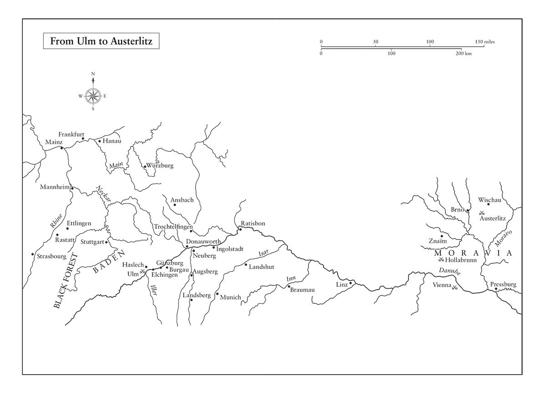
The following day the Austrian General Karl Mack von Leiberich crossed the Bavarian border and quickly captured the fortified city of Ulm, expecting to be reinforced soon afterwards by the Russians under General Mikhail Kutuzov, bringing the Coalition forces up to a total of 200,000 men in that theatre. Yet Ulm was dangerously far forward for the Austrians to come without already being in direct contact with the Russians, who for some reason – bad staff-work has been blamed, as has the eleven-day difference between Russia’s Julian and the rest of Europe’s Gregorian calendar – were very late deploying.51 Meanwhile, Archduke Charles prepared to attack in Italy, where Napoleon had replaced Jourdan with Masséna. After warning Eugène and his army commanders of the Austrian attack on September 10, Napoleon took time that day to instruct the fifty-three-year-old Pierre Forfait, prefect of Genoa, to stop taking his young mistress – ‘a Roman girl who is no more than a prostitute’ – to the theatre.52
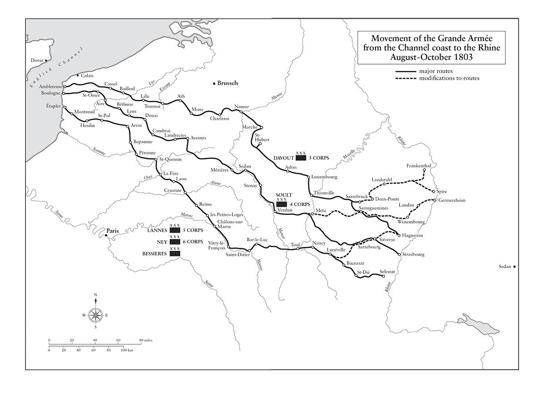
The seven corps of the Grande Armée under marshals Bernadotte, Murat, Davout, Ney, Lannes, Marmont and Soult, totalling over 170,000 men, raced eastwards at astonishing speed, crossing the Rhine on September 25. The men were delighted to be fighting on dry land and not hazarding the English Channel in flimsy flat-bottomed boats, and marched off merrily, singing ‘Le Chant du Départ’. (It wasn’t unusual for a demi-brigade to know as many as eighty songs by heart; as well as keeping up morale on marches and before attacks, musicians doubled as stretcher-bearers and medical orderlies during battles.) ‘Finally everything is taking on colour,’ Napoleon told Otto that day.53 It was the largest single campaign ever conducted by French troops. Arriving from Boulogne, Holland and elsewhere, the front stretched across nearly 200 miles, from Coblenz in the north to Freiburg in the south.
The day before the Grande Armée reached the Rhine, a rumour swept Paris that Napoleon had seized all the gold and silver reserves of the Bank of France to pay for the campaign and that consequently there wasn’t enough to cover the notes in circulation. (Although no gold had in fact been removed, the Bank had circulated 75 million francs in paper against 30 million francs in collateral.) The Bank was besieged by crowds, whom it first paid slowly, then stopped paying altogether, and later paid very slowly at 90 centimes in the franc.54 Napoleon was acutely aware of the crisis, in which the police had to be summoned to quell panicking crowds who feared a return of the days of the paper assignat. He felt that Parisian bankers were not showing enough confidence in France, and realized that a quick victory and profitable peace were more important than ever.
Napoleon left Saint-Cloud on September 24 and joined the army at Strasbourg two days later, where he left Josephine and headed towards the Danube east of Ulm to try to encircle Mack and cut him off from the Russians. General Georges Mouton was sent to the Elector of Württemberg to demand passage for Ney’s corps of 30,000 men, which could hardly be refused, and when the Elector asked that Württemberg be promoted to a kingdom Napoleon laughed: ‘Well, that suits me very well; let him be a king, if that’s all he wants!’55
The corps system allowed Napoleon to turn his entire army 90 degrees to the right once over the Rhine. The manoeuvre was described by Ségur as ‘the greatest change of front ever known’ and meant that by October 6 the Grande Armée was in a line facing south, all the way from Ulm up to Ingolstadt on the Danube.56 This agile placing of a very large army across Mack’s line of retreat before he even knew what was happening, at the loss of no troops, stands as one of Napoleon’s most impressive military achievements. ‘There is no further premise to negotiate with the Austrians,’ he told Bernadotte at this time, ‘except with cannon-fire.’57 He was buoyed by the fact that contingents from Baden, Bavaria and Württemberg had all now joined with the Grande Armée.
Years after the campaign, Napoleon’s toymaker made a miniature carriage that was harnessed to four mice, in order to amuse some children with whom the Emperor was staying. When it wouldn’t move, Napoleon told them ‘to pinch the tails of the two leaders, and when they started the others would follow’.58 All through late September and early October, he pinched the tails of Bernadotte and Marmont, pushing them on to Stuttgart and beyond, with Bernadotte marching through the Prussian territories of Ansbach and Bayreuth, to Berlin’s private fury but without any public response. ‘I am at the court of Württemberg, and although waging war, am listening to some very good music,’ Napoleon told his interior minister, Champagny, from Ludwigsburg on October 4, commenting on Mozart’s ‘extremely fine’ Don Juan. ‘The German singing, however, did seem somewhat baroque.’59 To Josephine he added that the weather was superb and the pretty Electress ‘seems very nice’, despite being the daughter of George III.60
On the evening of October 6 Napoleon pushed on to Donauwörth, in the words of Ségur, ‘in his impatience to see the Danube for the first time’.61 The word ‘impatience’ recurs often in Ségur’s narrative, and might almost be considered the most constant of all Napoleon’s military, indeed personal, traits. Of those closest to him on this campaign – Berthier, Mortier, Duroc, Caulaincourt, Rapp and Ségur – all mention his great impatience throughout, even when his plans were ahead of schedule.
Napoleon wrote the first of thirty-seven bulletins while still at Bamberg, prophesying from there the ‘total destruction’ of the enemy.62 ‘Colonel Maupetit, at the head of the 9th Dragoons, charged into the village of Wertingen,’ he wrote in a report of a fight in which Murat and Lannes defeated an Austrian force on October 8; ‘being mortally wounded, his last words were: “Let the Emperor be informed that the 9th Dragoons have showed themselves worthy of their reputation, and that they charged and conquered, exclaiming ‘Vive l’Empereur!’”’63 Napoleon’s bulletins were exciting to read, even as fiction. He used them to inform the army of the meetings he had held, how cities were decorated, and even of the ‘extraordinary beauty’ of Madame de Montgelas, wife of the Bavarian prime minister.64
On October 9 the French were victorious at a minor engagement at Günzburg, and then again at Haslach-Jungingen on the 11th. By 11 p.m. the next evening, after Bernadotte had captured Munich, and an hour before Napoleon left for Brugau on the River Iller, he was already telling Josephine, ‘The enemy is beaten, he has lost his head, and everything proclaims the happiest of my campaigns, the shortest, the most brilliant ever waged.’65 It was hubristic to say so, of course, but his words eventually proved true. To encourage Mack not to retreat from his exposed position, French intelligence planted ‘deserters’ to be captured who would tell the Austrians that the French army was ready to mutiny and return to France, and even that there were rumours of a coup in Paris.
His envelopment of Ulm almost complete, on October 13 Napoleon ordered Ney to re-cross the Danube and take the heights of Elchingen, the last major obstacle before Ulm: from Elchingen Abbey there is a magnificent view across the floodplain all the way to Ulm cathedral, 6 miles away. Ney took it the next day. If one scans the slopes of Elchingen, up which the voltigeurs, carabiniers and grenadiers charged to take the abbey, one appreciates the importance of the high morale and esprit de corps that Napoleon did so much to instil in his men. In the course of the fighting a grenadier of the former Army of Egypt lay wounded on his back in the pelting rain crying ‘Forwards!’, so Napoleon, who recognized him, took off his own cloak and threw it over him, saying: ‘Try to bring this back to me, and in exchange I will give you the decoration and the pension that you have so well deserved.’66 In the fighting that day Napoleon came to within a pistol-shot of Austrian dragoons.
That night an aide-de-camp made Napoleon an omelette, but couldn’t find any wine or dry clothing, upon which the Emperor remarked good-humouredly that he had never before gone without his Chambertin, ‘even in the midst of the Egyptian desert’.67 ‘The day was dreadful,’ he wrote of the capture of Elchingen, ‘the troops were up to their knees in mud.’68 But he now had Ulm completely surrounded.
On October 16 Ségur found Napoleon in a farmhouse in the hamlet of Haslach near Ulm, ‘dozing by the side of a stove, while a young drummer was dozing also on the other side’. Sometimes Napoleon’s naps would last only ten minutes, but they would leave him re-energized for hours. Ségur recalled the incongruity of seeing how ‘the Emperor and the drummer slept side by side, surrounded by a circle of generals and high dignitaries, who were standing while waiting for orders’.69 The next day Mack opened negotiations with a promise to surrender if he hadn’t been relieved by the Russians within twenty-one days. Napoleon, who was starting to run low on provisions and didn’t want to lose momentum, gave him a maximum of six.70 When Murat defeated a relief effort by Field Marshal Werneck and captured 15,000 men at Trochtelfingen on October 18, the news hit Mack like a blow to the solar plexus and he ‘was obliged to support himself against a wall of the apartment’. Napoleon wrote to Josephine from Elchingen the next day to say that ‘Eight days of constantly being soaked to the skin and having cold feet have made me a little unwell, but I have not gone out all day today and that has rested me.’71 In one bulletin he boasted of not having removed his boots for over a week.72
Mack surrendered Ulm at 3 p.m. on October 20, together with around 20,000 infantry, 3,300 cavalry, 59 field guns, 300 ammunition wagons, 3,000 horses, 17 generals and 40 standards.73 When a French officer who did not recognize him asked who he was, the Austrian commander replied: ‘You see before you the unfortunate Mack!’74 The soubriquet stuck. ‘I have carried out all my plans; I have destroyed the Austrian army simply by marches,’ Napoleon told Josephine, before inaccurately claiming, ‘I have made 60,000 prisoners, taken 120 artillery pieces, over ninety flags, and over thirty generals.’75 In his 7th bulletin he wrote ‘not more than 20,000 men escaped of that army of 100,000 men’, another wild exaggeration even taking into account all the engagements since Günzburg.76
The surrender took place on the Michelsberg plateau outside Ulm. From the Aussichtsturm tower just outside the Old Town one can see the (now partly afforested) place where the Austrian army filed out of the city and laid down their muskets and bayonets, prior to going off into captivity to work on French farms and Parisian building projects. When an Austrian officer, remarking on Napoleon’s mud-spattered uniform, said how fatiguing the campaign in such wet weather must have been, Napoleon said: ‘Your master wanted to remind me that I am a soldier. I hope he will own that the imperial purple has not caused me to forget my first trade.’77 Speaking to the captured Austrian generals, he added: ‘It’s unfortunate that people as brave as you, whose names are honourably quoted everywhere you fought, should be the victims of the stupidity of a cabinet which only dreams of insane projects, and which does not blush to compromise the dignity of the State.’78 He tried to persuade them that the war had been entirely unnecessary, merely the result of Britain bribing Vienna to protect London from capture. In one Order of the Day, Napoleon described the Russians and Austrians as mere ‘mignons’ of the British (meaning ‘plaything’ or ‘lapdog’, although the word also had the slight sexual connotation of a catamite).
Rapp recalled that Napoleon ‘was overjoyed at his success’ – as he had every reason to be, since the campaign had been flawless and almost bloodless.79 ‘The Emperor has invented a new method of making war,’ Napoleon quoted his men saying in one bulletin; ‘he makes use only of our legs and our bayonets.’80
• • •
With almost poetic timing – though Napoleon wasn’t to learn of it for another four weeks – the Coalition wreaked its revenge on France the very next day. Off Cape Trafalgar, 50 miles west of Cadiz, Villeneuve’s Franco-Spanish fleet of thirty-three ships-of-the-line were destroyed by Admiral Nelson’s twenty-seven ships-of-the-line, with a total of twenty-two French and Spanish ships lost to not one British.* Displaying what later became known as ‘the Nelson touch’ of inspired leadership, the British admiral split his fleet into two squadrons that attacked at a ninety degree angle to the Combined Fleet’s line and thereby cut the enemy into three groups of ships, before destroying two of them piecemeal. With the Grande Armée on the Danube it was entirely unnecessary for Villeneuve to have given battle – even if he had won, Britain couldn’t now have been invaded until the following year at the earliest – yet Napoleon’s persistent orders to engage had led directly to the disaster.* The battle led to British naval dominance for over a century. As the philosopher Bertrand de Jouvenel put it, ‘Napoleon was master in Europe, but he was also a prisoner there.’81 The only slight compensation for Napoleon was Nelson’s death in the battle. ‘What Nelson had he did not acquire,’ Napoleon was to say on St Helena. ‘It was a gift from Nature.’82 The victory at Trafalgar allowed Britain to step up its economic war against France, and in May 1806 the government passed an Order-in-Council – effectively a decree – which imposed a blockade of the entire European coast from Brest to the Elbe.
Instead of now abandoning his invasion dreams entirely, Napoleon continued to spend huge amounts of money, time and energy trying to rebuild a fleet that he believed could threaten Britain again through sheer numbers. He never understood that a fleet which spent seven-eighths of its time in port simply could not gain the seamanship necessary to take on the Royal Navy at the height of its operational capacity. While a conscript in the Grand Armée could be – indeed very often was – trained in drill and musketry while on the march to the front, sailors couldn’t be taught on land how to deal with top-hamper lost in a gale, or to fire off more than one broadside in a rolling sea against an opponent who had been trained to fire two or even three in the same length of time.83Napoleon’s mastery of land warfare was perfectly balanced by British mastery at sea, as the events of the autumn of 1805 were to demonstrate.
• • •
There was now nothing to hold up the Grande Armée before it reached Vienna. Yet the campaign was far from over, as Napoleon had to stop Kutuzov’s 100,000-strong westward-moving Russian army from combining with the 90,000-strong Austrian army under Archduke Charles, which was then in Italy. Napoleon’s hope that Charles could be prevented from protecting Vienna was realized when Masséna managed to hold the Austrians to a draw in the hard-fought battle of Caldiero over three days in late October.
‘I’m on the grand march,’ Napoleon told Josephine from Haag am Hausruck on November 3. ‘The weather is very cold; the country covered by a foot of snow . . . Happily there is no lack of wood; here we are always in the midst of forests.’84 He couldn’t know it, but that same day Prussia signed the Treaty of Potsdam with Austria and Russia, promising armed ‘mediation’ against France on receipt of a British subsidy. Rarely has a treaty, which was ratified on November 15, been more swiftly overtaken by events. Frederick William III of Prussia was willing to put pressure on France when her lines of communication were extended, but he was too timid to strike, and failed to extract Hanover from Britain as the price for his ‘mediation’.
Napoleon marched on towards Vienna. The supply dislocations encountered led to vocal complaints from the ranks, and even from officers as senior as General Pierre Macon, but he spurred the army forward and on November 7 gave ‘most stringent orders’ against pillaging, with hundreds being punished at Braunau and elsewhere, deprived of their spoils and even flogged by their comrades (which was very unusual in the French army).85 ‘We are now in wine country!’ he was able to tell the army from Melk on November 10, though they were allowed to drink only what had been requisitioned by the quartermasters.86 The bulletin ended with a now-customary tirade against the English, ‘the authors of the misfortunes of Europe’.87
At 11 a.m. on November 13, the key Tabor bridge over the Danube was taken by little more than bluster by the French, who spread the entirely false news that peace had been signed and Vienna declared an open city. Austrian artillery and infantry under Field Marshal Prince von Auersperg were ready to fight, and charges were primed to blow up the bridge, but Murat and other officers screened the advance of two battalions of Oudinot’s grenadiers, who ‘threw the combustible matters into the river, sprinkled water on the powder, and cut the fuses’; one tale is told of a grenadier grabbing a lit match off an Austrian soldier.88 Once the truth had been discovered it was too late, and Murat peremptorily ordered the Austrians to vacate the area. It was thus a ruse de guerre that delivered Vienna into French hands, although the Austrian high command had not planned to resist much beyond blowing up the bridges. When Napoleon heard the news he was ‘beside himself with delight’ and quickly pushed on to occupy the Habsburg palace of Schönbrunn, staying there that same night and entering Vienna in pomp with his army the next day as Francis and his court retreated eastwards towards the oncoming Russians.89 The triumph was only marred when Murat allowed an Austrian army to escape capture at Hollabrünn on November 15.
Eager to press on fast for the decisive victory he required, Napoleon left Schönbrunn on the 16th ‘in a fit of anger’ with Murat.90 He was no happier with Bernadotte, of whom he wrote to Joseph: ‘He made me lose one day and on one day depends the fate of the world; I would not have let one man escape.’91 He was at Znaïm on the 17th when he learned about Trafalgar. The censorship he ordered was so complete that most Frenchmen heard about the disaster for the first time only in 1814.92
The need to garrison captured towns and protect his supply lines meant that Napoleon was reduced to 78,000 men in the field by late November, as he marched a further 200 miles eastwards to make contact with the enemy. With the Prussians adopting a threatening posture to the north, archdukes Johann and Charles marching from the south and Kutuzov still ahead of him to the east in Moravia, the Grande Armée was starting to seem very exposed. It had been marching solidly for three months and was by now hungry and weary. Captain Jean-Roch Coignet of the Imperial Guard estimated that he had covered 700 miles in six weeks. In one of the clauses of the subsequent peace treaty Napoleon demanded shoe-leather as part of the war reparations.
Napoleon was ‘surprised and delighted’ by the surrender of Brünn (present-day Brno) on November 20, which was full of arms and provisions and where he made his next base.93 The following day he stopped 10 miles east of the town, on ‘a small mound by the side of the road’ called the Santon, not far from the village of Austerlitz (present-day Slavkov), and gave orders that the lower section should be dug out towards the enemy’s side so as to increase its escarpment.94 He then rode over the ground, carefully noting its two large lakes and its exposed areas, and ‘stopping several times over its more elevated points’, principally the plateau known as the Pratzen heights, before declaring to his staff: ‘Gentleman, examine this ground carefully. It’s going to be a battlefield, and you will have a part to play upon it!’95 Thiébault’s version goes: ‘Take a good look at those heights; you will be fighting here in less than two months.’96 On that same reconnaissance, which took him in addition to the villages of Grzikowitz, Puntowitz, Kobelnitz, Sokolnitz, Tellnitz and Mönitz, Napoleon told his entourage: ‘If I wished to stop the enemy from passing, it is here that I should post myself; but I should only have an ordinary battle. If, on the other hand, I refuse my right, withdrawing it towards Brno, [even] if there were three hundred thousand of them, they would be caught in flagrante delicto and hopelessly lost.’97 From the start, therefore, Napoleon was planning a battle of annihilation.
The Russians and Austrians had developed a plan to try to trap Napoleon between them. The main field army, accompanied by the two emperors, was to march west from Olmütz with a force totalling 86,000 men, while Archduke Ferdinand would strike south from Prague into Napoleon’s open rear. Napoleon stayed at Brno until November 28, allowing the army some rest. ‘Each day increased the peril of our isolated and distant position,’ recalled Ségur, and Napoleon decided to use that fact to his advantage.98 In his meetings at Brno with two Austrian envoys on November 27, Count Johann von Stadion and General Giulay, he feigned concern over his position and general weakness, and gave orders for units to retreat in front of the Austrians, hoping to instil over-confidence in the enemy. ‘The Russians believed the French did not dare fight a battle,’ wrote General Thiébault of this stratagem.
The French had evacuated all the points they threatened, fled from Wischau, Rausnitz and Austerlitz at night; had retreated eight miles without halting; had concentrated instead of trying to threaten the Russian flanks. These signs of hesitation and apprehension, this appearance of backing down, seemed to them a final proof that our nerve was shaken and for themselves a sure presage of victory.99
Napoleon was tougher towards Frederick William’s envoy, Count Christian von Haugwitz, the next day, rejecting any concept of ‘mediation’, before leaving at noon for a post-house and coaching inn at Posorsitz, the Stara Posta.
Learning from a deserter that the Coalition forces were definitely on the offensive, and from Savary’s intelligence service that they were not going to wait for 14,000 Russian reinforcements, Napoleon concentrated his forces. With Marmont at Graz, Mortier in Vienna, Bernadotte in the rear watching Bohemia, Davout moving towards Pressburg watching so-far-quiescent Hungary, and Lannes, Murat and Soult spread out in front of him on the Brno–Wischau–Austerlitz axis, Napoleon needed to bring all his corps together for the battle. He met Tsar Alexander’s arrogant young aide-de-camp, the twenty-seven-year-old Prince Peter Petrovich Dolgoruky, on the Olmütz road outside Posorsitz on November 28. ‘I had a conversation with this whippersnapper,’ Napoleon told Elector Frederick II of Württemberg a week later, ‘in which he spoke to me as he would have spoken to a boyar that he was sending to Siberia.’100 Dolgoruky demanded that Napoleon hand over Italy to the King of Sardinia, and Belgium and Holland to a Prussian or British prince. He was answered suitably drily, but Napoleon didn’t send him away until he was allowed to spot what looked like preparations for a retreat.101
A sentry from the 17th Légère had overheard the prince’s demands. ‘Do you know, these people think they are going to swallow us up!’ Napoleon told him, to which the sentry replied, ‘Let them just try it; we should soon choke them!’102 That put Napoleon in a better mood. These brief but obviously heartfelt interactions with private soldiers, inconceivable for most Allied generals, were an integral part of Napoleon’s impact on his men. That night, after giving orders urgently recalling Bernadotte and Davout, on the receipt of which the latter moved 70 miles in just forty-eight hours, Napoleon slept at the Stara Posta.
• • •
Napoleon’s original plan was for Soult, Lannes and Murat to fight a holding action to lure forward the 69,500 Austro-Russian infantry, 16,565 cavalry and 247 guns, and for Davout and Bernadotte to arrive once the enemy were fully engaged and their weak points had become apparent. Although Napoleon had only 50,000 infantry and 15,000 cavalry with him in total, he had 282 guns and managed to concentrate more men at Austerlitz than the Allies – who were ill-served by their intelligence departments – even knew he possessed. In order further to lull the enemy into thinking that he was about to retreat, Soult was ordered to abandon the Pratzen heights with what looked like undue haste. Despite their name, the heights are more undulations than cliff-like slopes and the folds of the ground were capable of hiding relatively large bodies of troops quite close to its plateaued summit. Some parts of them were deceptively steep, and must have seemed more so when marching uphill under fire.
The days of November 29–30 were both spent in reviews and reconnaissance, entrenching the Santon hillock on the north end of the battlefield with earthworks that can still be seen today, and awaiting the arrival of Davout and Bernadotte. ‘Bivouacking for the last four days among my grenadiers,’ Napoleon wrote to Talleyrand at 4 p.m. on the 30th, ‘I’ve only been able to write on my knees, thus I have been unable to write anything to Paris; besides that I’m very well.’103
The Allies also recognized the importance of the Pratzen heights; their plan, drawn up by the Austrian chief-of-staff General Franz von Weyrother, was for General Friedrich von Buxhöwden to oversee the attack of three (out of five) columns from the heights onto the French right in the south. These would then turn north and roll up the French line as the whole army closed in. In the event, this concentrated far too many men on broken ground in the south of the battlefield, where they could be checked by smaller French forces, while leaving the centre wide open for Napoleon’s counter-attack.104 Tsar Alexander approved these plans, although his battlefield commander, Kutuzov, disagreed with them. By contrast, French strategy derived solely from one presiding authority.
Thomas Bugeaud of the Imperial Guard wrote to his sister on November 30 and told how within two miles of the enemy ‘The Emperor came there himself and slept in his carriage in the middle of our camp . . . He was always walking through all the camps, and talking to the soldiers or their officers. We gathered round him. I heard much of his talk; it was very simple and always turned upon military duty.’ Napoleon promised them he would keep his distance so long as victory followed, ‘but if by mischance you hesitate a moment, you will see me fly into your ranks to restore order’.105
On December 1 Napoleon learned that Bernadotte was at Brno and would arrive the next day, so battle could now be joined. After giving his generals orders at 6 p.m., he dictated some ideas about the establishment of the Saint-Denis boarding school for the daughters of members of the Légion d’Honneur.106 Later, at 8.30 p.m., he dictated the general dispositions of the army for the forthcoming battle, the last thing that survives on paper from him until his post-battle bulletin. Later that night, after an alfresco dinner of potatoes and fried onions, he walked from campfire to campfire with Berthier, talking to the men. ‘There was no moon, and the darkness of the night was increased by a thick fog which made progress difficult,’ recalled one of those present, so torches were made of pine and straw and carried by the Chasseurs à Cheval of the Guard. As they approached the troops’ bivouacs, ‘In an instant, as if by enchantment, we could see along our whole line all our bivouac fires lighted up by thousands of torches in the hands of the soldiers.’107 Louis-François Lejeune of Berthier’s staff, who later became one of the greatest of all Napoleonic battlefield painters, added ‘Only those who know the difficulty of securing a little straw to sleep on in camp can appreciate the sacrifice made by the men in burning all their beds to light their general home.’108 The cheers that greeted Napoleon, thought Marbot, were all the louder because of the good omen that the following day would be the first anniversary of his coronation. The many torches held aloft by the troops were mistaken by the Austrians for the burning of the French camp before a retreat, in a classic example of cognitive dissonance, whereby pieces of evidence are forced into a predetermined set of assumptions.
Thiébault recalled some of the banter that night. At one point Napoleon promised that if the battle went badly he would expose himself to wherever the danger was greatest, whereupon a soldier from the 28th Line called out, ‘We promise you’ll only have to fight with your eyes tomorrow!’ When he asked the 46th and 57th demi-brigades if their supply of cartridges was adequate, a soldier replied, ‘No, but the Russians taught us in the Grisons [a canton of Switzerland] that only bayonets were needed for them. We’ll show you tomorrow!’109 Thiébault added that the men also ‘danced a farandole* and shouted “Vive l’Empereur!”’110
• • •
At 4 a.m. on Monday, December 2, 1805, the French troops were moved into their initial positions on the battlefield of Austerlitz, largely unobserved because the lower ground was shrouded in a thick mist that continued to confuse the Allied high command about Napoleon’s intentions through the early hours of the battle. ‘Our divisions were silently assembling in the bright and bitterly cold night,’ recalled Thiébault. ‘In order to mislead the enemy, they made up the fires which they were leaving.’111
Napoleon had been reconnoitring since long before daybreak, and at 6 a.m. he called marshals Murat, Bernadotte, Bessières, Berthier, Lannes and Soult, as well as several divisional commanders including General Nicolas Oudinot, to his field headquarters on a small hillock on the centre-left of the battlefield called the Zuran, which was later to give him a superb view towards what was to become the centre of the battle at the Pratzen heights, but from where he couldn’t see the villages of Sokolnitz and Tellnitz where much of the early fighting took place. The conference continued till 7.30 a.m., when Napoleon was certain that everyone understood precisely what was required of them.
Napoleon’s plan was to keep his right flank weak to draw the enemy into an attack in the south, yet to have it well protected by Davout’s approaching corps, while the left flank in the north was held by Lannes’ infantry and Murat’s cavalry reserve at the Santon, on which he placed eighteen cannon. General Claude Legrand’s 3rd Division of Soult’s corps would hold up the Austrian attack in the centre, while Bernadotte’s corps – which was moved from the Santon to re-form between Grzikowitz and Puntowitz – would support the main attack of the day. That would be Soult’s assault on the Pratzen, led by Saint-Hilaire’s and Vandamme’s divisions, which would begin as soon as the Allies’ troops had started to vacate it to attack the French in the south.
‘You engage,’ Napoleon said of his tactical art, ‘and then you wait and see.’112 So he kept the Imperial Guard, Murat’s cavalry reserve and Oudinot’s grenadiers in reserve to use either as an emergency force on the southern flank or to trap the enemy once the Pratzen heights were captured. In the Bavarian State Archives is a sketch he drew outlining how the battle had been fought, which shows how remarkably closely it progressed to his original concept. Although Napoleon continually changed his battle-plans according to circumstances, on some occasions engagements did go according to plan, and Austerlitz was one such.
Shortly after 7 a.m., even before the conference ended and Soult’s men were formed up, fighting had started around Tellnitz when Legrand was attacked by the Austrians as expected. At 7.30 a.m. Soult’s troops were formed up at Puntowitz to deceive the Allies into thinking they were moving on the right flank, whereas in fact they were going to storm the Pratzen heights and smash through the centre of the battlefield. By 8 a.m. the Russians (who did most of the fighting that day) were moving south off the Pratzen heights towards the French right flank, weakening the Allied centre. By 8.30 a.m. the Allies had captured Tellnitz and Sokolnitz, but at 8.45 a.m. Sokolnitz fell back into French hands following a counter-attack by Davout, who personally commanded a brigade there. Entering the village, the thirty-five-year-old marshal, who was fighting his first large-scale battle, received an urgent appeal from the defenders at Tellnitz and sent off his brother-in-law, General Louis Friant, with the 108th Line to charge into the smoke-covered village to recapture it from the Russians. At one point Friant’s superb 2nd Division was down to 3,200 effectives, only half its proper size; but although it was stretched thin it didn’t break. As often happened in the era of gunpowder, there were some severe ‘friendly-fire’ incidents, as when the 108th Line and 26th Légère fired on one another outside Sokolnitz and stopped only when they caught sight of each other’s eagles.
Legrand now defended Sokolnitz with two demi-brigades, one of which, the Tirailleurs Corses, was a Corsican unit nicknamed ‘The Emperor’s Cousins’. He was up against twelve battalions of Russian infantry advancing towards the walled pheasantry just outside the village, which was defended by only four French battalions. During the struggle, the 26th Légère was flung into Sokolnitz and put five Russian battalions to flight, just as Friant’s 48th Demi-Brigade turned back another 4,700 Russians. By 9.30 a.m., however, the Russians had stormed Sokolnitz castle in a general assault; out of the twelve most senior French commanders in Sokolnitz, eleven were killed or wounded. As was often the case, it was the last, fresh, formed-up body of troops to be sent in who swung the battle, justifying Napoleon’s policy of always holding back reserves. By 10.30 a.m. Davout’s 10,000 men had neutralized 36,000 of the enemy, as he fed his infantry and artillery slowly into the battle and held back his cavalry. Davout bought Napoleon the all-important time he needed to dominate in the centre, and furthermore allowed him to reverse the odds there, bringing up 35,000 troops against 17,000 Austro-Russians at the decisive point of the battlefield, the Pratzen heights.
At 9 a.m. Napoleon was waiting impatiently at the Zuran for two of the four enemy columns to leave the Pratzen heights. ‘How long will your troops take to crown the plateau?’ he asked Soult, who said twenty minutes should be enough. ‘Very well, we will wait another quarter of an hour.’ Once that time had elapsed Napoleon concluded: ‘Let us finish this war with a thunderclap!’113 The attack was to start with Saint-Hilaire’s division, which was hidden in the undulations and lingering mists of the Goldbach valley. By 10 a.m. the sun had risen and burned off the mist, and thenceforth ‘the sun of Austerlitz’ became an iconic image of Napoleonic genius, and luck. Soult harangued the 10th Légère, gave them treble brandy rations and sent them up the slope. The French adopted theordre mixte combination of line and column to attack, with a line of skirmishers in front, who charged straight into the fourth Russian column that was moving off the heights. Seeing the danger, Kutuzov sent Kollowrath’s Austrians to plug the gaps between the Russian columns. In the fierce struggle that ensued, very few prisoners were taken and virtually no wounded were left alive.
Saint-Hilaire took Pratzen village and much of the high ground of the plateau amid heavy fighting. Colonel Pierre Pouzet’s advice that he mount a fresh attack under terribly adverse conditions in order to prevent the enemy from counting their dwindling numbers seems to have won the day there, with troops returning to pick up weapons they had previously flung down in retreat. By 11.30 a.m. Saint-Hilaire had reached the plateau, and Soult poured in many more men than the Russians, as soon as they became available. The 57th Line (‘Les Terribles’) again distinguished itself.
Kutuzov was left watching in dismay as 24,000 French engaged the 12,000 Allied forces still on the heights; he reversed the direction of the last of the south-bound columns, but it was too late. Watching from the Zuran, and also receiving reports from streams of aides-de-camp, Napoleon could see the dense columns moving up the slopes of the Pratzen and at around 11.30 gave Bernadotte the order to advance. Bernadotte asked for cavalry to accompany him, only to receive the curt reply: ‘I have none to spare.’ One can hardly expect politeness on a battlefield, and it was no more than the truth, but if there was such a thing as the opposite of a favourite at Napoleon’s court, Bernadotte filled that role.
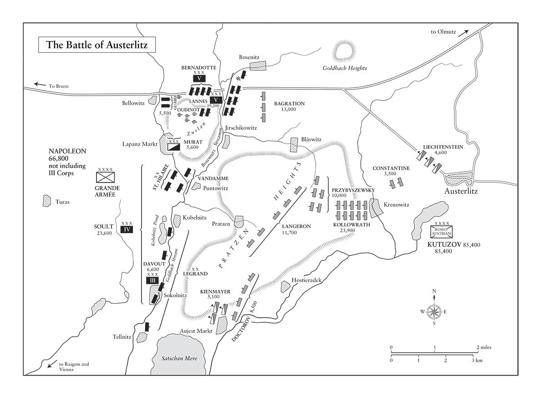
At 11 a.m. Vandamme’s division had stormed Tsar Alexander’s headquarters, the Stare Vinohrady hillock on the Pratzen, attacking with wild enthusiasm to the sound of massed bands, which ‘was enough to galvanize a paralytic’, as Coignet recalled. Grand Duke Constantine sent forward the 30,000 men (including cavalry) of the Russian Imperial Guard to take on Vandamme, whose line wavered under the blow. The 4th Line, commanded by Major Bigarré but whose honorary colonel was Joseph Bonaparte, was charged by the Russian Guard Cuirassiers; it broke, turned and fled, although its men had the presence of mind to cry ‘Vive l’Empereur!’ as they ran past Napoleon.114
At 1 p.m. Napoleon sent Bessières and Rapp with five squadrons of Guard cavalry, and later two more, including one of Mamluks, to help Vandamme regain the initiative on the Pratzen from the Russian Imperial Guard. Marbot was present when Rapp arrived, with a broken sabre and a sword wound to the head, and presented to the Emperor the flags they had captured along with his prisoner, Prince Nikolai Repnin-Volkonsky, commander of a squadron of the Russian Guard. ‘One mortally wounded chasseur presented his standard and fell down dead on the spot,’ recalled an eyewitness.115 When François Gérard painted the battle, Napoleon asked him to depict that moment of Rapp’s arrival. Less glorious was the Mamluk Mustapha, who although he had captured a standard told Napoleon that if he had killed the Grand Duke Constantine he would have brought him his head, to which the Emperor retorted: ‘Will you hold your tongue, you savage?’116
• • •
In the north of the battlefield, Murat and Lannes engaged General Pyotr Bagration, who took large numbers of casualties. By noon Napoleon had every reason to be satisfied. Soult had taken the Pratzen heights, the Santon’s defences were keeping the line stable in the north and Davout stood firm in the south. At 1 p.m. he moved his headquarters up to the Stare Vinohrady, where he could look down the Goldbach valley and work out his plan for the annihilation of the enemy. His chamberlain Thiard was present when Soult came to find Napoleon there and Soult was complimented on the brilliant part that he had played. ‘For the rest, Monsieur le Maréchal, it was on your Corps that I was most counting on to win the day,’ he said.117 Napoleon then sent Saint-Hilaire’s and Vandamme’s divisions around the rear of the Russians fighting at Sokolnitz, and, despite still being outnumbered three to one, Davout ordered a general offensive between Tellnitz and Sokolnitz. By 2 p.m. the outcome of the battle was not in doubt.
With the Pratzen heights now occupied by Bernadotte, Napoleon was able to order Oudinot, Soult and the Imperial Guard south to envelop Buxhöwden, as Davout’s cavalry attacked towards the southern village of Augedz. Napoleon then left the Pratzen heights at speed for the tower of the Chapel of St Anthony which overlooked the whole lake region, in order to oversee the last stage of the battle. Buxhöwden’s Russian force was split in two and fled east of the frozen lakes and across them, whereupon Napoleon had his gunners open fire on the ice. This incident led to the myth that thousands of Russians drowned as the ice cracked, though recent excavations of the reclaimed land at Lake Satschan turned up only a dozen corpses and a couple of guns.118 Overall, however, the Allied forces suffered terribly as they fled the field closely pursued by French cavalry and fired upon by artillery that had been brought up to the heights. (Austrian cavalrymen wore no backs to their breastplates, which made them lighter to carry in attack but left them highly vulnerable to sword and lance thrusts and to canister shot in retreat.) Although a Russian regiment and two Austrian battalions that had shut themselves up in Sokolnitz castle were massacred, large-scale surrender was allowed in the pheasantry and far beyond, as the French bands struck up ‘La Victoire est à Nous’.
At 10 p.m. Napoleon returned to the Stara Posta. ‘As may be imagined,’ recalled Marbot, ‘he was radiant, but frequently expressed regret’ that his brother Joseph’s regiment should have lost its eagle to that of Alexander’s brother, the Grand Duke Constantine.119The next day Napoleon berated those soldiers for losing their eagle to the Russian Guard cavalry. Even though he wasn’t a member of the regiment, a spectator to this monumental dressing-down recalled, ‘I must own that my flesh crawled. I broke into a cold sweat, and at times my eyes were coursing with tears. I do not doubt the regiment would have performed miracles if it had been led into action at the very next instant.’120
• • •
‘Soldiers of the Grande Armée,’ Napoleon wrote to his victorious army on the night of Austerlitz, with his customary rhetoric:
Even at this hour, before this great day shall pass away and be lost in the ocean of eternity, your emperor must address you, and say how satisfied he is with the conduct of all those who have had the good fortune to fight in this memorable battle. Soldiers! You are the finest warriors in the world. The recollection of this day, and of your deeds, will be eternal! Thousands of ages hereafter, as long as the events of the universe continue to be related, will it be told that a Russian army of 76,000 men, hired by the gold of England, was annihilated by you on the plains of Olmütz.121
He added that they had captured 140 cannon and 10,000 prisoners and ‘left 26,000 men dead on the field’. The next day he revised the number of cannon down to 120 but trebled the prisoners-of-war taken, along with twenty generals. Reliable modern sources put the Austrian and Russian losses at 16,000 killed and wounded, including 9 generals and 293 officers, and 20,000 captured, as well as 186 guns, 400 ammunition wagons and 45 standards.122 The French losses came to 8,279, of whom only 1,288 were killed. Of the wounded 2,476 needed long-term care, although Saint-Hilaire’s division had suffered 23 per cent casualties, and Vandamme’s 17 per cent.
With large numbers of Russians still unengaged, Archduke Charles on his way from Italy and the Prussians threatening to declare war against France, the Allies could theoretically have fought on, but the Austrians’ nerve was broken at Austerlitz and so too was Alexander’s. He retreated into Hungary. Prince Johann of Liechtenstein arrived at the Stara Posta soon afterwards to discuss terms. ‘Never, perhaps,’ noted General Dumas, ‘was so important an affair treated of in any palace of the European sovereigns as in this miserable dwelling.’123 Napoleon explained his victory to Joseph, saying the enemy ‘was caught in flagrante delicto while manoeuvring’ (he was clearly fond of the phrase). He was almost equally succinct in his letter to Josephine: ‘I have beaten the Russian and Austrian army commanded by the two emperors. I am a little tired. I have bivouacked eight days in the open air, with the nights rather cool . . . The Russian army is not merely beaten; it is destroyed.’124 A masterful plan, an appreciation of terrain, superb timing, a steady nerve, the discipline and training instilled at Boulogne, the corps system, exploitation of a momentary numerical advantage at the decisive point, tremendous esprit de corps, fine performances on the day by Friant, Davout, Vandamme, Soult and Saint-Hilaire, and a divided and occasionally incompetent enemy – Büxhowden was drunk during the battle – had given Napoleon the greatest victory of his career.*