
18
‘The Emperor Napoleon was often known to take off his cross of the Légion d’Honneur and place it with his own hands on the bosom of a brave man. Louis XIV would have first inquired if this brave man was noble. Napoleon asked if the noble was brave.’
Captain Elzéar Blaze of the Imperial Guard
‘The first qualification of a soldier is fortitude under fatigue and privation. Courage is only the second. Hardship, poverty and want are the best school for a soldier.’
Napoleon’s Military Maxim No. 58
‘I’ve never seen men so completely beaten,’ Napoleon said of the Prussians after Jena.1 Yet Frederick William didn’t surrender. Instead he withdrew north-eastwards to continue fighting, knowing that the Russian army was on its way. Although negotiations were opened after the battle between the Marquis Girolamo di Lucchesini, the Prussian ambassador to Paris, and Duroc, nothing came of them. Napoleon rightly suspected Lucchesini to have been a prime supporter of the war.2 ‘I think it would be difficult to give a greater proof of the imbecility of this pantaloon,’ he wrote to Talleyrand.3
Meanwhile the Grande Armée continued its relentless drive through Prussia, never allowing the Prussians a chance to stop and regroup. Spandau capitulated to Suchet on October 25, Stettin to Lasalle on the 29th and the heavily fortified Magdeburg to Ney on November 11, which secured the whole western half of Prussia. On November 7 General Gerhard von Blücher, who had fought bravely at Auerstädt, was forced to surrender his whole force at Lübeck when he completely ran out of ammunition.
The fall of Berlin came so quickly that shopkeepers didn’t have time to take down the numerous satirical caricatures of Napoleon from their windows.4 As in Venice, the Emperor had the city’s Quadriga and winged Victory removed from the Brandenburg Gate and taken back to Paris, while prisoners from the Prussian Guard were marched past the same French embassy on whose steps they had so hubristically sharpened their swords the previous month.5 Napoleon visited the battlefield of Rossbach, the scene of France’s humiliation by Frederick the Great in 1757, and ordered the column erected there to be sent to Paris too.6 ‘I am wonderfully well,’ he repeated to Josephine from Wittenberg on October 23, ‘fatigue agrees with me.’7 His habit of signing off so very many letters to Josephine with the words ‘I’m well’ (Je me porte bien), turned out later to become a dangerous one.8
Sheltering in a hunting lodge in a surprise storm that day, a young widow told him of being married to the chef de bataillon of the 2nd Légère who had died at the battle of Aboukir, leaving her with their son. On being shown proof of the child’s legitimacy, Napoleon gave her a pension of 1,200 francs per annum, to revert to the boy on her death.9 The next day at Potsdam he was shown Frederick the Great’s sword, belt, sash and all his decorations at his palace of Sanssouci, which he sent to Les Invalides, as further ‘revenge for the disasters of Rossbach’.10 (He kept the king’s alarm clock by his bed for the rest of his life, but didn’t take Frederick’s flute, which can still be seen at Sanssouci.) ‘I would rather have these than twenty million,’ said Napoleon of his booty, and, gazing on Frederick’s tomb with his staff, he modestly added: ‘Hats off, gentlemen. If this man were alive I would not be standing here now.’11
While at Potsdam, Napoleon nearly took an altogether more serious revenge when it was discovered that Prince Franz Ludwig von Hatzfeld, who was on a Prussian delegation from Berlin, had been writing in code to Hohenlohe reporting on the size and state of the French army there. Even though Berthier, Duroc, Caulaincourt and Rapp tried to appease Napoleon’s anger, the Emperor wanted to arraign Hatzfeld as a spy in front of a military tribunal and have him shot. Shades of d’Enghien must have weighed heavily with Caulaincourt, and Berthier actually left the room when Napoleon ‘lost all patience’ with his advisors.12 Recognizing that he had overreacted, Napoleon arranged a touching scene whereby Hatzfeld’s pregnant wife threw herself in tears at his feet begging for her husband’s life. The Emperor then magnanimously tossed the intercepted coded letter into the fire, destroying the evidence.13
On the same day that Davout entered Berlin and Suchet took Spandau, Napoleon was writing to Fouché about the expense of the stage scenery for Pierre Gardel’s ballet The Return of Ulysses, and asking for a detailed report ‘to make sure there is nothing bad in it; you understand in what sense’ (Penelope had suitors when Ulysses was abroad).14 Yet somewhat hypocritically Napoleon was perfectly willing to make exactly the same insinuations against Queen Louise that he feared being made about himself, stating in a bulletin: ‘There was found in the apartment that the Queen occupied at Potsdam the portrait of the Emperor of Russia which that prince had presented to her.’15
The accusations that Frederick William had succumbed to petticoat government were unrelenting. ‘The notes, reports and State papers were scented with musk,’ read the campaign’s 19th bulletin from the Charlottenburg Palace on October 27, ‘and were found mixed with scarves and other objects on the dressing table of the Queen.’16 In case anyone missed the point, it stated how these ‘historical documents . . . demonstrate, if it needs demonstration, how unfortunate princes are when they allow women to have influence on political affairs’. Even the devoted Bausset thought that Napoleon wrote ‘with anger and without courtesy’ about Queen Louise, and when Josephine complained of the queen’s treatment in his bulletins, Napoleon admitted: ‘It’s true that beyond all I hate manipulative women. I am used to good, gentle and compassionate women . . . but that is maybe because they remind me of you.’17
• • •
‘Soldiers,’ Napoleon proclaimed from Potsdam on October 26, ‘the Russians boast of coming to us. We will march to meet them, and thus spare them half the journey. They shall find another Austerlitz in the heart of Prussia.’18 This was not what the army wished to hear. Now that the Prussian capital had fallen they wanted to return home.
Napoleon entered Berlin on the 27th in a grand procession at the head of 20,000 grenadiers and cuirassiers in their full-dress uniform. ‘The Emperor moved proudly along in his plain dress with his small hat and his one-sou cockade,’ recalled Captain Coignet. ‘His staff was in full uniform and it was a curious sight to see the worst dressed man the master of such a splendid army.’19 In 1840, writing to the future Empress Eugénie, Stendhal recalled how Napoleon ‘rode twenty paces ahead of his soldiers; the silent crowd was but two paces from his horse; he could have been shot down by a rifle from any window’.20 He settled in Frederick William’s vast rococo Charlottenburg Palace in Berlin, which became his headquarters. Napoleon’s treasury expenses record some 23,300 francs being given to a lady at this time who is described merely as ‘a Berliner’.21 On October 30, Napoleon offered peace on the basis of Prussia renouncing all its territories west of the Elbe, which Frederick William was prepared to do, but when he then added that the kingdom must also serve as his operational base for the coming struggle with Russia, the king ignored the advice of the majority of his council and continued the war, retreating to Königsberg (present-day Kaliningrad) up on the Baltic coast.22
France provided Napoleon with around 80,000 French conscripts a year, and many of the 1806 intake were now on their way to Prussia. These together with the 80,000 men he already had in the field – not including the garrisons in captured Prussian cities – and various detachments from the Confederation of the Rhine, meant that by November 1806 Napoleon could cross the Vistula into what had recently been Poland, and he could do so in force before winter closed down the campaign. Poland had been a European nation since 966, a kingdom since 1205 and part of a commonwealth with Lithuania after the Union of Lublin of 1569. It had been steadily erased from the map when it was partitioned in 1772, 1793 and 1795 between Russia, Prussia and Austria, but although it no longer existed as a country there was nothing the three partitioning powers could do to damage Poles’ sense of nationhood. This Napoleon continually encouraged, allowing the Poles to believe that one day he would restore their nation. Perhaps he would have done so eventually, but he had no plans for it in the short-term. Since 1797, when the French revolutionary army created ‘Polish Legions’, some 25,000 to 30,000 Poles had served in the two Italian campaigns, Germany and Saint-Domingue. Napoleon’s apparent sympathy with their cause encouraged many more Poles than that to rally to him, and some of Napoleon’s finest troops were Polish – including the first lancer units in the Grande Armée, who proved so effective that by 1812 he had converted nine regiments of dragoons into lancer regiments.
Horses were collected from all over France and Germany for the coming campaign, and the Army of Italy was stripped of cavalry in favour of the Grande Armée. Napoleon requisitioned uniforms, food, saddles, shoes, and so on from Prussia, but the state of Polish roads meant there were constant supply shortages. His abiding concern with how his soldiers were shod led him to write twenty-three letters about boots and shoes in November and December alone, including one to General François Bourcier, commandant of the cavalry depot in Potsdam, ordering that Prussian cavalrymen be made to give up their boots in exchange for French shoes, explaining: ‘They won’t be needing their boots again, and needs must . . .’23
On November 2 Napoleon ordered Davout to push east to Posen with Beaumont’s dragoons, followed by Augereau.24 Once there they set up a base and built bakeries before the corps under Lannes, Soult, Bessières, Ney and Bernadotte followed, with approximately 66,000 infantry and 14,400 cavalry in total. Napoleon took the territory between the Oder and the Vistula primarily to deny it to the Russians, but he also hoped to prevent the Prussians from staging a resurgence and to persuade the Austrians to remain neutral. He himself remained in Berlin. On the 4th he learned that 68,000 Russian soldiers were marching west from Grodno with the aim of joining the 20,000 Prussians under the command of General Anton von Lestocq.* ‘If I let the Russians advance I should lose the support and the resources of Poland,’ he said. ‘They might decide Austria, which only hesitated because they were so far off; they would carry with them the whole Prussian nation.’25 Murat, Davout, Lannes and Augereau therefore marched on towards the Vistula to establish bridgeheads before repairing to their winter cantonments on the western side of the river. Marching eastwards a thousand miles from Paris into a freezing winter through some of Europe’s worst-provisioned, poorest countryside against two enemy nations, with a third possibly hostile one to the south, was always going to be a considerable risk, though no worse a one than the Austerlitz campaign had been.
Almost all the fighting in the next part of the campaign took place inside East Prussia, formerly Polish territory, in what is today the 5,830 square mile Russian enclave of Kaliningrad. Much of it is a flat, boggy plain with many rivers, lakes and forests. In winter temperatures drop to −30°C and there is daylight only between 7.30 a.m. and 4.30 p.m. The roads were often only tracks unmarked on maps; even the main road from Warsaw to Posen was unpaved and lacked side ditches. Heavy rain turned the entire countryside into seas of mud, with cannon moving at 11/4 mph. Napoleon joked that he had discovered a fifth element to add to water, fire, air and earth: mud! He sent his survey department forward to map and sketch the countryside, note the name of each village, its population and even soil type, all recorded beside the officer’s signature so that he could summon him to learn more details later.
• • •
Even as he prepared to confront the Russians again, Napoleon’s thoughts turned to Britain, which he saw as an equally serious threat to France’s long-term interest. On Friday, November 21, 1806, he signed into law the Berlin Decrees. These were designed to force Great Britain to the negotiating table, but instead were to lead – once he tried to impose them by force on Portugal, Spain and Russia – to his own downfall. The ‘Continental System’ created by the Berlin Decrees (and their successors the Milan and Fontainebleau Decrees of 1807 and 1810) was what Napoleon called ‘a retaliation’ against the British Order-in-Council of May 16, 1806, which had imposed a blockade of the European coast from Brest to the Elbe.26 ‘That England does not admit at all the law of nations followed universally by all civilized people,’ the Berlin Decrees began, means her adversaries have ‘a natural right to oppose the enemy with the same arms he uses.’ Therefore the articles, drafted and redrafted by Talleyrand, who supported the policy, were uncompromising:
1. The British Isles are in a state of blockade.
2. All trade and all correspondence with the British Isles is forbidden.
3. Every British subject, of whatever state or condition he may be . . . will be made a prisoner of war.
4. All warehouses, all merchandise, all property, of whatever nature it might be, belonging to a subject of England will be declared a valid prize . . .
5. No ship coming directly from England or the English colonies, or having been there since the publication of the present decree, will be received in any port.27
Since one-third of Britain’s direct exports and three-quarters of her re-exports went to continental Europe, Napoleon intended the decrees to put huge political pressure on the British government to restart the peace negotiations broken off in August.28 Writing to Louis on December 3, he explained: ‘I will conquer the sea through the power of the land.’29 Later he explained: ‘It’s the only means of striking a blow to England and obliging her to make peace.’30 It was true; since the destruction of the French fleet at Trafalgar there was no direct way to damage Britain other than commercially.
Although Napoleon believed that the Berlin Decrees would be popular with French businessmen, who he hoped would pick up the trade that previously went to Britain, he was soon disabused by the reports from his own chambers of commerce. As early as December that of Bordeaux reported a dangerous downturn of business. International trade simply wasn’t the zero-sum game that, with his crude Colbertism, Napoleon assumed it to be. By March 1807 he had to authorize special industrial loans from the reserve funds to offset the crises that were resulting.31
Although the most ardent articles in the influential British Whiggish journal the Edinburgh Review (apart from those attacking Wordsworth’s poetry) called for peace in order to allow trade to resume, the British government managed to ride out domestic criticism. By contrast, the Continental System damaged precisely those people who had done well from Napoleon’s regime and had hitherto been his strongest supporters: the middle classes, tradesmen, merchants and better-off peasantry, the acquirers of biens nationauxproperty he had always sought to help. ‘Shopkeepers of all countries were complaining about the state of affairs,’ recalled the treasury minister Mollien, but Napoleon was in no mood to listen, let alone compromise.32
On January 7, 1807 Britain retaliated with further Orders-in-Council, ‘subjecting to seizure all neutral vessels trading from one hostile port in Europe to another . . . interdicting the coastal trade of the enemy to neutrals’.33 Then, in November, still more Orders stated that France and all its tributary states were under a state of blockade and that all neutral vessels intending to go to or from France had to sail to Britain first, pay duties there and obtain clearance. All American trade with France was therefore blocked unless the United States’ ships bought a licence in a British port for a substantial fee. Along with the British practice of ‘impressing’ (i.e. kidnapping) thousands of Americans for service in the Royal Navy, the November 1807 Orders-in-Council were the primary cause of the War of 1812 between Britain and the United States.
One major problem with the Continental System was that it could not be imposed universally. In 1807, for example, because Hamburg and the Hanseatic towns such as Lübeck, Lüneberg, Rostock, Stralsund and Bremen couldn’t manufacture the 200,000 pairs of shoes, 50,000 greatcoats, 37,000 vests and so on that the Grande Armée required, their governors were forced to buy them from British manufacturers under special licences allowing them through the blockade. Many of Napoleon’s soldiers in the coming battles of the Polish campaign wore uniforms made in Halifax and Leeds, and British ministers boasted in the House of Commons that Napoleon couldn’t even provide the insignia stitched onto his officers’ uniforms except by resort to British manufacturers.34
In some parts of the Empire, the Continental System caused genuine distress as it unbalanced, dislocated and occasionally wrecked entire industries. There were serious disturbances in the Grand Duchy of Berg, and two demi-brigades had to be sent to Mainz to confiscate all English and colonial goods. Comestibles destined for larders across Europe were publicly burned, and the parts of Germany closest to France suffered more than Britain.35 Napoleon’s protectionist decrees led to huge bonfires of confiscated British produce on the beaches of Dieppe and Honfleur.
Another problem was that there was widespread undermining of the System, even by the imperial family. Louis turned a blind eye to smuggling in Holland, Murat failed to impose the System fully when he became king of Naples, and Josephine herself bought smuggled goods on the black market.36 Even the ultra-loyal Rapp allowed contraband into Danzig when he became governor in 1807, and refused to burn merchandise.37 ‘No prohibited merchandise whatever may enter without my order,’ an infuriated Napoleon told his finance minister, Gaudin, ‘and I should be expressly derelict to permit any abuse which touches my House so closely. Where there is a law, everybody should obey it.’38 He dismissed Bourrienne in 1810 – who as governor of Hamburg had been taking bribes from merchants to relax the System’s prohibitive measures – and dethroned Louis the same year to set an example, but abuses continued virtually unabated.
Although Napoleon was not so naive as to believe that smuggling could be stamped out altogether, he went to great lengths to suppress it, posting three hundred customs officers along the Elbe in 1806, for example. Yet the British made even greater efforts to facilitate smuggling, setting up a huge operation on the Baltic island of Heligoland.39 By 1811 there were 840 vessels plying their often night-time trade between Malta and southern Mediterranean ports. Once landed, coffee and sugar were smuggled across borders despite the penalty of ten years’ penal servitude and branding, and after 1808 the death penalty on occasion for repeat offenders.40 (Britain had imposed the death penalty for smuggling in 1736, which was regularly enforced.)
The blockaded French navy could not hope to police the European coastline, and Lisbon, Trieste, Athens, Scandinavia, the Balearics, Gibraltar, Livorno, the Ionian Islands and St Petersburg all provided points at which, at different times and in differing amounts, British goods could enter the continent overtly or covertly. When French customs officials did capture contraband a proportion of it was often returnable for a bribe, and in due course it became possible to take out insurance against seizures at Lloyd’s of London. Meanwhile, French imperial customs revenues collapsed from 51 million francs in 1806 to 11.5 million in 1809, when Napoleon allowed the export of grain to the British at high price when their harvest was weak – some 74 per cent of all British imported wheat came from France that year – in order to deplete British bullion reserves.41* The Continental System failed to work because merchants continued to accept British bills-of-exchange, so London continued to see net capital inflows.42 Much to Napoleon’s frustration, the British currency depreciated against European currencies by 15 per cent between 1808 and 1810, making British exports cheaper. The Continental System also forced British merchants to become more flexible and to diversify, investing in Asia, Africa, the Near East and Latin America much more than before, so exports that had been running at an average of £25.4 million per annum between 1800 and 1809 rose to £35 million between 1810 and 1819. By contrast, imports fell significantly, so Britain’s balance of trade was positive, which it hadn’t been since 1780.43
Napoleon hoped, by preventing continental consumers from buying British produce, to stimulate European production, especially French, and to encourage producers to explore alternatives. When it was discovered in 1810 that sugar beet and indigo could be produced in France, he told his secretary that it was like discovering America a second time.44 An experimental school was set up in Saint-Denis to teach sugar-making and in March 1808 Napoleon asked Berthollet to research whether ‘it is possible to make good sugar from turnips’.45 He could not persuade people to drink Swiss tea, however, let alone chicory rather than coffee, and his plans to manufacture cotton out of thistles in 1810 also came to nothing.46
Had Britain merely been ‘a nation of shopkeepers’, the economic downturn in the fiscal years 1810 and 1811 that has been attributed to the Continental System might well have stirred up political problems for the government, but the Cabinet was largely made up of upper-class former colleagues of William Pitt – indeed the Duke of Portland’s government of 1807–9 abjured the labels ‘Whig’ and ‘Tory’ altogether and simply called itself ‘the friends of Mr Pitt’ – who put their support for the war against Napoleon above all commercial considerations. Spencer Perceval, who followed Portland as prime minister in October 1809, was quite unhinged on the subject. He told his brother-in-law Thomas Walpole that Napoleon could be identified in the Book of Revelation as ‘the woman who rides upon the beast, who is drunk with the blood of the saints, the mother of harlots’.47 When Napoleon was stopped at Acre in 1799, Perceval wrote an anonymous pamphlet, catchily entitled Observations Intended to Point out the Application of a Prophecy in the Eleventh Chapter of the Book of David to the French Power, which sought to argue that the Bible had foretold the fall of Napoleon. (Perceval’s detailed calculations from the scriptures also convinced him that the world was going to end in the year 1926.)48 With Britain’s politicians possessed by beliefs so resistant to reason, it is hard to see how Napoleon could ever have persuaded Britain to make peace after the death of Fox. When in 1812 Perceval was assassinated by someone even more deranged than him, his place as prime minister was taken by another disciple of Pitt, Lord Liverpool (formerly the foreign secretary Lord Hawkesbury), who was just as committed to the destruction of Napoleon and who would serve until 1827.
• • •
At 3 a.m. on November 25, 1806 Napoleon left Berlin for a tour of the Polish front, inviting Josephine, who was in Mainz, to come east to stay with him,49 a suggestion he was later to regret. He entered the Polish city of Posen on the night of the 27th to a tremendous reception from the inhabitants, whose hopes for nationhood he had excited but avoided making any commitment to gratify. ‘I ought not to have crossed the Vistula,’ he later said in one of his many acknowledgements of blunders. ‘It was the taking of Magdeburg that induced me to enter Poland. I did wrong. It led to terrible wars. But the idea of the re-establishment of Poland was a noble one.’50 To the town fathers begging for the restitution of their kingdom he chose his words carefully: ‘Speeches and empty wishes are not enough . . . What force has overthrown only force can restore . . . what has been destroyed for lack of unity only unity can re-establish.’51 It sounded positive and martial, but fell well short of a promise to re-establish Poland as a nation-state.
The next day Count Levin von Bennigsen, the Hanoverian-born commander of the Russian army, retreated from Warsaw and stopped 40 miles to the north near Pultusk. Murat entered Warsaw that evening, installing himself as governor. Napoleon was not about to be coerced by the Poles’ enthusiastic welcome into alienating for ever the three countries which had partitioned and extinguished Poland for their own immense territorial gain in 1795. ‘I am old in my knowledge of men,’ he told Murat on December 2. ‘My greatness does not rest on the help of a few thousand Poles . . . It is not for me to take the first step.’ As for General Prince Józef Poniatowski, the pro-French nephew of Poland’s last king, Napoleon said: ‘He is more frivolous and lightweight than most Poles, and that is saying a good deal.’52 Napoleon wanted Murat to convey to the Poles ‘that I am not begging for a throne for a member of my family; I have no shortage of thrones to give them.’53
• • •
The Grande Armée hated life on the Vistula, and saw only ‘want and bad weather’ ahead.54 One of the army’s jokes was that the entire Polish language could be reduced to five words – ‘Chleba? Nie ma. Woda? Zaraz!’, ‘Bread? There is none. Water? Immediately!’ – so when an infantryman in a column near Nasielsk shouted out to Napoleon: ‘Papa, Chleba?’, he immediately called back ‘Nie ma’, whereupon the whole column roared with laughter.55 During a storm before the army went into its winter quarters (cantonments), another soldier shouted: ‘Have you bumped your head, leading us without bread on roads like this?’ To which Napoleon replied: ‘Four more days of patience, and I won’t ask you for anything more. Then you’ll be cantoned.’ The soldier shouted back: ‘Well, it’s not too much, but remember it, because after that we’ll canton ourselves!’56 The grognards had genuine grievances – on occasion they were reduced to drinking horses’ blood from saucepans while on the march – but Savary recalled of this period of the campaign how: ‘He loved the soldiers who took the liberty of talking to him, and always laughed with them.’57
To a letter from Josephine saying that she wasn’t jealous of him spending his evenings with Polish women, Napoleon replied on December 5:
I have long since perceived that choleric people always maintain they are not choleric; those who are afraid declare repeatedly that they are not afraid; you, then, are convicted of jealousy; I’m enchanted! Anyway, you’re wrong to think that in the wastes of Poland I think of beautiful women. There was a ball last night given by the provincial aristocracy, with quite pretty and rich women, but badly dressed, even though they tried to emulate Parisian fashion.58
The following week he pulled off a significant coup when the Elector Frederick Augustus of Saxony, whose forces had fought alongside the Prussians at Jena and Auerstädt, left his alliance with Frederick William III and joined the Confederation of the Rhine. Napoleon arrived in Warsaw to an ecstatic welcome on December 19. He immediately set up a provisional government of Polish nobles, albeit with little more than consultative powers. He assumed that the Russians would not retreat much further and were ready to fight, so he ordered all his corps over the Vistula. Hoping to make for the gap between the German-born Russian generals Bennigsen and Büxhowden, he told the corps commanders to expect a major offensive soon. When Davout’s corps reached the village of Czarnowo on the Bug river on December 23, Napoleon reconnoitred the area and launched a night attack, which was successful in putting to flight 15,000 overextended Russians under Count Alexander Ostermann-Tolstoy,* at the end of which the waterways north of Warsaw were in French hands.59
On Christmas Day 1806, Napoleon tried to destroy Bennigsen’s army while it was retreating to the north-east by sending Lannes to Pultusk to cut off his line of retreat, while Davout, Soult and Murat marched north, Augereau went north-east from the Wkra river and Ney and Bernadotte south-east from the Vistula. The weather ruined his chances, cutting movement down to 7 miles a day. ‘The ground over which we passed was a clayey soil,’ recalled Rapp, ‘intersected with marshes: the roads were excessively bad: cavalry, infantry and artillery stuck in the bogs, and it cost them the utmost difficulty to extricate themselves.’60 When battle was joined at Pultusk the next day, ‘Many of our officers stuck in the mud and remained there during the whole of the battle. They served as marks for the enemy to shoot at.’
Bennigsen fought a successful rearguard action during a snowstorm at Pultusk with 35,000 men against Lannes’ 26,000-strong corps, and withdrew the next day.61 On the same day at Golymin, Prince Andrei Galitzin fought until dark before neatly extricating his force from one of Napoleon’s traps (Murat, Augereau and Davout were to descend on him from three sides) – when they met at Tilsit in July Napoleon congratulated Galitzin on his escape.62 Napoleon visited the Golymin battlefield the next day, and the soldier-painter Lejeune recorded how ‘the Emperor and Prince Berthier stopped a few minutes to hear us sing airs from the latest operas of Paris’.63
Having withdrawn successfully, the Russians went into winter quarters around Bialystok, and on December 28 Napoleon suspended hostilities and cantoned the army along the Vistula, returning to Warsaw on New Year’s Day. He had little choice considering the bad weather, terrible state of the roads and the fact that due to fever, injury, hunger and exhaustion, 40 per cent of his army was absent at any one time, much of it looking for food in land that could barely support its own population in peacetime, let alone two huge armies at war.64 Orders were given to build hospitals, workshops, bakeries and supply depots, as bridgeheads and fortified camps went up so that the Grande Armée wouldn’t have to force a passage over the river in the spring.
‘Never was the French army so miserable,’ noted Baron Pierre Percy, its surgeon-in-chief.
The soldier, always marching, bivouacking each night, spending days in mud up to his ankles, doesn’t have one ounce of bread, not a drop of brandy, doesn’t have the time to dry his clothes, and he falls from exhaustion and hunger. We found some who had expired on the side of ditches; a glass of wine or brandy would have saved them. His Majesty’s heart must be torn by all this, but he marches to his goal and fills up the great destinies he prepares for Europe; if he failed or only got mediocre results the army would be demoralized and cry out.65
It was estimated that one hundred soldiers had committed suicide by Christmas.66
Napoleon had long placed great emphasis on the treatment, evacuation and care of the wounded, writing around six hundred detailed letters on the subject since the start of the Italian campaign ten years earlier. He often wrote to his senior doctors, Percy and Dominique Larrey, praising the ‘courage, zeal, devotion and, above all, patience and resignation’ of the army’s service de santé.67 He was constantly quizzing surgeons about diseases, and asking them how French medicine differed from that of other countries.68‘Here you are, you great charlatan,’ Napoleon would tease his own doctor, Jean-Nicolas Corvisart. ‘Did you kill a lot of people today?’69 He liked and trusted Corvisart, who cured his sciatica and kept him generally healthy until a series of minor but irritating diseases starting afflicting him from the Russian campaign onwards. On other occasions Napoleon could be coruscating about doctors, writing to Jean-Gérard Lacuée in January 1812: ‘The inexperience of the surgeons does more harm to the army than the guns of the enemy.’70
Napoleon only put suggestions for an ambulance service into practice in 1813, when lack of resources prevented it from taking proper effect.71 Yet he did increase the numbers of medical officers serving in the French army, from 1,085 in 1802 to 5,112 a decade later, and the number of battlefield surgeons from 515 to 2,058.72 These few doctors had to deal with truly vast numbers of patients in the Polish campaign; between October 1806 and October 1808, French military hospitals treated 421,000 soldiers. Even when the fighting was fiercest in that period, less than a quarter of these were actually wounded in battle; the rest were ill, mostly from fever.73
• • •
On January 1, 1807, on his way back from Pultusk to Warsaw, Napoleon changed horses in a post-house at Błonie and there met the beautiful blonde, white-skinned twenty-year-old Polish Countess Marie Colonna-Walewska, who he soon discovered was married to an aristocratic landowner a full fifty-two years older than her.74 He arranged to meet her again at a ball, after which she quickly became the mistress to whom he became the most attached. One of the other ladies present at the ball, the gossipy diarist Countess Anna Potocka, ‘saw him squeeze her hand’ at the end of a dance, which she assumed equated to a rendezvous. She added that Marie had a ‘delicious figure but no brains’.75
Napoleon quickly rescinded his invitation to Josephine to join him in Warsaw. ‘It’s too great a stretch of country to cover between Mainz and Warsaw,’ he told her two days after meeting Marie. ‘I’ve many things to settle here. I think you should return to Paris, where you are needed . . . I’m well, the weather’s bad. I love you with all my heart.’76 To her subsequent pleas to be allowed to join him, he replied: ‘I’m more vexed about this than you are; I would have loved to share these long winter nights with you, but one has to yield to circumstances.’77*
• • •
Napoleon visited Rapp in Warsaw, who had been wounded for the ninth time at the battle of Golymin, this time in his left arm. ‘Well, Rapp,’ he said, ‘you are wounded again, and in your unlucky arm too.’ Rapp told him it was small wonder, as ‘we are always in the midst of battles’. ‘We shall perhaps have done fighting when we are eighty years old,’ Napoleon replied.78 This indication that he expected to live far longer than his father is supported by a letter to Dalberg at this time, in which he wrote: ‘One is only two-thirds of the way through life at sixty.’79
Although Napoleon was quite content to let the Russians hibernate through the winter, Ney was desperately short of supplies, so entirely contrary to orders he suddenly struck north on January 10, hoping to capture the major supply depot of Königsberg by surprise. It was the kind of adventurous insubordination that he knew Napoleon would condone if he were successful. He reached Heilsberg a week later, where he stumbled on Lestocq’s Prussian Corps, thereby uncovering the fact that Bennigsen had begun his own surprise attack, and was moving quietly through the 500-square-mile Johannisburg Forest, north-east of Warsaw.
Prisoners captured by Ney and later Bernadotte allowed Napoleon to piece together a major enemy offensive moving towards the Vistula. He immediately spotted the opportunity for a devastating counter-attack. With so much of his army to the south, Napoleon saw a way of operating on Bennigsen’s flank and maybe also on his rear, since the further west the Russians moved, the easier it would be for the French to cut them off. He therefore decided on an attack from Warsaw one hundred miles north to Allenstein on the Alle river. Marshal Lefebvre, who had been taken off the inactive list in 1805, was given a corps with which to besiege Danzig, and was retained at Thorn. Augereau was moved across the Vistula. Bernadotte was ordered to put a screen along the Passarge river and to be ready to make a fighting retreat through Elbing if necessary. Meanwhile, Napoleon pivoted on Thorn, swinging the entire army from south to north. Davout was guarding the eastern flank until replaced by Lannes, whereupon his corps pushed forward towards Ostrolenka and Makow. By January 19 Napoleon’s advance guard met Bennigsen’s moving towards Danzig. The weather was still dire. ‘Never has a campaign been tougher,’ wrote the artillery General Alexandre de Sénarmont. His cannon were up to their axles and his gunners up to their knees in mud.80 Soon after the ground hardened in the frost, and several feet of snow further slowed the army.
On January 27 the Grande Armée was still moving north by forced marches, while Ney and Bernadotte were ordered to continue their retreat westwards, thereby drawing Bennigsen further into Napoleon’s trap. ‘My health has never been better,’ he boasted to Joseph, ‘and in consequence I have become more galant than before.’81 He was by now vigorously pursuing his affair, using the ‘tu’ form to address Marie which he otherwise reserved solely for Josephine and the Shah of Persia: ‘Oh! come to me! Come to me!’ he wrote to her, ‘all your desires will be fulfilled. Your homeland will be dear to me if you take pity of my poor heart. A few days later, sending her a brooch, he wrote
Please accept this bouquet; may it become a secret link that ties us together through the crowds that surround us. When all eyes are on us, we will have a secret code. When my hand touches my heart, you will know that you fill it entirely, and in response, you will put your hand on your bouquet! Love me, my sweet Marie, and may your hand never leave your bouquet!82
He was generous to her too, giving her 50,000 francs in three tranches up to October 1809.83*
• • •
On January 31, the day after Napoleon left Warsaw for the front, Cossacks in the Russian General Bagration’s advance guard captured an aide-de-camp carrying a message from Napoleon to Bernadotte, the aide having failed to destroy his uncoded despatches in time. (Napoleon ordered his aides-de-camp to keep messages sewn into the heels of their boots; ‘An aide-de-camp may lose his trousers on his way,’ he once quipped, ‘but never his despatches or his sabre.’84) The message ordered Bernadotte to rejoin the left of the Grande Armée by a secret night march. It included the dispositions of the entire Grande Armée and made clear his intention to cut off the entire Russian army by attacking up from the south. Bennigsen calmly ordered an immediate retreat to the Alle.85Unaware that his plan had been compromised, Napoleon continued striking north, along terrible roads in atrocious weather. For a commander for whom speed was always the essential element, Poland’s winters were exceptionally frustrating. On February 2 Napoleon learned that instead of advancing to the Vistula, Bennigsen was now retreating towards the Alle, back to safety. He moved as fast as possible to Bergfried in an effort to fix him in position before he escaped. He only had five infantry divisions, Murat’s Cavalry Reserve and part of the Imperial Guard with him. The next day Bennigsen crossed the Alle, leaving only a rearguard to hold off the French. Napoleon called off the assault, and by the following day the Russians had gone. ‘I’m in pursuit of the Russian army,’ he told Cambacérès, ‘and am going to force it back beyond the Niemen.’86*
When Murat caught up with the Russian rearguard at the bridge over a tributary of the River Frisching at Hof on February 6, General Jean-Joseph d’Hautpoul charged his cuirassiers straight at the Russian cannon, taking the position. Half an hour later in front of the whole division Napoleon embraced the enormous, loud and salty-tongued veteran, who true to form turned to his troops afterwards and bellowed: ‘The Emperor is pleased with you, and I am so pleased with you that I kiss all your arses!’87 Murat took 1,400 casualties at Hof. His adversary, the Scots-Lithuanian-born General Michael Barclay de Tolly, lost 2,000 Russians, but Bennigsen had successfully extricated himself again.88 The only way for Bennigsen to protect Königsberg 20 miles to the north – where he could not allow himself to be trapped – was to give battle at Eylau (present-day Bagrationovsk), then an East Prussian town of 1,500 inhabitants 130 miles from the Russian border. He had around 58,000 men with him but was expecting Lestocq to arrive shortly with 5,500 more. Napoleon had 48,000, but Ney 12 miles to the west and Davout 10 miles to the south-east were on their way with nearly 30,000. The Russians had a huge advantage in artillery, however, with 336 guns to Napoleon’s 200.
The main road from Landsberg to Königsberg passes for some 9 miles between a plain and a forest until it emerges onto an undulating plain about 11/2 miles from Eylau, which ends in a slight elevation. From this point Napoleon had a clear view over the broad valley leading to the pronounced ridge on which the Russian army was deployed. On his left foreground was Lake Tenknitten, on his right Lake Waschkeiten. For a thousand yards between them is a slight elevation, more marked at the road crossing after which the road then drops down for the last half mile into Eylau across a slight valley. A church and its cemetery stand on a small hillock to the right of what was in 1807 a town of solid houses on an important crossroads. There were several frozen lakes and marshes and birch woods dotted about. The high point of the plain was the village of Serpallen, where the snow was three feet deep in places.
Bennigsen’s army deployed for battle on the late morning of Saturday, February 7, 1807. At 2 p.m. Murat’s cavalry and the head of Soult’s infantry reached the woods before the village of Grünhofschen. Augereau came up next and deployed towards Tenknitten. Soult sent the 18th and 46th Line into battle against the Russian vanguard unsupported; the former crossed the end of the frozen Tenknitten lake under heavy artillery fire, veered to its right and, much shaken, were attacked by bayonet. Then the St Petersburg Dragoons, looking for revenge after their defeat at Hof, crossed the frozen lake and attacked their left rear, catching both battalions out of square and breaking them, where the 18th Line lost its eagle.* French dragoons arrived in time to counter-charge and save them from complete destruction, but there was much carnage. The 46th Line were able to retire in good order. When Soult deployed his artillery between Schwehen and Grünhofschen, the Russian vanguard began to fall back towards the main body of the army.
Napoleon now held all the plateau ground up to the valley, but his losses had been severe; three weeks later there was still a mound of corpses visible there. He had not intended to storm Eylau that evening, preferring to wait for Ney and Davout to arrive, but various accidents and misunderstandings summed up in that useful phrase ‘the fog of war’ forced him to do so. Soult’s explanation was probably best, that some of the Reserve Cavalry had followed the Russians into Eylau, and that his 24th Line had gone in after them, whereupon general fighting for the church and cemetery had begun which naturally sucked in more men as it progressed. Whatever the reason, the battle was now a two-day affair, with 115,000 men contesting an area only five miles square.
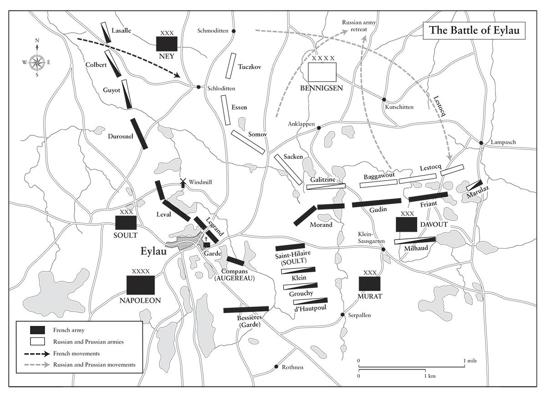
The church and cemetery were stormed by Saint-Hilaire’s division, during which Barclay de Tolly, one of the best generals of the Russian army, was severely wounded by grapeshot, which left him hors de combat for fifteen months. Bagration would have evacuated Eylau but Bennigsen ordered it recaptured it at all costs, so he led three columns in on foot against French infantry and artillery firing canister shot. By 6 p.m. the Russians had retaken most of the town, though not the church and cemetery. Bennigsen then changed his mind, and at 6.30 p.m. he ordered the Russian troops to pull back from the town to the slight elevation that contemporary writers referred to as ‘heights’ to the east, whereupon the French reoccupied the town.
As night fell, Legrand’s division moved just beyond Eylau; Saint-Hilaire camped out in the open near Rothenen; Milhaud’s cavalry was at Zehsen; Grouchy was behind Eylau; Augereau was in a second line between Storchnest and Tenknitten, and the Imperial Guard slept on the elevated area where Bagration had started the day. As snow fell both armies huddled around bivouac fires. Because the supply wagons could not stay apace with the army on forced marches, a number of soldiers hadn’t had bread for three days, and some ate the flesh of dead horses from the battlefield. One soldier complained to Captain Blaze of the Imperial Guard that he had nothing to smoke but hay.89 In Marbot’s words, the French army had ‘for days been living on nothing but potatoes and melted snow’.90
An hour before nightfall, Napoleon visited Eylau. ‘The streets were full of corpses,’ Captain François-Frédéric Billon recalled, ‘what a horrible spectacle. Tears welled in the Emperor’s eyes; nobody would have believed possible such an emotion from this great man of war, however I saw them myself, these tears . . . The Emperor was doing his best to prevent his horse stepping on human remains. Being unsuccessful . . . it’s then that I saw him crying.’91 On a freezing night with snow falling after midnight, Napoleon slept in a chair in the ransacked post-house below the Ziegelhof without taking off his boots.
• • •
At 8 a.m. on the morning of Sunday February 8 the Russians began a furious cannonade upon Eylau, their sheer numbers making up for any lack of accuracy. The French artillery reply did great damage to the Russian formations exposed against the snow. With freezing winds and recurrent snow flurries, visibility was to be a major factor that day, dropping down to ten yards at times, so that the Russians on the heights sometimes couldn’t see Eylau and very often commanders couldn’t see their own troops.
At 9.30 a.m. Napoleon ordered Soult to move north-west of Eylau on the extreme left of his line. Davout’s corps was approaching the town from the other direction, and the Emperor wanted to divert Bennigsen’s attention. By 10 a.m., however, Soult was being forced back by the Russians into Eylau itself. ‘Three hundred cannon on either side pouring out a hail of grapeshot at close quarters wreaking terrible havoc,’ recalled Lejeune. When Davout’s corps arrived on Napoleon’s right they were held up by ferocious attacks from Ostermann-Tolstoy’s cavalry against Friant’s advance-guard. With the left under Soult weak, and Davout deploying painfully slowly, Napoleon needed a major diversion on the right. He instructed Augereau to attack the Russian left with his 9,000 men and try to link up with Davout. Augereau was very ill before the battle and so cold he had a scarf wrapped around his head with his marshal’s hat jammed on top; he had to be supported in his saddle by an aide-de-camp. As he advanced he got lost in the blizzard and marched straight into a Russian battery firing grapeshot at point-blank range, its direction only discernible by the flashes from the barrels. (Walking along Augereau’s approach at Eylau, with its multiple slopes and folds in the ground, it’s easy to see how brigades could have become completely disorientated in the snowstorm.) Five thousand soldiers and officers were killed or wounded in fifteen minutes, and Augereau himself was wounded.92 Saint-Hilaire’s division, which had stayed on course to try to relieve Davout, was also flung back. By 11.15 the situation was serious. Napoleon watched from Eylau church despite its being fired at by Russian artillery. His left was effectively wrecked, his right had been badly mauled, and reinforcements were delayed. He found himself in personal danger too, when a column of Russian infantry managed to get into Eylau during the battle and came close to the church before it was checked and destroyed.
At 11.30, once it was clear that Augereau had failed, Napoleon sprung one of the great audacious moves of his military career. As the blizzard abated, he flung almost the whole of Murat’s Cavalry Reserve into the greatest cavalry charge of the Napoleonic Wars. Pointing to a Russian cavalry attack developing on Augereau’s smashed corps, he said to Murat either ‘Are you going to let those fellows eat us up?’ or ‘Take all your available cavalry and crush that column’ (or possibly both).93 Murat, who was wearing a green Polish cape and green velvet bonnet for the occasion, and carried only a riding whip, then led 7,300 dragoons, 1,900 cuirassiers and 1,500 Imperial Guard cavalry into a headlong attack. ‘Heads up, by God!’ cried Colonel Louis Lepic of the Guard grenadiers-à-cheval. ‘Those are bullets, not turds!’ The Russian cavalry was hurled back against its own infantry; Russian gunners were sabred alongside their guns; Serpallen was recaptured, and Murat only stopped when he reached Anklappen. (Lepic refused to surrender during a Russian counter-attack and was later rewarded by Napoleon with 50,000 francs for his bravery, which he shared out to his men.)
Murat’s charge checked the Russian centre and regained the initiative for Napoleon. It came at the high cost of up to 2,000 casualties, including d’Hautpoul, who was hit by grapeshot and died some days after the battle. Meanwhile, Ney made his way agonizingly slowly through the blizzard across the terrible roads to the battlefield. By 3.30 p.m. Davout had managed to get behind Bennigsen, and was almost at Anklappen. Napoleon was about to snap shut his trap, encircling the Russian army, when Lestocq suddenly appeared and launched an attack on Friant’s division. He evicted the French from Anklappen with only half an hour of daylight left, thus saving Bennigsen’s left flank. At 7 p.m. Ney finally arrived but he was too late to deliver the devastating blow for which Napoleon had been hoping. The fighting slowly wound down as darkness descended and both sides succumbed to total exhaustion. At midnight Bennigsen, now very short of ammunition and realizing that Ney had arrived, ordered a retreat, leaving the field to the French.
‘When two armies have dealt each other enormous wounds all day long,’ Napoleon commented, ‘the field has been won by the side which, armoured in constancy, refuses to quit.’94 Yet the field was all that Napoleon did win at Eylau. Because he hadn’t known whether he faced the Russian rearguard or Bennigsen’s whole army, his attacks had been disjointed and costly, and the street-fight in Eylau had been an unnecessary accident. Ney was only called in at 8 a.m. on the 8th, far too late, because Murat had erroneously reported a Russian retreat that morning. Augereau’s attack in the snowstorm had been so disastrous that his corps had to be split up and distributed to other marshals as he convalesced, something for which he never truly forgave Napoleon. Murat’s cavalry charge had been splendid and worthwhile, but a desperate remedy, as the presence of Napoleon’s own bodyguard in it eloquently attested. The Guard infantry also took serious losses at Eylau, having been exposed to enemy artillery fire to conceal Napoleon’s numerical weaknesses.95
It had been a truly horrific two days. ‘Not a lot of prisoners but a lot of corpses,’ recalled Roustam of Eylau, who nearly died of exposure there. ‘The wounded on the battlefield were hidden under the snow, you could only see their heads.’96 Napoleon attempted to minimize his losses as usual, claiming only 1,900 killed and 5,700 wounded, but more reliable sources list 23 generals, 924 other officers and about 21,000 other ranks killed and wounded. Eleven days after the battle Lestocq buried around 10,000 corpses, over half of whom were French.97 Similarly the Russians lost 18,000 killed and wounded; 3,000 prisoners were captured and 24 guns. The Prussians suffered around 800 casualties. Bennigsen’s orderly retreat is illustrated by the fact that he lost less than 1 per cent of his guns, but – demonstrating that it wasn’t just Napoleon who ‘lied like a bulletin’ – he claimed to the Tsar to have suffered only 6,000 casualties. To Duroc Napoleon admitted ‘although the losses on both sides were very heavy, yet my distance from my base renders mine more serious to me’.98
As the Revolutionary and Napoleonic Wars progressed, the casualty rates in battles increased exponentially: at Fleurus they were 6% of the total number of men engaged, at Austerlitz 15%, at Eylau 26%, at Borodino 31% and at Waterloo 45%. This was partly because with ever-larger armies being raised, battles tended to last longer – Eylau was Napoleon’s first two-day engagement since Arcole; Eggmühl, Aspern-Essling and Wagram in 1809, Dresden in 1813 were also two and Leipzig in 1813 went on for three – but mainly because of the huge increase in the numbers of cannon present. At Austerlitz the ratio was two guns per thousand men, but by Eylau this had leapt to nearly 4, and at Borodino there were 4.5. Eylau therefore represented a new kind of battle of the Napoleonic Wars, best summed up by Ney at its close: ‘What a massacre! And without any result!’99