
20
‘There is no country in Europe in the affairs of which foreigners can interfere with so little advantage as in those of Spain.’
The Duke of Wellington to Lord Castlereagh, 1820
‘That unfortunate war destroyed me; it divided my forces, multiplied my obligations, undermined morale . . . All the circumstances of my disasters are bound up in that fatal knot.’
Napoleon on the Peninsular War
Napoleon was conscious of the need for a new social hierarchy in France, one based on service to the state rather than accident of birth, and on his return to Paris in the summer of 1807 he set about putting it in place. ‘It was at Tilsit that the main titles of a new nobility were launched,’ recalled Anatole de Montesquiou, the son of Napoleon’s grand chamberlain, who served as an artillery officer under Davout. ‘For a long time, all the European cabinets were reproaching the Emperor for the lack of titles around him. According to them, it gave France a revolutionary appearance.’1 The Légion d’Honneur had gone some way towards inaugurating a new system of privilege based on merit, but couldn’t provide the basis for an entire social system. In May 1802 Napoleon had complained that his new order would remain as ‘grains of sand’ unless it could be anchored by ‘some masses of granite’.2 As an army officer, his mind naturally gravitated towards a hierarchical structure of ranks and titles, but he also wanted to avoid the damning flaws of the Ancien Régime – those of heredity and legal privileges. As ever he looked to the ancient world for guidance. ‘A prince gains nothing from the displacement of the aristocracy,’ he wrote later in Caesar’s Wars, ‘on the contrary he puts everything back in order by letting it subsist in its natural state, by restoring the old houses under the new principles.3
In March 1808 the ranks of count, baron and chevalier of the Empire were created. By introducing nobility based on merit – one in which 20 per cent came from the working classes and 58 per cent from the middle classes – Napoleon harnessed the revolutionary Frenchman’s ambition to serve his country.4 He did not see the reintroduction of nobility as contradicting the spirit of the Revolution. ‘The French people fought for only one thing: equality in the eyes of the law,’ he told Cambacérès. ‘Now, my nobility, as they style it, is in reality no nobility at all, because it is without prerogatives or hereditary succession . . . its hereditary succession depends on the will of the sovereign in confirming the title on the son or nephew of the deceased holder.’5 Unlike anywhere else in Europe, a French family’s noble status simply lapsed if the next generation hadn’t done enough to deserve its passing on.6 Napoleon’s new titles were therefore analogous to the British concept of the life peerage, which wasn’t instituted until 1958.
What has been described as Napoleon’s ‘re-hierarchization’ of French life involved a complete reordering of the social system.7 At the top were high-ranking army officers, ministers, councillors of state, prefects, presidents of the electoral colleges, senior judges, the mayors of the larger cities, and a few academics, professionals and artists. Below them came the more than 30,000 members of the Légion d’Honneur. Further down were around 100,000 sub-prefects, mayors of lesser cities, officials of the educational, judicial and administrative arms of the state, members of the electoral colleges, chambers of commerce, prefects’ councils and other office-holders and notables.8 These were Napoleon’s true ‘masses of granite’. Lying deep within the French Revolution were the seeds of its own destruction because the concepts of liberty, equality and fraternity are mutually exclusive. A society can be formed around two of them, but never all three. Liberty and equality, if they are strictly observed, will obliterate fraternity; equality and fraternity must extinguish liberty; and fraternity and liberty can only come at the expense of equality. If extreme equality of outcome is the ultimate goal, as it was for the Jacobins, it will crush liberty and fraternity. With his creation of a new nobility Napoleon dispensed with that concept of equality, and instead enshrined in the French polity the concept of equality before the law in which he believed wholeheartedly.
Under the Ancien Régime the noblesse had numbered anywhere between 80,000 and 400,000 people; under Napoleon the figures were much more exact and limited. In 1808 he created 744 nobles, in 1809 502, in 1810 1,085, in 1811 428, in 1812 131, in 1813 318, and in 1814 55. So whereas seven in 10,000 Frenchmen had been noble in 1789, by 1814 it was only one in every 10,000.9 Of the 3,263 nobles Napoleon created, 59 per cent were military, 22 per cent fonctionnaires and 17 per cent notables.10 Several doctors, scientists, writers and artists were ennobled too.* No fewer than 123 of Napoleon’s 131 prefects were ennobled, and the Paris appeal court boasted four counts, three barons and eleven chevaliers. In 1811 all but three ambassadors were titled. The system also allowed Napoleon to perpetuate the names of military victories, with principalities and dukedoms bearing such names as Castiglione, Auerstädt, Rivoli and Eckmühl.*
Separate from the new nobility, though often overlapping with it, he also introduced donations in 1806, whereby loyal subjects, the donataires, received lands and property confiscated from defeated enemies in the conquered territories. With them often came endowments, generally from Italy, Germany and, later, Poland. By 1815 there were 6,000 recipients of such land gifts, totalling 30 million francs.
The creation of the imperial aristocracy coincided with a hardening of Napoleon’s attitude towards internal dissent. On August 9, 1807 he told an extraordinary meeting of the Conseil d’État that he wanted the Tribunate, ‘whose name and object seemed foreign to a monarchical government’, to be abolished. This was duly done by a sénatus-consulte ten days later.11 A minority of the Tribunate had spoken and voted against the Concordat, the Légion d’Honneur, various sections of the Civil Code and the proclamation of the Empire. Even though it was precisely in order to hear different voices that the Tribunate had been created, Napoleon increasingly took an army officer’s view of these expressions of dissent in the legislative ranks; indeed it is remarkable that such a body had survived under him for as long as eight years. Savary explained in his memoirs that Napoleon never minded people disagreeing with him, so long as they did it in a loyal spirit and in private: ‘He never resented anyone who frankly showed opposition to his opinion; he liked his opinions to be discussed.’12 While he liked discussing his views with Cambacérès and the Conseil, he was less enthusiastic about tribunes such as Constant, Daunou and Chénier doing so. ‘Keep an eye on Benjamin Constant,’ he told Cambacérès about the notorious philanderer, ‘if he meddles with anything I’ll send him to Brunswick to be with his wife.’13 At the same time that the sénatus-consulte abolished the Tribunate, Napoleon raised the lower age limit for all members of the legislature to forty. He himself was still only thirty-eight.
• • •
Once back in Paris, Napoleon could concentrate on improving French finances, a task that was greatly helped by his recent victories. In September 1807, Daru drew up a detailed list of the cash and supplies that twenty-two Prussian cities would have to pay as part of the Tilsit settlement, which totalled 72,474,570 francs and 7 centimes in cash, and 30,994,491 francs and 53 centimes in supplies. Once other regions were included, the total came to over 153 million francs.14 This, as well as the declaration of peace, saw a huge surge in confidence in Napoleon’s government on the Paris Bourse: 5 per cent government stock, which had been trading at 17.37 in February 1800, rose to 93.00 on August 27, 1807, and thereafter stabilized in the mid-80s.15
This period back from what he called the Polish War was not all work for Napoleon. On October 4, 1807 he is recorded as having given 30,000 francs to the Comtesse de Barral, Pauline’s mistress of the robes and the wife of one of Jérôme’s notoriously adulterous chamberlains in Westphalia.16 He also displayed his controlling nature when in September 1807 he ordered the arrest of Mr Kuhn, the American consul in Genoa, for wearing the Order of Malta awarded him by the British. In the same month he demanded to know which Bordeaux aristocrats had boycotted Senator Lamartillière’s ball and why. He even assumed the role of amateur sleuth in a murder mystery, instructing Fouché to reopen a poisoning case from May 1805 concerning ‘a certain Jean-Guillaume Pascal, from Montpellier. This scoundrel is said to have murdered his wife.’ Napoleon ordered M. Pascal’s brother-in-law be interviewed by police and a post-mortem conducted on the couple’s dog, which he suspected might also have been poisoned.17
After such a long absence on campaign he was able to enjoy domestic life for the first time in nearly a year. While Napoleon was in Egypt, Josephine had borrowed money to buy the lovely Malmaison, a chateau 7 miles west of Paris, and she and Napoleon had split their time between there and the Tuileries. Featuring an aviary, a botanical hothouse for exotic plants, a summer pavilion, a tower, a ‘temple of love’, vineyard and fields adjoining the Seine, the Malmaison estate grew to three hundred acres of gardens, woods and fields, and a magnificent collection of statuary.* Josephine also kept there a menagerie of kangaroos, emus, flying squirrels, gazelles, ostriches, llamas and a cockatoo that had only one word (‘Bonaparte’) which it repeated incessantly. She would occasionally invite a female orang-utan dressed in a white chemise to eat turnips among her guests at table.18 Napoleon brought back gazelles from Egypt, to which he would occasionally give snuff.* ‘They were very fond of tobacco,’ recalled his private secretary, ‘and would empty the snuffbox in a minute, without appearing any the worse for it.’19 Although Napoleon kept a carbine in his study at Malmaison, with which he would sometimes shoot at birds through an open window, Josephine persuaded him not to open fire on her swans.20 (He would probably have missed; his valet Grégoire recalled that he ‘didn’t hold his gun properly on his shoulder, and as he asked for it to be tightly loaded, his arm was always black after he’d fired a shot’.21 He once took seven shots to kill a cornered stag.)
At its height, Napoleon’s imperial household covered thirty-nine palaces,* almost amounting to a state within a state, even though he never visited several of them.22 Taking Louis XIV as his model, he reintroduced public Masses, meals and levées, musical galas and many of the other trappings of the Sun King.23 He was certain that such outward displays of splendour inspired feelings of awe in the populace – ‘We must speak to the eyes,’ he said – as well as encouraging the French luxury-goods industry.24 The palaces had an annual budget of 25 million francs, comprising the sixth largest outlay in the whole of French public expenditure. In all he amassed a total of 54,514 precious stones in his personal treasury, which he saw as indistinguishable from that of France (although that wasn’t uncommon: the British Civil List only started in 1760).*
When he toured France, his entourage drove in sixty coaches in a deliberate attempt to impress, not unlike today’s American presidential motorcades that can number forty-five vehicles, a similarly visible metaphor for the power of the office. In private, however, he retained the modesty of the petit noblesse army officer that was always his true persona. ‘When he received on his throne,’ recalled Chaptal, ‘he displayed himself with great luxury. His orders were made of beautiful diamonds, as was the hilt of his sword, the cord and button of his hat and his buckles. These clothes ill became him, he seemed embarrassed, and he took them off as soon as he could.’25 His daily wear was either the blue undress uniform of a colonel of grenadiers of his Imperial Guard or the green uniform of its Chasseurs à Cheval, and when it was discovered that no cloth could be procured of the right shade of green on St Helena, he simply turned his coat inside out.
The contrast between Napoleon’s personal lack of adornment away from official occasions and the gorgeousness of the costumes of those around him was noted by many, as it was intended to be; indeed Denon instructed the painter François Gérard to ‘Take care to emphasize the full splendour of the uniforms of the officers surrounding the Emperor, as this contrasts with the simplicity he displays and so immediately marks him out in their midst.’26 Captain Blaze also noticed that ‘His small hat and green chasseur’s frock distinguish him amid the crowd of princes and generals with embroidery on every seam.’27 As well as the Légion d’Honneur, Napoleon wore his medal of the Iron Crown of Italy, but none of the many other decorations to which he was entitled, an array which might have drawn a sniper’s attention in battle (a consideration Nelson might have done well to consider). In 1811 a list was made of all Napoleon’s clothes, which included only nine coats (to last three years), two dressing-gowns, twenty-four pairs of silk stockings, twenty-four pairs of shoes and four hats. ‘Nothing is to be spent except after the approbation of His Majesty,’ it noted, and when the chamberlain Comte Charles de Rémusat did spend too much on Napoleon’s wardrobe he was dismissed.28
Everything in the organization of Napoleon’s palaces revolved around work. Dinner was at 6 p.m. but he very often missed it, instead eating whenever work permitted; dozens of chickens were put on spits throughout the day so that one would always be ready for him (hardly in conformity with his wishes for economy). He ate food as it was brought to him, in no particular order. He was no gastronome, and was perfectly happy eating macaroni. ‘Napoleon preferred the most simple dishes,’ recalled one of his chamberlains, ‘he drank no wine but Chambertin, and that rarely undiluted’.29 Even the Chambertin wasn’t always of the best vintages; when asked for his opinion, Augereau judged, ‘I’ve known better.’30 Napoleon brandy is ill named as he never drank any spirits, habitually taking one cup of coffee after breakfast and another after dinner. There is no known example of his ever being drunk. Napoleon recognized that he was no gourmand. ‘If you want to dine well, dine with Cambacérès,’ he told General Thiébault during the consulate, ‘if you want to dine badly, dine with Lebrun; if you want to dine quickly, dine with me.’31 He would generally spend less than ten minutes at table, except for family suppers on Sunday nights when he might stay for a maximum of half an hour.32 ‘We all obeyed the Emperor’s signal of rising from table,’ recorded a fellow diner, ‘his manner of performing this ceremony being brusque and startling. He would push the chair suddenly away, and rise as if he had received an electric shock.’33 Napoleon once said that although a number of people, especially Josephine, had told him he ought to stay longer at table, he considered the amount of time he spent there to be ‘already a corruption of power’.34
At home as on campaign, he slept only when he needed to, regardless of the time of day. ‘If he slept,’ his finance minister Comte Molé recalled, ‘it was only because he recognized the need for sleep and because it renewed the energies he would require later.’35He needed seven hours’ sleep in twenty-four, but he slept, as one secretary recalled, ‘in several short naps, broken at will during the night as in the day’.36 Since his bedroom was close to his study in all his palaces, he could be at work in his dressing-gown at any time of the day or night, with his secretaries on rotations to take dictation. ‘He used to get up,’ recalled another secretary, ‘after an hour’s sleep, as wide awake and as clear in the head as if he had slept quietly the whole night.’37
Napoleon was excellent at prioritization, dealing immediately with urgent matters, placing important but not urgent papers in a stack to be dealt with afterwards and throwing anything he considered unimportant onto the floor. Whereas Louis XVIII had a stamp made up for his signature, Napoleon always read letters through before signing them personally, not least because his speed of dictation meant that secretaries could sometimes take words down incorrectly. ‘The ideas go on fastest,’ Napoleon said in explaining his need for secretaries, ‘and then goodbye to the letters and the lines! I can only dictate now. It’s very convenient to dictate. It’s just as if one were holding a conversation.’38 He virtually never sat down at his desk except to write to his wives and mistresses (who received the only letters he didn’t dictate) and to sign documents. His three private secretaries – Bourrienne, who held the post from 1797 to 1802, Claude-François de Méneval (1802–13) and Agathon Fain (1813–15) – all developed their own shorthand to keep up with his torrent of words at their small desks while he sat on a green taffeta sofa in his study at the Tuileries near a folding screen that shielded him from the fire, an arrangement that was replicated in all his palaces. If they were still working at 1 a.m., Napoleon would sometimes take his secretary out incognito to the rue Saint-Honoré, where they would drink cups of hot chocolate.39 (On one occasion he complained to the prefect of police the next morning that the lamps at the palace gates had gone out: ‘He could not imagine how I had found it out.’40)
Each of his secretaries and ministers had his own story of Napoleon’s prodigious memory and dictating capacity. His interior minister Jean Chaptal’s tale of when he wanted to establish a military academy at Fontainebleau might be taken as entirely typical. Napoleon sat Chaptal down and dictated 517 articles to him, entirely without notes. Chaptal spent all night drawing them up, after which Napoleon ‘told me it was good but incomplete’.41 He once told Méneval that after he had left Brienne he started to work sixteen hours a day and never stopped.42
Everything around Napoleon happened at a tremendous pace. Molé recalled him going from a Mass to a levée at Saint-Cloud in the summer of 1806, ‘walking fast, with an escort of foreign princes and . . . grand French dignitaries, who were out of breath in their efforts to keep up with him’.43 He hated wasting a minute of the day, and was constantly performing several tasks simultaneously. He loved taking long hot baths which, unusually for early nineteenth-century Europeans, he did most days, but during those one or two hours he would have newspapers or political writings read to him, as he also did when his valet shaved him, and sometimes during breakfast. He was almost masochistic in listening to the British newspapers, which his secretaries hated translating for him: he insisted on hearing everything written about himself, however abusive.44 On long journeys in their carriage, Josephine read novels to him, chosen from the précis of newly published ones that he had the historical novelist the Comtesse de Genlis draw up for him every week.45
Although he worked them inordinately hard, Napoleon was considerate to his staff, who almost universally admired him. He was indeed a hero to his valets, aides-de-camp and orderlies, and far more of his personal servants volunteered to go into exile with him than the British could allow, a remarkable tribute to his talent as an employer. Mademoiselle Avrillon, who worked for Josephine, remembered him as being ‘extremely polite’ and ‘very indulgent when small errors were committed’. His chamberlain, the Comte de Bausset, wrote: ‘I can categorically say that few men were more level in their character and gentle in their behaviour.’ Agathon Fain thought ‘Napoleon was a loyal friend and the best of masters’, not least because ‘he would spoil everybody’.46 An alcoholic coachman was kept on the payroll years after he should have been sacked, because he had driven a wagon at Marengo.
‘I had expected to find him brusque, and of uncertain temper,’ recalled Méneval, ‘instead of which I found him patient, indulgent, easy to please, by no means exacting, merry with a merriness which was often noisy and mocking, and sometimes of a charming bonhomie.’47 The one secretary who wrote critically of Napoleon was Bourrienne, whose gross corruption had led to his demotion in 1802. Napoleon had later given him another job, as governor of Hamburg, which Bourrienne also abused for personal gain, and he went on to repay his master’s kindness with years of libels.
Insofar as there was ever an average evening in the life of Napoleon, it featured many of the pleasures of normal French bourgeois family life. As Méneval recalled:
He dined with his family, and after dinner would look in on his cabinet [office] and then, unless kept there by some work, would return to the drawing room to play chess. As a general rule he liked to talk in a familiar way. He was fond of discussions, but didn’t impose his opinions, and made no pretension of superiority, either of intelligence or of rank. When only ladies were present he liked to criticize their dresses, or tell them tragic or satirical stories – ghost stories for the most part. When bedtime came, Madame Bonaparte followed him to his room.48
He danced at the little balls given at Malmaison on Sunday nights, praised his stepchildren for their playlets and ‘found a charm in this patriarchal life’.49 He hunted stags and wild boar, but more for the exercise than the pleasure of the chase, and occasionally cheated at board and card games – though he usually repaid the money he won in that way. He simply could not bear not winning.
• • •
By early 1808 Prussia had been subdued and there was a grand understanding with Russia. Napoleon could now turn his mind to the means by which he might force Britain to the negotiating table. After Trafalgar it was clear that he could not revive plans to invade, but the British were still actively encouraging smuggling across Europe in an attempt to wreck the Continental System, blockading French ports and showing no signs of wanting to end the war. So Napoleon looked southwards in his hopes to damage British trade, which he had always thought was the key to bringing the ‘nation of shopkeepers’ to heel. Ever since November 1800, when he had written to Joseph, ‘The greatest damage we could inflict upon English commerce would be to seize upon Portugal’, Napoleon had seen Britain’s oldest ally as her Achilles heel.50* While he was galloping through Dresden on July 19, 1807 he had demanded that Portugal close her ports to British shipping by September, arrest all Britons in Lisbon and confiscate all British goods. Portugal had been defaulting on the indemnity she had agreed to pay when she sued for peace in 1801. She let British ships into her ports to buy wine, her largest export, and had large colonies and a substantial fleet, but an army of only 20,000 men. The country was ruled by the lazy, obese and slow-witted but absolute Prince João, whose Spanish wife Carlota had attempted to overthrow him in 1805.51
After the French had invaded Etruria on August 29, 1807 to try to suppress its chronic smuggling of British goods, the Spanish premier, Don Manuel de Godoy y Álvarez de Faria, knew he would need to co-operate with Napoleon in order to get suitable compensation for the Infanta María Luisa, Queen of Etruria and daughter of Charles IV of Spain, whose husband King Louis I had died of epilepsy in May 1803. Napoleon didn’t like or trust Godoy; when in 1801 Godoy had asked Lucien for a picture of Napoleon, he had retorted: ‘I shall never send my portrait to a man who keeps his predecessor in a dungeon [Godoy had imprisoned the previous prime minister, the Count of Aranda, after a Spanish defeat at the hands of the French in 1792] and who adopts the customs of the Inquisition. I may make use of him, but I owe him nothing but contempt.’52 He was highly suspicious when Godoy mobilized the Spanish army on the same day as the battle of Jena, only to demobilize quickly on hearing of its outcome. Godoy decided that it would be wise to allow French troops through Spain to attack Portugal.
‘Above all Portugal must be wrested from the influence of England,’ Napoleon wrote to King Charles IV on September 7, 1807, ‘so as to oblige this latter Power to sue for peace.’53 On October 27 Godoy’s representative signed the Treaty of Fontainebleau, which contained secret clauses planning for the partition of Portugal into three, the north going to Infanta María Luisa as compensation for Etruria, the centre coming under Franco-Spanish military occupation, and the south becoming the personal fiefdom of the handsome, wily, vulgar and ostentatious Godoy himself, who would become prince of the Algarves. He already carried the self-aggrandizing title the Prince of the Peace, a reference to the Treaty of Basle he had negotiated in 1795 with France.54 (He preferred either title to the popular nickname ‘The Sausage-Maker’, attached to him because he came from Estremadura, the centre of Spanish pig-breeding.) The treaty guaranteed Charles IV’s domains and would allow him the title ‘Emperor of the Two Americas’.55
Napoleon ratified the treaty on October 29, by which time French troops were already deep inside the Iberian peninsula. On October 18 Junot had crossed the Bidasoa river into Spain en route to Portugal. He met no resistance even at Lisbon, and on November 29 the Portuguese royal family escaped to Rio de Janeiro in good time on Royal Navy warships, booed at the docks by the crowds for their desertion.56 Napoleon ordered Junot to ensure that his engineers sketched Spanish roads along the way. ‘Let me see the distances of the villages, the nature of the country, and its resources,’ he wrote, indicating that even then he was contemplating invading his ally.57
Spanish politics were so rotten, and the Spanish Bourbons so decadent and pathetic, that their throne seemed ripe for the taking. Charles IV and his domineering wife, María Luisa of Parma, hated their eldest son and heir, the twenty-four-year-old Ferdinand, Prince of the Asturias (later Ferdinand VII), a feeling that was entirely reciprocated. Although he had both a wife and a mistress living in his house, Godoy was also the lover of the queen. The king was so compliant that when Godoy had intercepted a letter from Napoleon to Charles warning him of Godoy’s cuckolding some years earlier, he merely passed it on. Godoy’s power in Spain was such that he was appointed an admiral without once having been to sea. Ferdinand, who was just as weak and pusillanimous as his father, loathed Godoy, a sentiment that was mutual. Godoy was in fact hated throughout Spain for the sorry state to which he had brought the country by 1808, and in particular for the loss of her colonies to Britain, the catastrophe at Trafalgar (where Spain lost eleven ships-of-the-line), the weak economy, corruption, famines, the sale of clerical land, the abolition of bull-fighting and even for the yellow fever outbreak in the south.58
A tantalizing prospect presented itself in October 1807, when Ferdinand wrote to Napoleon – or rather to ‘that hero who effaces all those who preceded him’, as the prince sycophantically put it – asking to marry into the Bonaparte family.59 His father had had him arrested for treason (under false pretences) that month, only to release him with ill grace, and he probably wanted to outmanoeuvre his parents as well as to protect the throne from a French invasion. It would have been the ideal solution, saving Napoleon from what he was later to call ‘the Spanish ulcer’, but the best candidate, his eldest niece, Lucien’s daughter Charlotte, was only twelve. During her brief sojourn at Napoleon’s court she had written several letters to her parents in Rome complaining of its immorality and begging to be allowed to go home, to which Napoleon, who had intercepted the letters, acceded.60*
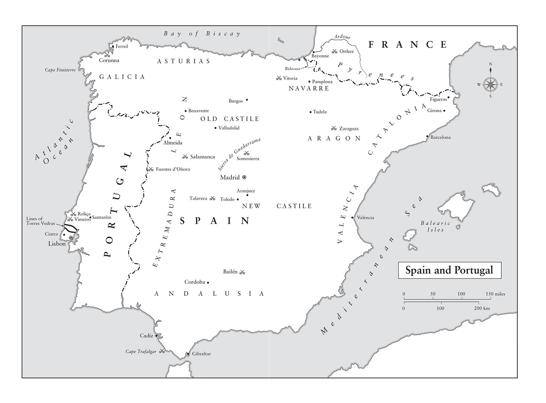
Once Junot had occupied Lisbon he formally deposed the absent Braganza dynasty and confiscated their property, imposed a ‘contribution’ of 100 million francs and promulgated a constitution which included religious toleration, equality before the law and the freedom of the individual.61 He declared that roads would be built, canals dug, industry and agriculture improved and public education fostered, but the Portuguese remained wary. Napoleon decreed that Junot’s troops were to receive, in addition to their normal rations, a bottle of Portuguese wine a day.62
With Portugal seemingly secured, Napoleon sent troops under Murat into northern Spain in January 1808, ostensibly to aid Junot but in fact to take over the great fortresses of San Sebastián, Pamplona, Figueras and Barcelona, all with the support of Godoy, who was determined to become a sovereign in his own right under the secret terms of the Fontainebleau treaty. Spain was being invaded in all but name, with her prime minister’s support. By March 13 Murat was in Burgos with 100,000 men, and moving towards Madrid itself. To lull the Spaniards, Napoleon gave orders to ‘spread the word that it is part of my plan . . . to lay siege to Gibraltar and go to Africa’.63*
On the night of March 17, 1808 Godoy was overthrown by ‘the Tumult of Aranjuez’, a popular uprising 25 miles south of Madrid where the royal family had their winter palace, which had been whipped up by the rumour that he was planning to take the king and queen to America via Andalusia. A mob burst into his house to lynch him, but he successfully hid in a rolled-up carpet (or possibly some matting) in his attic.64 Prince Ferdinand supported the revolt, and two days later Charles IV abdicated. The previous day he had reluctantly been pushed into dismissing Godoy, leading to huge celebrations in Madrid. ‘I was well prepared for some changes in Spain,’ Napoleon told Savary on hearing the news, ‘but I believe I see that affairs are taking another course from the one I expected.’65Napoleon, seeing an opportunity to extend his influence, refused to recognize Ferdinand as king, saying that Charles had been his loyal ally.
When, desperate for food and water after thirty hours in hiding, Godoy tried to surrender himself to the authorities, the mob grabbed him, nearly blinded him in one eye and wounded him in the hip, but he was nevertheless arrested alive.66 His finance minister was murdered in Madrid and the mob sacked the houses of his family and friends before moving on to the wine shops. At the time, Napoleon was seen by the Spanish public and British press as the instigator of the Tumult, which he was not. He was, however, about to try to exploit the opportunity it presented by playing each party off against the other. Spain was strategically and economically far too important to be allowed to remain in the hands of Ferdinand, whom Napoleon suspected of being the pawn of reactionary aristocratic and Church elements (which he was) and in secret alliance with the British (which – for the moment – he wasn’t).
Napoleon could ill afford to have a chaotic state on his southern border, especially one that had hitherto been providing him with a steady 12 million francs a month and even after Trafalgar possessed a large navy that he would need if he were ever to resuscitate his dream of invading Britain. Power abhors a vacuum, and the Bourbons – who had ruled Spain only since 1700, when they were installed by Louis XIV – had effectively created one. As 18 Brumaire had demonstrated, Napoleon was perfectly willing and capable to carry out a coup if he deemed it advantageous.
Now, after Tilsit, the Grande Armée had no continental commitments beyond garrison duty and some anti-guerrilla activity in Calabria. ‘[I] did not invade Spain in order to put one of [my] own family on the throne,’ Napoleon was to claim in 1814, ‘but to revolutionize her; to make her a kingdom of laws, to abolish the Inquisition, feudal rights, and the inordinate privileges of certain classes.’67 He hoped that the modernization formula that seemed to have gone down so well in Italy, Belgium, Holland and the western parts of the Rhine Confederation might also reconcile Spaniards to his rule. There was a good deal of post facto rationalization in all of this of course, but he did genuinely expect his reforms to be popular with some classes in Spain, and to an extent they were. Denying that he wanted her vast Latin American treasures, he said that all he needed was 5 million francs a month to Frenchify Spain (pour la francifier).68 Despite these aspirations, however, this was to be a dynastic war, unlike any of his previous ones, and in that sense it represented a break from the Revolutionary Wars of the past.
On March 21 Charles IV withdrew his abdication on the perfectly reasonable grounds that it had been made under compulsion.69 Two days later, Murat occupied Madrid with 50,000 men of Moncey’s and Dupont’s corps. Initially all seemed quiet, even after Ferdinand had arrived in Madrid to wild scenes of welcome the next day. Ferdinand was under the impression that Napoleon wanted only Godoy’s removal from office, and on April 10 he left Madrid bound for a conference with Napoleon near the Spanish border at Bayonne, where his parents were also headed separately. On his way to Bayonne ordinary Spaniards took off their jackets and placed them under the wheels of his carriage in order to ‘preserve the marks of a journey which occasioned the happiest moment of their lives’, assuming – as did Ferdinand himself – that Napoleon would recognize him as the rightful king of Spain.70
• • •
Napoleon arrived in Bayonne on April 15, 1808 and installed himself at the nearby Château de Marracq, where he was to remain for over three months with a detachment of the Imperial Guard bivouacked on the lawn. On the battlefield he always sought to take advantage of his opponents by striking at the hinge point where their forces were weakest: now he would do the same in his negotiations with the Bourbons. Charles and María Luisa’s hatred for their son Ferdinand, and his for them, was much greater than any feelings any of them had for him. He was perfectly willing to intrude on that highly dysfunctional family’s private grief, and as he had 50,000 men stationed in Madrid neither side could reign without his support. This enabled him to engineer a truly remarkable construct.
Under the terms of a series of agreements at Bayonne, Ferdinand would cede the crown of Spain back to his father Charles IV, on condition that Charles should then immediately cede it in turn to Napoleon, who would then pass it to his own brother Joseph.71Meanwhile, Godoy was spirited out of Spain by Murat, to the delight of María Luisa who could now be with him, and it seemed that yet another country had fallen into the lap of the Bonaparte family. ‘Unless I am mistaken,’ Napoleon told Talleyrand on April 25, ‘this tragedy is in Act Five; the denouement will soon play out.’72
He was wrong: only the second act was about to begin. On May 2, with rumours leaking from Bayonne and by this stage expecting the worst, the people of Madrid (madrileños) rose in revolt against Murat’s occupation, killing about 150 of his men in the insurrection known as El Dos de Mayo.73 As in Pavia, Cairo and Calabria, the French brutally suppressed the uprising. They were not, however, facing a united national uprising in Spain. In some regions, such as Aragon, there was very little opposition to French rule; in others such as Navarre, there was a great deal. The Cortes in Cadiz found it just as difficult as Joseph would do to raise taxes or impose conscription.74 Spain was of such a size that in the provinces that did rebel, regional insurgent governments (juntas) could be set up around the country and France had to fight a war against both the regular Spanish army and local guerrilla bands.
The French started by besieging Girona, Valencia, Saragossa and other strategically important cities – indeed there were more sieges undertaken in the Peninsular War than in all other theatres of the Napoleonic Wars put together.75 Thus even while Calabria was still not pacified, Napoleon undertook the occupation of another, far bigger territory in which much the same factors were in play: bad communications, fanatical Catholic priests, a hardened, primitive peasantry, a Legitimist Bourbon monarchy with a far better claim to the people’s loyalty than the Bonaparte candidate, and every prospect of easy resupply by the Royal Navy. Spain had been easily defeated by France in 1794–5 and Napoleon assumed that in the absence of any Spanish general and army of any distinction, it would happen again. Despite the experience of Calabria, he had not learned how effective a guerrilla insurgency can sometimes be against even the most powerful and well-disciplined army. It didn’t help that Napoleon interfered with his generals’ fighting of the war in Spain after he left, moving units from places where they had become familiar with the terrain, and sending orders to officers that arrived only after they had been made irrelevant by events.
• • •
‘Grapeshot and the bayonet cleared the streets,’ Murat reported to Napoleon from Madrid.76 After the insurrection was over, Murat had groups of peasant insurgents shot by firing squad, in scenes later immortalized by Francisco Goya which can today be seen at the Prado. Years later, Napoleon’s secretary inserted into his memoirs an entirely forged letter, purportedly written by Napoleon to Murat from Bayonne on March 29, 1808, urging caution and moderation.77 Generations of historians fell for this Bonapartist fraud before the truth was discovered, despite Napoleon not having arrived in Bayonne until April 15. A letter that Napoleon genuinely did write to Murat, however, on the Dos de Mayo, read: ‘I will give you the kingdom of Naples or of Portugal. Give me your answer immediately as this must happen in a day.’78 (Luckily for him, Murat chose Naples, as within three months a British army had arrived in Portugal.)
Although the Dos de Mayo revolt certainly had patriotic, anti-French, anti-atheist and pro-Ferdinand aspects to it, there were also issues of class, land ownership, military desertion, smuggling, regionalism, anti-conscription lawlessness, anti-clericalism, food shortages and a collapse in trade that made the coming war vastly more complex than the simple narrative of a struggle between grasping French invaders and heroic Spanish resisters, though there were undoubtedly elements of that.79 A few of the militarized bands fighting the French – such as those of Juan Martín Díez in Guadalajara and Francisco Espoz y Mina in Navarre – were well organized, but many were little more than bandit gangs of the kind Napoleon had suppressed in France as First Consul, and that any government would have had to act against. As in any guerrilla insurgency, some of the partisans were motivated by patriotism, others by revenge for what were undeniably atrocities, others by opportunism, and several bandit groups preyed on their fellow Spaniards. The Imperial Guard’s Captain Blaze found many villages in which the local people simply didn’t differentiate between the French army and Spanish brigands.80
When the news of the Dos de Mayo arrived from Madrid, Napoleon decided to expedite the very outcome that the rioters had most hoped to avoid. On May 6, after an hour-long ceremony in which everybody – even the poor old gouty and rheumatic Charles IV – was kept standing, Ferdinand VII signed the Treaty of Bayonne, abdicating in favour of his father.* Charles, keen that his hated son shouldn’t succeed him, two days later handed over all his rights to Napoleon and requested asylum in France.81 Writing to persuade Joseph to accept the throne, Napoleon said: ‘Spain is not Naples; it has eleven million people, a revenue of more than 150 million francs, without counting the immense colonial revenues and the possession of “all the Americas”. It is a crown that installs you in Madrid three days from France, which covers one of her borders. Naples is at the end of the world.’82 Later he would repent at leisure, saying ‘I committed a great mistake in putting that fool of a Joseph on the Spanish throne.’83 When Joseph was crowned in Madrid in July, Murat took over his Neapolitan crown, and Louis and Hortense’s eldest surviving son, the three-year-old Prince Napoléon-Louis, filled Murat’s place as Grand Duke of Berg.
To keep him under Napoleon’s control should the Spanish people reject the Bayonne arrangements, Ferdinand stayed at Talleyrand’s country estate at Valençay, which he allowed his supporters to characterize as a kidnapping and imprisonment.* When the dashing twenty-eight-year-old colonel of his Guard, Don José de Palafox, suggested that he try to escape, Ferdinand said he preferred to remain there doing his embroidery and cutting out paper patterns.84 (When he did return to Spain, in the spring of 1814, he cancelled all of Napoleon’s liberal reforms and even reintroduced the Inquisition.) ‘The King of Prussia is a hero compared to the Prince of the Asturias,’ Napoleon told Talleyrand; ‘he is indifferent to everything; very materialistic, eats four times a day and hasn’t got a single idea in his head.’85 Napoleon asked Talleyrand to make sure that Ferdinand enjoyed Valençay. ‘If the Prince of the Asturias became attached to a pretty woman there will be no harm,’ he wrote, ‘especially if she can be depended upon.’86 So affected was Ferdinand by what is today known as Stockholm Syndrome that he wrote to Napoleon in November 1808 to congratulate him on a French victory over the Spanish army at the battle of Tudela, and once again tried to solicit marriage with a Bonaparte. His father Charles IV travelled first to Marseilles and then went to live quietly in Rome for the rest of his life. Although Napoleon agreed to pay the Bourbons a pension of 10 million francs per annum, he ensured that it was all refunded by Spain, and as early as July 1808 was writing to Mollien: ‘There is no rush in paying the King of Spain’s pension – he is not short of cash.’87
For all the criticism that was to fall upon Napoleon for his Spanish heist, it is often forgotten that during the same year Tsar Alexander simply took Finland from Sweden in a short but equally illegitimate war. ‘I sold Finland for Spain,’ as Napoleon said, but he got the worst of the deal.88 He hadn’t needed to make explicit threats against anyone or even really to fight at all for the Spanish throne to fall into his hands, but his error was to believe, as he told Talleyrand in May, that ‘The Spaniards are like other peoples and not a race apart; they will be happy to accept the imperial institutions.’ Instead, they dubbed Joseph ‘El Rey Intruso’ (the intruder king), and even before he entered Madrid there were full-scale insurrections in Biscay, Catalonia, Navarre, Valencia, Andalusia, Estremadura, Galicia, León, the Asturias and part of both Castiles, and many Iberian ports were handed over to the Royal Navy. Napoleon’s impatience got the better of him. As Savary later admitted: ‘We rushed the outcome of the affair, and we didn’t show enough consideration for national self-esteem.’89
On June 2 Napoleon brought together as many Spanish grandees at Bayonne as he could muster in order to ratify the first written constitution of the Spanish-speaking world.90 This abolished privileges and the Inquisition, preserved the national parliament (Cortes) with three estates and established Catholicism as the country’s sole religion. It certainly appealed to those pro-French collaborators, largely from the liberal, enlightened, middle and professional classes, known as the josefinos orafrancesados(Francophiles), but they made up only a small minority of the population of what was then very much still a rural, illiterate, economically backward, ultra-Catholic and reactionary country. (Seats on Spanish town councils had been hereditary until 1804 and the Inquisition was still in operation.)
‘I seized by the hair the chance Fortune gave me to regenerate Spain,’ Napoleon later told one of his secretaries.91 Perhaps one of the reasons he expected the Spanish to co-operate with his regime was that his own father had been just such a pro-French collaborator; if so he ought to have recalled his own youthful hatred of the French occupying Corsica, and to have seen Spain as Corsica writ large. Even Napoleon’s chamberlain and admirer Bausset had to admit that the constitution was received ‘with a silent and equivocal indifference’ in French-occupied Spain but with ‘bitter contempt’ everywhere else.92
On May 25 the fortified medieval city of Saragossa, the capital of Aragon, rose in revolt under the command of Colonel Palafox, who had escaped from France dressed as a peasant. He had only 220 men and the Spanish equivalent of £20 6s 8d in the treasury, but nonetheless he declared war on the French Empire.93 Although on June 8 at Tudela General Charles Lefebvre-Desnouettes had flung aside a force commanded by Palafox’s elder brother, the Marquis of Lazán, by the time he tried to storm Saragossa a week later with 6,000 men he was rebuffed with 700 casualties; the first siege of the city of 60,000 people began. When Lefebvre-Desnouettes demanded Palafox’s surrender with two words, ‘La capitulation’, Palafox replied with three: ‘Guerra al cuchillo’ (War to the knife).94
• • •
Although one of Napoleon’s primary reasons for invading Spain had been to try to secure the Spanish navy so that the dream of invading Britain could be resuscitated, on June 14 Admiral Villeneuve’s successor, Admiral François de Rosily-Mesros, was forced to surrender to the Spanish army that small part of the French fleet – six ships – moored at Cadiz that had not been sunk or captured at Trafalgar.* Napoleon suffered another blow on June 25 when he heard that Archduke Charles had ordered a 150,000-man levy to be raised in Austria. He had Champagny warn Vienna that his army was still 300,000 strong, but it had no effect. A month later he told Jérôme: ‘Austria is arming; she is denying it; she is therefore arming against us . . . If Austria is arming, we should too . . . There’s no grudge between Austria and me, I ask nothing from her, and the only reason I’m arming is because she is.’95
Napoleon assumed that even if Joseph wasn’t welcomed as a saviour-reformer in Spain, he could always defeat the Spanish army in the field, and indeed on July 14 Bessières did defeat Captain-General Don Gregorio de la Cuesta and the Spanish Army of Galicia at the battle of Medina del Rioseco. Yet only eight days later a catastrophe befell French arms when General Pierre Dupont surrendered his entire corps of 18,000 men, 36 guns and all his colours to General Francisco Castaños’s Army of Andalusia after being defeated at the battle of Bailén. When the Royal Navy, which had not been party to the surrender terms, refused to repatriate Dupont’s army back to France as promised by Castaños, his troops were despatched to the Balearic isle of Cabrera, where more than half were starved to death, though Dupont and his senior officers were allowed home.96
The news of Bailén reverberated around Europe; it was France’s worst defeat on land since 1793. Napoleon was of course completely livid. He court-martialled Dupont, imprisoned him in the Fort de Joux for two years and stripped him of his peerage (he had been a count of the empire), later saying, ‘Out of all the generals who served in Spain, we ought to have selected a certain number and sent them to the scaffold. Dupont made us lose the Peninsula in order to secure his plunder.’97 While it was true that Dupont’s army was loaded down after sacking Córdoba, few French generals could have escaped the trap Castaños had set for him. Nonetheless Napoleon insisted that Cécile, the wife of General Armand de Marescot who had signed the capitulation, be dismissed as one of Josephine’s ladies-in-waiting, ‘no matter how innocent she may be’. At a Tuileries reception he grabbed the wrist of General Legendre, who had also signed it, demanding, ‘Why didn’t this hand wither?’98
‘He seemed to do everything very well at the head of a division,’ Napoleon wrote to Clarke of Dupont, ‘he has done horribly as a chief.’99 It was a problem that was to recur so frequently with Napoleon’s subordinates that Napoleon himself has been blamed for it, accused of being so controlling as to stifle initiative. On occasion he reproached himself for the fact that most of his lieutenants, even marshals, seemed to perform at their best only when he was present. Yet besides being ordered into Andalusia, Dupont had not been inundated with orders. ‘In war, men are nothing, but one man is everything,’ Napoleon wrote to Joseph on August 30.100 Long interpreted as an egotistical expression of heartlessness towards his own troops, this was in fact written in reference to Dupont, in a letter full of self-criticism: ‘Up to now we had to look for examples of this only in the history of our enemies; unfortunately today we find it in our own midst.’ Far from being a paean to his own genius, it was in fact a recognition that a bad leader could bring disaster.
‘You should not think it anything extraordinary to conquer a kingdom,’ Napoleon had written to Joseph before he heard the news of Bailén. ‘Philip V and Henri IV were obliged to conquer theirs. Be gay, and do not allow yourself to be affected, and do not doubt that things will finish better and more quickly than you think.’101 Joseph scuttled out of his capital only eleven days after he arrived, fleeing 135 miles north to Burgos. The sieges of Girona and Saragossa were raised on August 14 and 16; Bessières withdrew from the Portuguese border, and large numbers of troops began to be diverted to Spain from the rest of the Empire. ‘The army is perfectly organized to tackle the insurgents,’ Napoleon told Joseph on August 16, ‘but it needs a head.’102 Of course that should have been him, but back in June he had arranged to meet Tsar Alexander for another conference in September, so even a letter from Joseph asking for permission to abdicate, which sent Napoleon into another fury, didn’t persuade him to go to Spain. He would not appear there for another three months, during which time the situation steadily worsened.
While Joseph huddled in Burgos, Napoleon who had left Bayonne on the night of July 22, visited Pau, Toulouse (where he visited the Canal du Midi), Montauban, Bordeaux (where he received the news of Bailén on August 2), Pons, Rochefort (where he visited the prefecture, dockyards, arsenal and hospital), Niort, Fontenay (where he visited the new town of Napoléon-Vendée which he had ordered to be built three years earlier), Nantes (where he attended a ball at the Rouge Chapeau Circus with Josephine, who had come to join him), Saumur, Tours, Saint-Cloud (where he went hunting and had a heated 75-minute discussion with the Austrian ambassador Metternich about Austrian rearmament), Versailles (where he watched the ballet Vénus et Adonis) and the Tuileries (where he met the Persian ambassador). At the supposedly model town of Napoléon-Vendée he was so furious that the houses had only been built from mud and straw that he took out his sword and drove it into one of the walls up to the hilt, before sacking the builder responsible. In Toulouse he asked to see the man who had built a bridge over the Midi canal. In the course of questioning the engineer-in-chief who presented himself, Napoleon realized that although he was hoping to take the credit, he couldn’t have built the bridge, so he told the prefect, M. Trouvé, to produce the real bridge-builder, to whom he said, ‘I’m happy that I came myself, otherwise I’d not have known that you were the author of such a fine work, and would have deprived you of the reward to which you’re entitled.’ With a poetic justice found all too rarely in history, he then gave the bridge-builder the engineer-in-chief’s job.
On September 7, Napoleon received more bad news, this time of Junot’s surrender to the British in Portugal, having lost the battles of Roliça and Vimeiro to Sir Arthur Wellesley commanding a small British expeditionary force of only 13,000 men.* Under the very lenient terms of the Convention of Cintra signed on August 30 – for which Wellesley was later court-martialled, though afterwards acquitted – Junot’s army, with its arms and even its booty, was returned to France by the Royal Navy, but nothing could disguise the fact that France had lost Portugal. Napoleon has been criticized for not taking Wellington (as he became in August 1809) more seriously at this juncture, but seen in the context of Britain’s earlier failed amphibious excursions – against Holland in 1799, Naples in 1805, northern Germany in 1805–6, Stralsund, Alexandria and South America in 1807 and Sweden in 1808 – his attitude was understandable. Over the next five years Wellington enormously helped the Spanish and Portuguese regular and guerrilla forces to expel the French from Iberia at the cost of fewer than 10,000 British lives. When it became clear that Wellington was indeed likely to be a formidable opponent, in August 1810 Napoleon inserted a paragraph in the Moniteur describing him as a mere ‘sepoy general’, that is a soldier who had only commanded Indian troops. He was perhaps unaware that the Indian soldiers fighting for the British included some superb fighting men.103
From Saint-Cloud on September 18 Napoleon issued another classic proclamation, promising peace once ‘the leopard’ (that is, England) was defeated, Gibraltar captured and Bailén avenged. ‘Soldiers, I have need of you,’ he declared.
The hideous presence of the leopard defiles Spain and Portugal; at your approach let him fly away in terror. Let us carry our triumphant eagles to the Pillars of Hercules [that is, Gibraltar], there also we have insults to avenge. Soldiers, you have surpassed the renown of modern armies, have you yet equalled the glories of the armies of Rome, who in the same campaign triumphed on the Rhine, the Euphrates, in Illyria, and on the Tagus? A long peace and durable prosperity will be the prize of your labours.104
Such a victory ought to be all the easier because, as he told Joseph of his new subjects, ‘The Spanish people are despicable and cowardly, and remind me of Arabs I have known.’105
• • •
Napoleon had used his time in Paris productively, ensuring that the legislature passed a measure calling up 160,000 recruits from the classes of 1806 to 1809. He visited a panorama depicting Tilsit in the Boulevard des Capucines on the 21st, and the next day left for Erfurt, 400 miles away, a distance he covered in five days.
The conference at Erfurt took place against a background of noticeably cooler Franco-Russian relations. It was, as he put it to Savary, ‘the moment to judge the solidity of my work at Tilsit’.106 Napoleon had been writing warm letters to Alexander throughout the year – ‘In these few lines I’ve expressed my entire soul to your Majesty . . . our work at Tilsit will determine the destiny of the world’ – but with the crisis of the Friedland defeat abated and Finland ingested into his Empire, Alexander was growing lukewarm about an alliance that was costing him a good deal domestically because of the deeply unpopular Continental System.107 Earlier that month he had written to his mother, the Dowager Empress Maria Feodorovna, saying ‘Our interest obliged me’ to conclude an alliance with Napoleon, but ‘We will see his fall with calmness, if such is the will of God . . . the wisest policy is to await the right moment to take measures.’108 Going to Erfurt was necessary, he told her, because ‘it would save Austria and conserve its strength for the true moment when it can be used for the general good. This moment may be near, but it has not sounded; to accelerate it would be to ruin everything, to lose everything.’ Meanwhile, Russia ‘must be able to breathe freely for a while and, during this precious time, augment our means and our forces . . . It is only in the most profound silence that we must work, and not in publicizing our armaments and our preparations, nor in declaring loudly against the one whom we are defying.’109 In these private letters Alexander still called him ‘Bonaparte’ or sometimes ‘the Corsican’.110 While ordering his foreign minister, Count Nikolai Rumiantsev, to stay close to France, Alexander was preparing, diplomatically and militarily, for ‘the right moment to take measures’.
The pretty Thuringian town of Erfurt was chosen for the conference because it was a French enclave in the middle of the Confederation of the Rhine, a principality that had been a personal fiefdom of Napoleon’s since Tilsit. Napoleon met Alexander on the road 5 miles outside the town on Wednesday, September 28; they descended from their carriages and ‘cordially embraced’.111 Alexander wore the grand cross of the Légion d’Honneur, Napoleon the Russian order of St Andrew. At Tilsit Alexander had given Napoleon the malachite furniture now in the Emperor’s Salon at the Grand Trianon at Versailles, so at Erfurt Napoleon gave Alexander one of only two sets of the Sèvres porcelain Egyptian service which featured scenes from Denon’s Voyage dans la Basse et la Haute Égypte. It has rightly been described as one of the most lavish gifts ever given by one sovereign to another.112* Napoleon placed Alexander at his right hand at meals, they visited each other’s apartments, led each other down to the entrance halls on receiving and saying farewell each time, and dined together almost every day. They even took it in turns to give the grand marshal the night-watch passwords every evening.
One can still see where the Tsar lodged in the Angerplatz, and where Napoleon stayed in what is now the state chancellery, as well as where they met in the classically baroque 1715 Kaisersaal. Napoleon took a large entourage, including Berthier, Duroc, Maret, Champagny (the foreign minister), Rémusat, Savary, Caulaincourt, Daru, Lauriston, Méneval, Fain, his doctor Yvan, four equerries and eight pages.113 He had dismissed Talleyrand as foreign minister in August 1807 because the kings of Bavaria and Württemberg had complained about how much he was demanding in bribes.114 He nevertheless retained him as Vice-Grand Elector, with access to the palaces and his person. Napoleon enjoyed Talleyrand’s company – ‘You are aware of the esteem and attachment I entertain for that minister,’ he told Rapp – so he was therefore prepared to overlook, and perhaps did not fully realize, that this access allowed Talleyrand to sell secrets whenever he chose. He took Talleyrand to Erfurt for his experience and advice. Since Talleyrand had encouraged Napoleon to execute the Duc d’Enghien, drew up the Berlin Decrees instituting the Continental System and supported the invasion of Spain, it is a wonder that he still took his advice, but he did. It was a serious error to bring him now, because he hadn’t forgiven Napoleon for his dismissal, and (in return for cash) he leaked French plans to both the Russians and the Austrians, while advising Napoleon to withdraw from Germany.115 ‘Sire,’ Talleyrand said to Alexander at the first of several secret meetings at Erfurt, ‘what have you come to do here? It is for you to save Europe, and the only way of doing this will be for you to resist Napoleon. The French are a civilised people; their sovereign is not.’116
Alexander brought twenty-six senior officials in his entourage. There were also four kings present – those of Bavaria, Saxony, Westphalia and Württemberg – as well as the Prince Primate of the Confederation, Karl Dalberg, two grand dukes and twenty other princes, whose order of precedence was established by the date that they acceded to the Rhine Confederation. (Bausset rightly identified this as a clever move by Napoleon to give the Confederation more prestige.117) The overt friendliness – and the balls, concerts, reviews, receptions, banquets, plays, hunting trips and fireworks – did not mean that the negotiations were easy. Most of the important discussions were conducted tête-à-tête between the two emperors. ‘Your Emperor Alexander is as stubborn as a mule,’ Napoleon told Caulaincourt. ‘He plays deaf when things are said that he is reluctant to hear.’118 Napoleon teased Caulaincourt about being pro-Russian (hence the ‘your’) but it was true that the Tsar didn’t want to listen to Napoleon’s evidence of Russian customs inspectors surreptitiously allowing British produce into St Petersburg and elsewhere. At one point during the negotiations, Napoleon threw his hat on the ground and started kicking it. ‘You’re hot-tempered while I’m stubborn,’ said an unruffled Alexander. ‘By anger no one can get anywhere with me. Let’s talk, discuss things, otherwise I will leave.’119
Russia’s adherence to the Continental System had damaged her economy, preventing her from selling wheat, timber, tallow and hemp to Britain. The mere existence of the Grand Duchy of Warsaw left her concerned about the re-emergence of a kingdom of Poland. For his part, Napoleon looked unfavourably on Russian schemes against Turkey, not wanting a Russian warm-water fleet in the Mediterranean. Much of the talk at Erfurt was speculative. Napoleon approved in theory of Alexander’s desire for territorial gain against Turkey in Moldovia and Wallachia – for which France would be compensated – while Alexander in theory promised to ‘make common cause’ with Napoleon in the event of a French war against Austria, even though another Austrian defeat would tilt the European balance of power yet further towards France.
It seems that one matter Napoleon might have discussed was the possibility of divorcing Josephine, because only eight days after Alexander returned to St Petersburg the Dowager Empress announced the marriage of her daughter, Alexander’s sister the Grand Duchess Catherine Pavlovna, to Prince George of Holstein-Oldenburg, the younger brother of the heir to the Duchy of Oldenburg, a Baltic coastal duchy not part of the Rhine Confederation. By a special ukaz (decree) of Tsar Paul I, Alexander’s sisters could marry only with the permission of their mother, so Alexander could genuinely claim that he did not have the final say despite being ‘the Autocrat of All the Russias’. With Alexander’s other unmarried sister Anna only thirteen, both Romanov girls seemed to have been saved from what Maria Feodorovna may have seen as the threatened ravages of the Corsican minotaur.
• • •
Napoleon took advantage of being in Erfurt to meet his greatest living literary hero, who lived only 15 miles away in Weimar. On October 2, 1808, Goethe lunched with Napoleon at Erfurt, with Talleyrand, Daru, Savary and Berthier in attendance. As he entered the room, the Emperor exclaimed, ‘Voilà un homme!’ (Here’s a man!), or possibly ‘Vous êtes un homme!’ (You’re a man!).120 The two men discussed Werther, Voltaire’s play Mahomet, which Goethe had translated, and drama in general.* Napoleon complained that Voltaire should not have ‘made such an unfavourable portrait of the world-conqueror’ Julius Caesar in his play La Mort de César.121 Goethe later reported that Napoleon ‘made observations at a high intellectual level, as a man who has studied the tragical scene with the attention of a criminal judge’. Napoleon told him he felt that French theatre had strayed too far from nature and truth. ‘What have we now to do with Fate?’ he asked, referring to plays in which prearranged destiny formed the determining agency. ‘Politics is fate.’122 When Soult arrived, Napoleon spent a few moments addressing Polish affairs, allowing Goethe to look at tapestries and portraits, before returning to discussing Goethe’s personal life and family – ‘Gleich gegen Gleich’ (on equal terms), as Goethe later put it.
They met again at a ball in Weimar four days later, where the Emperor told the author that tragedy ‘should be the training ground of kings and peoples, and is the highest achievement of the poet’.123 (He wrote to Josephine that Alexander ‘danced a lot, but not me: forty years are forty years’.124) Napoleon suggested that Goethe write another play on Caesar’s assassination, portraying it as a blunder. He went on to denounce Tacitus’ prejudices, obscurantism and ‘detestable style’, and also the way that Shakespeare mixed comedy with tragedy, ‘the terrible with the burlesque’, and expressed his surprise that such a ‘great spirit’ as Goethe could admire such undefined genres.125 Napoleon did not give his opinions didactically, but regularly ended by asking, ‘What do you think, Herr Goethe?’126 He unsuccessfully pressed Goethe to move to Paris, where he said he would find a broader view of the world and an abundance of material for poetic treatment, and he conferred the Légion d’Honneur on him before they parted. Goethe was to describe his time discussing literature and poetry with Napoleon as one of the most gratifying experiences of his life.127
• • •
The Emperor and Tsar spent eighteen days in each other’s company at Erfurt. They watched plays almost every night, sitting together on thrones set apart from the rest of the audience; reviewed each other’s regiments (Napoleon was keen that Alexander see as much of the Grande Armée going through its manoeuvres as possible); spoke long into the night; shared the same carriages on visits; shot stag and roebuck together (killing fifty-seven) and toured the battlefield of Jena, lunching where Napoleon had bivouacked the night before the battle. When Alexander noticed that he had left his sword at his palace, Napoleon took off his own and presented it to him ‘with all possible grace’, and the Tsar said, ‘I accept it as a mark of your friendship: Your Majesty is well assured that I shall never draw it against you!’128 Watching the first scene of Oedipus on October 3, when the actor playing Philoctetes said to the hero’s friend and confidant Dimas, ‘A great man’s friendship is a gift of the gods!’, Alexander turned to Napoleon ‘and presented to him his hand, with all the grace possible’. The wildly applauding audience saw Napoleon bow in reply, ‘with an air of refusing to take to himself so embarrassing a compliment’.129 A few nights later they spoke for three hours alone together after dinner. ‘I’m happy with Alexander; I think he is with me,’ Napoleon told Josephine on October 11. ‘Were he a woman, I think I’d take him as my lover [amoureuse]. I’ll be with you shortly; stay well, and may I find you plump and fresh [grasse et fraîche].’130
The Erfurt talks reinforced the agreement reached at Tilsit to divide Europe between France and Russia, but despite the many hours of intimate discussions Napoleon and Alexander came to few concrete arrangements. Although they couldn’t agree on dismembering Turkey, by a secret article of the Erfurt Convention signed on October 12 Napoleon recognized Finland, Moldavia and Wallachia as part of the Russian Empire and agreed that France would join Russia if Austria opposed these arrangements by force. Alexander agreed to recognize Joseph as king of Spain, and promised to come to Napoleon’s aid should Austria attack France, although crucially the precise extent of any help wasn’t discussed in detail. That day, Napoleon wrote to George III to offer Britain peace once more in familiar terms – ‘We are gathered here to beg your Majesty to listen to the voice of humanity’ – a plea that was again ignored by the British government.131 The two emperors embraced and took their leave on October 14, near the spot on the Erfurt–Weimar road where they had met. They were never to see each other again.
• • •
Napoleon’s writ now ran from the Channel ports to the Elbe, in central Germany up to the Oder–Neisse line, in southern Germany to the River Inn and beyond. In Italy he controlled everywhere but the Papal States and Calabria. Denmark was his ally, Holland was ruled by his brother. The glaring exception to his control of western Europe was Spain, where no fewer than half a million of his troops were to serve over the next six years, including significant numbers of Dutch, Germans, Italians and Poles. ‘This war could be over in one fell swoop with a clever manoeuvre,’ Napoleon told Joseph on October 13 of the fighting in Spain, ‘but I must be there for that.’132 By November 5 he was at the Basque city of Vitoria in northern Spain, indignant as ever with the war commissariat, sending a series of letters to General Dejean, the war administration minister, complaining, ‘Your reports to me are nothing but paper . . . Yet again, my army is naked as it’s about to start campaigning . . . It’s like throwing money into the water’, and ‘I’m being told fairy tales . . . Those at the head of your department are stupid or thieves. Never has one been so badly served and betrayed’, and so on.133 He absolutely refused to pay local contractors for sixty-eight mules that had been supplied to the artillery, because they were three and four years old and ‘I gave the order only to buy mules that are five years old.’134
It is estimated that there were only 35,000–50,000 guerrillas operating in Spain. Even in regions they controlled completely there was not much co-operation between bands; when the French had been forced out of an area, many of the guerrilla fighters simply returned to their villages.135 But even once Napoleon had recaptured Madrid at the end of the year and attempted to establish control from the centre outwards, the large distances and poor roads made it hard for the French to impose their will.136
Lines of communication were constantly harried by the guerrillas in a countryside that was perfect for ambushes, until it got to the point where it took two hundred men to escort a single despatch. In 1811 Masséna would need 70,000 men merely to maintain safe communications between Madrid and France.137 All told, the Spanish and Portuguese guerrillas killed more Frenchmen than the British, Portuguese and Spanish regular armies combined, and also ensured that josefino civilians caught collaborating with the French, supplying them with information or food, faced summary execution.138 (As before, Britain stepped in quickly to help finance the opposition to Napoleon, giving various local juntas in Spain and Portugal an average of £2.65 million each year between 1808 and 1814.139) Once the French started responding to guerrilla terror tactics – which included mutilation (especially of the genitals), blinding, castration, crucifixions, nailing to doors, sawing in half, decapitation, burying alive, skinning alive, and so on – with equally vicious measures, the fighting in Spain swiftly took on a character that was a far cry from the warfare of élan, esprit de corps and gorgeous uniforms that had characterized Napoleon’s earlier campaigns, which for all their carnage had been generally free of deliberate torture and sadism.140 When Spanish banditti – men not in regular army uniform – were captured, they were hanged. There was no logic to killing a uniformed regular soldier in battle and not hanging a bandit when captured.
‘I’m pretty well,’ Napoleon reported to Josephine on November 5 as he assumed command of the army on the Ebro, resolving to march on Madrid, ‘and I hope that all this will soon be ended.’141 If the war in Spain could have been won in the manner of his earlier campaigns, by defeating the enemy’s regular army and occupying his capital, it is safe to assume that Napoleon would have soon been victorious. He quickly appreciated that this was not going to happen, telling General Dumas, who had complained about being left in the rear of Soult’s army at Burgos, ‘General, in such a theatre of war there is no rear nor van . . . you will have employment enough here.’142
At 3 a.m. on November 30, Napoleon was 5 miles from the pass at Somosierra, which protected the route to Madrid. Clad in a ‘superb fur’ given to him by Tsar Alexander, he was warming himself by a campfire and, ‘seeing himself on the point of engaging in an important affair, was unable to sleep’. At the battle later that day, his 11,000 men ground down and pushed back the smaller Spanish regular forces of 7,800 before Napoleon unleashed two charges of Polish lancers and one of the Guard chasseurs, which took the pass and sixteen guns. After the battle, Napoleon ordered the whole Imperial Guard to present arms to the much reduced Polish squadron as it rode past.143
Reaching Madrid on December 2, Napoleon recognized that the best-defended place there was the Retiro Palace, which Murat had fortified. Some shells were exchanged, and on the morning of the 3rd Bausset, who spoke Spanish and thus translated for the Emperor, recorded that Napoleon walked outside the walls ‘without taking much notice of the projectiles which were discharged from the highest points of Madrid’.144 The city capitulated at 6 a.m. on the 4th but Napoleon stayed at Chamartin, his headquarters in a small country house just outside Madrid, going into the capital only once, incognito, to inspect Joseph’s Royal Palace, which he was astonished to see the Spanish had respected, including David’s portrait of him crossing the Alps and the ‘precious wines’ in the royal cellar. He pardoned the Marquis de Saint-Simon, a French émigré who had been captured while firing on French troops from Madrid’s Fuencarral gate, after his daughter pleaded for his life.145
Napoleon stayed at Chamartin until December 22, when he heard news that a British expeditionary force under General Sir John Moore had returned to Salamanca, 110 miles west of Madrid. Bausset recorded that he ‘experienced a lively joy at finding that he could at last meet these enemies on terra firma’.146 Moore began to retreat towards Corunna on December 23, and to pursue him Napoleon had to cross the Sierra de Guadarrama mountain range in gales and blizzards. Together with the Alpine crossing and the Eylau campaign this convinced him that his men were hardy enough for any climatic conditions, a disastrous conclusion for his decision-making in the future. Up in the mountains, Napoleon fell off his horse, but was unhurt.147 For most of the crossing he went on foot at the head of one of the columns, through weather that froze Bausset’s brandy-sozzled servant to death on the mountainside.148 ‘We passed the mountains of Guadarrama in a frightful hurricane,’ recalled Gonneville, ‘the snow was driven by whirlwinds and fell with extreme violence, enveloping and covering us with a thick coating that made its way through our cloaks . . . There was incredible difficulty in taking the artillery over.’149 They managed it, however, with Napoleon continually pressing them on, even though on occasion the grognards swore at him to his face. ‘My love,’ he wrote to Josephine from Benavente on the last day of 1808, ‘I’ve been in pursuit of the English for some days; but they keep on flying in panic.’150 The English were not in fact panicking, merely pragmatically withdrawing before his far larger force.
Although Napoleon was looking forward to catching up with Moore and throwing the British off the peninsula, his spies in Vienna were warning him that Austria was rearming fast, indeed might be mobilizing. Years later Wellington would claim that Napoleon left Spain because ‘he was not sure of victory’ against Moore, but that is quite wrong.151 ‘I am pursuing the English, sword to their kidneys,’ Napoleon wrote on January 3, 1809.152 Yet the next day the dire news from Austria compelled him to hand over the pursuit to Soult, so that he could return to Benavente and then Valladolid to assume better communications with France.153 From Valladolid he sent his Polish aide-de-camp Adam Chlapowski to Darmstadt, Frankfurt, Cassel and Dresden to warn the German princes that they needed ‘to ready their forces immediately for war’, and another aide-de-camp, the son of the Comte de Marbeuf, his family’s benefactor from Corsica, to Stuttgart and Munich with the same message.154
At Valladolid, Napoleon suppressed the Dominican monastery when the corpse of a French officer was found in its well.155 He summoned all forty monks and furiously ‘expressed himself somewhat militarily, and plainly used a very strong word’, in Bausset’s prim reminiscence of the event. The diplomat Théodore d’Hédouville, who was translating, passed over the expletive, upon which Napoleon ‘ordered him to deliver the villainous word in question with firmness, and the same tone’.156 In the middle of January, when he became certain of the need to return to Paris, he asked Joseph to put some apartments aside for him in the Royal Palace for the time when he could come back to Madrid.157 He never did.
The ‘Spanish ulcer’ forced Napoleon to station 300,000 men in the Iberian peninsula in the winter of 1808; the number rose to 370,000 for the spring offensive of 1810 and to 406,000 in 1811, before falling to 290,000 in 1812 and to 224,000 in 1813. Except at the very beginning, these were troops he simply could not afford to spare.158 Too often he sent untested conscript battalions, led by elderly or wounded veterans or inexperienced National Guard officers, and conscripts were grouped together rather than being fed into established regiments to make up losses.159 He constantly raided units fighting in Spain to fill spaces in artillery, garrison, gendarme, transport, Imperial Guard and engineering units elsewhere, so that four-battalion brigades that ought to have had 3,360 men in them actually had only around 2,500. While he didn’t take many men away from Spain for the 1812 campaign in Russia, he severely cut back the number of recruits who were sent there, and no army can fight without reinforcements, especially considering the regular wastage experienced in Iberia, where one-fifth of the army was on the sick list at any one time.160 Overall, France suffered around a quarter of a million casualties in Spain and Portugal.161 ‘I embarked pretty badly on this affair, I admit it,’ Napoleon acknowledged years later, ‘the immorality showed too obviously, the injustice was too cynical, and the whole of it remains very ugly.’162