
4
‘On 15 May 1796, General Bonaparte made his entry into Milan at the head of a youthful army which had just crossed the bridge at Lodi and let the world know that after all these centuries, Caesar and Alexander had a successor.’
Stendhal, The Charterhouse of Parma
‘A general’s most important talent is to know the mind of the soldier and gain his confidence, and in both respects the French soldier is more difficult to lead than another. He is not a machine that must be made to move, he is a reasonable being who needs leadership.’
Napoleon to Chaptal
Some would later claim that Napoleon was an unknown quantity when he arrived at the headquarters of the Army of Italy in Nice on March 26, 1796, and that his divisional commanders all despised him when they met him for the first time because, as a sneering contemporary put it, he had ‘won his reputation in a street riot and his command in a marriage bed’.1 He had in fact served as head of artillery of the same force only two years before, was known to many from his success at Toulon, and had written no fewer than three detailed reports for the Topographical Bureau on how to win the coming campaign. It was only natural that there should be some initial resentment at his having been appointed over the heads of more experienced generals but Napoleon’s officers knew perfectly well who he was.
He was in charge of five divisional commanders. The eldest, Jean Sérurier, had thirty-four years’ service in the French army. He had served in the Seven Years War and was considering retiring from soldiering when the Revolution broke out, but had fought well in the years afterwards and had been made a divisional general in December 1794. Pierre Augereau was a tall, swaggering, somewhat coarse thirty-eight-year-old former mercenary, clock-seller and dancing-master whose nicknames were ‘child of the people’ and ‘proud brigand’. He had killed two men in duels and a cavalry officer in a fight and only escaped torture by the Lisbon Inquisition through the good offices of his spirited Greek wife. André Masséna, also thirty-eight, had gone to sea as a cabin boy at thirteen but switched to the army in 1775 and became a sergeant-major before being discharged just before the Revolution. He became a smuggler and fruit trader in Antibes before joining the National Guard in 1791 and rapidly rising up the ranks. His services in the siege of Toulon won him promotion to divisional general in the Army of Italy, where he served with distinction in 1795. Amédée Laharpe was a thirty-two-year-old heavily moustachioed Swiss. Jean-Baptiste Meynier had fought in the Army of Germany, but in mid-April Napoleon reported to the Directory that he was ‘incapable, not fit to command a battalion in a war as active as this one’.2 All five men were experienced veterans, whereas Napoleon hadn’t commanded so much as an infantry battalion in his life. They would be a tough group to impress, let alone inspire. As Masséna later reminisced:
At first they did not think much of him. His small size and puny face did not put him in their favour. The portrait of his wife that he held in his hand and showed to everyone, his extreme youth, made them think that this posting was the work of another intrigue, but a moment after, he donned his general’s cap and seemed to grow by two feet. He questioned us on the position of our divisions, their equipment, the spirit and active number of each corps, gave us the direction that we had to follow, announced that, the next day, he would inspect all the corps and that the day after that they would march on the enemy to give battle.3
Masséna misremembered the last part – they didn’t give battle for a month – but he captured the spirit of activity that Napoleon radiated, his confidence, his obsessive demand for information, which was to be a feature throughout his life, and his love of his wife.
In that initial meeting, Napoleon showed his commanders how the Savona–Carcare road led to three valleys, any one of which could ultimately lead them into the rich plains of Lombardy. Piedmont had opposed the French Revolution and had been at war with France since 1793. Napoleon believed that if his army could push the Austrians to the east and take the fortress stronghold at Ceva, it could knock the Piedmontese out of the war by threatening their capital, Turin. This would mean pitting 40,000 French troops against 60,000 Austrians and Piedmontese, but Napoleon told his commanders he would use speed and deception to retain the initiative. His plan was based both on Pierre de Bourcet’s Principes de la guerre des montagnes (1775), and on an earlier strategy intended for use in a campaign against Piedmont of 1745 which had been aborted by Louis XV but which had also concentrated on capturing Ceva. Bourcet wrote of the importance of clear planning, concentration of effort, and keeping the enemy off balance. Napoleon’s campaign in Italy was to be a textbook operation in both senses of the term.
• • •
For the Directory, Italy was something of a sideshow. They had concentrated their resources in western and southern Germany where the two principal forces of the Republic, the Army of the Rhine and Moselle under General Jean Moreau, and the Army of the Sambre and Meuse under General Jean-Baptiste Jourdan, launched an offensive in June that had seen some initial success. The formidable Archduke Charles von Habsburg, younger brother of the Emperor Francis of Austria, fighting at his very best, defeated Jourdan at Amberg in August 1796 and at Würzburg in September. He then turned on Moreau and beat him at Emmendingen in October, before driving both French armies back across the Rhine. As a result of the sidelining of military efforts in Italy, Napoleon was given only 40,000 francs – less than his own annual salary – to pay for the entire campaign.4 According to one possibly apocryphal story, in order to help transport himself and his aides-de-camp from Paris to Nice, he sold his silver-hilted sword and had Junot stake the proceeds at the gambling tables.5
When Napoleon arrived in Nice, therefore, he found his army in no state to move anywhere. It was freezing and the men had no overcoats. No meat had been issued for three months and bread arrived only irregularly. Mules pulled the artillery, since all the draft-horses had died of malnutrition, and entire battalions were shoeless or in clogs, wearing makeshift uniforms often taken off the dead. Some of the men were only identifiable as soldiers because they carried army-issue cartridge pouches, and many of their muskets lacked bayonets. They hadn’t been paid for months, prompting mutterings of mutiny.6 Fever was rampant, killing no fewer than six hundred men of the 21st Demi-Brigade in twenty days.* Mariana Starke, an English writer in Florence, accurately described the ‘wretched state’ of the French army before Napoleon’s arrival: ‘a total want of necessities, and a pestilential fever, the natural consequence of famine . . . dejected and enfeebled by sickness, and destitute of horses, cannon, and almost every other sinew of war’.7
Napoleon’s response to the ‘wretched state’ of his army was to demote Meynier and give his quartermaster Chauvet a brief to reorganize the commissariat completely, including, as he told the Directory on March 28, to ‘threaten the contractors, who have robbed much and who enjoy credit’.8 He also ordered Citizen Faipoult, France’s minister in Genoa, to solicit ‘without noise’ 3 million francs in loans from the Jewish financiers there and he recalled the cavalry from its winter pastures in the Rhône valley. Within two days of arriving in Nice, Napoleon had disbanded the 3rd Battalion of the 209th Demi-Brigade for mutiny, dismissed its officers and NCOs from the army and distributed the other ranks in groups of five to other battalions. He believed it was essential for everyone to be treated according to the same rules, appreciating, as he put it, that ‘If there were a single privilege granted to anyone, no matter whom, not one man would obey the order to march.’9 On April 8 he reported to the Directory that he had been forced to punish his men for singing anti-revolutionary songs, and he had court-martialled two officers for crying ‘Vive le roi!’10
Napoleon’s divisional commanders were immediately impressed by his capacity for hard work. Subordinates could never say they would attend to something and then let it slide, and the staff who had been stationary in Nice for four years suddenly felt the pulsating effect of Napoleon’s energy. In the nine months between his arrival in Nice and the end of 1796 he sent more than eight hundred letters and despatches, covering everything from where drummer-boys should stand in parades to the conditions under which the ‘Marseillaise’ should be played. Augereau was the first of his generals to be won over, followed by Masséna. ‘That little bastard of a general actually frightened me!’ Augereau would later tell Masséna.11
Napoleon decided to make the best of his reputation as a ‘political’ soldier. In his Order of the Day of March 29, he told his troops that they would ‘find in him a comrade, strong in the confidence of the Government, proud of the esteem of patriots, and determined to acquire for the Army of Italy a destiny worthy of it.’12* After all, a general with the ear of the Directory might get his troops fed. Napoleon feared the indiscipline that arose when armed men face near-starvation. ‘Without bread the soldier tends to an excess of violence’, he wrote, ‘that makes one blush for being a man.’13* Certainly his demands on Paris were constant, and on April 1 he managed to get 5,000 pairs of shoes delivered. An astonishing number of his letters throughout his career refer to providing footwear for his troops. Although he probably never said ‘An army marches on its stomach’, as legend has it, he was always deeply conscious that it indubitably marched on its feet.14
That same Order of the Day of March 29 announced that the forty-three-year-old Alexandre Berthier, a former engineer who had fought in the American War of Independence, was now Napoleon’s chief-of-staff, a position he was to retain until 1814. Berthier had fought well in the Argonne campaign in 1792 and in the Vendée over the next three years, and his brother had been in the Topographical Bureau with Napoleon.
Napoleon was the first commander to employ a chief-of-staff in its modern sense, and he couldn’t have chosen a more efficient one. With a memory second only to his own, Berthier could keep his head clear after twelve hours of taking dictation; on one occasion in 1809 he was summoned no fewer than seventeen times in a single night.15 The Archives Nationales, Bibliothèque Nationale and the Archives of the Grande Armée at Vincennes teem with orders in the neat secretarial script and short concise sentences that Berthier used to communicate with his colleagues, conveying Napoleon’s wishes in polite but firm terms, invariably starting ‘The Emperor requests, general, that on receipt of this order you will . . .’16 Among Berthier’s many qualities was a diplomatic nature so finely attuned that he somehow managed to persuade his wife, the Duchess Maria of Bavaria, to share a chateau with his mistress Madame Visconti (and vice versa). He rarely opposed Napoleon’s ideas directly except on strict logistical grounds, and built up a team that ensured the commander-in-chief’s wishes were quickly put into action. His special ability, amounting to something approaching genius, was to translate the sketchiest of general commands into precise written orders for every demi-brigade. Staff-work was rarely less than superbly efficient. To process Napoleon’s rapid-fire orders required a skilled team of clerks, orderlies, adjutants and aides-de-camp, and a very advanced filing system, and he often worked through the night. On one of the few occasions when Napoleon spotted an error in the troop numbers for a demi-brigade, he wrote to correct Berthier, adding: ‘I read these position statements with as much relish as a novel.’17
On April 2, 1796, Napoleon moved the army’s headquarters forward to Albenga on the Gulf of Genoa. On that same day Chauvet died of fever in Genoa. This was ‘a real loss to the army’, Napoleon reported; ‘he was active, enterprising. The army sheds a tear for his memory.’18 Chauvet was the first of a large number of his friends and lieutenants who were to die on campaign with him, and for whom he felt genuine grief.
The Austrians – who had dominated northern Italy since 1714 – were sending a large army westwards to Piedmont to engage the French, and the Piedmontese were being supplied by the Royal Navy from Corsica. This forced Napoleon to haul everything he needed over the high mountain passes of Liguria. When he reached Albenga on April 5 he told Masséna and Laharpe his plan to cut the enemy off between Carcare, Altare and Montenotte. The Austrian commander, Johann Beaulieu, had much experience and some talent, but he was seventy-one and had been beaten by French armies before. A keen student of past campaigns, Napoleon knew that Beaulieu was cautious, a flaw he planned to exploit. The Austrian alliance with the Piedmontese was weak, and Beaulieu had been warned not to trust too much to it. (‘Now that I know about coalitions,’ Marshal Foch was to joke during the First World War, ‘I respect Napoleon rather less!’) Even within the Austrian army, the heterogeneous nature of the sprawling Habsburg Empire meant that its units often didn’t speak the same language; the common tongue employed by its officer corps was French. To add to Beaulieu’s problems, he had to answer to the unwieldy and bureaucratic Aulic Council in Vienna, which tended to give orders so late that by the time they arrived they had been overtaken by events. By contrast, Napoleon planned to adopt a daring manoeuvre now known in military academies as ‘the strategy of the central position’: he would remain between the two forces opposing him and would strike first at one and then at the other before they could coalesce. It was a strategy to which he would adhere throughout his career. ‘It is contrary to all principle to make corps which have no communication act separately against a central force whose communications are open’, was one of his maxims of war.19
‘I am very busy here,’ he wrote to Josephine from Albenga. ‘Beaulieu is moving his army. We are face-to-face. I’m a little tired. I’m every day on horseback.’20* His daily letters to Josephine continued throughout the campaign, covering hundreds of pages of passionate scrawl. Some were written on the same day as major battles. He would constantly switch from romantic protestations (‘I’ve not passed a day without loving you’) to more self-centred considerations (‘I’ve not taken a cup of tea without cursing that glory and that ambition which keep me separated from the soul of my life’), to maudlin reflections on why she hardly ever wrote back. When she did, she called him ‘vous’, which greatly irritated him. Napoleon’s letters were full of coy erotic allusions to his desire to ravish her as soon as she would come out to join him in Italy. ‘A kiss on your breast, and then a little lower, then much much lower,’ he wrote in one.21 There is some debate as to whether ‘la petite baronne de Kepen’ (occasionally ‘Keppen’) in his letters was a Napoleonic soubriquet for Josephine’s sexual parts. Sadly, the etymology of the ‘Baronne de Kepen’ is lost to history, although it may simply have been the name of one of Josephine’s many lap-dogs, so that ‘Respectful compliments to the little baroness de Kepen’ might have had no sexual overtones.22 There is not much doubt about the less imaginative ‘little black forest’, as in: ‘I give it a thousand kisses and wait with impatience the moment of being there.’23 Somewhat unromantically these letters were often signed ‘Bonaparte’ or ‘BP’, just like his orders.24 ‘Adieu, woman, torment, joy, hope and soul of my life, whom I love, whom I fear, who inspires in me tender feelings which summon up Nature and emotions as impetuous and volcanic as thunder’, is an entirely representative sentence from one of them.
• • •
‘The army is in a terrible state of destitution,’ Napoleon reported to the Directory on April 6 from Albenga. ‘I have still great obstacles to surmount, but they are surmountable. Distress has led to insubordination, and without discipline, victory is out of the question. I hope all this will be changed in the course of a few days.’25 The Army of Italy numbered 49,300 men, against some 80,000 Austrians and Piedmontese. Fortunately, by then Berthier had mastered the immediate supply problems. Napoleon had planned to launch his offensive on April 15, but the Austro-Piedmontese forces started theirs five days earlier, coming up the same road Napoleon had intended to go down. Despite this unforeseen move, within forty-eight hours Napoleon had turned the situation around. Once he got his troops back from the town of Savona largely unscathed, he was able to organize a counter-attack. On the evening of April 11, realizing that the Austrian line was overextended, he fixed the enemy in place with an attack at Montenotte, a mountain village 12 miles north-west of Savona in the valley of the River Erro and then sent Masséna around the right flank in the pouring rain at 1 a.m. to envelop them. It was a tough environment in which to fight: a ridge runs down from Montenotte Superiore to a series of peaks between 2,000 and 3,000 feet high and there was (and still is) thick vegetation all around, climbing up exhausting slopes. Many redoubts had been built by the Austrian army, which were now captured by the swift-moving French infantry columns.
When the fighting was over, the Austrians had lost 2,500 men, many of whom were captured. Napoleon had lost 800. Though it was a relatively modest engagement, Montenotte was Napoleon’s first victory in the field as commander-in-chief, and was as good for his own morale as for that of his troops. Several of his future battles were to follow the same parameters: an elderly opponent lacking energy; a nationally and linguistically diverse enemy confronting the homogeneous French army; a vulnerable spot which he would latch on to and not let go. The French had moved significantly faster than their enemy, and he had employed a concentration of forces that reversed the numerical odds for just long enough to be decisive.
Another recurring feature was the fast follow-up after victory: the day after Montenotte, Napoleon fought another engagement at Millesimo, a hamlet on the River Bormida, where he managed to prise the retreating Austrian and Piedmontese forces apart. The Austrians wanted to retreat eastwards to protect Milan, and the Piedmontese westwards to protect their capital of Turin. Napoleon was able to exploit their differing strategic imperatives. In order to escape the river valley, both had to fall back to the fortified village of Dego, where on April 14 Napoleon won his third victory in three days. Austro-Piedmontese losses numbered around 5,700 while the French lost 1,500 men, most due to Napoleon’s impatience to capture the well-defended castle of Cosseria.
A week later at the battle of Mondovì, a town on the River Ellero, Napoleon vigorously fixed the Piedmontese front while attempting a double-envelopment. It was an ambitious and difficult manoeuvre to pull off but devastating to enemy morale when, as now, it succeeded. The next day the Piedmontese sued for peace. This was fortunate as Napoleon had no heavy siege weaponry with which to besiege Turin. One of the reasons why he maintained such a fluid campaign was that he had no resources for anything else. He complained to Carnot that he had been ‘seconded neither by the artillery nor the engineers, as, in spite of your orders, I have not a single one of the officers I asked for’.26 Conducting (or withstanding) a siege would have been impossible.
On April 26 Napoleon made a stirring proclamation to his army from Cherasco: ‘Today you equal by your services the armies of Holland and the Rhine. Devoid of everything, you supplied everything. You have won battles without guns; passed rivers without bridges; accomplished forced marches without shoes; bivouacked without brandy and often without bread . . . Today you are amply provided for.’27 He continued: ‘I promise you the conquest of Italy, but on one condition. You must swear to respect the people you deliver, and repress the horrible pillage in which scoundrels, excited by the enemy, have indulged.’28
A victorious, hungry army pillages. Napoleon was genuinely concerned by the conduct of his troops and wanted to keep the devastation in check. Four days earlier he had published an Order of the Day blaming ‘fearful pillage’ on ‘perverse men, who join their corps only after the battle, and who commit excesses which dishonour the army and the French name’. He authorized generals to shoot any officers who allowed it, though there are no examples of this actually happening. He wrote privately to the Directory two days after his proclamation: ‘I intend to make terrible examples. I shall restore order, or shall cease to command these brigands.’29 It was the first of many hyperbolic threats of resignation he was to make over the course of this campaign.
Napoleon always differentiated between ‘living off the land’, which his army had to do by dint of insufficient supply, and ‘fearful pillage’.30 This took some sophistry, but his supple mind was up to the task. Often in the future he would blame Austrian, British and Russian armies for pillaging in a manner that he must have known his army had on many occasions greatly exceeded.* ‘We lived upon what the soldiers found,’ recalled an officer of the time. ‘A soldier never steals anything, he only finds it.’ One of Napoleon’s most competent commanders, General Maximilien Foy, would later point out that if Napoleon’s troops had ‘waited for food till the administration of the army caused rations of bread and meat to be distributed, they might have starved’.31
‘Living off the land’ allowed Napoleon a speed of manoeuvre that was to become an essential element of his strategy. ‘The strength of the army,’ he stated, ‘like power in mechanics, is the product of multiplying the mass by the velocity.’32 He encouraged everything that permitted faster movement, including the use of forced marches which more or less doubled the 15 miles per day a demi-brigade could move. ‘No man ever knew how to make an army march better than Napoleon,’ recalled one of his officers. ‘These marches were frequently very fatiguing; sometimes half the soldiers were left behind; but, as they never lacked goodwill, they did arrive, though they arrived later.’33
In warm weather the French army didn’t sleep in tents at night, because, as a veteran recalled, the armies ‘marched so rapidly that they could not have carried with them all the requisite baggage’.34 The only thing that followed them at pace were the wagons carrying ammunition. Armies moved much faster at the end of the eighteenth century than at the beginning due to improved road surfaces – especially after the recommendations of the French engineer Pierre Trésaguet, in his memorandum on scientific road-building of 1775, were taken up. Lighter field guns, more roads, smaller baggage-trains and far fewer camp-followers helped Napoleon’s armies to move at what he calculated to be twice the speed of Julius Caesar’s.
• • •
Armistice negotiations with the Piedmontese at Cherasco began immediately. In one exchange, Napoleon sardonically told a plenipotentiary who had suggested terms that left him with fewer fortresses than he desired: ‘The Republic, in entrusting to me the command of an army, has credited me with possessing enough discernment of what that army requires without having recourse to the advice of my enemy.’35 One of the two negotiators, the Savoyard colonel Marquis Henry Costa de Beauregard, later wrote a memoir in which he described the encounter: ‘[He was] always cold, polished and laconic’.36 At 1 a.m. on April 28 he took out his watch and said: ‘Gentlemen, I give you notice that the general attack is ordered for two o’clock, and if I am not assured that [the fortress of] Coni will be placed in my hands before the end of the day, this attack will not be delayed for a moment.’
It might have been a classic Napoleonic bluff, but the Piedmontese couldn’t take the risk. The armistice was signed immediately. Tortona, Alessandria, Coni and Ceva were handed over to the French, along with the route to Valence and all the territory between Coni and the Stura, Tanaro and Po rivers. In a smart ploy, Napoleon insisted on a secret clause giving him the right to use the bridge over the River Po at Valenza, knowing the news would be leaked to the Austrians and that Beaulieu would send troops to cover the bridge. He actually planned to cross the river near Piacenza, 70 miles further east.
Over bottles of celebratory Asti wine and a pyramid of cakes supplied by the nuns of Cherasco, Napoleon spoke openly of the events of the previous days, blaming himself for the loss of lives at Cosseria Castle during the battle of Millesimo, triggered by his ‘impatience to separate the Austrian and Piedmontese armies’. He recounted that he had been stationed at Dego two years earlier, when he had been in charge of an artillery column. He had proposed the same invasion strategy then, but it had been rejected by a council of war. Then he added ‘Nothing should ever be decided by this means in an army under [my] command’, and said that these councils were only ever resorted to as ‘a cowardly proceeding’ intended to distribute blame.37
Napoleon told the Piedmontese he had executed a soldier for rape the previous night, and diplomatically praised them for their strategic withdrawals on April 17 and 21, saying: ‘You twice escaped very dexterously out of my claws.’ He showed Beauregard the small travelling case in which he kept all his personal belongings, and said: ‘I had a great deal more of these superfluities when I was a simple artillery officer than now when I am commander-in-chief.’ In their hour-long conversation while watching the sun rise, Beauregard was impressed with his knowledge of Piedmont’s history, artists and scholars. Napoleon likened his movement to ‘the combat of the younger Horatius, distancing his three enemies so as to disable them and kill them in succession’. He said he wasn’t actually the youngest French general, though he conceded that his age was an asset. ‘Youth is almost indispensable in commanding an army,’ he told Beauregard, ‘so necessary are high spirits, daring, and pride to such a great task.’38
The day after the armistice document was signed, Napoleon wrote to Paris, conscious that he had overstepped his authority in concluding a diplomatic agreement with a foreign power – let alone, as a good republican, allowing King Victor Amadeus III of Piedmont-Sardinia to stay on his throne. ‘It’s an armistice accorded to one wing of an army, giving me time to beat the other,’ he wrote. ‘My columns are on the march; Beaulieu is flying, but I hope to overtake him.’39 He hoped to quell any quibbles from Paris with cash, promising to levy what he euphemistically termed a ‘contribution’ of several million francs on the Duke of Parma and suggesting one of 15 million francs from Genoa. Such ‘contributions’, once levied right across northern Italy, would allow him to pay the army half its wages in silver, rather than the despised mandats territoriaux, paper money that constantly depreciated in value.40 Saliceti – for whom Napoleon had found a post organizing the Army of Italy, having clearly forgiven him for the incident in Antibes prison – appears to have hit upon the rather obvious recourse of paying the army first, before shipping the balance back to the cash-strapped Directory. Nothing short of military defeat demoralizes a country so totally as hyper-inflation, and the Directory, led by Barras since Vendémiaire, desperately needed the bullion that Napoleon was to send. This largely explains why, though they came to resent and even fear his successes in Italy and Austria, they made only one (feeble) attempt to replace him.
‘Leave nothing in Italy which our political situation will permit you to carry away,’ Napoleon was instructed, ‘and which may be useful to us.’41 Napoleon embraced this part of his remit enthusiastically. He was determined that Italy – or at least the parts that had opposed him – would be mulcted not merely of cash, but also of its great art. On May 1 he wrote to Citizen Faipoult: ‘Send me a list of the pictures, statues, cabinets and curiosities at Milan, Parma, Piacenza, Modena and Bologna.’42 The rulers of those places had every cause to tremble, for many of their finest treasures were destined for the art gallery in Paris known as the Musée Central des Arts from its opening in 1793 until 1803, then as the Musée Napoléon until 1815, and after that as the Musée du Louvre.
The French connoisseurs and curators appointed by Napoleon to choose which objets d’art to remove argued that bringing the greatest examples of Western art together in Paris actually made them far more accessible. ‘Formerly it was necessary to climb the Alps and wander over whole provinces in order to gratify this learned and dignified curiosity,’ wrote the Briton Rev. William Shephard in 1814, but ‘the spoils of Italy are now brought together almost under the same roof, and there thrown open to the whole world’.43*As the pro-Bonapartist English writer and translator Anne Plumptre pointed out at the time, much of what the French were removing were objects that Romans such as the consul Lucius Mummius had themselves taken from places like Corinth and Athens.44
Napoleon wanted what became his museum – which he refurbished, gilded, filled with sculptures and turned into a ‘parade palace’ – to boast not only the world’s greatest art, but also its greatest collection of historical manuscripts. A committed bibliophile, he would declare that he wanted to ‘collect in Paris in a single body the archives of the German Empire, those of the Vatican, of France, and of the United Provinces’. He later instructed Berthier to ask one of his generals in Spain to find out where the archives of Charles V and Philip II were kept, since they ‘would so nicely complete this vast European collection’.45
• • •
Napoleon told the Directory in early May that he intended to cross the River Po, and that it would be a tough operation. He warned them not to listen to ‘the soldiers of the clubs, who believe we can swim across broad rivers’.46 Beaulieu, the commander of the Austrian forces, had retreated into the angle of the Po and Ticino rivers, covering Pavia and Milan with his lines of communication running north of the Po. He had swallowed Napoleon’s bait and had been closely watching Valenza. Napoleon made a dash for Piacenza in the dukedom of Parma, bypassing several river defence lines and threatening Milan. This was the first example of what was to become another favoured strategy, the manoeuvre sur les derrières, getting behind the enemy. Both the ‘dashes’ for Vienna in 1805 and 1809 and his strategic movements in Poland in 1806 and 1807 were to mirror this original dash to cross the Po.
Beaulieu was a day’s march closer to Piacenza, so Napoleon would need two or preferably three days’ advantage to cross the Po safely. He asked the army to move even faster, confident that he had calculated every supply requirement in detail. While Sérurier and Masséna moved to Valenza to deceive Beaulieu, and Augereau added to the confusion by taking up a post midway between Valenza and Piacenza, cutting all cross-river communications, Napoleon rushed forward with Laharpe and General Claude Dallemagne – to whom he had promised a consignment of new shoes, as many of his men were only wearing rags on their feet – and General Charles ‘Brave’ Kilmaine’s cavalry. Technically they would be marching through neutral Parma, but Napoleon knew her duke to be hostile and didn’t allow the niceties of international law, such as it existed at the time, to detain him.
By dawn on May 7, the French army were ready to cross the Po where it joins the Trebbia. The intrepid General Jean Lannes scoured the riverbank for miles, gathering every boat and all bridging materials. He found a ferry that could take five hundred men at a time across the 500-yard-wide river, whereupon Augereau (who was 20 miles away), Masséna (35 miles) and Sérurier (70 miles) were all recalled to rejoin Napoleon as soon as possible. Napoleon himself crossed on the 8th and made for Piacenza, whose governor opened the city gates for him after a short but frank explanation of what would happen to his city otherwise. ‘One more victory,’ Napoleon predicted to Carnot that day, ‘and we are masters of Italy.’47 Horses were forcibly requisitioned so that mules no longer had to pull the artillery, indeed many of the cannon Napoleon used at the coming battle were drawn by the coach-horses of the Piacenza nobility.
After concluding an armistice with the Duke of Parma, whose territory he had so casually invaded, Napoleon sent to Paris twenty paintings, including works by Michelangelo and Correggio, as well as Francesco Petrarch’s manuscript of the works of Rome’s greatest poet, Virgil.48 Not content with that, the French also removed flora and fauna: the scientists Gaspard Monge and Claude-Louis Berthollet and the botanist André Thouin were sent to Pavia to take specimens of various plants and animals back to Paris’s Jardin des Plantes. Napoleon even found some mercury for Berthollet to use in his experiments.49
By May 10, the Austrian army was retreating towards Milan via the town of Lodi, 22 miles south-east of Milan on the right bank of the River Adda. It was there that Napoleon decided to intercept them. Marmont led a hussar regiment and Lannes a battalion of grenadiers and chased the Austrian rearguard through the town. Both were abruptly halted by canister shot from the other end of a 200-yard-long and 10-yard-wide wooden bridge. Napoleon commandeered the first two guns he could find, brought them up to the bridge and directed fire in order to prevent the enemy from destroying the bridge, while sending for more guns and setting up sniper fire from the riverbank and nearby houses. He then went on to direct the battle from the bell-tower of the church directly behind the bridge.*
The Austrian rearguard commander, General Sebottendorf, had three battalions and fourteen guns covering the bridge, with eight battalions and fourteen cavalry squadrons in reserve, about 9,500 men in all. To turn the position might take days, ruining any chance of catching Beaulieu’s retreating army. Napoleon decided that the bridge would have to be stormed immediately. He had thirty guns in place by 5 p.m., and sent 2,000 cavalrymen north and south to try to find a ford across the river. Then he formed up Dallemagne’s column of 3,500 men in the backstreets of Lodi and gave them an inspirational harangue. (‘One must speak to the soul,’ he once said of his battlefield speeches, ‘it is the only way to electrify the men.’50) He ordered Berthier to double the rate of artillery fire, and at 6 p.m. he sent the 27th and 29th Légère demi-brigades onto the bridge in the teeth of Austrian grapeshot. Colonel Pierre-Louis Dupas’ combined companies of carabiniers had actually volunteered to lead the attack, an almost suicidal mission and certainly foreign to any natural instinct for self-preservation. Yet it was this frenzied spirit – known as ‘the French fury’ – that often gave Napoleon an edge in battle once his harangue had played on regimental pride and whipped up patriotic fervour.
The first soldiers on the bridge were cut down and flung back, but some jumped into the shallow river and continued to fire from under and around the bridge, as Napoleon sent in further waves of men. With great bravery, the bridge was taken and held, despite cavalry and infantry counter-attacks. When a French chasseur regiment appeared on the right bank of the river, having found a ford across it, the Austrians fell back in good order, as was generally their wont. Five days later the Austrians had been forced back to the Adige river and Napoleon was in Milan.*
The storming of the bridge at Lodi quickly became a central story in the Napoleonic legend, even though Napoleon faced only the Austrian rearguard and both sides lost around nine hundred men. It took tremendous courage to charge down a long, narrow bridge in the face of repeated grapeshot cannonades, and several of the officers who led the attacks that day – Berthier, Lannes and Masséna among them – became Napoleon’s greatest commanders.* (Berthier acted as chief-of-staff, artillery captain and column commander that day, but it was the last time he was allowed to lead troops in a tactical capacity, as he was rightly considered too valuable to be risked in battle.) From the battle of Lodi on, Napoleon’s men gave him the nickname le petit caporal, in that ancient tradition of soldiers affectionately teasing commanders they admire: Julius Caesar’s men sang songs about ‘the bald adulterer’ (according to Suetonius), Wellington was called ‘Nosey’, Robert E. Lee ‘Granny’ and so on. ‘The little corporal’ was a soubriquet that Napoleon liked and encouraged, emphasizing as it did a republican ordinariness of which he was in fact divesting himself. After Lodi, all mutinous rumblings disappeared, and that vital sense of esprit de corps took its place and never left for the rest of the campaign.
‘I no longer regarded myself as a simple general,’ Napoleon later said of his victory, ‘but as a man called upon to decide the fate of peoples. It came to me then that I really could become a decisive actor on our national stage. At that point was born the first spark of high ambition.’51 He repeated this to so many different people on so many different occasions throughout his life that Lodi really can be taken as a watershed moment in his career. Vaunting ambition can be a terrible thing, but if allied to great ability – a protean energy, grand purpose, the gift of oratory, near-perfect recall, superb timing, inspiring leadership – it can bring about extraordinary outcomes.
• • •
‘I hope soon to send you the keys of Milan and Pavia,’ Napoleon told the Directory on May 11, in one of fifteen letters he wrote that day. He told Carnot separately that if he could take the near-impregnable Mantua – where Beaulieu was heading – he thought he could be ‘in the heart of Germany’ within two décades (the republican ten-day week).52 He reported that he had lost 150 men against Austria’s two to three thousand, even though casualty lists and the counting of corpses had undoubtedly told him the true numbers. The systematic exaggeration of enemy losses and diminution of his own was to be a persistent feature throughout all Napoleon’s campaigns, and had of course been a feature of the writings of the classical authors with whom he was so familiar. He even did this in his private letters to Josephine, expecting that she would disseminate the information and that it would be given added credence due to its source. (Writing to Josephine after one battle he put down the number of his wounded as 700 before scribbling it out and inserting 100 instead.53) He knew that with no real means of obtaining corroboration, the French people would (at least initially) believe the figures he chose to tell them, not just about the killed and wounded, but also about the numbers of prisoners, cannon and standards captured. He didn’t consider himself to be on oath when writing military bulletins.
Napoleon has been criticized for lying in his post-battle reports, but it is absurd to ascribe conventional morality to these reports since disinformation has been an acknowledged weapon of war since the days of Sun-tzu. (Winston Churchill once observed that in wartime, truth is so precious that she needs to be defended by a bodyguard of lies.) Where Napoleon did err, however, was in making the exaggerations so endemic that in the end even genuine victories came to be disbelieved, or at least discounted; the phrase ‘to lie like a bulletin’ entered the French language. When he could, Napoleon gave the French people hard evidence, sending captured enemy standards to be displayed at the military church of Les Invalides, but throughout his career he displayed an extraordinary ability to present terrible news as merely bad, bad news as unwelcome but acceptable, acceptable news as good, and good news as a triumph.
For two weeks Napoleon had been asking Josephine to join him in Italy. ‘I now beg you to leave with Murat,’ he had written, asking her to go via Turin,
thus you would shorten your journey by fifteen days . . . My happiness is to see you happy; my joy, to see you gay; my pleasure, to see you pleased. There was never a woman loved with more devotion, passion or tenderness. Never again can I be the complete master of my heart, dictating thereto all its tastes, its inclinations, forming all its desires . . . No letter from you; I only get one every four days; instead of which, if you loved me, you would write to me twice a day . . . Adieu, Josephine, you are to me a monster I can’t make out . . . I love you more every day. Absence cures the small passions; it increases the great . . . Think of me, or tell me disdainfully that you do not love me, and then perhaps I shall find in my spirit the means of making myself less pitiable . . . That will be a happy day . . . the day you pass the Alps. It will be the finest compensation for my sufferings, the happiest reward for my victories.54
Josephine had no intention of making the journey. She came up with a particularly cruel excuse – if that is what it was – telling Murat that she thought she was pregnant. This news sent Napoleon into transports of delight and excitement. He wrote to her from his headquarters at Lodi on May 13: ‘Would it were possible that I might have the happiness of seeing you with your little belly! . . . Soon you will give life to a being who will love you as much as me. Your children and I, we shall always be around you to convince you of our care and love. You will never be cross, will you? No humphs!!! except for fun. Then three or four faces; nothing is prettier, and then a little kiss patches up everything.’55
It is possible that Josephine either had a phantom pregnancy or a genuine miscarriage, but there would be no child. There were in fact other distractions preventing her from joining her husband in Italy: she was pursuing an affair with an hussar lieutenant called Hippolyte Charles, a dapper wit and practical joker who was nine years younger than her. ‘You will be mad about him,’ she wrote to a friend, saying that his face ‘is so beautiful! I think that no-one before him has ever known how to tie a cravat.’56 The financier Antoine Hamelin, who knew Charles fairly well, thought him ‘a little shrimp of a man whose only advantage was his good figure’, and said he possessed ‘the elegance of a wigmaker’s boy’.57 Although this makes him sound like a mere lounge-lizard, it must be acknowledged that Lieutenant Charles did have some courage to cuckold Napoleon Bonaparte in an era when duelling was common.
• • •
Even before the Directory had received the news of Napoleon’s victory at Lodi, they conceived a plan to try to force him to share the glory of the Italian campaign, not least because the lacklustre performances of Generals Moreau and Jourdan in Germany meant that public adulation was starting to concentrate dangerously around him. Ever since General Dumouriez’s treason in 1793, no government had wanted to accord too much power to any one general. When Napoleon requested that reinforcements of 15,000 men be taken from General Kellermann’s Army of the Alps, the Directory replied that the men could indeed be sent to Italy, but Kellermann must go with them and command of the Army of Italy would be split. Replying on May 14, four days after Lodi and the day before he captured Milan, Napoleon told Barras: ‘I will resign. Nature has given me a lot of character, along with some talents. I cannot be useful here unless I have your full confidence.’ He described Kellermann, the victor of the battle of Valmy, as ‘a German for whose tone and principles I have no respect’.58 At the same time he told Carnot: ‘I cannot serve willingly with a man who believes himself the first general of Europe, and furthermore I believe it would be better to have one bad general than to have two good ones. War, like government, is a matter of tact.’59
Napoleon showed considerably more tact in his official reply to the Directory: ‘Each to his own way of making war. General Kellermann has more experience and will do it better than myself; but both of us doing it together will do it extremely badly.’60 Coupled with that faux modesty came the arrogance of youth: ‘I have conducted the campaign without consulting anyone. I should have accomplished nothing worth the trouble had I been obliged to reconcile my ideas with those of another . . . Because I was persuaded of your entire confidence, my moves were as prompt as my thought.’61 Napoleon was right that the two men would soon have clashed; he would have made an impossible co-commander, let alone subordinate. The campaign so far had proven that a single commander-in-chief had a major advantage over the unwieldy Austrian command structure.* His resignation threat, coming upon the news of the victory at Lodi and capture of Milan, ensured that no more was heard of the scheme. Afterwards, Napoleon knew that if he continued to win battles he would have the whip hand over the Directory, a body to which he continued to pay proper rhetorical obedience but which he was increasingly coming to despise.
Napoleon’s letters to the Directory were heavily censored when they were published in the Moniteur, excising all the jokes and gossip. Of the weak and unimpressive Duke Hercules III of Modena, for example, Napoleon had written that he was ‘as unworthy of his baptismal name as of his descent from the noble house of Este’. He then suggested that the duke’s chief negotiator, Seignor Frederic, was his illegitimate brother by a Spanish dancer.62 Barras later claimed to have been shocked by the ‘humiliating’ and ‘sarcastic’ remarks in Napoleon’s reports, but it is safe to assume that he enjoyed them at the time.
On Sunday, May 15, 1796 Napoleon entered Milan in triumph.* The carabiniers had the honour of entering first, in recognition of their heroism in capturing the bridge at Lodi, and ‘were covered with flowers and received with joy’ by the populace.63 Although Napoleon was cheered loudly as he rode through the streets, he understood that conquerors always tended to be welcomed into cities they were about to occupy. While many Italians were delighted that the Austrians had been expelled, they felt little real warmth and plenty of apprehension towards their French replacements. A small but nonetheless significant group, however, was genuinely excited about the effect that French revolutionary ideas might have on Italian politics and society. As a rule, the educated, professional and secularized elites were more likely to regard Napoleon as a liberating force than the Catholic peasantry, who saw the French armies as foreign atheists.
Napoleon was invited to stay at the gorgeous Palazzo Serbelloni in Milan by the Duke of Serbelloni, who had thirty indoor servants and one hundred staff in the kitchens. He needed them, because his guest began to entertain on a lavish scale, receiving writers, editors, aristocrats, scientists, academics, intellectuals, sculptors and opinion-formers, and revelling in Milan’s opera, art and architecture. There was a political purpose to all this. ‘As a celebrated artist you have a right to the special protection of the Army of Italy,’ he wrote to the sculptor Antonio Canova in Rome. ‘I have given orders for your board and lodging to be paid at once.’64 Wishing to appear as an enlightened liberator, rather than just the latest in a long line of conquerors, Napoleon held out the hope of an eventually independent, unified nation-state and thereby kindled the sparks of Italian nationalism. To that end, the day after his arrival in Milan, he declared the creation of a Lombardic Republic. It would be governed by Italian pro-French giacobini (Jacobins, or ‘patriots’) and he encouraged political clubs to mushroom throughout the region (the one in Milan soon included eight hundred lawyers and merchants). He also abolished Austrian governing institutions, reformed Pavia University, held provisional municipal elections, founded a National Guard and conferred with the leading Milanese advocate of Italian unification, Francesco Melzi d’Eril, to whom he handed over as much power as possible. None of this prevented Napoleon and Saliceti from levying a 20-million franc ‘contribution’ from Lombardy, ironically on the same day he issued an Order of the Day stating that he had ‘too lively an interest in the honour of the army to allow any individual to violate the rights of property’.65
Italy in 1796 was, as Metternich would later observe, ‘merely a geographical expression’, a notion far more than a nation, despite her shared culture and slowly developing common language. Lombardy was now a theoretically independent republic, albeit now a French protectorate, but Venetia was still an Austrian province and Mantua was occupied by the Austrian army. Tuscany, Modena, Lucca and Parma were ruled by Austrian dukes and grand dukes; the Papal States (Bologna, Romagna, Ferrara, Umbria) were owned by the Pope; Naples and Sicily formed a single kingdom ruled by the Bourbon Ferdinand IV, and the Savoyard monarchy still reigned in Piedmont and Sardinia. Italians such as Melzi who dreamed of a unified state had no alternative but to place their hopes in Napoleon, despite his demands for ‘contributions’.
Over the course of the next three years, known as the triennio, Italians saw the emergence of the giacobini in a series of ‘sister-republics’ that Napoleon was to set up. He wanted to establish a new Italian political culture based on the French Revolution that would prize meritocracy, nationhood and free-thinking over privilege, city-state localism and Tridentine Catholicism.66 This was the Directory’s political agenda too, although Napoleon increasingly imposed his views with less and less deference to theirs. Thegiacobiniwere imbued with the principles of the Revolution, and during the triennio Napoleon gave them a chance to exercise limited power. Yet much of the old order remained; the Italians, as so often under past occupations, had a way of blunting the zeal of their conquerors. Very often the actual sway of giacobini governments never extended much beyond the cities, and rarely for long. French power was too naked, too centralized, too demanding (especially of money and art) and too foreign for most Italians. Yet it is worth noting that but for a few months in Lombardy in the summer of 1796, and later in rural, southern, ultra-Catholic Calabria, there was no mass rebellion against Napoleonic rule in Italy in the way that there was to be in the Tyrol and Spain, because overall the Italians accepted that the French methods of government were better for them than the Austrian ones had been.
Reforms that Napoleon imposed on the newly conquered territories included the abolition of internal tariffs, which helped to stimulate economic development, the ending of noble assemblies and other centres of feudal privilege, financial restructurings aimed at bringing down state debt, ending the restrictive guild system, imposing religious toleration, closing the ghettos and allowing Jews to live anywhere, and sometimes nationalizing Church property. These modernizing measures, which were repeated in most of the territories he conquered over the coming decade, were applauded by middle-class progressives in many lands beyond France, including by people who hated Napoleon. Voltaire’s view that European civilization was on a progressive course was fairly universally held in France in Napoleon’s time, and underlay his civilizing mission. Where he abolished the Inquisition, obscure feudal practices, anti-Semitic regulations and restraints on trade and industry such as the guilds, Napoleon also brought genuine enlightenment to peoples who, without his armies’ victories, would have remained often without rights or equality before the law.
For Napoleon to convince Europe of the essential superiority of the French model of government, he would need active collaboration and not mere submission. He could win the war, but his administrators would have to move in swiftly afterwards to win the peace. As zealous leaders of what they truly considered to be a new form of civilization – although the actual word ‘civilization’ itself had only entered the French lexicon in the 1760s and was very little used in the Napoleonic era – the French revolutionary elites genuinely believed they were advancing the welfare of Europe under French leadership. They were offering a new design for living whose prerequisite was, of course, unchallenged French military might. Since Louis XIV’s time France had called itself the ‘Great Nation’, and in August 1797 the Army of Italy’s newspaper trumpeted the view that ‘Every step of the Great Nation is marked by blessings!’67 Under the Directory, French officers drank such toasts at patriotic banquets as ‘To the unity of French republicans; may they follow the Army of Italy’s example and, supported by it, regain the energy that is fitting for the leading nation on Earth!’68 Although this didn’t have the brevity essential to the best toasts, it exuded that sense of civilizational superiority necessary to any serious imperial enterprise.
‘All men of genius, everyone distinguished in the republic of letters, is French, whatever his nationality,’ Napoleon wrote from Milan in May 1796 to the eminent Italian astronomer Barnaba Oriani. ‘Men of learning in Milan have not enjoyed proper respect. They hid themselves in their laboratories and thought themselves lucky if . . . priests left them alone. All is changed today. Thought in Italy is free. Inquisition, intolerance, despots have vanished. I invite scholars to meet and propose what must be done to give science and the arts a new flowering.’69 Academics were impressed by the abolition of censorship, though of course this didn’t extend to criticism of the French occupation.
Yet, for any of these promises to bear fruit, Napoleon would need to capture northern Italy altogether. In May 1796 a large Austrian force was inside Mantua, with little prospect of being dislodged and every possibility of being relieved. ‘Soldiers,’ read one of Napoleon’s proclamations to his troops soon after entering Milan,
you have rushed like a torrent from the top of the Apennines. You have overthrown and scattered all that opposed your march . . . The Dukes of Parma and Modena owe their political existence to your generosity alone . . . These great successes have filled the heart of your country with joy . . . There your fathers, your mothers, your wives, sisters and loved-ones rejoiced in your good fortune, and proudly boasted of belonging to you.70
The praise was fulsome, but any soldier hoping to rest and recuperate in Milan was immediately disabused:
An effeminate repose is tedious to you: the days that are lost to glory are lost to your happiness. Well then, let us set forth! We still have forced marches to make, enemies to subdue, laurels to gather, injuries to avenge . . . You will then return to your homes and your country. Men will say as they point you out: ‘He belonged to the Army of Italy.’71
On May 23 a revolt against the French occupation in Pavia led by Catholic priests was put down harshly by Lannes, who simply shot the town council.72 A similar incident took place the following day at Binasco, 10 miles south-west of Milan.73 The village had been fortified by armed peasants who launched attacks on the French lines of communication: ‘As I was half way to Pavia, we met a thousand peasants at Binasco and defeated them,’ Napoleon reported to Berthier. ‘After killing one hundred of them we burned the village, setting a terrible but efficient example.’74 The burning of Binasco was similar to the kind of anti-guerrilla action that was then taking place across the Vendée, where massacres and village-burnings were employed against Chouans.75 Napoleon believed that ‘bloodletting is among the ingredients of political medicine’, but he also thought that quick and certain punishments meant that large-scale repression could largely be avoided.76 He almost never indulged in brutality for its own sake, and could be sensitive to people’s suffering. A week after Binasco he told the Directory: ‘Although necessary, this spectacle was nevertheless horrible; I was painfully affected by it.’77 Ten years later Napoleon would write in a postscript of a letter to Junot: ‘Remember Binasco; it brought me tranquillity in all of Italy, and spared shedding the blood of thousands. Nothing is more salutary than appropriately severe examples.’78 ‘If you make war,’ he would say to General d’Hédouville in December 1799, ‘wage it with energy and severity; it is the only means of making it shorter and consequently less deplorable for mankind.’79
During the Pavia revolt, which spread over much of Lombardy, five hundred hostages from some of the richest local families were taken to France as ‘state prisoners’ to ensure good behaviour. In the country around Tortona, Napoleon destroyed all the church bells that had been used to summon the revolt, and had no hesitation in shooting any village priest caught leading peasant bands. Although his earlier anti-clericalism in Corsica was enough to make him resent what he called la prêtraille (canting priesthood), it was confirmed now by the way in which parish priests encouraged uprisings. Yet it also instilled in him a respect for the power of the Church as an institution, which he realized that he could not wholly oppose. He promised to protect those priests who did not mix religion and politics.
• • •
By late May Napoleon was in torment. Josephine had stopped writing to him, despite his stream of long letters asking ‘Are you coming? How is your pregnancy going?’ and calling her his dolce amor five times in one letter alone.80 ‘I have a presentiment that you have left to come here,’ he wrote in one,
that idea fills me with joy . . . As for me, your coming will make me so happy that I shall be quite out of my senses. I am dying with the wish to see how you carry children . . . No, sweet love, you will come here, you will be very well; you will give birth to a child as pretty as its mother, which will love you like its father, and, when you are old, when you are a hundred, it will be your consolation and your joy . . . come quickly to hear good music and to see beautiful Italy. There is nothing lacking to it except the sight of you.81
Josephine wouldn’t leave Paris for another month, so fascinated was she by Hippolyte Charles’s sky-blue uniform, red morocco boots, tight Hungarian-style breeches and puerile practical jokes.
• • •
On June 2, 1796, Napoleon began his siege of the well-provisioned Mantua. His forces were stretched thin, for he had yet to capture Milan’s castle, known as the Citadel, and was watching for the return of the Austrians from the Tyrol while simultaneously quelling the revolt in the north. He had been told by the government in Paris to spread the revolution southwards into the Papal States, and to expel the Royal Navy from the papal city of Livorno. He also had to threaten Venice to ensure she would not compromise her neutrality by helping Austria. He called up his siege equipment from Antibes to Milan, hoping to add to it with guns he would capture in Bologna, Ferrara and Modena in a sudden southern sweep against the Papal States in mid-June.
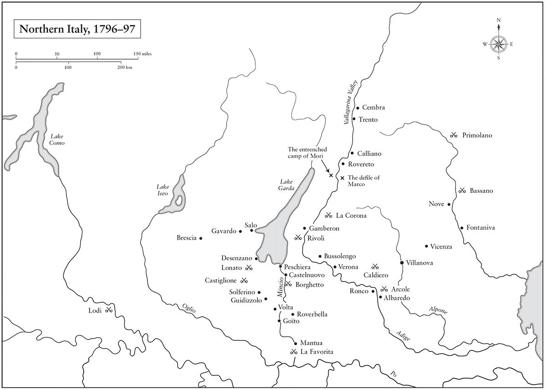
At the battle of Borghetto on May 30, Napoleon crossed the Mincio river and forced Beaulieu to retreat northwards up the Adige valley towards Trento. After he had nearly been captured during the fighting, Napoleon dismissed his bodyguards and appointed a new company of chasseurs to protect him, the forerunner of his Chasseurs à Cheval de la Garde, under the cool and cautious General Jean-Baptiste Bessières. After Borghetto, Emperor Francis relieved the hapless Beaulieu of his command of the Austrian field army – though he stayed in command of Mantua – and appointed Field Marshal General Dagobert von Wurmser, an Alsatian and yet another septuagenarian who had won his reputation in the Seven Years War, which had ended six years before Napoleon was born.
Four fortresses, known as the Quadrilateral, held the key to Austrian power in northern Italy: Mantua, Peschiera, Legnagno and Verona. Together they protected the entrance to the Alpine passes to the north and east and the approaches to the Po and Lake Garda. Napoleon generally liked to keep his movements fluid and to avoid sieges, but now he had no choice. He had only 40,400 men with which to besiege Mantua, keep communication routes open and hold the line of the River Adige. Between June 1796 and February 1797 Mantua lay under siege for all but five weeks. Protected on three sides by a wide lake and on the fourth by high thick walls, it presented a formidable challenge to any attacker. The besieged heavily outnumbered the besiegers, and, at least initially, the Austrians fired twice as many cannonballs at the French as the French could fire back. But by early June Napoleon was so well provisioned from the Lombardy plains and by ‘contributions’ that he could send to the Directory one hundred carriage horses, to ‘replace the mediocre horses that draw your coaches’.82 He also sent them a much-needed 2 million francs in gold.
On June 5 Napoleon met the diplomat André-François Miot de Melito, the French minister to Tuscany. Miot would write of their encounter that Napoleon had an
extremely spare figure. His powdered hair, oddly cut and falling squarely below the ears, reached down to his shoulders. He was dressed in a straight coat, buttoned up to the chin, and edged with very narrow gold embroidery, and he wore a tricoloured feather in his hat. At first sight he did not strike me as handsome, but his strongly marked features, his quick and piercing eyes, his brusque and animated gestures revealed an ardent spirit, while his wide and thoughtful brow was that of a profound thinker.83
Miot noted that when Napoleon gave orders to Murat, Junot and Lannes, ‘Everyone maintained towards him an attitude of respect, I may even say one of admiration. I saw none of the marks of familiarity between him and his companions as I had observed in other cases, which was consonant with republican equality. He had already assumed his own place, and set others at a distance.’ This was deliberate; even at twenty-seven Napoleon was beginning to use his aides-de-camp, secretaries and domestic staff to regulate his accessibility and enhance his status. To this end he appointed two new aides-de-camp to join Junot, Marmont, Muiron and Murat. These were Joseph Sulkowski, a Polish captain in the revolutionary army, and Géraud Duroc, an artillery officer who had shown his efficiency as General Augustin de Lespinasse’s aide-de-camp. Napoleon was years later to describe Duroc as ‘the only man who had possessed his intimacy and entire confidence’.84 Duroc would be one of the very few people outside Napoleon’s family to use ‘tu’ when addressing him.
The Directory had wanted Napoleon to move on Bourbon Naples, but he understood that to march south would be dangerous in light of the threat from the Tyrol, so now, instead of exceeding his orders from Paris as at Cherasco, he defied them. Napoleon ordered Miot to negotiate an armistice with Naples that would require her to withdraw her four cavalry regiments from the Austrian army and her ships from the Royal Navy squadron at Livorno. The alternative was an invasion of Naples by the Army of Italy. Once he was threatened with invasion, the Neapolitan negotiator, Prince de Belmonte-Pignatelli, signed the treaty that was put before him in two hours flat. Napoleon was by then willing to disparage the Directory, asking Pignatelli whether he really thought that he ‘was fighting for those scamps of lawyers’.85 (Although Napoleon liked and admired some individual lawyers, he utterly detested them en masse, and of the five Directors, three were former lawyers and one – Barras – a former judge. Only the mathematician Carnot had no legal background.)
Back in Milan on June 5, Napoleon wrote again to Josephine, who he still thought was pregnant and on her way to see him. The volcanic expressions of love, anger, confusion and self-pity, and the sheer number and length of his letters, suggest that writing them must have been a form of release, an escape from the political and military pressures crowding in upon him at the time. In an age of self-conscious Romantic letter-writing, Napoleon was clearly striving for the greatest possible effect and the boundary between what he was writing to his wife and the fantasy of Clisson et Eugénie is all but invisible. ‘My soul was all expectant of joy,’ reads one letter,
it is filled with sorrow. The mails keep arriving without bringing anything from you. When you do write, it is only a few words, without any evidence of deep feeling. Your love for me was only a light caprice; you feel that it would have been ridiculous had your heart even deeply engaged . . . As for you, my only remaining hope is that the recollection of me will not be odious to you . . . My heart has never entertained commonplace feelings . . . it has steeled itself against love; you came and inspired a limitless passion, an intoxication which degrades. The thought of you has taken precedence of all else in my soul, the universe besides was nothing; your slightest caprice was to me a sacred mandate; to be able to see you was my supreme happiness. Beautiful you are, gracious; a sweet, a celestial soul expresses itself in heavenly tints through your face . . . Cruel!!! How could you have allowed me to imagine in you feelings you never entertained!!! But reproaches are unworthy of me. I have never believed in happiness. Death flutters about me every day . . . Is life worth all the fuss and clatter we make about it? Adieu, Josephine . . . A thousand daggers stab my heart; do not plunge them in deeper. Adieu my happiness, my life, all that had any real existence for me on this earth.86
He had turned to unpublished literary endeavours many times before to seek release from his sadness over Désirée, to recall the loss of his virginity, to express his hatred of France over its ‘subjection’ of Corsica, to explain his Jacobinism, and so on. But now he actually sent these overwrought letters off to Josephine, who was so bound up in her own love affair that she scarcely bothered to send more than two or three lines once a fortnight – and for a whole month up to June 11 didn’t write at all. By then Napoleon seems to have finally guessed that something was amiss, for that day he wrote to her former lover Barras: ‘I am in despair that my wife does not come to me; she has some lover who keeps her in Paris. I curse all women but I embrace my good friends with all my heart.’87
To Josephine herself he wrote to say that he was almost resigned to the fact that she no longer loved him – if indeed she ever had – but then at the next moment he was so incapable of accepting this somewhat obvious conclusion that he grasped at every other possibility, including the notion that she might be dying (though Murat, currently in Paris, reported that any illness she might have contracted was ‘light’).
You do not love me anymore. I have only to die . . . would it were possible!!! All the serpents of the Furies are in my heart, and already I am only half alive. Oh! You . . . my tears flow, there is neither rest nor hope. I respect the will and unchanging law of this destiny; it weighs me down with glory to make me feel my unhappiness all the more bitterly. I will grow accustomed to everything in this new state of affairs; but I cannot accustom myself to no longer respecting it; but no, it is not possible, my Josephine is en route; she loves me, at least a little; so much love promised cannot vanish in two months. I hate Paris, women and the love-making . . . That state of affairs is frightful . . . and your conduct . . . But should I accuse you? No, your conduct is that of your destiny. So kind, so beautiful, so gentle, should you be the perpetrating instrument of my despair? . . . Farewell my Josephine; the thought of you was wont to make me happy, but all that is changed now. Embrace for me your charming children. They write me delightful letters. Since I must not love you any longer, I love them all the more. Regardless of destiny and honour, I will love you all my life. I re-read all your letters again last night, even the one written with your blood: what feelings they made me have!88
At one point he asked her not to wash for three days before they met so he could steep himself in her scent.89 By June 15 he was frankly telling her, ‘I could not tolerate a lover, much less allow you to take one.’ He said he recalled a dream ‘in which I took off your boots, your dress, and made you enter bodily into my heart’.90
Although Napoleon wrote hundreds of pages of emotional rhapsodies to Josephine, endlessly suggesting that he would kill himself if anything were to happen to her, he rarely told her anything about the war that couldn’t be gleaned from the public gazettes. Nor did he trust her with his innermost thoughts about people or events. It might have been because he feared that his letters, which took two weeks to reach Paris by special courier, might be captured by the enemy. Perhaps, as the British politician John Wilson Croker suggested in the Quarterly Review in 1833, when 238 of Napoleon’s letters to Josephine were first published, it was because he thought her ‘frivolous, capricious, and giddy – too vain not to be flattered, too indiscreet to be trusted’. Croker was harsh, but not unfair, in denouncing the letters as showing: ‘No real confidence, no interchange of mind . . . no communication of serious thoughts, no identity of interests.’91
Napoleon was capable of compartmentalizing his life, so that one set of concerns never spilled over into another – probably a necessary attribute for any great statesman, but one he possessed to an extraordinary degree. ‘Different subjects and different affairs are arranged in my head as in a cupboard,’ he once said. ‘When I wish to interrupt one train of thought, I shut that drawer and open another. Do I wish to sleep? I simply close all the drawers, and there I am – asleep.’92 An aide-de-camp wrote of how much his staff ‘admired the strength of mind and the facility with which he could take off or fix the whole force of his attention on whatever he pleased’.93 In the middle of this hurricane in his private life and the growing, gnawing realization that the woman he worshipped was at best lukewarm in her affections towards him, Napoleon was putting the finishing touches to a bold campaign plan that would lead to a string of seven more victories on top of the five already won, the capture of Mantua and the expulsion of Austria from Italy after three centuries of Habsburg rule.