
6
Napoleon conquered what was later Germany in 1805, Hitler overran France in 1940. Both smashed coalitions whose armies had appeared to have overwhelming superiority. These unexpected, complete victories made the Emperor and the Führer masters of Europe. Each was intoxicated by his success, yielding to unbridled ambition.
Marshal Alexandre Berthier, the son of an engineer who had been ennobled by Louis XV and himself a sapper, is recognized as one of the greatest staff officers in history. He was both a genius and a dogsbody. While Napoleon was his own chief military planner – crouched over or even lying on his maps with a pair of dividers (spaced to cover 22 to 25 miles, the distance infantry could march in a day), marking his divisions by coloured pins which he moved so as to know where they would be at any given moment, only issuing orders after the most meticulous calculations – the provider of maps and everything else was Berthier, who knew the strength and position of every unit. During one campaign he is said to have gone without sleep for nearly a fortnight. He was so much under his master’s spell, that guilty at having deserted in 1814 and not daring to rejoin him, he eventually threw himself out of a window.
General Alfred Jodl and the future Marshal Wilhelm Keitel together constituted a species of joint Berthier. Jodl, originally an artilleryman, was a Bavarian of bourgeois background with intellectual tastes. Too intelligent not to question Hitler’s wilder fantasies, he was totally dominated by him, often cynically agreeing for the sake of peace and quiet. Nevertheless, he could plan anything. (He was to plan the brilliantly successful invasion and conquest of Yugoslavia.) Keitel, a Hanoverian country gentleman whose family had fought against the Prussians in 1866, was also a gunner but not so clever as Jodl. ‘From an honourable, soldierly respectable general he had developed in the course of years into a servile flatterer,’ comments Speer. ‘Basically Keitel hated his own weaknesses; but the hopelessness of any dispute with Hitler had ultimately brought him to the point of not even trying to form his own opinion.’ So enslaved was he that when his master staggered to his feet after the bomb attempt of 1944 he embraced him, crying, ‘My Führer, my Führer, you’re alive!’ (It was Keitel who gave Hitler the title Grösster Feldherr aller Zeiten – ‘Greatest War Lord of All Time’; abbreviated to ‘Gröfaz’, it became a sarcastic nickname at Wehrmacht headquarters during the war’s later stages.) Together Jodl and Keitel enabled the Führer to function as a commander.
The basic difference is that the Emperor was his own best strategist and tactician, as well as a leader in the field. Hitler, on the other hand, was at this phase of the war – in contrast to later phases – prepared to listen to ideas on strategy and tactics; the defeat of France was undoubtedly due to his readiness to listen to an officer with a plan rejected by the High Command. Modern warfare made it impossible for him to be up at the front like Napoleon.

In 1805 the French were opposed by 100,000 fresh Austrian and Russian troops under the Holy Roman Emperor and the Tsar of Russia. Napoleon had 60,000 men who had marched nearly 1,500 miles during the last three months. On 1 December 1805 the French bivouacked near the Austro-Russian positions around Austerlitz (Slavkov) between Brno and Morava in what is now Czechoslovakia, but deliberately left the Pratzen plateau unoccupied. The Austrians and Russians hastened to seize it, since the plateau commanded the entire area. They saw that the French right was surprisingly weak, and they planned to turn it, though to do so they would have to weaken their centre on the plateau in order to strengthen their left – which was just what the French Emperor wanted. Kutuzov (the future hero of 1812) feared a trap, but his warnings were ignored. On the following morning the battlefield was shrouded by dense fog, enabling Napoleon to mass below the plateau, without being observed, the troops which he had withdrawn from his right, together with those of his centre. On the other hand, the plateau was free from fog, so that the French could see exactly what their opponents were doing. At 9.00 a.m., after three Russian divisions had come down to attack the French right – meeting a ferocious resistance from Marshal Davout – the Emperor promptly hurled 25,000 men up the slopes, overwhelming the Russian Imperial Guard which defended the plateau, cutting the Allied army neatly in two. The battle continued fiercely all along the front for seven hours. The Allies tried desperately to retake the Pratzen, the last Russian attempt to do so failing at about 1.30 p.m. The French then advanced across the plateau to fire down on the Allies’ left wing. Bewildered Austro-Russian troops fled in panic across frozen lakes on the plains below, many of them drowning when the ice was broken by French cannon-balls. The Emperor killed 15,000 men, took 10,000 prisoners, and captured 180 guns with 40 colours.
While Tsar Alexander took refuge farther east the Emperor Francis II demanded an interview with Napoleon. Almost his first words to his vanquisher were a bitter reference to British subsidies – ‘The English are dealers in human flesh.’ He was given an armistice which resulted in the Treaty of Pressburg three weeks later. Despite Talleyrand cautioning his master that he was asking too much, Austria had to surrender Venice, Istria and Dalmatia to the Emperor, with Swabia and the Tyrol going to his Württemberger and Bavarian allies. Besides being driven out of her German and Italian possessions, Austria had to pay a huge indemnity, with 8 million gold francs as a first instalment. Hanover was given to Prussia, to ensure she did not ally with Britain. As for Naples, the Emperor announced that its dynasty no longer reigned, its new king being his brother Joseph; French troops occupied it early in 1806. Holland became a kingdom under Louis Bonaparte.
In addition a confederation of German client states was set up under French control. This Rheinbund (‘Confederation of the Rhine’), designed to replace the ‘Holy Roman Empire of the German Nation’, included all Charlemagne’s territory; as he had threatened in 1802, Napoleon was reviving the Western Empire. To assert his primacy he promoted the Electors of Bavaria and Württemberg to kings. The Emperor Francis formally renounced the title Holy Roman Emperor in August 1806, taking that of Emperor of Austria in its place.
Always biased in Napoleon’s favour, Charles James Fox guessed from the outset how his campaign would end. Otherwise even the stoutest heart of oak was shaken. A grim Canning compared Bonaparte to Alexander the Great, Julius Caesar and Frederick the Great, a general unhampered by constitutional control. William Hazlitt discerned ‘a spirit of unbounded ambition, the insolence of almost unexampled success, resentment for supposed injuries and the most consummate military skill’. The British were especially alarmed by the Confederation of the Rhine. ‘There is nothing to break the gloom,’ wrote Lord Addington (the former prime minister), ‘Europe is France.’ Sheridan commented ‘Bonaparte is surrounding France not with the iron frontier which distinguished the childish ambition of Louis XIV, but with kingdoms of his own creation.’
Britain was still at war. After Trafalgar, invasion was out of the question, but there were other ways of bringing her to her knees. Later in 1806, when he had knocked out Prussia, Napoleon used his control of Germany to cut Britain off from the markets of northern Europe. By the Decree of Berlin in November that year he would introduce the ‘Continental Blockade’, or ‘Continental System’. All trade and communications with the British Isles were forbidden, and any British merchandise, whether from Britain or her colonies, was declared forfeit. The governments of Spain, Holland, Etruria and Naples as well as those in Germany were ordered to enforce the blockade. The Emperor explained, ‘I am going to conquer sea-power with land-power.’
Indirectly, the Blocus Continental affected the United States. Britain forebade Americans to trade with Napoleonic Europe, allowing direct trade with Sweden alone. American vessels were intercepted by British warships, their cargoes seized and their crews press-ganged. At the end of 1807 President Jefferson steered an Embargo Act through Congress, forbidding trade with both Britain and France; his object was to starve Britain into changing her policy without war. Relations continued to deteriorate, and in 1812 President Madison declared war on Britain. John Randolph of Roanoke warned that such a war meant allying with forces opposed to civilization; privately Madison agreed. Most informed Americans detested Napoleon.23 During the crisis of 1807 Jefferson admitted, ‘It is really mortifying that we should wish success to Bonaparte and look to his victims as our salvation.’ In 1816 he wrote, ‘I considered him the very worst of human beings, and as having inflicted more misery on mankind than any other who had ever lived’; in 1823, ‘He wanted totally the sense of right and wrong’, had destroyed ‘millions of human lives’ and ‘must have been a moral monster, against whom every hand should have been lifted to slay him’.
Despite its hostility, the Emperor was fascinated by America, by the speed of its development and constant expansion. (On St Helena he would read all he could about it.) He prophesied that ‘The Americans will not become a great people at once but gradually’, that one day they would be the ‘avengers of the sea’ and cause the British serious anxiety.
In 1801 in exchange for creating ‘Etruria’ (by adding formerly Habsburg Tuscany to Bourbon Parma) he obtained from Spain the former French territory of Louisiana, which had been under Spanish rule since 1763. For a moment he toyed with the old dream of a French transatlantic empire and tried to secure Florida as well. However, he was too much of a realist not to realize the difficulties. In the event of a renewed war the British fleet would at once sail into New Orleans; on the other hand, if he sent French troops to garrison it, the Americans would immediately ally with Britain – as Thomas Jefferson observed, if French soldiers arrived ‘We must marry ourselves to the British fleet and nation.’ Accordingly he sold the entire territory to the United States in 1803 for the paltry sum of 60 million francs. He secured by this more than money, preventing an Anglo-American rapproachement. His own comment on the Louisiana Purchase was that, by making the United States a truly continental power, ‘I have just given to England a maritime rival that sooner or later will humble her pride. He did not regret surrendering Louisiana because, as he said, ‘with war on the way I could not have kept it and then the English would have taken it.’ Even so he always wanted to visit Louisiana.
As it was, the French were causing the British quite enough anxiety already. Fox was certain Napoleon had mastered Europe. He would have agreed with him when he wrote to Josephine after Austerlitz: ‘The English won’t be able to stand up to us now.’ Pitt despaired, and the failure of his foreign policy killed him. On 23 January 1806, broken by gout, overwork and alcoholism – he was rumoured to need twenty glasses of wine at dinner before making a speech in the House – the Prime Minister died at forty-six ‘like a candle burning out’. His government was succeeded by a coalition of ‘All the Talents’, from both Whigs and Tories, in which Fox was Foreign Secretary. He sent Lord Yarmouth to Paris in June 1806 to explore the possiblity of a general peace.
In France public opinion, nervous about reopening a full-scale European war, was delighted by the Treaty of Pressburg, which it hoped meant lasting peace. Yet even the least warlike Frenchmen felt pleasure at what seemed to be final victory over the Habsburgs. Few save Talleyrand realized that Austria would seek revenge. In vain he advised his master to give her Moldavia and Wallachia so she would look east, but Napoleon had ambitions of his own in that direction.
Talleyrand considered the sheer brilliance of Napoleon’s intellect the principal cause of his ultimate ruin. In his view the Emperor made plans for too many contingencies, anticipating the most unlikely dangers from his neighbours – a state of mind which led inevitably to war. Before Austerlitz his foreign policy had been essentially defensive, more or less content with the ‘natural frontiers’ of the Alps and the Rhine. But his amazing victory intoxicated him, convinced him he was invincible, made him wish to rule all Europe.
Yet this was not immediately apparent after Austerlitz. Many in Britain as well as in France believed that peace was possible now that Charles James Fox was in charge of British foreign policy. The Emperor offered Malta and in secret Hanover – George III’s former electorate – although he had just given it to Prussia. He insisted that in return Britain must let him occupy Bourbon Sicily. But this was unacceptable, and negotiations broke down. Then Fox died in September after only a few months in office. Napoleon wrote years later that had Fox lived his career might have been very different – ‘we would have arranged a new order in Europe’. It was wishful thinking.
Britain informed Prussia that she had been offered Hanover, promising to subsidize the Prussian army if it fought the French. Tsar Alexander visited Berlin to persuade King Frederick William III to declare war. A wave of anti-French sentiment swept through Prussia. Despite the French victories of recent years, the Prussians were convinced that their own rigidly drilled troops were still the best in Europe, as they had been under Frederick the Great. When war was declared on 1 October 1806, instead of waiting for the Emperor to invade and for Russian reinforcements, 160,000 Prussians advanced into Saxony on too wide a front, taking up positions on the river Saale, with their main supply depot at Naumburg dangerously exposed on their right. From the very beginning their campaign was disastrous. On 10 October Prince Louis of Prussia was killed shortly before the French turned his army’s flank and seized Naumburg, blowing up the magazines and cutting their opponents off from fresh ammunition. On 15 October, having crossed the river Saale at Jena, Napoleon routed Prince Hohenlohe, inflicting 12,000 casualties and taking 25,000 prisoners and 200 guns. On the same day Marshal Davout, guarding one of the crossings of the Saale with 26,000 men, was attacked at Auerstadt by the Duke of Brunswick with 60,000. The Prussians relied on their cavalry to break the French squares, charging again and again, only to be mowed down. Davout then formed his squares into columns and charged the Prussian infantry, which broke; Brunswick and his two senior officers were mortally wounded, 10,000 Prussians lay dead or dying and 115 guns were captured. The Prussians were dazed; one of their officers described the French as small, pitiful creatures who under fire become ‘superhuman’. Murat’s cavalry pursued relentlessly, making it impossible for the Prussians to rally. Hohenlohe surrendered with another 20,000 men. On 27 October the Emperor entered Berlin to the strains of the Marseillaise, chosen for its anti-royal sentiment. Frederick William fled to Memel, on the eastern-most border of his realm. By 8 November the Prussian army no longer existed. Besides Memel only Königsberg and a few towns held out.
It has often been said that on this occasion Prussia had treated her army like some family heirloom credited with miraculous powers, taken down from its glass case and dusted. Her generals followed blindly the strategy of fifty years before.
Among prisoners of the French were Prince August of Prussia and his 26-year-old ADC, Captain Carl von Clausewitz. They would spend the next two years in captivity in France. Clausewitz wrote bitterly in after years of the defeat at Jena that the Prussian generals had together thrown ‘themselves into the open jaws of destruction with the oblique order of Frederick the Great, and managed to ruin Hohenlohe’s army in a way that no army was ever ruined, even on a field of battle. All this was done through a manner which had outlived its day, together with the most downright stupidity.’ Elsewhere he writes that ‘the stain of a cowardly submission can never be effaced’ – words that would be quoted in Mein Kampf.
Napoleon took the opportunity to visit the tomb of a soldier whom he genuinely admired – Frederick the Great. Indeed, to some extent he had modelled himself on the grim old King, whose example inspired his plain grey uniform and small unbraided hat. He sent back to Paris not only 340 Prussian standards to hang up in the Invalides but Frederick’s sword which he took from the tomb at Potsdam. (Der Alte Fritz was even more a hero of the Führer. ‘Despite all Napoleon’s genius, Frederick the Great was the most outstanding man of the eighteenth century’, he declared. ‘When seeking to find a solution for essential problems concerning the conduct of affairs of State, he refrained from all illogicality’ – presumably a reference to the King’s notorious lack of scruple. In particular Hitler considered him the Emperor’s superior because of the latter’s nepotism: ‘When Napoleon set the interests of his family clique above all, Frederick the Great looked around him for men, and, at need, trained them himself.’)
The years 1806 and 1807 represent the peak of the Emperor’s achievement as a soldier. He did not invent his tactics. His genius lay in improving on them. They are the brain-children of officers of the old pre-1789 French army – Bourcet, Guibert and to a lesser extent Montalembert. Bourcet’s contribution was manoeuvring an opponent into dispersing his troop concentrations and then concentrating one’s own forces. Guibert was the advocate of mobility and fluidity, of self-contained divisions operating autonomously, and of the rear attack – a Napoleonic speciality. Montalembert was the creator of a complete new system of fortification. However, the Emperor applied these innovations under totally changed conditions. As Clausewitz observes, the wars which preceded the French Revolution had been on a small scale, restricted by generally observed conventions and with limited objectives; plundering and devastating were looked on as barbarous and counter-productive. Then came the Revolution, and war suddenly turned into ‘an affair of the people, and that of a people numbering nearly thirty millions’, while ‘energy in the conduct of war was immensely increased; the object of an action was the downfall of the foe; and not until the enemy lay prostrate on the ground was it supposed to be possible to stop’. The new Revolutionary warfare was perfected by Napoleon – ‘this military power, based on the strength of the whole nation, marched over Europe, smashing everything in pieces, so surely and certainly, that where it only encountered the old fashioned armies the result was not doubtful for a moment’. One day the Führer’s revolution would inspire the German army to very similar achievements.
Where the Emperor did not resemble Hitler was in his complete lack of interest in technical innovation. His cannon were those introduced by the great artilleryman Guibert, who had died in 1789, weapons with which he had first become familiar as a young officer in the regiment of La Fère; they remained unchanged, apart from slight modifications in 1803 and a new 24-inch howitzer. The standard musket carried by the Imperial army was the model of 1777. He rejected rockets and the percussion cap, together with observation balloons, submarines and the telegraph.
The British did not despair at the Prussian collapse, though they were deeply depressed by it. Wordsworth wrote:
Another year! – another deadly blow!
Another mighty Empire overthrown!
And We are left, or shall be left, alone;
The last that dare to struggle with the Foe.24
But Russia had not given up the fight.
Marshal Murat rode into Warsaw on 28 November 1806, the Emperor a fortnight later. He did not give the Poles back the independence they had lost ten years before, as they had expected; he was nervous that Austria might fight for the Polish provinces, while he would need a bargaining counter when dealing with the Russians after their defeat. It was a bad mistake, since although many Poles fought for him he never gained the entire support of that fanatically patriotic nation. Despite terrible winter weather, and ignoring their disaster at Austerlitz, 120,000 Russians advanced into Poland and East Prussia. There were a series of minor if bloody engagements at the end of December, brought to a halt by an unexpected thaw turning the ground into a sea of mud. Napoleon sited his men’s winter quarters on the far side of the Vistula to tempt the Russians into attacking. Their new commander-in-chief, Bennigsen, swallowed the bait. The Emperor was waiting, and eventually caught up with him at Eylau on 7 February 1807, the battle being fought the next day. Bennigsen’s batteries, concealed by a snowstorm, blew Augereau’s corps into red ruin, the Cossacks finishing them off, whereupon the Russians surged forward at the French centre and nearly took the Emperor prisoner. He was saved by Murat charging at the head of 10,000 sabres, though when the French cavalry pressed on it was mown down in turn by cannon masked by snow. Davout almost broke the Russian left, but was beaten off. Both sides charged again and again, all along the line, neither gaining any advantage. It was Napoleon’s longest and bloodiest battle so far. In the end Bennigsen decided to withdraw, 30,000 of his men being casualties or prisoners. But the French were in no condition to pursue him, with 3,000 dead and 7,000 wounded. Even the Emperor was shaken by the butchery, which had gained him no advantage. He spent the rest of the winter mopping up what remained of Prussia.
On 14 June Napoleon again caught up with Bennigsen at Fried-land in East Prussia. Marshal Lannes had intercepted him, barring his retreat with 26,000 men against more than 80,000 from 3.00 a.m. until midday when the Emperor arrived. He feigned attack on all fronts while concentrating his strength on the right, eventually driving the Russians into the river Alle; 25,000 were killed or drowned, and the rest fled, abandoning 80 guns. It was the anniversary of Marengo.
Tsar Alexander asked for an armistice. The two emperors met near Tilsit on 8 July in a pavilion constructed on a raft in the middle of the river Niemen. The Tsar’s first words were: ‘I hate the English even more than you do.’ ‘If that’s the case, then peace has been made’ was Napoleon’s reply. Both fascinated each other. Alexander commented, ‘I have never loved anything more than that man’, while Napoleon thought the Tsar ‘a very handsome, very fine young emperor’. He had brought the Comédie Française with him, and when an actor declaimed, ‘A great man’s friendship is like a gift from the Gods’ Alexander seized his hand. Yet in secret the Tsar listened to Talleyrand, who warned him not to join in schemes which might destroy Europe.
By the Treaty of Tilsit Russia entered on an alliance with France, stipulating that she might be allowed to wrest Finland from Sweden if she enforced the Continental Blockade. Prussia had to surrender half her territory and five million subjects – lands west of the Elbe being joined to Hesse-Cassel to make the Kingdom of Westphalia for Napoleon’s brother Jerome; her Polish provinces became the Grand Duchy of Warsaw, with the King of Saxony as Grand Duke. In addition, besides enforcing the Continental Blockade she had to pay indemnities beyond her power, ensuring French occupation.
The Emperor was now the undisputed master of Europe. In addition to France, territories directly under his rule included Belgium, northern and much of central Italy, and Dalmatia. The German lands, Holland, Switzerland, Naples, and the Grand Duchy of Warsaw were client states, while Russia, Denmark and – in theory – Spain were his allies. The leitmotif of his ‘new Western Empire’ was the Continental Blockade. He knew that to impose a lasting hegemony over Europe he must eventually break Britain’s will to defy him. It became an obsession which caused him to demand even tighter control over satellites and neighbours in order to see that they enforced the blockade, which ultimately drove him to annexation and fresh wars.
Napoleon’s next great enterprise was the destruction of Portugal, Britain’s last ally in Europe. (Her loyalty had been assured by preferential tariffs for her port wine and wool.) It was intended to be a first step in the subjection of the Iberian peninsula. Even Hitler never quite surpassed the sheer duplicity of what ensued. It was agreed (in the secret Treaty of Fontainebleau) that Portugal should be divided in three, one-third going to the Spanish minister Godoy and another to the King of Spain’s sister (in exchange for her kingdom of Etruria), while the remaining third would become a French puppet state. In November 1807 General Junot entered Lisbon after a gruelling march across Spain; the Portuguese did not even try to fight, their royal family fleeing to Brazil. The tiny French army had to be reinforced, the Spaniards allowing the French to concentrate vast numbers of troops in northern Spain. In February 1808 Murat was given sealed orders and appointed Lieutenant General in Spain.
In 1795 Spain had accepted that the French Revolution was there to stay, and since then had fought by the side of France against Britain, her traditional enemy. Some Spaniards with ‘enlightened’ views were happy with the alliance. Most, however, detested being ruled by Godoy, the Queen’s lover, whom the French controlled with bribes and threats, and despised Charles IV. Opposition to Godoy and Charles, opposition largely hostile to France, centred round the boorish Ferdinand, Prince of the Asturias, who hoped to replace his father on the throne. In March 1808 Godoy was overthrown and Charles forced to abdicate. The new King, the insecure Ferdinand VII, asked France for a dynastic alliance. A pretence was made of considering an Imperial niece but finding her unsuitable.
Murat and a French ‘Army of Observation’ installed themselves in Madrid on 23 March. He had been instructed by the Emperor to ‘treat the King and the Prince of the Asturias well and everybody else. Tell them you know nothing and are awaiting my orders.’ Murat told Ferdinand that he had no authority to recognize him as King, he sympathized with Charles IV and the Queen, and advised them to go to France and seek Napoleon’s arbitration. Hopefully, they travelled to Bayonne. Here the Emperor was at first most amiable, persuading Ferdinand to return his father’s crown, but then bullied Charles into abdicating; the three were sent into semi-captivity in France. (Napoleon had already offered Spain to his brother.) The Spanish expressed their disapproval, regardless of 50,000 French troops outside Madrid. On 2 May the Madrileños killed 700 Frenchmen. Murat crushed them with grapeshot and the bayonet, slaughtering 1,200 and shooting 200 more who had been taken prisoner.
All Spain now rose, French soldiers being murdered everywhere. Marshal Bessières routed the main Spanish army at Riosecco on 14 July, killing 20,000 and securing Madrid for ‘King José’ – Joseph Bonaparte – with whom Napoleon had replaced the Bourbons. But General Dupont was cut off and forced to surrender at Baylen with 20,000 men, while Saragossa held out heroically. A British expeditionary force under Sir Arthur Wellesley (the future Duke of Wellington), quickly defeated Junot and occupied Lisbon. By September 1808 the French had been driven back into the Spanish provinces north of the Ebro.
The news infuriated Napoleon. He hastened to Paris, then to Spain, bringing 150,000 men with him. He broke the Spaniards at Burgos, Espinosa and Tudela, battering his way to Madrid with a superb charge through the Somosierra Pass by his Polish lancers, entering the capital on 4 December. The British under Sir John Moore fled before him over the Sierra de Guadarrama in atrocious weather; the Emperor heard his own troops cursing him during the snowstorms. Undeterred, he pressed on after the British. However, at Astorga, convinced he had subdued the peninsula, he handed over command to Marshal Soult and rushed back to Paris.
He had good reason to hurry back from Spain. He suspected Talleyrand of plotting against him, though he could discover nothing. He had fallen out with the Pope; his troops had occupied Rome in April 1808, while Pius VII was to be imprisoned in 1809; he had refused to recognize Joseph Bonaparte first as King of Naples and then as King of Spain and would not enforce the Continental Blockade against the British in the Papal States – the cornerstone of Imperial foreign policy. Moreover, Austria was rearming and preparing to attack him once again.
Austria declared war on 6 April 1809. The Archduke Karl, a formidable commander, marched on Bavaria with 175,000 men. Davout had 50,000 troops at Ratisbon, Masséna 60,000 at Augsburg; the Austrian plan was to get between them and destroy each separately. The Emperor hurled himself into the gap with 40,000 troops, his two marshals linking up with him. On 22 April he inflicted a crushing defeat on his opponents at Eckmühl. On 10 May he entered Vienna once more. But on 21 May at Aspern the Archduke cut Napoleon off from Davout and his reserves by destroying the bridges over the Danube with fire-boats, bottling him up on the island of Lobau. It was his first serious reverse. However, the Austrians had suffered too many casualties to destroy him and he escaped from the fortifications with which they had encircled him. On 6 July at Wagram, after Masséna had blocked an attempt to turn the French left, Karl extended his front too far, enabling the Emperor to overwhelm his centre. The Archduke retreated, having suffered 24,000 casualties, a further 12,000 of his men being taken prisoner. The French had 18,000 killed or wounded. At the Treaty of Vienna in October 1809 Austria surrendered nearly 4 million subjects, ceding territory to France, Russia, Saxony-Warsaw and Bavaria.
Napoleon was growing tired of war, and decided that a dynastic alliance would strengthen his position. Although the Tsar had not intervened to help him during the recent campaign, he would have liked a Russian Grand Duchess, but Josephine’s gossip lost him his Romanov bride. Fearful of being divorced, she told the Prince of Mecklenburg-Schwerin that her husband was impotent. (She had long been spreading rumours that ‘Bonaparte est bon-à-faire-rien’.) The Prince informed the Dowager Tsarina, who refused to let her daughter make so humiliating a marriage. The Emperor turned to the Habsburgs instead.
Looking back, he thought he had made a bad mistake in not insisting on the division of the Austrian Empire into its three major states – Austria, Hungary and Bohemia. If this was wisdom with hindsight, he was correct in believing that Austria had been left much too strong for France’s safety and would be able to join in destroying her. It is probable, however, that he was already contemplating making the Austrian Empire his junior partner instead of Russia. At the back of his mind there may have been an unwilling acceptance of Talleyrand’s opinion, that if Austria did not exist she would have to be invented.
In his own words, ‘The [Napoleonic] monarchy, the well being and best interests of my people, which have always dictated my actions required me to leave the throne on which Providence had placed me to legitimately begotten children.’ At the end of 1809 he divorced Josephine in order to marry Francis II’s daughter, the Archduchess Marie Louise – Marie Antoinette’s niece – in March 1810 at a proxy wedding in Vienna. Afterwards he spoke of his grief at having to abandon Josephine, ‘my beloved wife’, giving a curious insight into her character – she loved luxury and was a consummate liar but was none the less devoted to him and possessed an extraordinary knowledge of the way in which his mind worked.
Far from making him more secure, the marriage ensured that France and Russia would soon be at war. Not only did Tsar Alexander mutter, ‘The next thing will be to drive us back into our forests’, but he genuinely believed it. At the state banquet which followed the formal wedding in Paris, Prince Metternich, the Austrian Emperor’s special envoy, drank ostentatiously to ‘The King of Rome’ – a title very like that once borne by the heirs of Holy Roman Emperors. For the moment even Metternich thought that the Napoleonic hegemony looked likely to last.
Nevertheless, bad news was again coming out of the peninsula. Sir Arthur Wellesley had beaten the French at Talavera in 1809, while Masséna had failed to drive him out of the lines of Torres Vedras. In Holland Louis Bonaparte proved so independent-minded that he had to abdicate, his kingdom being incorporated into the French Empire in 1810. Both the Confederation of the Rhine and occupied Prussia hated the French; there was no proper commissariat, so they fed and paid themselves by plunder. Even the Emperor was uneasy about occupying the Papal States, anxious to come to an understanding with the imprisoned pontiff. In 1810 too Marshal Bernadotte, whom Napoleon sometimes suspected of being a secret enemy, became the King of Sweden’s adopted heir. The Continental Blockade was becoming harder and harder to enforce, imposing an ever-increasing strain on the Russian alliance.
Even so, Napoleon’s confidence knew no bounds. His marriage to an Austrian Archduchess and the birth of a son and heir in June 1811 induced something like euphoria. ‘Up to the time of her marriage Marie Louise possessed but one social talent, on which she prided herself not a little’, says the great Napoleonic historian Frédéric Masson, ‘the power of moving her ears without stirring a muscle of her face. It proved a somewhat insufficient means of amusement, and was neglected in favour of billiards.’ The Emperor had to take lessons from a chamberlain to play with her. She loathed warm rooms, while he detested cold. Yet he was in love with her, and although she was over twenty years younger, she seems to have returned his affection. A strongly sensual streak in her nature contributed, but it also made her vulnerable to other men. (In 1814 General von Neipperg would seduce her away from the Emperor.) He allowed her to sponge him in his bath and ate his meals with her, interminable courses in rich cream sauces which increased his obesity. As Masson points out, ‘It was not so much the woman he desired as the princess.’ She was a status symbol, a token of his acceptance by other monarchs. The existence of a future Napoleon II, ‘King of Rome’, heightened his illusions. His judgment of Austrians, especially of his wife’s relations, suffered; as he said himself, he ‘gorged them with diamonds’. In Hitler’s opinion, the arrival of an Austrian Empress in France ‘irremediably wounded the national pride of the French’. Politically if not domestically, the Habsburg marriage turned out to be a disastrous mistake.
Fouché came out of retirement to warn against a war with Russia while Spain remained unconquered. He thought it unwise to fight beyond the Pyrenees and the Niemen at the same time. The Emperor brushed his objections aside, without even reading the memorandum he had presented. ‘There is no crisis. This is a political war,’ he told the horrified Fouché. ‘Spain will fall as soon as I destroy the English influence at St Petersburg. I need 800,000 troops and I’ve got them. I can drag all Europe along with me, and nowadays Europe is only a rotten old whore who has to do just what I want when I have 800,000 men.’ ‘Don’t you worry,’ he continued. ‘Regard the Russian war as a war of common sense, for everyone’s good and peace of mind, for everyone’s security.’ He added, ‘How can I help it when all this power is sweeping me on to world dictatorship?’ Then he revealed his real plans. ‘I’m going to finish what is so far only on the drawing-board. We want a European legal code, a European appeal court, a single currency, a single system of weights and measures. I shall make the European nations into one nation and Paris the world capital.’
Fouché’s account is borne out by the Abbé Pradt’s record of a conversation with the Emperor in November 1811. ‘In five years I shall be master of the world. Only Russia is left, but I’m going to crush her.’ Paris, the centre of the universe, would reach as far as Saint-Cloud. ‘I want to make it a city of two, three or even four million people, something fabulous, something colossal, something unknown before our time. Its public buildings will be in proportion to the population.’ He regretted that it was not possible to transport St Peter’s from Rome for re-erection on the bank of the Seine.
While there are indications that even Napoleon had his nervous moments about so vast an enterprise, he had decided that war with Russia was inevitable. He would have preferred a peaceful solution, for the Tsar to obey him. However, he did not doubt for a moment that he would be victorious. He contemplated annexing a large area of territory to the Grand Duchy of Warsaw, while the remainder of the western half of the Russian Empire might be replaced by a puppet Grand Duchy of Smolensk. Sweden could be bribed into attacking St Petersburg with the promise of Finland and the Baltic.

The western powers were aghast at the seemingly effortless way in which the Wehrmacht had subdued a people whom Chamberlain called ‘that great virile nation’. Foreign observers did not take into account Polish inferiority in equipment. The Führer and his army appeared invincible. The notably un-Napoleonic French General Staff adopted a supinely defensive strategy, their slogan being ‘We’re going to win because we’re stronger’ (‘Nous gagnerons parce que nous sommes le plus fort’).
The Allies made no move of any sort until April 1940. A Franco-British expeditionary force then landed at Narvik in Norway, with the objective of blocking German imports of iron ore from Sweden. However, they were forestalled, 2,000 crack Austrian mountain troops under the Nazi General Dietl (one of Hitler’s favourite officers) holding Narvik against 20,000 British, while an even smaller German force seized Oslo. At the same time Denmark was overrun by a single Wehrmacht battalion. Within a matter of weeks a mere 10,000 German troops had conquered all Norway, despite being heavily outnumbered by the French and British. Although initially the Führer had been reluctant to move, showing considerable nervousness, this remarkable campaign was largely due to his inspiration.
On 10 May 1940 General von Bock invaded Holland and Belgium, the Dutch surrendering almost immediately. The Allies had expected the main thrust to come from this direction, since plans for such a campaign had been captured; it was very like the old Schlieffen plan of 1914, to strike at Paris through Belgium. The French and British advanced into Belgium to meet the invaders, with a third of their entire joint strength. But the real German thrust was to be at the Allied centre, through the hills and woods of the Ardennes and over the river Meuse, between the main Belgian redoubt near Liège and the Maginot Line. No one expected the Wehrmacht to come that way, since the terrain was thought unsuitable for armoured vehicles; it was guarded by only a few poor-quality troops, most of them cavalry. General Gerd von Rundstedt and 50 German divisions struck here on 13 May. Once through they raced towards the Channel ports, sweeping as intended like a sharp scythe round the right and rear of the Allied armies to the north, 1,500 tanks refuelling at roadside petrol pumps. They were almost unopposed, those French troops they met surrendering in droves. By 20 May German tanks had reached to sea. The British were cut off in Belgium, together with France’s best fighting divisions.
None the less, 338,000 British and French troops were evacuated from Dunkirk, in what Churchill called ‘a miracle of deliverance’. If the Wehrmacht had not halted between 24 and 26 May the entire British Expeditionary Force would have been destroyed and Britain almost certainly forced to surrender. The halt, which gave the Allies time to prepare defences around Dunkirk, was ordered by Hitler personally. It has been said that he did so to avoid driving Britain into a last-ditch mentality. In reality there were more practical considerations; during the 1914-18 War advances on the Eastern Front had frequently petered out because of overworked horses – nearly half the German tanks in France had broken down by 24 May 1940. There was still a danger of a counter-attack by the remaining two-thirds of the French army, while Goering had assured the Führer that his Luftwaffe could deal with the Dunkirk pocket. Finally, Rundstedt advised it would be wise to allow the infantry to catch up with their armour. Hitler’s caution would probably have been endorsed by Napoleon, even if some generals argued against it. In the event the RAF were able to give just enough protection and make possible an evacuation by 4 June.
By then nearly half a million Allied troops had been eliminated at a cost to the Wehrmacht of less than 25,000 men. On 10 June German armour crossed the Seine in strength; four days later they took Paris. The Italians invaded from the south. The octagenarian Marshal Pétain who had saved the French army from dissolution in 1917 – and who many had wanted to take power during the 1930s – was appointed Head of State. To avoid what he called the ‘Polonisation de la France’, Pétain asked for an armistice. It was signed on 22 June in the same railway carriage, and on the same spot in the forest of Compiègne, in which the Germans had signed the armistice of November 1918; outside, bands played Deutschland über Alles and the Horst Wessel Lied. Pétain’s régime kept south-eastern France, with Vichy for a capital, while the north-west, including Paris and the main industrial areas, was to be under German rule, though with French local-government officials and police. The French army was to be disbanded, surrendering allweapons and munitions, and prisoners of war were to stay in German captivity till the end of the war. Hitler presided over the armistice ceremony, though not over the victory parade in Paris – he had no need.
The amazing victory had been won by Hitler’s personal decision, against his generals’ advice, to strike through the Ardennes. He had rejected their original plan of attacking through Belgium as much too obvious. By a fluke General von Manstein, transferred to Poland in disgrace for producing a plan based on an advance through the Ardennes, managed to meet him and discuss it. The Führer had already suggested an attack on the area, and responded enthusiastically, eventually forcing the Wehrmacht to adopt the Manstein plan. He had not intervened during the Polish campaign in any way, leaving the entire planning and direction to the generals, though it had been his decision to intervene at Narvik.
General Jodl, his chief military planner, attributes the victory entirely to Hitler. ‘The man who succeeded in occupying Norway before the very eyes of the British Fleet with its maritime supremacy, and who with numerically inferior forces brought down the feared military power of France … had overruled the General Staff’s thought of a broad encirclement [through Belgium, as in the Schlieffen Plan] by initially careful but then increasingly tenacious and unhesitating intervention in the military leadership.’ Jodl adds, ‘First the [enemy] front collapsed; then Holland, Belgium and France collapsed. The soldiers were confronted by a miracle.’
The ascendancy which was established henceforward by the Führer over his commanders is conveyed to some extent by Jodl – ‘it was always Hitler whose restless spirit would first cast its spotlight into the dark future, long before the eyes of his military staff were able to perceive anything tangible or threatening in that darkness.’ Even so, it is often said that the Führer cannot be considered a true military commander since he never fought at the head of his troops, ignoring the fact that no twentieth-century commander – Haig or Ludendorff, Eisenhower or Montgomery – has done so. Recently John Keegan has published a study of how throughout history great commanders have persuaded their troops that their struggle is a common one by giving them the impression they are led by a hero. Keegan (who omits Napoleon from his survey) describes how until the second half of the nineteenth century generals stayed reasonably near the ‘killing zone’, but that with the coming of modern weaponry they had to command from the rear. There was an instinctive popular revulsion against this style of leadership after the 1914-18 War, during which commanders like Haig had sent vast numbers of men to their deaths without having to risk their own lives. Keegan argues that Hitler cast himself as both a First World War hero and a Titan engaged in mortal combat with the evil forces of the world, convincing his troops that the latter was ‘the moral equivalent of their physical ordeal’. Through Goebbels’s skilful propaganda Ministerium he succeeded to such effect that his armies accepted the myth totally and fought ‘until five minutes past midnight’. There is a good deal to be said for this argument, not least because the Führer believed in the myth himself.
Moreover, in Clausewitz’s words: ‘To conduct a whole war, or its great acts, which we call campaigns, to a successful termination, there must be an intimate knowledge of State policy in its higher relations. The conduct of the war, and the policy of the State, here coincide; and the general becomes at the same time the statesman.’ In the Führer’s case the statesman became the general, combining, as Liddell Hart points out, strategy and policy in one person – ‘Thus he enjoyed the same advantages as Alexander or Caesar in the ancient world, or Frederick the Great and Napoleon in later times. This gave him an unlimited opportunity, such as no pure strategist would enjoy, to prepare and develop his means for the end he had in view.’
General Jodl, when in prison at Nuremburg, made much the same comment as Liddell Hart. ‘Strategy is the supreme leadership activity in war,’ he wrote. ‘It comprehends foreign and domestic policy, military operations and economic mobilization, propaganda and popular leadership, and must harmonize these vital aspects of the war effort in terms of the purposes and the political goal of the war.’ He emphasizes that the Führer really did lead the war, that for all the German senior commanders ‘the strategic remained for them a veiled secret’.
Jodl also claims that the Führer’s early victories gave him overweening self-confidence, because he had always refused to allow the High Command to overrule any of his decisions. If he increasingly lost touch with reality during the later stages of the war, one can only agree with Jodl that his early victories seemed to verge on the miraculous. (This had been no less true of Napoleon’s military career.)
After the war Liddell Hart gained the definite impression from German generals whom he interviewed that most of them considered ‘Hitler had a natural flair for strategy and tactics of an original kind.’ However, his chief-of-staff General Franz Halder held a very different opinion of him. Halder’s diary is full of unflattering entries. ‘His underestimation of the enemy’s potentialities, always his weakness, is beginning to assume grotesque forms,’ he wrote in 1942. ‘Morbid over-reaction to the impression of the moment and a total inability to understand the apparatus of leadership and its opportunities characterize this so-called “leadership”.’ The disillusioned General von Tippelskirch thought the Halt Order before Moscow in 1941 ‘his one achievement’. According to another fighting commander, General of Panzers Hasso von Manteuffel – who saw more of the Führer than any other front-line soldier during 1944, when the situation was growing desperate – ‘Hitler had a magnetic and indeed hypnotic personality’, though he himself stood up to him. The Führer ‘had read a lot of military literature, and was also fond of listening to military lectures … coupled with his personal experience of the last war as an ordinary soldier, he had gained a very good knowledge of the lower level of warfare,’ the General told Liddell Hart. ‘He was particularly good in gauging how the troops felt.’ On the other hand, ‘he had no idea of the higher strategical and tactical combinations … he did not understand how armies operated’. Yet Manteuffel concedes that he would listen to soldiers who had fighting experience and practical ideas. By contrast, a staff general like Alfred Jodl – who practically never left Hitler’s side during the war – while agreeing (in a memorandum of 1946) that he ‘resented any form of counsel regarding the major decisions of the war’, regarded him as a great warlord who ‘acted as all heroes in history have acted and will always act’.
We have already noted how, unlike the Emperor, the Führer was fascinated by new technology. Jodl was not only impressed by the way he watched the production of weapons and munitions down to the last detail but, in Jodl’s words by:
his astounding technical and tactical vision [which] led him also to become the creator of modern weaponry for the army. It was due to him personally that the 75-mm anti-tank gun replaced the 37-mm and 50-mm tank guns in time, and that the short guns mounted on the tanks were replaced by the long 75-mm and 88-mm guns. The Panther, the Tiger, and the Königstiger [i.e. Tiger II] were developed as modern tanks at Hitler’s own initiative.
This applied also to the psychological aspect of weaponry: the terrifying sirens attached to the wing-tips of Stuka dive-bombers were the Führer’s suggestion. Field Marshal von Manstein confirms Jodl: Hitler ‘could display a staggering grasp of the effectiveness even of new enemy weapons as well as of our own and enemy production figures’.
During a brief visit to Paris three days after the armistice the Führer visited Napoleon’s shrine at the Invalides, standing in silence for a long time. Later he commented that his own tomb would have to be raised so that pilgrims would gaze up at it instead of looking down, as they did on the Emperor’s. He did more than visit. ‘L’Aiglon’, Napoleon’s son – in theory Napoleon II – had been buried with the Habsburgs in Vienna. At one o’clock on the morning of 15 December 1940 his coffin, escorted through the snowy darkness by German motor-cyclists, arrived at the Invalides, where it was handed over to the Garde Républicaine for reinterment near his father.
The British were horrified by the collapse of France, and of what had been the world’s most formidable army. Their chiefs of staff warned, ‘Should the Germans succeed in establishing a force with its vehicles in this country, our Army forces have not got the offensive power to drive them out.’ But Churchill had succeeded Chamberlain as Prime Minister in May. He admitted that many ‘have feared for our survival when they saw so many states and kingdoms torn to pieces in a few weeks or even a few days by the force of the Nazi war machine.’ Fortunately, Britain was protected by sea, had strong economic resources and – as it had shown in 1914-18 – was capable of turning civilians into soldiers at short notice. Hitler declared publicly he did not want war with Britain, guaranteeing the survival of the British Empire which accorded with his own racial and historical philosophy. His aims remained unaltered – the destruction of Bolshevism and Judaism, the conquest and colonization of western Russia.
On 16 July 1940 the Führer issued Directive No 16. ‘As England in spite of her hopeless military situation shows no sign of wishing to reach an understanding, I have decided to prepare a landing operation against England and, if necessary, to implement it.’ He envisaged occupying the whole country. ‘Operation Sea-Lion’ was based around a wide front from Ramsgate to an area west of the Isle of Wight.
Even at the time many German officers supposed that Hitler had no intention of launching such an operation. After the war Rundstedt recalled: ‘We looked upon the whole thing as a sort of game because it was obvious that no invasion was possible when our Navy was not in a position to cover a crossing of the Channel or carry reinforcements. Nor was the German Air Force capable of taking on these functions.’ He himself had always been sceptical. ‘I have a feeling that the Führer never really wanted to invade England. He never had sufficient courage. He used to say, “On land I am a hero but on water I am a coward.” Hitler definitely hoped that the English would make peace overtures to him.’ During 1940 Rundstedt is known to have referred to ‘Sea-Lion rubbish’, and he is borne out by General Blumentritt, who informed Liddell Hart that among themselves senior German officers talked about it as bluff to frighten the British.
Yet Rundstedt admits that ‘serious preparations were made’. Hitler had issued Directive No 16 in deadly earnest, if reluctantly. However, he had not hitherto examined the feasibility of an invasion. Only later in the year did he begin to realize fully the immense difficulties. Nevertheless, both he and a number of his commanders definitely considered for some weeks at least that Sea-Lion had a good chance.
Since France had fallen so miraculously, the Wehrmacht were confident of success, according to Jodl. He comments, ‘Eight weeks earlier they would have regarded this order as the vagary of a madman.’ The General explains, however, that Hitler was ill at ease with ‘nautical imponderables’ and allowed himself to be swayed by professional advice – for perhaps the only time during the war – and abandoned the invasion. ‘The warnings of the Commander-in-Chief of the Navy [Admiral Raeder] together with an evaluation of the situation that I had prepared for him decided the issue.’
One can see with hindsight that Hitler’s invasion had even less chance of success than the Emperor’s. Yet neither was entirely unfeasible. Immediately after Dunkirk, Churchill cautioned the British people that there was no absolute guarantee against invasion:
In the days of Napoleon the same wind which would have carried his transports across the Channel might have driven away the blockading fleet. There was always the chance, and it is that chance which has excited and befooled the imagination of many continental tyrants.
He reminded the House of Commons of when the Emperor ‘Lay at Boulogne for a year with his flat-bottomed boats and his Grand Army’. In September he informed the nation that there were clusters of ships or barges in harbours all the way from Hamburg to Brest, behind which immense numbers of German troops were waiting to embark. As late as October he warned the House that the enemy had enough shipping to send over ‘half a million men in a single night’, though conceding that autumn weather was ill suited for such a crossing, and that ‘over our own island we have the mastery of the air’.
In the Führer’s view there were other ways of bringing down Britain. As early as November 1939 he had issued Directive No 9, imposing a ‘Continental Blockade’. At first he hoped to cripple the British economy simply by attacking ports and merchant shipping. Then in May 1940 on his instructions Keitel sent an addendum ordering both the destruction of British industry and an attack on food imports to ‘break the will to resist’, This replaced Operation Sea-Lion, which was discreetly forgotten. Like the Emperor before him, he recognized Britain’s refusal to surrender was a very dangerous obstacle. In the words of Liddell Hart, ‘It is evident that Hitler’s thoughts ran so closely in Napoleon’s groove that he imagined a conspiracy between England and Russia when nothing of the sort existed.’ However, unlike the Emperor – who fought Russia to get at Britain – the Führer saw the Soviet Union as his ultimate enemy.
He decided to strike at Britain by taking control of the Mediterranean. In Directive No 18 he explained that political measures to bring Spain into the war had begun, with the object of capturing Gibraltar and closing the Straits. He was confident of securing General Franco’s permission to send his troops through Spain, since he had helped him so much during the Civil War. ‘Operation Felix’ was timed for 10 January 1941, the assault on Gibraltar for a month later. Most unexpectedly, Franco refused to co-operate despite a meeting with the Führer in October 1940 on the Spanish border which the latter rated worse than a lengthy visit to the dentist. Shortly after, Keitel announced that Operation Felix would not take place since ‘The necessary political situation no longer exists.’
Hitler was forced to fight on more than one new front because of Italian incapacity. By February 1941 General Wavell had thrown an invading Italian army out of Egypt, advancing 500 miles into Libya; ten Italian divisions disintegrated, 130,000 men being taken prisoner. The British naval presence in the Mediterranean was growing alarmingly – in November 1940 the Italian fleet had suffered severely in a raid on Taranto. It was necessary to send General Rommel and his Afrika Korps to Africa.
By spring 1941 Hitler’s hegemony over Europe stretched from Scandinavia to the Pyrenees, from the Atlantic to the Balkans. In November Romania allied with him; although she had had to give half Transylvania to Hungary and some coastal towns to Bulgaria, her Conducator or Leader, Marshal Antonescu – who had recently replaced King Carol with the boy king Michael – needed support for his semi-fascist state. The Romanian alliance was of great value to Germany because of the country’s oil-wells, though the value of its army was doubtful. Hungary joined reluctantly the same month, despite the grave reservations of its Prime Minister Count Teleki, as did Slovakia, which had no choice. Yugoslavia joined in March, though its regent, Prince Paul, was far from pro-Nazi (as asserted mistakenly), and like Teleki had serious misgivings. Bulgaria also joined in March, its extremely able ruler King Boris seeing no alternative. In the Balkans only Greece remained hostile, because of Italy’s onslaught. If Spain remained uncommitted, many of Franco’s ministers were sympathetic, while Finland would soon become an ally. Sweden and Turkey seemed friendly enough. And the Axis was now world-wide; in September 1940 Germany, Italy and Japan had signed a Tripartite Pact, promising to assist each other in their programmes of expansion.
Hitler found himself sending troops to a front in which he had small interest. After Mussolini had conquered Albania in 1938, inspired by the Führer’s successes, he had invaded Greece in October 1940. It was scarcely blitzkrieg. Within days the Italians had been thrown back into Albania; by December 1940 they were contemplating an armistice. In January Hitler agreed to bail them out, partly because the British were helping the Greeks, partly because of an oddly quixotic attitude towards Mussolini – in a letter he assured him that he was ‘A man who feels bound to you in good times and in bad alike.’
Before intervening in Greece the Führer was involved on yet another front. Anti-German officers in Yugoslavia overthrew Prince Paul’s government at the end of March 1941. Hitler reacted with savage speed, bullying the Hungarians into allowing his troops to pass through their territory. The invasion began on 6 April, Yugoslavia surrendering eleven days later after a lightning campaign conducted, on Hitler’s instructions, with ‘merciless brutality’. With the disintegration of the formal Yugoslav resistance the Germans could attack Greece from the north. The Greeks surrendered on 24 April, the British being driven out from even Crete at the end of May. Liddell Hart was secretly convinced that his country could not win the war.
Hitler was equally confident of a lightning victory in Russia. As he explained in Directive 32, ‘After the destruction of the Soviet Armed Forces Germany and Italy will be military masters of the European continent – with the temporary exception of the Iberian Peninsula. No serious threat to Europe by land will then remain.’ In consequence it would be possible to bring about ‘a final collapse through a landing in England’. He saw war with Russia as the logical outcome of his ‘philosophy’, the final triumph of Teuton over Slav and the beginning of a new German empire. He also saw it as a clash between two systems – National Socialism and the Bolshevism which had betrayed his country in 1918. He did not foresee much difficulty – ‘We’ll kick the front door in and the whole rotten structure will come crashing down.’ Further, the war would demonstrate Germany’s leadership of Europe. When it was in full swing he boasted in a speech in October 1941, ‘In the ranks of our German soldiers, making common cause with them, march the Italians, the Finns, the Hungarians, the Romanians, the Slovaks and the Croats; the Spaniards are joining the combat; the Belgians, the Dutch, the Danes, the Norwegians and even the French are fighting on the same front. Many people in the nations he had conquered or bullied into submission hated communism more than Nazism – like the men of France’s SS Charlemagne Division.
Like Metternich in 1811-12 informed observers agreed in 1941 that Russia was doomed. She had liquidated most of her senior officers in 1937-8 – everyone had seen how easily Finland had at first routed her forces during the recent Winter War. Stalin himself was clearly terrified of Germany, acceding slavishly to every German demand for supplies. American Intelligence estimated that in the event of war the Soviet Union could not hold out for more than three months. The British estimate was still gloomier – six weeks.
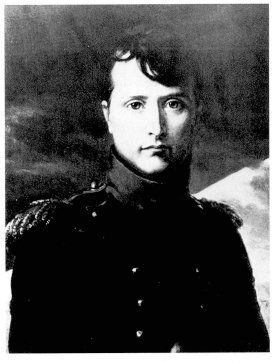
Napoleon as First Consul, not yet ready to conquer Europe. By Gérard.
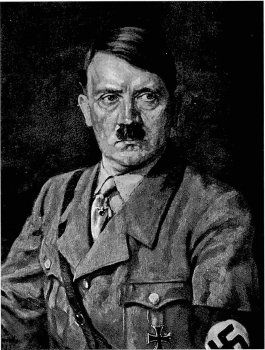
Adolf Hitler as Führer and Reich Chancellor in 1935. By B. Jacobs. (Mary Evans Picture Library)
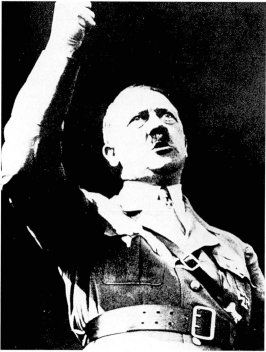
The Führer hoping to avoid war in the West – despite appearances.
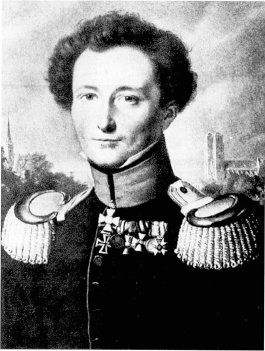
Generalmajor Carl Philipp Gottlieb von Clausewitz, the Prussian strategist who was on Kutuzov’s Staff in 1812 and believed that Napoleon had been right to invade Russia. By Wilhelm Wach.
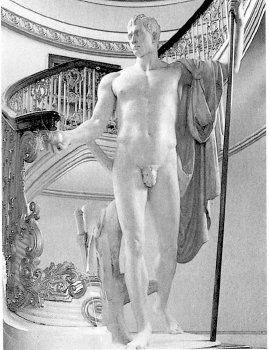
Napoleon as a Roman Emperor. By Canova, (Woodmansterne)
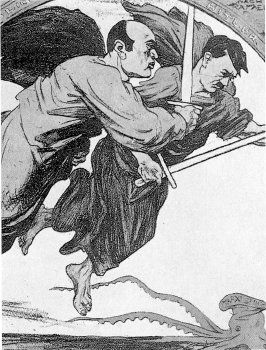
Hitler (aided by Mussolini) saving the world from Marxism in 1933. (Mary Evans Picture Library)
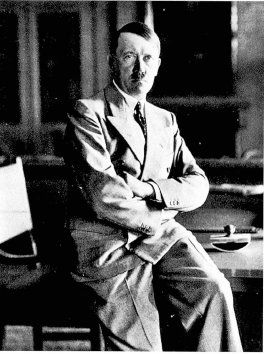
The pre-war Führer at home at Berchtesgaden (Popperfoto)
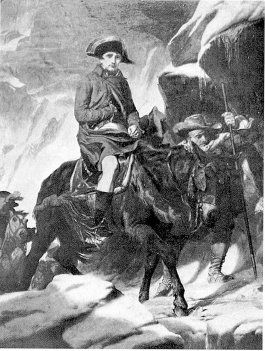
Napoleon crossing the St Bernard Pass on the way to Marengo. By Paul Delaroche. (Mary Evans Picture Library)
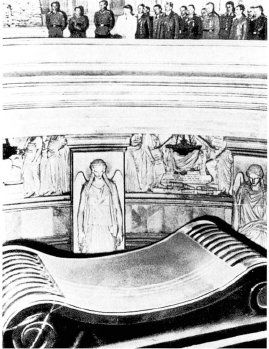
The Führer visits the Emperor’s tomb at the Invalides. June 1940.
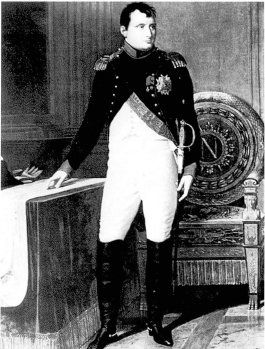
Napoleon in 1810, ruler of Europe. By Robert Lefèvre.
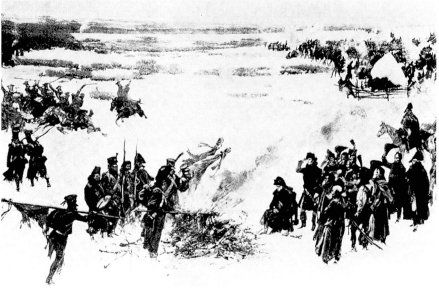
The Emperor supervises the burning of his Eagles during the Retreat from Moscow. By A. von Kossak.
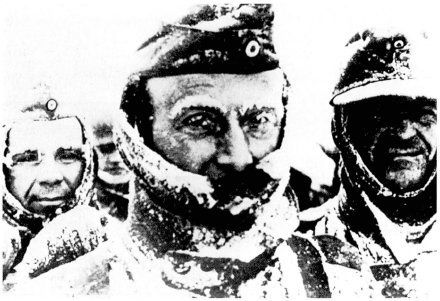
Soldiers of the Wehrmacht on the Russian front in 1944. Hitler had claimed in 1942 that ‘We have mastered a destiny which broke another man 130 years ago’.
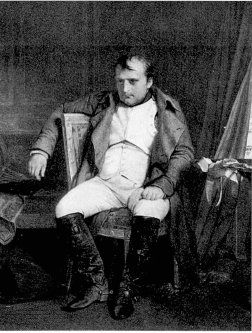
Napoleon in 1814. By Paul Delaroche. (Mary Evans Picture Library)
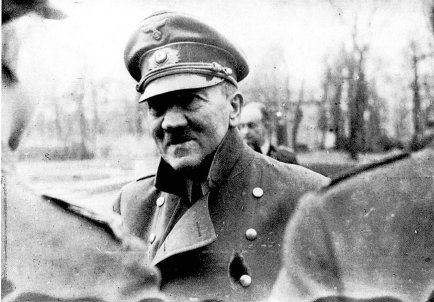
Hitler ten days before his death. (Popperfoto)
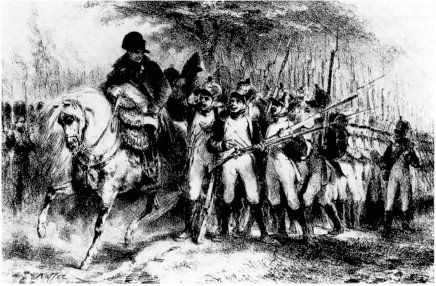
The Emperor’s army in 1814. By Auguste Raffet.
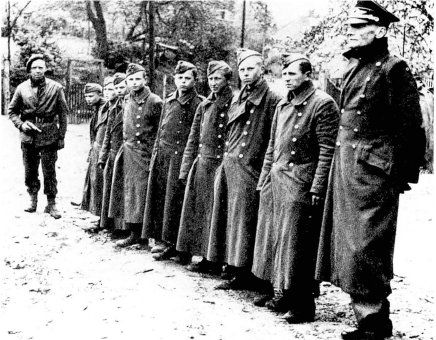
The Führer’s Army in 1945.
The motives of Emperor and Führer for invading Russia were somewhat different. As Napoleon made plain, he did so to enforce the Continental Blockade; in attacking Russia he was above all attacking Britain. Hitler’s principal aim was to carve out a new German Empire. Yet both intended to attack British India after the success of their invasions.
Originally neither man had intended to conquer Europe, whatever contemporaries may have suspected. The Emperor came to do so gradually, because it would accept neither him nor his hegemony, the Führer for much the same reason, though also because it stood in the way of his plans for expansion in the East. Both had wanted peace with Britain, in the almost certainly sincere if mistaken belief that ‘the two most powerful nations in the world’ had no cause to quarrel. One can understand their reasons for thinking so. An unending war with an apparently invincible Bonaparte could well have meant Britain’s economic ruin; as it was she had to spend vast sums on her Navy and on subsidizing Continental allies, while her trade and industry suffered grievously – British statesmen like Fox questioned the need for conflict. Similarly there was a case (of sorts) for Britain leaving Hitler to destroy Communist Russia and, hopefully, perhaps himself as well, instead of pouring out her resources and undermining her Empire in a struggle to the death.
Had anyone other than Winston Churchill been prime minister it is quite possible that Britain would have made peace in 1940. In the event Napoleon and the Führer chose to play the same fatal card. Ironically, what prompted their decision was the desire to avoid a war on two fronts.
Why Hitler invaded Russia is, in my opinion, that he found himself in exactly the same situation as Napoleon. Both men looked upon Britain as their strongest and most dangerous adversary. Both could not persuade themselves to attempt the overthrow of England by invading the British Isles. Both believed, however, that Great Britain could be forced to come to terms with the dominating continental power, if the prospect vanished for the British to gain an armoured arm as an ally on the Continent. Both of them suspected Russia of becoming this ally of Britain’s.
General Walther Warlimont
Most of the commanders were now asking: ‘When are we going to stop?’ They remembered what had happened to Napoleon’s army. Many of them began to re-read Caulaincourt’s grim account of 1812. That book had a weighty influence at this critical time in 1941. I can still see von Kluge trudging through the mud from his sleeping quarters to his office, and there standing before the map with Caulaincourt’s book in his hand. That went on day after day.
General Günther Blumentritt