
7

Why should messengers be made to stay constantly out in the sun and so die in the sun?… They are made to die in the sun.1
Year 12 saw tremendous celebrations at Amarna, recorded in the tombs of Huya and Meryre II, Steward of Nefertiti. The king, accompanied by his queen and all six daughters (although only four appear in the tomb of Huya), presents himself before a host of ambassadors and vassals summoned from Nubia, Libya, the Mediterranean islands and the Near East. There is feasting, merriment, and a great deal of standing about in the hot Egyptian sun, a tedious feature of Amarna life for all except the royal family who are prudently provided with sunshades. Best of all is the reception of a huge amount of tribute including horses, chariots, women and gold. No reason is given for the fantasia, but its purpose seems clear. Akhenaten is celebrating his role as the head of a vast empire, perhaps even as its living god, in his wonderful new city.
Meryre II (Fig. 7.1) shows us Akhenaten sitting on a throne with Nefertiti beside him, although Nefertiti is represented only as an outline drawn around the figure of her husband, a method of drawing which may simply be a means of overcoming a lack of space, but which also confirms the queen’s unity with the king. Six small-scale daughters stand in groups of three behind their parents. This is the last time that we see the royal family together.
Suddenly the seemingly perfect life of the royal family was shattered as Meketaten, who can have been no more than twelve years old, died. The date of this tragedy goes unrecorded although, as we have seen Meketaten participating in the Year 12 celebrations, we can tentatively suggest that she passed away in Year 13 or 14. Akhenaten had already started to carve a splendid royal tomb into the Amarna cliffs. This work would never be completed, although the main corridors, principal burial

Fig. 7.1 Nefertiti, Akhenaten and family at the Year 12 celebrations
chamber and two subsidiary suites, one of which was intended for Nefertiti, had by now been cut. Meketaten was laid to rest within her father’s tomb and it is here (Room Gamma, wall A), in some of the most simple and poignant illustrations of the entire dynastic period, that we see Nefertiti and Akhenaten grieving over their dead daughter.
The Amarna letters confirm that Meketaten died at a time when plague was rampant in the Near East. Perhaps, following the international festivities of Year 12, plague had arrived to threaten the security of life at Amarna. It may be no coincidence that other members of the royal family disappear at this time, and Kiya, Tiy and the three younger sisters Neferneferuaten-the-Younger, Neferneferure and baby Setepenre all fade out of view. Indeed, the fact that Neferneferuaten was plastered out of a family group within the royal tomb suggests that she, and her youngest sister Setepenre who was never included in the scene, may already have died. Both Neferneferure and Setepenre are excluded from a scene of mourning for Meketaten, although the other three princesses are present. The discovery of an amphora handle stamped with a reference to the ‘robing room of Neferneferure’ found within a dump outside an unfinished tomb close to the royal tomb provides us with a clue to her final resting place, but there is no trace of the tombs of the others.2
This series of deaths, or perhaps the plague which accompanied them, signalled the beginning of the end of the Amarna idyll, and it may be no coincidence that Akhenaten now intensified his campaign against the old gods. Meanwhile, work on the non-royal Amarna tombs ground to a halt.
The royal sculptors set to work chiselling out the image and titles of the deceased Kiya, removing her name from the sunshade temple Maru-Aten and replacing it with the name of Meritaten. The ease with which the king was prepared to substitute one beloved woman’s name for another is slightly shocking to over-sentimental modern eyes. It may have been a practical response to a crisis – an immediate replacement may have been necessary for the continuation of a female-orientated cult at Maru-Aten – but the impression given, fairly or not, is that that to Akhenaten, one royal woman was very much the same as another.
Nefertiti vanishes from the political scene soon after the death of her daughter. The obvious inference is that she too is dead, possibly another victim of the plague. If so, we might reasonably expect to find traces of her interment within the royal tomb. Akhenaten’s grief over the death of his daughter had been expressed on the tomb walls with a sincere dignity. How much more would he commemorate the loss of his beloved wife, and how much more splendid would have been her funeral? And yet, the royal tomb gives no evidence of any such burial and there is no official pronouncement of the queen’s passing. The only evidence to suggest that she was interred at Amarna is provided by a broken shabti figure whose separate pieces are now housed in the Louvre and Brooklyn Museums, and whose inscription has been reconstructed by Christian Loeben:
The Heiress, high and mighty in the palace, one trusted of the King of Upper and Lower Egypt Neferkheperure Waenre, the Son of Re [Akhenaten], Great in his lifetime, The Chief Wife of the King, Neferneferuaten-Nefertiti, Living for ever and ever.3
As the Egyptian royal family spent many years preparing their tomb equipment, there is no means of telling whether this figure was inscribed during Nefertiti’s lifetime or after her death. Nor, of course, do we know that it was actually used in her burial.
Earlier twentieth-century historians noted the sudden, unexplained, disappearance of the queen. They linked this to the abrupt change of name at Maru-Aten but, erroneously, they believed that the obliterated name was that of Nefertiti rather than Kiya. This was a crucial mistake that led to a dramatic conclusion. Nefertiti had committed some heinous crime and had been banished. John Pendlebury envisaged a terrible family quarrel over Akhenaten’s foreign policy which left Nefertiti, still the Aten’s most faithful disciple, disgraced, divorced and confined to a northern palace named Hwt Aten, or the Mansion of the Aten.4 Not everyone was convinced. It made little political sense that Nefertiti, now Akhenaten’s implacable enemy, should have been allowed to establish a rival court at Amarna where she could cultivate her own pro-Aten supporters. Norman de Garis Davies, again basing his reasoning on the misinterpreted Maru-Aten inscriptions, proposed an alternative scenario where Nefertiti was not the defender of the new faith, but its first and greatest traitor:
One might even venture into the dangerous field of pure, or almost pure, conjecture and suppose that, when to shrewd sight the coming victory of Amun [sic] cast its shadow before it, the faithless Nefertiti allowed herself to be proclaimed by the faction as rival monarch at Thebes…5
He tentatively suggested that the underlying cause of Nefertiti’s banishment was the fact that Akhenaten, anxious for a son and heir, had actually married his own daughter Meritaten. Davies was reluctant, however, to believe his own theory, and he added a footnote to his text that ‘this would be a double blow to the idyll of El-Amarnah, and we may hope that evidence for it will fail’.
Davies was not the only egyptologist reluctant to abandon the ideal of the loving royal family. Many found it simply impossible to reconcile what they saw as Akhenaten’s obvious affection for Nefertiti with such harsh treatment, and Baikie again spoke for many:
The Egypt Exploration Society’s excavators have most unkindly and ungraciously tried to insinuate a serpent into this little Eden in the shape of a suggestion that the absence of the name of Queen Nefertiti from the fragmentary inscriptions which have been recovered from Maru-Aten points to domestic trouble in the royal family, and to the breaking up of that idyllic love and unity of which so may pictures have survived. Surely such a suggestion is an entirely unnecessary outrage upon our feelings, and upon the memory of a couple whose mutual affection must have been the only stay of their hearts in sore trouble. Akhenaten has had to bear enough blame, living and dead, without saddling him, almost gratuitously, with that of having quarrelled with his beautiful wife.6
Baikie may have been basing his argument on intuition rather than scientific evidence, and his blaming of the unfortunate excavators for their message is perhaps slightly unfair, but it would appear that he was substantially correct in his instincts. We now know that it was Kiya’s name, not Nefertiti’s, which was originally carved at Maru-Aten. If anyone was disgraced – and there is no need to assume that anyone was – that person was Kiya.
So what had happened to Nefertiti? In the 1970s John Harris used philology to develop an ingenious theory. Nefertiti had not died. She had remained at Amarna where, using an evolving succession of names, she had ruled as king first alongside and then as successor to Akhenaten.7 Egyptologists already knew of one or maybe two potential co-regents/successors to Akhenaten. The names Ankhkheperure Neferneferuaten and Ankhkheperure Smenkhkare had been discovered in sound archaeological contexts, but the names could refer to one individual or two. Harris convincingly demonstrated that it is possible to trace Nefertiti’s name as it evolves from the simple Nefertiti to Neferneferuaten Nefertiti, then through the use of the double cartouche and the use of an enhanced form of the title King’s Great Wife which occurred towards the end of Akhenaten’s reign. Far more speculative is his proposed subsequent evolution, even later in the reign, to the use of a prenomen and nomen, until finally Nefertiti emerges as Akhenaten’s co-ruler using the name Ankhkheperure Neferneferuaten. Following the death of Akhenaten, the theory holds, Ankhkheperure Neferneferuaten (Nefertiti) ruled alone as Ankhkheperure Smenkhkare, before handing over the reins of power to the young Tutankhamen.
Ankhkheperure Smenkhkare, more usually known as Smenkhkare, was a real but shadowy figure, little more than a carved name. Like Beketaten before him, Smenkhkare seemed to spring from nowhere, exist for a short period as heir of Akhenaten, and then vanish. He had no known relationship to the royal family, no tomb, and no body. The attraction of the Nefertiti as Smenkhkare theory is obvious. By linking the sudden appearance of Smenkhkare with the sudden disappearance of Nefertiti, two archaeological mysteries could be cleared up with one elegant solution. However, recent research on human remains recovered from a small rock-cut tomb in the Valley of the Kings has highlighted a seemingly insurmountable flaw in this argument.
The modest entrance to Tomb KV 55 was discovered during the 1906–7 season of Theodore M. Davis’s expedition to the Valley of the Kings, which was led by the English archaeologist Edward Ayrton.8 The recording of the excavation and tomb clearance was lamentable. As Cyril Aldred has remarked, without exaggeration:
The evidence is all too clear that instead of proceeding with caution and skill, these men, two of them at least with specialist training and experience, somehow managed to carry out one of the worst pieces of excavation on record in the Valley [of the Kings].9
Hindsight and superior modern techniques of excavation make it all too easy to criticize the excavators of the past. But in this case Aldred is absolutely right to be critical. KV 55, definitely one of the most complex and potentially one of the most informative tombs in the Valley of the Kings, was swiftly stripped of its contents without any proper photographic or written record, and with no real attempt at conservation. This failure to keep proper records has caused modern archaeologists to revisit the burial time and time again in an attempt to reconstruct its contents and make sense of its meaning.
The tomb itself was deceptively simple. The outer door, reached by a flight of steps, opened into a sloping rubble-filled corridor that led in turn to the single burial chamber. This was a high, undecorated room that was, when discovered, in a state of total disarray. Wooden panels, boxes, mud bricks, stone chips, fallen plaster and tools dropped by the ancient labourers were jumbled on the floor, and all were dusted with a thin film of gold leaf which had flaked off the more fragile pieces. Mrs Emma B. Andrews, who entered the tomb soon after its opening as the guest of Mr Davis, made a note of her visit in her diary:
1907, Jan 19. At the Valley. Dr Wiedemann and wife and Mr Sayce were over and lunched with us in the lunch tomb. I went down to the burial chamber and it is now almost easy of access; and saw the poor Queen as she lies now just a bit outside her magnificent coffin, with the vulture crown on her head. All the woodwork of the shrine, doors &c. is heavily overlaid with gold foil and I seemed to be walking on gold, and even the Arab working inside had some of it sticking in his woolly hair.10
The vulture crown observed by Mrs Andrews was in fact a displaced pectoral. There was no stone sarcophagus, perhaps a sign that the tomb had been filled in a hurry, but four human-headed canopic jars stood in a recess cut into the right-hand wall and there were magical bricks intended to protect the deceased.
The elaborate inlaid anthropoid coffin had originally been placed on a low wooden bed. But a narrow crack in the ceiling had proved disastrous, allowing floodwater to drip into the tomb and rot the wood beneath. When the bed collapsed the coffin was thrown to the ground where it lay with its lid dislodged and the head of the mummy exposed. The mummy, now lying in a pool of water, started to decompose. Further damage to both mummy and coffin was caused when a rock fell from the roof and split the coffin in two. By the time it was removed from the tomb the coffin had disintegrated into hundreds of pieces; it was later re-assembled in Cairo Museum where it is displayed today.
The coffin was made of wood, covered with gold leaf and decorated with semi-precious stones. Its head was dressed with a wig rather than a royal crown, but some time after its manufacture it had been fitted with the beard and uraeus that would have made it suitable for the burial of a royal male. Following the burial both the uraeus and the gold mask that covered the face had been torn off, leaving the underlying wood exposed.11 A uraeus recovered by the excavators bore the name of the Aten, but it is by no means certain that this is the original uraeus from the coffin, as at least one other uraeus was recovered from the tomb.
The measurements and design of the reconstructed coffin show that it had originally been made for a woman. The twelve lines of text on the foot-end and the five bands of hieroglyphs that decorated the coffin agreed with this; they were words intended to be spoken by a woman, someone who could be described as the beloved of Waenre (Akhenaten). However, some time after the coffin had been completed, the inscriptions had been altered from feminine to masculine while the name of the original owner had been replaced by a royal name in a cartouche, which was itself later erased.
The confusion over the ownership of the coffin – a woman followed by a royal male whose name was later obliterated – merely added to the confusion over the ownership of the tomb. This was clearly an incomplete re-burial with a jumble of artifacts taken from different tombs; Davis found royal names ranging from Amenhotep II through Amenhotep III, Tiy and Akhenaten to Tutankhamen. Only one thing seemed clear. The discovery of Tutankhamen’s sealings confirmed that KV 55 must have been closed some time after Tutankhamen had come to the throne, and as his was the last name in the tomb, it seemed safe to assume that he had been responsible for the re-burial.
The magical bricks bore the name of Akhenaten, and had presumably come from his burial equipment. The inscribed golden bands recovered within the mummy wrappings apparently also bore the name of Akhenaten, but these were stolen from Elliot Smith’s laboratory before they could be properly recorded.
A series of large gilded wooden panels recovered from both the corridor and the burial chamber were the constituent parts of a shrine made by Akhenaten for inclusion with Tiy’s burial equipment where it would have been erected around her coffin. The shrine’s inscriptions made its ownership clear: ‘The King of Upper and Lower Egypt, living on truth [Akhenaten]; what he made for the King’s Mother, the Great King’s Wife Tiy’. Akhenaten’s image had been erased from the panels, but Tiy remained to worship beneath the Aten’s rays. Unfortunately the panels were in a highly fragile state, and disintegrated, again before they could be properly recorded.
The four alabaster canopic jars were equally perplexing. They had originally been carved with the name of their owner but this too had been erased, leaving the jars anonymous. We now know that they probably belonged to Kiya.12 The lids of these jars do not display the traditional four sons of Horus but four delicately carved heads wearing Nubian-style wigs. These beautiful lids are remarkably ill-fitting, so much so that it is generally accepted that they may not be the original stoppers. Various identifications of the heads have been attempted; on the basis of the wigs and the features of the faces, it would appear that the heads most probably represent either Kiya or Meritaten. Of the three jars which have been subjected to analysis two were found to contain a ‘hard, compact, black, pitch-like mass surrounding a well-defined centrally situated zone of different material, which was of a brown colour and friable nature’, while the third yielded the same compact black mass, but the inner material had been removed some time after its discovery.13 This friable brown substance was almost certainly the remains of the original viscera, and it would seem that the jars when discovered held their original contents. These three jars are now in the collections of Cairo Museum. The fourth jar was given to Davis and is now in the Metropolitan Museum, New York.
The golden shrine clearly belonged to Queen Tiy, and on this basis it was first assumed that both the coffin and the body were those of Tiy. Following the analysis of the coffin this theory had to be amended, so that the coffin became that of Tiy, usurped by Akhenaten. Sir Alan Gardiner proposed a different owner.14 Pointing out that the inscription on the foot-end, quoted as the introduction to Chapter 6, did not indicate a female occupant of the coffin, merely a female speaker, and comparing KV 55 with more traditional royal burials where the foot-end of the coffin was the position held by Isis, he tentatively suggested that the speaker might be Nefertiti, taking over the role of Isis in the funerary ritual. This would imply that the coffin was originally intended for Akhenaten, but that the text had been attacked and defaced during the post-Amarna period when the mummy of Akhenaten may even have been removed from the tomb and that of Smenkhkare put in its place. This argument, however, ignored the fact that the coffin was originally built for a woman. More recently the textual evidence has been reviewed and it is now generally accepted that the coffin, like the canopic jars, had initially been prepared for Kiya. The inscription which decorated the three bands on the exterior of the coffin had originally read:
[Wife and greatly beloved of] the King of Upper and Lower Egypt, living in order, Lord of the Two Lands [Neferkheperure Waenre], the perfect little one of the living disk, who shall be alive continuously for ever, [Kiya, justified].15
The body within the tomb seemed, superficially at least, relatively well preserved. Davis was present as it was removed from its coffin:
Presently, we cleared the mummy from the coffin, and found that it was a smallish person, with a delicate head and hands. The mouth was partly open, showing a perfect set of upper and lower teeth. The body was enclosed in mummy-cloth of fine texture, but all of the cloth covering the body was of a very dark colour. Naturally it ought to be a much brighter colour. Rather suspecting injury from the evident dampness, I gently touched one of the front teeth (3,000 years old) and alas! it fell into dust, thereby showing that the mummy could not be preserved. We then cleared the entire mummy…16
Ayrton adds to this description, telling us that the left arm was bent with the hand on the breast and the right arm was straight with the hand on the thigh, while Walter Tyndale records a ‘dried-up face, sunken cheeks, and thin leathery-looking lips, exposing a few teeth’.17 Unfortunately, the unwrapping of the mummy was never properly recorded, and no photographs were taken. Once it was agreed that the body was damaged beyond salvation, little care was taken as the rotten bandages were stripped away to expose the bare bones.
From almost the moment of its discovery there was controversy over the identity of the body. Theodore Davis never wavered in his belief that he had discovered Queen Tiy, and sought to prove his case by calling on the services of a local doctor, Dr Pollock, and an American obstetrician who was fortunately spending the winter in Luxor. These two examined the body, or rather the ‘disconnected bones with a few shreds of dried skin and flesh adhering to or hanging from them’ which were all that remained of the unfortunate corpse, and pronounced the remains to be female on the basis of the wide pelvis. It was as the tomb of Queen Tiy that Davis published his record of the discovery, and as Arthur Weigall, no great admirer of Mr Davis, observed:
… Owing to some curious idiosyncrasy of old age Mr Davis entertained a most violent and obstinate objection to the suggestion that he had discovered the body of Akhenaten. He had hoped that he had found Queen Taia [sic], and when he was at last forced to abandon this fallacy, he seemed to act almost as though desiring to obscure the identification of the body. He was still in a passionate state of mind in this regard when, a few years later, his brain gave way, and a tragic oblivion descended upon him.18
Elliot Smith, however, begged to differ. Examining the bones in the Cairo Museum he found them to be the remains of a young man about twenty-five years old. This was what many had been waiting to hear; virtual confirmation that the body was that of Akhenaten himself. Admittedly, Akhenaten was generally supposed to have lived for longer than twenty-five years, but Smith, when pressed, cheerfully amended his diagnosis to admit that ‘the skeleton is that of a man of twenty-five or twenty-six years of age, without excluding the possibility that he may have been several years older’.19 He himself had always been convinced that the bones were those of Akhenaten:
I do not suppose that any unprejudiced scholar who studies the archaeological evidence alone would harbour any doubt of the identity of this mummy, if it were not for the fact that it is difficult from the anatomical evidence to assign an age to this skeleton sufficiently great to satisfy the demands of most historians, who want at least 30 years into which to crowd the events of Khouniatonou’s eventful reign.20
Weigall, perhaps Akhenaten’s greatest admirer, was delighted to think that he had gazed on the misshapen skull of ‘the first of the wise men of history’. He had already made his own rather belated attempt to preserve the remains:
I may mention, in order to debar any possible suggestion of confusion or mistake in regard to the body, that I soaked the bones in paraffin wax so as to preserve them, and that the bones examined by Elliot Smith were thus distinguished.21
Weigall’s attempt at conservation archaeology was far too little, far too late; the skull was already broken, possibly as a result of the rock fall within the tomb. By the time Professor Douglas Derry examined the remains in the late 1920s the skull was in fragments. ‘Fortunately the majority of the most important parts of the face were found in the box containing the skeleton, as well as the missing parts from the side of the cranium, and with a little trouble these were replaced and the face restored.’22 Professor Derry disputed the identification as Akhenaten, feeling that the unfused epiphyses and an unerupted right upper third molar indicated that their owner could have been no more than twenty-five years old at death, whereas Akhenaten is likely to have been in his forties when he died.
Professor Harrison, re-examining the bones in 1963, similarly concluded that they were the remains of a male less than twenty-five years old who had shared the same relatively rare blood group (A2 and MN) as Tutankhamen and Thuyu, a blood group which seems to have run through the Amarna royal family.23 Later, X-ray and skull-shape analysis allowed Dr James Harris to conclude that there is a high degree of probability that the bones from KV 55 are those of a slight-framed male whose cranio-facial morphology bore a striking resemblance to the skulls of both Tutankhamen and Tuthmosis IV.24 The most recent analysis of the KV 55 bones was conducted in 2000 by egyptologist and physical anthropologist Joyce Filer. Her analysis coincides exactly with the diagnosis of Professors Derry and Harrison: ‘The human remains from Tomb 55, as presented to me, are those of a young man who had no apparent abnormalities and was no older than his early twenties at death and probably a few years younger.’25
So, the bones in KV 55 represent a young man closely related to Tutankhamen: either his son, his brother or his father. Tutankhamen does not give details of his parentage in his tomb, but a block recovered from Hermopolis Magna, originally from Amarna, describes him as ‘the bodily son of the King, his beloved’.26 Curiously, on the Prudhoe lions recovered from Soleb and now housed in the British Museum, he claims to be the son of Amenhotep III, ‘he who renewed the monument for his father, the King of Upper and Lower Egypt, Lord of the Two Lands, Nebmaatre, image of Re, Son of Re, Amenhotep Ruler of Thebes’. However, this text was inscribed relatively late in Tutankhamen’s reign, at a time when he may well have felt it prudent to associate himself with the orthodox Amenhotep III rather than the heretic Akhenaten. The word used for ‘father’ is in any case a word that may with equal validity be taken as meaning grandfather or even forefather. The most likely king to have fathered Tutankhamen is Akhenaten – we would have to accept a very long Amenhotep III–Akhenaten co-regency for Amenhotep to have fathered Tutankhamen. As the KV 55 mummy died in his late teens/early twenties, he is unlikely to be Akhenaten who ruled for seventeen years, and he is even less likely to be the aged Amenhotep III. The body cannot be Tutankhamen’s son, as Tutankhamen himself died in his late teens or early twenties, too young to have buried a twenty-year-old son. The KV 55 body must therefore be Tutankhamen’s brother. The person who best fits this description is the ephemeral Smenkhkare, the ruler who enjoyed a brief reign between Akhenaten and Tutankhamen.
If Smenkhkare and Tutankhamen are brothers, both sons of Akhenaten and therefore both heirs to the throne, who was their mother? There is a possibility that Nefertiti bore sons as well as daughters, although it is curious that we have not one mention of sons in the nuclear royal family. A stronger contender for the role of mother is Kiya. We know that she was Akhenaten’s favourite during the middle years of his reign, when we may assume that the boys were born, and the fact that she was able to provide the king with a son may well have accounted for her position of unusual honour at Amarna. This would explain the exclusion of the boys from formal depictions of the royal family, and their sudden appearance as from nowhere towards the end of their father’s reign.
Indirect evidence as to Tutankhamen’s parentage is provided by a more detailed consideration of the reliefs within the royal tomb at Amarna. Two scenes, carved on wall F of room Alpha, lie one above the other (Fig. 7.2). In the first scene, which is set at the palace, we see Akhenaten and Nefertiti with their right arms raised to their heads in grief as they stand before something or someone who has unfortunately been lost to us. Outside the room a woman cradles a tiny baby in her arms, while an attendant holds an open fan, symbol of royalty, over the baby. Behind them female attendants grieve, and a group of male dignitaries raise their arms in sorrow. In the scene below we see the stiff body of a young woman lying on a bier. Akhenaten and Nefertiti are again shown in an attitude of mourning, and Akhenaten reaches out to grasp his wife’s arm in a poignant gesture of comfort and solidarity.
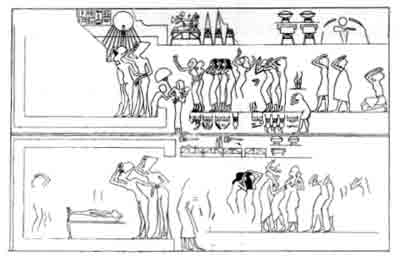
Fig. 7.2 The death of Kiya
There is no sign of the baby, but female attendants again weep and one, overcome by sorrow, is supported by two men.
The story behind the tragedy seems clear and simple. A mother has died giving birth to a royal child. The presence of the queen in her distinctive flat-topped crown rules Nefertiti out as the mother. It is possible that the dead mother is one of the royal daughters, but this seems unlikely given that Meketaten’s death is depicted elsewhere in the tomb, while Meritaten and Ankhesenpaaten, the only other daughters old enough to themselves bear children, outlived their parents. Instead, Geoffrey Martin has suggested that the lady on the bier might be Kiya, dying as she gave birth to Tutankhamen.27
If the KV 55 body is Smenkhkare, it follows that Nefertiti and Smenkhkare cannot be the same person. It does not exclude the possibility that Nefertiti (or someone else, perhaps a missing royal brother?) took the throne as Ankhkheperure Neferneferuaten before power passed to Ankhkheperure Smenkhkare, and this might well explain why their shared name is occasionally found written in a feminine form.28 This reasoning has led to the development of two conflicting scenarios, outlined briefly below. Argument for and against both the original and the revised theory has raged long and fierce, with all sides being handicapped by a lack of direct evidence with which either to prove their case or disprove their rivals.
In the first scenario, Akhenaten and Ankhkheperure Neferneferuaten ruled together until Akhenaten died, when Ankhkheperure Neferneferuaten retired and Ankhkheperure Smenkhkare took the throne. To explain the fact that neither Nefertiti nor Ankhkheperure Neferneferuaten are mentioned in the contemporary diplomatic correspondence, James P. Allen has gone further in suggesting that the co-regency may have been an actual rather than a theoretical division of the king’s role, with ‘Akhenaten as pharaoh in Amarna and in foreign affairs (which would explain the co-regent’s absence – if not accidental – from the Amarna letters) and Neferneferuaten ruling the rest of Egypt’.29 If this is the case Nefertiti may well have lived through the reign of Smenkhkare and into the reign of Tutankhamen.
In the second version, Akhenaten’s intended successor Ankhkheperure Smenkhkare was married to Princess Meritaten and made co-regent but died either before or soon after Akhenaten. The next in line for the throne, Smenkhkare’s brother Tutankhamen, was too young to rule unaided and Nefertiti rather than Meritaten was called upon to act as regent under the name Ankhkheperure Neferneferuaten. This would fit quite well with the tradition that a widowed queen might rule on behalf of her son, although Nefertiti is likely to have been Tutankhamen’s stepmother rather than birth-mother, but it does not explain why a queen regent would feel it necessary to take her own throne name. Are we to imagine that Nefertiti was making the preliminary moves towards annexing the kingship?
In considering Nefertiti’s fate we have wandered far into the dangerous realm of speculation. The only type of evidence that we have not so far considered is that provided by Amarna’s sculptors. Here we are able to witness an interesting progression. Mid-way through Akhenaten’s reign Nefertiti has evolved from a queen who very much mirrors her husband’s exaggerated, ugly look into a woman whom we today recognize as beautiful. The best-known representation of the new-style Nefertiti is provided by the world-famous Berlin bust (cover illustration and Plate 19). A yellow quartzite head also recovered from the Amarna workshop of Tuthmosis (Plate 14) shows a woman of equal beauty. To Dorothea Arnold:
The serene expression on the lean, austere face speaks of strength, equanimity, and that unwavering sense of justice that the ancient Egyptians understood to be the quintessential quality of a pharaoh. This is a queen who looks as if she is entirely capable of joining the king, at the great Year 12 festivities, on his ‘carrying chair of electrum in order to receive the products of Kharu [lands in the Near East] and Kush [Nubia], the west and the east… while granting that the breath of life is made to them’…30
The last sculpture recovered from the workshop of Tuthmosis (Plate 17) tells a different story. This broken and probably unfinished limestone statuette shows Nefertiti as a middle-aged woman. She stands erect, with her hands by her side, wearing a dress so clinging that all the features of her body are revealed and we can clearly see her drooping breasts and rounded tummy. On her bald head she wears the cap crown, and she has sandals on her feet. The face of the figure is that of a woman well past her prime; the cheeks are plumper than usual making the eyes appear small, the skin sags and the mouth is dragged downwards giving an expression of sadness tinged with resignation. We are here being presented with the Amarna equivalent of Tiy’s wrinkled and elderly Gurob head.
It may be that this sad and somehow lonely figure, carved after the deaths of the royal children, is intended to show a mother aged by grief. However, this would be unusual as Egyptian art tended to ignore unflattering signs of female aging. Could Tiy have died, allowing her daughter-in-law to advance from the role of fertility symbol to family ‘wise woman’? If so, would this be a promotion, allowing Nefertiti to become Akhenaten’s near equal and even co-regent, or, as we might expect from a consideration of Tiy’s peripheral role within the Amarna family, a demotion into semi-retirement? Are we looking at a woman whose influence has started to wain as she loses her fertility? Setepenre was born sometime before Year 10, and Nefertiti’s last recorded appearance is at the funeral of Meketaten, some four or five years later. We have already noted how Nefertiti’s influence increased with the birth of the first three children; could it have started to decline as it became evident that she was never going to produce a son?
Now, as so many female members of the royal family disappear, Meritaten attains new importance, until eventually she is recognized as a royal wife. But wife to whom? For a long time egyptologists toyed with the idea that Meritaten may have married her father. But now we have Smenkhkare as a living, flesh-and-blood heir to the throne, it makes far more sense to suggest that she married Smenkhkare, co-regent to Akhenaten. We might go further. We know that Ankhesenpaaten was later to marry Tutankhamen her half-brother and full brother to Smenkhkare. Could the middle sister, Meketaten, have married a third half-brother, perhaps even the ephemeral Ankhkheperure Neferneferuaten?
Although Meketaten died at a time when plague was sweeping across the Near East, she did not necessarily die from plague. Within the Amarna royal tomb the scene of Nefertiti and Akhenaten mourning over their daughter’s bier is depicted on Room Gamma wall A, while Room Alpha wall F shows the death of Kiya in childbirth. In Room Gamma we are presented with a tableau highly reminiscent of that in Room Alpha, although here there has been extensive damage to the wall so that the body and most of the grieving parents are missing (Fig. 7.3). An inscription carved above the dead princess is now largely obscured but, as it was recorded by Bouriant at the turn of the century, we know that it originally read ‘King’s Daughter of his body, his beloved, Meketaten, born of the Great Royal Wife Nefertiti, may she live for ever and eternally’. The identity of the deceased is therefore not in doubt.
Once again the royal couple are facing a bier and, although only their feet remain, we can imagine Akhenaten again reaching out to comfort his wife in her distress as she views her dead daughter. Outside the chamber there are three registers of figures. The bottom row is taken up by a row of tables prepared for a feast. Above this we see a nurse, standing before a group of mourners and holding a child in her arms. The nurse is followed by two female attendants who carry the fans customarily used to signal royalty. The upper register shows a distressed female figure being restrained and groups of frenzied mourners including a dignitary who may have been summoned to witness an imminent royal birth. It is the greatest misfortune that the inscription which would have named the baby is now lost. Although some have sought to identify
1. Statue of Amenhotep III with the god Sobek

2. The Colossi of Memnon at Thebes