
PART THREE

THE PLANTAGENETS
CHAPTER 8
‘How high does the arrogance of woman rise if it is not restrained?’
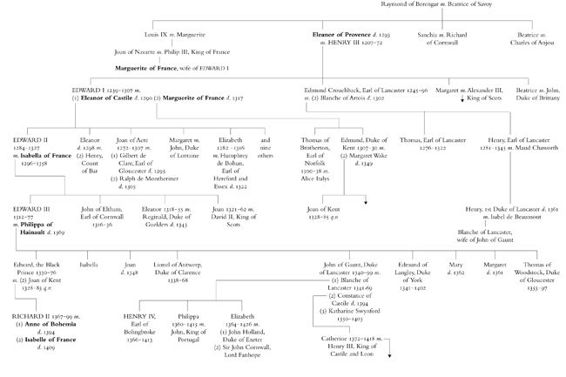
Eleanor of Provence was the second daughter of Count Raymond-Berengar, who had ruled Provence as a vassal of the Emperor Frederick II since 1219, and Beatrice of Savoy. Eleanor’s sisters Marguerite (born 1221), Sanchia (1228) and Beatrice (1231) were all to become queens, and each of their marriages was to be influential in shaping the direction of English policy abroad. In 1234, Marguerite joined the French monarchy as the bride of Louis IX, and it was this alliance that encouraged Henry III of England to consider Eleanor as a wife. Their union provides an exceptionally strong example of the significance of women in the dynastic strategies of Europe’s royal houses as well as of the importance a queen’s natal family could achieve in the politics of her adopted country.
On attaining his majority in 1227, Henry was anxious to begin the recovery of the Angevin lands lost under his father, John, and since the French crown would naturally oppose any such attempt, a marriage with Eleanor had the potential to counter the influence of her sister’s. Both the French and English kings were interested in securing the support of the house of Savoy, which was powerful in the east and south of France. Raymond-Berengar was neither particularly rich nor likely to be able to leave his daughters any great territorial claims, and both Marguerite and Eleanor were selected as royal wives as much for their maternal family’s connections as for their status as the Count’s daughters.
Henry was keen enough to marry Eleanor to dissolve a previous arrangement with Joan, the heiress to the small but strategically placed county of Ponthieu on the Norman border. This agreement had progressed so far that in April 1235 Henry had written to her father asking for Joan to come to England, and had planned her coronation for the next month. The French King — or more specifically his mother, Eleanor of Aquitaine’s granddaughter Blanche of Castile — strongly objected to the match, and by invoking a promise made by Joan’s father that he would forfeit his lands if he married his eldest daughter without the King’s permission, they were able to stop the marriage at the last minute. Henry’s acceptance of their interference suggests that he was glad to have an excuse to renege on his pledge.
Apparently, Joan did not much mind being jilted by the King of England, and released Henry from his engagement. By October, Henry’s envoys Richard le Gras and John of Gatesden were in Provence to inspect the new lady (who, like nearly all girls of her class, was complacently pronounced to be beautiful), while John FitzPhilip and Robert de Mucegros were charged with the negotiation of her dowry, which was settled at 10,000 marks. Eleanor’s dower arrangements were more complicated – Isabelle of Angoulême was still living, and if Henry were to die before the new queen and the dowager queen it would be difficult to provide for both of them — but the portion was provisionally fixed at fourteen English towns including Gloucester, Cambridge and Bath. With the business arrangements settled, in November the twelve-year-old Eleanor was married by proxy, with Robert de Mucegros standing in for the King at the castle of Tarascon, and, after travelling via Vienne, Dover and Canterbury, where her marriage was consummated, she was crowned at Westminster on 20 January 1236.
In just a few months, Eleanor’s world had changed completely. It is not possible to extrapolate her ‘real’ feelings from the sources, but the fact that, nearly fifty years later she joined forces with her daughter-in-law Eleanor of Castile, who was married at fourteen, to persuade Edward I that his thirteen-year-old daughter was not yet ready for matrimony, suggests she herself may have found the transition difficult. Eleanor’s subsequent and often ill-advised dependence on her Savoyard relatives may also have stemmed from a sense of personal isolation at the time of her marriage. Unlike many royal brides raised with the expectation of their future role, often in the country of which they would become queen, Eleanor had had to adjust to both marriage and queenship in a very short space of time. She was to display great ambition and a highly protective love for her children, but also a strong tendency to control, which was interpreted as ‘arrogance’ by her critics but which may well have had its source in self-preservation, in a need for the reassurance that came from feeling she was mistress of her own environment. She also demonstrated a certain impatience with what she saw as the provincial insularity of English politics, which compared so unfavourably with her own sophisticated, cosmopolitan background.
The Proven;çal court was culturally, if not financially rich, and Eleanor’s father was a patron of troubadour literature. Eleanor herself spoke Occitan, French and the Norman French of Henry’s court, as well as having some grasp of Latin, and though the north—south divide in European culture, which had been exaggerated even in Eleanor of Aquitaine’s time, was now still less pronounced, it may still have seemed very marked to a young girl spending her first freezing winter far from home. Much like Eleanor of Aquitaine, Eleanor of Provence was a daughter of the south, ‘a milieu of music, dancing, tournaments, knights-errant and fair damsels in distress, while Henry’s dominions to the north symbolised sobriety and joylessness, the world of . . . stubborn and irreducible facts, the boring domain of penny-pinching accountants, nit-picking lawyers and pedantic administrators’.1 Eleanor’s later career proved she could pick a nit as well as the next man, but Henry’s initial treatment of his young wife suggests that he was eager to make the contrasts between old and new homes less jarring.
Henry was clearly aware that his new wife might find her English accommodation rather shabby, for he built or improved apartments for her in nine of the royal residences, including a chamber and chapel at Westminster and a room decorated with roses painted on a white ground in the Tower of London. At Clarendon, modern conveniences were installed: a ‘fair privy chamber, well-vaulted’ on both floors of her rooms, and glazed windows that could be opened in the chapel. Architecture was one of Henry’s passions, and Eleanor benefited from his decision to show his welcome to her in buildings. All her life, she seems to have loved gardens. A walled garden was made at Clarendon and herb gardens at Kempton and Winchester, while at Woodstock, a favourite residence of the couple, a flower garden was laid for her outside her chapel, with another herb garden around the ‘stew’, or fish pond. Later, at Gloucester, a bridge was constructed to enable Eleanor to walk in the gardens of neighbouring Llanthony Priory. Most touchingly of all, one of the gardens laid out for her at Windsor was ‘Proven;çal’ in style. Henry was also thoughtful when it came to the initial appointments to Eleanor’s household, choosing John of Gatesden and Robert de Mucegros, the two courtiers with whom she had had most contact before her wedding, as her wardrobe keeper and steward respectively. For the post of her doctor and tutor, he selected Nicholas Farnham, a scholar who eventually became bishop of Durham. Without reading too much into these gestures, it might be said Henry was mindful that his young wife was feeling insecure and lonely, and that he tried to make her surroundings comforting.
Despite Eleanor being twelve to her husband’s twenty-eight, they had begun sleeping together straight away and, in a dramatic incident at Woodstock in 1237, it was Henry’s intimacy with his wife that saved his life. In the middle of the night, a madman somehow broke into the royal bedroom, waving a knife and demanding the crown. He stabbed at Henry’s bed, but luckily Henry wasn’t in it, as he was with Eleanor in her apartments. When the intruder began searching for the King, the alarm was raised by one of Eleanor’s ladies, Margaret Biset, who had stayed up late to read her psalter. Eleanor remembered Margaret’s courage, and thirty years later Henry confirmed a property grant to the Biset family’s leper foundation at Maiden Bradley on account of his Queen’s ‘great love’ for the house.
In general, however, Eleanor’s queenship was to be marked not by particular loyalty to her English servants but by her close and continuing associations with her Savoyard family. She has been described as the ‘supreme example’2 of the manner in which wellborn women could maintain political power after marriage by manipulating the connections of their birth families. Her mother, Beatrice of Savoy, had five brothers, all of whom were impressively skilled diplomats. Together, the ‘eagles of Savoy’ were able to build up a network of alliances that extended their influence all over England and France and across the Alps into Italy. The brilliance of Eleanor’s uncles lay in their capacity to engage in apparently conflicting policies while simultaneously working for their collective good. By 1240, two of these uncles, Thomas and Peter, were at Henry’s court, and in 1244, a third, Boniface, was provided to the see of Canterbury. In Peter of Savoy, to whom she was especially close, Eleanor found a guide and a teacher as she began to negotiate her first steps in English politics.
Her political career really began after the birth of her first child, Edward, in 1239, when she and her uncles worked together to neutralise any threat posed to the baby prince’s interests by King Henry’s younger brother, Richard of Cornwall. Peter of Savoy had arrived in England while Richard was away on crusade and Henry was preparing for a military expedition in Poitou. If he were to be killed, Edward’s position would be highly vulnerable, and Eleanor sought to associate the future of the Savoyards with his security. Henry ordered that, in the event of his death, the castles of the Welsh marches should be delivered to Edward, and in early 1242 he issued similar instructions for several fortresses, including Dover. Moreover, Eleanor’s own importance was augmented at Richard’s expense, since not only was he left out of any guardianship arrangements made for Edward, but it was also decided that any castle the Queen could not hold personally as regent would be delivered up to any of her uncles who were not in a position of fealty to France (which at this point meant Peter of Savoy). While these decisions went some way to ensuring that Edward would have powerful and loyal supporters in the event of his inheriting the crown, they obviously risked alienating Richard of Cornwall. The solution to this was a proposed marriage between Richard and Eleanor’s sister Sanchia of Provence, which would dissipate any conflict between Prince Edward and his uncle by allying their interests. So in May 1242 Peter of Savoy was dispatched as an envoy to participate in a proxy marriage ceremony with Sanchia at Tarascon.
That summer, Eleanor accompanied Henry to Poitou on campaign. She had given birth to a daughter, Margaret, in September 1240, and was now in the last stages of pregnancy with her third child. They landed at Royan in Gascony and while Henry set off to confront his brother-in-law Louis on the battlefield, Eleanor was delivered of another girl, Beatrice, at Bordeaux. The expedition was a failure, largely as a result of the defection of Hugh de Lusignan after the English and French forces met at Taillebourg, a disastrous battle for the English, and one in which, as we have seen, Henry himself was saved from capture only by the quick thinking of Richard of Cornwall, who rode into the enemy camp and negotiated a retreat to Saintes. Impulsively, Henry promised Gascony to his brother in return for his rescue, which did not suit Eleanor’s plans at all. It is possible that her reaction to Henry’s gesture resulted in Richard being deprived of Chester, as on 17 August 1243, a month before the royal party returned from Gascony, some of Eleanor’s dower lands were exchanged for the county in a document witnessed by yet another Savoyard uncle, Philip. Richard was then persuaded to renounce Gascony in return for lands worth 500 pounds a year.
Despite the failure of Taillebourg, Henry put on a magnificent show when Beatrice of Savoy and Sanchia arrived for the wedding proper, which took place at Westminster on 23 November. Beatrice’s visit was diplomatic as well as celebratory: she aimed to convince Henry to lend her embattled husband 4,000 marks on the security of five castles in Provence, which were to be held for the use of the King and Queen of England. The inclusion of Eleanor in this contract emphasises the importance of her right of inheritance in Provence, which was a means for Henry to acquire strategic strongholds in the province. The smoothness of these arrangements was not, however, appreciated by the English people, who already perceived the marriage between Richard and Sanchia as evidence of Eleanor’s excessive power over the King. ‘The whole community in England,’ wrote Matthew Paris, ‘taking it ill, began to fear that the whole business of the kingdom would be disposed of at the will of the Queen and her sister.’
The devious devices of the Savoyards were further exposed when Eleanor’s father Raymond-Berengar died in 1245.As the sole unmarried sister, Beatrice was to inherit, but Blanche of Castile, the Dowager Queen of France (and mother-in-law to Eleanor’s sister Marguerite) had no intention of letting such a prize escape French clutches. She conspired with the Pope, Innocent IV, to marry Beatrice to Charles of Anjou, King Louis’s younger brother. Shockingly, this plan was faciliated not only by Eleanor’s mother, whose allegiances were quite evenly divided, but also by Philip of Savoy and Archbishop Boniface. However, if the Savoyards took, they also gave. Even as Henry was being relieved of his stake in the Proven;çal inheritance, Peter was negotiating a deal with Eleanor’s fifth uncle, Amadeus, the ruler of Savoy, whereby Amadeus became Henry’s vassal and awarded him four castles in exchange for a pension of 200 marks and a downpayment of 1,000. A further clause was the marriage of Amadeus’s granddaughter to a royal ward. Having accepted these conditions, Henry was then unwise enough to permit a number of marriages between Savoyard girls and eligible English aristocrats, among them Edmund de Lacy, heir to the Earl of Lincoln, Richard de Burgh, heir to the Irish lordship of Connacht, William de Vescy, heir to Alnwick, Alexander Balliol and Baldwin, heir to the Earl of Devon, who married Queen Eleanor’s first cousin Marguerite, the daughter of Thomas of Savoy. Naturally, English magnates with daughters of their own to provide for greatly resented this plague of Savoyard brides, and though the policy was Henry’s much of the blame was laid on Eleanor.
In total, 170 Savoyards are known to have enjoyed royal patronage, though the majority of them were clerks and fewer than eighty-five remained permanently in England. Thirty-nine did receive grants of land, and at the top of the scale Eleanor’s uncles, notably Peter, received massive gifts of land and money. Matthew Paris was quick to point out the resentment this provoked, a resentment not confined, in his account, to the immediate circle of the court. So why was Eleanor so insensitive to the effect of this favouritism on her own reputation and her husband’s popularity? One answer may be found in the legacy of another English queen, Isabelle of Angoulême. Isabelle had five children by her second husband, Hugh de Lusignan: William de Valence, Geoffrey, Guy and Aymer de Lusignan and Alice. Despite the treachery of their father, in 1247 Henry invited all his half-siblings to join him in England. Immediately, the Lusignans set themselves up as a counter-faction to the Savoyards. In particular, they were jealous of the affinity of interest Eleanor had created between Edward (who was their nephew, too) and her Savoyard family. Almost immediately, conflict between the rival groups began to focus on Eleanor, so it might be concluded that she was prepared to ignore the negative consequences of Savoyard patronage in the interests of the valuable bulwark it provided against the Lusignans who, from the start, she seems to have perceived as her enemies.
In 1244, Eleanor gave birth to a second son, Edmund. Henry, determined that this child should be a boy, had had 1,000 candles set before the altar of Becket’s shrine at Canterbury and 1,000 more at the church of St Augustine. He told the abbot of St Edmund’s that if he had a son he would name the child for the saint and had the monks chant the Antiphon of St Edmund while Eleanor was in labour, so the result of his efforts was highly satisfactory. The birthdates of Eleanor’s first four children (1239, 1240, 1242 and 1244) indicate that she and Henry had been sleeping together regularly (the fact that no baby is known to have been born earlier suggests that she might not have fully reached puberty at the time of her marriage), but she was not to have another child until 1253. While she may have suffered miscarriages or unrecorded stillbirths, this absence of documented pregnancy may point to an estrangement between a couple whose married life had begun so successfully. That Eleanor and Henry were at odds in these eight years is clear from their actions, and their difficulties may have stemmed from Eleanor’s increasing appetite for power and her antipathy towards the Lusignans.
In addition to her lands and queens-gold, Eleanor raised funds through the incomes of royal wardships, whereby the estates of a minor were managed to the profit of the holder until the heir came of age. Gifts of such wardships were a convenient means for a king to increase his wife’s income without impinging directly on the crown estates, and they were to become a significant part of the financial endowments of English queens. (For the period between 1257 and 1269, for example, Eleanor raised an average of over 750 pounds a year from wardships.) Among numerous similar arrangements, Eleanor had received wardship of the De Toesny lands in 1242. Her De Toesny grant explicitly excluded advowsons, or the right to present a chosen candidate to a Church living, so when, some years later, she placed a churchman, William of London, in a De Toesny benefice to which she had no right, she found herself in conflict with her husband. Henry dismissed her choice and attempted to appoint his own man, Artaud de St Romain, to the post. Eleanor saw this as a public humiliation and, with the support of Robert de Grosseteste, the sheriff of Buckinghamshire, the dispute was brought to court. At this point, Eleanor was clearly angry enough with Henry to risk openly embarrassing him, and since her candidate won (at least, he was still in office in 1274), the case would have made the King seem shamefully henpecked. It may have been this incident that prompted Henry to take a strong line against Eleanor’s meddling when, in 1252, the Lusignan-Savoyard rivalry spilled over into ecclesiastical matters.
The archbishop of Canterbury, Eleanor’s uncle Boniface, found himself in conflict with Aymer de Lusignan, who had been appointed archbishop elect of Winchester, over the appointment of a prior to the hospital of St Thomas at Southwark. Aymer installed his own candidate while Boniface was travelling abroad, but Boniface’s official, Eustace de Lenn, excommunicated the new prior on the grounds that Boniface had to confirm the election. When the prior defied him, Eustace had him imprisoned at Maidstone, and Aymer promptly sent a group of armed men to release him. They set fire to the archepiscopal manor and kidnapped Eustace. Both Eleanor and Henry were furious at this undignified pettiness, but Eleanor saw in the situation an opportunity to strike against the Lusignans. When he learned that she had tried to interfere, Henry packed her off to Guildford in disgrace, took over control of her lands and deprived her of her right to queens-gold. Peter of Savoy was also forced to leave the court for a time. This seems an exceptionally stern reaction, but Henry’s patience had been sorely tried. As well as the embarrassment of the court case, Eleanor’s involvement with one of his most difficult subjects, his brother-in-law Simon de Montfort, had been plaguing him for years.
While the Lusignan-Savoy conflict can be seen at the simplest level as two competing families struggling for royal favour, De Montfort had been an ongoing source of a variety of problems for Henry since 1239. Simon de Montfort senior had been the leader of the crusade against the Albigensian heresy in the Languedoc, and though he had acquired a reputation for greed and cruelty, his high standing in England was reflected in the promotion of his son, who was given a share of the earldom of Leicester. De Montfort junior had made a scandalous secret marriage to Henry’s sister Eleanor, the widow of William Marshal. Eleanor had taken a vow of chastity in the presence of the archbishop of Canterbury after her first husband died, but De Montfort persuaded her into a clandestine ceremony at Westminster. Henry and his brother Richard were deeply angered by the offence to themselves, to the Church and to their sister’s dignity, but De Montfort was shameless. He cavalierly used the King’s name as security for loans and there was an ugly incident at the churching ceremony for Queen Eleanor after the birth of Edward when Henry, having discovered that De Montfort had borrowed 20,000 marks from Thomas of Savoy against his name, rounded on Simon and Eleanor, calling them fornicators. For a time the couple were forced into exile, but by 1247 De Montfort had been restored to favour and appointed governor of Gascony, with Eleanor’s support: it is possible that she feared Richard of Cornwall still had designs on the province, which she was determined would form part of Edward’s apanage, hence her desire to have her own man in place.
In 1249, Eleanor persuaded De Montfort to free a rebel lord, Gaston de Béarn, a cousin of hers, requesting a pardon and the restoration of his lands. De Bearn did homage to both Henry and Edward, but raised another rebellion as soon as he was released, leaving Eleanor’s strategy of appeasement looking very foolish. In 1251, another family occasion provided the arena for a public quarrel. The wedding of eleven-year-old Princess Margaret and ten-year-old Alexander III of Scotland, to whom she had been betrothed since the age of four, was spoiled by Henry and De Montfort falling out over money. Henry had undertaken to reimburse De Montfort for the maintenance of the royal castles in Gascony, but De Montfort’s administration was proving expensive and ineffective, and now Henry refused to pay up. Mindful of the safety of her eldest son’s inheritance, Eleanor nagged Henry into handing over the money. The next year, Henry’s mistrust of De Montfort was confirmed when his brother-in-law was put on trial to answer charges of corruption and incompetence brought by Gascon landowners and churchmen. The King was enraged when Peter of Savoy spoke up for him and the English lords cleared him of the charges.
By 1252, then, it appeared that the rather trivial dispute over the prior of St Thomas’s was only one of a series of situations in which Eleanor had put her own interests above her husband’s wishes, and in which she had not been afraid to use her powerful family, whom Henry himself had supported, against him. The apparent eight-year gap in their sexual relationship puts this incident at the climax of a dispute which had been going on for some years, and Henry’s exasperation might be seen more as a reaction to Eleanor’s presumption over a long period than a specific response to a single event.
Eleanor’s punishment lasted only two weeks. She returned to court at Clarendon fifteen days after the incident and her queens-gold was restored ten days later. She and Henry kept Christmas at Winchester, spent a few days at Westminster and travelled together to Windsor in January. Chastened, Eleanor exchanged New Year gifts with the Lusignans. Since the days of the Anglo-Saxon kings, such gifts had been part of the pageantry of English royalty, combining an impressive display of wealth and patronage with a certain mystical symbolism, and in January 1253 Eleanor gave more than sixty of them at a cost of over 200 pounds. She presented sixty-one rings, ninety-one brooches, thirty-three ornamented belts and ten gilded goblets. Geoffrey de Lusignan and William de Valence were among the recipients and Eleanor accepted a gift of plate from Aymer de Lusignan. Magnificent jewels and plate were a component of the largesse a queen was expected to dispense as a courteous demonstration of her status, but often, as was the case with the Lusignans, they carried a diplomatic message (echoed, in the aftermath of the St Thomas’s quarrel, by the kiss of peace exchanged by Aymer and Boniface at a council held at the end of January). The distribution of plate and goblets was a particularly symbolic act for a queen, recalling the Anglo-Saxon emphasis on the king’s wife as the ‘peace-weaver’ celebrating concord by acting as a cup-bearer for the king and his lords.
One outcome of Eleanor’s reconciliation with Henry was her last child, Katherine, born in the November of that year. Another was that when Henry was obliged to return to Gascony to quell a rebellion in the province that spring, Eleanor was appointed regent, a position she held for ten months between August and May. As a measure of her status, she was awarded a large increase in her dower and the right to bequeath 3,000 marks beyond her own possessions in her will, while Peter of Savoy, who had also been returned to favour, was awarded 15,000 marks. During this period Eleanor attended two Parliaments, met foreign embassies, sat in council and in meetings of different sections of the Westminster administration and took a close interest in the financial arrangements for Henry’s campaign, all while either pregnant or newly delivered. In her husband’s absence, she organised her own banquet for her churching after Katherine’s birth, a reminder that as regent she was responsible not only for the execution of royal power, but for the maintenance of the splendour of the crown as demonstrated in formal state occasions.
Eleanor was also prepared to make use of her sexual relationship with Henry to get what she wanted. She had inherited the patronage of two previous queens’ institutions, the hospital of St Katherine by the Tower and the Augustinian house of Holy Trinity, which had charge of the hospital. In 1253, the prior of Holy Trinity installed his own candidate as master of the hospital, and the hospital appealed to Eleanor. She wrote to the bishop of London, Henry Wingham, a former royal chancellor, and the prior of Holy Trinity, threatened by Wingham with the consequences of Eleanor’s anger, was forced to back down. The canons of Holy Trinity complained to the Pope, who expressed his disapproval, but Eleanor grandly ignored him and in 1273 gave the hospital a new charter of endowment, providing for a master, three brothers, three sisters and twenty-four poor men, of whom six were to be scholars. Eleanor’s secret weapon was the canons’ description of her as the King’s ‘nicticorax’, or ‘night bird’, the implication being that her influence over Henry in bed might provoke him to punish Holy Trinity if the prior would not relent. Eleanor bequeathed the patronage of St Katherine’s to all future queens and dowager queens of England, and the foundation still exists today, as the Royal Foundation of St Katherine - still in the gift of the queen consort and still abiding by the rules so imperiously set down by Eleanor.
In the spring of 1254, Eleanor was preparing for another visit to Gascony, this time with a happy prospect in mind. Edward was to be married to another Eleanor, the thirteen-year-old sister of Alfonso X, King of Castile. The background to this match stretched as far back as 1152, when Eleanor of Aquitaine had first made her duchy part of the Angevin possessions on her marriage to Henry II. When Eleanor’s daughter Leonor became Queen of Castile, her husband, Alfonso VIII, maintained that she had been promised Gascony as a dowry, and though there was no formal confirmation of this assertion, he had used it as a pretext to invade the province in 1206, when King John was being assailed by Philip Augustus’s encroachments to the north of the Angevin lands.
Now the Gascon question had flared up again as Alfonso X began to claim Aquitainian magnates, including the restless Gaston de Béarn, as his vassals. When he started to proclaim himself the heir of the murdered Arthur of Brittany, Henry III even suspected that he had designs on the English throne. After Henry’s successful suppression of the 1253 rebellion support for Alfonso in Gascony declined, but a marriage between the heir of England and the Spanish princess would consolidate the resolution of the dispute and accordingly Henry began proceedings that May, which is when Eleanor of Castile’s name first appears in English records.
Eleanor of Provence’s new daughter-in-law was the child of her former rival for Henry’s hand, Joan of Ponthieu, and Ferdinand III of Castile. Ferdinand already had seven sons by his first marriage, so had hardly been short of an heir, but his mother Berengaria (the sister of Blanche of Castile and another granddaughter of Eleanor of Aquitaine) was concerned that he would fall into immoral ways if he did not remarry, and together she and Blanche had arranged the match with Joan. Ferdinand and Joan had five children, of whom Eleanor, born in 1241, was one of three to survive beyond infancy. In February 1254, Henry III nominated the bishop of Hereford and John Maunsel to negotiate the arrangements for the wedding with Alfonso, and on the fourteenth of the month Edward’s apanage was confirmed in expectation of his marriage. It included Gascony and the county of Chester, both of which his mother had worked hard to attain for him.
Eleanor of Provence fitted out 300 ships in preparation for the voyage, but her grand departure was spoiled by a violent outbreak of jealousy between the men of Winchelsea, who were furnishing the Queen’s ship, and the shipwrights of Yarmouth, who were responsible for Edward’s. The Winchelsea men attacked their rivals, some of whom were killed, and the mast of Edward’s ship was stolen and attached to Eleanor’s. In early June, Edward and Eleanor arrived without further incident in Bordeaux, where Eleanor presented three gold cloths to the churches of St André, St Séver and St Croix. It is not certain when the two Eleanors first met, as Edward travelled on to Castile for his wedding, which almost certainly took place on 1 November at the convent of Las Huelgos, near Burgos. Edward and his bride were back in Gascony later that month, but by then Eleanor and Henry had left for Paris.
In spite of its inauspicious start, this journey was probably one of the most pleasant of Eleanor’s life. For once she and her husband were travelling unburdened by war or politics and could relax in the knowledge that Gascony was settled and Edward’s marriage accomplished. They even found time for a little sentimental tourism, visiting the abbey of Fontevrault, where Henry would request that his heart be sent for burial, and the shrine of Edmund of Abingdon, who had married them nearly twenty years before at Pontigny. They moved on to Chartres, where they visited the cathedral, an experience that greatly influenced Henry’s ambitions for Westminster Abbey, and where Eleanor was reunited not only with her mother and youngest sister Beatrice but also with Marguerite, Queen of France, and Sanchia, who had travelled from England. The agreement then forged between Henry and Louis IX, known as the treaty of Paris, might officially have been an arrangement between men, but it was brought about by five women. If the relationships between these sisters and their mother had on occasion been strained by the diplomatic entanglements of their husbands, their meeting in 1254 suggests that they were bound by a strong, even atavistic loyalty – a loyalty on which Eleanor would depend during the greatest crisis of her queenship.
Practically, the treaty of Paris did not in fact change a great deal in the long term, but it was regarded by contemporaries as a breakthrough in Anglo-French relations. Henry was to pay homage for his remaining French possessions and renounce his claims to Anjou, Poitou, Maine and Touraine in return for the grant of Gascony as a fief, lands in Cahors, Limoges and the Périgueux and funds for 500 knights for two years. The unofficial agenda, which may well have been managed by the Provençal women, included the marriage of Eleanor’s daughter Beatrice to John, Duke of Brittany, agreements of financial and diplomatic aid from France and promises to protect Eleanor’s interests against the Lusignans who, to the English Queen’s irritation, were very much in the ascendant after the Gascon campaign, where their provision of Poitevin knights through local affinities had greatly aided Henry.
After the success in France Eleanor turned to another project close to her heart: the establishment of her second son, Edmund, as king of Sicily. At this time, Sicily comprised not only the eponymous island but also a large tranche of southern Italy, known together as the Regno. The plan, or ‘the business of Sicily’, as contemporaries called it, had been in train for some time, since the death of the Emperor Frederick II in 1250. Frederick had controlled the Regno, but when he was succeeded by his son Conrad, the Pope decided to install his own candidate. Edmund was suggested, along with his uncle by marriage Charles of Anjou. In 1254, Henry accepted the proposal and the Pope conveyed his formal agreement, followed by a confirmation of the grant of Regno in May. Again, the hand of the Savoyards can be seen in what has been mooted as the first stage in the creation of a Mediterranean empire. The papal chaplain who acted as a go-between for Henry and the papal nuncio, John d’Ambléou, was a Savoyard close to Peter of Savoy, and Eleanor’s uncles Peter, Philip and Thomas were among the nine proctors appointed to manage Edmund’s succession. Even the Pope had Savoyard connections -his niece, Beatrice di Fieschi, was married to Thomas of Savoy. However, Eleanor’s hopes were thwarted when Conrad died just a week after the confirmation and the Regno was seized by Manfred, Emperor Frederick’s illegitimate son. In December, Pope Innocent also died, and it appeared that the only means of acquiring Sicily for Edmund would be a military campaign. Both Eleanor and the new Pope, Alexander IV, pushed for armed intervention, but the pontiff insisted that any campaign would have to be financed by Henry. To the great resentment of the English clergy, he ordered a diversion of the crusading tax from the English Church for five years to raise funds. In 1255, Edmund was invested as King of Sicily at Westminster, looking somewhat foolish in traditional Sicilian dress, but his prospects of success appeared even more remote when Thomas of Savoy failed to put down a rebellion in Turin and was taken prisoner by his own subjects.
It is quite possible that the Savoyards, whose complex trans-European involvements always geared towards the bigger picture, had never seriously intended a war to be fought on Edmund’s behalf, and had supported the scheme merely to gain leverage with the Holy See to extract concessions in matters with which they were more closely concerned. Now the priority was raising the ransom for Thomas’s release, but Eleanor’s funds had been exhausted by the pursuit of Sicily, and Gascony had eaten too much crown revenue. To both help her uncle and keep her ambitions for Edmund alive, she was obliged to borrow. She did so with the help of her clothes merchant, William, one of a group of businessmen who arranged to lend Eleanor, Henry and Edward a total of 14,500 marks against the religious foundations of Cirencester, Chertsey, Abingdon, Hyde and Pershore, to be raised through letters of obligation issued in the names of Eleanor and Peter of Savoy.
Dear though it was to Eleanor, the ‘business of Sicily’ and the costs it incurred were seen as another instance of the Queen and her foreign relatives attempting to enrich themselves at the expense of the English people. Neither Henry nor Eleanor had taken account of the volatile atmosphere in their kingdom, and it has been suggested that they saw diplomacy as simply a family matter (which in fact it was) and England as little more than a piggybank to dip into to fund their schemes. But the mood in England in the mid-thirteenth century was angrier and more restless than they realised. In addition to the resentment over the hated crusading tax, the clergy were weary of Henry’s interference in ecclesiastical elections and courts and of his holding sees open to profit from their revenues. The combination of the costs of Gascony and the papal commitment in Sicily led the King to push his sheriffs to extortionate measures in the shires, which affected smaller landowners badly. Their disgruntlement was compounded by Henry’s favouritism towards his own relatives – Richard of Cornwall, Peter of Savoy and the Lusignans were, for example, exempt from any writs in Chancery, which effectively meant that there was no recourse against them if they chose not to honour any debts. Eleanor’s management of her finances was also making her unpopular.
The queen’s council had existed as an independent body since at least the early thirteenth century. The three Matildas had held and managed their own dower lands in their husbands’ lifetimes, whereas Eleanor of Aquitaine and Berengaria of Navarre had theoretically been able to administrate their dower property only as widows. From Eleanor of Provence’s time, the queen of England had the unique legal status of ‘femme sole’ while her husband was living. She could control her property, grant and acquire land and bequeath her own possessions, including crops grown on her estates. The queen’s council also had jurisdiction over local officials and, contrary to general practice, the queen’s tenants could not take her to court, leaving the council as the ultimate arbiter of disputes. The queen, on the other hand, could serve writs in her own name (Eleanor’s lawyer, Gilbert de Chalfont, represented her in several such suits). The only place where the queen could be held to legal account was the king’s court. This was obviously a highly advantageous position, and one neither Eleanor of Provence nor several of her successors was above abusing.
Before passing judgement on Eleanor’s governance of her finances, it is worth remembering how qualities that were seen as being merely businesslike in a man were quickly interpreted as a sign of unfeminine avarice in a medieval woman. Eleanor was a strict manager, impressively well informed about her sources of income and unembarrassed about extracting her due. She ‘evidently condoned ruthless exploitation of estates in her wardship’3 and her steward William of Tarrant was widely hated. Despite Matthew Paris’s disapproval of the ‘loss and peril’ Tarrant caused to Eleanor’s tenants, she was prepared to make excuses for him, whether through expedience or indifference. As public discontent with the King’s financial exigency began to mount, Eleanor was named in a complaint by the sheriff of Buckinghamshire, who claimed he was unable to obtain dues on certain lands because of the protectionism that sheltered their owners. Perhaps Eleanor’s grasping way with money could be attributed to her father’s perennial financial difficulties, but Henry, too, seemed blind to the way in which his fund-raising was perceived. Even on Edward’s birth, the joyful citizens of London were so offended by Henry’s demands for increasingly grand celebratory gifts that a saying doing the rounds was: ‘God gave us this child, but the King sells him to us.’
Eleanor’s indifference to her lesser subjects is unfortunately typical of a rather crass political attitude towards her husband’s realm that characterised her daily life in the 1250s. She was simply not very interested in the English. She ordered books and elegant headgear from Paris, the cloth for her dresses was imported from Florence and her carpets from Spain. To the Queen of England, fresh from a visit to her sister the Queen of France and her wondrous court at Paris, her own country might well have seemed a pinched, prejudiced sort of place, and Eleanor was far too sure of her own status to bother to try to hide her feelings. The messenger evidence from her household bears out the supposition that beyond the Savoyard network, Eleanor had very little contact with even high-ranking English people. She and Sanchia did exchange books with the countesses of Arundel and Winchester, but beyond the formal intercourse of court ceremony, Eleanor’s relationships with the magnate class were relatively limited.
If the Queen saw herself as rather too grand for the parochial concerns of her husband’s barons, the events of the 1260s forced a change in her perceptions. She and Henry had hoped to prevent the spread of further factionalism, by resolving their differences after the ecclesiastical dispute, but by 1258 the mood was once more turning against the Lusignans. In April, a group of magnates marched on Westminster and issued an ultimatum, demanding the exile of all Poitevins and the inauguration of a council of twenty-four men chosen to assist the King. In June, the Parliament held at Oxford enumerated a list of ‘provisions’ which called for all castles to be held by Englishmen, all alienated lands to be restored to the crown and a new arrangement for the government, consisting of three annual Parliaments, an elected council of fifteen served by twelve representatives from the baronage, the annual appointment of local sheriffs and a justiciar to travel the country hearing complaints. Further reforms (the Provisions of Westminster) had a personal impact upon Eleanor. The sale of wardships in the King’s gift was to be decided by a committee of five and that same committee was to determine in which areas the tariff of queens-gold should apply. An oath of allegiance, upon pain of excommunication, was imposed, and at some point Eleanor swore it, which indicates how powerful her contemporaries considered her to be. Constitutionally, a queen had only a customary relationship with government, since she did not take an oath on coronation, but in Eleanor’s case, her allegiance was formally required along with the King’s.
Eleanor was deeply affronted by what she saw as the Provisions’ attack on her prerogative, and from the start she was intent on overthrowing them. In November 1259 she left for France to witness the confirmation of the treaty of Paris and to attend her daughter Beatrice on her journey to marry John, Duke of Brittany. Before she embarked, she defiantly made a gift of the first available wardship with a value of forty to sixty pounds to her steward, Matthias, completely ignoring her promise to the committee. The treaty of Paris was published on 4 December, but the family celebrations were marred by the death of the Dauphin, Prince Louis. Henry was one of the coffin-bearers at his funeral, and Beatrice’s marriage, which had been scheduled for the same day, had to be put back a week. Eleanor and Henry remained in France until April, but already they had sought a papal dispensation to absolve Henry from his oath of allegiance to the Provisions.
The chroniclers of Waverley, Tewkesbury and Bury St Edmunds all lay the blame for Henry’s repudiation of the reforms at Eleanor’s door. She was seen as ‘the root, the fomentor and disseminator of all the discord which was soon between her husband King Henry and the barons of his kingdom’.4 In May, the papal bull cancelling the threat of excommunication over Henry was issued at Winchester. The King had made three statements to the barons in Parliament to try to establish his own position, but the publication of the bull prompted them to call an independent Parliament at St Albans on the same day as Henry summoned them to Windsor. Neither Parliament was held, but it seemed that armed conflict was now inevitable, and Henry and Eleanor withdrew briefly to the Tower. War was avoided by Henry’s acquiescence to the treaty of Kingston in November and for a while it appeared that the ‘Queen’s party’ was back in control.
The next spring, however, the violence began in earnest and Eleanor and those loyal to her provided a focal point for the rebels. Those among them who sincerely promoted reform objected to her obstruction of the Provisions, while many English lords had long resented the Savoyard usurpment of royal patronage. Attacks on Eleanor’s supporters began in the west of the country in Gloucester and Hereford, spreading to Bristol, Worcester and Shrewsbury, and then as far as Peter of Savoy’s lands in East Anglia. By June, Henry and Eleanor were back in the Tower, where Henry received a delegation of Londoners who demanded that he reinstate and swear to the Provisions. The letter had been sealed by Simon de Montfort.
By July, the whole of south-east England was in rebel hands. If Eleanor had refused to accept responsibility for her own part in bringing about this situation, she was rudely reminded of the hatred she had provoked when she attempted to flee the Tower and ride to Prince Edward at Windsor. She was mobbed on London Bridge by a howling, jostling crowd who pelted her with rubbish and pursued her, jeering, back to the Tower, where Henry refused to allow her to enter. The Queen was forced to seek asylum in the home of the bishop of London. As seems to have been the case with the St Thomas’s squabble ten years earlier, Henry apparently felt that only the strongest measures could force his stubborn wife to submit to his will, and the fear and shame of London Bridge cowed Eleanor sufficiently for her to appear with him at Westminster three days later, Henry having used her absence to accept the barons’ terms. The incident was deeply shocking, not just to Eleanor, but to her family, and especially to the King and Queen of France. That the people should so far forget the deference owed to an anointed queen as to physically threaten her was terrifying: it was revolutionary. Eleanor was to have the last word with the Londoners, though. After the wars had ended Henry gave London Bridge into her keeping and she was too stingy, or too vengeful, to repair it. The nursery rhyme ‘London Bridge is Falling Down’ commemorates the city’s protests.
Family discord now had to be forgotten in the pursuit of a greater interest - the preservation of the crown. Three areas of support were open to the royal house: the Pope, the French and mercenary troops. An agreement was negotiated with the barons whereby Henry and Eleanor would be permitted to leave for France to seek arbitration from King Louis, on condition that they returned. In January 1264, Louis pronounced his judgement at the Mise of Amiens. His decision was attributed by several chroniclers to Eleanor’s influence - he was held to have been ‘deceived and beguiled by the serpentlike fraud and speech of a woman: the Queen of England’5 - and unsurprisingly comprised a rousing defence of Henry’s prerogative. Equally unsurprisingly, De Montfort, who had been kept away from Amiens by a riding accident, entirely rejected Louis’s conclusions. Despite Louis’s support and that of the Pope, whom Eleanor was urging to appoint a special legate, Henry was not really any stronger. He and Edward returned to England as they had agreed, but Eleanor remained proudly at her sister’s court. This was a war of arms, not words, and accordingly the Queen set about raising an army.
Eleanor’s understanding of the probability of military engagement was extremely prescient. As early as 1259, she had engaged her distant relative Isabella de Fiennes to distribute rings among knights in Flanders with a view to calling on their services if necessary. In the first months of 1260, when she and Henry were in France, Eleanor had begun to cultivate contacts that would provide her in future with a force of French and Flemish mercenaries. That these activities were known of in England certainly contributed to her unpopularity, and gave the lie to any gestures of acquiescence she made in the interests of maintaining (if not actually winning) support for Henry when he was at his lowest ebb. Her refusal to keep her promise and return to England was also crucial. She was able to call on her family network, her sister Marguerite and her mother Beatrice of Provence in mustering men and money. She even went as far as to pawn the King’s jewels. Her foresight was confirmed when both Henry and Edward were taken prisoner by De Montfort’s rebels after the battle of Lewes in May 1264, leaving Eleanor as the leader of the royalist party.
Eleanor had known De Montfort for a long time and she understood his hatred of Henry, his ambition and his ruthlessness. But she did not allow herself to be overcome by fear. Instead, she sold off three bishoprics, borrowed from Henry of Castile, persuaded Peter of Savoy to guarantee substantial loans and called up men from France, Burgundy, Gascony, Poitou, Flanders, Normandy, the Brabant, Germany, Brittany, Spain and Savoy. With her invasion force stationed at St Omer, she requisitioned English ships from Gascon ports to carry her soldiers to liberate the King. She worked ceaselessly - ‘insudeuarit’, notes The St Albans Chronicle, literally, ‘she sweated at it’ -but as her funds dwindled, so did her support. She had paid no mind to the papal legate, Guy Foulquois, who strongly opposed the invasion from his base at Boulogne and rather feebly pronounced sentences of interdict and excommunication before returning to Rome to get himself elected Pope Clement IV, but her determination faltered as, over the winter of 1264, her unpaid men began to desert. In 1265, she made a strategic retreat to Gascony.
Eleanor had not given up, but all her efforts had come to nothing. Still, it is pleasing to think that one of her well-placed gifts had a tiny bearing on the next stage in the conflict. On 28 May, Edward escaped with the help of Roger de Mortimer, whose wife Maud had received a girdle from the Queen in the New Year gift-giving of 1253. When De Montfort was finally defeated at the battle of Evesham on 4 August, his head and testicles were given to Maud Mortimer as a rather more grisly trophy of loyalty. Eleanor herself returned to England in late October 1265, tactfully accompanied by the new papal legate, Ottobuono de Fieschi, the brother of her aunt Beatrice. By arriving with De Fieschi, Eleanor was demonstrating that she came in a spirit of peace, though in fact this was not fully achieved for another two years.
From 1265 to 1267, Eleanor actively supported Henry in the reassertion of royal authority. A policy of disinheriting the rebels drove them to a last, desperate push under the leadership of Robert Ferrers and Adam Gurdon, who were imprisoned in Eleanor’s care at Windsor Castle. In 1267, the Earl of Gloucester fomented an uprising in the northern and eastern counties, and in the spring and summer of that year Eleanor was at Dover Castle, ordering supplies in the event of a siege and overseeing the stockpiling of weapons. Gloucester succeeded in entering London with an army and, for a brief period, as the Londoners attacked ‘royalist’ property and even the Palace of Westminster, it looked as if Henry’s rule was once more severely threatened, but Eleanor’s groundwork on the Continent now bore fruit, in the shape of the arrival of a mercenary force of a hundred knights in May, and by early July Gloucester had surrendered.
At the same time, Eleanor was busily making good her parlous financial situation. The Pope had sanctioned a triennial levy of one tenth of clerical incomes, from which she personally obtained 15,000 pounds to pay off the debts she had incurred while maintaining her army at St Omer. Her clerk, Henry Sampson, pursued her claims diligently, even though the tax was inevitably unpopular. Eleanor was also determined to compensate Prince Edmund for the loss of the Sicilian crown, which had eventually been presented to her brother-in-law Charles of Anjou. De Montfort’s death had provided Edmund with the forfeited earldom of Leicester and the honour of Lancaster, but Eleanor was involved in some unscrupulous machinations to provide him with an even greater inheritance. The imprisoned rebel Robert Ferrers, the Earl of Derby, was theoretically permitted the restoration of his lands on the payment of 50,000 pounds, a deliberately unfeasible sum. The custodian to whom the debt was to be paid was, conveniently, Edmund. On 9 April 1269, Edmund married Aveline de Forz, the heiress to the Aumale and Devon earldoms, for which Eleanor had negotiated with her guardians, her mother Isabella and grandmother Amice, who had received 1,000 pounds apiece. It appears that the three women had conspired to defraud Ferrers, who was, of course, in Eleanor’s custody, of the initial payments of his fine to enable Edmund to get his hands on Ferrers’ lands as well as Aveline’s.
This degree of ruthless ambition for her son is an unattractive aspect of Eleanor’s character, but her relationships with her children also provide an insight into a gentler facet of her nature, one that connected her emotionally with both Henry and her daughter-in-law Eleanor of Castile. Medieval motherhood for women of her class has proved a vexed issue for scholars, notably in the case of Eleanor of Aquitaine, but Eleanor of Provence’s aspirations for and interest in her children was not confined to their roles in adulthood; she also exhibited a relatively involved concern for them as infants. For example, from July 1252 to July 1253, she spent thirty weeks at Windsor with her children which, given her demanding itinerary, suggests a genuine commitment to devoting time to them.
Her accounts illustrate her participation in her children’s day-to-day lives, showing orders for gowns for Beatrice, a silk tabard for Edward, tunics and robes for both boys. And, like any modern mother, Eleanor found herself constantly buying shoes. An order of hawking gloves for herself and Beatrice suggests that she took her children hunting with her when they were old enough. Introducing them to activities appropriate to their status was a significant part of their education, as was ensuring that they were dressed according to the pageantry expected of the royal family on formal occasions. At Margaret’s wedding, the mother of the bride is depicted in silk robes trimmed with gold and an ermine cloak, while the twelve-year-old Prince Edward wears a gold tabard decorated with the royal leopards of England. Eleanor also initiated her children into the ritual of jewel-giving, providing them with gifts to present graciously to their attendants. In 1253, Beatrice and Edward were supplied with brooches to give to their respective nurses, Lady Agnes and Lady Alice, and to their cousin Edmund, Sanchia’s son.
When Edward fell ill on a visit to the monastery of Beaulieu in 1246, Eleanor insisted on remaining with him for the three weeks it took him to recover, in flagrant contravention of the house’s male-only rule. Although Edward by now had his own household, Eleanor sent for three of her own doctors to attend him and paid for his medicines herself. She was obviously displeased with the monks’ response to her anxieties, because the prior and cellarer of Beaulieu were dismissed once Edward was well again.
There is no more touching illustration of the speciousness of the argument that royal mothers’ concern for their children was predominantly a matter of political expediency than the reaction of Eleanor and Henry to the death of their youngest child, Katherine, in 1257. Katherine had suffered from some form of disability since birth - Matthew Paris cruelly describes her as ‘muta et inutilis’ -and during her last illness her parents were desperately worried. Eager for news of her condition, Henry presented a messenger from his wife with a robe and had a silver statue of Katherine placed on St Edward’s shrine. When she died, both Henry and Eleanor were reported as being ill with grief. They built her a beautiful tomb at Westminster and engaged a chaplain to say a daily Mass for her soul, a sincere if conventional gesture of mourning, but their real feelings were expressed more poignantly in the presents they made to the nurses who had tended to little Katherine on her deathbed. Eleanor’s empathy with other mothers is shown in a late letter to Edward, after he had become King, on behalf of Margaret de Nevile, the mother of a royal ward. ‘We pray you, sweetest son, that you may command and pray the aforesaid Margaret de Weyland, that she will suffer that the mother may have the solace of her child after her desire,’ she wrote. ‘I know well the longing of a mother to see a child from whom she has long been parted.’
Eleanor was close to both her elder daughters, Margaret and Beatrice. When, in 1251, Margaret, aged eleven, had been married to Alexander III of Scotland, the tension between the two countries made visiting difficult. In 1252 Henry asked that Margaret might be permitted to come to the English court, but his request was denied, so in 1255 Eleanor sent an envoy, Reginald of Bath, to investigate her daughter’s situation and report back. Reginald was allegedly poisoned by the Scots after advising that Margaret was miserable, and Eleanor and Henry immediately set off for Scotland, accompanied by troops. Margaret and Eleanor were able to spend time together at Wark in Northumberland, and the next year she and her husband came to London and Woodstock. In 1260, Margaret was at Windsor, with Eleanor in attendance, for the birth of a grandchild. Eleanor was considerate towards Margaret’s servants in Scotland, Matilda Cantilupe and Geoffrey de Langley, who received New Year gifts of dishes and a goblet.
Beatrice, as Duchess of Brittany, was even further away than Margaret, but evidently trusted her mother: she sent some of her children to live with Eleanor while she was away on crusade with her husband. Eleanor had to endure the grief of outliving both her surviving daughters, who died within a month of one another in 1275. Beatrice’s request to be buried in the Franciscan convent in London, a place Eleanor favoured and where her own heart was placed after her death, suggests that they enjoyed a religious connection which may have given Eleanor some consolation. A surviving book of hours, probably presented to Beatrice by Eleanor on her marriage, also points to a spiritual affinity. Edmund’s first wife, Aveline, too, died early, after giving birth to twins in 1274.
Eleanor took comfort in her closeness to her brood of grandchildren after the loss of her daughters. Edward and Eleanor had fourteen children in total, though many of them died young. After the demise in 1272 of Richard of Cornwall, who had been left in loco parentis while they were away on crusade, their daughter Eleanor and son Henry lived with their grandmother, and thereafter Eleanor continued to stay with her for long visits when she was not travelling with her father and mother. Henry’s death in the sad year of 1274 was also attended by Eleanor of Provence, and, as John Carmi Parsons remarks, ‘it was perhaps better that the dying boy . . . was supported by the grandmother he knew intimately, not the mother he had met for the first time in his memory only some ten weeks earlier’.6 Eleanor founded a Dominican priory at Guildford in Henry’s memory.
The two Eleanors were united in their concerns for the children’s welfare and, one suspects, in deploring the English climate: a letter from the elder to the younger in 1290 warns of the dangers of a long visit to the north. They went on a pilgrimage together to St Albans in 1257, attended the consecration of Salisbury Cathedral in 1258 and held court together at Mortlake in 1259. The most notable instance of the two women working together was their successful prevention of an early marriage for Edward’s eldest daughter. Both women had been married in their early teens, and their collaboration here suggests they had discussed their experiences intimately. Perhaps Eleanor of Provence took pains to avoid causing the kind of difficulties mothers-in-law could create after hearing about the experiences of her sister Marguerite of France with the overbearing Blanche of Castile. And for her part, Eleanor of Castile was a support to her mother-in-law when she herself became Queen in 1272.
When Henry III died at Westminster that November, Eleanor of Provence found herself suddenly isolated. Sanchia had died in 1261, Peter of Savoy in 1268, her mother and Boniface were also dead and all her children were abroad. Though Prince Edward’s succession passed uncontested, the grievances of the past still lingered. The King had passed away to the sounds of riots outside his palace. He was buried on 20 November, after which Eleanor travelled to Windsor to join her grandchildren Eleanor, Henry and John of Brittany. Edward and the new Queen joined her there when they returned to England in December.
For the next decade, Eleanor lived mainly on her dower properties at Guildford, Marlborough and Ludgershall, though she also spent time at Clarendon, Westminster and Windsor. By the mid-1280s, now in her early sixties, she was considering a retreat to the cloister. Curiously, for one who had had such a cold and troubled relationship with the country of which she had been queen for nearly forty years, Eleanor chose to spend her last years in England. Her choice of retreat was Amesbury, a daughter house of Fontevrault, though Fontevrault itself would have seemed a more obvious destination. Perhaps Eleanor’s determination to die in England was a gesture of reconciliation.
Like Berengaria of Navarre, Eleanor changed her title when she entered the convent, styling herself ‘a humble nun of the order of Fontevrault of the convent of Amesbury’, but typically, she did not choose to retire altogether humbly. Fifty-seven oaks were used in making the improvements to Amesbury she considered essential for her arrival, and she never became a fully professed nun, choosing to retain both her wealth and a degree of influence in the outside world. Although she entered the monastery in July 1286, she was still exchanging letters with her daughter-in-law that year about the murage rights of Southampton, which had been passed on in dower to Eleanor of Castile. She also maintained a correspondence with Edward and kept a sharp eye on her lands and business. The fact that she still had one foot firmly planted in the world gave rise to a degree of mockery, yet it was her removal to Amesbury that led to the only known conflict with Eleanor of Castile. Beatrice’s daughter Eleanor of Brittany took the veil there in March 1285, eventually rising to become abbess of Fontevrault itself, and while her vocation may well have been genuine, this was not the case with Edward’s little daughter Mary, who was enclosed at Amesbury at the age of six in August the same year. Eleanor of Castile objected to the move, probably because Mary was too young to know her own mind, but Eleanor was selfishly bent upon keeping her granddaughter with her. (Mary showed that her vocation was not all it might have been when, after her grandmother’s death, she took to visiting her father’s court and developed a taste for extravagant gambling. There were also slanderous rumours of a liaison with the Earl of Surrey, her nephew by marriage.)
Eleanor of Provence died at Amesbury on 24 June 1291, and was buried there on 8 September with Edward, Edmund and a large gathering of magnates and clergy in attendance. The Westminster Chronicle described her as ‘Generosa et religiosa virago’, a rare accolade for a woman. Eleanor had not been popular, but she was respected. Her informal role in government had been essential during the De Montfort revolution and her position had been affirmed internationally even as De Montfort was issuing writs in Henry’s name, as a powerful counter-influence to the depleted command of her imprisoned husband and son. Eleanor’s resourcefulness, intellligence and above all her conviction of her own authority emphasised the implicit power of English queenship. After the uneven career of Eleanor of Aquitaine and the almost total lack of influence of Berengaria of Navarre and Isabelle of Angoule me, Eleanor of Provence re-established the role of consort on its great Anglo-Norman model. Her financial acuity did not make her lovable, but the thousands of pounds she disbursed in ‘secret gifts and private alms’7 had created a discreet diplomatic network on which she drew in crisis. Her snobbery and lack of sympathy for her husband’s magnates contributed directly to a pivotal struggle for power between lords and crown, but it was her perspicacity and energy that also helped to solve it. At the end of her life, despite its many defeats and disappointments, Eleanor had made her peace with the English. The differences between the posthumous reputations of Eleanor and her daughter-in-law exemplify the way in which monarchs could manipulate posterity, to the extent that Eleanor of Castile is the better remembered of the two. Yet it was the first of three southern princesses who was the greater English queen.